

Home › Answering Critics › Start here: Are Latter-day Saints Christian? · The CES Letter: A Faithful Response
Yes, the Bible has textual variants, which is exactly why Latter-day Saints say “as far as it is translated correctly.” Goliath’s height differs between manuscripts, the longer ending of Mark (16:9–20) and the Comma Johanneum (1 John 5:7) aren’t in the oldest copies, and a paragraph missing from 1 Samuel 10–11 turned up in the Dead Sea Scrolls. Modern Bibles admit these in their own footnotes.
Let’s talk about one of the favorite talking points against the Book of Mormon. You’ve heard it a hundred times: “The Book of Mormon has been changed THOUSANDS of times since 1830! How can God’s word change?” They say it like it’s a mic drop. Then they turn around and hand you a Bible they call inerrant, perfect, and preserved down to the last word.
So let’s do something they almost never do. Let’s open the Bible’s OWN manuscripts and look at what is actually in them. Not a cartoon, not a Reddit thread. The Dead Sea Scrolls, the great Greek codices, and the footnotes sitting right there in their own modern translations.
Spoiler: the Bible has been “changed” too. A LOT. And Latter-day Saints were told that long before anybody pulled a scroll out of a cave.
Check the assumptions first
Before the twelve examples, notice what the inerrancy position has to assume about our Bible:
- That we have the original manuscripts. We don’t. Every Bible is built from copies of copies, and those copies disagree in hundreds of thousands of places, most of them small.
- That copyists never changed the text on purpose. Jeremiah already complained about scribes: “the pen of the scribes is in vain” (KJV), which the ESV renders “the lying pen of the scribes has made it into a lie” (Jeremiah 8:8).
- That one English translation is the fixed standard. The KJV, the ESV, and the NRSV follow different manuscripts in places like Deuteronomy 32:8 and 1 John 5:7.
- That admitting variants means rejecting the Bible. Latter-day Saints believe the Bible is the word of God “as far as it is translated correctly” (Articles of Faith 1:8). That’s an honest description of the evidence, not a rejection.
For the wider picture, see The CES Letter: A Faithful Response and Anachronisms in the Bible (KJV Edition).
What We Actually Believe
The eighth Article of Faith says: “We believe the Bible to be the word of God as far as it is translated correctly; we also believe the Book of Mormon to be the word of God.”
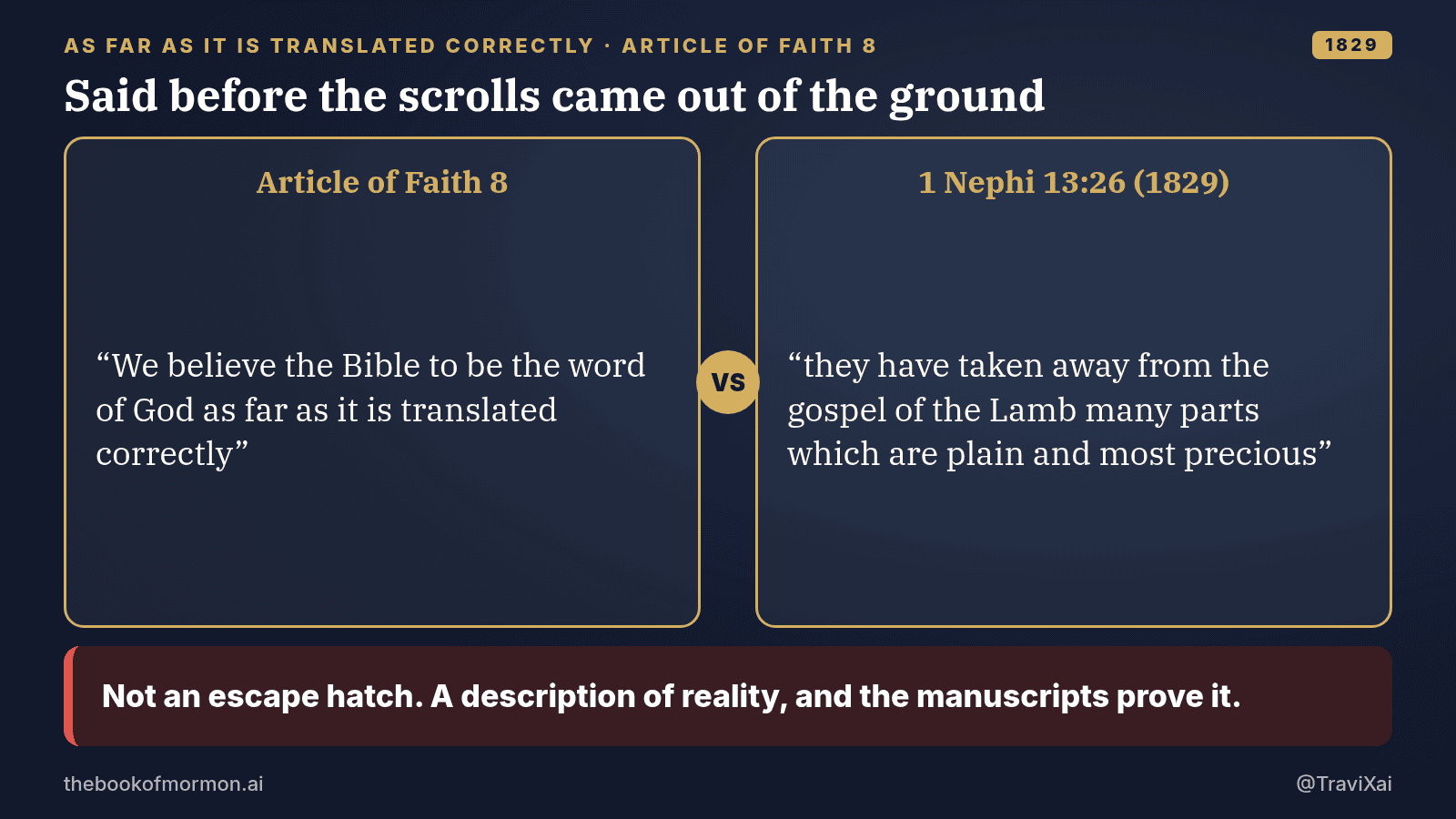
Critics mock “as far as it is translated correctly” as an escape hatch. It isn’t. It’s a description of reality, and the manuscripts prove it.
In 1829, before the Dead Sea Scrolls, before Codex Sinaiticus came out of St. Catherine’s Monastery, the Book of Mormon said this about the Bible:
“for behold, they have taken away from the gospel of the Lamb many parts which are plain and most precious; and also many covenants of the Lord have they taken away.” (1 Nephi 13:26)
And people stumble “because of the many plain and precious things which have been taken out of the book” (1 Nephi 13:28-29).
So our position was never “the Bible is a perfect, untouched text.” Our position is that the Bible is the word of God, carried down by human hands, and things were lost along the way. Now let’s see who the evidence agrees with.
How Many Variants Are We Talking About?
Bart Ehrman wrote in Misquoting Jesus (2005) that scholars’ estimates run from 200,000 to 400,000 or more, and that “there are more variations among our manuscripts than there are words in the New Testament.” Daniel B. Wallace, the evangelical scholar who founded the Center for the Study of New Testament Manuscripts and has debated Ehrman, doesn’t deny the scale. He has put it at about 400,000 variants against roughly 138,000 words in the Greek New Testament, and noted that some estimates now run to half a million. His defense is that the vast majority are spelling and word-order trivia, and only about 1 percent are “both meaningful and viable.”
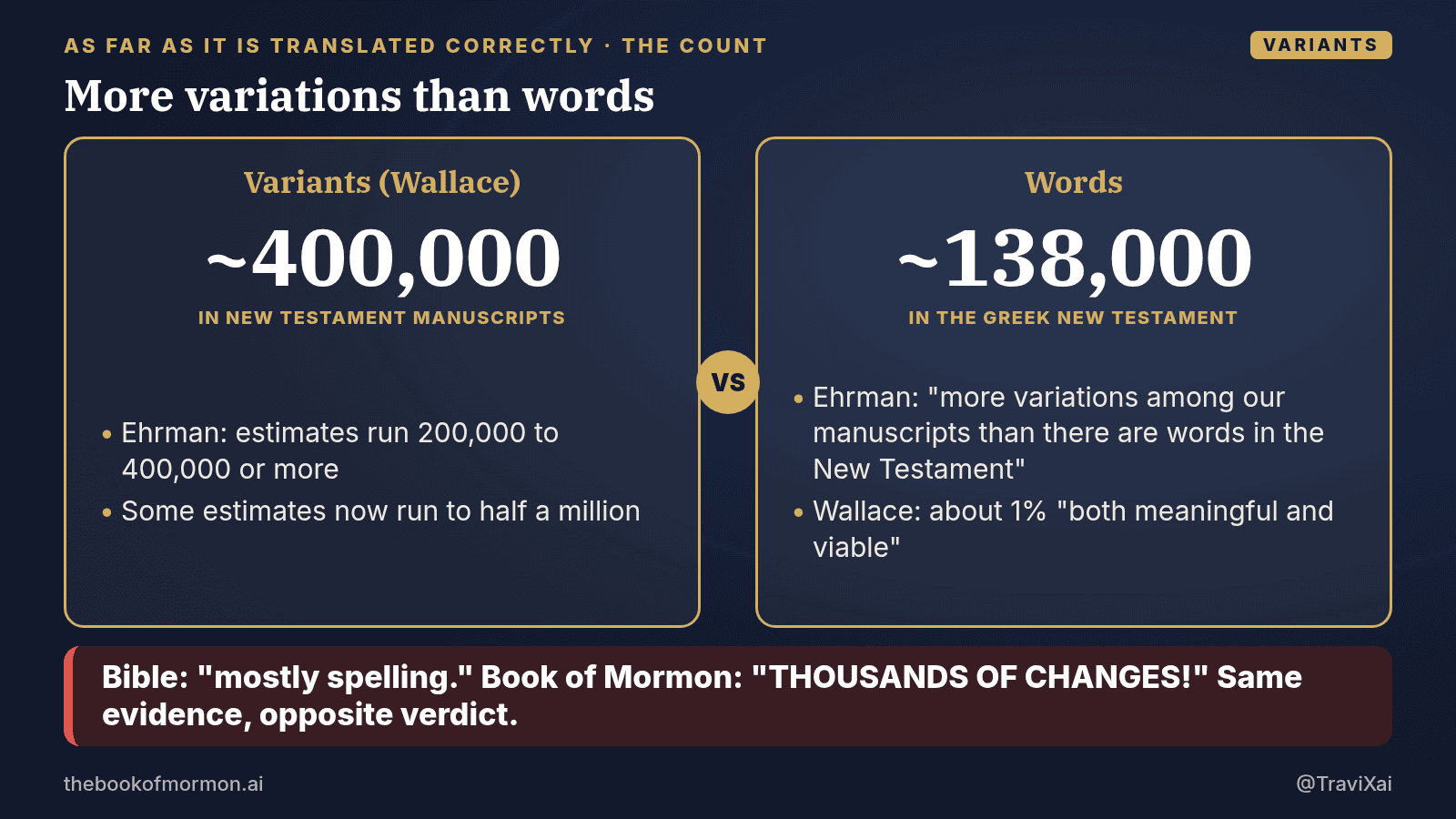
Fine. I agree most are minor. But notice what just happened. When the Bible has hundreds of thousands of variants, the answer is “it’s mostly spelling, it doesn’t affect doctrine.” When the Book of Mormon has edition changes that are overwhelmingly spelling, punctuation, and grammar, suddenly it’s “THOUSANDS OF CHANGES!” Same kind of evidence, opposite verdict. That’s special pleading, plain and simple.
And Wallace’s 1 percent isn’t nothing. Some of it is whole verses. Some is whole paragraphs. One is twelve verses at the end of a Gospel. Let’s go.
1. Deuteronomy 32:8: “Sons of God” or “Children of Israel”?
KJV: “When the most High divided to the nations their inheritance, when he separated the sons of Adam, he set the bounds of the people according to the number of the children of Israel.”
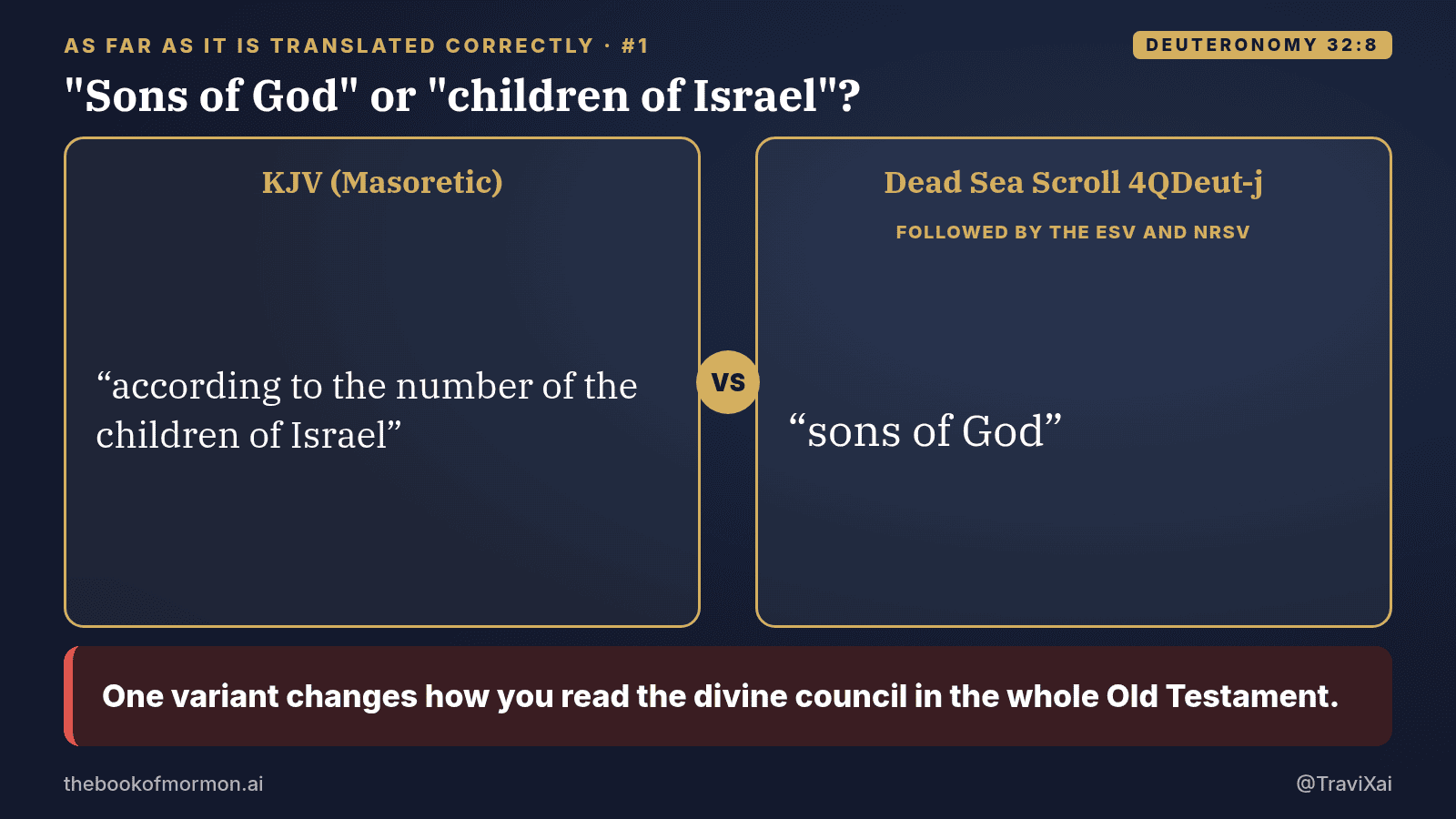
The Dead Sea Scroll 4QDeut-j reads “sons of God” instead of “children of Israel,” and the ESV and NRSV follow the scroll. That one variant changes how you read the divine council in the whole Old Testament. I covered it in depth here: Deuteronomy 32:8-9 and the Dead Sea Scrolls.
2. 1 Samuel 17:4: How Tall Was Goliath?
KJV: “And there went out a champion out of the camp of the Philistines, named Goliath, of Gath, whose height was six cubits and a span.”
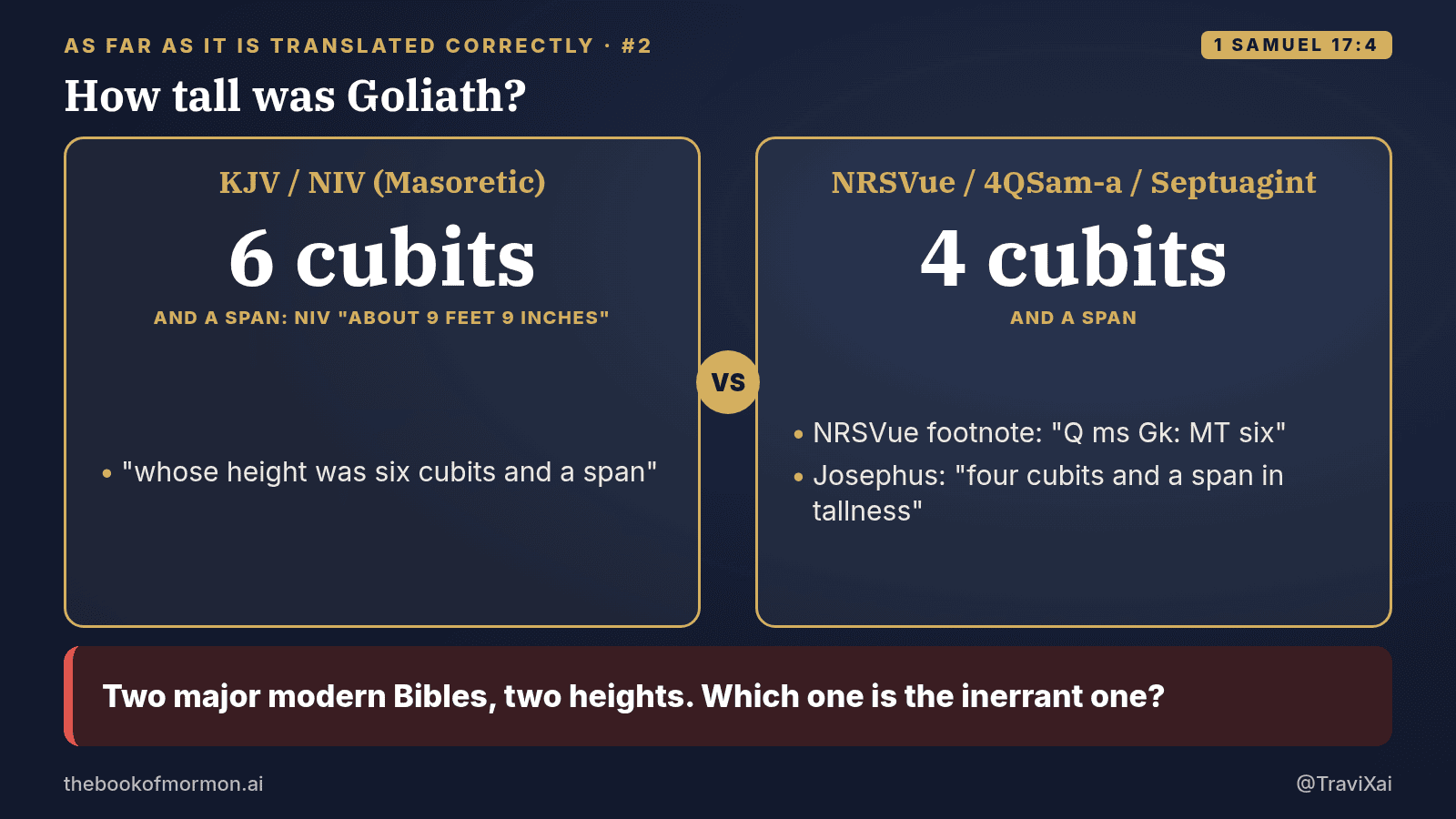
The NIV keeps six and footnotes it as “about 9 feet 9 inches.” But the NRSV Updated Edition reads FOUR cubits and a span, with the footnote “Q ms Gk: MT six.” In other words, the Dead Sea Scroll 4QSam-a and the Greek Septuagint say four. Josephus says the same: Goliath “was of four cubits and a span in tallness” (Antiquities 6.9.1, Whiston).
I posted on this before: x.com/TraviXai/status/2111444788008440217. Two major modern Bibles now give Goliath two different heights. Which one is the inerrant one? If two copies of the Book of Mormon gave different numbers, critics would call it fraud. In the Bible, it’s a footnote.
3. 1 Samuel 10-11: The Missing Nahash Paragraph
In the KJV, 1 Samuel 11:1 starts abruptly: “Then Nahash the Ammonite came up, and encamped against Jabesh-gilead.”
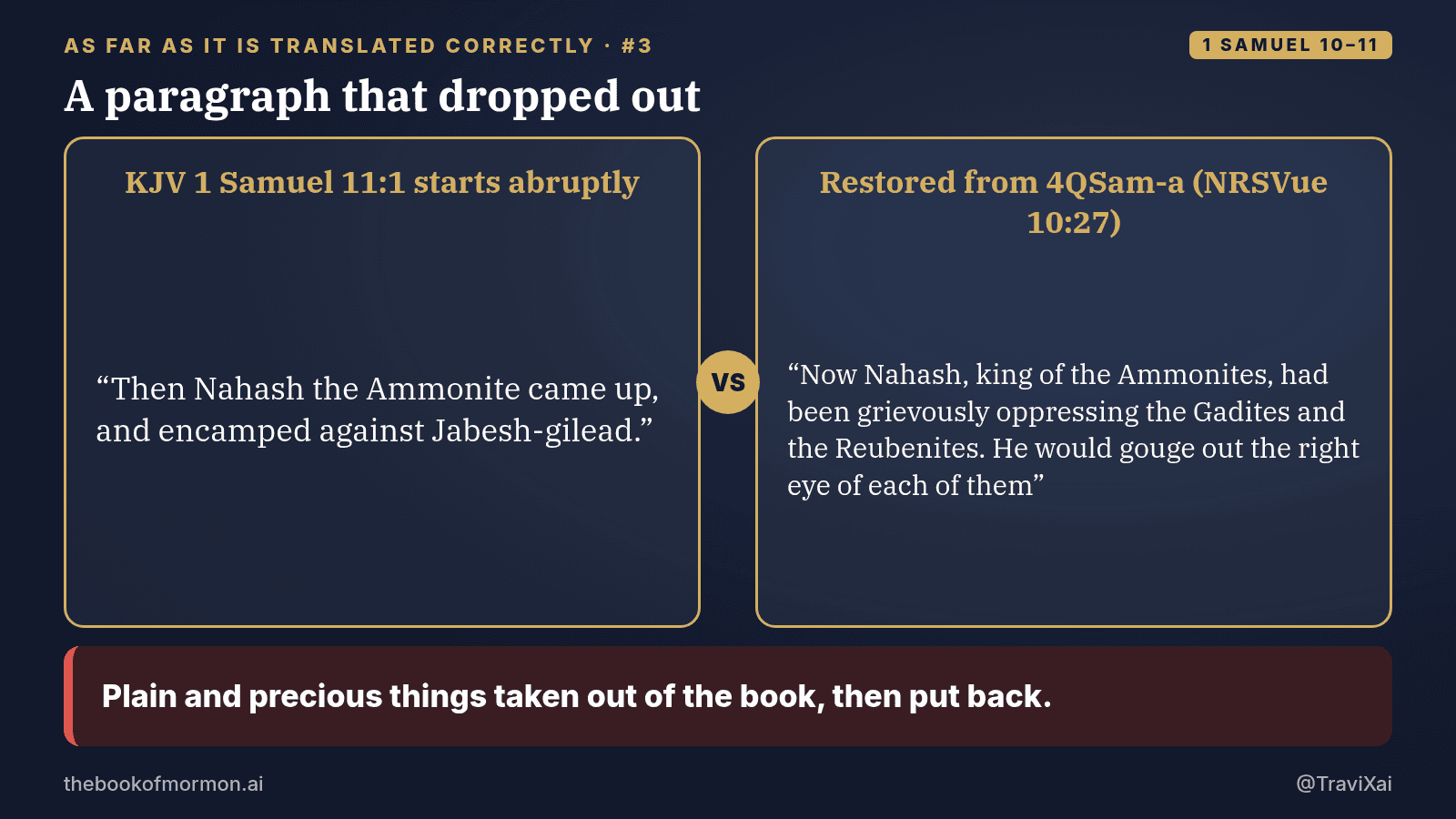
The scroll 4QSam-a preserves a paragraph that is missing from the Masoretic Text, and the NRSV Updated Edition prints it at the end of 1 Samuel 10:27: “Now Nahash, king of the Ammonites, had been grievously oppressing the Gadites and the Reubenites. He would gouge out the right eye of each of them and would not grant Israel a deliverer.” Josephus knew the same story, that Nahash “put out the right eyes” of those he conquered (Antiquities 6.5.1, Whiston).
Think about that. A major modern Bible put a paragraph BACK into Scripture because a scroll showed it had dropped out. That is literally plain and precious things taken out of the book and then restored.
4. The Shorter Jeremiah
Emanuel Tov, former editor-in-chief of the Dead Sea Scrolls publication project, writes that the Septuagint of Jeremiah “is shorter than MT by one-seventh and it differs from MT in its arrangement of the material.” People used to blame a sloppy Greek translator. Then Qumran produced Hebrew fragments, 4QJer-b and 4QJer-d, which Tov says resemble the Septuagint in both its arrangement and its shortness. Translation: two Hebrew editions of Jeremiah were circulating at the same time.
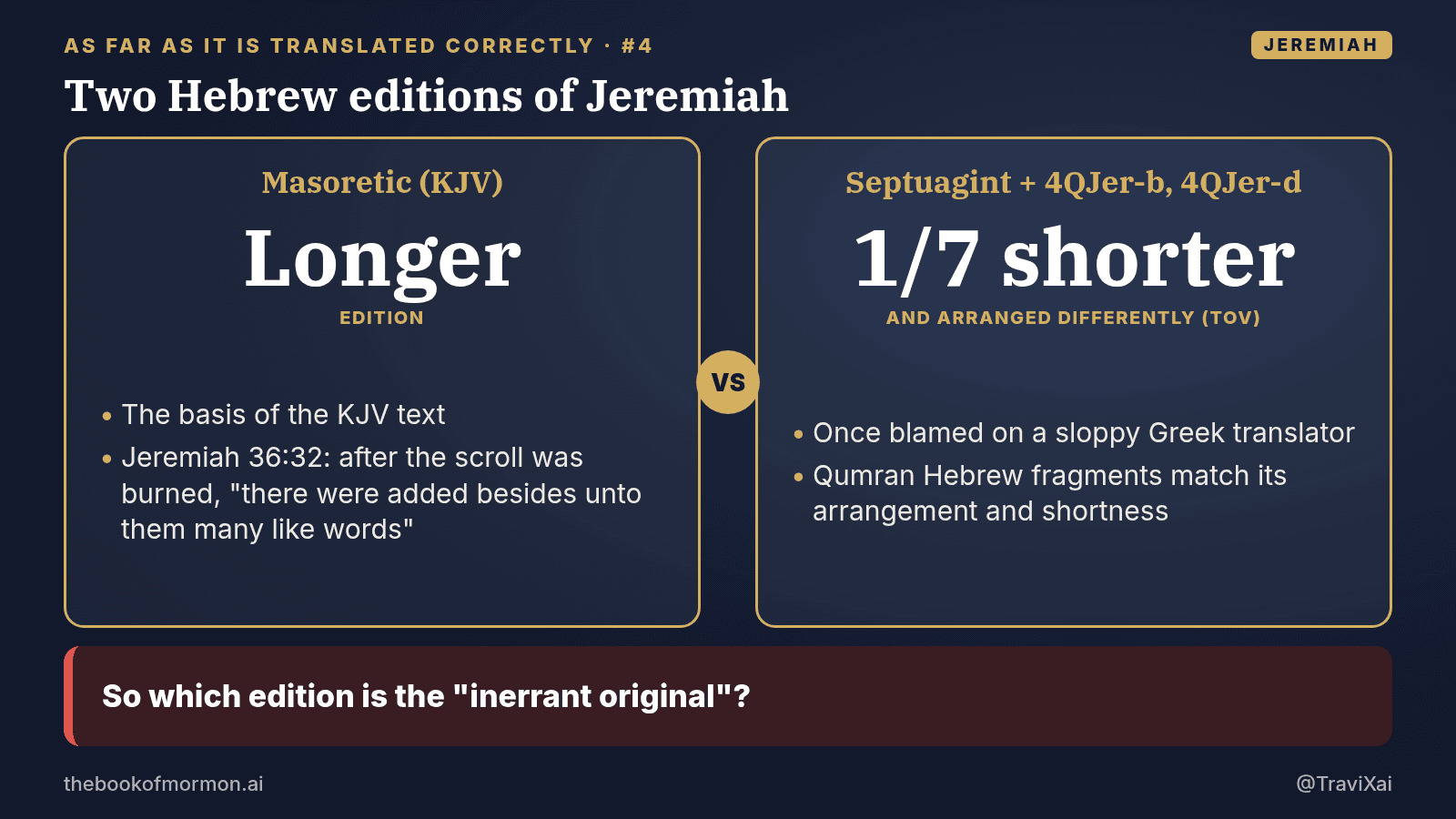
So which edition is the “inerrant original”? The Bible itself tells you Jeremiah’s book was rewritten. After the king burned the first scroll, Baruch wrote it again from Jeremiah’s mouth, “and there were added besides unto them many like words” (Jeremiah 36:32).
5. Mark 16:9-20: The Longer Ending
KJV Mark 16:9: “Now when Jesus was risen early the first day of the week, he appeared first to Mary Magdalene, out of whom he had cast seven devils.” It runs through verse 20, including taking up serpents and drinking deadly things.
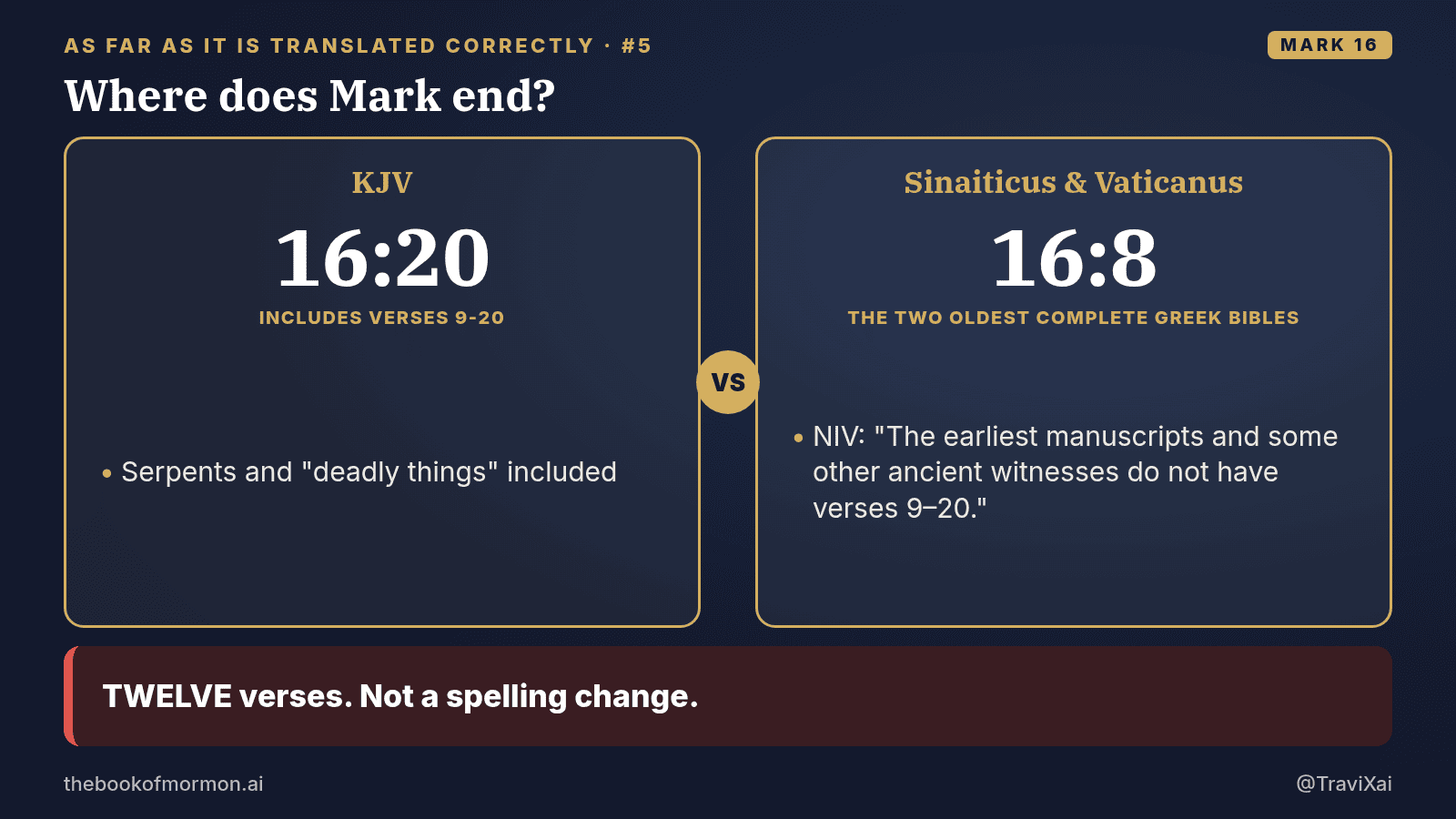
Codex Sinaiticus and Codex Vaticanus, the two oldest complete Greek Bibles we have, end Mark at 16:8. The NIV prints this right in the text: “[The earliest manuscripts and some other ancient witnesses do not have verses 9–20.]”
TWELVE verses. Not a spelling change. Twelve verses that whole movements built practices on. Now imagine the Book of Mormon had twelve verses that weren’t in the original manuscript. Critics would never stop talking about it.
6. John 7:53-8:11: The Woman Taken in Adultery
“He that is without sin among you, let him first cast a stone at her” (John 8:7). One of the most beloved stories in the Bible.
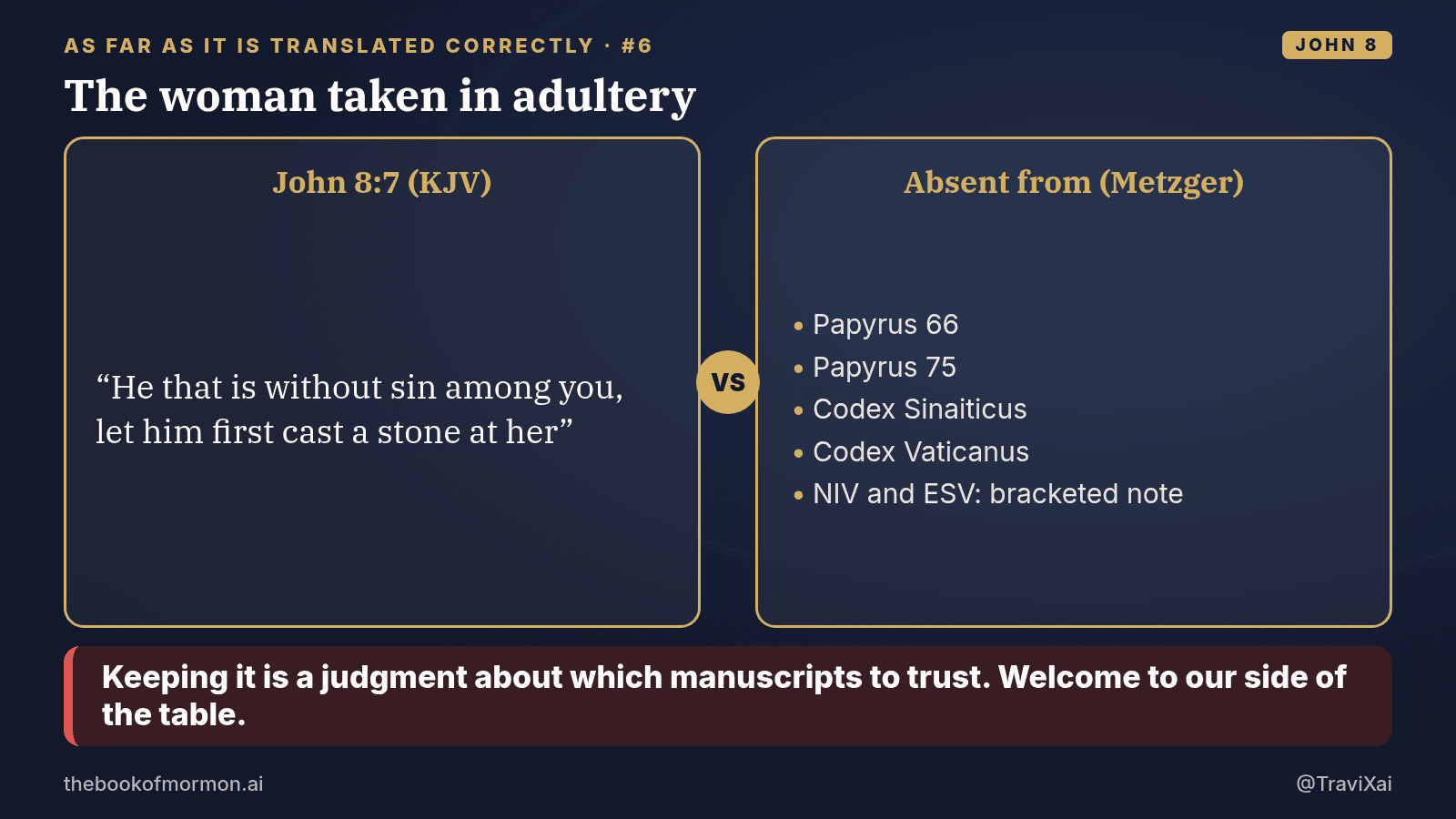
Bruce Metzger’s Textual Commentary lists it as absent from Papyrus 66, Papyrus 75, Sinaiticus, and Vaticanus, and his committee concluded it was not originally part of John. The NIV and ESV both set it off with a bracketed note that the earliest manuscripts do not have it.
I love this story and I believe it reflects the Savior. But that’s the point. Your belief that it belongs isn’t coming from “the text alone.” It’s coming from a judgment about which manuscripts to trust. Welcome to our side of the table.
7. 1 John 5:7: The Comma Johanneum
KJV: “For there are three that bear record in heaven, the Father, the Word, and the Holy Ghost: and these three are one.”
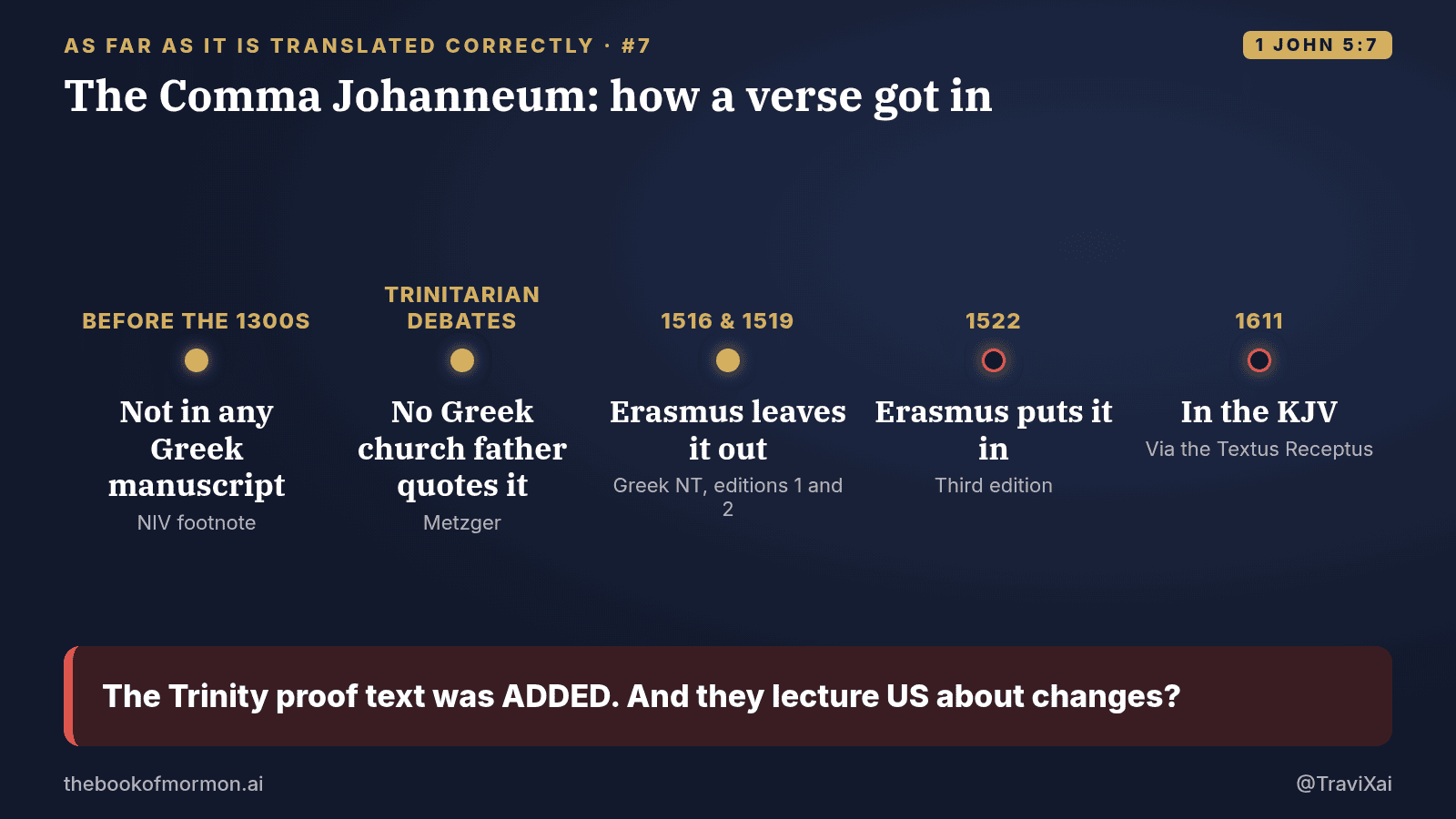
This is the closest thing to an explicit Trinity proof text in the Bible, and it isn’t original. The NIV footnote says it is “not found in any Greek manuscript before the fourteenth century.” Metzger points out that no Greek church father quotes it, even during the Trinitarian controversies, when it would have been the ultimate weapon. Erasmus left it out of the first two editions of his Greek New Testament (1516, 1519) and put it in the third (1522). From there it flowed into the Textus Receptus and the KJV.
The verse creedal Christians quoted for centuries to defend the Trinity was ADDED. And they want to lecture US about changes?
8. Acts 8:37: The Eunuch’s Confession
KJV: “And Philip said, If thou believest with all thine heart, thou mayest. And he answered and said, I believe that Jesus Christ is the Son of God.”
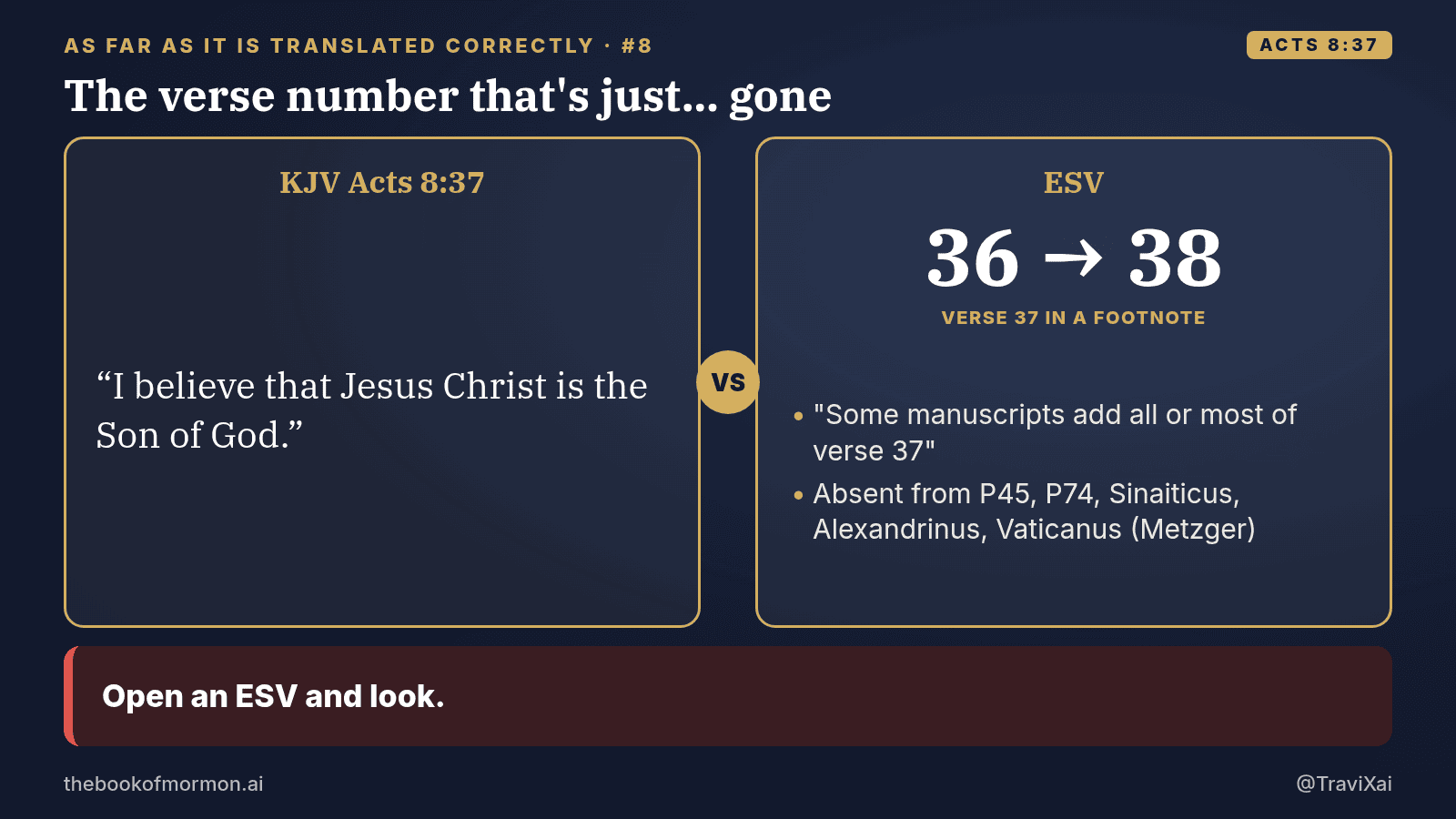
Metzger lists it as absent from Papyrus 45, Papyrus 74, Sinaiticus, Alexandrinus, Vaticanus, and others. The ESV drops it to a footnote (“Some manuscripts add all or most of verse 37”), so the verses jump from 36 to 38. Open an ESV and look. The verse number is just… gone.
9. Luke 22:43-44: Sweat as Great Drops of Blood
KJV: “And there appeared an angel unto him from heaven, strengthening him. And being in an agony he prayed more earnestly: and his sweat was as it were great drops of blood falling down to the ground.”
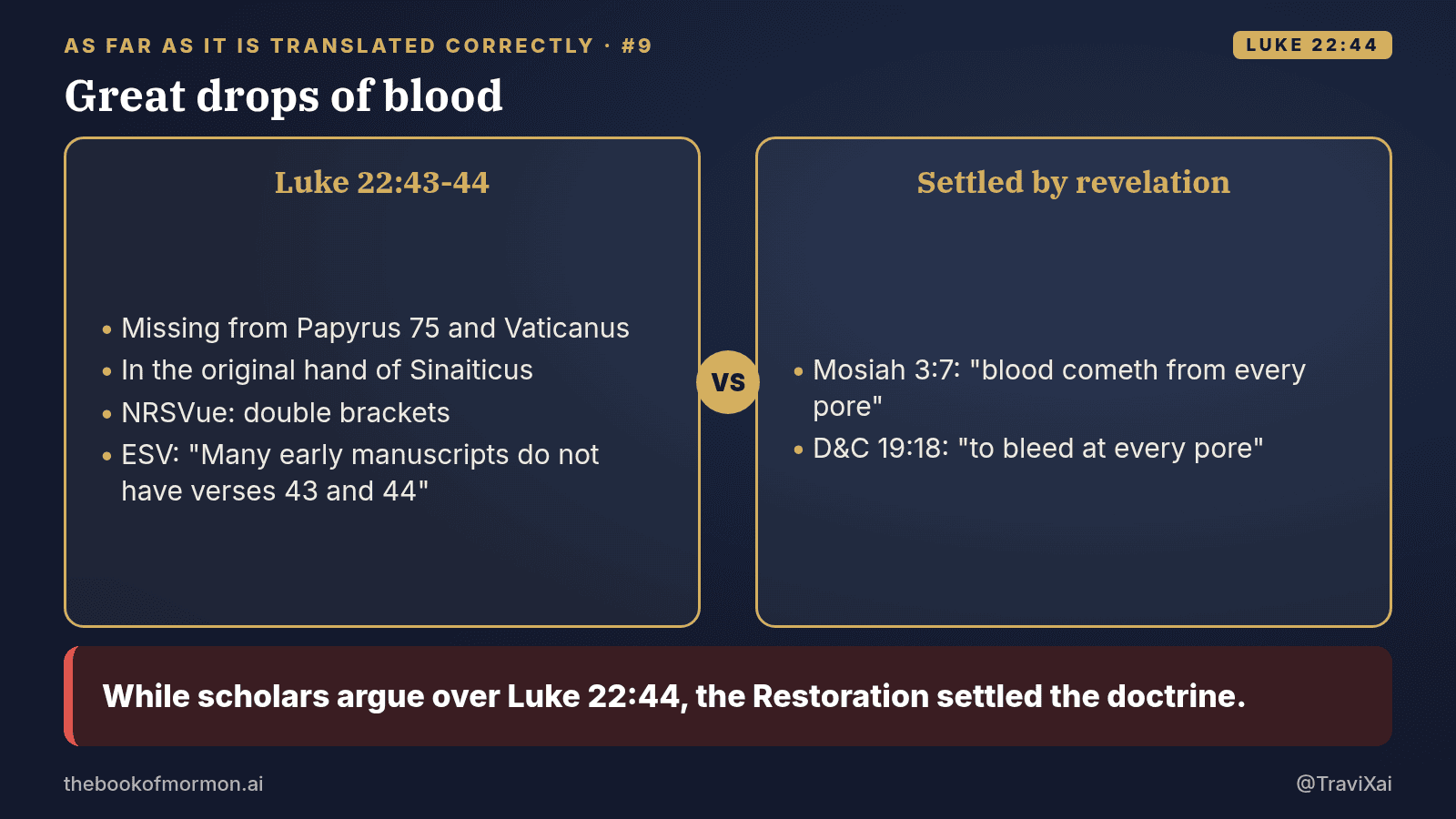
These verses are missing from Papyrus 75 and Vaticanus, though the original hand of Sinaiticus has them. The NRSV Updated Edition puts them in double brackets (“Other ancient authorities lack 22.43 and 22.44”). The ESV notes, “Many early manuscripts do not have verses 43 and 44.”
Here’s where Latter-day Saints have something nobody else has. King Benjamin taught that “blood cometh from every pore, so great shall be his anguish” (Mosiah 3:7), and the Lord Himself said His suffering caused Him “to bleed at every pore” (D&C 19:18). While scholars argue over Luke 22:44, the Restoration settled the doctrine by revelation. That’s what restored scripture is FOR.
10. Matthew 6:13: The Doxology
KJV: “And lead us not into temptation, but deliver us from evil: For thine is the kingdom, and the power, and the glory, for ever. Amen.”
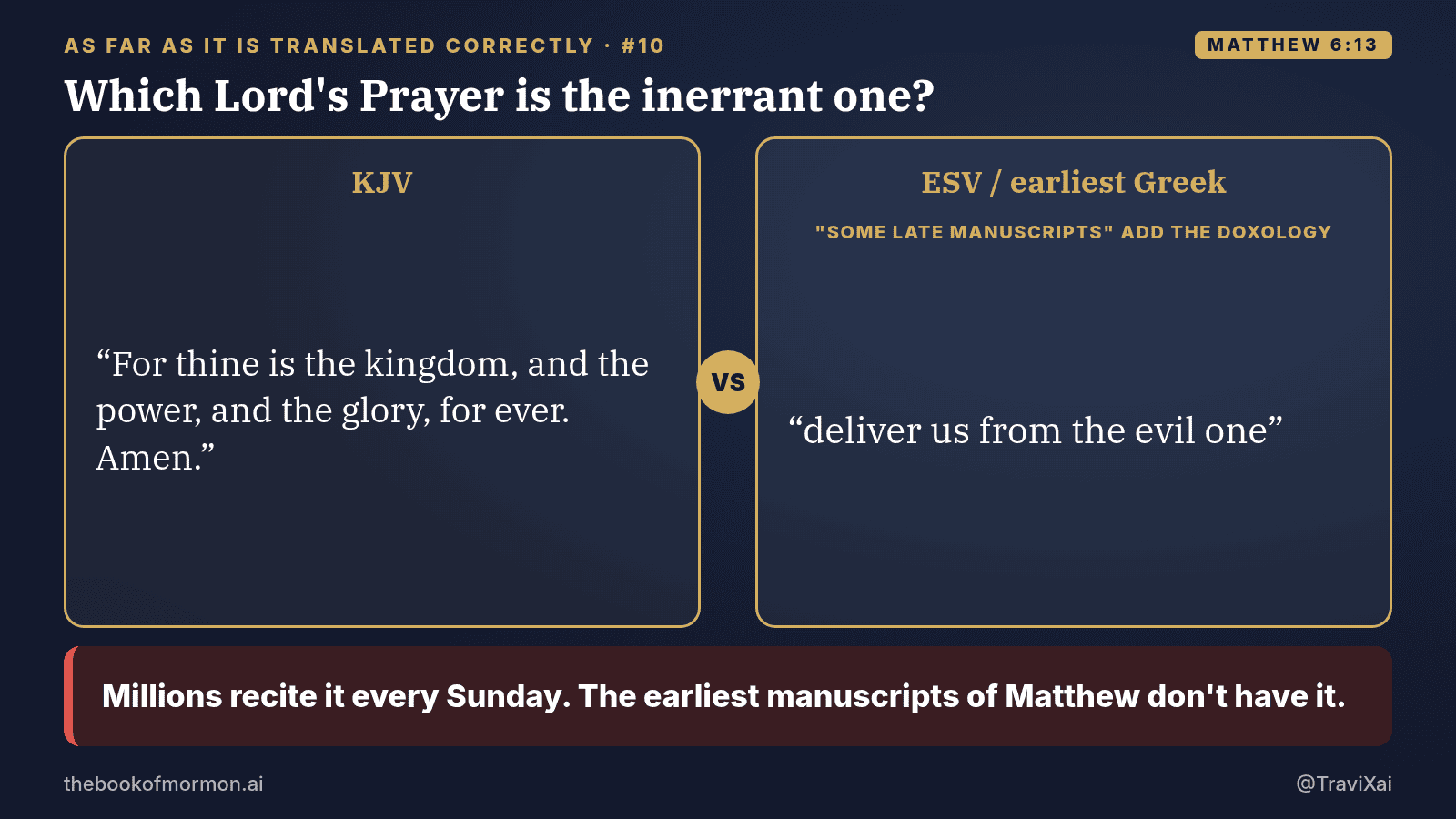
The ESV ends the prayer at “deliver us from the evil one,” with a note that “some late manuscripts” add the doxology. The earliest Greek manuscripts of Matthew don’t have it. The Didache, an early Christian church manual, gives a shorter form, “for thine is the power and the glory for ever,” which points to the words growing out of church worship.
Millions recite those words every Sunday. They’re beautiful. And according to the earliest manuscripts, Matthew didn’t write them. So which Lord’s Prayer is the inerrant one?
11. Psalm 22:16: “They Pierced My Hands and My Feet”
KJV: “For dogs have compassed me: the assembly of the wicked have inclosed me: they pierced my hands and my feet.”
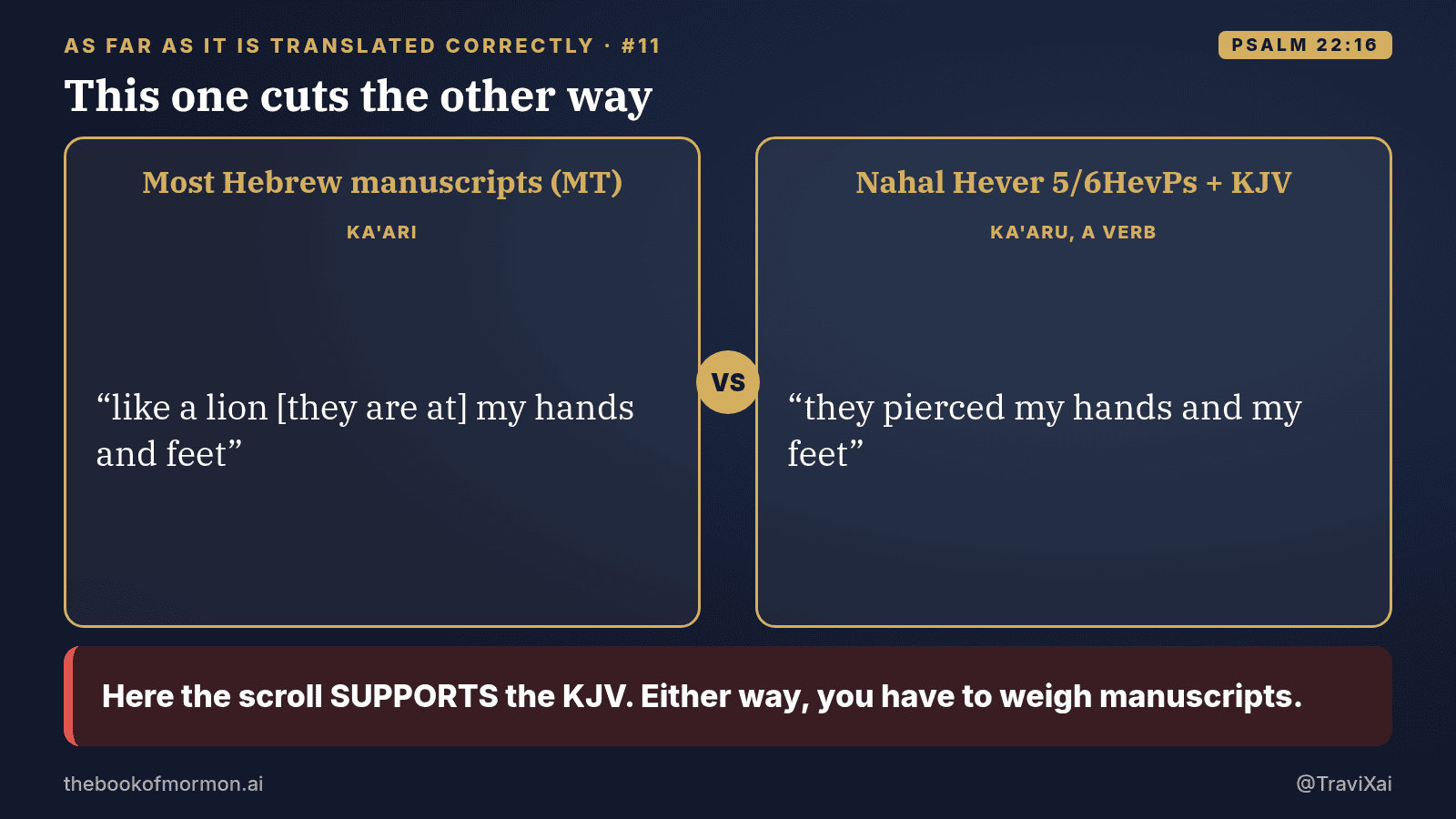
This one cuts the other way, and I’ll say so. The ESV footnote says most Hebrew manuscripts read “like a lion [they are at] my hands and feet,” while some Hebrew manuscripts, the Septuagint, Vulgate, and Syriac support “pierced.” The Psalms scroll from Nahal Hever (5/6HevPs) reads ka’aru, a verb, instead of the Masoretic ka’ari, “like a lion.” Shon Hopkin laid out the evidence in BYU Studies (“The Psalm 22:16 Controversy: New Evidence from the Dead Sea Scrolls”).
So here the scroll SUPPORTS the KJV against the standard Hebrew text. Good! I’m not here to make the Bible look bad. I’m here to show you CANNOT just pick up the Masoretic Text, declare it perfect, and call it a day. You have to weigh manuscripts. Every honest scholar does. The only people pretending otherwise are the ones using that pretense against the Book of Mormon.
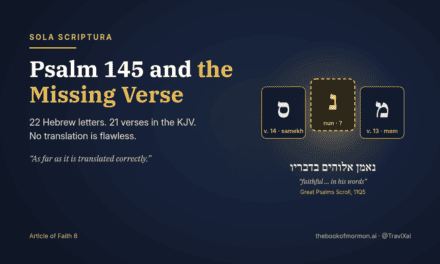
12. Psalm 145: The Missing “Nun” Verse
Psalm 145 is an acrostic. Each verse starts with the next letter of the Hebrew alphabet. But in most Masoretic manuscripts, and therefore in the KJV, the verse for the letter nun is missing. Verse 13 ends “thy dominion endureth throughout all generations,” and verse 14 jumps to the next letter.
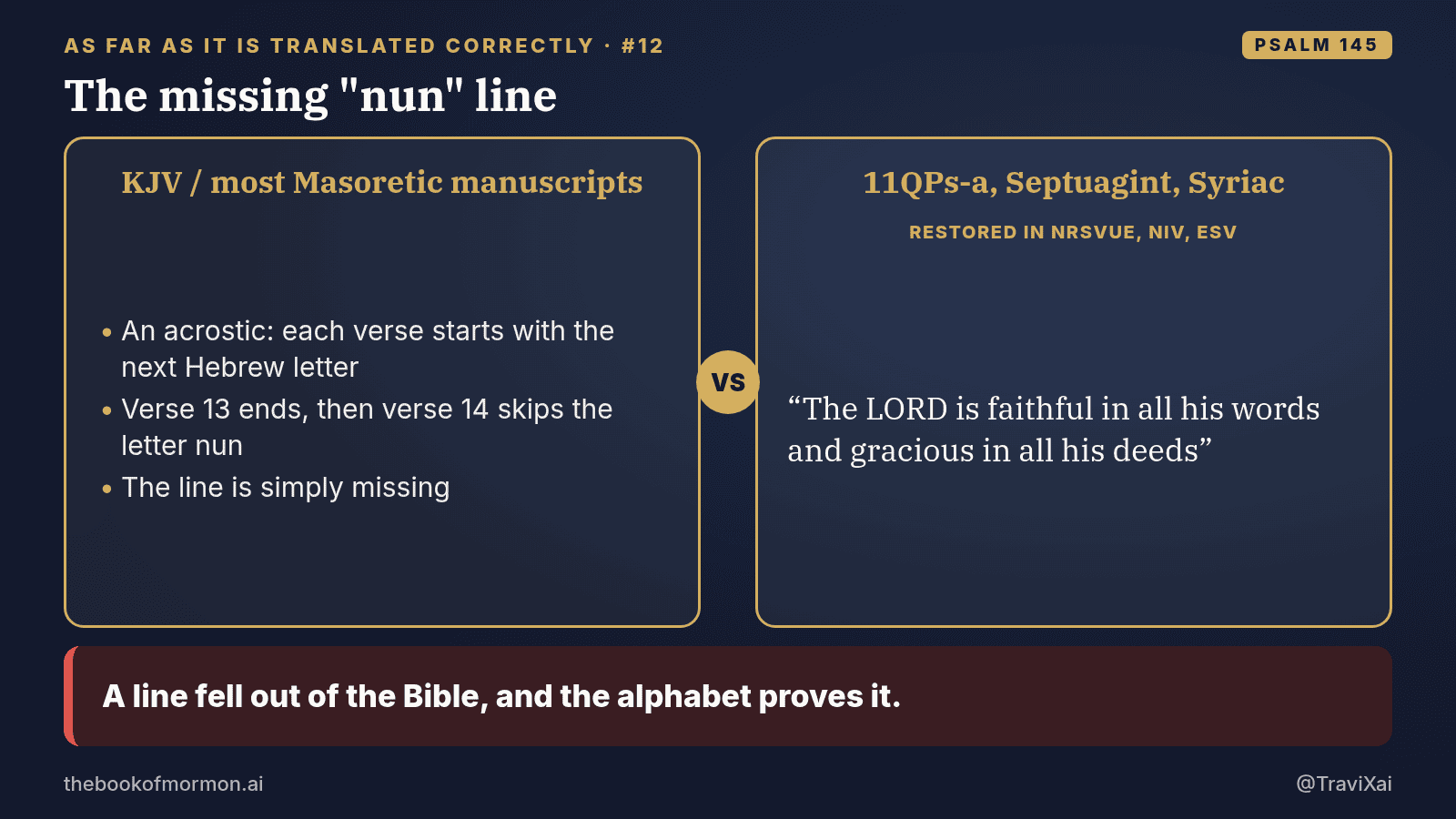
The Great Psalms Scroll from Qumran (11QPs-a) has the missing line, and so do the Septuagint and Syriac. The NRSV Updated Edition restores it: “The LORD is faithful in all his words and gracious in all his deeds,” footnoted “Q ms Gk Syr: MT lacks.” The NIV and ESV restore it too.
A line fell out of the Bible, and the alphabet proves it. The KJV never had it. A scroll from a cave put it back.
What This Means for Inerrancy
Article X of the Chicago Statement on Biblical Inerrancy (1978) says “inspiration, strictly speaking, applies only to the autographic text of Scripture.” The ORIGINALS. Which nobody has. Not one. Even P52, the oldest New Testament scrap, is the size of a credit card, as I covered in Moses Broke the Tablets.
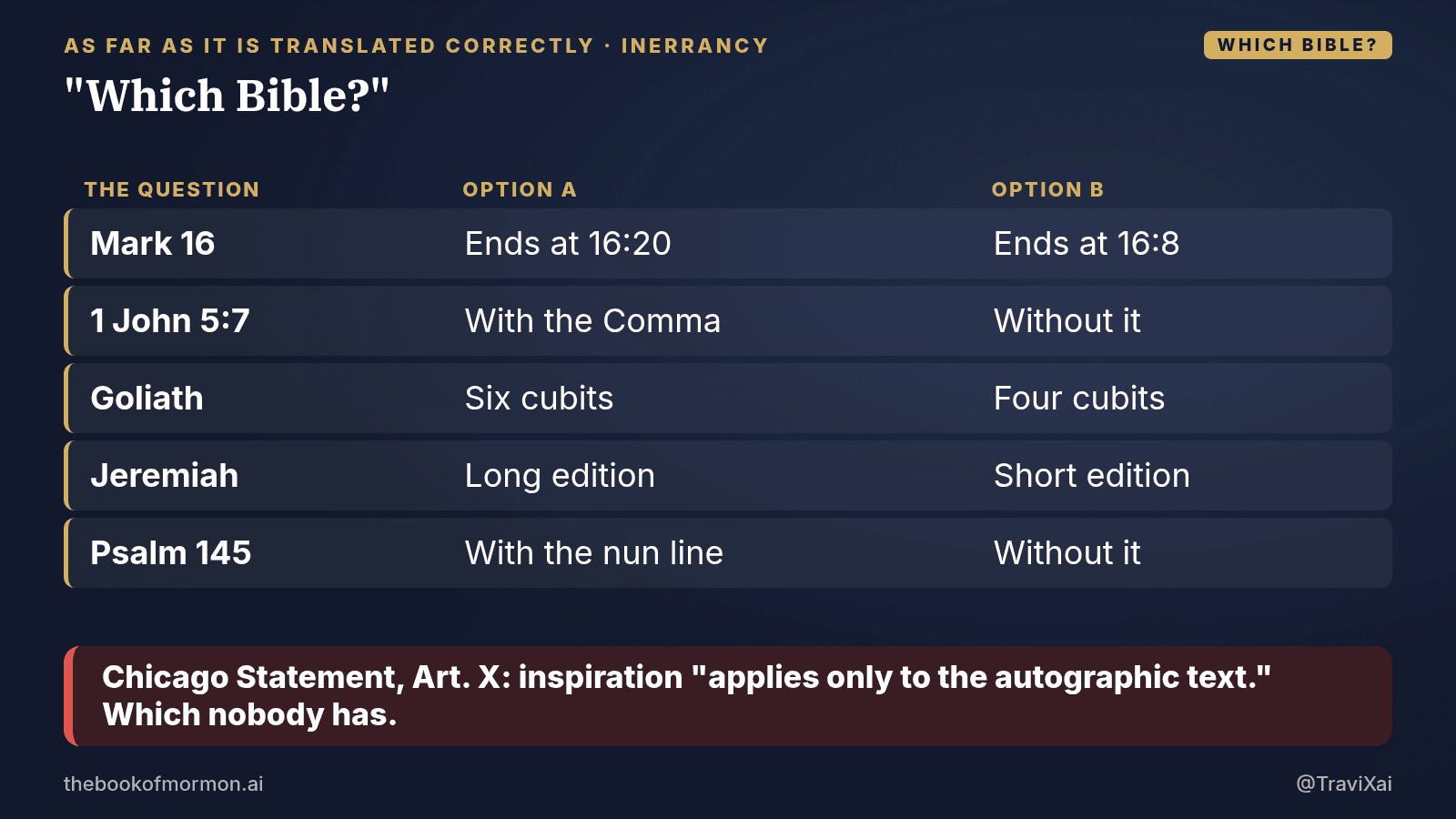
So when someone says “the Bible is perfect and the Book of Mormon was changed,” ask: WHICH Bible? With Mark 16:9-20 or without? With 1 John 5:7 or without? Six-cubit Goliath or four? Long Jeremiah or short? The acrostic with the nun line or without it?
They’ll retreat to “the originals.” Ok. So their inerrant Bible is a set of documents no living person has ever seen, reconstructed by scholars who disagree, printed in translations that bracket, footnote, add, and remove whole verses. And that’s fine to them. Mm hmm.
Now Apply the Same Standard to the Book of Mormon
The Book of Mormon has something the Bible doesn’t: a documented textual history going straight back to the translator. Royal Skousen’s Book of Mormon Critical Text Project reports that 28 percent of the original manuscript survives and the printer’s manuscript is virtually 100 percent extant, including Joseph Smith’s own handwritten edits for the 1837 edition. Skousen published the results as The Book of Mormon: The Earliest Text (Yale University Press, 2009).
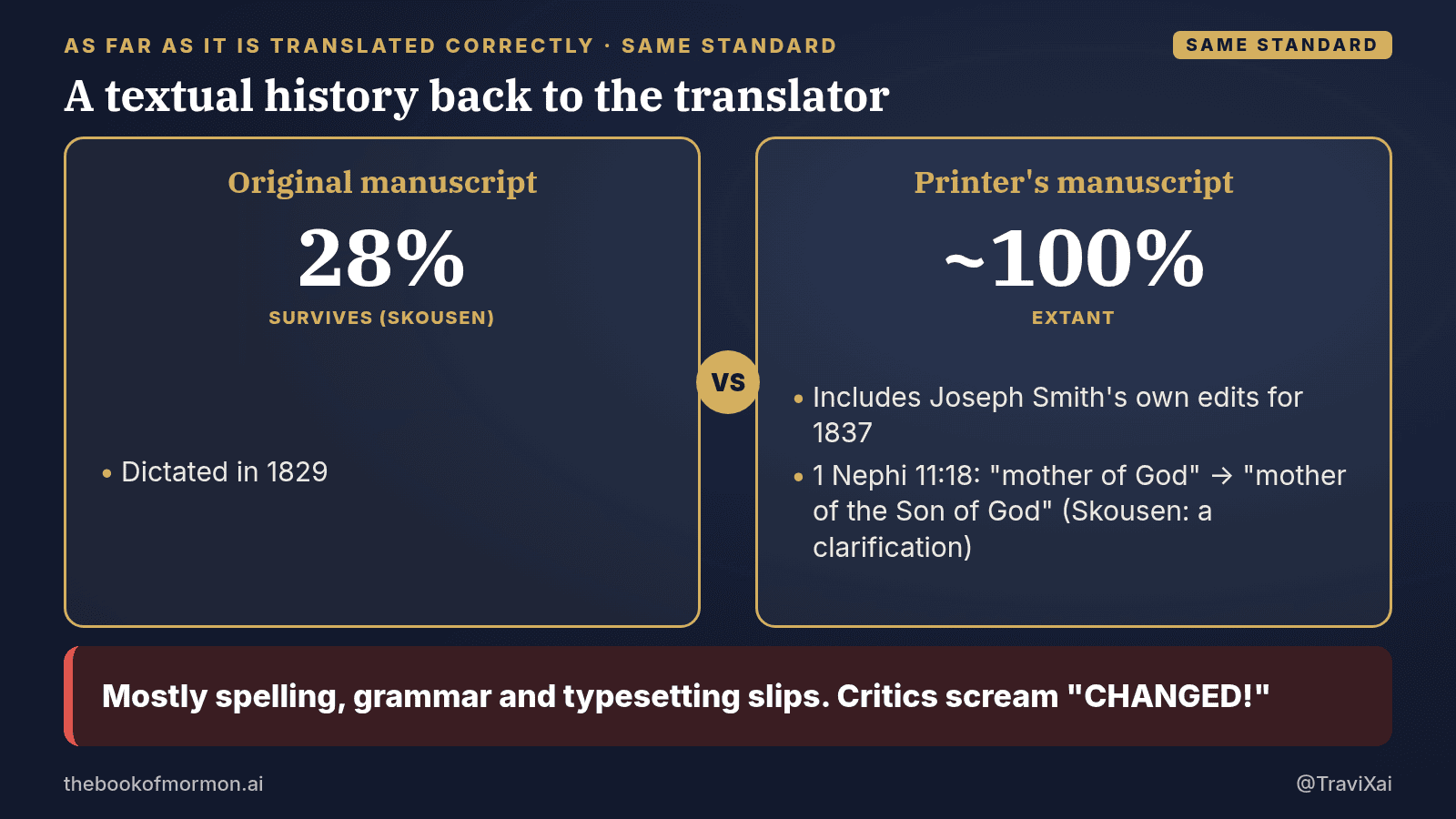
The changes are mostly spelling, grammar, and fixing copying and typesetting slips. The Church’s own history topic “Changes to the Book of Mormon” walks through the famous ones, like 1 Nephi 11:18 going from “the mother of God” (1830) to “the mother of the Son of God” (1837). Skousen calls that a clarification, not a doctrinal revision, and it’s about the mother of Jesus Christ either way.
Critics take that and scream “CHANGED!” Meanwhile they carry Bibles where paragraphs, whole verses, and the ending of a Gospel are in dispute, and they call it “God’s perfectly preserved word.”
Let me name it. It’s a DOUBLE STANDARD, and I took apart the bigger version here: “Your Church Changes”… So Does the Bible. It’s special pleading, because the same kind of evidence gets a pass in their book and a guilty verdict in ours. And it’s a strawman, because Latter-day Saints never claimed scripture is immune to human transmission. Article of Faith 8 says the opposite out loud.
If edition changes disqualify the Book of Mormon, the Dead Sea Scrolls and the great codices disqualify the KJV a hundred times over. If they DON’T disqualify the Bible, and I don’t think they do, then the critic’s argument against the Book of Mormon just collapsed under its own weight. You don’t get it both ways.
The Closing Argument
Here’s what blows my mind. In 1829, a farm boy with no Hebrew, no Greek, and no Dead Sea Scrolls put into print that plain and precious things had been taken out of the Bible. Nobody had 4QSam-a. Nobody had 11QPs-a. Nobody had 4QDeut-j. Sinaiticus was still sitting in a monastery. Over the next two centuries, manuscript after manuscript came out of the ground and showed EXACTLY that: lines lost, verses added, paragraphs dropped, a whole book in two editions.
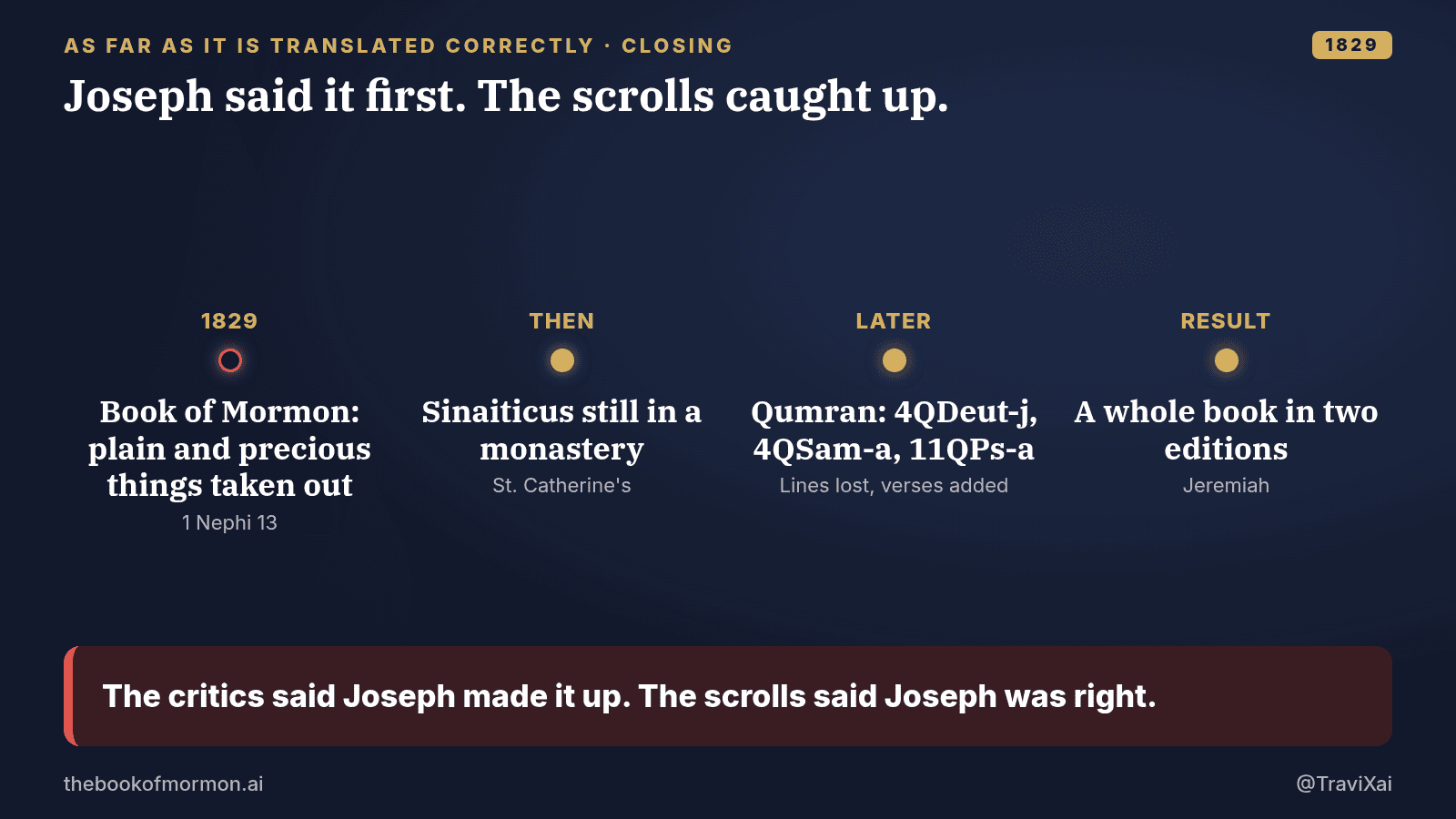
The critics said Joseph made it up. The scrolls said Joseph was right. Joseph was the best guesser ever!
I LOVE the Bible. We believe it is the word of God “as far as it is translated correctly,” because that’s what the evidence demands. And God didn’t leave us stranded with fragments and footnotes. He restored what was lost and gave us another witness of Jesus Christ.
So next time someone tells you the Book of Mormon was “changed,” hand them an ESV and ask them to find Acts 8:37.
Read it. Then read the Book of Mormon. Prove me wrong.
What all four standard works say about the Bible’s transmission
The manuscript evidence above isn’t a surprise to Latter-day Saints. All four standard works said it would be so.
The Bible
How do ye say, We are wise, and the law of the Lord is with us? Lo, certainly in vain made he it; the pen of the scribes is in vain.
Jeremiah 8:8
The Book of Mormon
These last records, which thou hast seen among the Gentiles, shall establish the truth of the first, which are of the twelve apostles of the Lamb, and shall make known the plain and precious things which have been taken away from them;
1 Nephi 13:40
Nephi didn’t say the Bible would be thrown out. He said later scripture would “establish the truth of the first.” The Book of Mormon confirms the Bible.
The Doctrine and Covenants
There are many things contained therein that are true, and it is mostly translated correctly; There are many things contained therein that are not true, which are interpolations by the hands of men.
D&C 91:1–2
That revelation is about the Apocrypha. It shows the balanced way the Lord teaches us to read any ancient text: much is true, some was added by men, and the Spirit helps tell them apart (D&C 91:4–5).
The Pearl of Great Price
And in a day when the children of men shall esteem my words as naught and take many of them from the book which thou shalt write, behold, I will raise up another like unto thee; and they shall be had again among the children of men.
Moses 1:41
The Lord told Moses that words would be lost from his book and restored by a later prophet. Latter-day Saints see that fulfilled in Joseph Smith’s work on the Bible.
Bible textual variants: quick answers
What is a textual variant?
A place where surviving manuscripts disagree on the wording of a passage.
How many variants are in the New Testament?
Hundreds of thousands, counting every spelling difference. Most are minor, but some, like Mark 16:9–20, affect whole passages.
What does “as far as it is translated correctly” mean?
Article of Faith 8 affirms the Bible as God’s word while recognizing that copying and translation introduced errors. See John 20:17 for one example Joseph Smith corrected.
Hasn’t the Book of Mormon been changed too?
Mostly spelling, grammar, and typesetting fixes, plus a few clarifications. The Bible’s manuscripts differ far more. See Moses broke the tablets and the CES Letter response hub.
Are there manuscripts older than the King James Version?
Yes. The KJV New Testament (1611) relied mainly on late Greek manuscripts. Since then scholars have found much older ones, including Codex Sinaiticus and Codex Vaticanus (4th century) and the Dead Sea Scrolls for the Old Testament.
Is 1 John 5:7 in the oldest Greek manuscripts?
No. The Comma Johanneum (“these three are one”) is missing from the early Greek manuscripts. Most modern translations leave it out or put it in a footnote.
What did Joseph Smith do to the Bible?
He made an inspired revision called the Joseph Smith Translation, restoring and clarifying passages. Moses 1 and much of the book of Moses come from that work (Moses 1:41).
Does the Book of Mormon replace the Bible?
No. Nephi said the later records would “establish the truth of the first” (1 Nephi 13:40). Latter-day Saints read both as the word of God.
Sources
- King James Version: Deut 32:8; 1 Sam 11:1; 1 Sam 17:4; Ps 22:16; Ps 145:13-14; Jer 36:32; Matt 6:13; Mark 16:9; Luke 22:43-44; John 8:7; Acts 8:37; 1 John 5:7.
- Article of Faith 8; 1 Nephi 13; 1 Nephi 11; Mosiah 3:7; D&C 19:18.
- Modern translation text and footnotes (NRSVUE, ESV, NIV) via Bible Gateway: 1 Sam 10:27; 1 Sam 17:4; Ps 22:16; Ps 145:13; Matt 6:13; Mark 16:8-9; Luke 22:43-44; John 7:53; Acts 8:36-38; 1 John 5:7-8.
- Bart D. Ehrman, Misquoting Jesus (HarperSanFrancisco, 2005); see also Ehrman, “Who Cares? Do the Variants in the Manuscripts Matter for Anything?”.
- Daniel B. Wallace, “The Gospel According to Bart,” JETS 49/2 (2006): 327-349; Wallace, “The Number of Textual Variants: An Evangelical Miscalculation” (2013).
- Emanuel Tov, “The Literary History of the Book of Jeremiah in Light of Its Textual History,” in The Greek and Hebrew Bible (Brill, 1999), 363-384.
- Josephus, Antiquities of the Jews 6.5.1 and 6.9.1, trans. William Whiston (Perseus).
- Bruce M. Metzger, A Textual Commentary on the Greek New Testament, 2nd ed. (UBS, 1994), at John 7:53-8:11, Acts 8:37, Luke 22:43-44, 1 John 5:7-8.
- Shon D. Hopkin, “The Psalm 22:16 Controversy: New Evidence from the Dead Sea Scrolls,” BYU Studies Quarterly 44:3.
- The Chicago Statement on Biblical Inerrancy (1978), Article X.
- Royal Skousen, “History of the Critical Text Project of the Book of Mormon”; The Book of Mormon: The Earliest Text (Yale University Press, 2009).
- “Changes to the Book of Mormon,” Church History Topics, churchofjesuschrist.org.