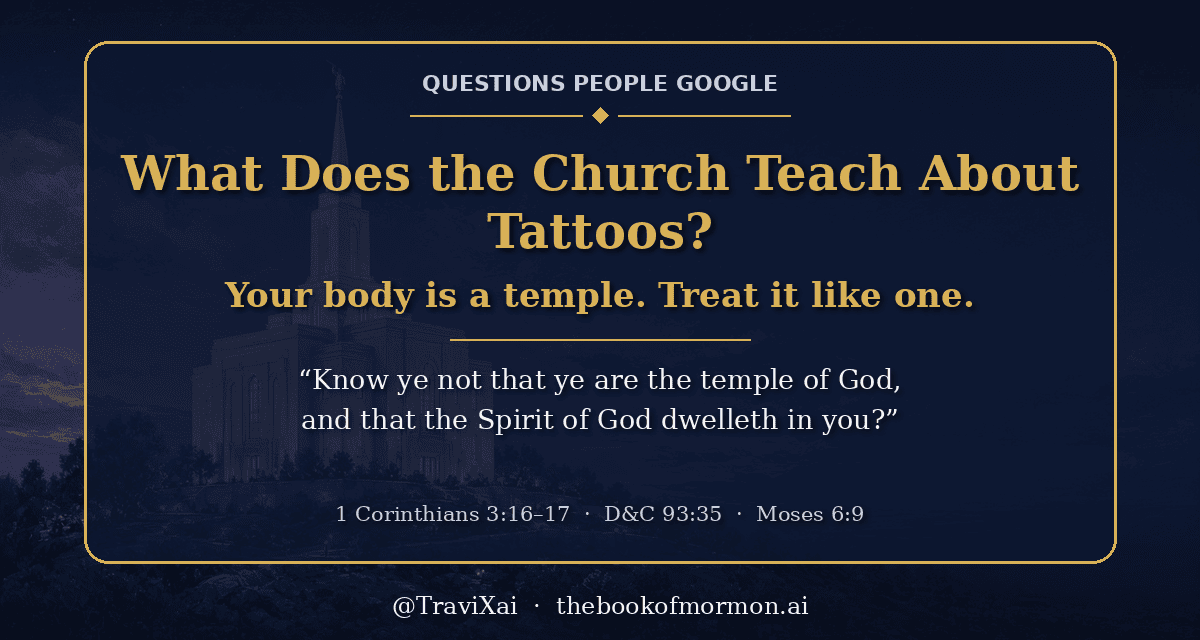

The Church discourages tattoos. Not because of a verse in Leviticus, but because of what the Restoration teaches the body is, and whose image it bears.
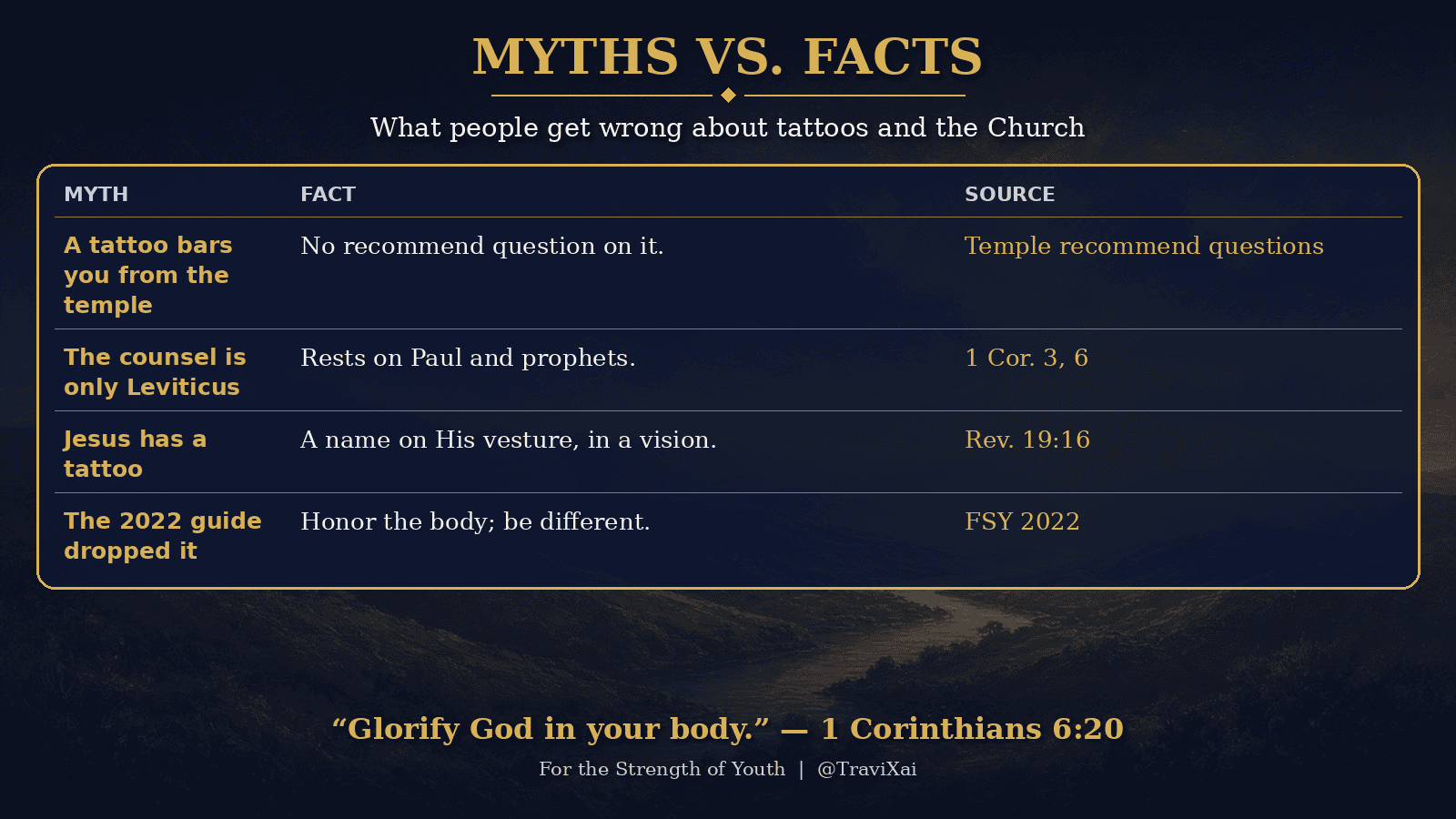
The question often assumes the Church’s position rests on Leviticus 19:28, so “it’s just the Old Testament.” It doesn’t. The Church discourages tattoos because the body is a temple: “Know ye not that ye are the temple of God?” (1 Corinthians 3:16–17). President Gordon B. Hinckley said in 2000 that the First Presidency and the Twelve discourage tattoos. The 2022 For the Strength of Youth guide asks youth to honor the body “even when that means being different from the world.” Tattoos do not bar anyone from baptism or the temple.
The answerDiscouraged, because the body is a temple
The Church of Jesus Christ of Latter-day Saints discourages tattoos. The reason is not a rule about ink. It is a doctrine about the body: your body is a gift from God, made in His image, and a temple where His Spirit can dwell. In 2000 President Gordon B. Hinckley said, “The First Presidency and the Quorum of the Twelve have declared that we discourage tattoos,” and summed it up in one line: “A tattoo is graffiti on the temple of the body.” He cited Paul: “Know ye not that ye are the temple of God, and that the Spirit of God dwelleth in you?” (1 Corinthians 3:16–17).
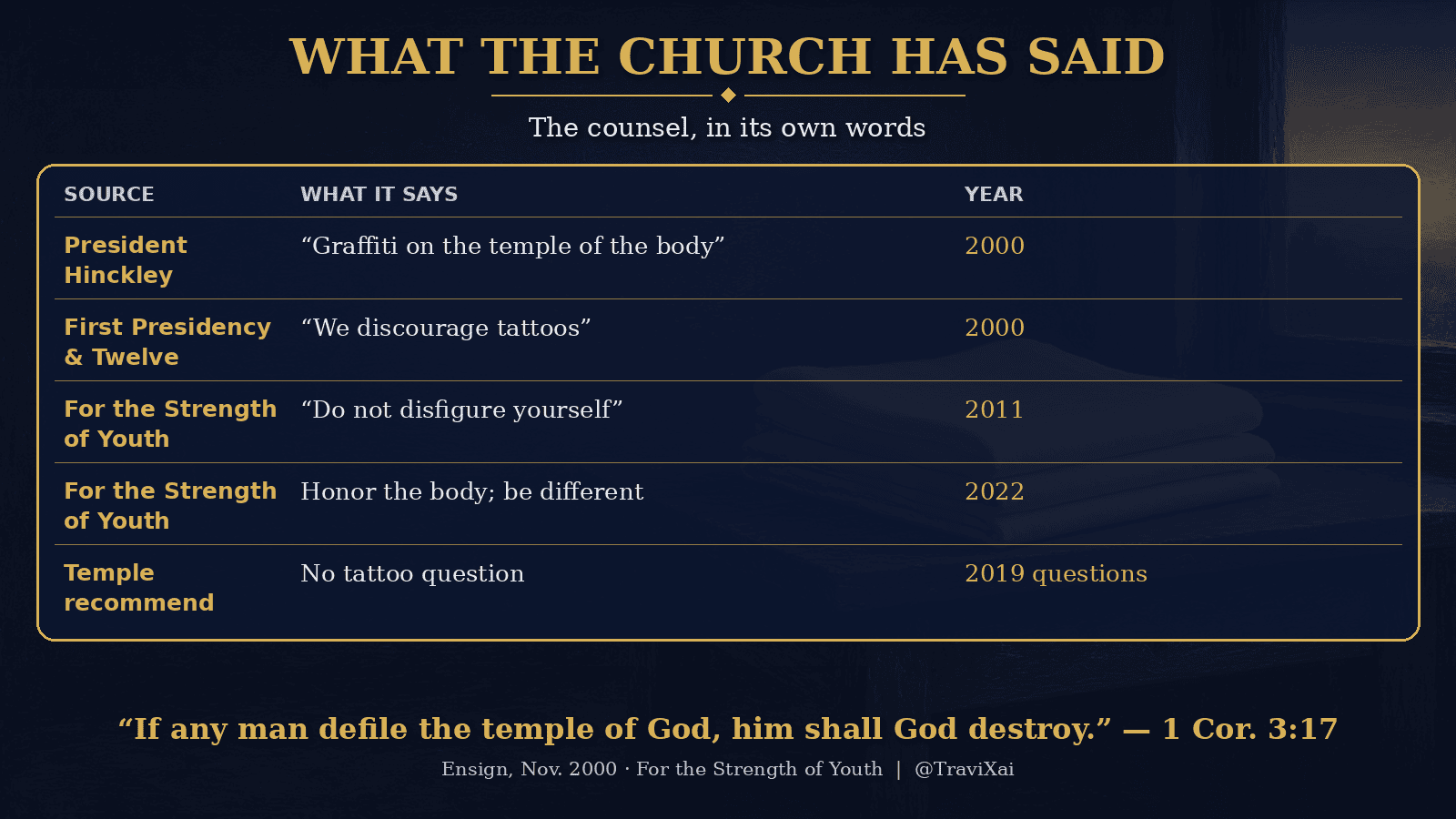
The 2022 For the Strength of Youth guide moved from lists to principles, and it answers the question directly: “What is the Lord’s standard on dress, grooming, tattoos, and piercings? The Lord’s standard is for you to honor the sacredness of your body, even when that means being different from the world. Let this truth and the Spirit be your guide as you make decisions—especially decisions that have lasting effects on your body. Be wise and faithful, and seek counsel from your parents and leaders.” Some readers took the softer wording as permission. Read it again: a tattoo is the textbook example of a decision with lasting effects on your body, and “being different from the world” is the point. See What Is the Word of Wisdom?.
If you already have oneNo scarlet letter
Plenty of faithful Latter-day Saints have tattoos, many from before they joined the Church. None of the temple recommend interview questions asks about tattoos. Converts with tattoos are baptized, serve and go to the temple. The counsel looks forward; it does not ask anyone to wear shame for a decision made before they understood it. The question for anyone considering a new one is the one the guide asks: “Am I honoring my body as a sacred gift from God?” See Who Can Enter an LDS Temple?.
Leviticus 19:28 in contextWhat the verse actually says
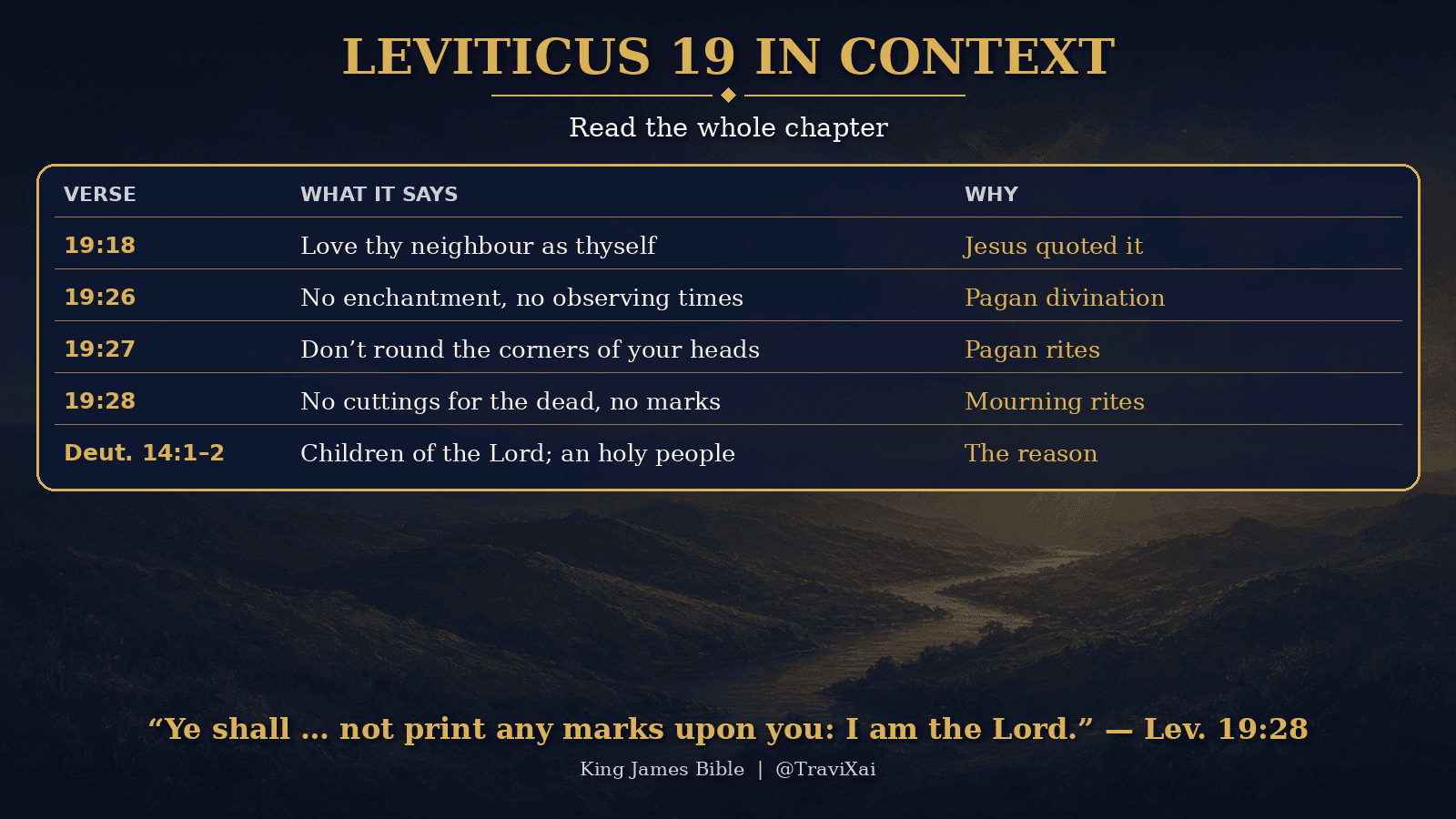
The verse everyone quotes: “Ye shall not make any cuttings in your flesh for the dead, nor print any marks upon you: I am the Lord” (Leviticus 19:28). Read it with its neighbors. Verse 26 forbids enchantment and observing times, pagan divination. Verse 27 forbids rounding the corners of the head and marring the beard, also linked to the rites of surrounding nations (Leviticus 19:26–27). Verse 28 ties cutting to mourning “for the dead.” Deuteronomy gives the reason: “Ye are the children of the Lord your God: ye shall not cut yourselves, nor make any baldness between your eyes for the dead. For thou art an holy people unto the Lord thy God” (Deuteronomy 14:1–2). The point was identity. Israel was not to mark their bodies the way people who served other gods did, because they belonged to the Lord.
“It’s just the Old Testament”Answering the presupposition
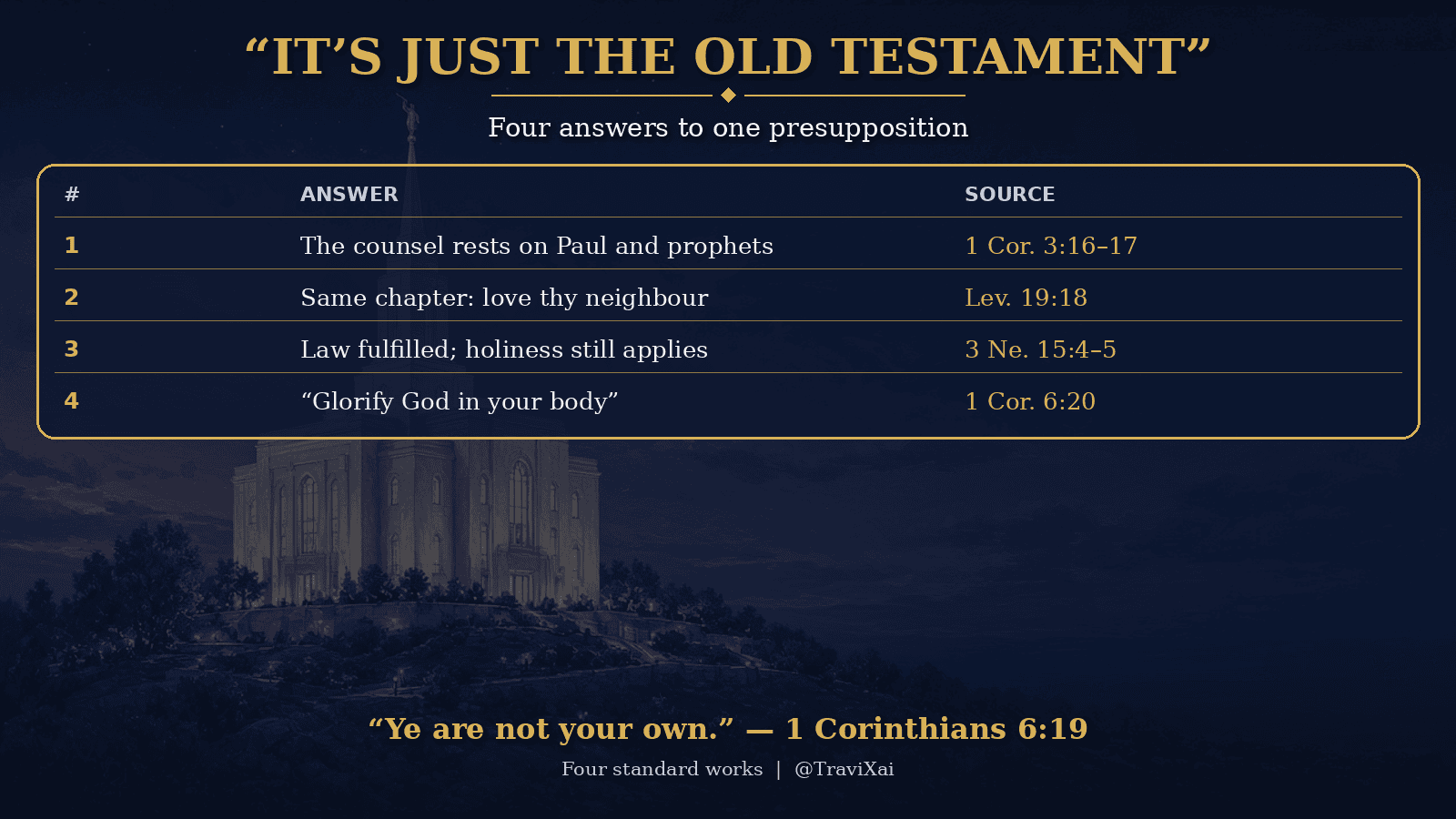
The common pushback: Leviticus also bans mixed fabrics and shellfish, so quoting 19:28 is cherry-picking. There is a real point inside that objection. The law of Moses is fulfilled in Christ: “Behold, I say unto you that the law is fulfilled that was given unto Moses” (3 Nephi 15:4–5). The Church does not teach that Leviticus 19:28 is binding Mosaic law on Christians. But the argument fails anyway, for four reasons.
First, it attacks a position the Church does not hold. The counsel rests on the New Testament and living prophets: 1 Corinthians 3 and 6, President Hinckley’s 2000 statement for the First Presidency and the Twelve, and For the Strength of Youth. Remove Leviticus from the conversation and the counsel stands. Second, “just the Old Testament” proves too much. The same chapter says “thou shalt love thy neighbour as thyself: I am the Lord” (Leviticus 19:18), and Jesus called that the second great commandment. Nobody throws that verse out because it sits in Leviticus. Third, fulfilled ceremonies are not cancelled principles. The ritual details ended; the reason behind them, a holy people who belong to God, did not. Fourth, Paul restates that reason for Christians in plain terms: “What? know ye not that your body is the temple of the Holy Ghost which is in you, which ye have of God, and ye are not your own? For ye are bought with a price: therefore glorify God in your body, and in your spirit, which are God’s” (1 Corinthians 6:19–20). That is the New Testament, not Leviticus.
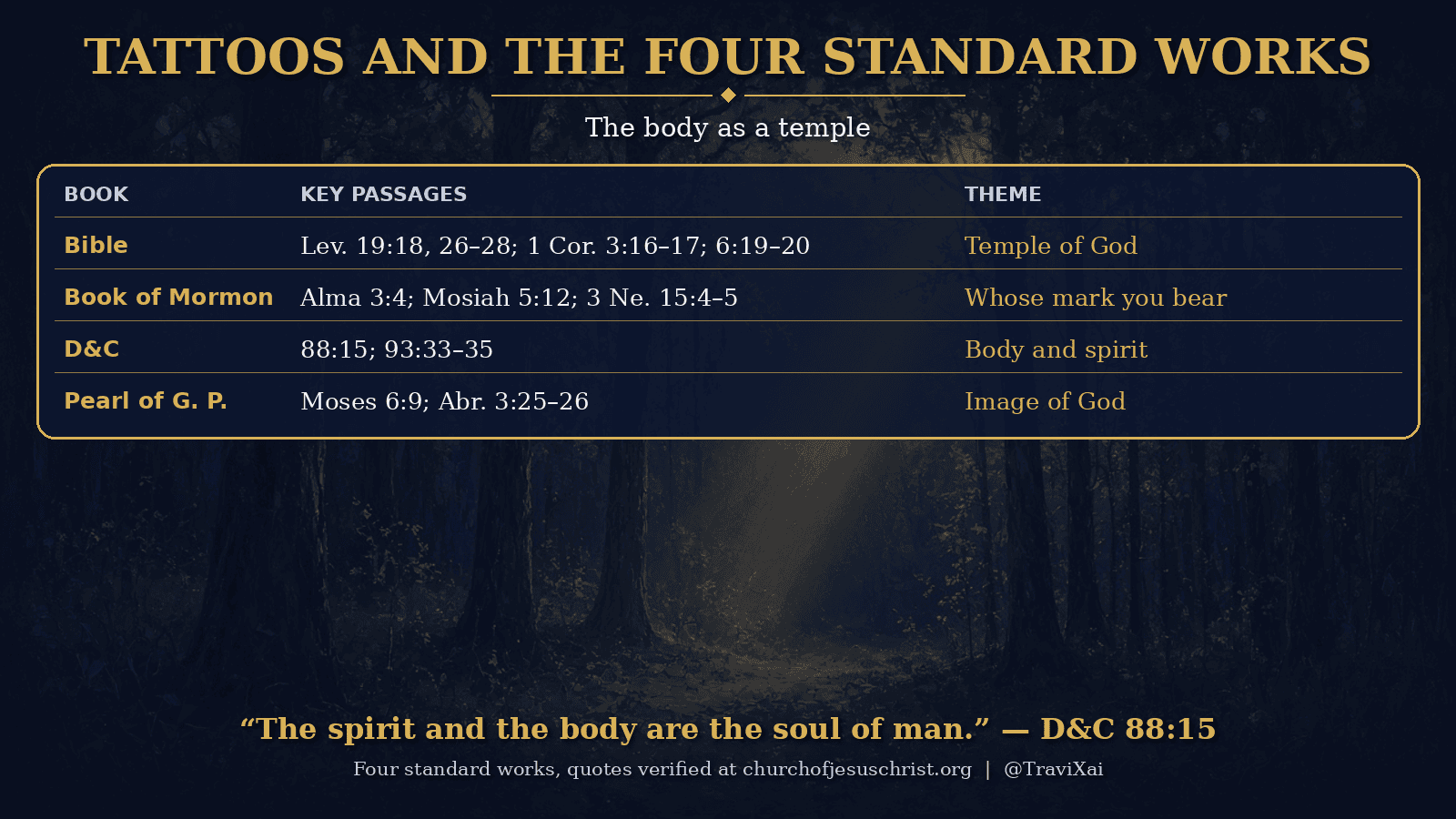
The BibleThe temple of God
Paul’s warning is stronger than people remember: “If any man defile the temple of God, him shall God destroy; for the temple of God is holy, which temple ye are” (1 Corinthians 3:17). Its first application in context is the Church as God’s temple. Paul then applies the same temple language to the individual body in 1 Corinthians 6, which is how President Hinckley used it. Some argue Jesus Himself has a tattoo because “he hath on his vesture and on his thigh a name written, King of Kings, and Lord of Lords” (Revelation 19:16). It is a symbolic vision, and the name is on His vesture, His robe. Building a tattoo policy on an apocalyptic image of a robe is a stretch nobody would accept in any other argument.
The Book of MormonWhose mark do you bear?
The Book of Mormon shows the old principle in action. When the Amlicites rebelled and joined the Lamanites, they took a visible mark of their new allegiance: “the Amlicites were distinguished from the Nephites, for they had marked themselves with red in their foreheads after the manner of the Lamanites” (Alma 3:4). Marks on the body say who you belong to. King Benjamin pointed to the mark that matters: “remember to retain the name written always in your hearts” (Mosiah 5:12). The name of Christ goes on the heart, by covenant. See Is the Book of Mormon True?.
The Doctrine and CovenantsEven temples
Latter-day Saints have a higher view of the body than most of Christianity. The body is not a shell the spirit leaves behind: “the spirit and the body are the soul of man” (D&C 88:15). “For man is spirit. The elements are eternal, and spirit and element, inseparably connected, receive a fulness of joy; And when separated, man cannot receive a fulness of joy. The elements are the tabernacle of God; yea, man is the tabernacle of God, even temples; and whatsoever temple is defiled, God shall destroy that temple” (D&C 93:33–35). A God with a glorified body of flesh and bones gave us bodies in His image so we could become like Him. That is why the body gets treated like a temple and not like a canvas. See Was God Once a Man? and What Are LDS Temple Garments?.
The Pearl of Great PriceThe image of His body
Moses records whose image the body carries: “In the image of his own body, male and female, created he them” (Moses 6:9). And Abraham explains why we have one at all. Spirits who kept their first estate came here to be proved and “added upon”: “they who keep their second estate shall have glory added upon their heads for ever and ever” (Abraham 3:25–26). The body is the thing we fought for in the premortal life. Treating it as God’s, not as ours to decorate permanently, is the Restoration’s whole argument in one sentence. See What Is the Premortal Life?.
Check the premiseThe presuppositions baked into the question
Before this question can be answered fairly, the person asking has to justify a few assumptions packed inside it:
- That the Church’s counsel on tattoos is based on Leviticus 19:28. It rests on 1 Corinthians 3:16–17 and 6:19–20, modern prophets and For the Strength of Youth. Leviticus shows the principle; it is not the foundation.
- That anything in the Old Testament is automatically irrelevant to Christians. Leviticus 19 also contains “love thy neighbour as thyself,” which Jesus called the second great commandment. The law is fulfilled; the principles of holiness are not discarded.
- That a tattoo keeps a person out of the Church or the temple. No temple recommend question asks about tattoos, and converts with tattoos are baptized and attend the temple.
- That your body is yours to do with as you please. “Ye are not your own. For ye are bought with a price: therefore glorify God in your body” (1 Corinthians 6:19–20).
FAQQuick answers
Can Latter-day Saints get tattoos?
The Church discourages tattoos because the body is a sacred temple. It is counsel, not a rule that bars anyone from membership or the temple.
What does For the Strength of Youth say about tattoos?
The 2022 guide says the Lord’s standard is to honor the sacredness of your body, even when that means being different from the world, especially with decisions that have lasting effects on it.
What did President Hinckley say about tattoos?
In October 2000 he said the First Presidency and the Twelve discourage tattoos and called a tattoo “graffiti on the temple of the body.”
Can you go to the temple with tattoos?
Yes. None of the temple recommend interview questions asks about tattoos.
What does Leviticus 19:28 mean?
It forbade cutting the flesh “for the dead” and printing marks on the body, practices tied to the mourning and worship of surrounding nations. Israel was to be holy to the Lord.
Does Leviticus 19:28 apply to Christians?
The law of Moses is fulfilled in Christ, so the Church does not treat it as binding law. Its principle of holiness is restated in 1 Corinthians 3 and 6.
What does 1 Corinthians 3:16–17 mean for tattoos?
Paul says “ye are the temple of God” and the temple is holy. Latter-day Saint leaders apply that temple language to how we treat the body.
Should members with tattoos remove them?
The counsel is about future choices. No recommend question or published standard asks members to remove tattoos they already have.
SummaryKey takeaways
- The Church discourages tattoos; the body is a temple (1 Corinthians 3:16–17; 6:19–20).
- President Hinckley (2000): “A tattoo is graffiti on the temple of the body.”
- For the Strength of Youth (2022): honor the body, even when that means being different.
- Leviticus 19:28 shows the principle; it is not the Church’s main basis.
- No temple recommend question asks about tattoos.
Read 1 Corinthians 6:19–20 and decide what your body is for. For quick, sourced answers, open Galatians18, and follow me on X at @TraviXai.
Sources
- King James Bible (churchofjesuschrist.org): Leviticus 19:18 · Leviticus 19:26–28 · Deuteronomy 14:1–2 · 1 Corinthians 3:16–17 · 1 Corinthians 6:19–20 · Revelation 19:16
- Book of Mormon: Alma 3:4 · Mosiah 5:12 · 3 Nephi 15:4–5
- Doctrine and Covenants: D&C 88:15 · D&C 93:33–35
- Pearl of Great Price: Moses 6:9 · Abraham 3:25–26
- For the Strength of Youth (2022), “Your Body Is Sacred” · Gordon B. Hinckley, “Great Shall Be the Peace of Thy Children,” Ensign, Nov. 2000
- New Era, “Think before You Ink” (Feb. 2014)
- Featured image and in-article graphic: original graphics by thebookofmormon.ai (painterly backgrounds; no photographs or likenesses of real people).