

Category: The Restoration
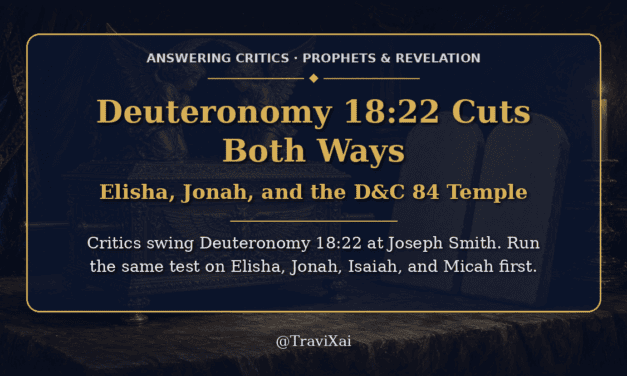
Deuteronomy 18:22 Cuts Both Ways: Elisha, Jonah, and the D&C 84 Temple
Critics use Deuteronomy 18:22 as a one-strike rule against Joseph Smith and the D&C 84 temple. Run the same test on Elisha, Jonah, Isaiah, and Micah, then read the conditions written into D&C 84, 105, and 124.
Read More
Christians, This Should Concern You: The Last-Days Prophecies Your Church Isn’t Looking For
The Bible lists what must happen before Christ returns: Elijah, an angel with the everlasting gospel, the stick of Joseph, prophets, temples, the gathering. If none of it is happening in your church, that’s a red flag.
Read More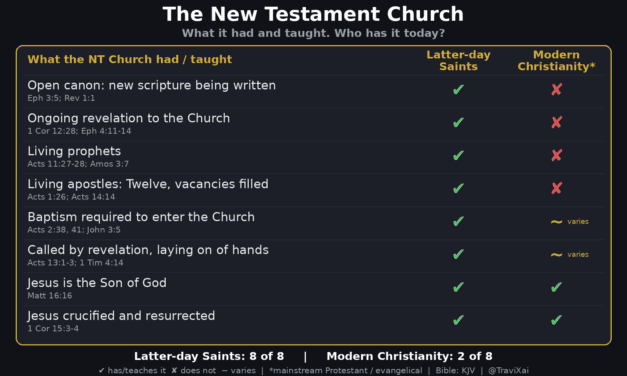
Line Them Up: The New Testament Church, Islam, and the Closed Heavens
Compare every trait, not just one. The Church of Jesus Christ of Latter-day Saints matches the New Testament Church; the closed heavens are what modern Christianity shares with Islam.
Read More
“Your Church Changes”… So Does the Bible. The Double Standard That Falls Apart
Christians and atheists love to say ‘your church changes, so it can’t be true.’ But God changed His commands in the Bible, prophets made mistakes, and the creeds came from councils. Hold everything to the standard you hold us to, and it ALL falls apart. With what measure ye mete…
Read More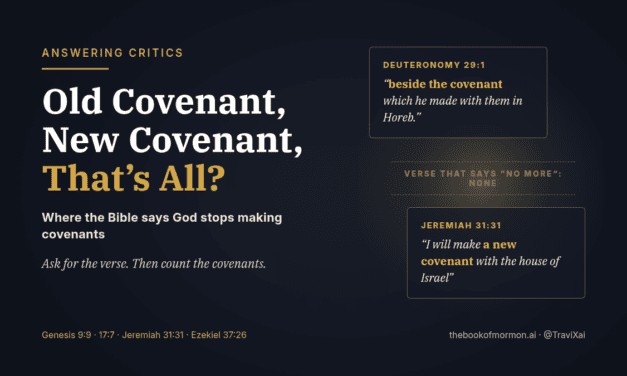
“Old Covenant, New Covenant, That’s All”? Where the Bible Says God Stops Making Covenants
Critics say there’s the Old Covenant and the New Covenant, and that’s all we need. Ask for the verse. God made covenants with Noah, Abraham, Israel at Sinai and again in Moab, Phinehas, and David, and the prophets promised more. Adding a covenant is the Bible’s pattern, not proof of a false church.
Read More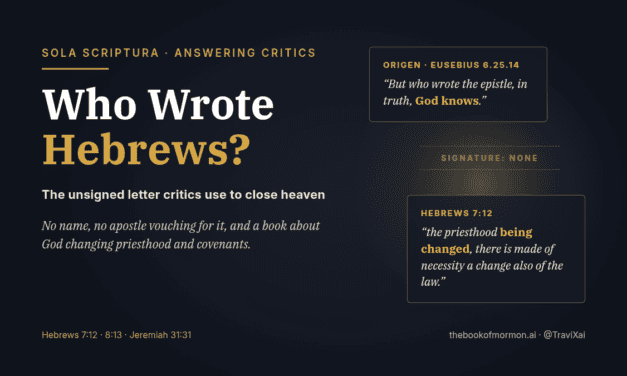
Who Wrote Hebrews? The Unsigned Letter Critics Use to Close Heaven
Critics quote Hebrews to say the New Covenant is final and God is done. But who wrote Hebrews, and which apostle ever vouched for it? Origen said only God knows. Then read what Hebrews actually teaches: God changes priesthood and covenants when He chooses, and the Bible never says He’d stop.
Read More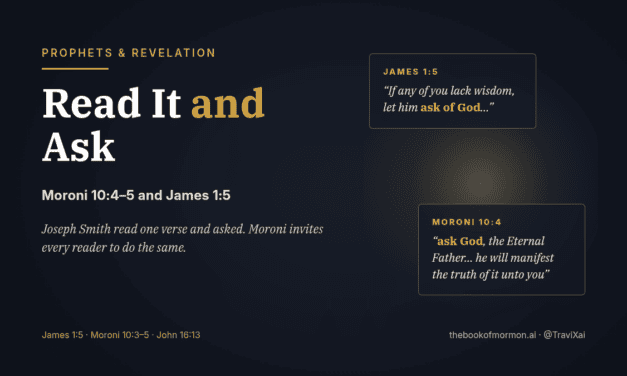
Read It and Ask: Moroni 10:4–5 and James 1:5
The Book of Mormon asks readers to do one thing: read it, then ask God. Joseph Smith did exactly that with James 1:5. Here’s Moroni 10:3–5 next to James 1:5–6, what the Bible says about the Spirit teaching truth, and why the Westminster Confession rests the Bible on the same witness critics call “just feelings.”
Read More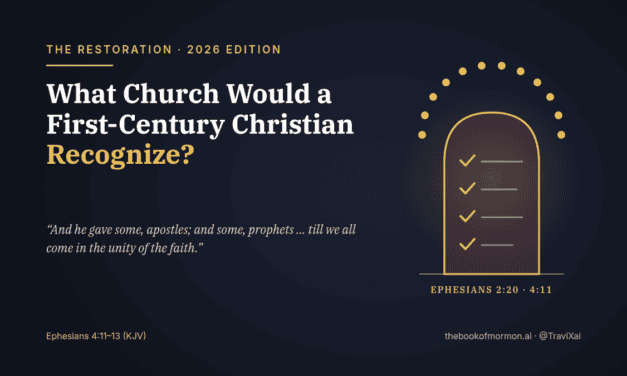
What Church Would a First-Century Christian Recognize? (2026 Edition)
Drop a Christian from first-century Ephesus into 2026 and hand him a New Testament checklist: apostles and prophets (Ephesians 2:20; 4:11–13), the Twelve kept full (Acts 1), the seventy (Luke 10:1), elders, bishops, and deacons, baptism by immersion, the Holy Ghost by laying on of hands (Acts 8:17), baptism for the dead (1 Corinthians 15:29), revelation, and Christ’s name. A fair, verse-by-verse comparison.
Read More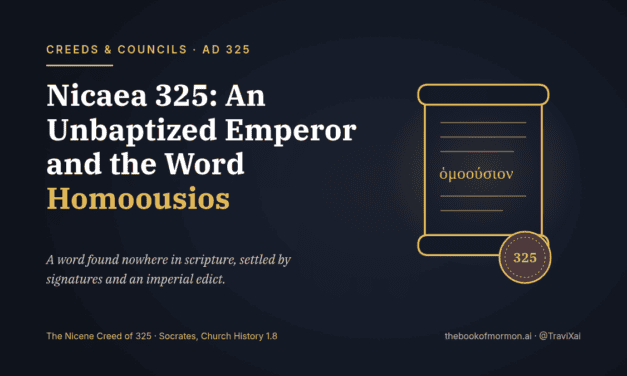
Nicaea 325: An Unbaptized Emperor and the Word ‘Homoousios’
The Council of Nicaea was convened by Constantine, a catechumen who wasn’t baptized until his deathbed in 337. Its key word, homoousios, appears nowhere in scripture; Athanasius admits the bishops adopted it because every Bible phrase also applied to people. Here’s what Eusebius, Socrates, and Jerome actually record, the myths to drop, and how Acts 15 settled doctrine instead.
Read More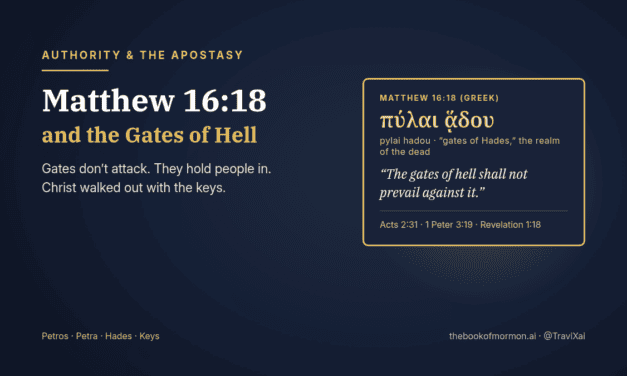
Matthew 16:18 and the Gates of Hell: What the Promise Really Means
Critics quote Matthew 16:18, “the gates of hell shall not prevail against it,” as proof the church could never fall away. But “hell” there is hadēs, the realm of the dead, and gates hold people in. Christ went into Hades and came out with “the keys of hell and of death,” the gospel was preached to the dead, and Peter received the keys of the kingdom. Here is what the Greek, the keys, and the New Testament’s own apostasy warnings say.
Read More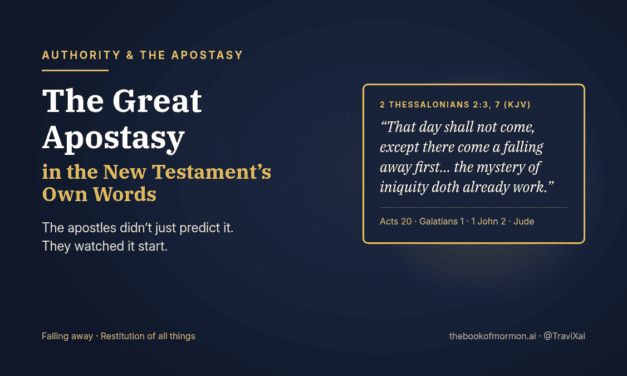
The Great Apostasy in the New Testament’s Own Words
Critics call the Great Apostasy a Latter-day Saint invention, but Paul, Peter, John, and Jude wrote it down first. From the “falling away” of 2 Thessalonians 2:3 and the wolves of Acts 20 to “doth already work,” “so soon removed,” and “even now are there many antichrists,” the New Testament records the apostles watching the falling away begin, and it promises a “restitution of all things” (Acts 3:21).
Read More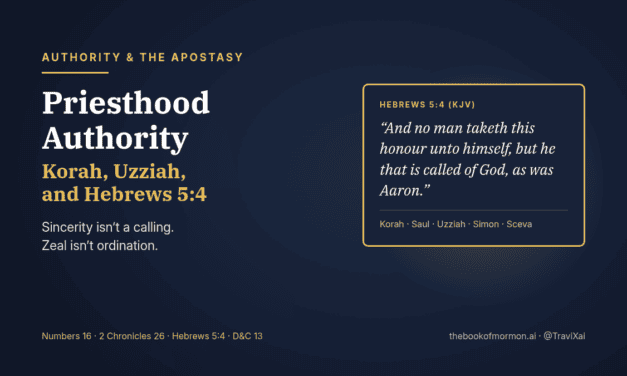
Priesthood Authority: Korah, Uzziah, and Hebrews 5:4
Korah was sincere, Saul had a good reason, Uzziah was a good king, and Simon offered to pay. The Bible’s verdict on all of them is the same: zeal doesn’t give anyone the right to act for God. From Numbers 16 to Hebrews 5:4 and Acts 19, authority comes by God’s call through the hands of those who hold it, which is why Latter-day Saints teach that the priesthood was restored by John the Baptist and by Peter, James, and John.
Read More