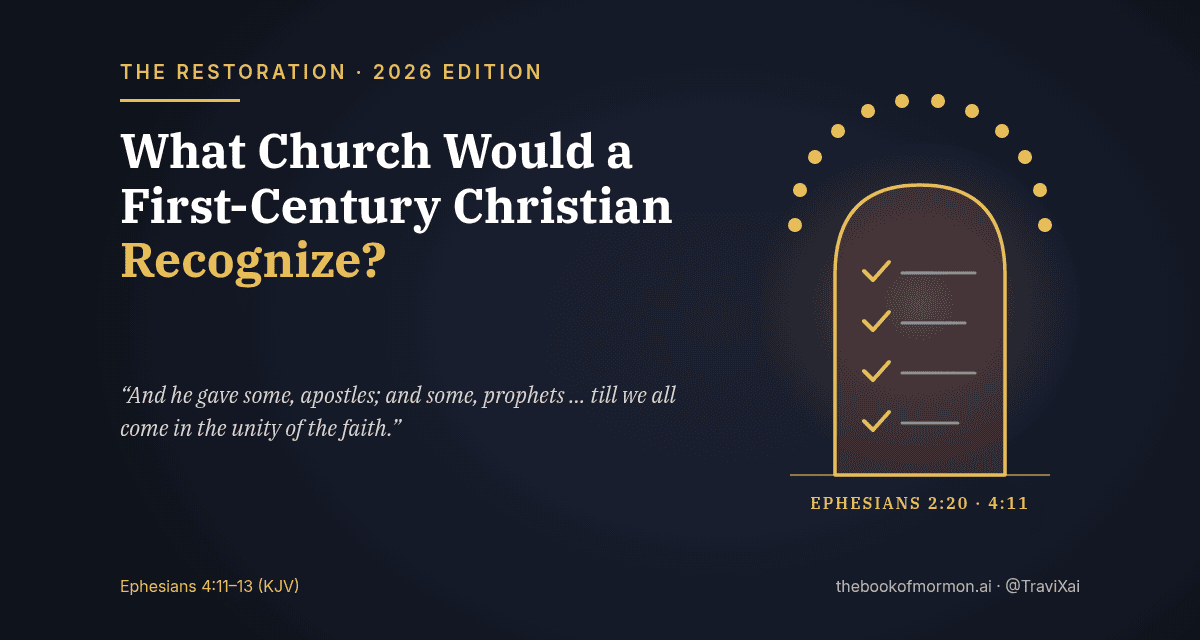

Drop a Christian from Antioch or Ephesus into 2026 and hand him a New Testament checklist: apostles and prophets, the Twelve kept at twelve, seventy sent out, baptism by immersion, the gift of the Holy Ghost by laying on of hands, baptism for the dead, unpaid local leaders, and a church called by Christ’s name. Then check every church fairly, including ours.
Picture a saint at Ephesus around AD 60. Paul taught him, he’s been baptized, and he’s felt hands on his head. Drop him into 2026 with one job: find his church.
Here’s his checklist, built only from the New Testament and walked fairly: credit to every church that kept a piece, and an honest look at what would puzzle him in our chapel too.
This is a 2026 edition of our earlier post, What Modern Church Would a 1st-Century Christian Recognize?. This one goes verse by verse and gives other churches credit where they’ve earned it.
Ephesians 2:20A foundation that talks back
His first question: “Who are your apostles and prophets?” Paul told his congregation what the church stood on:
And are built upon the foundation of the apostles and prophets, Jesus Christ himself being the chief corner stone.
Ephesians 2:20 (KJV)
“A foundation is laid once,” comes the reply. Except Paul also said how long the offices would last:
And he gave some, apostles; and some, prophets; and some, evangelists; and some, pastors and teachers; … till we all come in the unity of the faith … that we henceforth be no more children, tossed to and fro.
Ephesians 4:11–14 (KJV)
“Till we all come in the unity of the faith.” Look at a list of denominations and ask if we’ve arrived. If not, the scaffolding stays up.
Credit where it’s due: Catholics and Orthodox kept bishops and claim apostolic succession, and Pentecostals take prophecy seriously. But a living Quorum of Twelve Apostles is rare. Latter-day Saints sustain fifteen men as prophets, seers, and revelators, and the belief fits in one line: “We believe in the same organization that existed in the Primitive Church, namely, apostles, prophets, pastors, teachers, evangelists, and so forth” (Article of Faith 6). Where their authority comes from is covered in Priesthood Authority: Korah, Uzziah, and Hebrews 5:4; the Galatians18 “Living prophets” page has the short version.
Acts 1 · Luke 10Twelve, and then seventy
He’d expect the Twelve to stay twelve. When Judas died, the eleven didn’t turn the seat into a museum piece. They filled it:
Must one be ordained to be a witness with us of his resurrection. … And they gave forth their lots; and the lot fell upon Matthias; and he was numbered with the eleven apostles.
Acts 1:22, 26 (KJV)
If they were meant to be the last apostles, Acts 1 is an odd place to start replacing them, and Luke later calls “Barnabas and Paul” apostles too (Acts 14:14). Then there are the seventy, the group most people forget:
After these things the Lord appointed other seventy also, and sent them two and two before his face into every city and place, whither he himself would come.
Luke 10:1 (KJV)
They came back rejoicing that “even the devils are subject unto us through thy name” (Luke 10:17). In The Church of Jesus Christ of Latter-day Saints, when an apostle dies the Twelve is filled again, and Quorums of the Seventy are “called to preach the gospel, and to be especial witnesses unto the Gentiles and in all the world” (D&C 107:25).
Elders, bishops, deaconsWho leads, and who gets paid
Locally, Paul and Barnabas “ordained them elders in every church” (Acts 14:23), and Paul wrote to the saints at Philippi “with the bishops and deacons” (Philippians 1:1). Plenty of churches kept these titles. He’d find all three in a Latter-day Saint ward, and might blink at a 12-year-old deacon passing the sacrament, but he’d know the office.
The bigger surprise would be the paycheck. Paul told the Ephesian elders, “I have coveted no man’s silver, or gold,” and “these hands have ministered unto my necessities” (Acts 20:33–34). Peter told elders to feed the flock “not for filthy lucre, but of a ready mind” (1 Peter 5:2). To be fair, Paul also said “they which preach the gospel should live of the gospel” (1 Corinthians 9:14), and the Didache, an early Christian manual, says a true prophet who settles in a town “is worthy of his support.” The same manual is blunt about the traveling kind: if an apostle “ask money, he is a false prophet” (Didache, chs. 11, 13). So support wasn’t a sin, but Paul chose to preach “without charge” (1 Corinthians 9:18) and worked “night and day” so he wouldn’t be “chargeable” (1 Thessalonians 2:9).
Our honest picture: bishops, stake presidents, and teachers serve unpaid while holding regular jobs (Church Newsroom, “Lay Leadership”). General Authorities leave their careers for a uniform living allowance, which the Church says comes from investment proceeds, not tithing (Church FAQ). Lay ministry locally, 1 Corinthians 9:14 at the top. The Galatians18 “Paid ministry” page covers the objections.
Water, then handsBaptism the way Acts did it
Our visitor went all the way under the water. The verbs give it away: Jesus “went up straightway out of the water” (Matthew 3:16), Philip and the eunuch “went down both into the water” and “were come up out of the water” (Acts 8:38–39), and Paul says we are “buried with him by baptism” (Romans 6:4). You don’t get buried in a sprinkle.
Fairness check: Baptists, many evangelicals, and the Orthodox immerse. And the Didache, usually dated late first or early second century, allowed pouring when water was short (Didache, ch. 7). An exception for drought still tells you the norm. The Galatians18 “Baptism mode” page walks through the mode question.
What would really catch his eye is what came after the water. In Samaria, something was still missing:
(For as yet he was fallen upon none of them: only they were baptized in the name of the Lord Jesus.) Then laid they their hands on them, and they received the Holy Ghost.
Acts 8:16–17 (KJV)
Water, then hands, then the gift of the Holy Ghost. Catholics, Orthodox, and Anglicans kept a rite after baptism (confirmation or chrismation), and they deserve credit. Many Protestant churches dropped it. A Latter-day Saint convert is immersed, then confirmed by the laying on of hands: Samaria’s two steps, in Samaria’s order.
1 Corinthians 15:29The verse that rarely gets a sermon
Now the verse most Sunday sermons skip:
Else what shall they do which are baptized for the dead, if the dead rise not at all? why are they then baptized for the dead?
1 Corinthians 15:29 (KJV)
Paul is arguing for the resurrection from a practice the Corinthians already knew. Critics note he says “they,” not “we.” Fair. But he offers it as evidence without a word against it, and nobody builds his best argument on pagan nonsense.
Our visitor wouldn’t need a commentary. Latter-day Saints do it every week in temples, so the dead can receive the ordinance Jesus said no one enters the kingdom without (John 3:5). How it ties to Christ preaching to the dead is in Matthew 16:18 and the Gates of Hell; the Galatians18 “Baptism for the dead” page answers the objections.
Acts 13:2“The Holy Ghost said”
His church didn’t just read revelation. It got new revelation. At Antioch:
As they ministered to the Lord, and fasted, the Holy Ghost said, Separate me Barnabas and Saul for the work whereunto I have called them.
Acts 13:2 (KJV)
A prophet named Agabus “signified by the Spirit that there should be great dearth throughout all the world” (Acts 11:28). That’s Amos: “Surely the Lord GOD will do nothing, but he revealeth his secret unto his servants the prophets” (Amos 3:7).
Ask him where his Bible was and he’d look at you funny. He had the Jewish scriptures, some of Paul’s letters, and living apostles. Scripture wasn’t an idol or a closed book to him. It was the record of God speaking to prophets, and God was still speaking. “He’s said all He’s going to say” would sound foreign. Latter-day Saints “believe all that God has revealed, all that He does now reveal” (Article of Faith 9). More on that in Sola Scriptura: Which Verse Teaches It? and The Canon Was Never Meant to Close.
Romans 16:16Whose name is on the door?
Paul wrote, “The churches of Christ salute you” (Romans 16:16). When the Corinthians split into teams, he objected:
Now this I say, that every one of you saith, I am of Paul; and I of Apollos; and I of Cephas; and I of Christ. Is Christ divided? was Paul crucified for you? or were ye baptized in the name of Paul?
1 Corinthians 1:12–13 (KJV)
That’s not a dig at anyone’s congregation. Many churches carry Christ’s name, and good people worship in churches named for a reformer or a form of government. It’s just Paul’s standard. The Book of Mormon puts it in Jesus’ own words: “how be it my church save it be called in my name? … if it be called in my name then it is my church, if it so be that they are built upon my gospel” (3 Nephi 27:8). Note the condition: a name alone proves nothing. In 1838 the Lord named His restored church: “The Church of Jesus Christ of Latter-day Saints” (D&C 115:4). His name is on the door.
Fair is fairWhat would puzzle him in our chapel
What would puzzle him in our meetinghouse? The building (he met in homes), the organ, the basketball lines in the cultural hall, and a book from ancient America. He’d need a minute.
But those are buildings, tools, and new scripture, and he’d never seen a bound New Testament either. Furniture changes every century. His test is the pattern: who leads, how they’re called, how people enter, whether God still speaks, and whose name is on it. Jesus Christ is “the same yesterday, and to day, and for ever” (Hebrews 13:8), and so is the shape of His church.
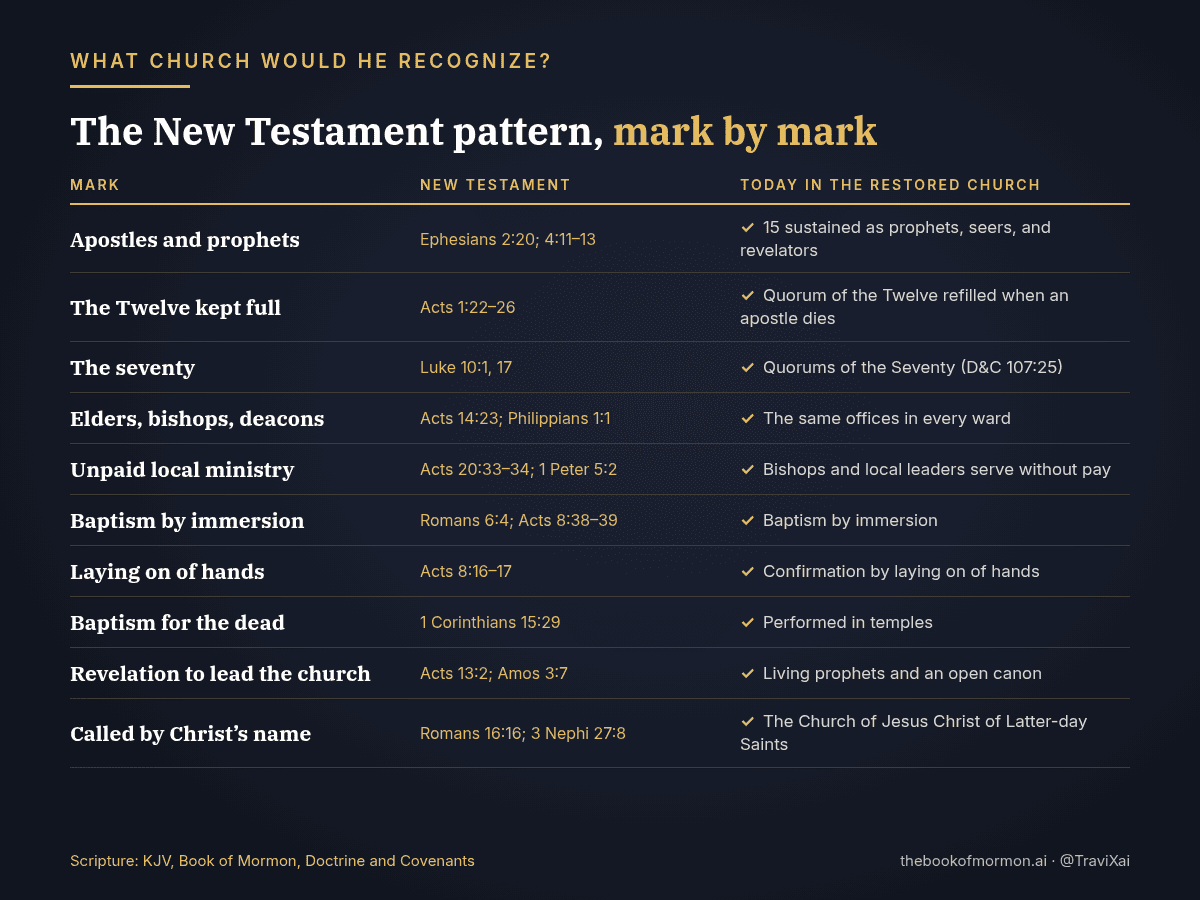
Other churches kept real pieces: bishops here, immersion there, prophecy somewhere else. The Restoration doesn’t claim everyone lost everything. It claims the whole pattern, with its authority, had to be given back, because the apostles warned it would fall away (The Great Apostasy in the New Testament’s Own Words). And men didn’t vote the details in council, the way the creeds came (Nicaea 325, Councils and Who Counts as Christian). The pattern was revealed.
SummaryKey takeaways
- Apostles and prophets were the foundation “till we all come in the unity of the faith,” the Twelve stayed twelve, and seventy went out (Ephesians 4:11–13; Acts 1:26; Luke 10:1).
- Baptism was by immersion, then the gift of the Holy Ghost by laying on of hands (Romans 6:4; Acts 8:16–17).
- Paul argued from baptism for the dead without condemning it (1 Corinthians 15:29), and the church was led by revelation (Acts 13:2).
- Many churches kept some marks. The Church of Jesus Christ of Latter-day Saints claims the whole pattern, restored by revelation and called by Christ’s name.
Don’t take my word for it. Take the verses above to any church, including mine, and ask where the apostles, the seventy, and the gift of the Holy Ghost are. For quick, sourced answers on authority, baptism, and living prophets, open Galatians18. And for more like this every day, follow me on X at @TraviXai.
Sources
- Scriptures (KJV, Book of Mormon, Doctrine and Covenants, churchofjesuschrist.org): Ephesians 2:20 · Ephesians 4:11–14 · 1 Corinthians 12:28 · Acts 1:22–26 · Acts 14:14, 23 · Luke 10:1, 17 · Philippians 1:1 · Acts 20:33–34 · 1 Peter 5:2 · 1 Corinthians 9:14, 18 · Matthew 3:16 · Acts 8:16–17, 38–39 · Romans 6:4 · 1 Corinthians 15:29 · John 3:5 · Acts 13:2 · Acts 11:28 · Amos 3:7 · Romans 16:16 · 1 Corinthians 1:12–13 · Hebrews 13:8 · 3 Nephi 27:8 · D&C 107:25 · D&C 115:4
- Articles of Faith (6 and 9)
- The Didache (Teaching of the Twelve Apostles), chs. 7, 11, 13, 15, trans. M. B. Riddle, Ante-Nicene Fathers, vol. 7 (1886): newadvent.org
- Church Newsroom, “Lay Leadership: Volunteer Ministry of the Church”: newsroom.churchofjesuschrist.org
- Church FAQ, “Do General Authorities get paid?”: faq.churchofjesuschrist.org
- Earlier edition: What Modern Church Would a 1st-Century Christian Recognize? (May 20, 2025)
- Related on this site: Priesthood Authority: Korah, Uzziah, and Hebrews 5:4 · The Great Apostasy in the New Testament’s Own Words · Matthew 16:18 and the Gates of Hell · Nicaea 325 · Councils and Who Counts as Christian · Sola Scriptura: Which Verse Teaches It? · The Canon Was Never Meant to Close
- Galatians18: Living prophets · Paid ministry · Baptism mode · Baptism for the dead
- Featured image and checklist card: original graphics by thebookofmormon.ai (no photographs or likenesses of real people).