
Critics call the Great Apostasy a Latter-day Saint invention. Funny, then, how much of it Paul, Peter, John, and Jude wrote down. The New Testament doesn’t just predict a falling away. It records the apostles watching it begin, and it promises a restitution of all things.
Say “Great Apostasy” to a critic and you’ll usually get an eye roll. A convenient story, they say. Joseph Smith needed the church to have fallen so he could restore it. Nice theory. Small problem: the apostles beat him to it by about eighteen centuries.
Ask whether the New Testament writers expected the church to stay on course, and the answer jumps off the page. They warned about it. They wept about it. And in their later letters they stopped saying “it will come” and started saying “it’s here.” Let’s let them speak for themselves.
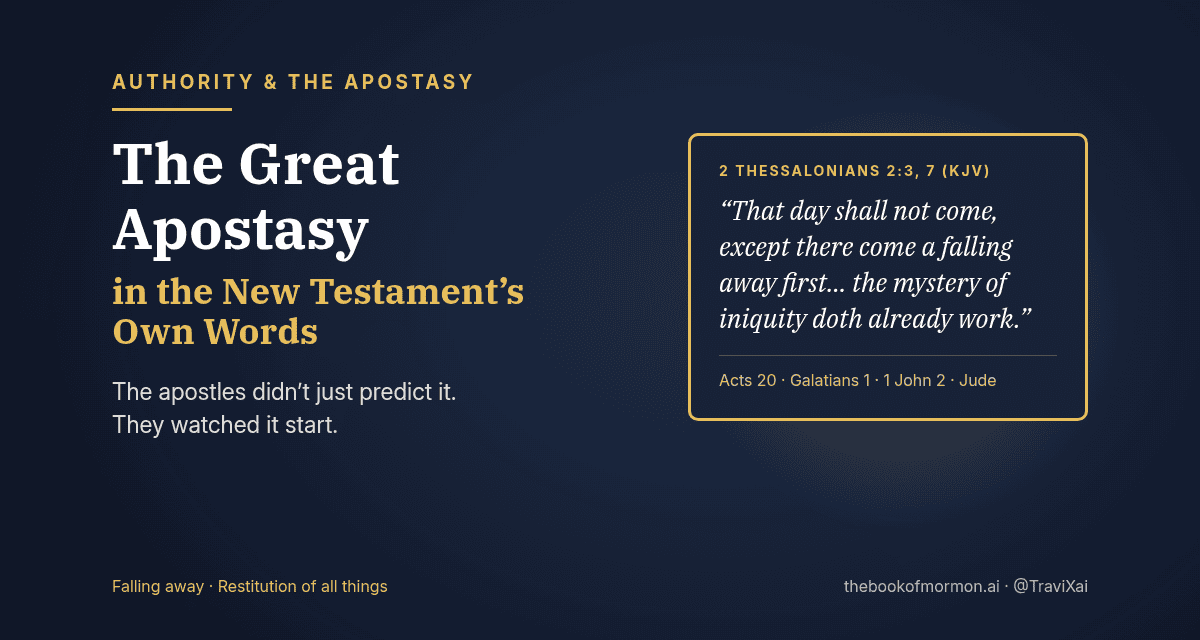
2 Thessalonians 2:3“A falling away first”
Some Thessalonian saints thought the Second Coming was right around the corner. Paul told them to slow down:
Let no man deceive you by any means: for that day shall not come, except there come a falling away first, and that man of sin be revealed, the son of perdition;
2 Thessalonians 2:3 (KJV)
The Greek word behind “falling away” is apostasia. That’s where we get “apostasy.” Notice the order: first the falling away, then the Lord’s return. And notice Paul treats it as old news: “Remember ye not, that, when I was yet with you, I told you these things?” (2:5). It was part of the basic lesson, not a footnote.
And a falling away has to fall away from something. Paul is describing Christ’s own church losing its grip. (For a quick-reference version, see The Great Apostasy on Galatians18.)
The warningsWolves, fables, and false teachers
It isn’t a one-off. Paul gave the elders of Ephesus a farewell they never forgot:
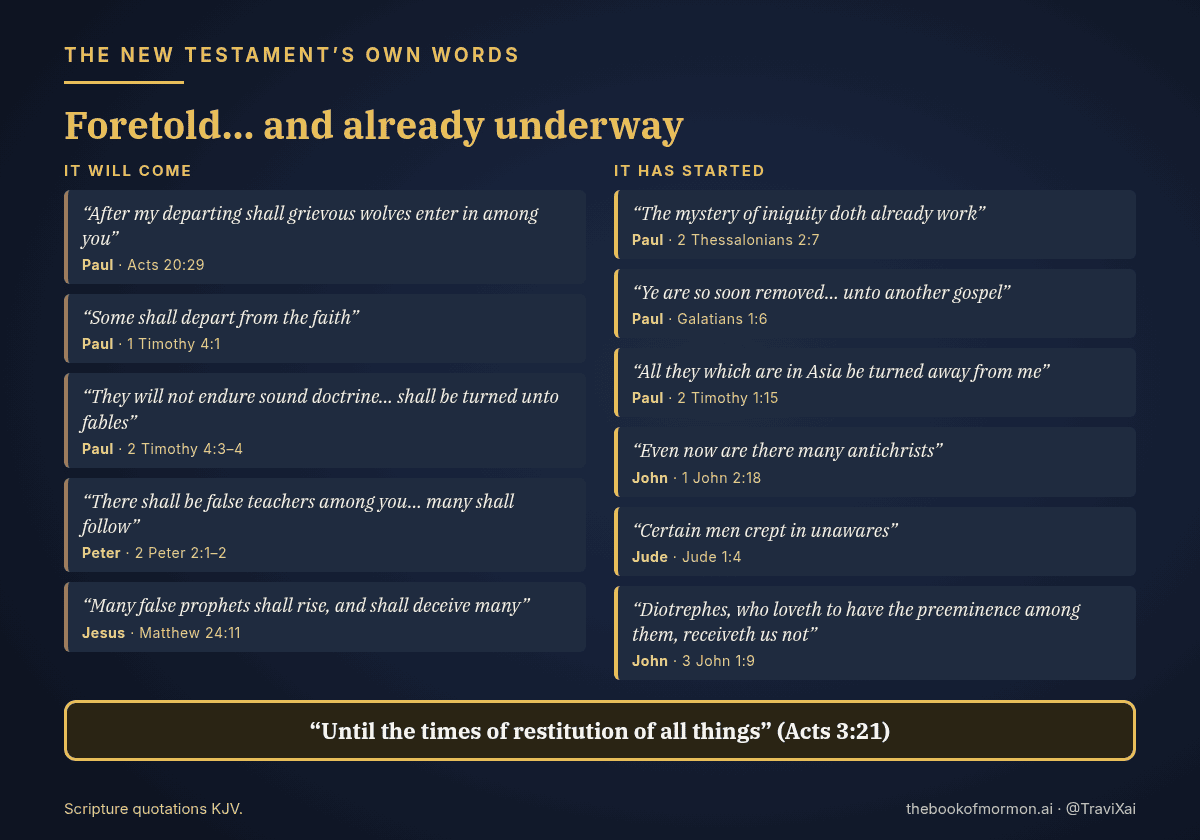
For I know this, that after my departing shall grievous wolves enter in among you, not sparing the flock. Also of your own selves shall men arise, speaking perverse things, to draw away disciples after them.
Acts 20:29–30 (KJV)
Wolves from outside, and men “of your own selves” from inside. Then: “by the space of three years I ceased not to warn every one night and day with tears” (Acts 20:31). Nobody spends three years crying over a problem that will never happen.
He told Timothy the same thing twice. “In the latter times some shall depart from the faith, giving heed to seducing spirits, and doctrines of devils” (1 Timothy 4:1). And:
For the time will come when they will not endure sound doctrine; but after their own lusts shall they heap to themselves teachers, having itching ears; And they shall turn away their ears from the truth, and shall be turned unto fables.
2 Timothy 4:3–4 (KJV)
Peter piles on: “there shall be false teachers among you, who privily shall bring in damnable heresies… And many shall follow their pernicious ways” (2 Peter 2:1–2). Many. And Jesus Himself warned, “many false prophets shall rise, and shall deceive many” (Matthew 24:11).
“Doth already work”The apostles watched it start
This is the angle most people miss. The apostles didn’t only forecast a distant apostasy. In the very same letter as the falling-away prophecy, Paul writes: “the mystery of iniquity doth already work” (2 Thessalonians 2:7). Already. While he was alive.
Follow the letters and you can watch it spread:
- Galatia. “I marvel that ye are so soon removed from him that called you into the grace of Christ unto another gospel” (Galatians 1:6). So soon. (Yes, this is the chapter with Galatians 1:8, and no, it doesn’t hurt us. See Did Moroni Bring Another Gospel?)
- Corinth. “Every one of you saith, I am of Paul; and I of Apollos; and I of Cephas; and I of Christ” (1 Corinthians 1:12). Denominations, before the ink was dry.
- Asia. In what reads as his farewell letter, Paul writes: “all they which are in Asia be turned away from me” (2 Timothy 1:15). All of them.
- John’s congregations. “Even now are there many antichrists; whereby we know that it is the last time… They went out from us” (1 John 2:18–19).
- Jude’s readers. Jude meant to write about “the common salvation” and had to switch topics, because “there are certain men crept in unawares” (Jude 1:3–4).
- A local leader vs. an apostle. “Diotrephes, who loveth to have the preeminence among them, receiveth us not,” and he was casting faithful members “out of the church” (3 John 1:9–10). A local leader shutting the door on the apostle John. That’s not drift. That’s mutiny.
If the Great Apostasy is a Latter-day Saint invention, Paul, John, and Jude got the memo awfully early.
Revelation 2–3Ephesus, again
Now jump to Revelation. The first of the seven letters goes to Ephesus, the same church whose elders Paul warned about wolves. The Lord praises them, because they “tried them which say they are apostles, and are not, and hast found them liars” (Revelation 2:2). Counterfeit apostles only make sense in a world where real ones exist and people are trying to fake the office.
Then the warning:
Nevertheless I have somewhat against thee, because thou hast left thy first love. Remember therefore from whence thou art fallen, and repent, and do the first works; or else I will come unto thee quickly, and will remove thy candlestick out of his place, except thou repent.
Revelation 2:4–5 (KJV)
“From whence thou art fallen.” Thyatira was tolerating a self-styled prophetess, “that woman Jezebel” (2:20). Laodicea was “lukewarm,” and the Lord said He would “spue thee out of my mouth” (3:16).
When the apostles were gone“Till we all come in the unity”
So who was going to hold the line? The apostles. That was the whole point of them:
And he gave some, apostles; and some, prophets; and some, evangelists; and some, pastors and teachers… Till we all come in the unity of the faith… That we henceforth be no more children, tossed to and fro, and carried about with every wind of doctrine, by the sleight of men.
Ephesians 4:11–14 (KJV)
Apostles and prophets were given “till we all come in the unity of the faith.” Look around and ask whether Christianity has reached that unity. And notice the alternative Paul names: “tossed to and fro… with every wind of doctrine.” Take away the apostles and that’s exactly what you’d expect. (More on why the Lord still calls them at Living Prophets.)
When Judas fell, the eleven didn’t shrug. They filled the seat, because “must one be ordained to be a witness with us of his resurrection,” and Matthias “was numbered with the eleven apostles” (Acts 1:22, 26). When James was killed by Herod (Acts 12:2), Luke records no replacement. One by one the apostles died, and with them went the authority to call and ordain the way they did. Why that authority can’t just be assumed: see Priesthood Authority: Korah, Uzziah, and Hebrews 5:4.
Even a second-century writer who wasn’t remotely Latter-day Saint saw the timing. Eusebius records the chronicler Hegesippus saying the church “had remained a pure and uncorrupted virgin” up to that time. Then:
But when the sacred college of apostles had suffered death in various forms, and the generation of those that had been deemed worthy to hear the inspired wisdom with their own ears had passed away, then the league of godless error took its rise.
Eusebius, Church History 3.32.8, quoting Hegesippus (trans. A. C. McGiffert)
To be fair, Hegesippus believed the church came through that storm intact, and we read the ending differently. But on when the trouble started, he and the New Testament agree: the moment the apostles were gone.
Amos 8:11–12A famine of hearing
The Old Testament had already described what a falling away feels like from the inside:
Behold, the days come, saith the Lord God, that I will send a famine in the land, not a famine of bread, nor a thirst for water, but of hearing the words of the Lord: And they shall wander from sea to sea, and from the north even to the east, they shall run to and fro to seek the word of the Lord, and shall not find it.
Amos 8:11–12 (KJV)
Israel had the law of Moses on scrolls when Amos wrote that. The famine wasn’t a shortage of scripture. It was a shortage of hearing: no living voice from heaven. People running “to and fro,” sincere and searching, and not finding it. (More on that famine in The Canon Was Never Meant to Close.)
And here’s the mirror test. Protestants already believe in an apostasy. It’s called the Reformation. The only real disagreements are how deep it went and how it gets fixed: by scholars reforming the old church, or by God restoring His own.
Acts 3:21The times of restitution
The New Testament doesn’t end on a falling away. Peter, preaching at the temple in Acts 3, pointed past it:
Whom the heaven must receive until the times of restitution of all things, which God hath spoken by the mouth of all his holy prophets since the world began.
Acts 3:21 (KJV)
Restitution means putting back what was lost. You can’t restore what never left. Paul calls it “the dispensation of the fulness of times,” when God would “gather together in one all things in Christ” (Ephesians 1:10). And John saw how it would start: “another angel fly in the midst of heaven, having the everlasting gospel to preach unto them that dwell on the earth” (Revelation 14:6). Why would heaven need to send the gospel back to earth by an angel, if it had never gone missing?
Latter-day Saints believe that is exactly what happened: the gospel, the priesthood, and living apostles brought back by heavenly messengers. (See Restoration of the Priesthood.)
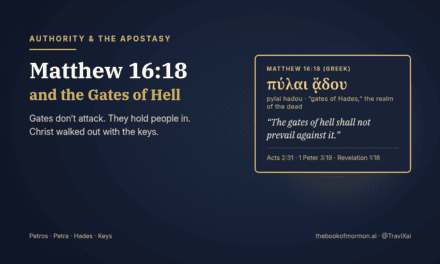
“But Jesus said the gates of hell shall not prevail!” He did (Matthew 16:18). He also said “many false prophets shall rise, and shall deceive many.” Both are true, and a restoration is how both stay true. We’ll take that verse head-on in its own article; for the short version, see The Gates of Hell.
WatchWas there actually a Great Apostasy?
Saints Unscripted walks through the same question:
SummaryKey takeaways
- 2 Thessalonians 2:3: the Lord won’t return “except there come a falling away first.” The Greek is apostasia.
- Paul, Peter, and Jesus warned of wolves, fables, and false teachers who would deceive “many” (Acts 20:29–30; 2 Peter 2:1–2; Matthew 24:11).
- It had already started in their lifetime: “doth already work” (2 Thessalonians 2:7), “so soon removed” (Galatians 1:6), “even now are there many antichrists” (1 John 2:18).
- Apostles were given “till we all come in the unity of the faith” (Ephesians 4:13). When they died, no one filled their seats the way Matthias was called (Acts 1:26).
- Scripture promises a “restitution of all things” (Acts 3:21) and an angel bringing “the everlasting gospel” (Revelation 14:6). You can’t restore what was never lost.
Next time someone tells you the Great Apostasy was made up in 1830, hand them 2 Thessalonians 2 and ask what Paul meant by “already.” Then ask who replaced the apostles. For fast, sourced answers on the Apostasy and the Restoration, open Galatians18. And for more like this every day, follow me on X at @TraviXai.
Sources
- Scriptures (KJV, churchofjesuschrist.org): 2 Thessalonians 2:3–7 · Acts 20:28–31 · 1 Timothy 4:1 · 2 Timothy 4:3–4 · 2 Timothy 1:15 · 2 Peter 2:1–2 · Matthew 24:11 · Galatians 1:6–7 · 1 Corinthians 1:10–12 · 1 John 2:18–19 · Jude 1:3–4 · 3 John 1:9–10 · Revelation 2:2–5, 20 · Revelation 3:16 · Ephesians 4:11–14 · Acts 1:22–26 · Acts 12:2 · Amos 8:11–12 · Acts 3:19–21 · Ephesians 1:10 · Revelation 14:6 · Matthew 16:18
- Eusebius, Church History, book 3, chapter 32, sections 7–8 (quoting Hegesippus), trans. Arthur Cushman McGiffert, Nicene and Post-Nicene Fathers, Second Series, vol. 1 (1890): New Advent
- Saints Unscripted, “Was there actually a ‘Great Apostasy?’ Ep. 44”: YouTube
- Related on this site: Priesthood Authority: Korah, Uzziah, and Hebrews 5:4 · The Canon Was Never Meant to Close · What Modern Church Would a First-Century Christian Recognize?
- Galatians18: The Great Apostasy · Living Prophets · Did Moroni Bring Another Gospel? · Restoration of the Priesthood · The Gates of Hell
- Featured image and chart: original graphics by thebookofmormon.ai (no photographs or likenesses of real people).