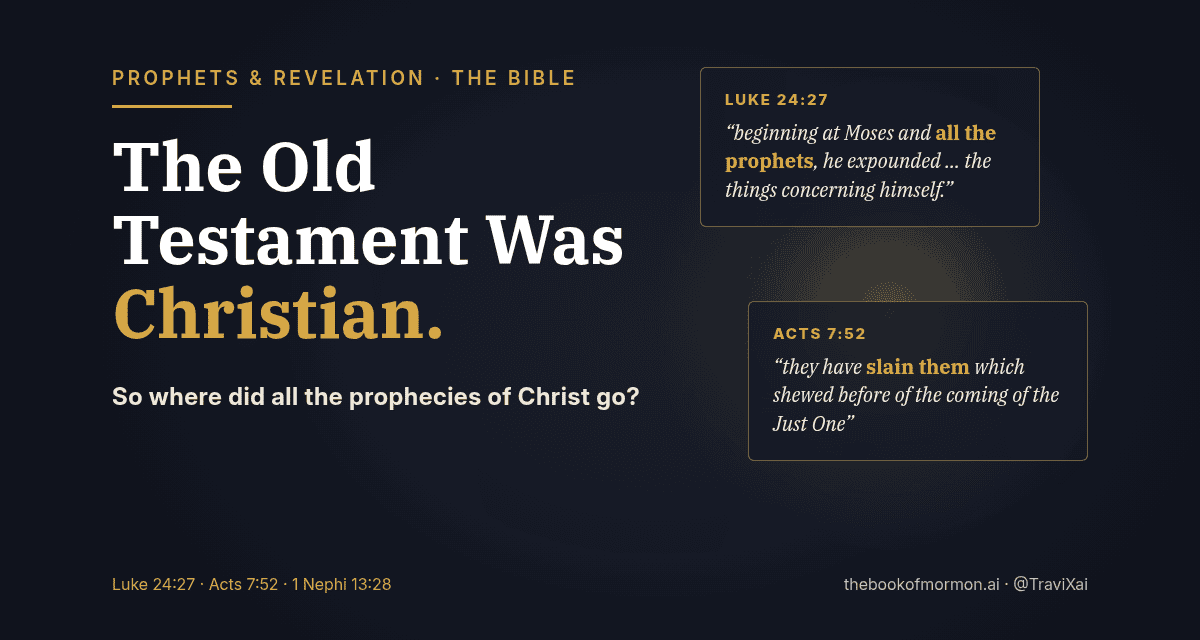

The New Testament says every prophet testified of Christ. So why is He so hard to find in the Old Testament? The Bible answers that itself.
The New Testament makes a bold claim: all the prophets testified of Christ. Not a few hints here and there. All of them, from the beginning.
So open the Old Testament and look for it. You’ll find types, shadows, and a handful of clear Messianic prophecies, but you won’t find prophet after prophet plainly preaching Jesus Christ. Either the apostles exaggerated, or something is missing from the record. The New Testament itself tells us which one it is.
The New Testament says every prophet preached Christ
On the road to Emmaus, the resurrected Lord didn’t teach from one or two proof texts. He taught from the whole thing:
And beginning at Moses and all the prophets, he expounded unto them in all the scriptures the things concerning himself.
Luke 24:27 (KJV)
Later that night He told the apostles that everything “written in the law of Moses, and in the prophets, and in the psalms, concerning me” had to be fulfilled (Luke 24:44). Peter preached the same thing:
To him give all the prophets witness, that through his name whosoever believeth in him shall receive remission of sins.
Acts 10:43 (KJV)
Yea, and all the prophets from Samuel and those that follow after, as many as have spoken, have likewise foretold of these days.
Acts 3:24 (KJV)
And the rest of the New Testament piles on:
- God “before had shewed by the mouth of all his prophets, that Christ should suffer” (Acts 3:18).
- The prophets had “the Spirit of Christ which was in them” and “testified beforehand the sufferings of Christ, and the glory that should follow” (1 Peter 1:10–11).
- Moses “wrote of me” (John 5:46), and Abraham “rejoiced to see my day: and he saw it” (John 8:56).
- The scripture “preached before the gospel unto Abraham” (Galatians 3:8).
- Israel in the wilderness “drank of that spiritual Rock that followed them: and that Rock was Christ” (1 Corinthians 10:4).
- “For unto us was the gospel preached, as well as unto them” (Hebrews 4:2).
That’s not a faint echo. That’s the gospel, preached by name, from Abraham forward. The God of the Old Testament was Christ Himself (see Jehovah Is Jesus Christ), and His prophets knew it.
So where are those prophecies?
Here’s the problem. Matthew quotes a prophecy you can’t find:
And he came and dwelt in a city called Nazareth: that it might be fulfilled which was spoken by the prophets, He shall be called a Nazarene.
Matthew 2:23 (KJV)
No Old Testament book says “He shall be called a Nazarene.” Some readers connect it to the “Branch” of Isaiah 11:1 because of a Hebrew wordplay, and that’s a fair guess. But Matthew says it was spoken by the prophets, plural, and he quotes words none of them say in our Bible.
He isn’t the only one. Jude quotes Enoch, “the seventh from Adam,” prophesying that “the Lord cometh with ten thousands of his saints” (Jude 1:14–15). Those words aren’t in Genesis. They match the book of 1 Enoch, which most Christian churches don’t treat as scripture. The Old Testament also points readers to the book of Jasher and the books of Nathan, Gad, and Iddo, none of which we have. We walked through the full list in Books the Bible Quotes That Aren’t in the Bible.
So the New Testament quotes prophecies about Christ that aren’t in our Old Testament, and the Old Testament cites books that aren’t in our Bible. Where did they go?
The prophets who foretold Him were killed
Stephen answered that question right before they stoned him:
Which of the prophets have not your fathers persecuted? and they have slain them which shewed before of the coming of the Just One; of whom ye have been now the betrayers and murderers:
Acts 7:52 (KJV)
Read that carefully. The prophets weren’t just killed. They were killed for showing beforehand the coming of Christ. Jesus said the same thing to the religious leaders of His day:
Woe unto you, scribes and Pharisees, hypocrites! because ye build the tombs of the prophets, and garnish the sepulchres of the righteous, And say, If we had been in the days of our fathers, we would not have been partakers with them in the blood of the prophets. Wherefore ye be witnesses unto yourselves, that ye are the children of them which killed the prophets.
Matthew 23:29–31 (KJV)
He charged them with “all the righteous blood shed upon the earth, from the blood of righteous Abel unto the blood of Zacharias” (Matthew 23:35). That runs from the first murder in Genesis to a Zacharias usually identified with the Zechariah stoned in the temple court in 2 Chronicles 24:20–21. Chronicles is the last book in the traditional Hebrew ordering, so that’s cover to cover. Elijah complained that Israel had “slain thy prophets with the sword” (1 Kings 19:10), and Hebrews remembers prophets who “were stoned, they were sawn asunder … were slain with the sword” (Hebrews 11:37).
O Jerusalem, Jerusalem, thou that killest the prophets, and stonest them which are sent unto thee, how often would I have gathered thy children together, even as a hen gathereth her chickens under her wings, and ye would not!
Matthew 23:37 (KJV)
Then Jesus added the line that should stop every critic cold: “Woe unto you, lawyers! for ye have taken away the key of knowledge” (Luke 11:52).
Think about it. If people killed the prophets because they testified of Christ, how likely is it that those same people carefully preserved every word of those testimonies?
Scrolls were burned, cut, and rewritten
A king with a penknife
The Old Testament itself records scripture being destroyed. When Jeremiah’s scroll was read to King Jehoiakim:
And it came to pass, that when Jehudi had read three or four leaves, he cut it with the penknife, and cast it into the fire that was on the hearth, until all the roll was consumed in the fire that was on the hearth.
Jeremiah 36:23 (KJV)
God had Jeremiah dictate it again, and “there were added besides unto them many like words” (Jeremiah 36:32). So one of the Bible’s own books was burned, rewritten, and expanded. Jeremiah also warned about the scribes: “the pen of the scribes is in vain” (Jeremiah 8:8, KJV). Modern translations put it even more bluntly: “the lying pen of the scribes has made it into a lie” (ESV).
Justin Martyr’s accusation
Around the middle of the second century, the Christian apologist Justin Martyr told a Jewish man named Trypho that passages about Christ had been removed:
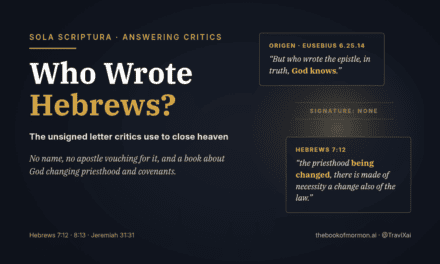
they have altogether taken away many Scriptures from the translations effected by those seventy elders who were with Ptolemy, and by which this very man who was crucified is proved to have been set forth expressly as God, and man, and as being crucified, and as dying
Justin Martyr, Dialogue with Trypho 71 (KJV)
He named examples from Esdras (Ezra), Jeremiah, and Psalm 96. One of them, his “lamb that is brought to the slaughter” line from Jeremiah, still survives in our Bibles in a slightly different form: “I was like a lamb or an ox that is brought to the slaughter” (Jeremiah 11:19). Others aren’t in any Bible today. Scholars still debate whether those lines were cut out or were never there. Justin also accused them of deleting passages “about the death of Isaiah, whom you sawed asunder with a wooden saw” (Dialogue 120).
Whatever you conclude about each passage, here’s the point: less than 150 years after Christ, Christians were already arguing over which words about Him belonged in the Old Testament. And the text isn’t perfectly preserved even where nobody fought over it. Psalm 145 is an acrostic with a verse for each Hebrew letter, but the King James Version has only 21 verses for 22 letters. The missing line survives in the Dead Sea Scrolls and the Septuagint.
We covered that in Psalm 145 and the Missing Verse, and the scrolls keep turning up more (see Dead Sea Scrolls and the Restoration).
Altered and complete? Pick one
This is where the critic gets stuck. He wants two things at once. He wants the Old Testament to be full of Christ, because the New Testament says it is. And he wants the Bible to be complete and untouched, because that’s what lets him shut the door on new scripture.
He can’t have both. Prophets were slain for testifying of Christ, scrolls were burned, scribes’ pens were called lying, the apostles quoted prophecies we don’t have, and the Old Testament cites books we’ve lost. So how can that record be the complete and final word?
Latter-day Saints love the Bible. We read it, quote it, and build our faith on it. We just take it at its word: “We believe the Bible to be the word of God as far as it is translated correctly” (Articles of Faith 1:8). That’s not an attack on the Bible. It’s what the Bible says about its own history. (More on that at Is the Bible Infallible?)
The Book of Mormon says what the New Testament says
Now read what the Book of Mormon says, and compare it with Peter in Acts 3:24.
For behold, did not Moses prophesy unto them concerning the coming of the Messiah, and that God should redeem his people? Yea, and even all the prophets who have prophesied ever since the world began—have they not spoken more or less concerning these things?
Mosiah 13:33
Behold, I say unto you that none of the prophets have written, nor prophesied, save they have spoken concerning this Christ.
Jacob 7:11
It doesn’t stop at the claim. It names prophets from the brass plates, a scripture record that left Jerusalem around 600 B.C., whose words aren’t in our Old Testament. Nephi says Christ would be “lifted up, according to the words of Zenock, and to be crucified, according to the words of Neum, and to be buried in a sepulchre, according to the words of Zenos” (1 Nephi 19:10). And Zenos is remembered the same way Stephen describes the prophets of Acts 7:52:
the prophet Zenos did testify boldly; for the which he was slain.
Helaman 8:19
The Book of Mormon even explains how the record lost its plainness. Nephi saw that “many plain and precious things” would be “taken away from the book, which is the book of the Lamb of God” (1 Nephi 13:28), and that later records would “make known the plain and precious things which have been taken away from them” (1 Nephi 13:40). For what may have been on those plates, see What Was on the Brass Plates?
So the New Testament says all the prophets testified of Christ and many of them were killed for it. The Book of Mormon says the same thing, gives us names, and gives us their words. That’s not a contradiction of the Bible. It’s the Bible’s own claim, backed up.
Rejected for being too Christian
And here’s the hypocrisy. Christians insist the Old Testament is full of Christ. Then they read a book where ancient prophets plainly preach Christ, and they call that proof it’s fake. Too Christian to be ancient, they say.
So if Old Testament prophets only hint at Christ, critics say that proves the Bible is complete. And if Book of Mormon prophets preach Christ plainly, that proves it’s a fraud. Heads they win, tails we lose. Yeah, mmm hmm.
Meanwhile Catholics, Orthodox, and Protestants still can’t agree on how many books belong in the Old Testament. Every time Catholics, Orthodox, and Protestants debate each other, all they do is prove there needed to be a restoration. Revelation restored what was lost, and the canon was never meant to close (see The Canon Was Never Meant to Close).
Key takeaways
- The New Testament says all the prophets testified of Christ (Luke 24:27; Acts 3:24; Acts 10:43; 1 Peter 1:10–11).
- Our Old Testament doesn’t show that plainly, and the New Testament quotes prophecies it doesn’t contain (Matthew 2:23; Jude 1:14–15).
- The prophets who foretold Christ were persecuted and killed for it, from Abel to Zechariah (Acts 7:52; Matthew 23:29–37).
- Scripture was burned and rewritten (Jeremiah 36), Justin Martyr accused scribes of cutting passages about Christ, and Psalm 145 lost a verse.
- The Book of Mormon says what the New Testament says, names prophets like Zenos and Zenock, and explains how plain and precious things were lost (1 Nephi 13).
Next time someone says the Bible is complete, ask them where all those prophecies of Christ went. For quick, sourced answers on the Great Apostasy, continuing revelation, and Bible inerrancy, open Galatians18, and follow me on X at @TraviXai for daily answers.
Sources
- Scripture quotations: King James Version, Book of Mormon, and Pearl of Great Price, churchofjesuschrist.org: 1 Kings 19:10; 2 Chronicles 24:20–21; Isaiah 11:1; Jeremiah 8:8; 11:19; 36:23, 32; Matthew 2:23; 23:29–31, 35, 37; Luke 11:52; 24:27, 44; John 5:46; 8:56; Acts 3:18, 24; 7:52; 10:43; 1 Corinthians 10:4; Galatians 3:8; Hebrews 4:2; 11:37; 1 Peter 1:10–11; Jude 1:14–15; 1 Nephi 13:28, 40; 19:10; Jacob 7:11; Mosiah 13:33; Helaman 8:19; Articles of Faith 1:8.
- Jeremiah 8:8, English Standard Version, BibleGateway.
- Justin Martyr, Dialogue with Trypho 71–73 and 120, trans. Marcus Dods and George Reith, Ante-Nicene Fathers vol. 1, at New Advent: chapters 69–88, chapters 109–124.
- Galatians18 topic pages: Jehovah Is Jesus Christ, Dead Sea Scrolls and the Restoration, Is the Bible Infallible?, The Great Apostasy, Continuing Revelation and an Open Canon.
- Featured image: original graphic by thebookofmormon.ai (no photographs or likenesses of real people).