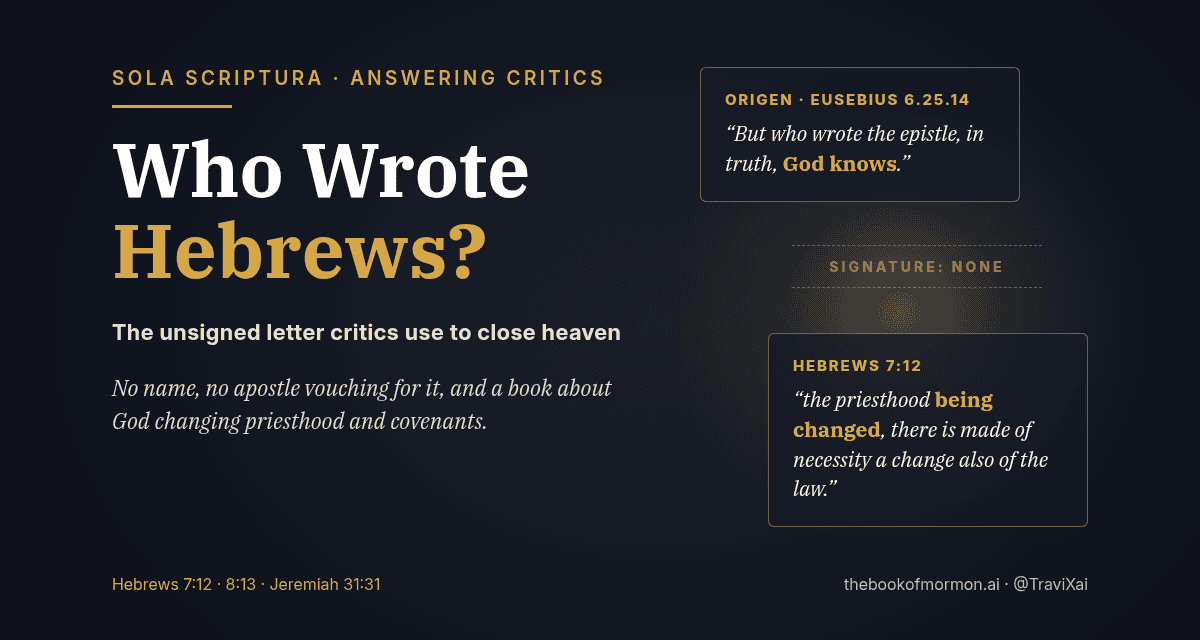

Critics use Hebrews to say God is done. Ask who wrote it. Then read what it actually says about God changing priesthood and covenants.
Bring up living prophets, new scripture, or a restored covenant, and someone will reach for Hebrews. “The New Covenant is final. God spoke through His Son. He’s done.” Case closed.
Fine. Let’s open Hebrews. But first, one simple question: who wrote it? And which apostle ever vouched for it? Because the letter critics use to close heaven doesn’t carry anyone’s name, and the book itself spends chapter after chapter showing that God changes priesthood and covenants whenever He chooses.
The verse that’s supposed to end the conversation
The argument usually leans on two passages. The first is the opening line of the book:
God, who at sundry times and in divers manners spake in time past unto the fathers by the prophets, Hath in these last days spoken unto us by his Son, whom he hath appointed heir of all things, by whom also he made the worlds;
Hebrews 1:1–2 (KJV)
The second is the end of chapter 8, where the writer quotes Jeremiah’s promise of a new covenant and concludes, “In that he saith, A new covenant, he hath made the first old” (Hebrews 8:13). From there the critic builds a wall: Christ came, the New Covenant arrived, so no more prophets, no more covenants, no more scripture.
Notice what neither verse says. Hebrews 1 says God spoke by His Son. It doesn’t say the Son would never send anyone again. He’s the one who gives apostles and prophets (Ephesians 4:11). We took Hebrews 1 apart in The Canon Was Never Meant to Close. Today the focus is the letter itself.
So who wrote Hebrews?
Hebrews has no author’s name. No greeting, no “Paul, an apostle,” no signature. The writer mentions “our brother Timothy” near the end (Hebrews 13:23) and calls the whole thing “a letter unto you in few words” (13:22), but never says who he is.
That matters, because Paul made a point of signing. Every one of his thirteen letters opens with his name, and he told the Thessalonians how to spot a real one:
The salutation of Paul with mine own hand, which is the token in every epistle: so I write.
2 Thessalonians 3:17 (KJV)
Hebrews doesn’t have the token. Even more telling, the writer says the gospel “was confirmed unto us by them that heard him” (Hebrews 2:3). He’s describing himself as someone who received the message from eyewitnesses. Paul, by contrast, insisted he got his gospel “by the revelation of Jesus Christ” (Galatians 1:12).
And no apostle in the Bible vouches for Hebrews. Peter mentions “all his epistles” when talking about Paul (2 Peter 3:16), but he doesn’t name a single letter, let alone this one. No apostle quotes it, names it, or signs off on it anywhere in scripture.
The early church knew it. Origen of Alexandria, one of the most influential Bible scholars of the third century, loved Hebrews. He thought its ideas were apostolic and that “not without reason have the ancients handed it down as Paul’s.” Then he said what everyone was thinking:
But who wrote the epistle, in truth, God knows.
Origen, quoted in Eusebius, Church History 6.25.14 (KJV)
That’s not a Latter-day Saint talking. That’s Origen, preserved by Eusebius.
Eighteen centuries of guessing
Origen wasn’t alone. For centuries, Christian leaders couldn’t agree on who wrote Hebrews or even whether it belonged in the Bible:
- Rome hesitated. Eusebius wrote that “some have rejected the Epistle to the Hebrews, saying that it is disputed by the church of Rome, on the ground that it was not written by Paul” (Church History 3.3.5).
- Tertullian said Barnabas. In the early 200s he cited “an Epistle to the Hebrews under the name of Barnabas” (On Modesty 20).
- Jerome listed the guesses. Around A.D. 392 he wrote that Hebrews “is not considered his [Paul’s], on account of its difference from the others in style and language,” and that it was credited to Barnabas, Luke, or Clement of Rome (Lives of Illustrious Men 5).
- Councils settled it by vote. The Council of Carthage (A.D. 419) listed “The Epistles of Paul, xiv” (canon 24), counting Hebrews as Paul’s fourteenth. The Council of Trent (1546) did the same: “fourteen epistles of Paul the apostle” (Session 4).
- Luther disagreed. In his preface to Hebrews he argued it was not St. Paul’s or any apostle’s, pointing to Hebrews 2:3, and he didn’t rank it fully with the apostolic letters (Luther’s preface, 1545 edition).
Every time Catholics, Orthodox, and Protestants debate each other, all they do is prove there needed to be a restoration. And this is the book that’s supposed to settle whether God can still speak.
So the critic trusts an unsigned letter that later church councils accepted into the canon, but he won’t accept a living apostle. A book by someone no one can name? Final authority. An apostle called by God today? Impossible. Yeah, mmm hmm.
Why we accept Hebrews anyway
Let’s be clear: we accept Hebrews. The anonymity doesn’t bother us, because God can speak through whoever He calls. He doesn’t need a famous name on the letter. He needs a servant He sent.
But think about how anyone can know an unsigned letter is from God. Not because it’s old. Old means old, not inspired. Not because a council voted on it, either, since councils disagreed for centuries. You know it the way Peter knew who Jesus was:
And Jesus answered and said unto him, Blessed art thou, Simon Bar-jona: for flesh and blood hath not revealed it unto thee, but my Father which is in heaven.
Matthew 16:17 (KJV)
Knowing Hebrews is inspired takes revelation. That’s our whole point. The critic accepts Hebrews too, which is great. He just won’t let it say what it says. And what it says is the opposite of “God is done.” (For more on how the list of books was settled, see Sola Scriptura: Which Verse Teaches It?)
What Hebrews actually says: God changes things
Hebrews is the Bible’s clearest book about change. Its central argument is that God replaced one priesthood and one covenant with another, on His own timing.
A changed priesthood, a changed law
The writer asks why, if the Levitical priesthood were enough, there was any need “that another priest should rise after the order of Melchisedec” (Hebrews 7:11). Then:
For the priesthood being changed, there is made of necessity a change also of the law.
Hebrews 7:12 (KJV)
The priesthood changed. The law changed. And Hebrews insists no one can claim that authority on his own: “no man taketh this honour unto himself, but he that is called of God, as was Aaron” (Hebrews 5:4). Authority comes by calling, which is exactly what was lost when the apostles were killed. (See Priesthood Authority: Korah, Uzziah, and Hebrews 5:4.)
A new covenant, because God said so
For if that first covenant had been faultless, then should no place have been sought for the second. For finding fault with them, he saith, Behold, the days come, saith the Lord, when I will make a new covenant with the house of Israel and with the house of Judah:
Hebrews 8:7–8 (KJV)
That’s a quote of Jeremiah 31:31. Jeremiah’s audience had a covenant, a temple, and the law of Moses. They could have said “that’s all we need.” God made a new one anyway. Then Hebrews says, “he hath made the first old” (8:13). He made it old. Not a council, not a creed. God decides when a covenant changes, and Hebrews is the proof.
God never stopped making covenants
Step back and look at the whole Bible. Making covenants isn’t something God did once. It’s what He does:
- Noah: “I establish my covenant with you, and with your seed after you” (Genesis 9:9).
- Abraham: “I will establish my covenant between me and thee and thy seed after thee in their generations for an everlasting covenant” (Genesis 17:7).
- Sinai: “if ye will obey my voice indeed, and keep my covenant, then ye shall be a peculiar treasure unto me” (Exodus 19:5).
- The new covenant: “I will make a new covenant with the house of Israel” (Jeremiah 31:31).
- The everlasting covenant: “I will make a covenant of peace with them; it shall be an everlasting covenant with them … and will set my sanctuary in the midst of them for evermore” (Ezekiel 37:26).
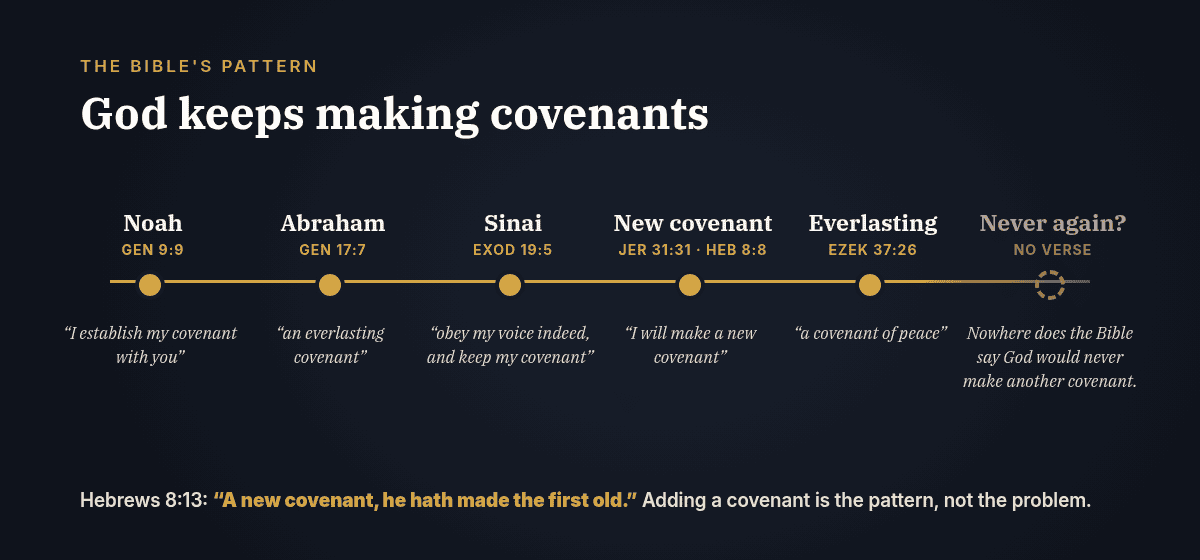
So where does the Bible say God would never make another covenant or send another prophet? Chapter and verse. It isn’t there. What is there is the opposite:
Surely the Lord God will do nothing, but he revealeth his secret unto his servants the prophets.
Amos 3:7 (KJV)
And Paul says Christ gave “apostles; and some, prophets” for a purpose, “till we all come in the unity of the faith,” so that “we henceforth be no more children, tossed to and fro, and carried about with every wind of doctrine” (Ephesians 4:11–14). Look at all the churches reading the same Bible and tell me we’ve reached the unity of the faith. The “till” hasn’t arrived.
Even Hebrews ends with “the blood of the everlasting covenant” (Hebrews 13:20). That’s how Latter-day Saints understand the Restoration. It isn’t a rival to Christ’s covenant. It’s His covenant restored, “a new and an everlasting covenant, even that which was from the beginning” (D&C 22:1), brought back by the same pattern Hebrews describes: God calls, God authorizes, God speaks. (See The Great Apostasy in the New Testament’s Own Words.)
Let Hebrews say what it says
The critic’s best proof text for “God is done” comes from a letter whose author only God knows. We still accept it, because God can speak through whoever He calls.
Then let it speak. Hebrews says the priesthood changed, so the law changed. It says God found fault and made a new covenant. It says no man takes this honor unless he is called of God. That isn’t a book about heaven closing. It’s a book about God moving, and nobody but Him deciding when. The same God who did that in Hebrews can do it again, and the Bible never says He won’t. (Revelation 22:18 doesn’t close it either; see “This Book.”)
Key takeaways
- Hebrews is unsigned. It lacks Paul’s “token in every epistle” (2 Thessalonians 3:17), and its writer says he received the gospel from those who heard the Lord (Hebrews 2:3).
- No apostle in the Bible names or vouches for Hebrews. Origen said, “who wrote the epistle, in truth, God knows” (Eusebius, Church History 6.25.14).
- Rome doubted it, Tertullian credited Barnabas, councils counted it as Paul’s, and Luther denied it was apostolic.
- We accept Hebrews because God speaks through whom He calls. Knowing it’s inspired takes revelation (Matthew 16:17).
- Hebrews itself shows God changing priesthood and covenants (Hebrews 7:12; 8:7–13), and no verse says He would stop (Amos 3:7; Ephesians 4:11–14).
Next time someone uses Hebrews to say God is done, ask who wrote it, then read them Hebrews 7:12. For quick, sourced answers on continuing revelation, living prophets, and priesthood authority, open Galatians18, and follow me on X at @TraviXai for daily answers.
Sources
- Scripture quotations: King James Version and the Doctrine and Covenants, churchofjesuschrist.org: Genesis 9:9; 17:7; Exodus 19:5; Jeremiah 31:31; Ezekiel 37:26; Amos 3:7; Matthew 16:17; Galatians 1:12; Ephesians 4:11–14; 2 Thessalonians 3:17; Hebrews 1:1–2; 2:3; 5:4; 7:11–12; 8:7–8, 13; 13:20, 22–23; 2 Peter 3:16; D&C 22:1.
- Eusebius, Church History 6.25.11–14 (Origen on Hebrews) and 3.3.5, trans. Arthur Cushman McGiffert, Nicene and Post-Nicene Fathers, 2nd series, vol. 1, at New Advent: Book VI, Book III.
- Tertullian, On Modesty 20, Ante-Nicene Fathers vol. 4, New Advent.
- Jerome, De Viris Illustribus (Lives of Illustrious Men) 5, Nicene and Post-Nicene Fathers, 2nd series, vol. 3, New Advent.
- Council of Carthage (A.D. 419), canon 24, Nicene and Post-Nicene Fathers, 2nd series, vol. 14, New Advent.
- Council of Trent, Session 4 (1546), Decree Concerning the Canonical Scriptures, Papal Encyclicals Online.
- Martin Luther, Vorrede auf die Epistel an die Hebräer (preface to Hebrews), 1545 Luther Bible text, Stilkunst.de. Paraphrase in English by this blog.
- Galatians18 topic pages: Continuing Revelation and an Open Canon, Living Prophets, Priesthood Authority and Apostolic Keys.
- Related on this blog: The Canon Was Never Meant to Close; Sola Scriptura: Which Verse Teaches It?; Priesthood Authority: Korah, Uzziah, and Hebrews 5:4; The Great Apostasy in the New Testament’s Own Words; Revelation 22:18 and “This Book”: Deuteronomy 4:2 Says the Same.
- Featured image and graphic: original graphics by thebookofmormon.ai (no photographs or likenesses of real people).