
From the voice in Eden to the voice in the grove: who closed the canon, when, on whose authority, and whether God ever agreed.
Picture a garden at the end of a day. A man and a woman, newly fallen, hiding among the trees. And then a sound.
“And they heard the voice of the LORD God walking in the garden in the cool of the day” (Genesis 3:8).
That is where the story of God and man begins in the Bible: with a voice. Not a book. Not a list. Not a council. A Father speaking to His children, even after they had disobeyed Him.
Now fast-forward to a modern pulpit. A preacher holds up a leather Bible and says, with total confidence, “The canon is closed. God has said everything He’s going to say. It’s all in here.”
Somewhere between that garden and that pulpit, the voice went silent. Or so we’re told.
This article is about that silence. Who announced it, when, on whose authority, and whether God ever agreed to it. We’re going to walk the whole story, from Adam to Sinai, from the prophets to Christ, from the apostles to the bishops who drew up the lists, through the Reformation that redrew them, to a fourteen-year-old boy in a grove of trees in upstate New York. Along the way we’ll test every claim against the scripture itself and against the historical record.
By the end, I think you’ll reach the same conclusion I have: the canon was never meant to close, and the act of closing it was never inspired.
- The pattern: “Surely the Lord God will do nothing, but he revealeth his secret unto his servants the prophets” (Amos 3:7).
- Revelation has a file: Sinai, “the third month” (Exodus 19:1); Joppa, “about the sixth hour” (Acts 10:9); Jerusalem, “It seemed good to the Holy Ghost” (Acts 15:28).
- Who drew up the lists: Athanasius (367), Hippo (393), Carthage (397), Trent (1546), Westminster (1646). None claimed a revelation closing the canon.
- Still no agreement: Protestant 66 books, Catholic 73, Orthodox more, Ethiopian about 81.
- Fallible interpreters: 2.3 billion Christians (Pew, 2020) at the low end, about 50,000 denominations (Gordon-Conwell, 2025), plus Jewish and secular scholarship (2 Peter 1:20; Ephesians 4:11–14).
- The answer: a prophet again, Joseph Smith, spring 1820 (Joseph Smith—History 1:17).
Short version on Galatians18: Revelation 22: You Can’t Add to the Bible?
Part IThe voice that never stopped
From the garden to the flood
The early chapters of Genesis read like a record of conversations. God speaks to Adam. God speaks to Cain. Then comes Enoch, about whom the Bible says almost nothing except the most important thing: “And Enoch walked with God: and he was not; for God took him” (Genesis 5:24). Enoch didn’t write a book of the Bible. But he was a prophet, and the New Testament quotes his prophecy, as we’ll see.
Then Noah. God gives him a warning, a deadline, and an engineering spec down to the cubit. Then Abraham, called out of Ur, given a covenant, visited by messengers. Then Isaac, Jacob, Joseph in Egypt interpreting Pharaoh’s dreams.
Notice the pattern already, because it’s going to repeat for thousands of years:
- God calls a man.
- God gives him authority.
- God reveals His will through him.
- The revelation is recorded (sooner or later) for the people.
Hold onto those four. They are the spine of this entire story.
Sinai: the day the rules changed
Around the “third month, when the children of Israel were gone forth out of the land of Egypt” (Exodus 19:1), a nation of former slaves camped at the foot of a mountain. What happened next was one of the biggest shifts in how God dealt with His people in the entire Old Testament: the Law of Moses.
Picture it. A desert plain at the foot of a granite mountain. Hundreds of thousands of people who had been slaves a few weeks before. And then, on the third morning: “there were thunders and lightnings, and a thick cloud upon the mount, and the voice of the trumpet exceeding loud; so that all the people that was in the camp trembled” (Exodus 19:16).
How did God do it? Not by consensus. “And Moses went up unto God, and the Lord called unto him out of the mountain, saying, Thus shalt thou say to the house of Jacob, and tell the children of Israel” (Exodus 19:3).
A named prophet. A specific time and place. God’s own words. A reason explained. And all of it written down.
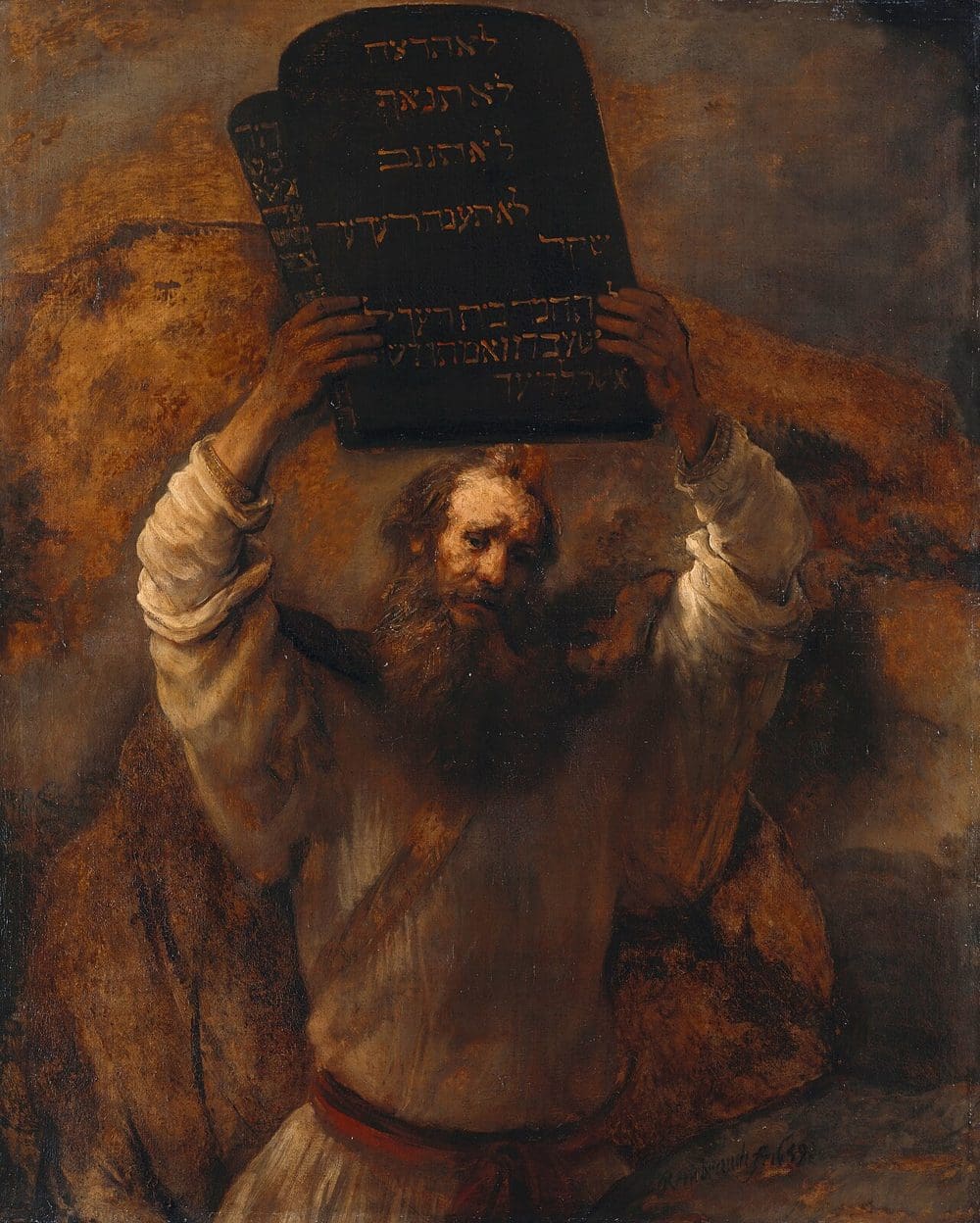
Even Moses didn’t think he should be the only one. When two men named Eldad and Medad began prophesying in the camp and Joshua wanted them stopped, Moses answered: “Enviest thou for my sake? would God that all the Lord’s people were prophets, and that the Lord would put his spirit upon them!” (Numbers 11:29). That’s the lawgiver himself, wishing for more prophets, not fewer.
And Moses gave a warning that sounds very familiar:
“Ye shall not add unto the word which I command you, neither shall ye diminish ought from it, that ye may keep the commandments of the Lord your God which I command you.”
Deuteronomy 4:2
Remember that verse. It’s going to come back to embarrass someone.
The prophets, and the God who does nothing without them
After Moses came centuries of prophets. Some wrote books. Most didn’t. Samuel anointed kings. Nathan walked into David’s palace and said, “Thou art the man.” Elijah called down fire on Mount Carmel. Elisha parted the Jordan with Elijah’s mantle. Isaiah, Jeremiah, Ezekiel, and Daniel carried God’s word into exile and back.
One of those prophets, a herdsman from Tekoa named Amos, put the whole system into a single sentence:
“Surely the Lord God will do nothing, but he revealeth his secret unto his servants the prophets.”
Amos 3:7
Nothing. That’s not a description of one era. It’s a description of how God operates.
The Bible also treats the absence of prophets as a curse, not a sign of spiritual maturity. In the dark days before Samuel, “the word of the Lord was precious in those days; there was no open vision” (1 Samuel 3:1). And Amos prophesied a coming disaster that wasn’t about bread or water:
“Behold, the days come, saith the Lord God, that I will send a famine in the land, not a famine of bread, nor a thirst for water, but of hearing the words of the Lord: And they shall wander from sea to sea, and from the north even to the east, they shall run to and fro to seek the word of the Lord, and shall not find it.”
Amos 8:11–12
“The Bible never calls the silence of heaven a blessing. It calls it a famine.”
Four hundred quiet years
After Malachi, the Old Testament goes quiet. Jewish writers of that era knew exactly what that silence meant. The book of 1 Maccabees, written in the second century BC, describes the Jews storing the stones of a defiled altar “until there should come a prophet to shew what should be done with them” (1 Maccabees 4:46), and later lamenting a “great affliction in Israel, the like whereof was not since the time that a prophet was not seen among them” (1 Maccabees 9:27, KJV Apocrypha).
Notice what they did not say. They didn’t say, “The canon is closed, so we’re fine.” They said: we’re waiting for a prophet. They knew the silence was a gap, not a finish line.
That’s another pattern worth naming: apostasy and silence, followed by restoration. It runs through the book of Judges, through the days of Elijah, through the four hundred years before John. God lets His people feel the famine, and then He sends a prophet. Keep that one in your pocket too.
And then the silence broke, the way it always breaks in the Bible: with a name and a date. “Now in the fifteenth year of the reign of Tiberius Cæsar, Pontius Pilate being governor of Judæa… Annas and Caiaphas being the high priests, the word of God came unto John the son of Zacharias in the wilderness” (Luke 3:1–2).
Luke dates it like a court record: an emperor’s regnal year, a governor, a tetrarch, two high priests. Revelation in the Bible is not vague. It happens to real people, in real places, on dates you can look up. A prophet again. Then the Son of God Himself.
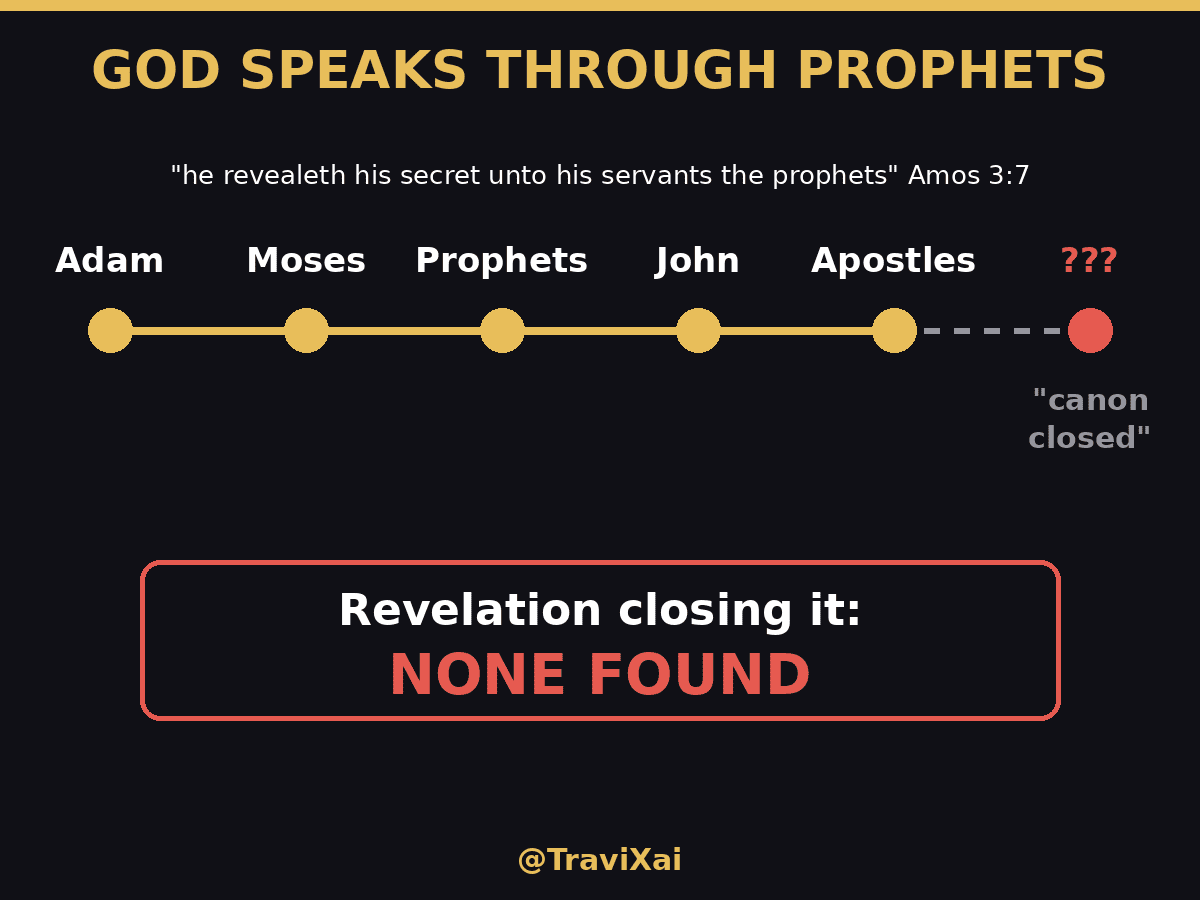
So when the Son of God Himself arrived, did He end that pattern, or build on it?
Part IIChrist and His apostles kept the pattern
The Son didn’t end prophecy. He organized it.
Some Christians read Hebrews 1 and conclude prophecy ended when Christ came:
“God, who at sundry times and in divers manners spake in time past unto the fathers by the prophets, Hath in these last days spoken unto us by his Son, whom he hath appointed heir of all things, by whom also he made the worlds;”
Hebrews 1:1–2
But look at what Christ actually did. He called twelve apostles. He sent them out. After His resurrection, He kept speaking to them for forty days. And then His Church kept having prophets. Paul ranked them: “And God hath set some in the church, first apostles, secondarily prophets, thirdly teachers” (1 Corinthians 12:28). Jesus Himself told the Pharisees, “Wherefore, behold, I send unto you prophets, and wise men, and scribes” (Matthew 23:34). The Son is the reason prophets exist, not the reason they disappeared.
Paul also told the Ephesians exactly how long these offices were supposed to last:
“And he gave some, apostles; and some, prophets; and some, evangelists; and some, pastors and teachers; For the perfecting of the saints, for the work of the ministry, for the edifying of the body of Christ: Till we all come in the unity of the faith, and of the knowledge of the Son of God, unto a perfect man, unto the measure of the stature of the fulness of Christ: That we henceforth be no more children, tossed to and fro, and carried about with every wind of doctrine, by the sleight of men, and cunning craftiness, whereby they lie in wait to deceive;”
Ephesians 4:11–14
The key word is Till. Apostles and prophets stay until the unity of the faith arrives. We’ll come back to whether it has.
Prophets in the book of Acts
Open Acts and you’ll find prophets everywhere, years after the Resurrection:
“And in these days came prophets from Jerusalem unto Antioch. And there stood up one of them named Agabus, and signified by the Spirit that there should be great dearth throughout all the world: which came to pass in the days of Claudius Cæsar.”
Acts 11:27–28
Agabus shows up again a decade or so later, takes Paul’s belt, binds his own hands and feet, and says, “Thus saith the Holy Ghost, So shall the Jews at Jerusalem bind the man that owneth this girdle” (Acts 21:10–11). That’s Old Testament language from a New Testament prophet.
Luke mentions “Judas and Silas, being prophets also themselves” (Acts 15:32) the way you’d mention a job title. And when Paul stayed with Philip the evangelist in Caesarea, Luke notes that Philip “had four daughters, virgins, which did prophesy” (Acts 21:9). Back in the temple at Jesus’ birth there was “one Anna, a prophetess” (Luke 2:36).
None of these people wrote a word of the Bible. Every one of them was a prophet. Remember that, because it matters later.
The biggest change in the New Testament
Now watch how God made the biggest administrative change in the early Church: taking the gospel to the Gentiles without requiring them to live the Law of Moses.
If any change could have been handled by a committee, it was this one. It wasn’t. Around noon one day in the coastal town of Joppa, Peter, the senior apostle, went up on a rooftop to pray:
“On the morrow, as they went on their journey, and drew nigh unto the city, Peter went up upon the housetop to pray about the sixth hour: And he became very hungry, and would have eaten: but while they made ready, he fell into a trance, And saw heaven opened, and a certain vessel descending unto him, as it had been a great sheet knit at the four corners, and let down to the earth: Wherein were all manner of fourfooted beasts of the earth, and wild beasts, and creeping things, and fowls of the air. And there came a voice to him, Rise, Peter; kill, and eat. But Peter said, Not so, Lord; for I have never eaten any thing that is common or unclean. And the voice spake unto him again the second time, What God hath cleansed, that call not thou common. This was done thrice: and the vessel was received up again into heaven.”
Acts 10:9–16
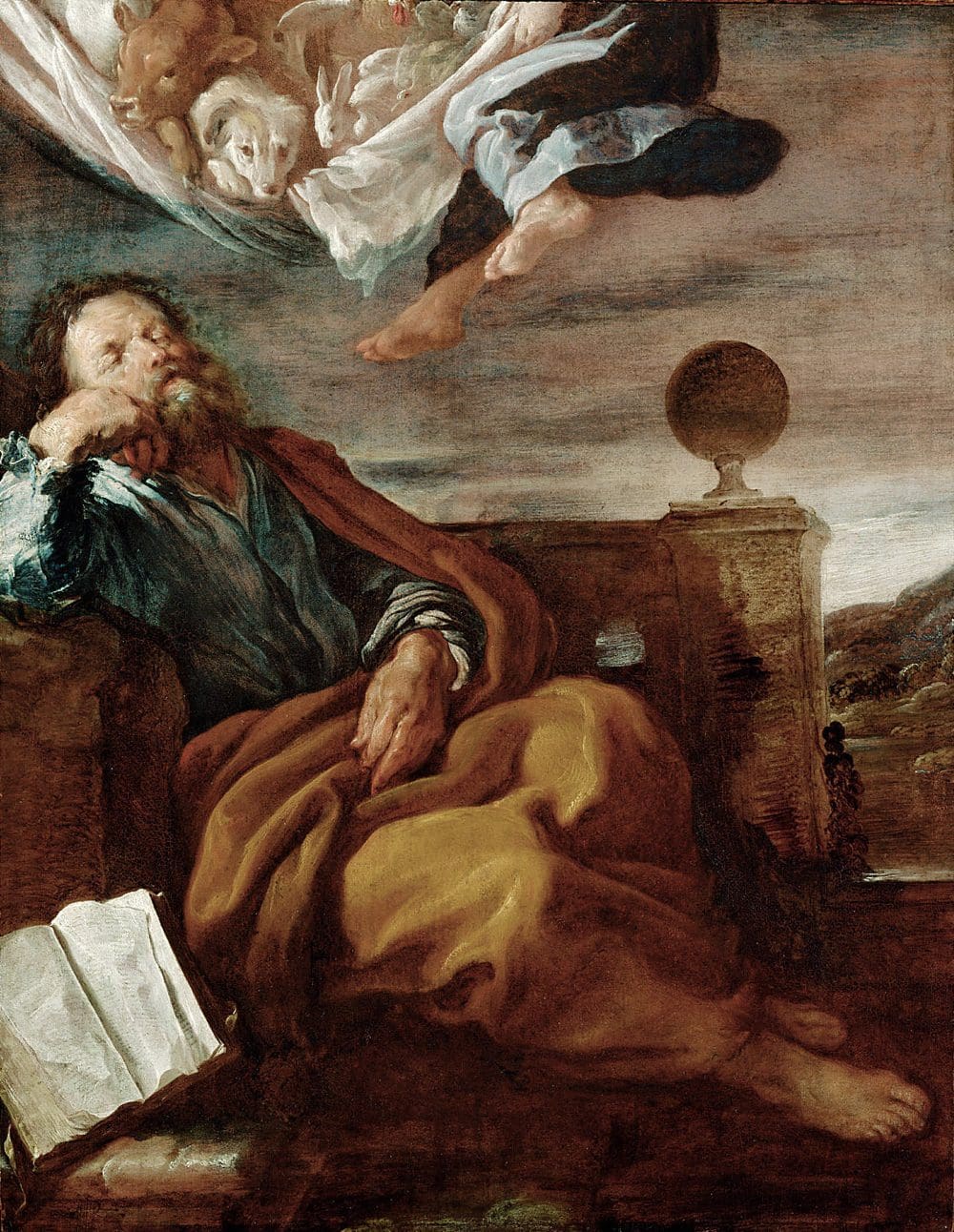
Joppa was an old port on the Mediterranean, today’s Jaffa on the edge of Tel Aviv. Peter was lodging “with one Simon a tanner, whose house is by the sea side” (Acts 10:6). A fisherman from Galilee, on a flat roof above the sea, at noon, hungry, and God changed the history of the world.
Peter then explained it to Cornelius: “God hath shewed me that I should not call any man common or unclean” (Acts 10:28), and “Of a truth I perceive that God is no respecter of persons: But in every nation he that feareth him, and worketh righteousness, is accepted with him” (Acts 10:34–35).
When the question came before the apostles and elders in Jerusalem (Acts 15), they didn’t publish it as their own opinion. Their letter said: “For it seemed good to the Holy Ghost, and to us” (Acts 15:28). The Holy Ghost first. Then the apostles. And prophets carried the letter.
Same four steps as Sinai. Call. Authority. Revelation. Record.
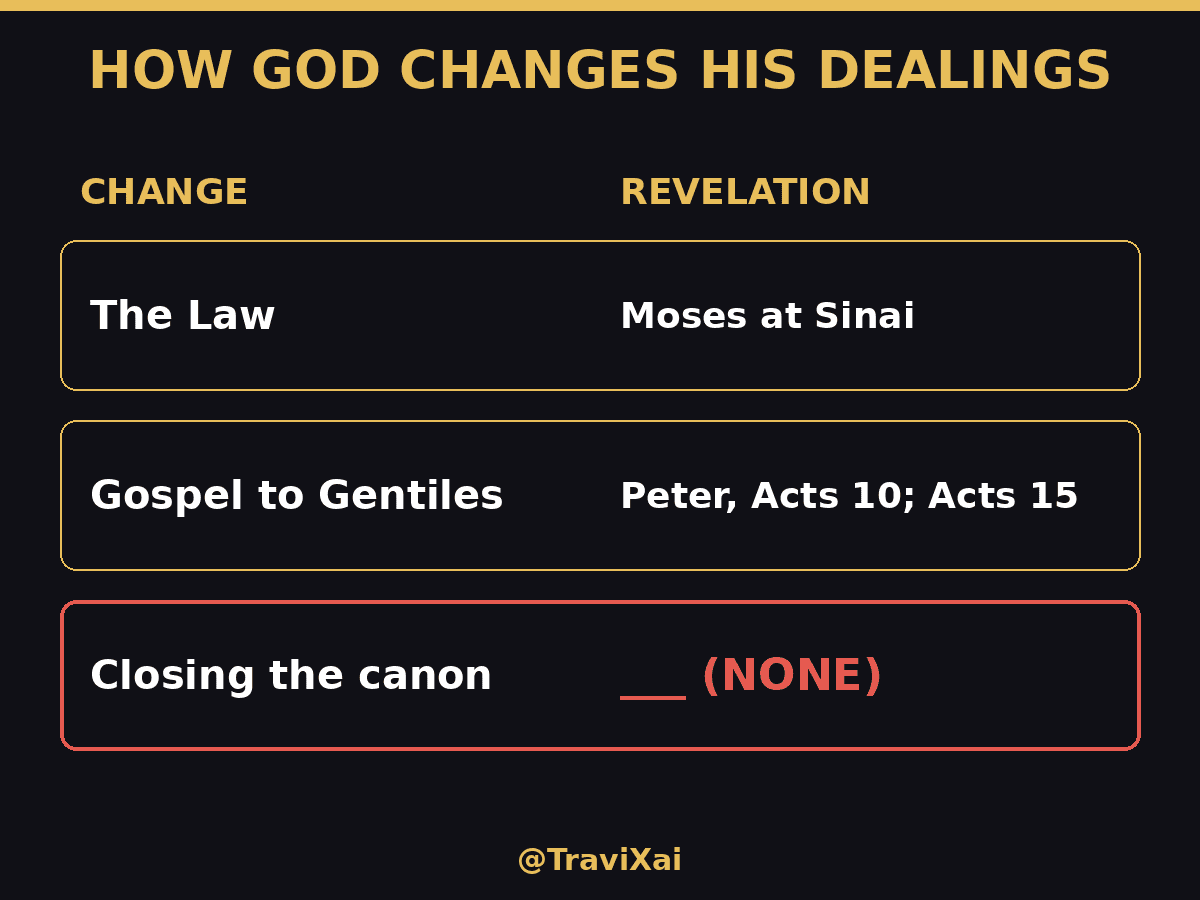
Which raises the obvious question. If every change that big came with a file, where is the file for the biggest change of all?
Part IIIThe missing record
Now let’s apply that pattern to the claim that the canon is closed.
Ending revelation would not be a small policy update. It would be the biggest change in how God deals with mankind since the garden, second only to the Atonement and Resurrection of Jesus Christ. For the whole span of biblical history, God’s people had prophets, or mourned the lack of them. Now, supposedly, they never would again, until the end of the world.
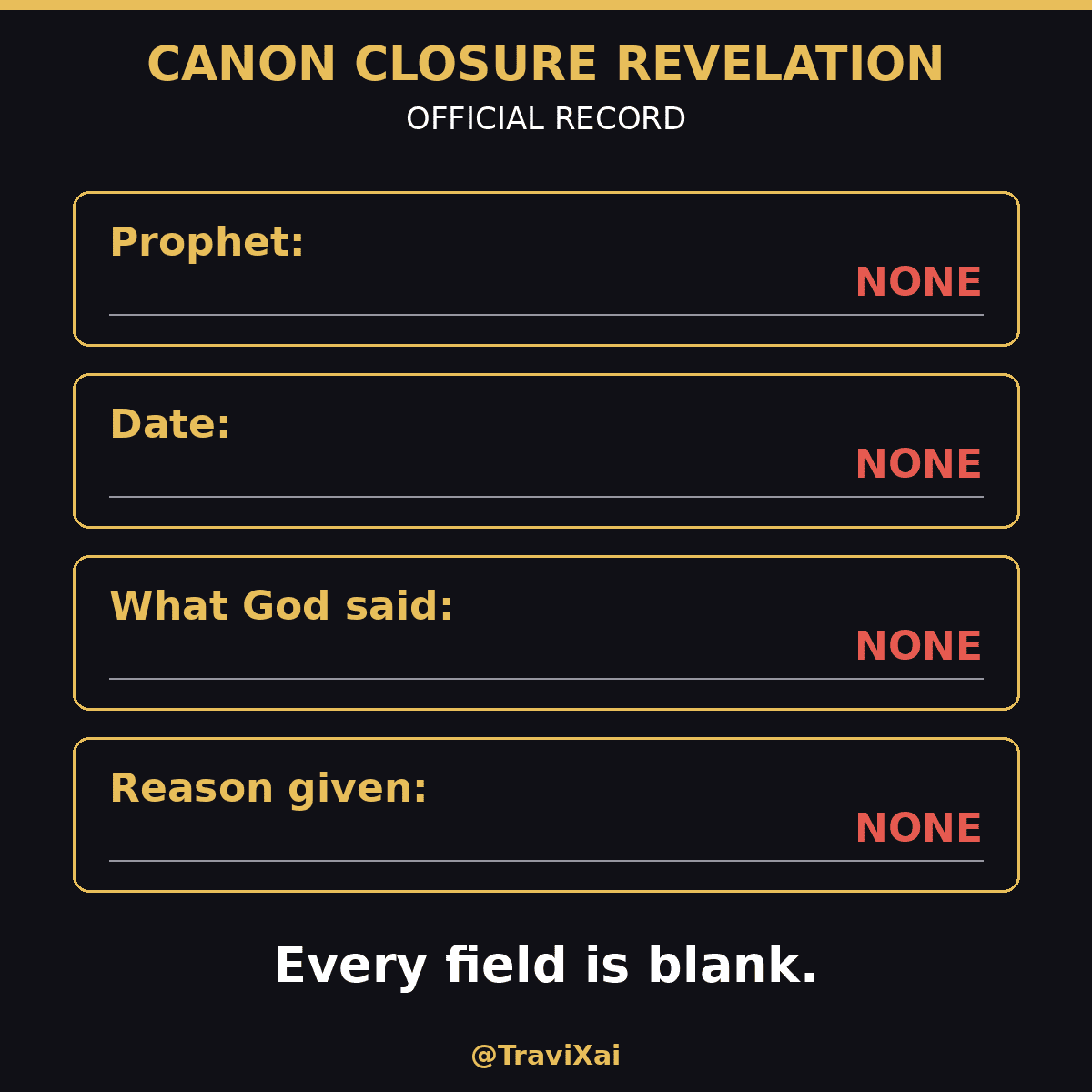
A change that size would have to meet at least the standard that every smaller change met. So let’s fill out the form.
- Prophet
- None named
- Date and place
- None given
- What God said
- No words recorded
- Reason given
- None
- Written record received as scripture
- None
Compare Moses at Sinai (Exodus 19:1–3) and Peter at Joppa (Acts 10:9–16), below.
| Required field | Law of Moses at Sinai | Gospel to the Gentiles | “Closing” the canon |
|---|---|---|---|
| Prophet who received it | Moses (Exodus 19–20) | Peter, senior apostle (Acts 10) | None named |
| Date / setting | Third month after leaving Egypt, at Sinai (Ex 19:1) | Sixth hour, housetop in Joppa (Acts 10:9) | Unknown |
| What God said | “Thus shalt thou say to the house of Jacob” (Ex 19:3) | “What God hath cleansed, that call not thou common” (Acts 10:15) | No words recorded |
| Reason given | Covenant people, holy nation (Ex 19:5–6) | “God is no respecter of persons” (Acts 10:34) | None given by God |
| Priesthood keys / authority | Moses, prophet of Israel | Peter, holder of the keys (Matt 16:19) | Bishops and councils; no apostle or prophet |
| Recorded as scripture | Yes | Yes | No |
Every field is blank. Not disputed. Blank.
Nobody can name the prophet who received a revelation saying prophets would end. Nobody can give the date God said it. Nobody can quote the words. Nobody can point to a reason God gave. Nobody can name the priesthood keys under which it was done. Nobody can show it written into scripture.
“Sinai has a file. Acts 10 has a file. The closing of the canon has a blank form.”
So if God didn’t close the canon, who did? To answer that, we have to leave the Bible and walk into the history books.
Part IVWhat men actually did
A century of books without a list
The New Testament writings were finished in the first century. But there was no leather-bound Bible handed down from heaven with a table of contents. Churches in different cities read different collections. Some books, like Hebrews, James, 2 Peter, 2 and 3 John, Jude, and Revelation, were argued over for generations.
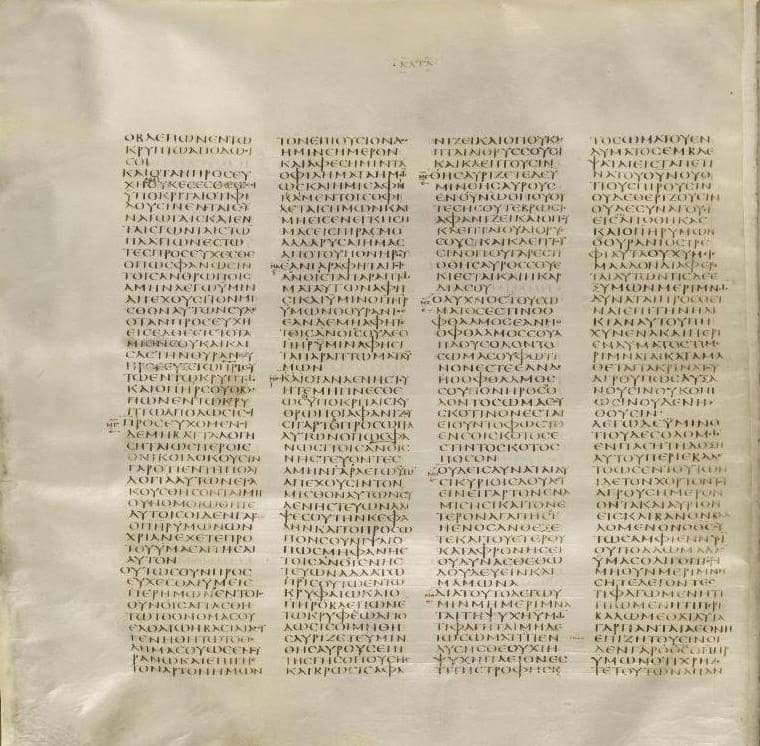
One of the oldest surviving complete New Testaments, the fourth-century Codex Sinaiticus, makes the point by itself. After Revelation it also contains the Epistle of Barnabas and part of the Shepherd of Hermas, two books that are not in your Bible today. The oldest complete New Testament we have does not match the one on your shelf.
The first person known to publish a fixed list of Christian scripture wasn’t an apostle. He was Marcion of Sinope, a wealthy shipowner who came to Rome around AD 140 and was expelled as a heretic about 144. His “canon” was one edited Gospel of Luke and ten of Paul’s letters. He cut the entire Old Testament. Many historians think his list pushed the orthodox churches to start making lists of their own.
Think about that. The first canon in Christian history was drawn up by a man the Church itself excommunicated. Lists were a human project from the very start.
Eusebius keeps score
Around AD 325, the church historian Eusebius of Caesarea surveyed the situation in his Ecclesiastical History (book 3, chapter 25). He sorted the books into categories: those “acknowledged” by everyone, those “disputed” (he names James, Jude, 2 Peter, and 2 and 3 John), and those he considered spurious. Revelation he couldn’t even place cleanly; he lists it in two categories, noting that some accepted it and some rejected it.
That’s nearly three hundred years after the Resurrection, and the most learned historian in the Church is still counting votes.
Nicaea: the council that didn’t
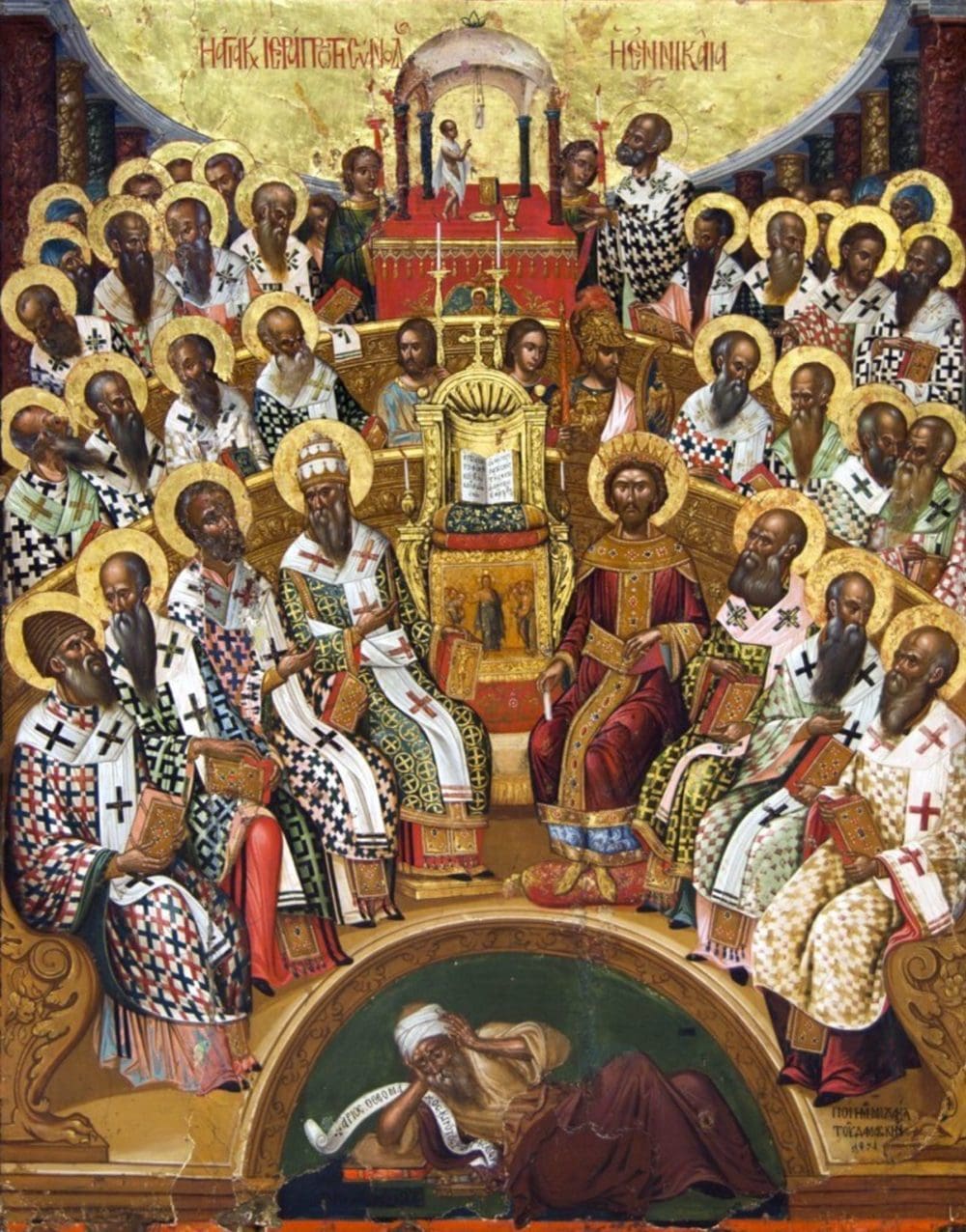
In the summer of AD 325, the emperor Constantine gathered a few hundred bishops at Nicaea, the lakeside town that is now İznik, Turkey. They debated the teachings of Arius about the nature of Christ, issued a creed, and ruled on the date of Easter.
A popular story says this was where the books of the Bible were chosen. It wasn’t. The creed and canons that survive from Nicaea say nothing about a list of books. The council most people imagine closed the canon never took up the question.
So who did?
Athanasius, AD 367
In AD 367, Athanasius, bishop of Alexandria, sent his churches his annual Easter letter, the 39th Festal Letter. It’s the earliest surviving list that matches our 27-book New Testament exactly. That’s the good news for the canon-closers.
The bad news is his Old Testament. Athanasius includes “Jeremiah with Baruch, Lamentations, and the epistle, one book.” Baruch is a book Protestant Bibles reject. And he leaves Esther, a book every Protestant Bible includes, out of the canon, putting it among books “appointed by the Fathers to be read,” alongside the Wisdom of Solomon, Sirach, Judith, Tobit, the Didache, and the Shepherd of Hermas.
He also writes: “Let no man add to these, neither let him take ought from these.” So the first man to list our New Testament also issued a closed-canon warning, about an Old Testament no Protestant or Catholic accepts today.
And how did he know which books belonged? He tells us: “as I have heard, it is handed down.” That’s tradition. Not “thus saith the Lord.”
Hippo and Carthage: bishops at a table
A generation later, in North Africa, bishops met in regional councils at Hippo (AD 393) and Carthage (AD 397). Their list included Tobit, Judith, the Wisdom of Solomon, Sirach, and 1 and 2 Maccabees. It was re-adopted in the Code of Canons of the African Church in 419, with a note asking Boniface, bishop of Rome, to confirm it.
Hippo Regius was a Roman port on the coast of what is now Annaba, Algeria. At the 393 gathering, a presbyter named Augustine, not yet a bishop, gave the address later published as On Faith and the Creed. Picture the scene: a regional meeting of bishops, a learned priest lecturing on the creed, and a list of books for reading in church. Important men doing their best. But nobody in the room said, “Thus saith the Lord.”
Their stated reason is right there in the text: “for these are the things which we have received from our fathers to be read in church.”
Received from our fathers. A list of books to read in church. Regional bishops asking another bishop to sign off. No apostle. No prophet. No vision. No voice. No “it seemed good to the Holy Ghost.”
“Acts 15 said, ‘It seemed good to the Holy Ghost, and to us.’ Carthage said, ‘We have received from our fathers.’ Spot the difference.”
The Reformation tears it up and redraws it
For more than a thousand years, the Western Church mostly read the larger list. Then came Martin Luther.
In 1521, after refusing to recant at the Diet of Worms, Luther was hidden away in Wartburg Castle above Eisenach. There, in roughly eleven weeks, he translated the New Testament from Greek into German. It came off the press in Wittenberg in September 1522, which is why it is remembered as the September Testament.
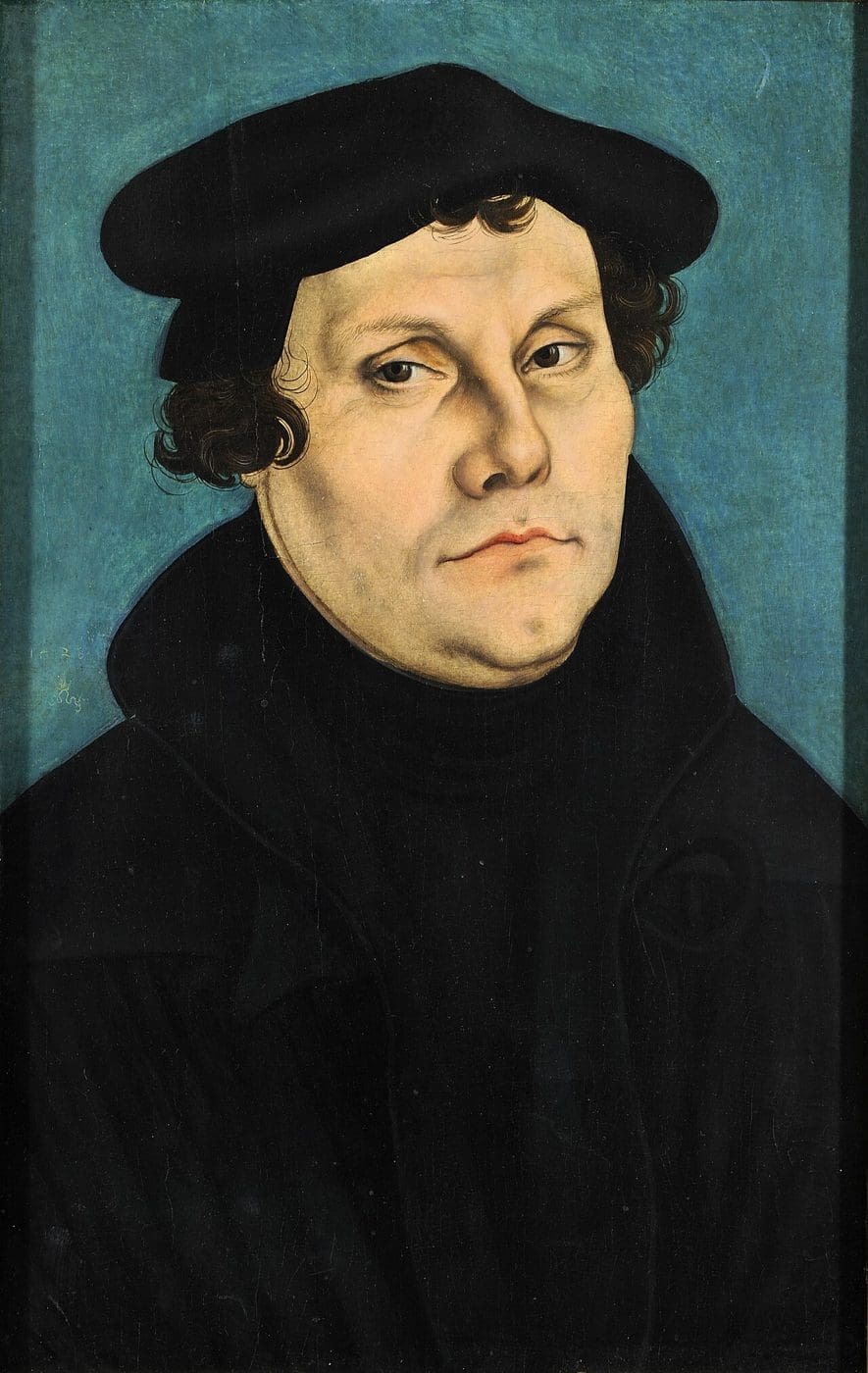
In his 1522 German New Testament, Luther moved four books, Hebrews, James, Jude, and Revelation, to the back, apart from the rest. In his preface he famously called James “an epistle of straw” compared to books like Romans and Galatians. He questioned whether Hebrews and Revelation were apostolic. Those four still sit at the end of German Luther Bibles today.
In his complete 1534 Bible, Luther took the books Catholics call deuterocanonical (Tobit, Judith, Wisdom, Sirach, Baruch, 1 and 2 Maccabees, plus additions to Esther and Daniel) and grouped them in a separate section labeled Apocrypha, describing them as books not held equal to Holy Scripture but useful and good to read. Note what he did and didn’t do: he set them apart, between the Old and New Testaments. He did not remove them. They stayed inside his Bible.
One man, by his own judgment, reshuffled the Bible. And he did not claim a revelation to do it either.
Trent answers back, 1546
Rome responded at the Council of Trent. On April 8, 1546, in its fourth session, the council formally defined the Catholic canon, including the deuterocanonical books, and pronounced an anathema on anyone who rejected them. That was the first time the Roman Church defined the canon as binding dogma, more than 1,500 years after the birth of Christ, and in reaction to the Reformation.
Westminster says it out loud, 1646
On the Protestant side, the Westminster Assembly in England completed its Confession of Faith in 1646. Chapter 1, section 6 says the whole counsel of God is in Scripture, “unto which nothing at any time is to be added, whether by new revelations of the Spirit, or traditions of men.”
Read that again. It forbids new revelation. But the statement itself isn’t a revelation. It’s an assembly of English and Scottish ministers writing a confession. Men declared that God may not add anything, on their own authority.
The King James Bible’s missing pages
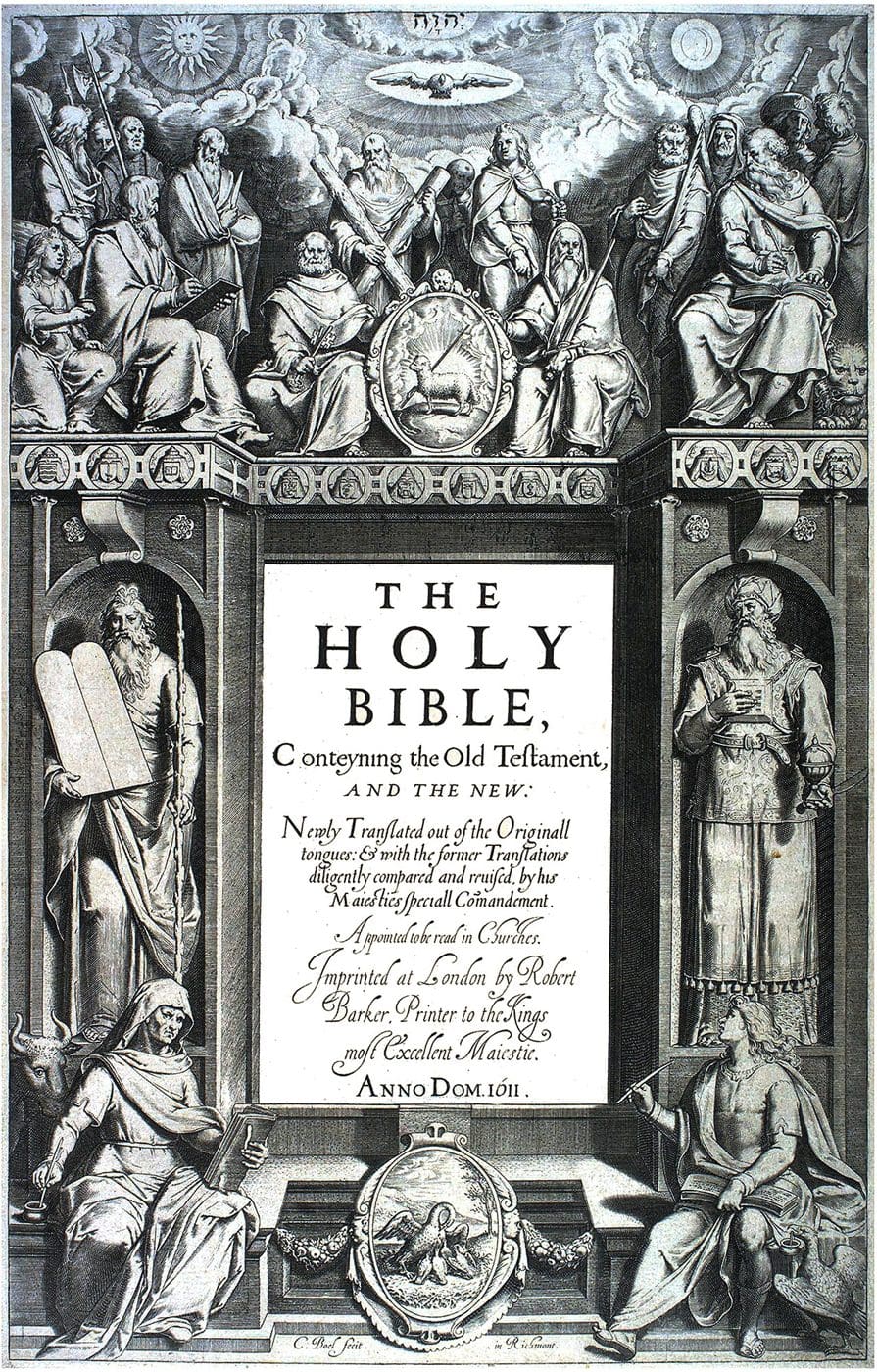
Here’s a detail many King James readers don’t know. The original 1611 King James Bible included the Apocrypha, printed between the Old and New Testaments. Later printings began dropping it, and in 1826 and 1827 the British and Foreign Bible Society adopted a policy against circulating Bibles that included it. The American Bible Society adopted a similar policy. That’s how the Apocrypha disappeared from most English Bibles: a publishing policy, two centuries after 1611.
So the Bible many canon-closers hold up as “the” Bible lost fourteen books’ worth of pages by the printing policy of a Bible society.
Timeline: how men drew the lines
Four Bibles, one “closed” canon
Here’s where Christianity stands today:
- Protestant Bibles: 66 books.
- Catholic Bibles: 73 books.
- Eastern Orthodox Bibles: the Catholic books plus several more, such as 1 Esdras, 3 Maccabees, and the Prayer of Manasseh. The Synod of Jerusalem in 1672 affirmed the deuterocanonical books for the Orthodox, and the exact list still varies between Orthodox churches.
- Ethiopian Orthodox Tewahedo Bibles: the broadest of all, traditionally counted at 81 books, including 1 Enoch and Jubilees. This is one of the oldest Christian traditions on earth, going back to the conversion of King Ezana of Aksum in the fourth century.
“If God closed the canon, He apparently closed it four different ways.”
That’s what you get when men do a job God never assigned. Competing results, all claiming finality, none claiming revelation.
But maybe the Bible itself settles it. Maybe the book claims to be complete. Let’s open it and see.
Part VThe Bible never claimed to be the whole record
So far we’ve seen that the closing has no revelation behind it. Now look at the book itself. Because the Bible, read honestly, tells you it isn’t everything.
Books the Bible cites that we don’t have
The Old Testament repeatedly sends its readers to other books, as sources it trusts:
- The book of Jasher. “Is not this written in the book of Jasher?” (Joshua 10:13); “behold, it is written in the book of Jasher” (2 Samuel 1:18).
- The book of the wars of the Lord. “Wherefore it is said in the book of the wars of the Lord” (Numbers 21:14).
- The books of Nathan and Gad. David’s acts “are written in the book of Samuel the seer, and in the book of Nathan the prophet, and in the book of Gad the seer” (1 Chronicles 29:29).
- The prophecy of Ahijah and the visions of Iddo. Solomon’s acts are “written in the book of Nathan the prophet, and in the prophecy of Ahijah the Shilonite, and in the visions of Iddo the seer” (2 Chronicles 9:29).
- The book of Shemaiah. Rehoboam’s acts are “written in the book of Shemaiah the prophet, and of Iddo the seer concerning genealogies” (2 Chronicles 12:15).
The New Testament does it too:
- Paul’s epistle from Laodicea. “And when this epistle is read among you, cause that it be read also in the church of the Laodiceans; and that ye likewise read the epistle from Laodicea” (Colossians 4:16).
- An earlier letter to Corinth. “I wrote unto you in an epistle not to company with fornicators” (1 Corinthians 5:9). That letter, written before 1 Corinthians, is gone.
- The prophecy of Enoch. “And Enoch also, the seventh from Adam, prophesied of these, saying, Behold, the Lord cometh with ten thousands of his saints” (Jude 1:14). This prophecy appears in 1 Enoch, which is in the Ethiopian Bible and not in yours.
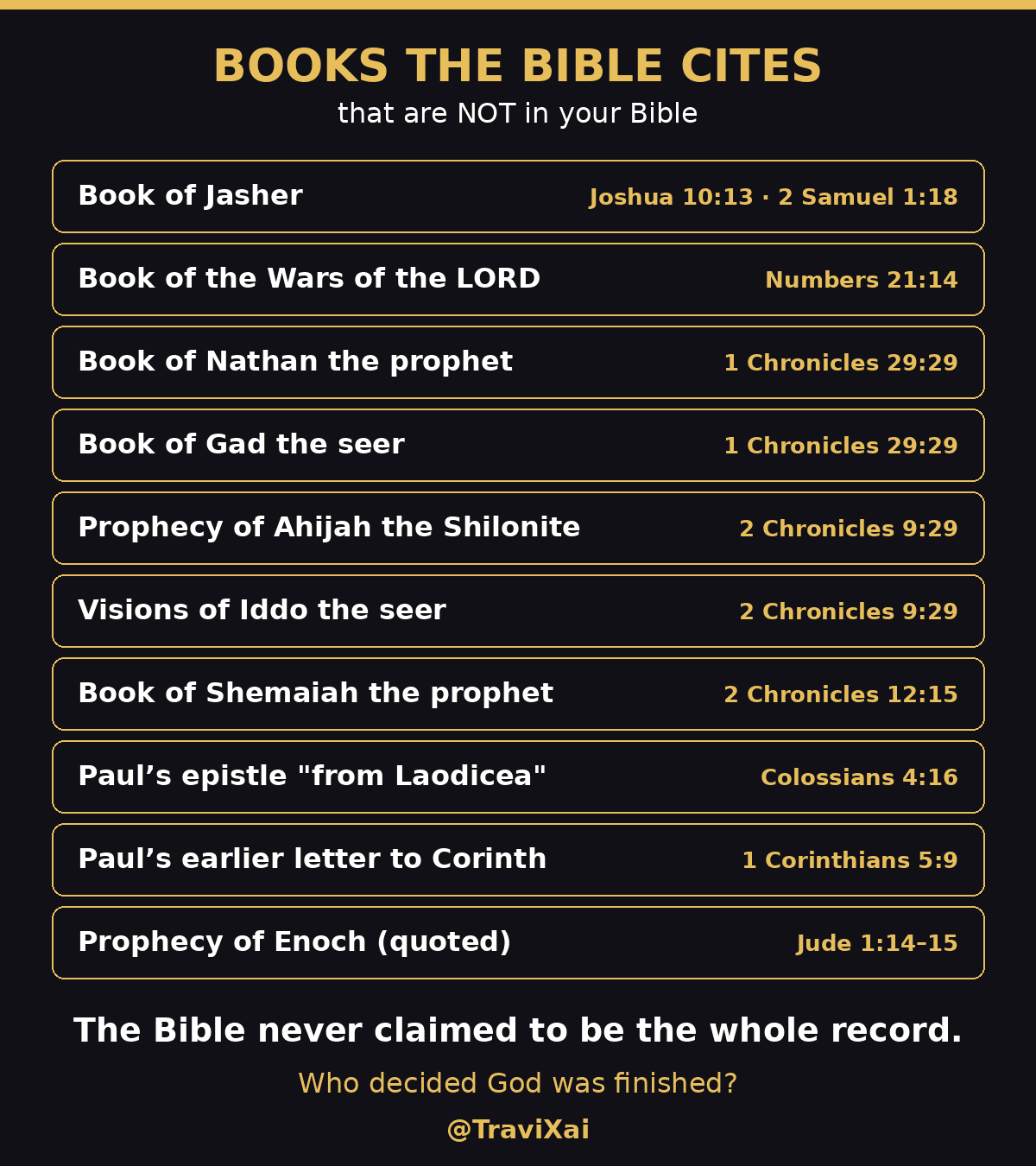
Some of these may have been court histories and not scripture. Fine. But Nathan was a prophet. Gad was a seer. Ahijah and Iddo and Shemaiah were prophets. And Paul was an apostle. The Bible itself tells you that writings by prophets and apostles existed and are not in the book you were told is complete.
Most prophets never wrote a word of the Bible
Here’s a list of prophets whose names you know, but whose books you don’t have, because they never had one: Enoch. Noah. Elijah. Elisha. Nathan. Gad. Ahijah. Agabus. Judas and Silas. Philip’s four daughters. Anna. When Jezebel was killing the prophets, Ahab’s own steward, Obadiah, “the governor of his house” (not the prophet Obadiah who wrote the short Old Testament book), “took an hundred prophets, and hid them by fifty in a cave, and fed them with bread and water” (1 Kings 18:4). A hundred prophets in one cave, and we can’t name one of them. There were whole communities called “the sons of the prophets” at Bethel and Jericho (2 Kings 2:3).
What made them prophets? Not writing scripture. God speaking to them. The Bible defines a prophet by revelation, not by publication. The closed-canon view quietly flips that around, as though God speaks only if it ends up in a bound volume.
Jesus never wrote a book of the Bible
Now the most uncomfortable fact for the “only what’s written” position. Jesus Christ, the Word made flesh, did not write a single book of the Bible. The only time the Gospels say He wrote anything, He wrote on the ground: “But Jesus stooped down, and with his finger wrote on the ground, as though he heard them not” (John 8:6), and “again he stooped down, and wrote on the ground” (John 8:8). We don’t know what He wrote. The wind took it.
Everything we have from Him was remembered and recorded by others, decades later. If the test of God’s word is “is it in the closed canon,” the Son of God Himself never produced anything that passes it directly.
John’s confession
And then, at the very end of his Gospel, John tells you plainly that the record is partial:
“And there are also many other things which Jesus did, the which, if they should be written every one, I suppose that even the world itself could not contain the books that should be written. Amen.”
John 21:25
The apostle who wrote the last Gospel ends it by saying: this isn’t all of it. Not even close. The world couldn’t hold it.
“John ended his Gospel by telling you it wasn’t the whole story. The councils ended the Bible by telling you it was.”
So which do you believe: the apostle, or the councils?
Part VIThe Bible promises more
A book that admits it’s partial is one thing. A book that promises more is another. And the Bible does.
Prophets in the last days
On the day of Pentecost, Peter stood up in Jerusalem and quoted the prophet Joel to explain what the crowd was seeing:
“And it shall come to pass in the last days, saith God, I will pour out of my Spirit upon all flesh: and your sons and your daughters shall prophesy, and your young men shall see visions, and your old men shall dream dreams: And on my servants and on my handmaidens I will pour out in those days of my Spirit; and they shall prophesy:”
Acts 2:17–18 (quoting Joel 2:28)
In the last days. Sons and daughters prophesying. Visions. That’s not a closed heaven.
Malachi, the last book of the Protestant Old Testament, ends with a promise, not a period: “Behold, I will send you Elijah the prophet before the coming of the great and dreadful day of the Lord: And he shall turn the heart of the fathers to the children, and the heart of the children to their fathers, lest I come and smite the earth with a curse” (Malachi 4:5–6). That’s a prophet scheduled to come before the Second Coming.
And Revelation, the very book whose last chapter is used to close the canon, describes two prophets working in Jerusalem before the end: “And I will give power unto my two witnesses, and they shall prophesy a thousand two hundred and threescore days, clothed in sackcloth” (Revelation 11:3). Verse 10 calls them, flatly, “these two prophets” (Revelation 11:10).
So the book that supposedly forbids new prophecy predicts new prophets in the same pages. The canon-closer has to explain why John’s warning in chapter 22 shuts down the prophets John himself foretold in chapter 11.
“The book used to close the canon predicts two prophets in chapter 11.”
Other sheep who would hear His voice
During His mortal ministry, Jesus said something His listeners didn’t understand:
“And other sheep I have, which are not of this fold: them also I must bring, and they shall hear my voice; and there shall be one fold, and one shepherd.”
John 10:16
They shall hear my voice. Not “read my words.” Hear His voice. That’s a personal visit, and a visit produces a record.
The Book of Mormon records that visit. After His resurrection, Christ appeared at a temple in a land called Bountiful in the Americas and told the people there:
“And verily I say unto you, that ye are they of whom I said: Other sheep I have which are not of this fold; them also I must bring, and they shall hear my voice; and there shall be one fold, and one shepherd.”
3 Nephi 15:21
Then He went further:
“And verily, verily, I say unto you that I have other sheep, which are not of this land, neither of the land of Jerusalem, neither in any parts of that land round about whither I have been to minister. For they of whom I speak are they who have not as yet heard my voice; neither have I at any time manifested myself unto them. But I have received a commandment of the Father that I shall go unto them, and that they shall hear my voice, and shall be numbered among my sheep, that there may be one fold and one shepherd; therefore I go to show myself unto them.”
3 Nephi 16:1–3
More sheep. More visits. More of His voice. And notice what Christ did while He was there: He checked their scripture. He asked about Samuel the Lamanite’s prophecy that saints would rise from the dead, then asked, “How be it that ye have not written this thing…?” And “Jesus commanded that it should be written; therefore it was written according as he commanded” (3 Nephi 23:11–13). The resurrected Lord added to scripture with His own mouth.
The Lord explained the plan to Nephi centuries earlier: “I shall speak unto the Jews and they shall write it; and I shall also speak unto the Nephites and they shall write it; and I shall also speak unto the other tribes of the house of Israel, which I have led away, and they shall write it; and I shall also speak unto all nations of the earth and they shall write it” (2 Nephi 29:12).
Jesus described the kind of disciple who could handle that: “every scribe which is instructed unto the kingdom of heaven is like unto a man that is an householder, which bringeth forth out of his treasure things new and old” (Matthew 13:52). New and old. Not old only.
Christ will be speaking when He comes
Last, and biggest: Jesus Christ is coming again, and He is not coming silent.
Isaiah saw it: “out of Zion shall go forth the law, and the word of the Lord from Jerusalem” (Isaiah 2:3). John saw Him ride out of heaven: “his name is called The Word of God” and “out of his mouth goeth a sharp sword” (Revelation 19:13, 15). And Jesus described His own judgment scene: “Then shall the King say unto them on his right hand, Come, ye blessed of my Father” (Matthew 25:34).
Then shall the King say. Future tense. New words from the mouth of Christ. A truly closed canon would have to treat even His Second Coming as off the record. Nobody actually believes that, which tells you the “closed canon” was never a principle. It was a fence built to keep out one particular kind of claim.
A fence like that has to be defended. And the way it is defended is older than Christianity itself.
Part VII“We are Moses’ disciples”
We’ve seen that men closed the canon, that the Bible admits it’s partial, and that it promises more. So why do sincere, Bible-loving people fight so hard against more scripture?
Because it has happened before. In fact, it’s one of the most consistent patterns in the whole Bible: people honor dead prophets and reject living ones.
The man born blind
In John 9, Jesus heals a man blind from birth. The Pharisees interrogate him, then his parents, then him again. Finally they lose patience:
“Then they reviled him, and said, Thou art his disciple; but we are Moses’ disciples. We know that God spake unto Moses: as for this fellow, we know not from whence he is.”
John 9:28–29
Listen to that logic. God spoke to Moses. That’s settled. This new one? We don’t know where he came from. They had a closed canon too. And it made them reject the very Messiah their scriptures were about.
“Search the scriptures”
Jesus told them exactly what was wrong:
“Search the scriptures; for in them ye think ye have eternal life: and they are they which testify of me. And ye will not come to me, that ye might have life.”
John 5:39–40
They had the book. They didn’t have Him. The scriptures were supposed to point them to a living voice, and they used the scriptures to block it.
Tombs for the prophets
He also told them how they’d treat future prophets:
“Woe unto you, scribes and Pharisees, hypocrites! because ye build the tombs of the prophets, and garnish the sepulchres of the righteous, And say, If we had been in the days of our fathers, we would not have been partakers with them in the blood of the prophets. Wherefore ye be witnesses unto yourselves, that ye are the children of them which killed the prophets.”
Matthew 23:29–31
Then, in verse 34: “Wherefore, behold, I send unto you prophets… and some of them ye shall kill and crucify” (Matthew 23:34). Stephen said it to the Sanhedrin just before they stoned him: “Which of the prophets have not your fathers persecuted?” (Acts 7:52).
“They have Moses and the prophets”
In the parable of the rich man and Lazarus, the rich man begs Abraham to send someone back from the dead to warn his brothers. Abraham answers: “They have Moses and the prophets; let them hear them” (Luke 16:29). And then: “If they hear not Moses and the prophets, neither will they be persuaded, though one rose from the dead” (Luke 16:31).
The point cuts both ways. If you truly heard Moses and the prophets, you’d recognize the next messenger. Rejecting the living one proves you never really heard the dead ones.
The modern version
Now line it up. “We are Moses’ disciples. We know that God spake unto Moses.” And today: “We have the Bible. We know God spoke to Paul. As for this Joseph Smith, we know not from whence he is.”
The Book of Mormon saw that coming nearly word for word:
“And because my words shall hiss forth—many of the Gentiles shall say: A Bible! A Bible! We have got a Bible, and there cannot be any more Bible.”
2 Nephi 29:3
“‘We are Moses’ disciples’ and ‘We have got a Bible’ are the same sentence, two thousand years apart.”
So let’s stop arguing in the abstract and lay out exactly what closing the canon would have required.
Part VIIIWhat it would actually take, and what it would mean
Let’s put the whole case on the table, because by now we’ve earned it.
What it would take
To close the canon legitimately, by the Bible’s own standard, you would need:
- A prophet holding priesthood keys, the way Moses led Israel and Peter held the keys of the kingdom (Matthew 16:19).
- A dated revelation, with a time and place, like “the third month” at Sinai or “the sixth hour” on a rooftop in Joppa.
- God’s actual words, not a bishop’s summary of what the fathers handed down.
- A stated reason, as God gave for the Law and for the Gentile mission.
- A written record, received as scripture by the Church.
We know what this looks like when it is done right, because the New Testament shows us. Around AD 49 or 50, by most scholars’ reckoning, the apostles and elders met in Jerusalem over whether Gentile converts had to keep the law of Moses. There was argument: “when there had been much disputing, Peter rose up” (Acts 15:7). Peter testified of his revelation at Joppa. James gave judgment. And the letter they sent out named its source: “For it seemed good to the Holy Ghost, and to us” (Acts 15:28).
That is the standard. Apostles holding keys, a recorded deliberation, a revelation testified to, and a written decision that claims the Holy Ghost.
Now hold the closing of the canon up against it. The Westminster Confession of 1646 says it more bluntly than any council before it: “those former ways of God’s revealing his will unto his people being now ceased” (chapter 1, section 1). It is a confident sentence. But it is a conclusion the divines reasoned their way to, not a revelation any of them claimed to receive.
Not one of those five exists. Not for Athanasius, not for Carthage, not for Trent, not for Luther, not for Westminster. The closing of the canon fails the test that every other change in the Bible passes.
Five requirements. Zero met.
What it would mean if it were true
Now take the claim seriously and follow it all the way out. If the canon really is closed:
- God has stopped speaking to His children as a people, after speaking to them from Adam onward, which contradicts “I am the Lord, I change not” (Malachi 3:6) and “Jesus Christ the same yesterday, and to day, and for ever” (Hebrews 13:8).
- There can be no more prophets, despite Acts 2:17, Malachi 4:5, and the two prophets of Revelation 11.
- The other sheep can’t have a record of hearing His voice, even though He said they would.
- Christ’s own words at His coming would technically fall outside the “complete” word of God.
- The Church has no mechanism for correction. When Christians disagree, as they do on baptism, grace, the sacraments, church government, and the nature of God, there is no one with authority to say, “Thus saith the Lord.” Only scholars and committees.
- Men become the final authority over God’s word. The people who decide what the book means, and which books are in it, are now above any prophet God might send.
That last one is the real heart of it. Look at the numbers. Pew Research Center estimates there were about 2.3 billion Christians in the world in 2020. And that is the low end of the count of people interpreting the Bible.
On top of those 2.3 billion, Jewish scholars publish their own translations and commentaries on the Hebrew Bible, and secular scholars in universities around the world publish their own interpretations, translations, and critical studies of both Testaments. The Center for the Study of Global Christianity at Gordon-Conwell counts roughly 50,000 Christian denominations as of 2025, each with its own reading of the same book. And beneath all of that is a number nobody can count: every Sunday morning, in every language, an endless number of pastors stand up and give their private interpretation and opinion of what the scripture means.
Every one of them is a fallible interpreter. Many are sincere, learned, and good. But one book that nearly all of them call infallible, read by billions of fallible people, yields thousands of incompatible readings. Each one saying, “So that means…”
Peter warned about exactly that: “Knowing this first, that no prophecy of the scripture is of any private interpretation. For the prophecy came not in old time by the will of man: but holy men of God spake as they were moved by the Holy Ghost” (2 Peter 1:20–21).
An infallible book with no authorized interpreter doesn’t produce unity. It produces 50,000 denominations. That’s why Paul said apostles and prophets would stay “Till we all come in the unity of the faith” (Ephesians 4:13), “That we henceforth be no more children, tossed to and fro, and carried about with every wind of doctrine.” Notice the order. Christ “gave some, apostles; and some, prophets; and some, evangelists; and some, pastors and teachers” (Ephesians 4:11), “For the perfecting of the saints” (Ephesians 4:12). Pastors and teachers were never meant to stand alone, each with a private reading. They were meant to stand under living apostles and prophets. Remove the apostles and prophets, and you get precisely the tossing Paul described, “by the sleight of men, and cunning craftiness” (Ephesians 4:14). Peter’s answer to private interpretation was never more interpreters. It was “holy men of God” who spoke “as they were moved by the Holy Ghost.” (See Is the Bible Infallible? and Living Prophets.)
“An infallible book with no authorized interpreter doesn’t produce unity. It produces 50,000 denominations.”
What we would lose
Follow it one step further, into ordinary life. Remember the famine Amos warned of, “not a famine of bread, nor a thirst for water, but of hearing the words of the Lord” (Amos 8:11).
In Amos, that famine was a curse. A closed canon makes it permanent policy, and calls it faithfulness.
It would also shrink every prayer. James promised that anyone who lacks wisdom can “ask of God, that giveth to all men liberally, and upbraideth not; and it shall be given him” (James 1:5). If the canon is closed, the most God can ever say to a seeking soul is, “Reread what I said two thousand years ago, and pick a pastor.” Peter, at Pentecost, read Joel’s promise the other way: “in the last days, saith God, I will pour out of my Spirit upon all flesh: and your sons and your daughters shall prophesy” (Acts 2:17).
Same God. Same promise. Either it is still in force, or the last days ended before they began.
Why it was never meant to happen
God’s pattern doesn’t change because God doesn’t change. Amos 3:7 is still in the Bible. Malachi 3:6 is still in the Bible. Hebrews 13:8 is still in the Bible. Ephesians 4:13 still says “Till.” The closing of the canon asks you to believe that the unchanging God changed the most basic thing about how He works, and told no one.
Part IX“But Revelation 22 says…”
Before we get to how it all ends, we have to deal with the proof texts. Critics have a handful. None of them say what they’re used to say.
Revelation 22:18–19
“For I testify unto every man that heareth the words of the prophecy of this book, If any man shall add unto these things, God shall add unto him the plagues that are written in this book: And if any man shall take away from the words of the book of this prophecy, God shall take away his part out of the book of life, and out of the holy city, and from the things which are written in this book.”
Revelation 22:18–19
Count how many times John says “this book.” It’s “the prophecy of this book,” “the plagues that are written in this book,” “the book of this prophecy,” “the things which are written in this book.” John is talking about the scroll he’s writing: the book of Revelation. He’s not talking about a Bible, because there was no Bible as a bound collection when he wrote it. As we saw, the 27-book list wouldn’t show up until Athanasius in 367.
And Revelation sits at the end of the Bible because of how the books were later arranged, not because God put it there as a lid. (Luther, remember, even moved it to the back himself.)
Most importantly, the warning is directed at “any man.” It forbids men from tampering with God’s word. It does not, and cannot, forbid God from speaking. A warning to men is not a gag order on God.
Deuteronomy 4:2, the parallel that proves the point
Moses used almost the same language, centuries earlier:
“Ye shall not add unto the word which I command you, neither shall ye diminish ought from it, that ye may keep the commandments of the Lord your God which I command you.”
Deuteronomy 4:2
He repeated it in Deuteronomy 12:32: “thou shalt not add thereto, nor diminish from it.” If the Revelation 22 argument works, then Deuteronomy 4:2 closed the canon at the fifth book of the Bible. Goodbye, Joshua. Goodbye, Psalms, Isaiah, the Gospels, and Paul.
Nobody believes that. Everyone understands Moses meant: don’t you, a man, tamper with what God commanded. Same meaning in Revelation. You can’t use the verse one way for John and another way for Moses. Proverbs 30:6 says the same thing: “Add thou not unto his words, lest he reprove thee, and thou be found a liar.” Thou add not. God’s not on the hook.
Here’s the irony. The ones who added to God’s word were the men who added a rule God never gave: that He would never speak again.
Jude 1:3
“Beloved, when I gave all diligence to write unto you of the common salvation, it was needful for me to write unto you, and exhort you that ye should earnestly contend for the faith which was once delivered unto the saints.”
Jude 1:3
The argument: “once delivered” means “delivered once, never again.” But Jude is talking about the faith, the gospel of Jesus Christ, not a list of books. Latter-day Saints agree completely that the faith was delivered to the saints and that we should contend for it. That’s exactly what the Restoration claims to restore.
Besides, Jude wrote this while apostles were still alive and still writing. If “once delivered” meant “no more scripture,” then any New Testament book written after Jude would be illegitimate. And as we saw, Jude quotes Enoch’s prophecy, from a book your Bible doesn’t include. The Ethiopians would like a word.
Hebrews 1:1–2
The argument: God used to speak by prophets, but “in these last days” He has spoken by His Son, so prophets are finished.
Except the man who wrote Hebrews lived in a Church that still had prophets: Agabus, Judas, Silas, Philip’s daughters, and the “prophets” Paul ranks second only to apostles. The writer is saying Christ is the supreme revelation of God, the one all prophets point to. Amen. Latter-day Saints believe that with all our hearts. But Christ speaking doesn’t silence His servants. It gives them their message. Jesus Himself said, “He that receiveth a prophet in the name of a prophet shall receive a prophet’s reward” (Matthew 10:41), and then He sent apostles and prophets out to speak for Him.
The Son is the reason prophets exist, not the reason they disappeared.
With the proof texts cleared away, one question is left: if God never closed the canon, what does it mean that men did?
Part XClosing the canon was the apostasy
Now we can say it plainly, and the gloves come off.
If God never revealed that the canon was closed, then closing it was men telling God He’s finished speaking. That’s not humility. That’s presumption on a cosmic scale. It takes the one channel God promised to use, “his servants the prophets,” and declares it out of service.
And the Bible predicted exactly that.
“Let no man deceive you by any means: for that day shall not come, except there come a falling away first, and that man of sin be revealed, the son of perdition;”
2 Thessalonians 2:3
A falling away. Not a gradual improvement. Paul told the Ephesian elders where it would come from:
“For I know this, that after my departing shall grievous wolves enter in among you, not sparing the flock. Also of your own selves shall men arise, speaking perverse things, to draw away disciples after them.”
Acts 20:29–30
“Of your own selves.” From inside. He told Timothy what it would look like:
“For the time will come when they will not endure sound doctrine; but after their own lusts shall they heap to themselves teachers, having itching ears; And they shall turn away their ears from the truth, and shall be turned unto fables.”
2 Timothy 4:3–4
Teachers, heaped up. Notice who’s missing from that picture. Prophets. Apostles. Ephesians 4 gave apostles, prophets, evangelists, pastors, and teachers. The apostasy keeps the teachers and drops the top of the list.
And Amos, the same prophet who said God does nothing without revealing it to His prophets, described what it would feel like when the prophets went silent:
“Behold, the days come, saith the Lord God, that I will send a famine in the land, not a famine of bread, nor a thirst for water, but of hearing the words of the Lord: And they shall wander from sea to sea, and from the north even to the east, they shall run to and fro to seek the word of the Lord, and shall not find it.”
Amos 8:11–12
A famine of hearing the words of the Lord. The Bible calls the absence of revelation a famine. Post-apostolic Christianity relabeled the famine as a feast and called it a closed canon. The apostles died, the keys were taken from the earth, and instead of mourning the loss, men wrote it into their creeds as the plan.
More on the Bible’s apostasy prophecies: The Great Apostasy and Priesthood Authority and Apostolic Keys.
“The Bible calls the absence of revelation a famine. Men relabeled the famine as a feast.”
The Book of Mormon saw it coming, word for word
We met verse 3 already. Here’s the whole passage. Nephi recorded it around 550 BC, and Joseph Smith published it in 1830:
That’s not a vague prediction. It’s a transcript of the most common reaction the Book of Mormon gets, written before anybody had a chance to say it. And the Lord answers:
“Thou fool, that shall say: A Bible, we have got a Bible, and we need no more Bible. Have ye obtained a Bible save it were by the Jews? Know ye not that there are more nations than one? Know ye not that I, the Lord your God, have created all men, and that I remember those who are upon the isles of the sea; and that I rule in the heavens above and in the earth beneath; and I bring forth my word unto the children of men, yea, even upon all the nations of the earth?”
2 Nephi 29:6–7
Then the question every canon-closer should have to answer:
“Wherefore murmur ye, because that ye shall receive more of my word? Know ye not that the testimony of two nations is a witness unto you that I am God, that I remember one nation like unto another?”
2 Nephi 29:8
Why are you complaining that God is giving you more of His word? Who gets angry about that?
“And I do this that I may prove unto many that I am the same yesterday, today, and forever; and that I speak forth my words according to mine own pleasure. And because that I have spoken one word ye need not suppose that I cannot speak another; for my work is not yet finished; neither shall it be until the end of man, neither from that time henceforth and forever. Wherefore, because that ye have a Bible ye need not suppose that it contains all my words; neither need ye suppose that I have not caused more to be written.”
2 Nephi 29:9–10
“According to mine own pleasure.” Not according to Athanasius. Not according to Trent. Not according to Westminster. God speaks when He pleases, and “because that I have spoken one word ye need not suppose that I cannot speak another.”
That’s the heart of it. The closed canon doesn’t protect God’s word. It puts God on a leash.
Every apostasy in the Bible ended the same way. This one would too.
Part XIThe Restoration, right on pattern
The Bible didn’t only predict a falling away. It predicted a restoration. Peter, preaching in Solomon’s porch, said heaven must receive Christ “until the times of restitution of all things, which God hath spoken by the mouth of all his holy prophets since the world began” (Acts 3:21). Restitution means restoring. You can’t restore what was never lost.
Spring 1820: the heavens open
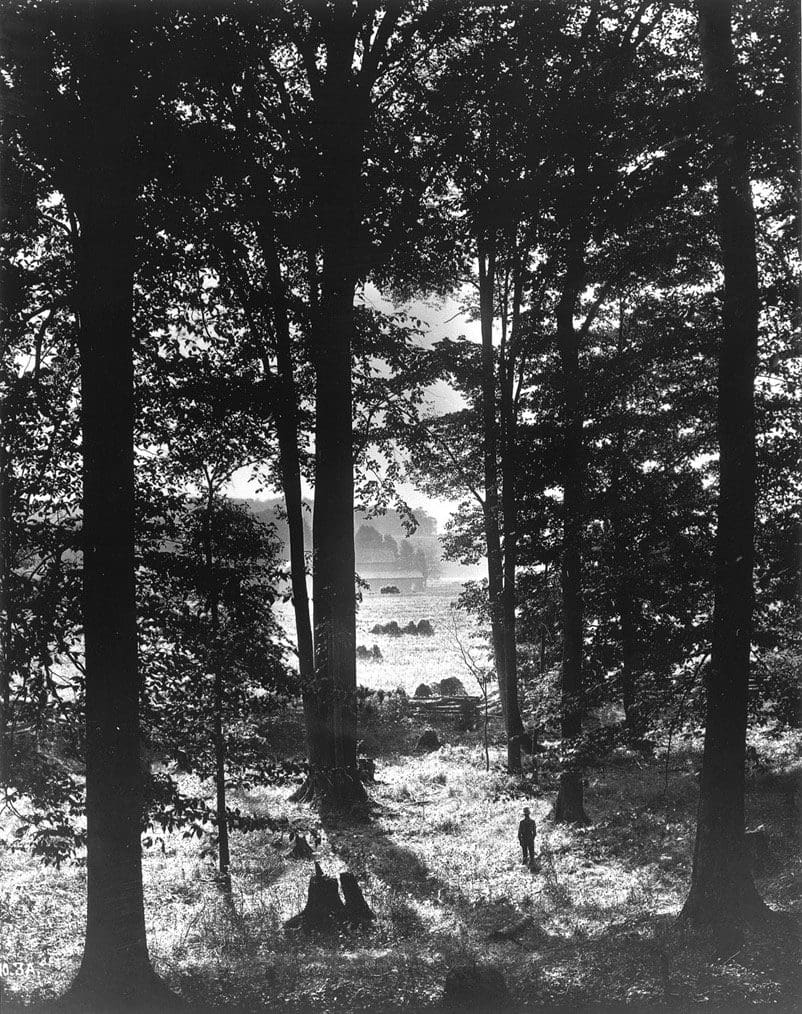
Now come back to that pattern: apostasy and silence, then restoration. Picture western New York in 1820. Revival preachers crisscross the countryside. Methodists, Presbyterians, and Baptists compete for converts, each with the same Bible and a different answer. A fourteen-year-old farm boy named Joseph Smith, confused by it all, reads James 1:5: “If any of you lack wisdom, let him ask of God.” Early one spring morning he walks into the woods near his family’s farm in Manchester Township, near Palmyra, kneels, and asks which church to join. He saw God the Father and His Son, Jesus Christ. The Father pointed to the Son and said, “This is My Beloved Son. Hear Him!” (Joseph Smith—History 1:17).
He later described the moment it happened: “I saw a pillar of light exactly over my head, above the brightness of the sun, which descended gradually until it fell upon me” (Joseph Smith—History 1:16).
Look at what that is. A named prophet. A date. A place. God’s own words. A reason. It is exactly the file the canon’s closing never had: call, authority to come, revelation, record. And notice the timing: the answer to fifty thousand competing interpretations of one book was the same answer God gave in every age. A living voice. (For the multiple accounts Joseph gave, see First Vision Accounts.)
Authority restored the way it was lost
Remember the pattern: God works through authority. So the Restoration didn’t stop at a vision. On May 15, 1829, John the Baptist conferred the Aaronic Priesthood on Joseph Smith and Oliver Cowdery (Doctrine and Covenants 13). Soon after, the ancient apostles Peter, James, and John restored the Melchizedek Priesthood and the apostleship. On April 3, 1836, in the Kirtland Temple, Moses, Elias, and Elijah committed further priesthood keys (Doctrine and Covenants 110).
Not self-appointed. Not voted in. Conferred by those who held the keys before. That’s how authority has always moved in the Bible: by the laying on of hands from someone who has it. More here: Restoration of the Priesthood.
Angels, plates, and new scripture
On the night of September 21–22, 1823, the angel Moroni appeared and told Joseph about a record engraved on gold plates. He received the plates in September 1827. Then came the very thing the Gentiles said couldn’t exist: more Bible. The Book of Mormon was published on March 26, 1830, and the Church was organized on April 6, 1830. The Book of Mormon is a second witness of Jesus Christ from another nation, containing the record of the other sheep hearing His voice, exactly as 2 Nephi 29 described: “the testimony of two nations.” The Doctrine and Covenants followed, containing revelations to a living prophet with dates, places, and the words of the Lord, the same kind of record you find in Exodus and Acts. Then the Pearl of Great Price.
And then the Church put the open canon into its creed, in one sentence:
“We believe all that God has revealed, all that He does now reveal, and we believe that He will yet reveal many great and important things pertaining to the Kingdom of God.”
Articles of Faith 1:9
Past, present, and future. All three tenses of revelation, where Westminster allowed only one. That’s not adding to God’s word. That’s refusing to subtract God’s voice.
“We believe all that God has revealed, all that He does now reveal, and … that He will yet reveal many great and important things.”
The Church of Jesus Christ of Latter-day Saints today is led by a living prophet and twelve apostles, the same structure Paul described in Ephesians 4, and the same “till” still applies.
God proved them wrong
Here’s the beautiful part. Men said the heavens were closed. God didn’t argue with them in a council. He just opened the heavens.
That’s the most effective rebuttal possible. If you tell your friend he’ll never speak to you again, and he calls you the next morning, the debate is over. The canon-closers said God would never again raise up a prophet, never again restore apostles, never again bring forth scripture. Then He did all three, in one man’s lifetime, in a way that matches the biblical pattern down to the details.
You can disagree with that claim. But you can’t refute it with “the canon is closed,” because that’s the very claim on trial.
Now step back and look at the whole story at once.
Part XIIIt was never inspired
Walk back through the story with me one more time.
A voice in a garden. A voice on Sinai, with a prophet, a date, and words carved in stone. A voice to Samuel in the night, to Elijah in the still small voice, to Amos among the sheep. Four hundred years of silence that the Jews themselves called an affliction. A voice at the Jordan. The Word made flesh. A voice on a rooftop in Joppa. A letter that began, “It seemed good to the Holy Ghost.”
And then the apostles died.
After that, the record changes. There’s no more “thus saith the Lord” about the canon. There’s a heretic’s list in Rome. A historian sorting books by popularity. A bishop’s Easter letter that cut Esther. African synods that “received from our fathers.” A reformer who called James straw and moved four books to the back. A council that settled the matter by anathema in 1546. An assembly that outlawed new revelation in 1646. A Bible society that dropped fourteen books’ worth of pages in 1826. And four Christian traditions that still can’t agree on what’s in the book they all call closed.
Every step of God’s pattern is there in the first half of the story: call, authority, revelation, record. Every step is missing from the second half.
The prophets who were honored, dead, while the living were rejected. That’s in the second half too, right on schedule.
So let’s say it without equivocation:
The closing of the canon was not a revelation. It was a decision. Made by men, at different times, in different places, with different results, and without a single word from God. It wasn’t inspired. It was the very famine Amos warned about, renamed as a feast.
And God answered it exactly as He has answered every apostasy since the beginning: by calling a prophet. He opened the heavens over a grove in New York, restored the priesthood by the hands of those who held it, and brought forth more of His word, just as He told Nephi He would: “because that I have spoken one word ye need not suppose that I cannot speak another; for my work is not yet finished” (2 Nephi 29:9).
“The closing of the canon was not a revelation. It was a decision.”
- From Adam onward, God led His people through prophets, and every major change came with a prophet, a date, God’s words, and a reason (Exodus 19; Acts 10; Acts 15; Amos 3:7).
- No prophet, council, or reformer ever claimed a revelation closing the canon. The lists came from bishops, councils, a reformer, and a Bible society.
- Christians still do not agree on the list: 66, 73, more for the Orthodox, about 81 in Ethiopia.
- The Bible names books it does not contain and says it is not the whole record (John 21:25).
- The Bible promises prophets and more of God’s word in the last days (Acts 2:17; Acts 3:21; John 10:16).
- Without living apostles and prophets, billions of fallible interpreters produce tens of thousands of readings (2 Peter 1:20–21; Ephesians 4:11–14).
- God answered the way He always has: by calling a prophet, in a grove, in 1820 (Joseph Smith—History 1:17).
Read it. Then ask Him.
You don’t have to settle this by debate. God gave a way to settle it directly, and that way is itself revelation.
The Book of Mormon ends with a promise:
“And when ye shall receive these things, I would exhort you that ye would ask God, the Eternal Father, in the name of Christ, if these things are not true; and if ye shall ask with a sincere heart, with real intent, having faith in Christ, he will manifest the truth of it unto you, by the power of the Holy Ghost. And by the power of the Holy Ghost ye may know the truth of all things.”
Moroni 10:4–5
Notice what that promise assumes: that God still answers. If the canon-closers are right, that prayer goes nowhere. If they’re wrong, God will tell you Himself.
So test it. Read the Book of Mormon. Not a summary, not a critic’s quote mine, the book. Then ask God, with real intent, whether it’s true. Either the heavens are shut, or they’re open. There’s one way to find out, and it costs you nothing but a prayer.
Read the Book of Mormon for yourself, then ask God, as Moroni invites: “ask God, the Eternal Father, in the name of Christ, if these things are not true… and by the power of the Holy Ghost ye may know the truth of all things” (Moroni 10:4–5).
The voice in the garden never stopped. The canon was never meant to close. And God is still speaking.
Key scriptures by theme
God works through prophets
Amos 3:7 · Numbers 11:29 · Hebrews 1:1–2 · Matthew 10:41 · 1 Corinthians 12:28 · Ephesians 4:11–14
Revelation comes with a name and a date
Exodus 19:1–3, 16 · Luke 3:1–2 · Acts 10:9–16, 28, 34–35 · Acts 15:7, 28 · Joseph Smith—History 1:15–17
Prophets in the New Testament church
Luke 2:36 · Acts 11:27–28 · Acts 13:1 · Acts 15:32 · Acts 21:9–11
The Bible is not the whole record
Joshua 10:13 · 2 Samuel 1:18 · Numbers 21:14 · 1 Chronicles 29:29 · 2 Chronicles 9:29 · Colossians 4:16 · 1 Corinthians 5:9 · Jude 1:14–15 · John 21:25 · 1 Kings 18:4
More is promised
Acts 2:17 · Acts 3:21 · Malachi 4:5 · Revelation 11:3 · John 10:16 · 2 Nephi 29:3–10
The proof texts, in context
Revelation 22:18–19 · Deuteronomy 4:2 · Deuteronomy 12:32 · Proverbs 30:6 · Jude 1:3
Apostasy and restoration
Amos 8:11–12 · 2 Thessalonians 2:3 · 2 Timothy 4:3–4 · Acts 20:29–30 · 2 Peter 1:20–21 · Articles of Faith 1:9 · Moroni 10:4–5
Sources
- Scripture (KJV and Latter-day Saint canon), all verified against churchofjesuschrist.org: Amos 3:7; 8:11–12 · Hebrews 1:1–2 · Ephesians 4:11–14 · 1 Corinthians 12:28 · Acts 3:21; 10:9–16, 28, 34–35; 11:27–28; 15:28, 32; 20:29–30; 21:10–11 · Exodus 19:3 · Matthew 10:41 · Revelation 22:18–19 · Deuteronomy 4:2; 12:32 · Proverbs 30:6 · Jude 1:3 · 2 Thessalonians 2:3 · 2 Timothy 4:3–4 · 2 Nephi 29:3–10 · Moroni 10:4–5 · Articles of Faith 1:9 · Joseph Smith—History 1:17 · Doctrine and Covenants 13; 110: churchofjesuschrist.org
- Athanasius, Letter 39 (Festal Letter of AD 367), sections 4–7: New Advent (NPNF translation)
- Code of Canons of the African Church (AD 419), canon 24, repeating the canon list of Hippo (393) and Carthage (397): New Advent
- Council of Trent, Fourth Session (April 8, 1546), Decree Concerning the Canonical Scriptures: Hanover College historical texts
- Westminster Confession of Faith (1646), chapter 1, section 6: A Puritan’s Mind
- “Biblical canon” (Athanasius, Hippo, Carthage, Trent, Luther’s 1534 Apocrypha, Ethiopian canon including 1 Enoch and Jubilees): Wikipedia, “Biblical canon” (overview; cross-check with primary texts above)
- Church History Topics, “First Vision” and “Priesthood Restoration”: churchofjesuschrist.org
- Galatians18 topic pages: bible-alone · great-apostasy · priesthood-authority · priesthood-restoration · first-vision-accounts
- Additional scripture verified on churchofjesuschrist.org: Genesis 3:8; 5:24 · Exodus 19:1 · Numbers 11:29; 21:14 · Joshua 10:13 · 1 Samuel 3:1 · 2 Samuel 1:18 · 1 Kings 18:4 · 2 Kings 2:3 · 1 Chronicles 29:29 · 2 Chronicles 9:29; 12:15 · Isaiah 2:3 · Joel 2:28 · Malachi 3:6; 4:5–6 · Matthew 13:52; 23:29–31, 34; 25:34 · Luke 2:36; 3:2; 16:29–31 · John 5:39–40; 8:6, 8; 9:28–29; 10:16; 21:25 · Acts 2:17–18; 7:52; 21:8–9 · 1 Corinthians 5:9 · Colossians 4:16 · Hebrews 13:8 · 2 Peter 1:20–21 · James 1:5 · Jude 1:14–15 · Revelation 11:3, 10; 19:13–15 · 2 Nephi 29:11–13 · 3 Nephi 15:21; 16:1–3; 23:9–13
- 1 Maccabees 4:46; 9:27 (KJV Apocrypha): King James Bible Online
- Eusebius, Ecclesiastical History 3.25: New Advent
- Luther’s 1522 placement of Hebrews, James, Jude, and Revelation and the “epistle of straw” preface; 1534 Apocrypha: Wikipedia, “Luther’s canon”
- Marcion’s canon (c. AD 140–144): Wikipedia, “Marcion of Sinope”
- King James Bible Apocrypha and the British and Foreign Bible Society policy of 1826–27: Hill, “The King James Bible Apocrypha,” summarized via Internet Bible Catalog
- Pew Research Center, “How the Global Religious Landscape Changed From 2010 to 2020” (June 9, 2025): 2.3 billion Christians in 2020: pewresearch.org
- Center for the Study of Global Christianity, “Status of Global Christianity, 2025”: about 50,000 denominations: gordonconwell.edu (PDF)
- Galatians18 additional topics: bible-inerrancy · living-prophets
For short, sourced answers to this and the other arguments critics use most, visit Galatians18. Related: Galatians 1:8: Another Gospel? · Are Latter-day Saints Christian?
Follow me on X for more: @TraviXai. And the next time someone tells you the canon is closed, ask them for the prophet’s name and the date God said it. Then wait.
Image credits
- Moses with the Ten Commandments, Rembrandt van Rijn, 1659. Gemäldegalerie, Berlin. Via Wikimedia Commons, public domain. File page.
- Peter’s Vision of a Sheet with Animals, Domenico Fetti, c. 1619. Kunsthistorisches Museum, Vienna. Via Wikimedia Commons, public domain. File page.
- The First Council of Nicaea, Michael Damaskinos, 1591. Via Wikimedia Commons, public domain. File page.
- Martin Luther, Lucas Cranach the Elder, 1528. Veste Coburg. Via Wikimedia Commons, public domain. File page.
- Title page of the first edition of the King James Bible, 1611. Via Wikimedia Commons, public domain. File page.
- Codex Sinaiticus, Matthew 6:4–32, 4th century. Via Wikimedia Commons, public domain. File page.
- Sacred Grove, photograph by George Edward Anderson, c. 1907. Via Wikimedia Commons, public domain. File page.
- Infographics (revelation form, timeline, changes chart, missing books): created for this article by @TraviXai.