

“Joseph Smith was a money digger.”
Critics drop that line like a confession pulled from a locked vault. It isn’t. Joseph answered the question himself, in print, in 1838. The Church’s own essays repeat it. The Joseph Smith Papers publish the documents online for anyone with a browser.
So the fact isn’t in dispute. The context is. And the context is where the critic’s story falls apart, because in the hill country where Joseph grew up, a farm boy with a seer stone wasn’t a con artist or an occultist. He was a neighbor.
Short version on Galatians18: Joseph Smith and Treasure Seeking
What critics claim
The charge usually comes in one of three flavors:
- The con man: Joseph took money from gullible farmers by pretending to see buried gold, then scaled the same trick up into a church.
- The occultist: seer stones and divining rods are witchcraft, so anything that came after is tainted.
- The cover-up: the Church hid all of this until the internet dragged it out.
The third one is the easiest to dismiss, so let’s start there.
Joseph never hid it
In July 1838, the Church’s newspaper, the Elders’ Journal, printed answers to questions Joseph was asked all the time. Question 10:
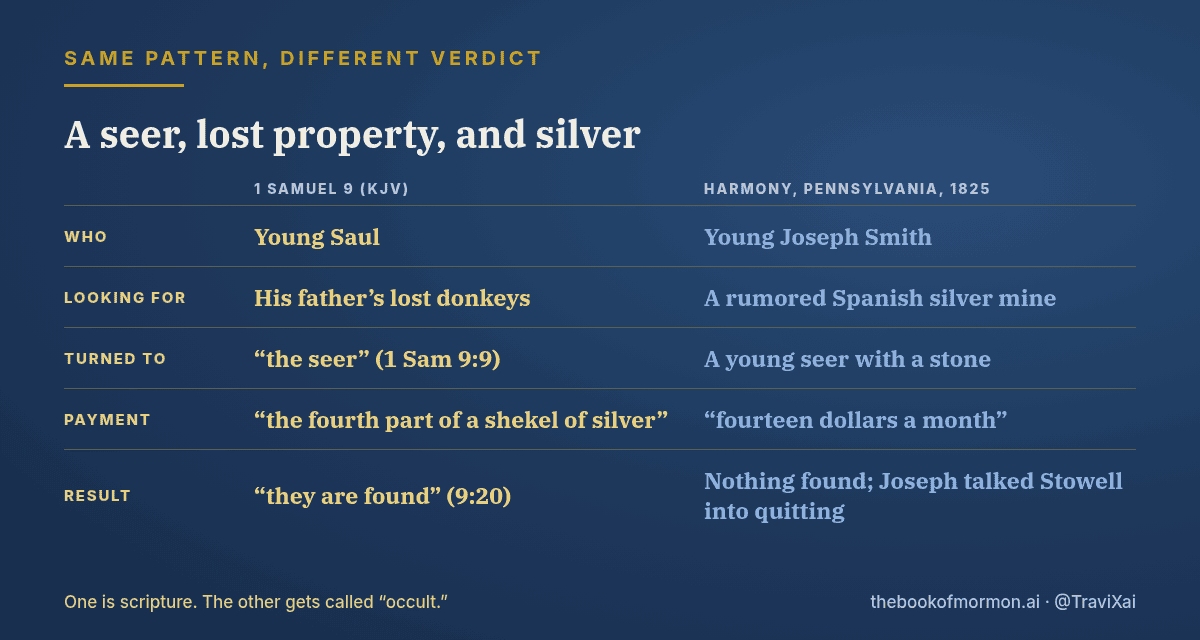
“Was not Jo Smith a money digger. Answer. Yes, but it was never a very profitable job to him, as he only got fourteen dollars a month for it.”
Elders’ Journal, July 1838, p. 43
That’s not a man burying his past. That’s a man joking about his wages.
The same year, he put the episode into the history that is now canonized scripture:
“In the month of October, 1825, I hired with an old gentleman by the name of Josiah Stoal, who lived in Chenango county, State of New York. He had heard something of a silver mine having been opened by the Spaniards in Harmony, Susquehanna county, State of Pennsylvania… After I went to live with him, he took me, with the rest of his hands, to dig for the silver mine, at which I continued to work for nearly a month, without success in our undertaking, and finally I prevailed with the old gentleman to cease digging after it. Hence arose the very prevalent story of my having been a money-digger.”
Joseph Smith—History 1:56
Today the Church’s Gospel Topics essay says it plainly: “As a young man during the 1820s, Joseph Smith, like others in his day, used a seer stone to look for lost objects and buried treasure.” The Joseph Smith Papers add that “in his youth, JS occasionally used seer stones to help neighbors find missing objects or search for buried treasure.” The “secret” is printed in the scriptures, the newspaper, the essays, and the archive. (Galatians18 has a quick answer for this one: Did the Church Hide Its History?)
“Like others in his day”: how common was it?
Very. Ronald W. Walker’s study in BYU Studies opens with the scale:
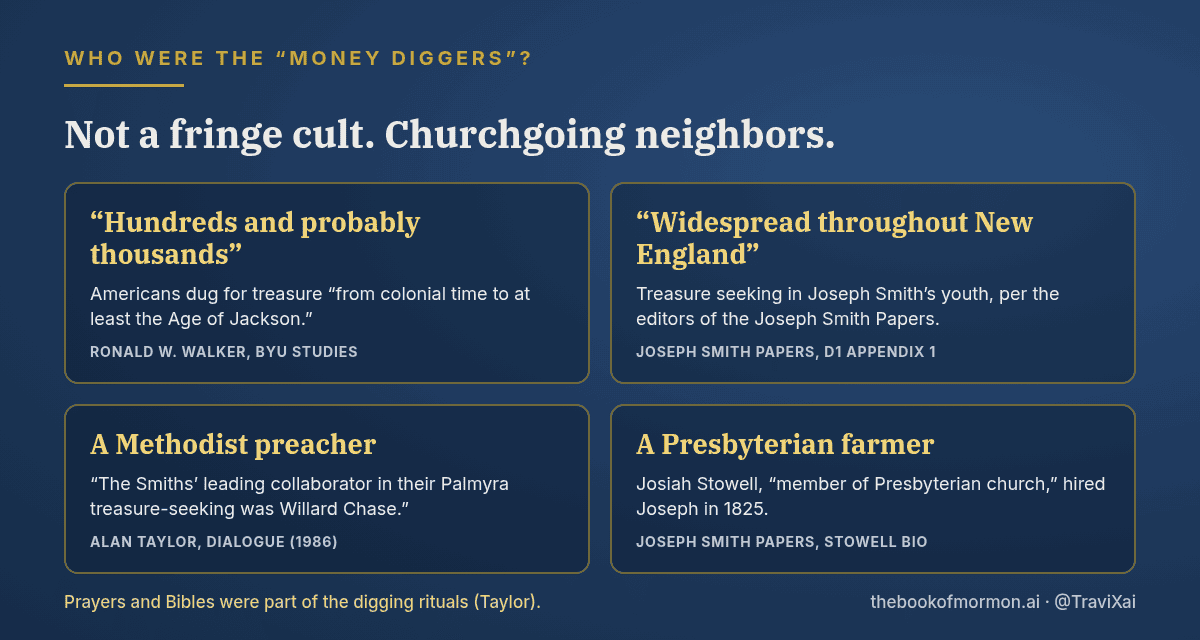
“From colonial time to at least the Age of Jackson, Americans dug for magical treasure. There were hundreds and probably thousands of these ‘money diggers,’ all seeking troves of fabled coins, mines, jewels, and other valued prizes. They worked from the Atlantic Coast to the Mississippi hinterlands…”
Ronald W. Walker, “The Persisting Idea of American Treasure Hunting,” BYU Studies 24, no. 4
Seer stones were part of the kit. Walker writes that “such stones seemed to be everywhere and were of every possible description.” Divining rods were even more respectable. He quotes one early nineteenth-century observer: “From north to south, from east to west, the divining rod has its advocates. Men in various callings, men above reach of mean arts, men of the soundest judgment, of large information, and of the most exemplary lives, do not disown the art.”
The Joseph Smith Papers, introducing the 1825 Stowell agreement, sum it up in one line: “treasure seeking was widespread throughout New England during JS’s youth.” Its glossary adds that the seer-stone tradition “accompanied European immigrants to North America and was part of JS’s cultural environment in western New York in the 1820s, though by then the practice was waning.”
That last phrase matters. Joseph wasn’t the inventor of a strange new scheme. He grew up at the tail end of an old one, which was already being laughed at by the town’s newly educated class.
Not witches: Christian folk religion
Here’s what critics almost never mention: the people doing this were overwhelmingly churchgoing Christians, and they treated it as part of their faith.
Alan Taylor, the non-LDS historian who later won two Pulitzer Prizes, describes the Smiths and thousands of their neighbors as “Christian primitivists,” rural believers who searched their Bibles and their dreams for direct contact with God and longed for the miracles of the apostolic church. He found that the treasure seekers proceeded “using prayers, Bibles, and religious pamphlets in their digging rituals,” and that they “insisted that the presence of anyone of dubious morality or incomplete faith doomed the attempt to recover a treasure.”
Then he adds a detail that wrecks the “occult outsiders” picture: “It was no accident that the Smiths’ leading collaborator in their Palmyra treasure-seeking was Willard Chase, a Methodist preacher.”
Walker found the same pattern. In 1800 a “lapsed Congregational minister” named Nathaniel Wood led a Vermont congregation that used divining rods in church meetings. In Rose, New York, money diggers used an eighteen-year-old minister’s son as their seer, held “mystic meetings,” and “employed a week long prayer vigil.”
And the man who hired Joseph in 1825? The Joseph Smith Papers list Josiah Stowell as a “member of Presbyterian church.” A Presbyterian farmer hiring a young seer to hunt for Spanish silver: that was rural Protestant America in the 1820s.
Non-LDS anthropologist Manuel Padro, as quoted by Saints Unscripted, put it bluntly: “If this were among the Smith family’s motivations, then we have misread the morality of their involvement in this practice.” (For the wider worldview, see Galatians18’s Magic, Folk Religion, and Joseph Smith.)
The Bible’s own seer for lost property
Before anyone calls a seer for lost things “occult,” they should read 1 Samuel 9. Saul’s father has lost his donkeys. After three days of searching, Saul’s servant has an idea:
“Behold, I have here at hand the fourth part of a shekel of silver: that will I give to the man of God, to tell us our way.”
1 Samuel 9:8
The narrator explains: “Beforetime in Israel, when a man went to inquire of God, thus he spake, Come, and let us go to the seer: for he that is now called a Prophet was beforetime called a Seer” (1 Samuel 9:9). And Samuel delivers: “as for thine asses that were lost three days ago, set not thy mind on them; for they are found” (1 Samuel 9:20).
A young man. Lost property. A seer. Silver in hand. If that happened in Harmony, Pennsylvania, it would be Exhibit A. In 1 Samuel it’s the chapter where Israel’s first king meets his prophet.
Jesus didn’t flinch at buried treasure either: “the kingdom of heaven is like unto treasure hid in a field; the which when a man hath found, he hideth, and for joy thereof goeth and selleth all that he hath, and buyeth that field” (Matthew 13:44). The Bible’s real warning was about the heart: “Lay not up for yourselves treasures upon earth… For where your treasure is, there will your heart be also” (Matthew 6:19, 21).
Hold that verse. It’s the turning point of Joseph’s story. (We covered the Bible’s stones, cups, and lots in detail in Seer Stones in the Bible.)
The “con man” math doesn’t work
Run the numbers on the con man theory.
The pay. Fourteen dollars a month, by Joseph’s own account, for a dig that found nothing.
The “victim.” If Joseph scammed Josiah Stowell, Stowell never noticed. The Joseph Smith Papers record that Stowell was a witness for Joseph’s defense in court in 1826 and again in 1830, was at the Smith home when Joseph brought home the plates in 1827, and was baptized into the Church around 1830. Con artists don’t usually turn their marks into character witnesses and fellow believers. (The 1826 hearing gets its own post next; for the short answer, see The 1826 Glass-Looking Hearing)
The family. Joseph’s mother, Lucy Mack Smith, dictated her history in 1844–45 and pushed back on the caricature even then: “let not my reader suppose that… we stopt our labor and went at trying to win the faculty of Abrac drawing Magic circles or sooth saying to the neglect of all kinds of buisness.” She added: “we never during our lives suffered one important interest to swallow up every other obligation.” Historians debate how much that line concedes, but either way she’s describing a farm family that worked, not a family of grifters.
The scholars. Taylor, who isn’t a Latter-day Saint, concluded that in this world “treasure-seekers were neither fools nor deceivers.” (More on outside historians in What Non-LDS Scholars Really Think of Joseph Smith, and on the fraud charge itself in Was Joseph Smith a Con Man?)
One more caution for critics: two of the most-quoted “treasure” documents of the 1980s, a supposed 1825 Joseph Smith letter to Stowell and Martin Harris’s “salamander” letter, turned out to be Mark Hofmann forgeries. Taylor’s own footnote flags the problem, and BYU Studies now prints a warning on Walker’s article. If a meme quotes a hazel stick or a white salamander, check the source.
Where the critic’s story actually comes from
The “dupes and con men” framing has an author. In 1833, Philastus Hurlbut, a former member who had turned against the Church, collected affidavits about the Smiths in Palmyra and Manchester. Taylor describes the premise those affidavits pushed: that treasure seeking “was an ignorant superstition whose devotees were either credulous dupes or cunning con-men equally driven by materialistic greed.”
Taylor’s point is that this was a class judgment, not a historical one. The rising village elite, he writes, “disdained rural folk notions as ignorant, if not vicious, superstitions.” Modern critics inherited that sneer and kept the label. The farmers it was aimed at were mostly ordinary Bible readers.
The real turning point: from buried gold to God’s glory
Here’s the part of Joseph’s story critics skip entirely. When the angel Moroni first appeared in 1823, he warned Joseph about the exact temptation his culture offered:
“Satan would try to tempt me (in consequence of the indigent circumstances of my father’s family), to get the plates for the purpose of getting rich. This he forbade me, saying that I must have no other object in view in getting the plates but to glorify God.”
Joseph Smith—History 1:46
The Church’s essay notes that according to Martin Harris, an angel commanded Joseph to stop treasure seeking, “which he did by 1826.” Joseph’s own history says he talked Stowell into quitting the dig. And the thing he finally brought out of a New York hillside wasn’t coin he could spend. It was a sacred record.
Walker, writing in BYU Studies, put the contrast perfectly: “No English or American village adept ever produced a Book of Mormon.”
That’s the context critics leave out. Treasure seeking was common, it was Christian, it paid Joseph almost nothing, and he walked away from it. The stone stayed. The purpose changed. By their fruits ye shall know them (Matthew 7:20), and the fruit here is a book of more than 500 pages testifying of Jesus Christ.
Sources
- Elders’ Journal, July 1838, p. 43 (Questions and Answers): josephsmithpapers.org
- Joseph Smith—History 1:46, 56: churchofjesuschrist.org
- Gospel Topics Essays, “Book of Mormon Translation” (treasure seeking, seer stone, footnotes on Harris and the 1838 answers): churchofjesuschrist.org
- Joseph Smith Papers, “Seer stone” glossary: josephsmithpapers.org
- Joseph Smith Papers, Josiah Stowell biography: josephsmithpapers.org
- Joseph Smith Papers, “Appendix 1: Agreement of Josiah Stowell and Others, 1 November 1825” (historical introduction): josephsmithpapers.org
- Lucy Mack Smith, History, 1844–1845, bk. 3, p. [10]: josephsmithpapers.org
- Alan Taylor, “Rediscovering the Context of Joseph Smith’s Treasure Seeking,” Dialogue 19, no. 4 (1986): 18–28: PDF
- Ronald W. Walker, “The Persisting Idea of American Treasure Hunting,” BYU Studies 24, no. 4: byustudies.byu.edu
- Saints Unscripted, “The truth about Joseph Smith, treasure-digging, witchcraft, magic, and the occult” (transcript, quoting Manuel Padro): saintsunscripted.com
- KJV texts (Church edition): 1 Samuel 9 · Matthew 13:44 · Matthew 6:19–21 · Matthew 7:20
The next time someone says “money digger” like it settles anything, ask them about Saul’s donkeys and the quarter shekel. For short, sourced answers to the attacks critics use most, visit Galatians18.
Follow me on X for more: @TraviXai.