

In debates on X, I keep asking one question, and it keeps going unanswered: which verse says the Father has no body? Not a verse that says God is great, or everywhere. A verse that says no body. The answer is almost always the same three words: “God is a Spirit.”
So let’s take John 4:24 seriously: read it in its chapter, check its grammar, and set it beside what the Bible says people saw when they saw God.
Related read: my shorter take on this in Same Divine Nature Isn’t Consubstantial. This is the deep dive.
A conversation at a well
John 4 opens with Jesus tired and thirsty. He “must needs go through Samaria,” and He sits on Jacob’s well near Sychar “about the sixth hour” (John 4:4–6). A Samaritan woman comes to draw water, and she’s startled that He talks to her at all, “for the Jews have no dealings with the Samaritans” (4:9).
When the conversation turns personal, she changes the subject to the oldest argument between their peoples:
Our fathers worshipped in this mountain; and ye say, that in Jerusalem is the place where men ought to worship.
John 4:20
“This mountain” is Mount Gerizim, the Samaritans’ holy place. The Jews said Jerusalem. The question on the table was where to worship. Jesus answers it:
Woman, believe me, the hour cometh, when ye shall neither in this mountain, nor yet at Jerusalem, worship the Father… But the hour cometh, and now is, when the true worshippers shall worship the Father in spirit and in truth: for the Father seeketh such to worship him. God is a Spirit: and they that worship him must worship him in spirit and in truth.
John 4:21, 23–24
The point is plain. Neither mountain. Worship isn’t a matter of location; it’s a matter of spirit and truth. Notice, too, that the Father in verse 23 seeks worshippers. That’s a person doing something, not an abstraction.
Nobody in the conversation asked what God is made of. Next she mentions the Messiah, and Jesus answers, “I that speak unto thee am he” (4:26). The Messiah at the well had a body, was tired, and wanted a drink.
Three Greek words
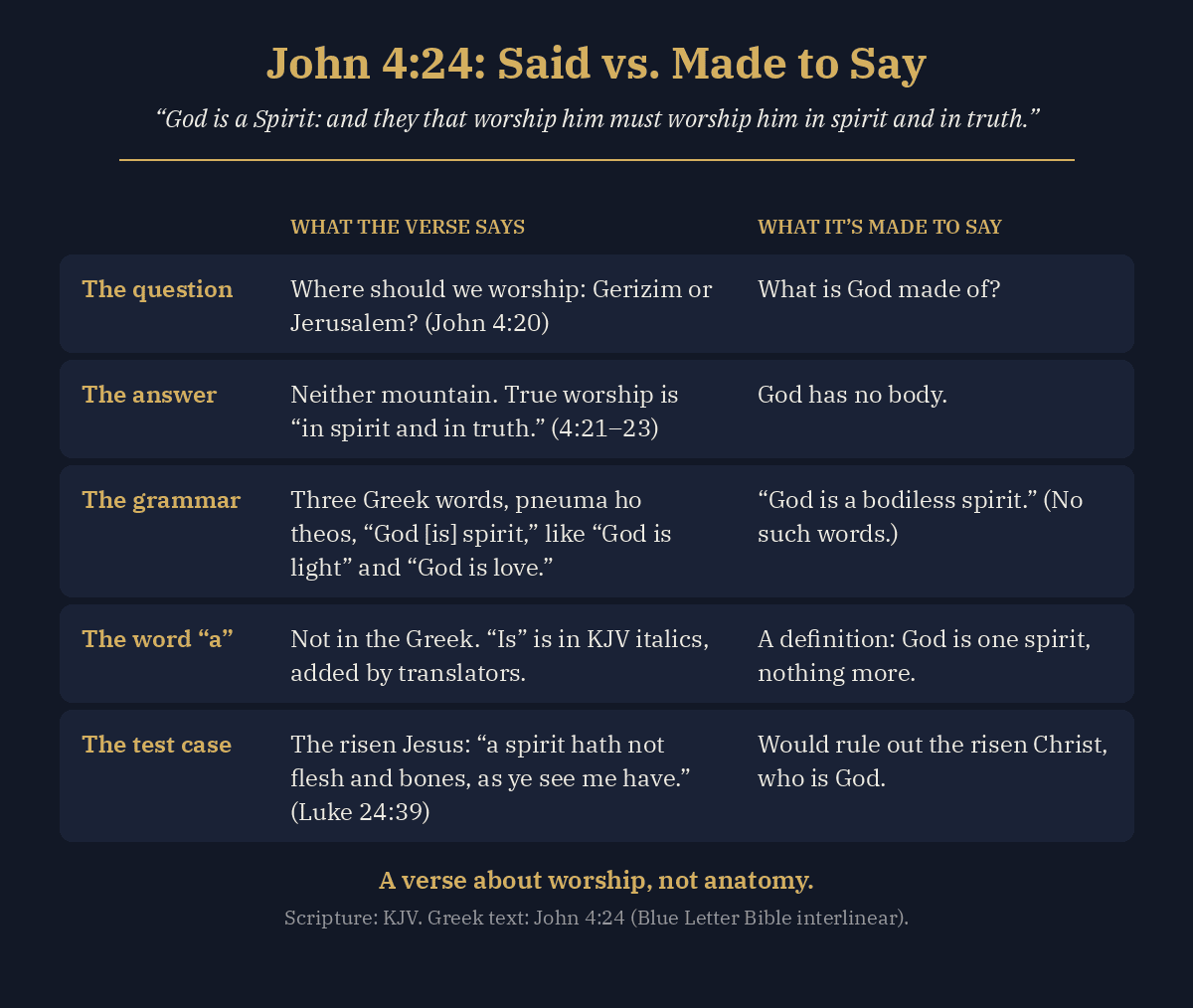
In Greek the clause is three words: pneuma ho theos, literally “spirit [is] God” in word order, “God is spirit” in sense. Greek has no indefinite article, so the “a” in “a Spirit” is the translators’ choice. In the KJV the word “is” is printed in italics, the KJV’s way of marking a word supplied for English. The Blue Letter Bible renders it “God [is] a Spirit.”
John uses the same kind of short statement elsewhere:
- “God is light, and in him is no darkness at all” (1 John 1:5).
- “He that loveth not knoweth not God; for God is love” (1 John 4:8).
- “For our God is a consuming fire” (Hebrews 12:29, echoing Deuteronomy 4:24).
Nobody reads 1 John 1:5 and concludes God is made of photons, or Hebrews 12:29 and concludes He’s combustion. These statements tell you what God is like and how to approach Him. If “God is light” doesn’t mean “God has no body,” “God is spirit” doesn’t either. The word that would settle it, “incorporeal,” isn’t in the verse.
The verse that answers John 4:24
If “God is spirit” means “God cannot have flesh and bones,” it rules out Jesus Christ, who is God and has flesh and bones right now.
After the Resurrection, the disciples “supposed that they had seen a spirit.” Jesus corrected them:
Behold my hands and my feet, that it is I myself: handle me, and see; for a spirit hath not flesh and bones, as ye see me have.
Luke 24:39
Then He ate broiled fish in front of them (24:42–43). And He didn’t set that body aside when He ascended. The angels said, “this same Jesus… shall so come in like manner as ye have seen him go into heaven” (Acts 1:11). Paul writes in the present tense: “in him dwelleth all the fulness of the Godhead bodily” (Colossians 2:9), and “Christ being raised from the dead dieth no more” (Romans 6:9). Our Mediator is still “the man Christ Jesus” (1 Timothy 2:5).
So John 4:24 and Luke 24:39 have to fit together. They fit easily if “spirit” describes God’s nature and how He’s worshiped. They collide head-on if “spirit” means “no body.”
“That’s just anthropomorphism”
The usual reply is that God’s face, hands, and feet in the Bible are figures of speech. Some passages really are. “Under his wings shalt thou trust” (Psalm 91:4) is poetry, and nobody claims to have seen feathers.
But the theophanies aren’t poems. They’re accounts of people who say they saw someone:
- Moses, Aaron, Nadab, Abihu, “and seventy of the elders of Israel… saw the God of Israel: and there was under his feet as it were a paved work of a sapphire stone.” Then, “they saw God, and did eat and drink” (Exodus 24:9–11). That’s a named group, on a mountain, at a meal.
- “The LORD spake unto Moses face to face, as a man speaketh unto his friend” (Exodus 33:11). Later God covers him “with my hand” and shows him “my back parts” (33:22–23). A metaphor doesn’t need a cleft in a rock.
- God contrasts other prophets, who get visions and dreams, with Moses: “With him will I speak mouth to mouth, even apparently, and not in dark speeches; and the similitude of the LORD shall he behold” (Numbers 12:6–8). God Himself says Moses’ experience wasn’t figurative.
- Isaiah “saw also the LORD sitting upon a throne” and cried, “mine eyes have seen the King, the LORD of hosts” (Isaiah 6:1, 5).
- Ezekiel saw on the throne “the likeness as the appearance of a man” (Ezekiel 1:26).
- Daniel saw “the Ancient of days” seated, his hair “like the pure wool,” and then “one like the Son of man… came to the Ancient of days, and they brought him near before him” (Daniel 7:9, 13). Two figures, one approaching the other.
- Stephen, “full of the Holy Ghost,” saw “Jesus standing on the right hand of God” (Acts 7:55–56).
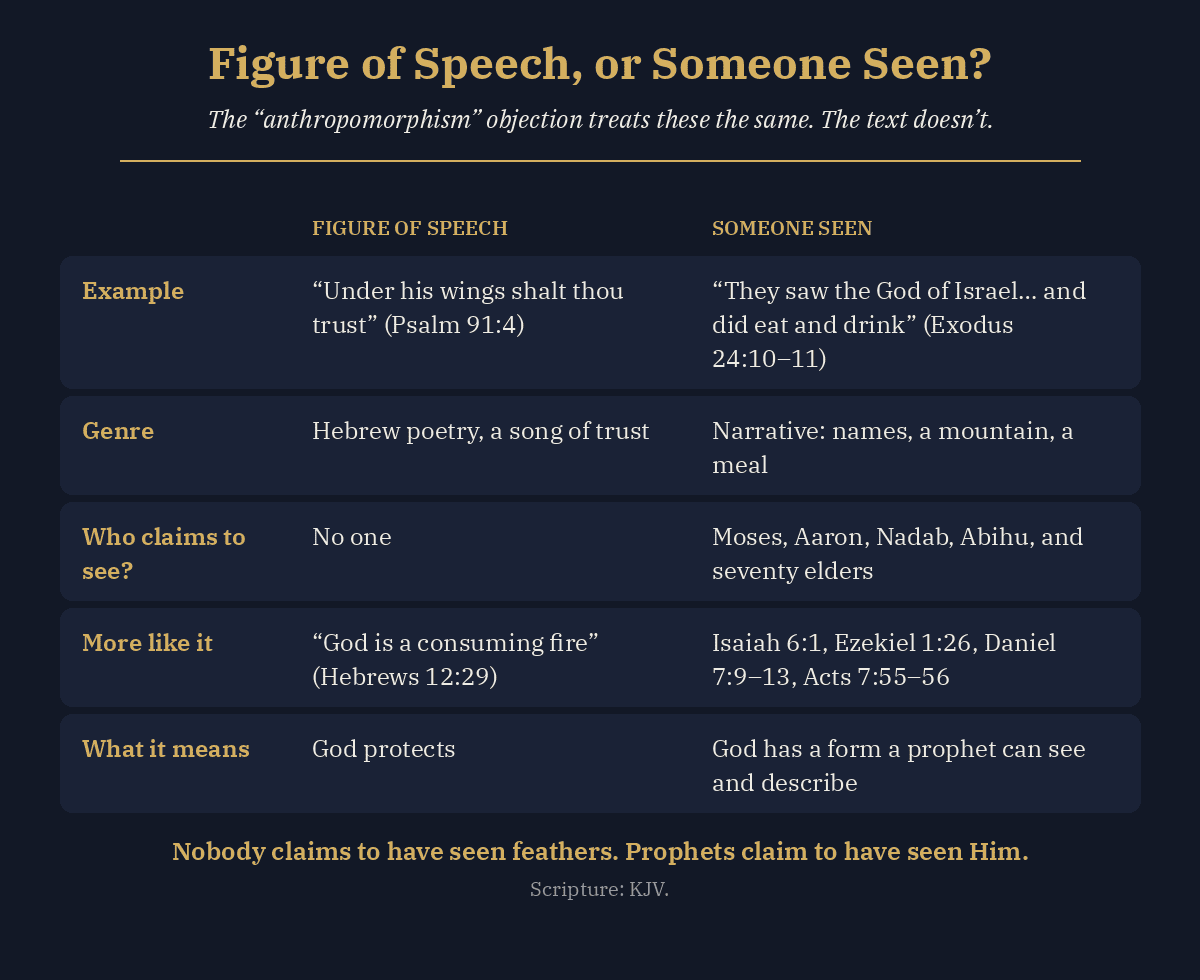
A vision shows the prophet what is there. Daniel sees two persons in two places. Stephen sees the Son at the right hand of someone else. If the Father has no form at all, what did they see?
“No man hath seen God at any time”
The other proof text is John 1:18. Read the whole verse: “No man hath seen God at any time; the only begotten Son, which is in the bosom of the Father, he hath declared him.” Two chapters later, John adds: “Not that any man hath seen the Father, save he which is of God, he hath seen the Father” (John 6:46). So the Father can be seen. The Son has seen Him.
Exodus 33 holds both truths: face to face in verse 11, “no man see me, and live” in verse 20. Mortal eyes can’t bear God’s full glory unaided. As Moses puts it in the Book of Moses, “mine own eyes have beheld God; but not my natural, but my spiritual eyes… for I was transfigured before him” (Moses 1:11). That’s a limit on us, not a statement that there’s nothing there to see.
The Son shows us the Father
When Philip asks to see the Father, Jesus says, “he that hath seen me hath seen the Father” (John 14:9). Paul calls Christ “the image of the invisible God” (Colossians 1:15), and Hebrews calls Him “the express image of his person” (Hebrews 1:3). The Greek there is charaktēr, the impression a seal stamps into wax. An exact impression of a person.
And the promise extends to us. Christ “shall change our vile body, that it may be fashioned like unto his glorious body” (Philippians 3:21). “We shall be like him; for we shall see him as he is” (1 John 3:2). In the end, the faithful “shall see his face” (Revelation 22:4). (Genesis 1:26 belongs here too, but that’s the next article.)
What early Christians actually said
It’s often assumed the church always taught a bodiless God. The record is messier, and the best witness is someone who opposed the idea of a corporeal God.
Origen of Alexandria, writing in the early 200s, opens On First Principles with this complaint: “I know that some will attempt to say that, even according to the declarations of our own Scriptures, God is a body.” And their evidence? “That our God is a consuming fire; and in the Gospel according to John, that God is a Spirit” (De Principiis 1.1.1). The very verse now used to prove God has no body was being used by Christians to argue that He does.
In his preface, Origen admits more. “The term ἀσώματον, i.e., incorporeal, is disused and unknown, not only in many other writings, but also in our own Scriptures.” He also lists, among the questions the church’s teaching hadn’t settled, “how God himself is to be understood — whether as corporeal, and formed according to some shape, or of a different nature from bodies — a point which is not clearly indicated in our teaching” (De Principiis, Preface 8–9). A caveat here: most of this work survives in Rufinus’s Latin translation, and the English quoted here is from the Ante-Nicene Fathers.
Tertullian, in North Africa around the same time, went further: “For who will deny that God is a body, although God is a Spirit? For Spirit has a bodily substance of its own kind, in its own form” (Against Praxeas 7). Tertullian’s view isn’t the Latter-day Saint view; he was thinking in the categories of his day. But it shows that “spirit, therefore bodiless” was not the obvious reading of John 4:24 to early Christians. It became official later, helped along at Nicaea by an emperor’s explanation that the divine nature “has no body” (see the earlier post).
The restored answer
In the spring of 1820, a farm boy in New York asked God which church to join. He later wrote, “I saw two Personages, whose brightness and glory defy all description, standing above me in the air. One of them spake unto me, calling me by name and said, pointing to the other—This is My Beloved Son. Hear Him!” (Joseph Smith—History 1:17). Two Personages, like Daniel’s two figures and Stephen’s two.
Later, the Lord revealed it plainly:
The Father has a body of flesh and bones as tangible as man’s; the Son also; but the Holy Ghost has not a body of flesh and bones, but is a personage of Spirit. Were it not so, the Holy Ghost could not dwell in us.
Doctrine and Covenants 130:22
That doesn’t contradict John 4:24. God is spirit, worship is “in spirit and in truth,” and the Father has a glorified body, as the risen Son does. Both are true. Only “no body” has to be read into the text.
The scorecard
On one side: Jacob “face to face” (Genesis 32:30), seventy elders at a meal, Isaiah’s King, Ezekiel’s “appearance of a man,” Daniel’s two figures, Stephen’s vision, a risen Christ who eats fish, and the promise that we’ll see His face. On the other: a verse about where to worship, read as a statement about anatomy.
So I’ll ask again, kindly: which verse says the Father has no body? Until someone finds it, I’ll take the prophets at their word. They said they saw Him.
For more on the many “gods” passages the Bible also contains, see The Gods of the Bible (2026 Edition). Next up here: “Made in His Image,” on Genesis 1:26 and 5:3.
Credit where it’s due
- The translators of the Ante-Nicene Fathers series (Frederick Crombie for Origen’s De Principiis, Peter Holmes for Tertullian’s Against Praxeas) and Kevin Knight and New Advent for putting the Church Fathers online free.
- Blue Letter Bible for its free KJV text and Greek interlinear.
- The Church of Jesus Christ of Latter-day Saints for its free scriptures and the Now You Know video above.
I argue this daily on X. Follow me at @TraviXai. And if someone answers all this with Galatians 1:8, the Galatians 1:8 app is ready for that conversation.
Sources
- Bible quotations from the King James Version.
- John 4:24 KJV with Greek interlinear: Blue Letter Bible
- Origen, De Principiis, Preface 8–9 (trans. Frederick Crombie, Ante-Nicene Fathers, vol. 4): newadvent.org
- Origen, De Principiis 1.1.1: newadvent.org
- Tertullian, Against Praxeas 7 (trans. Peter Holmes, Ante-Nicene Fathers, vol. 3): newadvent.org
- Letter of Eusebius of Caesarea to his church (325), trans. Aaron West: fourthcentury.com
- Doctrine and Covenants 130:22: churchofjesuschrist.org
- Joseph Smith—History 1:17: churchofjesuschrist.org
- Moses 1:11: churchofjesuschrist.org
- Video: “What Mormons Believe about the Godhead | Now You Know,” The Church of Jesus Christ of Latter-day Saints: YouTube