
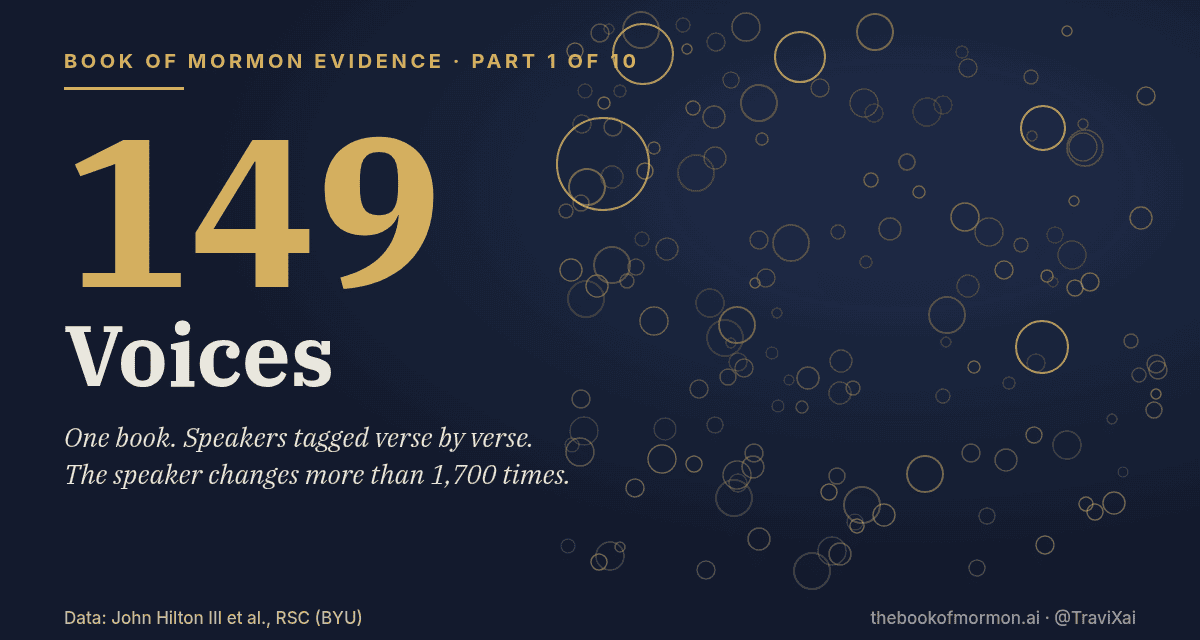

Ask a critic who wrote the Book of Mormon and you’ll usually get one name: Joseph Smith, age 23, dictating to a scribe in 1829. That’s a tidy answer for a book that’s anything but tidy. Open it and you get prophets quoting prophets, fathers writing to sons, a king’s sermon, a war captain’s letters, an angel, a lawyer, a few hecklers, and Jesus Christ himself. The book says it’s an abridgment of many records. So somebody went and counted the voices.
This started as a post on X, Part 1 of my 10-part Book of Mormon Evidence series. This is the longer version, with the numbers, the method, and the fine print.
The team that tagged every verse
In 2011, John Hilton III was a brand-new assistant professor of ancient scripture at Brigham Young University. He’d been hired along with Shon Hopkin and Jennifer Brinkerhoff Platt. Randal Wright, an institute teacher in Texas and a friend of all three, suggested a project: figure out who is speaking in every passage of the Book of Mormon. They hired a BYU student, Jana Johnson, as a research assistant and got to work.
The method was simple and slow. All five of them read the whole Book of Mormon on their own and noted who was speaking in each verse. Then they compared notes, went back over every passage where they disagreed, and checked their results against earlier speaker lists, including John L. Hilton and Kenneth Jenkins’s 1983 listing, Alvin Rencher’s divisions, and the quotation marks in Grant Hardy’s Reader’s Edition.
They made one big rule up front: take the text at face value. If Nephi writes that Laman said something, the words go to Laman. Hilton is upfront that this has limits. Nephi was writing about thirty years after some of those conversations, so he may be paraphrasing, the way ancient historians like Thucydides openly did. Hilton’s point is narrower: for the major speakers, there are enough words to hear real differences.
149 voices and 1,700 handoffs
Here’s what they found. In Hilton’s 2024 article in the RSC Review, he writes that he and his colleagues “identified 149 different voices.” (The opening chapter of his book gives the count as 150. Either way, it’s a crowded book.) Many speak only a few words. Hilton’s examples run “from Amnor to Zeram,” two of four men who report to Alma together in Alma 2:24–25.
The speaker changes “more than seventeen hundred times.”
Fifteen speakers each have at least 1 percent of the text, and together they account for 87 percent of it:
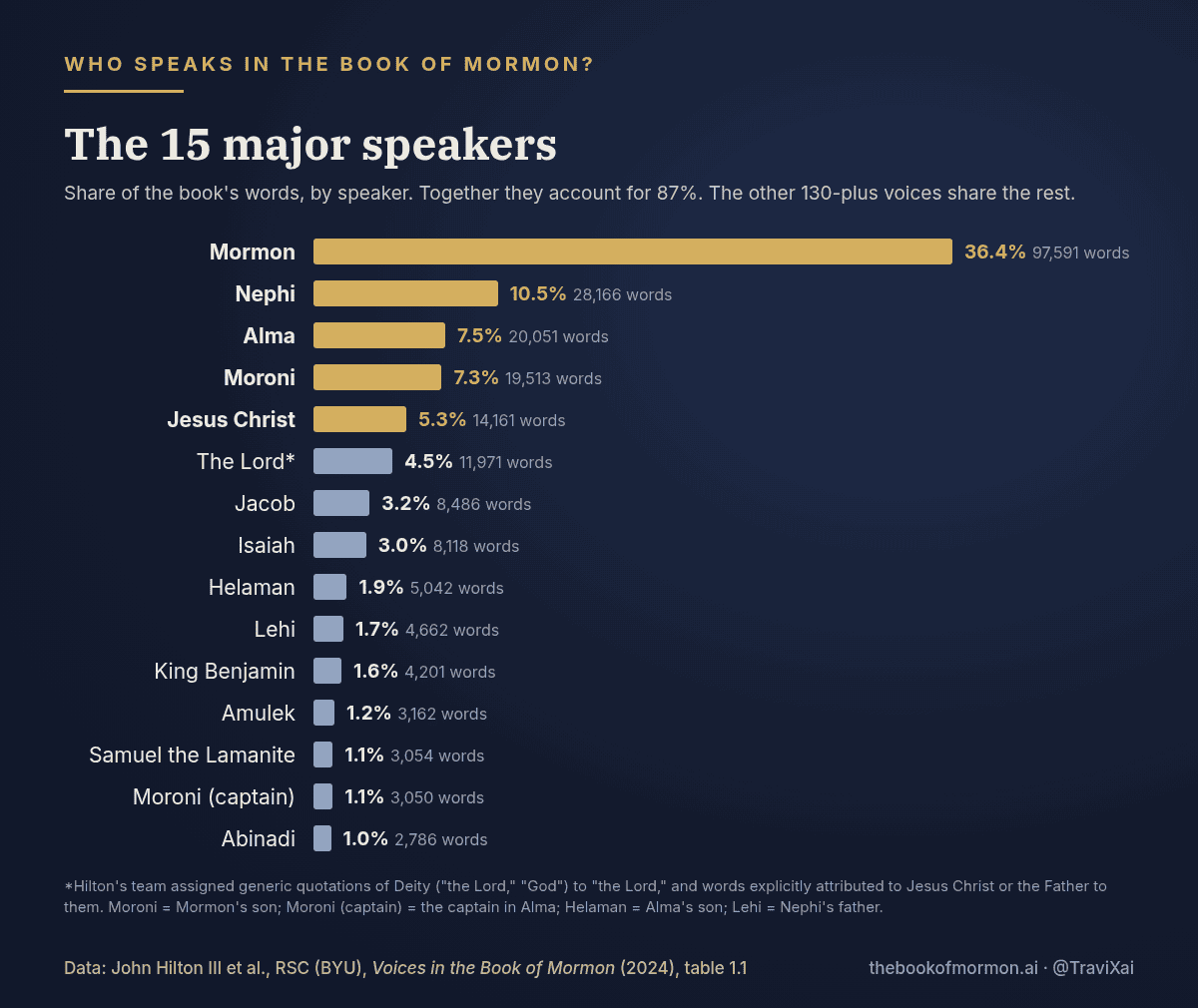
Mormon leads with 97,591 words (36.4%), which is what you’d expect from the man who abridged most of the record. Then Nephi (28,166 words, 10.5%), Alma (20,051, 7.5%), Moroni (19,513, 7.3%), and Jesus Christ (14,161, 5.3%).
A few things surprise people. Alma says more than Jacob or Moroni. Helaman outtalks his famous ancestor Lehi, mostly because of his long letter in Alma 56–58.
Some of the handoffs are layered. In Jacob 5, Jacob quotes Zenos, Zenos quotes the Lord, and the Lord tells a story in which the master of the vineyard speaks. That’s four voices deep within four verses. Historian Richard Bushman, quoted by Hilton, put it this way: “Almost always two minds are present, and sometimes three, all kept account of in the flow of words.”
Verbal fingerprints
Once every verse had a speaker, the team worked with the developers of WordCruncher to build a searchable database, “Voices of the Book of Mormon.” It’s free to download. A normal search tells you where a word appears. This one tells you who said it. That’s where the habits show up.
Nephi’s delight
The phrase “my soul delighteth” appears eleven times in the Book of Mormon, across multiple chapters. Every time, it’s Nephi:
For my soul delighteth in the scriptures, and my heart pondereth them, and writeth them for the learning and the profit of my children. Behold, my soul delighteth in the things of the Lord; and my heart pondereth continually upon the things which I have seen and heard.
2 Nephi 4:15–16
Two brothers, two vocabularies
Nephi and Jacob grew up in the same family, learned from the same father, and wrote on the same small plates. You’d expect them to sound alike. They don’t. Hilton’s son Joseph spotted it at age eleven, while making a spreadsheet of every title for Christ in the book. Nephi leans on “Lord” (9.6 times per 1,000 words, against Jacob’s 5.9). Jacob leans on “God” (12.6 per 1,000, against Nephi’s 7.2).
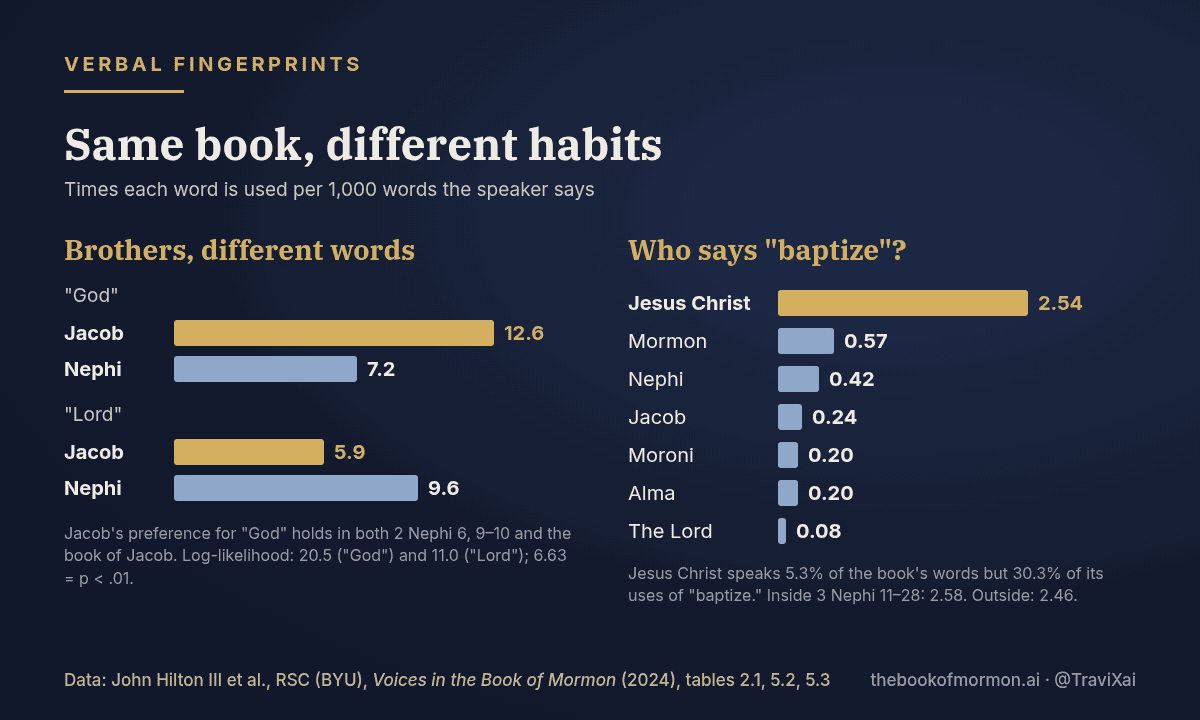
These differences are statistically significant. The log-likelihood scores are 20.5 for “God” and 11.0 for “Lord,” where 6.63 already means p < .01. Here's the part that matters most: Jacob first speaks in 2 Nephi 6 and 9–10, inside Nephi's book, nearly forty pages before the book of Jacob begins. If one man were writing both brothers, you'd expect those chapters to sound like the Nephi chapters around them. Instead, 2 Nephi 9–10 follows Jacob's pattern, not Nephi's. Jacob's voice comes through in both places.
There’s more. The phrase “beloved brethren” appears 72 times in the book, and Jacob says it 20 times, more than anyone, even though Nephi speaks more than three times as many words. One more detail: “God,” Jacob’s favorite word, never appears in Jacob 5. That chapter is almost all Zenos.
The Savior’s voice
Jesus Christ speaks 5.3 percent of the Book of Mormon’s words but says 30.3 percent of its “baptize”s. That’s 2.54 times per 1,000 words. The next highest major speaker is Mormon, at 0.57. It isn’t just a 3 Nephi 11 effect, either. Inside 3 Nephi 11–28, his rate is 2.58. Everywhere else in the book, it’s 2.46. Same habit, wherever he speaks.
It goes beyond word counts. In 61 percent of the verses where Jesus says “baptize,” he also says “name” (“baptized in my name”). Mormon does that 11 percent of the time, and Nephi never does in his own voice. The full phrase “verily, verily I say unto you” appears 25 times in the Book of Mormon, 24 of them from Jesus. “Verily I say” appears 23 times, all from Jesus. That matches the New Testament, where those phrases come only from Jesus.
Hilton noticed something about Mormon, too. Before 3 Nephi 9, Mormon writes “baptized unto repentance” eight times and never “baptized in the name of Jesus.” After Christ’s visit, it’s the reverse: the name phrase five times, the old phrase never again. One explanation Hilton offers is that Mormon took his cue from the Savior. As Jesus said in John 10:27, “My sheep hear my voice, and I know them, and they follow me” (KJV).
A father borrowing a prophet’s words
When Alma counsels his son Corianton in Alma 39–42, Hilton counts at least thirteen phrases that seem to come from Abinadi, and many of them appear nowhere else in the Book of Mormon. That makes sense: Abinadi converted Alma’s father, who “did write all the words which Abinadi had spoken” (Mosiah 17:4). The pattern is very specific. Two of the borrowings link Corianton’s mission to Abinadi’s. Every other one deals with one of Corianton’s three worries: the Resurrection, the restoration, and the justice of God in punishing sin. “Cast out” and “gnashing of teeth” appear together in the Book of Mormon only twice, in Abinadi (Mosiah 16:2) and in Alma’s counsel (Alma 40:13). Hilton first laid this out in BYU Studies in 2012.
“Couldn’t a gifted writer fake all this?”
It’s a fair question, and Hilton raises it himself. His answer: “yes, it is possible.” Good novelists give their characters distinct voices. Researchers Paul Fields, Larry Bassist, and Matt Roper showed that Dickens, Austen, Twain, and Cooper could do this in a way stylometry can measure.
Then the same team ran the Book of Mormon through the same method. According to Scripture Central’s summary, its “voice diversity value was more than twice that of the average for the 19th century novelists,” and bigger than all eight of their novels combined. As of Hilton’s 2024 book, this work hadn’t been formally published, so treat it as a strong pointer, not a final verdict.
Now remember who was supposed to be doing the faking. Hilton notes that Joseph Smith “was twenty-three years old and had very little formal education.” Those novelists were professional writers. Joseph dictated. His wife Emma, one of his scribes, described him “dictating hour after hour with nothing between us,” and said flatly, “He had neither manuscript nor book to read from.” After meals or interruptions, he would “at once begin where he had left off, without either seeing the manuscript or having any portion of it read to him” (quoted in the Church’s Gospel Topics essay on the translation).
So the theory is that a young farmer with no notes kept 149 characters straight through more than 1,700 speaker changes. He gave two brothers different vocabularies that stay consistent forty pages apart. He gave the Savior habits that hold across the whole book. And he had one prophet quietly borrow from another to answer a son’s exact worries. The book’s own explanation is shorter. The title page calls it “an abridgment of the record of the people of Nephi,” and Mormon explains that he’s working from records “delivered into my hands” (Words of Mormon 1:3). Many writers, one abridger. The voices are what you’d expect from that.
What this does and doesn’t prove
Hilton is careful here, and so am I. He writes, “I am certainly not advocating basing one’s testimony of the Book of Mormon on wordprints.” Speaker tagging can’t prove where the plates came from. What it does is take apart the idea that the book is one man’s voice wearing a hundred costumes. Hilton’s own conclusion is that the book’s complexity “strongly suggests that the Book of Mormon is a multiauthored work and that Joseph Smith did not write the Book of Mormon.”
He quotes the Anglican theologian Austin Farrer on why that kind of evidence still matters: “Rational argument does not create belief, but it maintains a climate in which belief may flourish.” The Bible sets the same standard: “In the mouth of two or three witnesses shall every word be established” (2 Corinthians 13:1, KJV). The Book of Mormon brings a lot more than three.
For the rest of the evidence in one place, see The Best Book of Mormon Evidences, in One Place.
Watch: John Hilton III on the voices
In this Y Religion episode from BYU Religious Education, Hilton walks through the voices of Nephi, Mormon, Jacob, and Jesus Christ, and how later prophets echo earlier ones.
Next: The Berkeley Wordprint Test
Hilton says his interest started with his grandfather. John L. Hilton was a BYU statistics professor who specialized in wordprints, and the FBI brought him in to analyze the Unabomber’s essay. He was also part of a group in Berkeley that put the Book of Mormon’s wordprints to the test. That’s Part 2: The Berkeley Wordprint Test, coming next here on the blog.
Credit where it’s due
This post rests on other people’s careful work. Thanks to:
- John Hilton III, professor of ancient scripture at BYU, for more than a decade on this project, for the RSC Review article, and for the book Voices in the Book of Mormon: Discovering Distinctive Witnesses of Jesus Christ (2024).
- Shon Hopkin, Jennifer Brinkerhoff Platt, Randal Wright, and Jana Johnson, who tagged the speakers with him and helped build the Voices of the Book of Mormon Database.
- Monte Shelley, Jason Dzubak, and Jesse Vincent for the WordCruncher work Hilton says the book couldn’t exist without, and Joseph Hilton for spotting the “Lord”/”God” pattern at age eleven.
- BYU’s Religious Studies Center for publishing the book (with Deseret Book) and putting its chapters online free.
- Paul J. Fields, Larry Bassist, and Matthew Roper for the voice-diversity research, and Scripture Central for summarizing it.
- Richard L. Bushman for the “two minds… sometimes three” line, and earlier speaker-list makers John L. Hilton, Kenneth D. Jenkins, Alvin C. Rencher, and Grant Hardy.
- BYU Religious Education and the Y Religion podcast for the video above.
For more like this, follow me on X at @TraviXai. And if someone answers all this with Galatians 1:8, the Galatians 1:8 app is ready for that conversation.
Sources
- John Hilton III, “Voices in the Book of Mormon,” RSC Review (Winter 2024): rsc.byu.edu
- John Hilton III, Voices in the Book of Mormon: Discovering Distinctive Witnesses of Jesus Christ (Provo, UT: Religious Studies Center, BYU; Salt Lake City: Deseret Book, 2024): rsc.byu.edu
- Hilton, ch. 1, “Voices in the Book of Mormon,” 3–24 (method, 150 voices, table 1.1, Bushman quote): rsc.byu.edu
- Hilton, ch. 2, “Jacob: Tender and Stern” (table 2.1, “beloved brethren”): rsc.byu.edu
- Hilton, ch. 5, “The Savior’s Voice in the Book of Mormon” (tables 5.2–5.4, “verily”): rsc.byu.edu
- Hilton, ch. 9, “Turning to Prophets: Similarities in the Words of Abinadi and Alma’s Counsel to Corianton”: rsc.byu.edu
- John Hilton III, “Textual Similarities in the Words of Abinadi and Alma’s Counsel to Corianton,” BYU Studies Quarterly 51, no. 2 (2012): 39–60: byustudies.byu.edu
- Voices of the Book of Mormon Database, free to download: johnhiltoniii.com
- Scripture Central, “Voice Diversity” (Fields, Bassist, and Roper): scripturecentral.org
- Fields, Bassist, and Roper, “Characters in 19th Century Novels Display Distinctive Voices as Seen by Stylometric Analysis” (DH 2017 abstract): dh-abstracts.library.virginia.edu
- “Book of Mormon Translation,” Gospel Topics Essays (Emma Smith quotations, from “Last Testimony of Sister Emma,” Saints’ Herald, 1879): churchofjesuschrist.org
- Scriptures: 2 Nephi 4:15–16; Jacob 5; Words of Mormon 1; Title Page; John 10:27 and 2 Corinthians 13:1 (KJV): John 10, 2 Corinthians 13
- The original X post: x.com/TraviXai