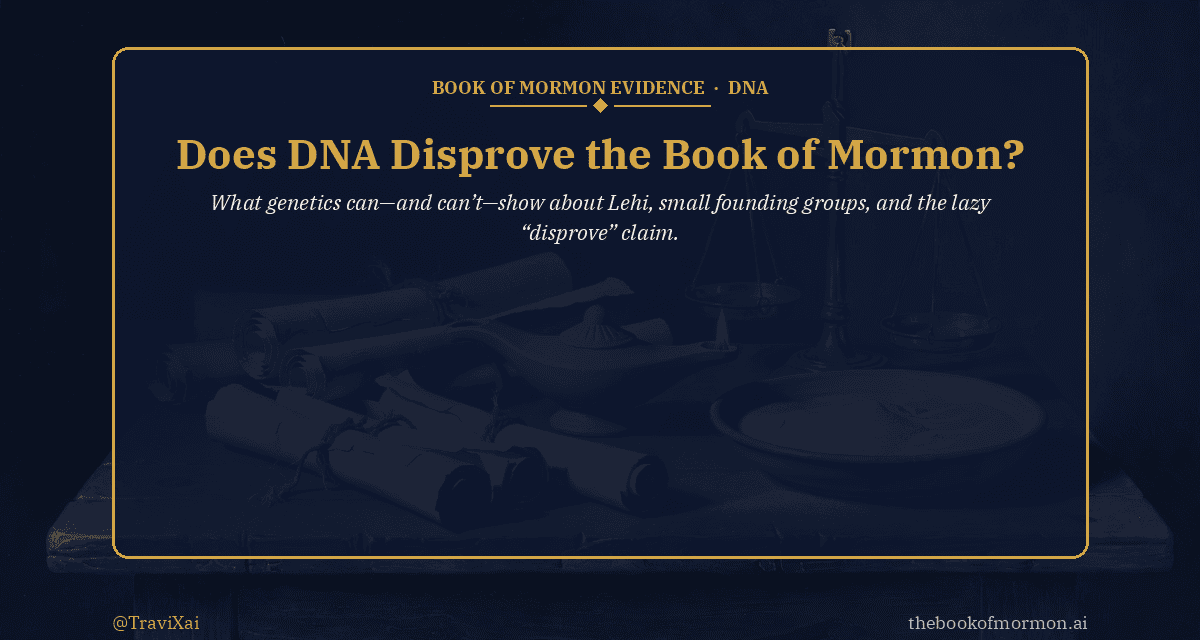

Critics say DNA buried the Book of Mormon. The book never claimed what they are testing, genetics can’t see a family this small this long ago, and “disprove” is still the lazy word.
Every few months someone announces that DNA has finally finished the Book of Mormon. The tweet-length version is simple: most Native American DNA points toward East Asia, the Book of Mormon says Israelites came to the Americas, therefore the book is false. Case closed.
That argument sounds scientific. It isn’t a fair test of the text. The Book of Mormon never claims Lehi’s family were the exclusive ancestors of every Native American. Nobody knows what DNA Lehi, Sariah, Ishmael’s household, or Zoram carried. Founder effect, admixture, drift, and post-contact bottlenecks can erase a small group’s signal. And if we ask critics to be fair, we have to be fair too: this 2025 post once leaned too hard on haplogroup X2. That framing is corrected below, and treated at full length in the 2026 DNA edition.
Update note: read the 2026 edition too
This April 2025 article is still published at its original URL. For the fuller 2026 treatment—including the X2 correction, population genetics, and the Bible double standard—read DNA and the Book of Mormon (2026 Edition). Especially: do not treat haplogroup X2 as Lehi’s marker. The core claim of this page still stands: DNA does not disprove the Book of Mormon.
Think of this refresh as the short, corrected version of the old argument. The long version lives at post 866. If you only have one link to share, share the 2026 edition.
What critics claim
The critic needs an assumption the book never makes: that Lehi’s party must be the main ancestors of Native Americans, leaving a strong Near Eastern signal across the hemisphere. No signal, no Lehi. No Lehi, false book.
The Church’s Gospel Topics essay on the subject refuses that exam. It states that the Book of Mormon “does not claim that the peoples it describes were either the predominant or the exclusive inhabitants of the lands they occupied,” and that “DNA studies cannot be used decisively to either affirm or reject the historical authenticity of the Book of Mormon” (Book of Mormon and DNA Studies).
So “DNA disproved the Book of Mormon” is not a careful conclusion. It is a slogan that tests a claim the text does not make, with a tool that cannot see the people it is looking for.
What the Book of Mormon actually claims
The current introduction to the Book of Mormon says the Lamanites “are among the ancestors of the American Indians” (Introduction). Among. That one word already kills the hemispheric-only straw man.
The narrative itself keeps hinting that Lehi’s family was not alone. When Mosiah’s people leave the land of Nephi, they find another nation already there:
And they discovered a people, who were called the people of Zarahemla.
Omni 1:14
Those people had become “exceedingly numerous” by the time Mosiah found them (Omni 1:17). Later the book says it outright:
Now there were not so many of the children of Nephi, or so many of those who were descendants of Nephi, as there were of the people of Zarahemla, who was a descendant of Mulek, and those who came with him into the wilderness.
Mosiah 25:2
In the Book of Mormon’s own pages, Nephi’s descendants are outnumbered in their own kingdom. The labels shift too. Jacob says he will call “Lamanites” those “that seek to destroy the people of Nephi” and call the friendly group Nephites:
But I, Jacob, shall not hereafter distinguish them by these names, but I shall call them Lamanites that seek to destroy the people of Nephi, and those who are friendly to Nephi I shall call Nephites, or the people of Nephi, according to the reigns of the kings.
Jacob 1:14
Centuries later the book separates dissenters who “had taken upon themselves the name of Lamanites” from “real descendants of the Lamanites” (Helaman 11:24). “Lamanite” becomes a political and covenant label, not a DNA barcode.
That is why many Latter-day Saint readers use a limited geography: a real people in a limited region, living next to others. The Church takes no official position on geography beyond the Americas. For more, see Limited Geography and Population and Are Native Americans “Lamanites”? on Galatians18.
The essay also quotes President Anthony W. Ivins of the First Presidency from April 1929—long before anyone sequenced a genome: the Book of Mormon “does not tell us that there was no one here before them [the peoples it describes]. It does not tell us that people did not come after” (Gospel Topics essay). This is not a modern retreat. It is the text’s own humility.
What genetics can and can’t see
To find Lehi’s DNA, you need to know what Lehi’s DNA was. Nobody does. The essay is blunt: “Nothing is known about the DNA of Book of Mormon peoples” (Book of Mormon and DNA Studies).
Lehi was “a descendant of Manasseh” (Alma 10:3). And who was Manasseh’s mother?
And unto Joseph were born two sons before the years of famine came, which Asenath the daughter of Poti-pherah priest of On bare unto him.
Genesis 41:50 (KJV)
The firstborn of those sons was Manasseh (Genesis 41:51). The tribe Lehi came from started with an Egyptian mother. Anyone who claims to know exactly what “Israelite DNA” Lehi should have carried is claiming more than the Bible tells us.
The essay walks through why a small founding group can vanish from the record anyway: admixture can make a smaller group’s markers “so diluted that they cannot be reliably identified”; genetic drift deletes rare lines by chance; bottlenecks from war and disease wipe out whole lineages. After 1492, native populations fell sharply—the essay cites molecular anthropologist Michael Crawford on a “genetic bottleneck” that forever altered surviving groups (essay).
Time makes it worse. From roughly 600 BC to today is more than 100 generations. Population geneticist Graham Coop has shown that you do not have to go back many generations before a given ancestor can leave you none of your autosomal DNA (Coop Lab, 2013). Someone can be your real ancestor and leave no detectable genetic trace.
Mitochondrial DNA and the Y chromosome are useful tools, but each follows one thread: mother’s mother’s mother, or father’s father’s father. Ten generations back you have 1,024 ancestor slots. Those two tests see two of them. A missing haplogroup tells you about one thread, not a whole family.
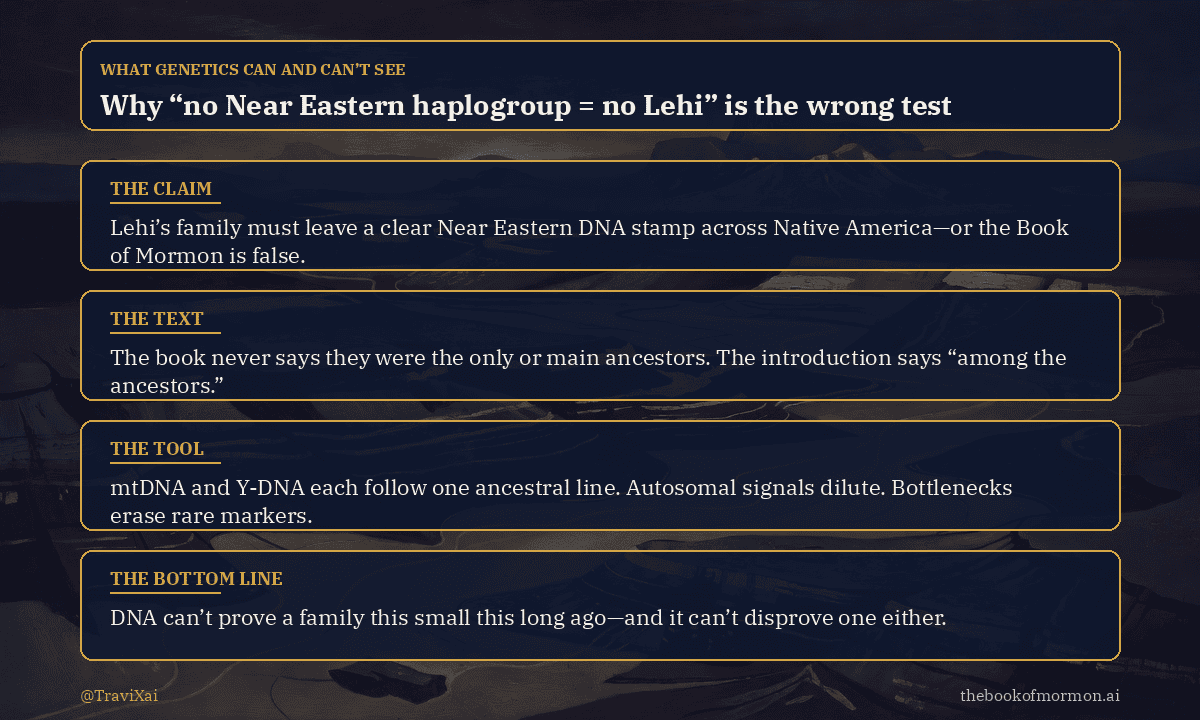
The essay’s scientific bottom line is the one defenders and critics both need: “DNA studies cannot be used decisively to either affirm or reject the historical authenticity of the Book of Mormon.” More on Galatians18: DNA and the Book of Mormon.
An honest correction on haplogroup X2
If we ask critics to be fair, we have to be fair too. The original 2025 version of this post leaned on mitochondrial haplogroup X2—found in some Native American groups around the Great Lakes—as if it were a helpful hint toward a Near Eastern migration like Lehi’s. That framing still gets shared online. The research points the other way.
In 2015, the genome of Kennewick Man (the Ancient One), a skeleton from Washington state dated to about 8,340–9,200 calibrated years before present, was sequenced. His mtDNA sits “at the root of haplogroup X2a” (Rasmussen et al., Nature 2015). That is thousands of years before Lehi. Geneticists Jennifer Raff and Deborah Bolnick added that “X2a has not been found anywhere in Eurasia,” and that the evidence fits the same ancient Beringian migration as the other founding Native American lineages (Raff and Bolnick, PaleoAmerica 2015).
So X2 is not Lehi’s fingerprint, and we should not say it is. The Gospel Topics essay warns that “arguments that some defenders of the Book of Mormon make based on DNA studies are also speculative” (essay). That cuts both ways. If DNA cannot confirm Lehi, it cannot rule him out either. The correction does not help the critic. It puts everyone back at the honest line: genetics cannot see a family this small, this long ago, on a continent with other peoples.
The double standard nobody DNA-tests Abraham with
Now flip it. Nobody demands an “Israelite haplogroup” before believing Abraham left Ur or Israel left Egypt. The Bible itself shows why that test would be hopeless.
And a mixed multitude went up also with them; and flocks, and herds, even very much cattle.
Exodus 12:38 (KJV)
Moses married Zipporah the Midianite (Exodus 2:21) and “an Ethiopian woman” (Numbers 12:1). Joseph married an Egyptian (Genesis 41:45). Jesus’ own genealogy includes Rahab of Jericho and Ruth the Moabitess:
And Salmon begat Booz of Rachab; and Booz begat Obed of Ruth; and Obed begat Jesse;
Matthew 1:5 (KJV)
Ancient DNA from the southern Levant tells the same story of mixture. A 2020 study of Bronze and Iron Age individuals from the region found ancestry from earlier local populations and newcomers related to the Zagros or the Caucasus (Agranat-Tamir et al., Cell 2020).
Yet the critic who would never say “no Hebrew haplogroup, no Exodus” turns around and says “no Hebrew haplogroup in America, no Lehi.” Same missing evidence, opposite conclusion. That is not science. It is a double standard wearing a lab coat. For the wider pattern, see The Hypocritical Book of Mormon Denier and “Your Church Changes”… So Does the Bible.
He that answereth a matter before he heareth it, it is folly and shame unto him.
Proverbs 18:13 (KJV)
The bottom line
DNA cannot prove Lehi landed in the Americas. DNA also cannot disprove him. The Book of Mormon describes small groups among others. Genetics cannot recover unknown founders after millennia of admixture, drift, and bottlenecks. Haplogroup X2 is not a Lehi marker, and hanging the book on it was a mistake this refresh refuses to repeat.
What the slogan “DNA disproved the Book of Mormon” really shows is impatience: an answer given before the matter is heard. For the fuller case, read DNA and the Book of Mormon (2026 Edition). For the positive evidence stack, start with The Best Book of Mormon Evidences, in One Place, the witnesses who never recanted, and the book’s own internal complexity. And for Arabia’s geography clues that sit upstream of the DNA debate, see Lehi in the Arabian Peninsula.
Key takeaways
- The Book of Mormon never claims Lehi’s family were the only or main ancestors of Native Americans. Its introduction says “among the ancestors.”
- The text itself shows others in the land: the people of Zarahemla outnumbered the Nephites (Mosiah 25:2), and “Lamanite” became a political label.
- Nobody knows what DNA Lehi’s party carried, and his own tribe began with an Egyptian mother (Genesis 41:50–51).
- Founder effect, admixture, drift, and bottlenecks can erase a small group’s signal; mtDNA and Y-DNA each trace only one line.
- X2 is not Lehi’s marker. DNA can’t confirm him, and it can’t rule him out. For the fuller treatment, see the 2026 edition.
- Critics don’t demand an “Israelite haplogroup” to believe the Bible. The same standard should apply to the Book of Mormon.
Follow @TraviXai on X for daily answers to critics, and dig deeper into any topic at galatians18.app.
Sources
- Scripture quotations: King James Version and the Book of Mormon, churchofjesuschrist.org: Genesis 41:45, 50–51; Exodus 2:21; 12:38; Numbers 12:1; Proverbs 18:13; Matthew 1:5; Omni 1:14, 17; Jacob 1:14; Mosiah 25:2; Alma 10:3; Helaman 11:24.
- “Book of Mormon and DNA Studies,” Gospel Topics Essays (The Church of Jesus Christ of Latter-day Saints), churchofjesuschrist.org. Source of the Ivins (1929) and Crawford quotations, the “Nothing is known…,” “also speculative,” dilution, bottleneck, and “cannot be used decisively” lines.
- Introduction to the Book of Mormon, churchofjesuschrist.org.
- Morten Rasmussen et al., “The ancestry and affiliations of Kennewick Man,” Nature 523 (2015): 455–58, nature.com.
- Jennifer A. Raff and Deborah A. Bolnick, “Does Mitochondrial Haplogroup X Indicate Ancient Trans-Atlantic Migration to the Americas? A Critical Re-Evaluation,” PaleoAmerica 1, no. 4 (2015): 297–304, doi.org.
- Liran Agranat-Tamir et al., “The Genomic History of the Bronze Age Southern Levant,” Cell 181 (2020), doi.org.
- Graham Coop, “How many genetic ancestors do I have?” Coop Lab blog, 2013, gcbias.org.
- Topics for further study: DNA and the Book of Mormon, Lehi in the Arabian Peninsula, Are Native Americans “Lamanites”?, Limited Geography and Population, Book of Mormon Historicity at galatians18.app.
- Related on this blog: DNA 2026 Edition, Hypocritical Book of Mormon Denier, Best Evidences, Shrinking Anachronisms List.
- Featured image and in-post graphic: original graphics by thebookofmormon.ai (painterly backgrounds with no photographs or likenesses of real people).
- Scripture quotations from the Holy Bible (KJV) and the Book of Mormon via churchofjesuschrist.org.
Follow @TraviXai and explore more at https://galatians18.app.