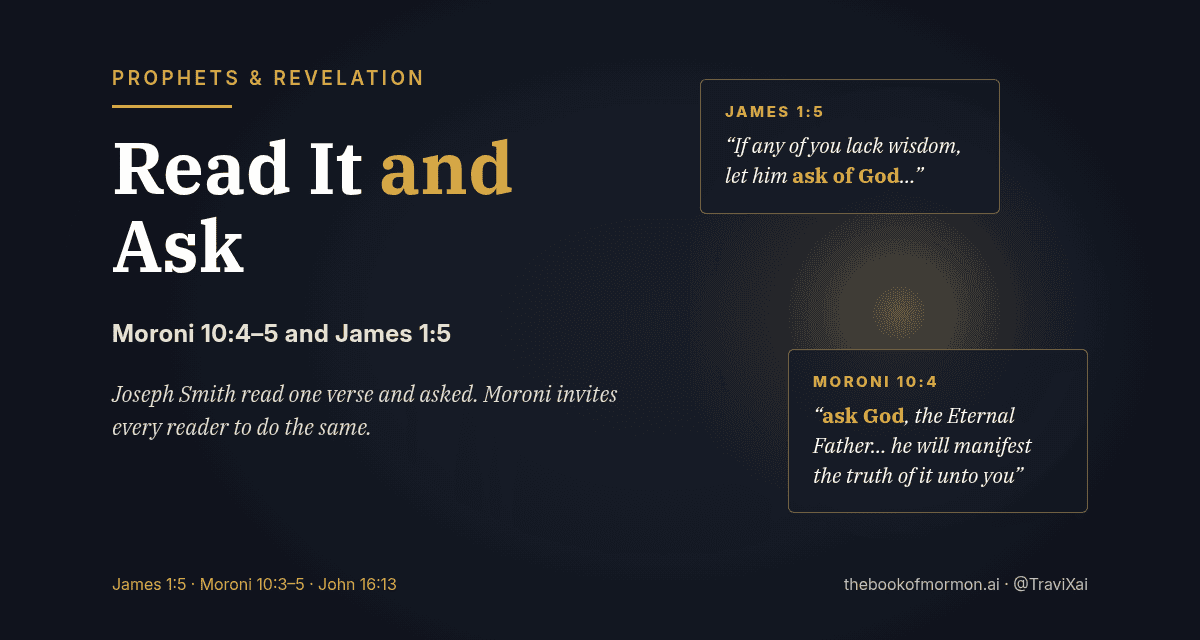

The Book of Mormon asks you to do one thing: read it, then ask God. Here’s why that’s the Bible’s own pattern, and why critics already rely on it.
Critics will tell you a hundred things about the Book of Mormon. The book asks you to do exactly one: read it, then ask God. Not a pastor, not Reddit, not even a missionary. God.
That invitation makes some people nervous, and the usual pushback is “you can’t trust your feelings.” Fair enough. Let’s look at what Moroni actually asks, what James asked a fourteen-year-old farm boy to do, and how the Bible says anyone comes to know God’s truth. Then let’s ask the critic the same question they ask us: how do you know the Bible is true?
(The witnesses series ended with this same promise in Part 10: The Witnesses Who Never Recanted. This post picks up where that one stopped.)
A fourteen-year-old and one verse
In 1820, young Joseph Smith was caught in a “war of words and tumult of opinions” between churches, asking, “Who of all these parties are right … and how shall I know it?” (JS—H 1:10). Then he read James:
If any of you lack wisdom, let him ask of God, that giveth to all men liberally, and upbraideth not; and it shall be given him.
James 1:5 (KJV)
Notice the reason Joseph gives for what he did next:
Never did any passage of scripture come with more power to the heart of man than this did at this time to mine. It seemed to enter with great force into every feeling of my heart. I reflected on it again and again, knowing that if any person needed wisdom from God, I did; for how to act I did not know, and unless I could get more wisdom than I then had, I would never know; for the teachers of religion of the different sects understood the same passages of scripture so differently as to destroy all confidence in settling the question by an appeal to the Bible.
Joseph Smith—History 1:12 (KJV)
Read that last line twice. Joseph had a Bible. Everyone did. The problem was that sincere ministers read “the same passages of scripture so differently” that the Bible alone couldn’t settle it. Two centuries later, nothing has changed. Every time Catholics, Orthodox, and Protestants debate each other, all they do is prove there needed to be a restoration.
So Joseph did the only thing left, the thing the verse told him to do. He concluded he “must do as James directs, that is, ask of God” (JS—H 1:13). He went into the woods and asked (see also His Name Had for Good and Evil).
Critics say James 1:5 is only about wisdom in trials, not visions. But James never added “and don’t expect too much.” Saul asked, “Who art thou, Lord?” and Jesus answered (Acts 9:5). When you ask a generous God, you don’t get to set the size of His answer. Galatians18 has the short version: James 1:5: Just Wisdom, Not a Church?
Moroni’s invitation: read, ponder, ask
Moroni closes the Book of Mormon with the same pattern. He asks readers, “when ye shall read these things,” to “remember how merciful the Lord hath been unto the children of men” and “ponder it in your hearts” (Moroni 10:3). Then:
And when ye shall receive these things, I would exhort you that ye would ask God, the Eternal Father, in the name of Christ, if these things are not true; and if ye shall ask with a sincere heart, with real intent, having faith in Christ, he will manifest the truth of it unto you, by the power of the Holy Ghost. And by the power of the Holy Ghost ye may know the truth of all things.
Moroni 10:4–5
Read the book, not a summary of it. Ponder. Then ask God, the Eternal Father, in the name of Christ. Not your gut, not a feeling in a vacuum. Real intent means you’ll act on the answer. You do the asking. God does the manifesting.
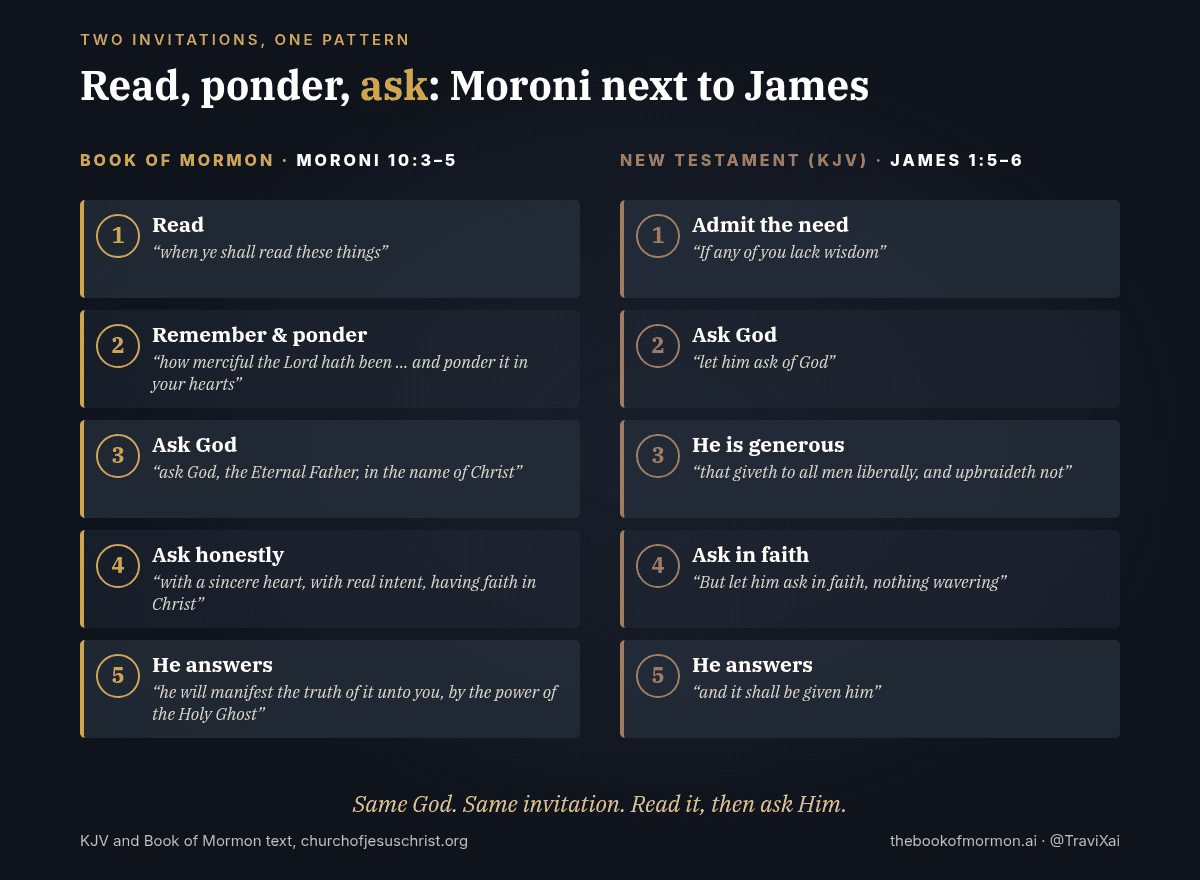
Side by side, the “cult” accusation falls apart. Cults don’t hand every reader a direct line to God and tell them to go check. Moroni isn’t saying “trust us.” He’s saying “ask Him.”
“But you can’t trust your feelings”
The standard reply is Jeremiah:
The heart is deceitful above all things, and desperately wicked: who can know it?
Jeremiah 17:9 (KJV)
Good verse. Now read the next one, which answers the question verse 9 just asked:
I the Lord search the heart, I try the reins, even to give every man according to his ways, and according to the fruit of his doings.
Jeremiah 17:10 (KJV)
Who can know the heart? The Lord can. That’s an argument for asking Him, not against it. Moroni doesn’t say “ask your heart.” He says ask God, and God answers. Proverbs agrees: “lean not unto thine own understanding” (Proverbs 3:5).
And if Jeremiah 17:9 rules out the Spirit’s witness, it rules out theirs too. The same “deceitful” heart reads the Bible, picks a denomination, and feels sure about Romans. You can’t disqualify our hearts and quietly exempt your own.
As for “burning in the bosom,” it comes from D&C 9:8, right after “you must study it out in your mind.” Mind first, then ask, then confirmation.
The Bible is full of the Spirit teaching
Here is how Jesus said His disciples would learn truth after He left:
Howbeit when he, the Spirit of truth, is come, he will guide you into all truth: for he shall not speak of himself; but whatsoever he shall hear, that shall he speak: and he will shew you things to come.
John 16:13 (KJV)
Not a committee. Not a library. The Spirit of truth. Paul says “the things of God knoweth no man, but the Spirit of God” (1 Corinthians 2:11), because they “are spiritually discerned” (2:14). The rest of the New Testament agrees:
- “the Comforter, which is the Holy Ghost … shall teach you all things” (John 14:26).
- “flesh and blood hath not revealed it unto thee, but my Father which is in heaven” (Matthew 16:17). Revelation, not research.
- “no man can say that Jesus is the Lord, but by the Holy Ghost” (1 Corinthians 12:3).
- “The Spirit itself beareth witness with our spirit” (Romans 8:16).
- “the anointing which ye have received of him abideth in you … the same anointing teacheth you of all things, and is truth, and is no lie” (1 John 2:27).
- “the fruit of the Spirit is love, joy, peace” (Galatians 5:22). That’s how the Spirit feels.
Then there are the two disciples on the road to Emmaus:
And they said one to another, Did not our heart burn within us, while he talked with us by the way, and while he opened to us the scriptures?
Luke 24:32 (KJV)
A burning heart while the scriptures were opened. Mock “burning in the bosom” all you want, but you’re mocking Luke.
“Prove all things” is an invitation, not a warning
Critics love “Prove all things; hold fast that which is good” (1 Thessalonians 5:21). So do we. Moroni 10 is the proving. Jesus offered the same kind of test: “If any man will do his will, he shall know of the doctrine, whether it be of God, or whether I speak of myself” (John 7:17). Do, then know. That’s not blind faith. It’s an experiment with God on the other end.
The Bereans “searched the scriptures daily” (Acts 17:11). Great. Search both books side by side, look at the fruits (Matthew 7:20), then ask, because “he that cometh to God must believe that he is, and that he is a rewarder of them that diligently seek him” (Hebrews 11:6). (See Faith Is a Verb.)
What you can’t do is refuse to ask and then call the question unanswered.
So how do you know the Bible is true?
When people ask me how I know the Book of Mormon is true, my answer is always the same: the same way I know the Bible is true. God told me, and I choose to believe Him.
That answer gets called circular and “just feelings.” So turn it around. How does the critic know the Bible is God’s word? Old manuscripts show a text was copied carefully, not who inspired it. Archaeology shows a city existed, not that God spoke there. “The Bible says so” is circular, and no verse lists which books belong in it. The canon itself was settled by church leaders centuries after the apostles. (More on that in The Canon Was Never Meant to Close and Sola Scriptura: Which Verse Teaches It?)
Here’s the fun part: their own confessions answered it our way. The Westminster Confession of Faith (1646) lists the Bible’s majesty and consistency, then says:
…yet, notwithstanding, our full persuasion and assurance of the infallible truth, and divine authority thereof, is from the inward work of the Holy Spirit, bearing witness by and with the Word in our hearts.
Westminster Confession of Faith 1.5 (KJV)
Look at the proof texts the Westminster divines attached to that line: 1 John 2:20, 27; John 16:13–14; 1 Corinthians 2:10–12. The same verses we just read. John Calvin said it even more bluntly: “the testimony of the Spirit is superior to reason,” and Scripture won’t “obtain full credit in the hearts of men, until they are sealed by the inward testimony of the Spirit” (Institutes 1.7.4).
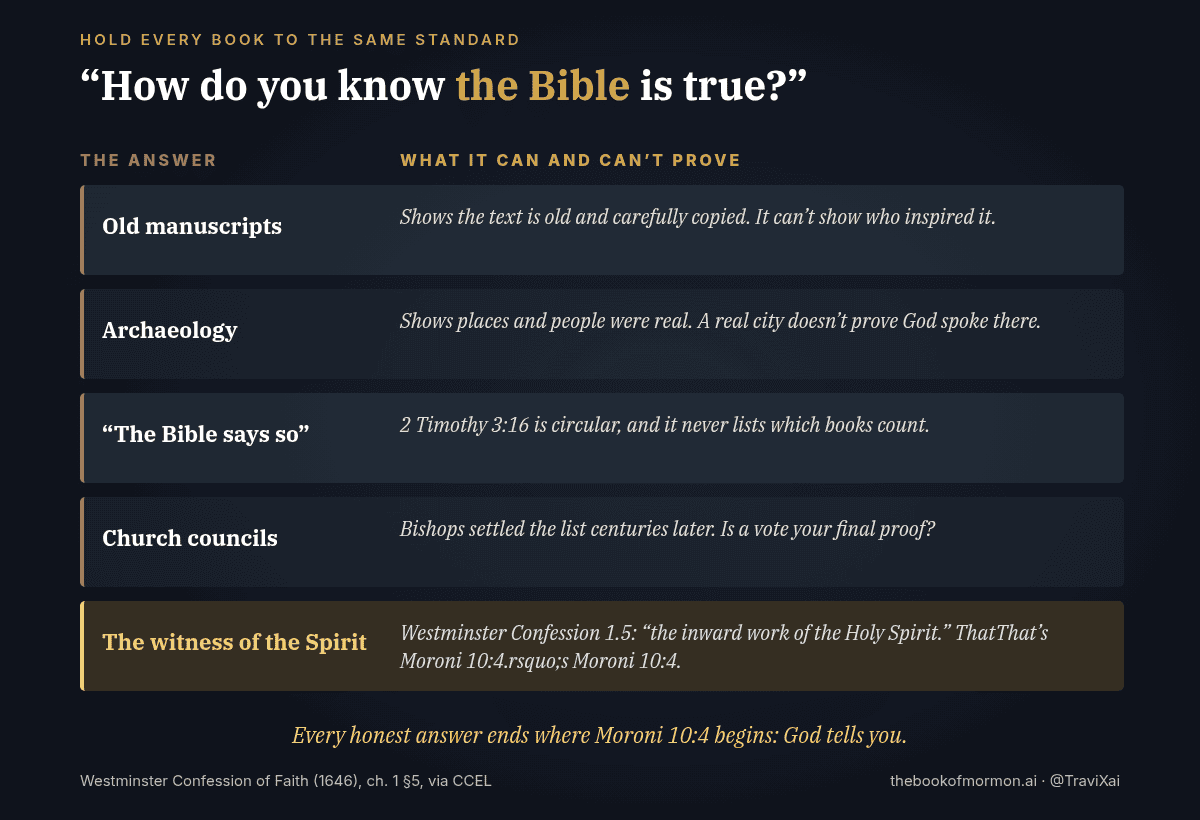
So the “inward work of the Holy Spirit” is good enough for the Bible, but “feelings” when it’s the Book of Mormon? That’s not a standard. That’s a double standard. We’re asking for the same test, run honestly. If that Spirit can still testify, He can still speak, which is the whole case for continuing revelation and an open canon. And if your confidence in the Bible rests on that witness anyway, there’s no reason to pretend it rests on inerrancy.
Read it and ask
So here’s the invitation. Don’t take my word for it, or the witnesses’, or the critics’. Read the Book of Mormon. Ponder it. Then ask God, the Eternal Father, in the name of Christ, with real intent.
James promised that God “giveth to all men liberally, and upbraideth not.” He doesn’t scold you for asking. Joseph asked and God answered. The only way to find out if the promise is real is to take Him up on it.
Key takeaways
- Joseph Smith turned to James 1:5 because ministers couldn’t agree on the Bible (JS—H 1:12). The fix was asking God.
- Moroni 10:3–5: read, ponder, and ask the Father in Christ’s name with real intent. God answers by the Holy Ghost.
- Jeremiah 17:10 answers 17:9: the Lord searches the heart. That’s a reason to ask Him.
- The New Testament teaches truth comes by the Spirit: John 14:26, 16:13, 1 Corinthians 2:11–14, 1 John 2:27, Luke 24:32.
- Westminster 1.5 and Calvin rest certainty about the Bible on the Spirit’s inward witness. Same test, same standard.
Next time someone says “you can’t trust your feelings,” ask them how they know the Bible is true, then read them Westminster 1.5. For quick, sourced answers to common attacks, open Galatians18, and follow me on X at @TraviXai for daily answers.
Sources
- Scripture quotations: King James Version, the Book of Mormon, the Doctrine and Covenants, and the Pearl of Great Price, churchofjesuschrist.org: Proverbs 3:5; Jeremiah 17:9–10; Matthew 7:20; 16:17; Luke 24:32; John 7:17; 14:26; 16:13; Acts 9:5; 17:11; Romans 8:16; 1 Corinthians 2:11–14; 12:3; Galatians 5:22; 1 Thessalonians 5:21; Hebrews 11:6; James 1:5–6; 1 John 2:27; Moroni 10:3–5; D&C 9:8; Joseph Smith—History 1:10–13.
- Westminster Confession of Faith (1646), chapter 1, section 5, in Philip Schaff, The Creeds of Christendom, vol. 3, Christian Classics Ethereal Library.
- John Calvin, Institutes of the Christian Religion, book 1, chapter 7, section 4 (Beveridge translation), Christian Classics Ethereal Library.
- Galatians18 topic pages: James 1:5: Just Wisdom, Not a Church?, Continuing Revelation and an Open Canon, Is the Bible Infallible?
- Related on this blog: Book of Mormon Evidence, Part 10: The Witnesses Who Never Recanted; His Name Had for Good and Evil: JS-H 1:33 Two Centuries Later; The Canon Was Never Meant to Close; Sola Scriptura: Which Verse Teaches It?; Faith Is a Verb: What Emunah and Pistis Really Mean
- Featured image and graphics: original graphics by thebookofmormon.ai (no photographs or likenesses of real people).