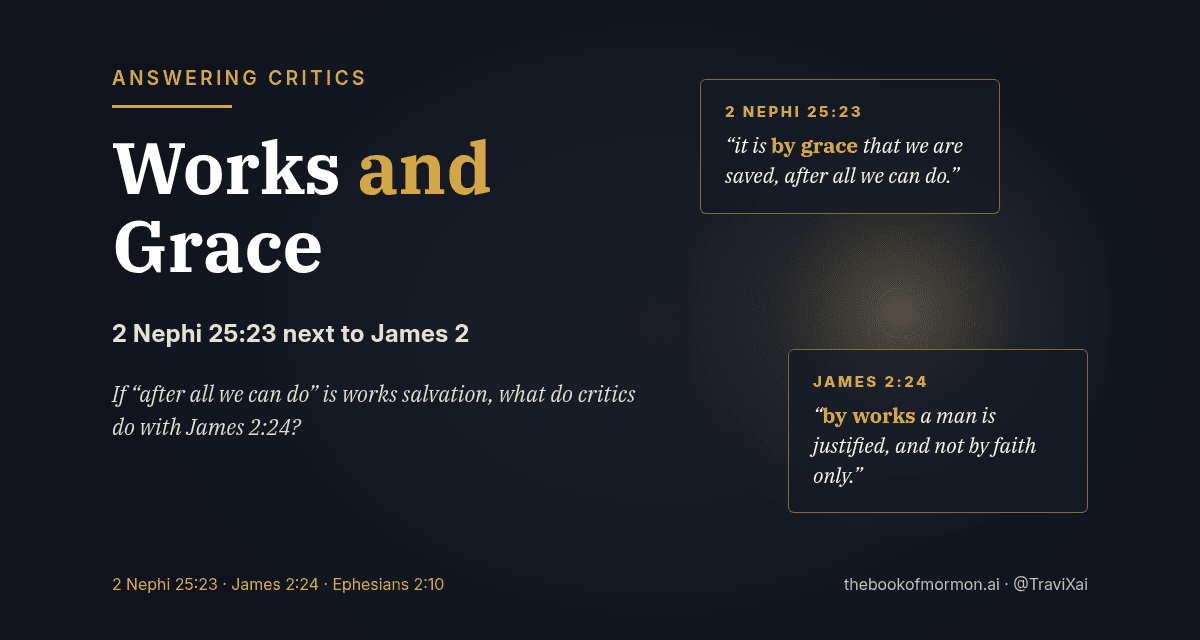

Critics quote “after all we can do” as proof of works salvation. Read 2 Nephi 25 in context, then hold James 2:24 to the same standard.
Ask a critic to prove the Book of Mormon teaches “works salvation” and you’ll get the same seven words every time: “after all we can do.” Half a verse from 2 Nephi 25:23, passed around as if it settles the question.
So let’s play by the critic’s rules. If half a verse about effort proves a book teaches salvation by works, I have a verse for them: “Ye see then how that by works a man is justified, and not by faith only.” That’s not the Book of Mormon. That’s James 2:24, King James Version.
So let’s set 2 Nephi 25:23 next to James 2 and the New Testament passages critics skip. (For the words themselves, see Grace Is Favor, Gift, and Power and Faith Is a Verb.)
Read the whole paragraph, not the meme
Here is the full verse, not the clipped version:
For we labor diligently to write, to persuade our children, and also our brethren, to believe in Christ, and to be reconciled to God; for we know that it is by grace that we are saved, after all we can do.
2 Nephi 25:23
Notice what Nephi is laboring at. He isn’t stacking up merit. He’s writing so his children will “believe in Christ” and “be reconciled to God.” The sentence’s main claim is “it is by grace that we are saved.” The meme keeps the last four words and drops the subject.
Three verses earlier, Nephi says “there is none other name given under heaven save it be this Jesus Christ, of which I have spoken, whereby man can be saved” (2 Nephi 25:20). He says the law of Moses “hath become dead unto us, and we are made alive in Christ because of our faith” (2 Nephi 25:25). Then comes the line every critic should have to read out loud:
And we talk of Christ, we rejoice in Christ, we preach of Christ, we prophesy of Christ, and we write according to our prophecies, that our children may know to what source they may look for a remission of their sins.
2 Nephi 25:26
The source of remission is Christ. Not a checklist. People still living the law of Moses, six centuries before Bethlehem, knew they were saved by grace. Galatians18 has a short answer on exactly this: “After All We Can Do”.
What “after all we can do” actually says
Critics read “after all we can do” as a timeline: you finish your part, then grace tops off the tank. But “after all” is ordinary English for “in spite of all” or “when everything is said and done.” As I put it on X: “even after all the good we can do and even after all the bad we inevitably do, we can’t be saved without grace” (@TraviXai).
The Book of Mormon even tells us what “all we can do” looks like in practice. The Anti-Nephi-Lehies were converts who had shed a lot of blood. Their king said:
And now behold, my brethren, since it has been all that we could do (as we were the most lost of all mankind) to repent of all our sins and the many murders which we have committed, and to get God to take them away from our hearts, for it was all we could do to repent sufficiently before God that he would take away our stain—
Alma 24:11
“All we could do” was repent. God did the taking away, and the king had just thanked Him for forgiving them “through the merits of his Son” (Alma 24:10). That’s not earning. That’s turning around and receiving. (The bicycle and piano analogies are in the grace word study.)
The Book of Mormon is soaked in grace
If the Book of Mormon taught self-salvation, it picked a strange way to do it. Lehi opens the case:
…that they may know that there is no flesh that can dwell in the presence of God, save it be through the merits, and mercy, and grace of the Holy Messiah, who layeth down his life according to the flesh, and taketh it again by the power of the Spirit…
2 Nephi 2:8
No flesh. None. Then the book keeps saying it:
- “remember, after ye are reconciled unto God, that it is only in and through the grace of God that ye are saved” (2 Nephi 10:24). Only.
- People on the path got there “relying wholly upon the merits of him who is mighty to save” (2 Nephi 31:19). Wholly.
- King Benjamin: if you served God “with all your whole souls yet ye would be unprofitable servants” (Mosiah 2:21). Every time you obey, He blesses you, so “ye are still indebted unto him … therefore, of what have ye to boast?” (Mosiah 2:24).
- Moroni’s closing invitation: “come unto Christ, and be perfected in him … that by his grace ye may be perfect in Christ” (Moroni 10:32), “sanctified in Christ by the grace of God, through the shedding of the blood of Christ” (Moroni 10:33).
Benjamin’s “unprofitable servants” isn’t original to him, by the way. Jesus said it first: “when ye shall have done all those things which are commanded you, say, We are unprofitable servants” (Luke 17:10). The book that supposedly teaches earning heaven is the one telling you that you can’t even break even.
Now read James 2 by the same rules
Now the fun part. Here’s James, with no Book of Mormon anywhere in sight:
What doth it profit, my brethren, though a man say he hath faith, and have not works? can faith save him?
James 2:14 (KJV)
“Even so faith, if it hath not works, is dead, being alone” (James 2:17). Abraham was “justified by works, when he had offered Isaac” (James 2:21), and “by works was faith made perfect” (James 2:22). Then the line:
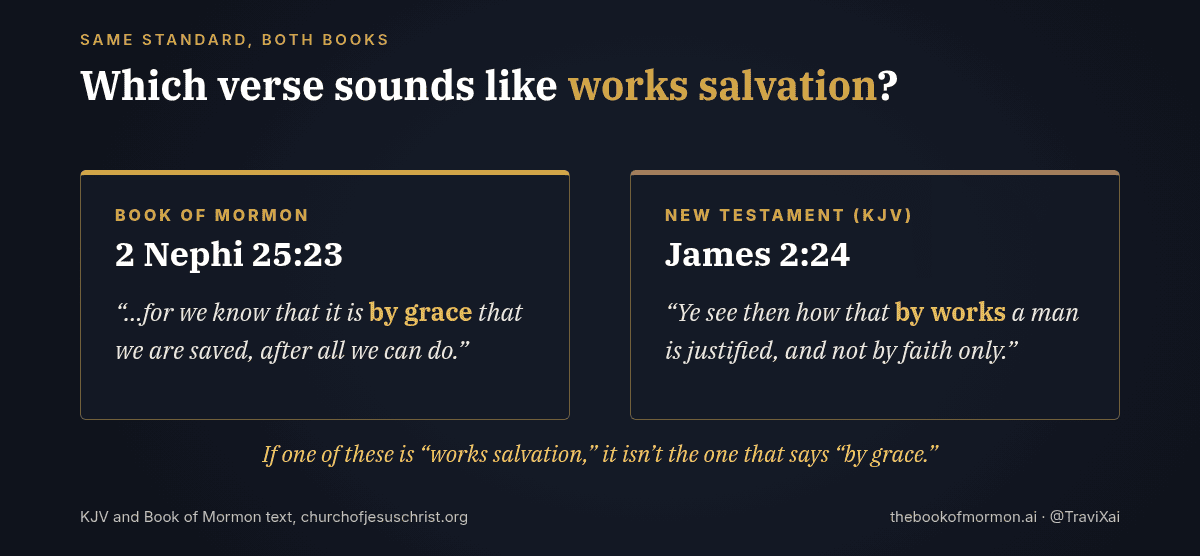
Ask an honest question: which one sounds more like works? 2 Nephi 25:23 says we are saved by grace. James 2:24 says a man is justified by works. If you rebuke Nephi, you have to rebuke James harder. My running joke still stands: “faith alone” is in the Bible, exactly once, and it has “not by” in front of it (@TraviXai).
Protestant historian Philip Schaff notes that Martin Luther inserted the word allein (“alone”) into Romans 3:28 in his German Bible, which “brought Paul into direct verbal conflict with James.” Luther “deemed it impossible to harmonize the two apostles in this article, and characterized the Epistle of James as an ‘epistle of straw’” (Schaff, History of the Christian Church, vol. 7, §63). When your doctrine needs one word added to Paul and one book downgraded, the problem isn’t 2 Nephi.
Paul didn’t stop at Ephesians 2:9
The favorite counter is Ephesians 2:8–9, and it’s a great passage. We believe every word of it:
For by grace are ye saved through faith; and that not of yourselves: it is the gift of God: Not of works, lest any man should boast.
Ephesians 2:8–9 (KJV)
Grace saves. It’s a gift. No boasting. Nephi agrees, and so does King Benjamin (“of what have ye to boast?”). But the quote usually stops one verse early. Paul keeps going: “For we are his workmanship, created in Christ Jesus unto good works, which God hath before ordained that we should walk in them” (Ephesians 2:10). Saved by grace, created for works. That’s 2 Nephi 25 in one sentence.
Paul says it again to the Philippians:
…work out your own salvation with fear and trembling. For it is God which worketh in you both to will and to do of his good pleasure.
Philippians 2:12–13 (KJV)
We work, and God works in us. That’s grace as power, not just pardon, exactly how Latter-day Saints describe it. More at Galatians18: Grace and Works.
Jesus and John set the same bar
Jesus didn’t leave this vague either:
Not every one that saith unto me, Lord, Lord, shall enter into the kingdom of heaven; but he that doeth the will of my Father which is in heaven.
Matthew 7:21 (KJV)
Not “he that saith.” He that doeth. And: “If ye love me, keep my commandments” (John 14:15). So ask the critic two questions. Is keeping commandments a work? Is loving Jesus required? If both answers are yes, they believe works matter too. They just don’t like hearing it from Nephi.
Then John describes the final judgment:
And I saw the dead, small and great, stand before God; and the books were opened: and another book was opened, which is the book of life: and the dead were judged out of those things which were written in the books, according to their works.
Revelation 20:12 (KJV)
Verse 13 says it twice: “they were judged every man according to their works” (Revelation 20:13). The Book of Mormon says the same thing, in the same words: “that they may be judged according to their works” (3 Nephi 27:15).
The double standard, plainly
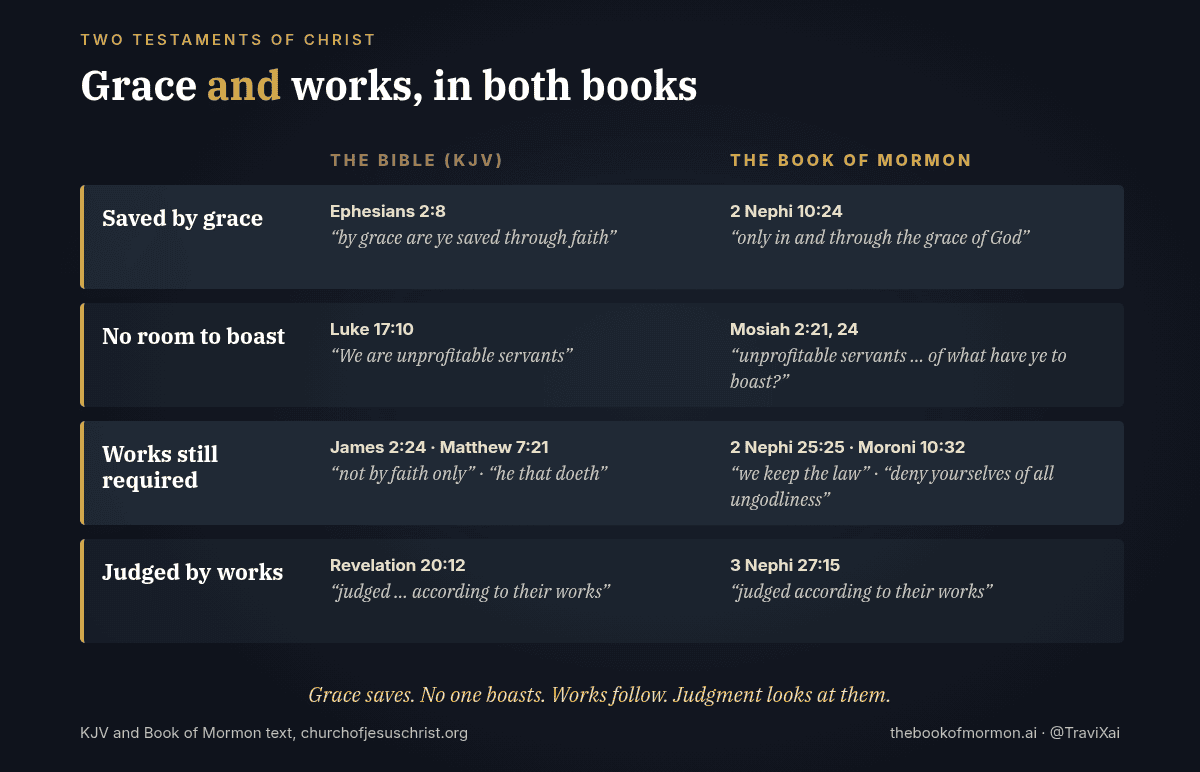
Here’s the standard the critic uses on 2 Nephi 25:23: if a verse mentions our effort alongside grace, it teaches salvation by works. Fine. Apply it evenly.
- James 2:24 says justified “by works … and not by faith only.” Works salvation?
- Philippians 2:12 says “work out your own salvation.” Works salvation?
- Matthew 7:21 says only “he that doeth” enters. Works salvation?
- Revelation 20:12–13 says the dead are judged “according to their works.” Works salvation?
Bible believers say no to all four. They read in context and let grace and works sit together. All we ask is the same courtesy for a verse that literally says “by grace … we are saved.” Reading the Bible generously and the Book of Mormon as harshly as possible isn’t exegesis. It’s a double standard. (More on that habit in Who’s Really Cherry-Picking?)
And the irony is plain: the Book of Mormon says salvation comes “only in and through the grace of God” (2 Nephi 10:24). The only verse in the Bible that puts “faith” and “only” together says “not by faith only.” If anyone has a grace problem, it isn’t Nephi. For the “but the thief on the cross” follow-up, see Galatians18: The Thief on the Cross.
Key takeaways
- The main claim of 2 Nephi 25:23 is “it is by grace that we are saved.” The same paragraph names Christ as the only source of remission (25:20, 26).
- “After all we can do” means after everything, good and bad, we still need grace. Alma 24:11 shows “all we could do” was repent.
- The Book of Mormon teaches grace constantly: 2 Nephi 2:8, 10:24, 31:19, Mosiah 2:21–24, Moroni 10:32–33.
- James 2:24 says “by works a man is justified, and not by faith only.” If 2 Nephi 25:23 is works salvation, James is more so.
- Ephesians 2:10, Philippians 2:12–13, Matthew 7:21, John 14:15, and Revelation 20:12–13 all join grace to obedience, just like the Book of Mormon.
Next time someone posts “after all we can do,” ask them to read 2 Nephi 25:23–26 out loud, then James 2:24. Then ask which verse sounds like works salvation. For quick, sourced answers to common attacks, open Galatians18, and follow me on X at @TraviXai for daily answers.
Sources
- Scripture quotations: King James Version and the Book of Mormon, churchofjesuschrist.org: Luke 17:10; Matthew 7:21; John 14:15; Ephesians 2:8–10; Philippians 2:12–13; James 2:14–26; Revelation 20:12–13; 2 Nephi 2:8; 10:24; 25:20–26; 31:19; Mosiah 2:21–24; Alma 24:10–11; 3 Nephi 27:15; Moroni 10:32–33.
- Philip Schaff, History of the Christian Church, vol. 7, Modern Christianity: The German Reformation, §63 “A Critical Estimate of Luther’s Version,” Christian Classics Ethereal Library.
- Travi𝕏 on X (@TraviXai): “after all we can do”; “faith alone” appears once.
- Galatians18 topic pages: “After All We Can Do”, Grace and Works, The Thief on the Cross.
- Related on this blog: Grace Is Favor, Gift, and Power: What Chen, Chesed, and Charis Really Mean; Faith Is a Verb: What Emunah and Pistis Really Mean; “You Twist the Bible”: Who’s Really Cherry-Picking?
- Featured image and graphics: original graphics by thebookofmormon.ai (no photographs or likenesses of real people).