


Here’s a line I hear a lot when I quote John 17:22: “Jesus has the same divine nature as the Father, so they’re one substance.”
I agree with the first half. The Son shares the Father’s divine nature, and Latter-day Saints have said so all along. What I don’t accept is the jump from “same nature” to “one substance.” The Bible makes the first claim on nearly every page and never makes the second. “Consubstantial” isn’t a translation of any verse. It’s a word a council added in 325.
So let’s read the verses critics actually cite, slowly, with the verse right next to each one. That second verse is usually where the argument comes apart.
John 1:1: the Word was “with” God
“In the beginning was the Word, and the Word was with God, and the Word was God.”
John 1:1
Critics stop at the last clause. But the middle clause is in the verse for a reason. The Word was “with” God, and you can’t be with yourself. John is introducing two: one who is God and another who is with Him and is also God. Verse 14 adds that this Word “was made flesh,” with “the glory as of the only begotten of the Father.” That’s a Son with a Father, not one being in two modes.
Read plainly, John 1:1 is a strong verse for the Godhead. It puts two divine persons in the same sentence and keeps them distinct.
John 10:30: “one” means what Jesus said it means
“I and my Father are one.”
John 10:30
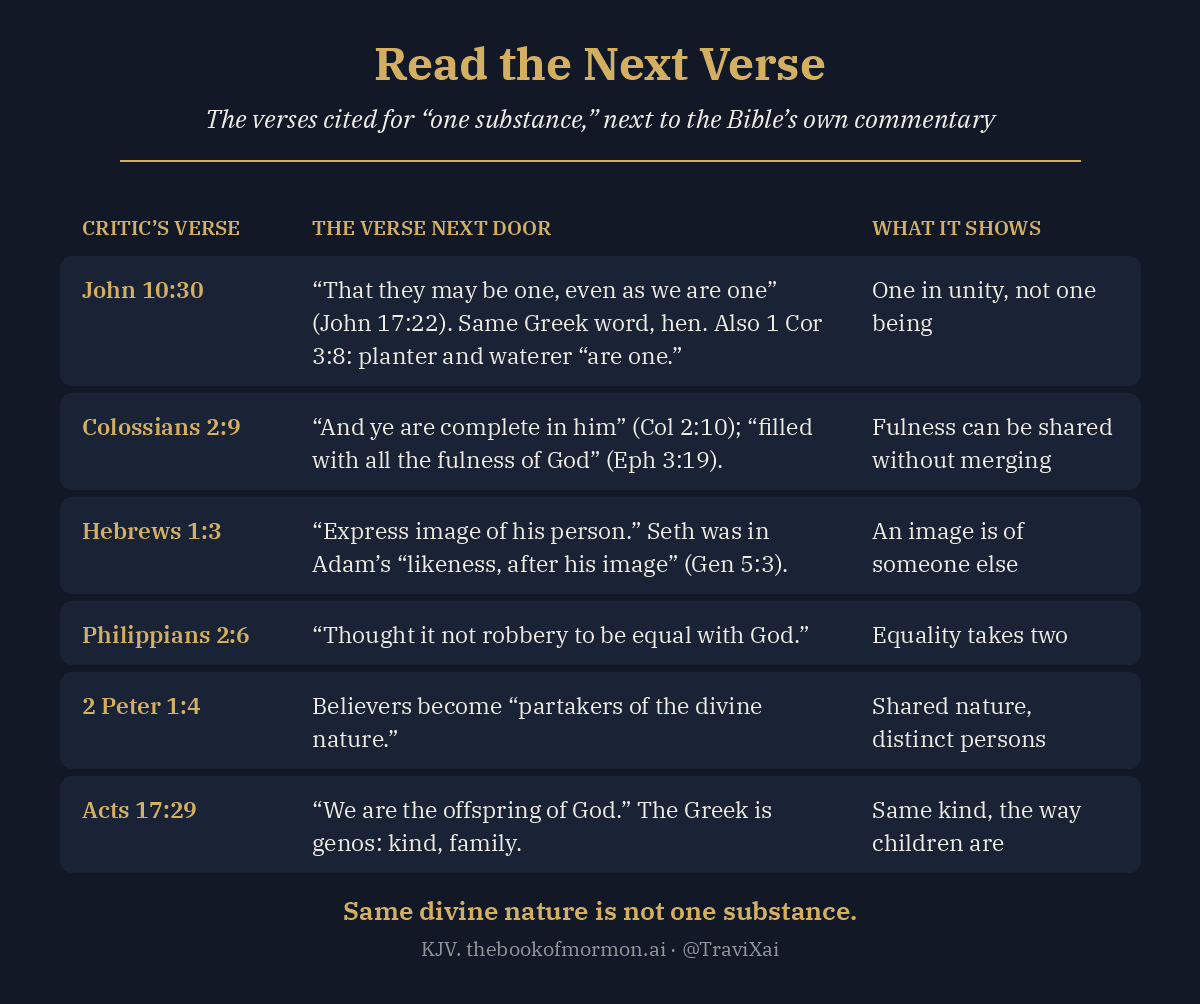
This is the main verse cited for one substance, and the Greek word is hen, “one.” Seven chapters later Jesus uses the same word in the same Gospel to explain it:
“That they all may be one; as thou, Father, art in me, and I in thee, that they also may be one in us… that they may be one, even as we are one.”
John 17:21–22
So the disciples are supposed to be one “even as” the Father and the Son are one. If hen in John 10:30 means one substance, then Jesus prayed for Peter, James, and John to become one substance, both with each other and with God. Nobody believes that. Paul uses the word the same way: “he that planteth and he that watereth are one” (1 Corinthians 3:8). Two workers, one purpose.
The rest of John 10 points the same way. When the crowd accuses Jesus of making Himself God, He doesn’t answer with one substance. He quotes Psalm 82:6, “I said, Ye are gods,” and then describes Himself as the one “whom the Father hath sanctified, and sent into the world,” who said, “I am the Son of God” (John 10:34–36). A sender, a sent one, and a Son.
Colossians 2:9: the fulness, “bodily”
“For in him dwelleth all the fulness of the Godhead bodily. And ye are complete in him.”
Colossians 2:9–10
Two things here usually get skipped.
First, “bodily.” Paul says the fulness dwells in Christ bodily, in the present tense, after the resurrection and ascension. Jesus still has a body (Luke 24:39; Acts 1:11). A verse about fulness in a body isn’t a good proof text for a God without one.
Second, verse 10. “Ye are complete in him” comes from the same Greek root as “fulness” in verse 9 (plērōma, peplērōmenoi). Paul says something even stronger in Ephesians 3:19: “that ye might be filled with all the fulness of God.” If having the fulness made you consubstantial with God, the Ephesian saints would be in the Trinity. Fulness is something God shares with His children. Sharing it doesn’t merge them.
Hebrews 1:3: the image of His person
“Who being the brightness of his glory, and the express image of his person…”
Hebrews 1:3
“Express image” translates charaktēr, an exact imprint, and “person” translates hypostasis. The Son is the exact image of the Father’s person. An image is always an image of someone else. A seal and its impression match perfectly, and they’re still two things.
Genesis uses the same idea for fathers and sons: “Adam… begat a son in his own likeness, after his image; and called his name Seth” (Genesis 5:3). Same nature, same likeness, two beings. That’s also the language God used of us: “Let us make man in our image, after our likeness” (Genesis 1:26). The Bible’s model for “same nature” is a father and a son, and nobody reads Genesis 5:3 as Adam and Seth being one substance.
Philippians 2:6: equal, in the form of God
“Who, being in the form of God, thought it not robbery to be equal with God.”
Philippians 2:6
I love this verse. Equality takes two. Nobody is equal with himself. Paul pictures the Son, existing “in the form [morphē] of God,” and choosing not to cling to that equality. Then the next verse says He “took upon him the form [morphē] of a servant, and was made in the likeness of men” (2:7). Same word. If morphē in verse 6 means the divine substance, then in verse 7 it means He took on the substance of a servant. What it actually describes is a real form, worn by a real person.
Read through verse 11 and the distinction gets sharper: “God also hath highly exalted him,” and every tongue confesses Christ “to the glory of God the Father.” One exalts, one is exalted.
2 Peter 1:4 and Acts 17:29: we share it too
This is the verse that settles the “same divine nature” argument, and it’s about us:
“…that by these ye might be partakers of the divine nature.”
2 Peter 1:4
If sharing the divine nature made someone one substance with God, every faithful Christian would be consubstantial with the Father. So “same divine nature” can’t mean “one substance.” It means what Genesis 5:3 means: the same kind.
Paul said this to the philosophers in Athens. Quoting their own poets, he said, “For we are also his offspring,” and concluded, “Forasmuch then as we are the offspring of God, we ought not to think that the Godhead is like unto gold, or silver, or stone” (Acts 17:28–29). The Greek word is genos: kind, family, race. We’re God’s kind the way children are their parents’ kind. Paul draws a conclusion about what God is like from what His children are like.
And marriage: “they shall be one flesh” (Genesis 2:24). Two people, one flesh, and nobody counts them as one person.
Does God have a body? Count the verses
Once “same substance” is gone, the next fallback is usually that the Father has no body and is pure spirit. Here is what the prophets and apostles said they saw:
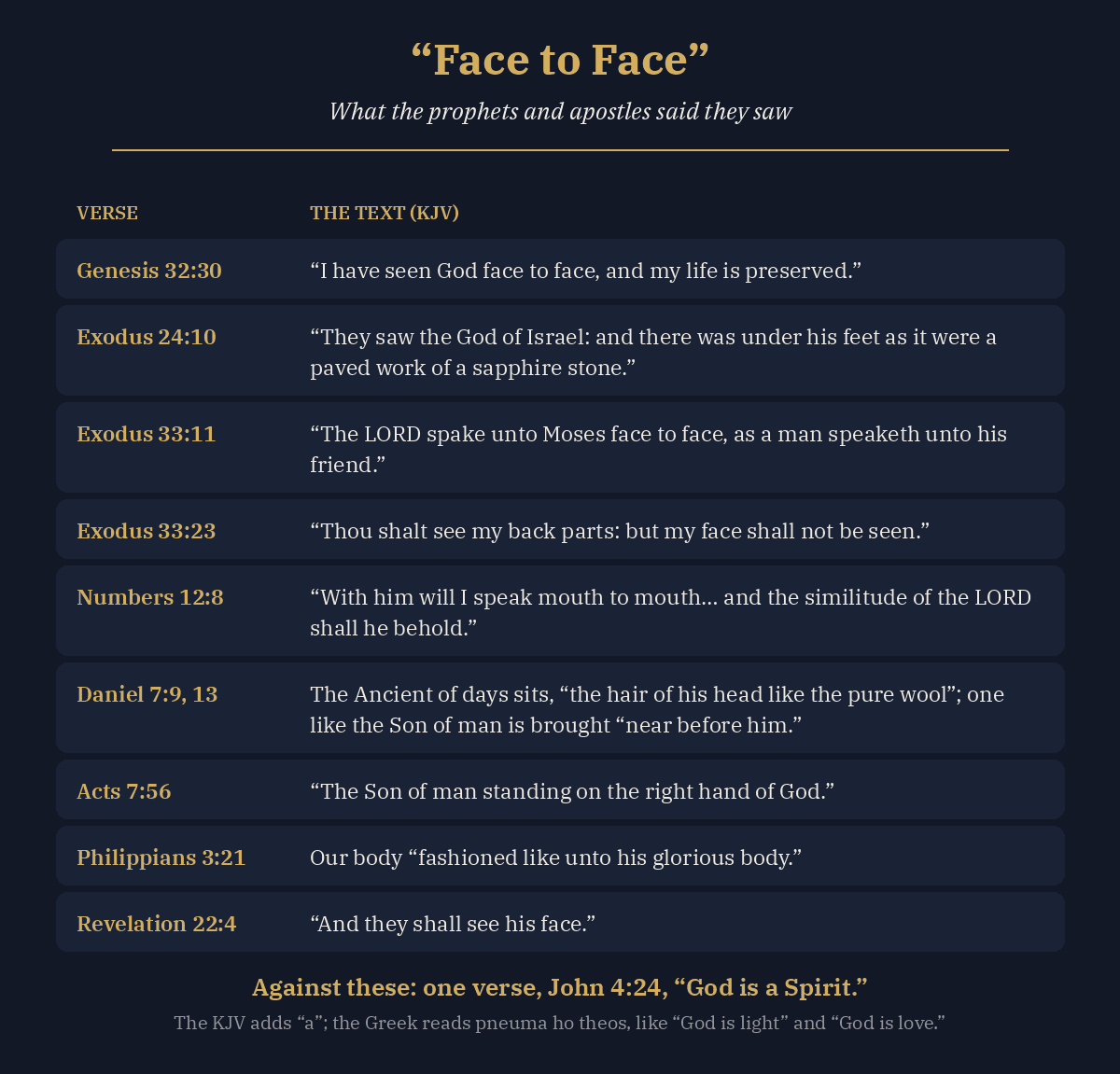
Jacob saw God “face to face” (Genesis 32:30). Moses and the seventy elders “saw the God of Israel,” with something “under his feet” (Exodus 24:10). The LORD spoke to Moses “face to face, as a man speaketh unto his friend” (Exodus 33:11) and showed him His “back parts” (33:23). Moses would “behold” the “similitude of the LORD” (Numbers 12:8). Daniel saw the Ancient of days seated, with hair “like the pure wool,” and one like the Son of man brought “near before him” (Daniel 7:9, 13). That’s two figures. Stephen saw “the Son of man standing on the right hand of God” (Acts 7:56). Two again. Our bodies will be “fashioned like unto his glorious body” (Philippians 3:21), and the faithful “shall see his face” (Revelation 22:4).
On the other side is one verse: “God is a Spirit” (John 4:24). In the KJV, “is” is in italics, which means the translators supplied it, and Greek has no word for “a” at all. The Greek is three words, pneuma ho theos, “God [is] spirit.” John uses the same grammar for “God is light” (1 John 1:5) and “God is love” (1 John 4:8), and Hebrews says “our God is a consuming fire” (Hebrews 12:29). Nobody thinks God is made of photons or fire. These verses describe what God is like and how He’s worshiped, “in spirit and in truth.” They don’t say what He’s made of.
Besides, Jesus is God and Jesus has a body right now. “A spirit hath not flesh and bones, as ye see me have” (Luke 24:39). If “God is spirit” means God can’t have a body, it rules out the risen Christ. That’s the whole problem with “one substance”: if the Son’s substance includes a glorified body and the substance is undivided, the Father shares that body. If He doesn’t, the persons aren’t one substance after all. You can keep “same substance” or “no body,” but not both.
Where “consubstantial” came from
If the word isn’t in the Bible, where did it come from? It came from a council called by an emperor.
Eusebius of Caesarea was at Nicaea in 325, and he wrote home to his church about what happened. According to Eusebius, Constantine praised the creed Eusebius submitted and then advised everyone to sign it “with the insertion of the single word” homoousios. The emperor then explained what the word meant: the divine nature “does not consist of matter, exists in a spiritual realm, has no body” (Letter of Eusebius to Caesarea, §7).
So the word that defines orthodoxy for most of Christianity was urged into the creed by a Roman emperor, and the “no body” idea came with it as his explanation. Neither one came from a prophet.
The word also had a history. Athanasius, Nicaea’s great defender, admits that the bishops who condemned Paul of Samosata at Antioch decades earlier “said with good reason, that Christ was not Coessential” (De Synodis 45). The 325 creed said only “and in the Holy Spirit.” The Spirit’s full place in the creed came at Constantinople in 381. And ousia, the root of “substance,” appears in the New Testament only in Luke 15:12–13, where it’s the prodigal son’s inheritance, “his substance” that he wasted. That’s not much of a foundation for the nature of God.
Not revealed, so not required
Here’s why this matters. “The Lord GOD will do nothing, but he revealeth his secret unto his servants the prophets” (Amos 3:7). Paul said his gospel came “not after man… but by the revelation of Jesus Christ” (Galatians 1:11–12). Jesus defined eternal life as knowing “the only true God, and Jesus Christ, whom thou hast sent” (John 17:3). That’s one who sends and one who is sent.
No prophet, no apostle, and not Jesus ever taught “one substance in three persons.” The councils formalized it centuries after the apostles were gone. If it was never revealed, it can’t be required. God doesn’t hide a test of salvation for three hundred years and then give it to a council to vote on. So whatever someone thinks of the creed, it can’t be the test of who counts as a Christian. Abraham, Moses, Peter, and Paul never heard the word.
What the Bible does reveal is what Latter-day Saints believe: “We believe in God, the Eternal Father, and in His Son, Jesus Christ, and in the Holy Ghost” (Article of Faith 1). They are three distinct persons, perfectly one in will, purpose, love, and glory. They share the same divine nature, the way a son shares his father’s. You can see all three at Jesus’ baptism: the Son in the water, the Spirit descending, and the Father’s voice from heaven (Matthew 3:16–17). The Nephites saw the same thing when the Father’s voice introduced His risen Son: “Behold my Beloved Son, in whom I am well pleased” (3 Nephi 11:7).
So yes, same divine nature. I’ll affirm that with anyone. Consubstantial is a different claim, and the verses don’t make it. A council did.
More on this: The Trinity or a Literal Father/Son Relationship? and Do You Accept This Research Method? I argue this stuff daily on X at @TraviXai, and the Galatians 1:8 app collects the verse-by-verse answers in one place.
Sources
- Bible quotations from the King James Version.
- Greek New Testament text and word studies: Blue Letter Bible, John 10:30 interlinear; John 4:24 interlinear; Colossians 2:9 interlinear.
- Letter of Eusebius of Caesarea to his church on the Nicene Creed (June 325), trans. Aaron West: fourthcentury.com
- Athanasius, De Synodis (On the Councils of Ariminum and Seleucia), §§43–45, Nicene and Post-Nicene Fathers, 2nd ser., vol. 4: newadvent.org
- Nicene Creed (325) and Niceno-Constantinopolitan Creed (381), overview: Encyclopaedia Britannica
- Article of Faith 1: churchofjesuschrist.org
- Doctrine and Covenants 130:22: churchofjesuschrist.org
- 3 Nephi 11: churchofjesuschrist.org
- Gospel Topics, “Godhead”: churchofjesuschrist.org