

Galatians 1:8 curses anyone who preaches “any other gospel.” It doesn’t say angels can never bring more light. Here’s the short answer, the Greek behind it, Paul’s own test applied to the Book of Mormon, and a reply you can use in a real conversation.
Home › Answering Critics › Start here: Are Latter-day Saints Christian? · The CES Letter: A Faithful Response
Sooner or later someone quotes Galatians 1:8 at you: “though we, or an angel from heaven, preach any other gospel.” The point is meant to be that Moroni was an accursed angel and the Book of Mormon is another gospel, so you can stop there. This is the short version of my answer. The verse-by-verse study, including the Greek, is further down this page.
The short answer
But though we, or an angel from heaven, preach any other gospel unto you than that which we have preached unto you, let him be accursed.
Galatians 1:8 (KJV)
Three things are in that sentence. The curse falls on a different gospel, not on an angel for being an angel. The standard is “that which we have preached.” And Paul has a specific problem in mind, which he names two verses earlier. Read it that way and the verse is a test for a message. It isn’t a lock on heaven.
Check the assumptions first
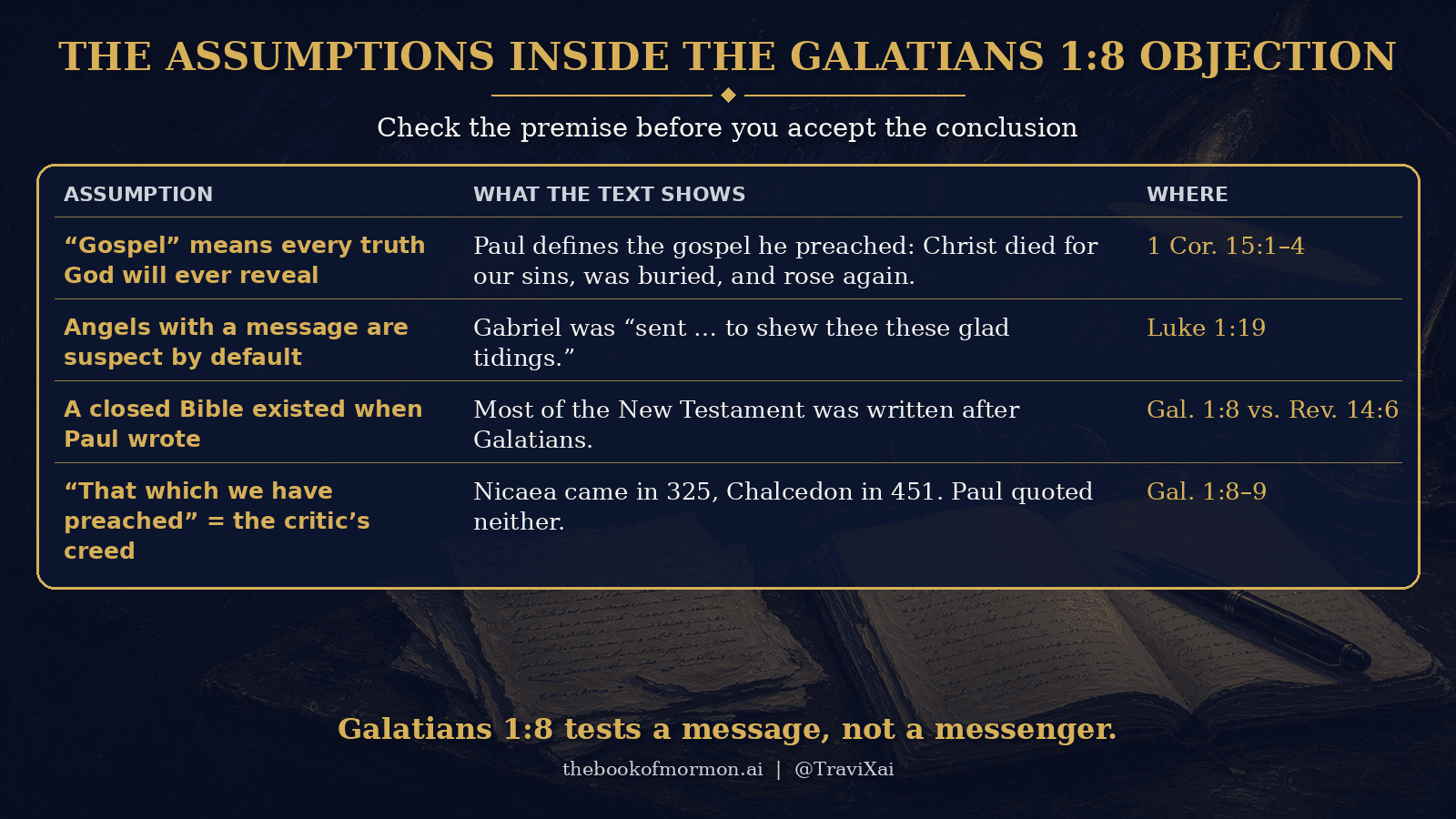
Before answering the verse, notice what the objection takes for granted. Each of these has to be true for “Galatians 1:8 condemns the Book of Mormon” to work, and none of them comes from the text.
- That “gospel” means every truth God will ever reveal. Paul defines the gospel he preached in plain words: “how that Christ died for our sins according to the scriptures; And that he was buried, and that he rose again the third day” (1 Corinthians 15:3–4). More revelation about that same Christ isn’t “another gospel.”
- That an angel with a message is suspect by default. The gospel was announced by angels. Gabriel said, “I am Gabriel, that stand in the presence of God; and am sent to speak unto thee, and to shew thee these glad tidings” (Luke 1:19).
- That the canon was closed when Paul wrote. It wasn’t. Most of the New Testament, including the Gospel of John and Revelation, was written after Galatians. If Galatians 1:8 ruled out anything written later, it would rule out most of the New Testament.
- That the critic’s theology is “that which we have preached.” Paul’s standard is what he preached, not the creeds of Nicaea (325) or Chalcedon (451), which came centuries later. A critic who uses the verse has to show the Book of Mormon contradicts Paul’s gospel, not a later creed.
- That Paul stopped receiving revelation. He kept writing: “I will come to visions and revelations of the Lord” (2 Corinthians 12:1).
Take those assumptions away and the verse does what Paul meant it to do: it tests the content of a message against the gospel of Jesus Christ. That’s a test the Book of Mormon welcomes. See also Is the LDS Church a cult? and Do Latter-day Saints read the Bible?.
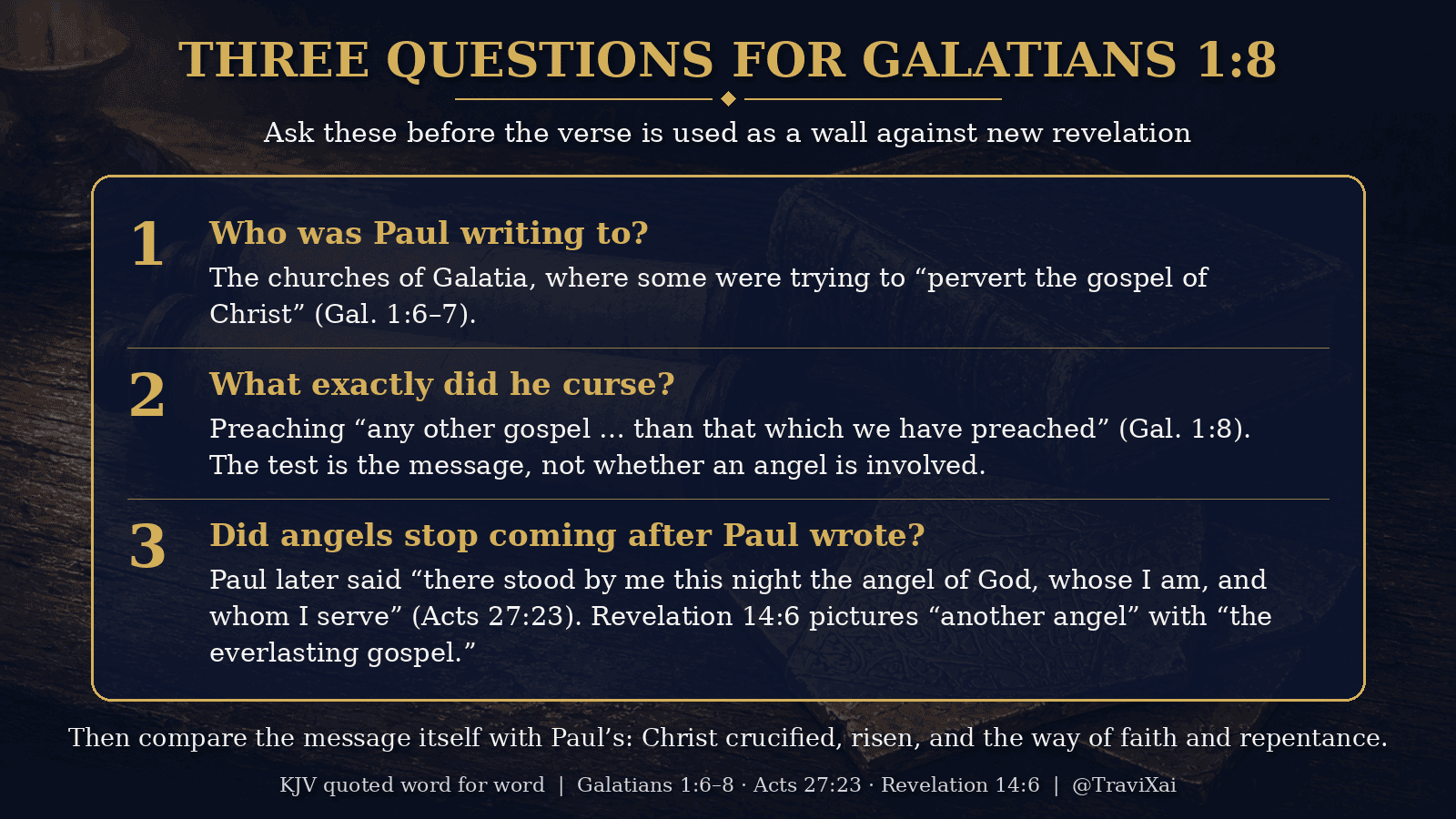
Who Paul was writing to
Paul wrote to churches in Galatia (in today’s Turkey) in the middle of the first century (dating discussion). He opens with surprise at what’s happening:
I marvel that ye are so soon removed from him that called you into the grace of Christ unto another gospel: Which is not another; but there be some that trouble you, and would pervert the gospel of Christ.
Galatians 1:6–7 (KJV)
Who were “some that trouble you”? The rest of the letter shows it. Teachers were telling Gentile believers they had to be circumcised and keep the law of Moses on top of faith in Christ. Paul’s answer is blunt: “if ye be circumcised, Christ shall profit you nothing” (Galatians 5:2). The same fight shows up in Acts, where men from Judaea taught “Except ye be circumcised after the manner of Moses, ye cannot be saved” (Acts 15:1). That was the “other gospel.” Joseph Smith and Moroni aren’t in the passage.
A quick note on the quote you may have heard. Many people cite a modern wording, “let them be under God’s curse.” That’s the NIV’s rendering, which I’ve used in older versions of this post. The KJV, which I quote throughout, says “let him be accursed,” and the Greek word behind both is anathema.
What Paul actually cursed
Paul tells you what he’s protecting: “the gospel of Christ,” the message he’d already taught them. He isn’t saying that nothing new could ever come from God. He’s saying a message that changes the way of salvation, whoever delivers it, is not to be received. That’s a test about content.
And it’s a test I’m happy to run. Christ crucified for our sins, risen, salvation by his grace, faith, repentance, baptism, and the gift of the Holy Ghost: all of it is in the Book of Mormon. The real question is whether the Book of Mormon’s message matches what Paul preached, and I take that apart line by line below. If you’re going to use Galatians 1:8, use it that way. Compare the messages. Don’t just ask if an angel was there.
Notice also that Paul puts himself under it: “though we.” If the verse means “nobody gets to add anything,” Paul’s own later letters are in trouble. If it means “don’t change the gospel,” he and Joseph both stand or fall on the same ground. More at Galatians18: Galatians 1:8 and “another gospel” and Is Moroni an accursed angel?
Paul’s own story has angels in it
Paul didn’t think angels were off the table. He told his own readers how he got the gospel:
But I certify you, brethren, that the gospel which was preached of me is not after man. For I neither received it of man, neither was I taught it, but by the revelation of Jesus Christ.
Galatians 1:11–12 (KJV)
And years after he wrote Galatians, on a ship caught in a storm, he told the crew:
For there stood by me this night the angel of God, whose I am, and whom I serve, Saying, Fear not, Paul; thou must be brought before Cæsar: and, lo, God hath given thee all them that sail with thee.
Acts 27:23–24 (KJV)
So the same Paul who curses a false gospel from an angel received his message by revelation and later had an angel stand by him. If Galatians 1:8 meant “no more angels, no more revelation,” Paul didn’t get the memo. It’s the content that matters.
Revelation didn’t stop at Galatians
The Bible also speaks of an angel carrying the gospel in the last days:
And I saw another angel fly in the midst of heaven, having the everlasting gospel to preach unto them that dwell on the earth, and to every nation, and kindred, and tongue, and people,
Revelation 14:6 (KJV)
Paul doesn’t treat prophecy as finished either. He tells the elders at Ephesus what will happen after he leaves:
For I know this, that after my departing shall grievous wolves enter in among you, not sparing the flock. Also of your own selves shall men arise, speaking perverse things, to draw away disciples after them.
Acts 20:29–30 (KJV)
Jude says the same kind of thing: “certain men crept in unawares … turning the grace of our God into lasciviousness” (Jude 1:4). The apostles saw a danger coming. That fits the Restoration claim: if the gospel was being corrupted, God would have to correct it, and the Bible’s own pattern is that he does so through prophets:
Surely the Lord God will do nothing, but he revealeth his secret unto his servants the prophets.
Amos 3:7 (KJV)
That’s the heart of the Latter-day Saint position, and I say it plainly: Moroni’s visit isn’t a violation of Galatians 1:8. It’s an example of how God has always worked. See continuing revelation and the Great Apostasy at Galatians18, and The Canon Was Never Meant to Close on this blog.
There’s a double standard to watch for here too. Critics use Galatians 1:8 as a seal on revelation, but nothing in the verse says the Bible is complete or that the New Testament canon is closed. The Bible doesn’t contain a list of its own books, and we have no original manuscripts. The assumption that it’s a finished, closed book comes from outside the text. See Sola Scriptura: Which Verse Teaches It? and Books the Bible Quotes That Aren’t in the Bible.
Where the real disagreement is
In fairness, my critics have a point I should state at full strength. Paul does say that no messenger gets a pass if the message changes. I agree. If Joseph Smith taught that Christ’s atonement doesn’t save, or that works earn salvation without grace, I’d reject him. The disagreement isn’t over the rule. It’s over whether the message matches.
And that’s where it gets uncomfortable for the critic. Catholics, Baptists, and Methodists disagree over baptism, grace and works, and the nature of God, and each calls the others’ view a serious error, but I don’t see them quoting Galatians 1:8 at each other as proof the other side is accursed. If the verse is a blanket curse on every doctrine you disagree with, it condemns a lot of people. If it’s about perverting the gospel of Christ, then the discussion has to be about what the gospel is. I’m happy to have that one: see grace and works.
Going deeperThe deeper study: the Greek, “though we,” and Paul’s own test
The wording: “Which is not another”
Two verses earlier, Paul says something that sounds strange in English:
I marvel that ye are so soon removed from him that called you into the grace of Christ unto another gospel: Which is not another; but there be some that trouble you, and would pervert the gospel of Christ.
Galatians 1:6–7 (KJV)
“Another gospel, which is not another.” In Greek, verse 6 says heteron (“a different”) gospel, and verse 7 says it is not allo (“another”) at all (1:6, 1:7 interlinear). There is only one gospel; the agitators offered a twisted version of it. His verb is “pervert” (metastrepsai, to turn around or distort).
Then verse 8. The KJV’s “any other gospel … than that which we have preached” translates the Greek par’ ho euēngelisametha (interlinear). Modern translations render it as a contradiction: “a gospel contrary to the one we preached” (ESV), “contrary to what we have preached” (NASB), and “contrary to what we proclaimed” (NRSVue). The NIV keeps “other than.”
Paul uses the same construction in Romans, and there the King James translators chose “contrary”:
Now I beseech you, brethren, mark them which cause divisions and offences contrary to the doctrine which ye have learned; and avoid them.
Romans 16:17 (KJV)
That’s para tēn didachēn, “contrary to the teaching” (interlinear). Nobody reads Romans 16:17 as a ban on learning anything new. It warns against contradicting what they had learned. Galatians 1:8 works the same way.
“Though we”: Paul put himself under the curse
Read the verse slowly and notice who comes first: “though we.” Paul names himself and his companions before he names the angel. Then he repeats the warning and widens it:
As we said before, so say I now again, If any man preach any other gospel unto you than that ye have received, let him be accursed.
Galatians 1:9 (KJV)
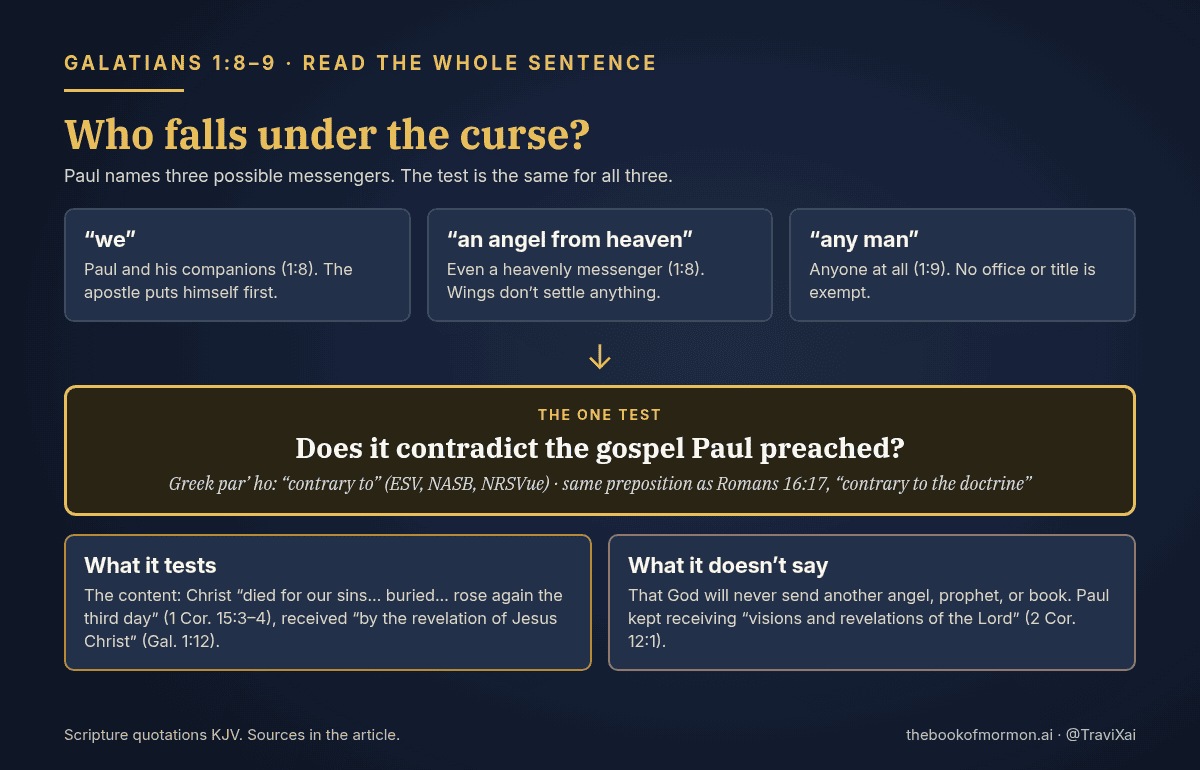
If Galatians 1:8 meant “no more revelation after this letter,” Paul just cursed himself for every letter he wrote afterward. What he built is a content test for apostles, angels, and everyone else alike. The question is never whether the messenger had wings. It’s whether the message contradicts the gospel.
The test: Paul’s gospel in Paul’s words
So what was the gospel Paul preached? He defines it plainly:
Moreover, brethren, I declare unto you the gospel which I preached unto you … For I delivered unto you first of all that which I also received, how that Christ died for our sins according to the scriptures; And that he was buried, and that he rose again the third day according to the scriptures.
1 Corinthians 15:1, 3–4 (KJV)
Galatians fills in the rest. We are “justified by the faith of Christ, and not by the works of the law” (Galatians 2:16). We receive “the promise of the Spirit through faith” (Galatians 3:14). “As many of you as have been baptized into Christ have put on Christ” (Galatians 3:27). And what counts is “faith which worketh by love” (Galatians 5:6).
Christ crucified and risen. Faith in Him, not in the law of Moses. Baptism into Him. The Spirit. Faith that shows itself in love. That’s the standard.
Applied: Hold the Book of Mormon to it
Now hold the Book of Mormon up to it. When the risen Christ defines “my gospel” in the Book of Mormon, He starts at the cross: “my Father sent me that I might be lifted up upon the cross” (3 Nephi 27:13–14). Then He gives the rest:
Now this is the commandment: Repent, all ye ends of the earth, and come unto me and be baptized in my name, that ye may be sanctified by the reception of the Holy Ghost, that ye may stand spotless before me at the last day. Verily, verily, I say unto you, this is my gospel.
3 Nephi 27:20–21
Faith, repentance, baptism, the Holy Ghost: the same order Nephi teaches as “the doctrine of Christ” (2 Nephi 31:17–21) and Jesus teaches at the temple in Bountiful (3 Nephi 11:32–39). And on the exact question that set off Galatians, the Book of Mormon lands where Paul does: “the law of circumcision is done away in me” (Moroni 8:8), and “the law hath become dead unto us, and we are made alive in Christ because of our faith” (2 Nephi 25:25).
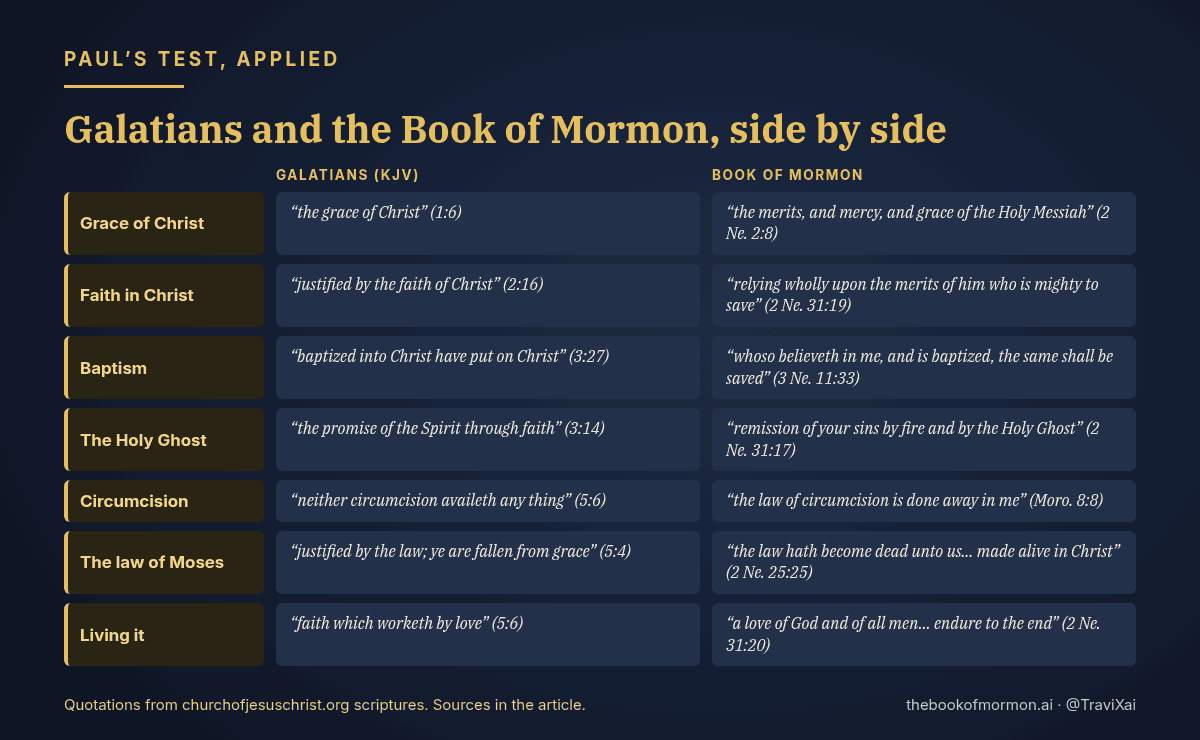
A book contrary to Paul’s gospel would sound like the Judaizers: Christ plus circumcision, Christ plus Moses. The Book of Mormon says the opposite in so many words. Disagree with it on other grounds if you like, but “contrary to the gospel Paul preached” is the one charge its own text refutes.
The works question: “Isn’t that what the Judaizers did?”
This is the strongest version of the objection, so here’s a straight answer. Latter-day Saints teach that baptism, obedience, and enduring to the end matter. Isn’t that adding works, like the agitators in Galatia?
Look at what Paul opposed: being “justified by the law” of Moses, with circumcision as the entry rite (Galatians 5:4). He did not oppose obedience to Christ. In the same letter he warns that people who practice the works of the flesh “shall not inherit the kingdom of God” (Galatians 5:19–21), and adds, “whatsoever a man soweth, that shall he also reap” (Galatians 6:7–8).
If teaching baptism (3:27) and faith that works by love (5:6) makes a gospel “other,” Galatians fails its own test. The Book of Mormon puts the credit where Paul does: no one can dwell with God “save it be through the merits, and mercy, and grace of the Holy Messiah” (2 Nephi 2:8), and we press forward “relying wholly upon the merits of him who is mighty to save” (2 Nephi 31:19). Galatians18 walks through the rest of this on its grace and works page.
A plain reply you can use
Here’s the conversation as I’d have it. Change the words to sound like you.
I get why Galatians 1:8 matters to you. It’s a serious verse about protecting the gospel. But look at what Paul wrote just before it. He’s writing to churches that were being told they had to be circumcised and keep the law of Moses on top of faith in Christ. That’s the “other gospel” he’s cursing.
He doesn’t say no angel will ever bring anything again. Later in Acts 27 an angel of God stands by Paul himself, and Revelation 14:6 describes an angel with the everlasting gospel. Paul got his own gospel “by the revelation of Jesus Christ,” not from men.
So the question I’d ask is whether the message is different. The Book of Mormon teaches Christ crucified and risen, salvation by his grace, faith, repentance, and baptism. If you think it contradicts Paul, show me where, and we’ll look at the text together. If the test is the message, I’m glad to take it.
Then listen. If they’re open, offer to read a chapter of the Book of Mormon with them and compare it with Paul. Keep it warm. Nobody was ever argued into the Spirit.
What all four standard works say
Latter-day Saints have four books of scripture, the standard works. All four agree with Paul on what the gospel is, and all four say God sends angels with it.
The Bible
And I saw another angel fly in the midst of heaven, having the everlasting gospel to preach unto them that dwell on the earth, and to every nation, and kindred, and tongue, and people.
Revelation 14:6
And the angels’ role is service: “Are they not all ministering spirits, sent forth to minister for them who shall be heirs of salvation?” (Hebrews 1:14).
The Book of Mormon
Behold I have given unto you my gospel, and this is the gospel which I have given unto you—that I came into the world to do the will of my Father, because my Father sent me.
3 Nephi 27:13
That is Paul’s gospel: the Son sent by the Father, “lifted up upon the cross” to draw all men to Him (3 Nephi 27:14). Mormon adds that angels still serve Christ’s purposes: “Behold I say unto you, Nay; neither have angels ceased to minister unto the children of men” (Moroni 7:29).
The Doctrine and Covenants
And this is the gospel, the glad tidings, which the voice out of the heavens bore record unto us—That he came into the world, even Jesus, to be crucified for the world, and to bear the sins of the world.
D&C 76:40–41
And the Lord ties the Restoration directly to Revelation 14:6: “I have sent forth mine angel flying through the midst of heaven, having the everlasting gospel” (D&C 133:36).
The Pearl of Great Price
And thus the Gospel began to be preached, from the beginning, being declared by holy angels sent forth from the presence of God, and by his own voice, and by the gift of the Holy Ghost.
Moses 5:58
The fourth Article of Faith lists the same first principles Paul and Peter taught: “Faith in the Lord Jesus Christ; second, Repentance; third, Baptism by immersion for the remission of sins; fourth, Laying on of hands for the gift of the Holy Ghost” (Articles of Faith 1:4; compare Acts 2:38).
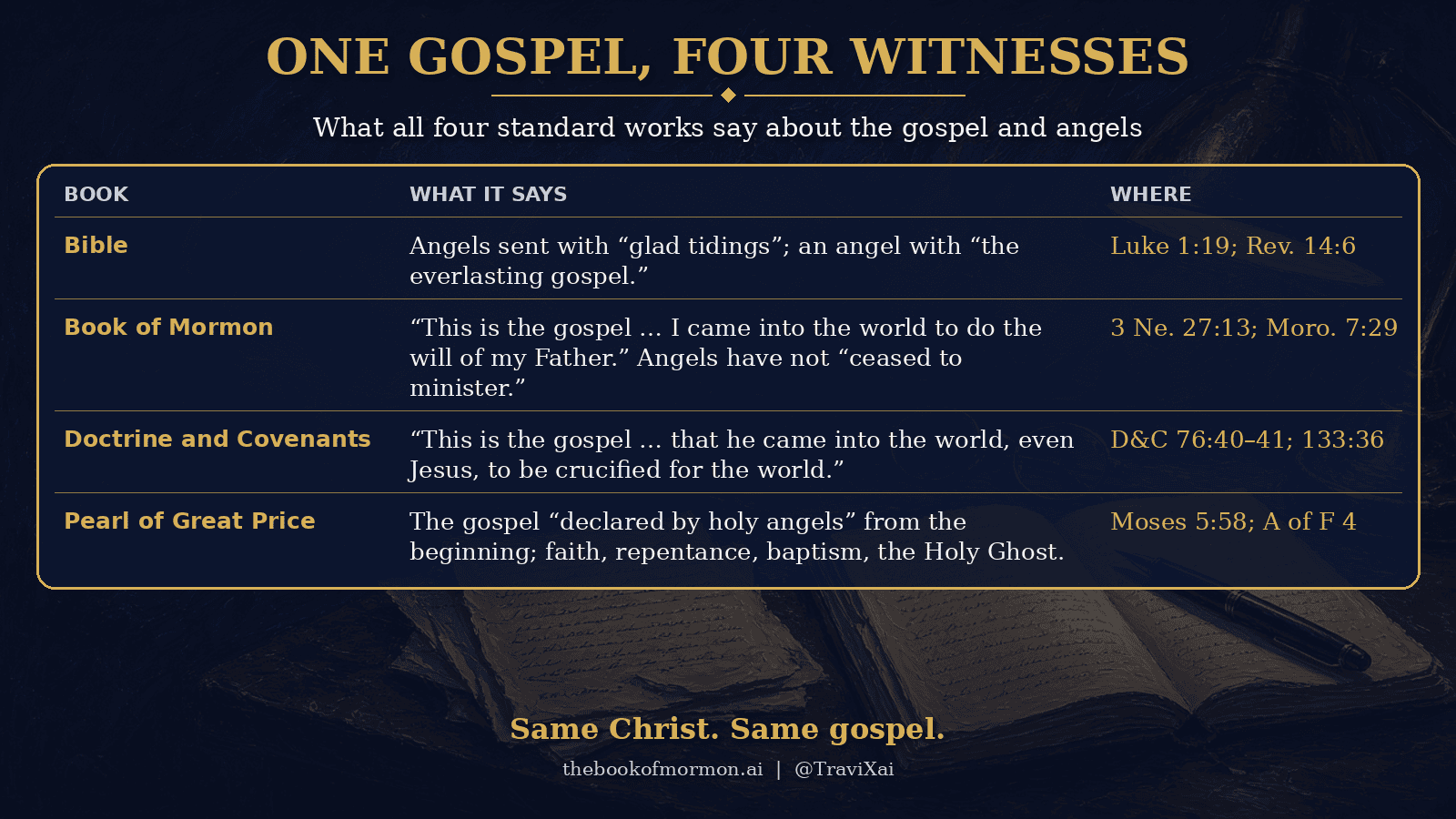
Four books, one gospel. The angel in Galatians 1:8 is cursed for changing that message. The angel in Revelation 14:6 is sent to carry it. Moroni’s message is the second kind. For a chapter-by-chapter answer to the most common critiques, see The CES Letter: A Faithful Response.
Key takeaways
- Galatians 1:8 curses “any other gospel,” and Paul names the problem in verses 6–7: people were perverting “the gospel of Christ.” It’s a test of the message.
- The “other gospel” in Galatia was a demand that Gentiles be circumcised and keep Moses’ law to be saved (Gal. 5:2; Acts 15:1).
- Paul received his gospel “by the revelation of Jesus Christ” (Gal. 1:12), and later said the angel of God stood by him (Acts 27:23).
- Revelation 14:6 pictures “another angel” with “the everlasting gospel,” and Amos 3:7 says God reveals his secrets to the prophets.
- Use the verse honestly: compare the Book of Mormon’s message with Paul’s. Don’t just ask whether an angel was involved.
Galatians 1:8 questions, answered
What does Galatians 1:8 mean?
Paul curses anyone, even “an angel from heaven,” who preaches a gospel “other” than the gospel of Christ he already taught the Galatians. In context the “other gospel” was the demand that Gentile converts be circumcised and keep the law of Moses to be saved (Galatians 5:2–4; Acts 15:1). It is a test of the message, not a ban on future revelation.
Does Galatians 1:8 condemn the Book of Mormon?
Only if the Book of Mormon preaches a different gospel, and it doesn’t. It teaches faith in Jesus Christ, repentance, baptism, the Holy Ghost, and salvation through His atonement (2 Nephi 31; 3 Nephi 27:13–21). Apply Paul’s test to the message, the way he did, and the charge collapses. See Are Latter-day Saints Christian?.
Didn’t an angel bring the Book of Mormon? Isn’t that exactly what Paul warned about?
Paul warned about the content, not the messenger. He himself was guided by “the angel of God” (Acts 27:23), Revelation 14:6 promises “another angel” with “the everlasting gospel,” and Galatians 1:8 includes “we,” meaning Paul himself. Angels delivering God’s message is a Bible pattern.
Did Galatians close the canon?
No. Galatians was written years before most of the New Testament, including John’s Gospel and Revelation. If Galatians 1:8 forbade more scripture, it would rule out books critics accept. Read Revelation 22:18 and “this book” and The Canon Was Never Meant to Close.
Was Moroni an angel preaching “another gospel”?
No. Moroni delivered a record whose stated purpose is “the convincing of the Jew and Gentile that Jesus is the Christ” (Book of Mormon title page). That is the gospel Paul preached (1 Corinthians 15:1–4), not a different one.
Does Galatians 1:8 mean there can be no new scripture?
No. Paul wrote it before most of the New Testament existed, and Revelation 14:6 describes an angel bringing “the everlasting gospel” later. The verse forbids a different gospel, not more scripture about the same Christ.
What gospel did Paul preach?
He summarized it in 1 Corinthians 15:3–4: Christ died for our sins, was buried, and rose again the third day. The Book of Mormon teaches the same (3 Nephi 27:13–14).
Do the Doctrine and Covenants and Pearl of Great Price agree with Paul?
Yes. D&C 76:40–41 defines the gospel as Jesus coming “to be crucified for the world,” and Articles of Faith 4 lists faith, repentance, baptism, and the gift of the Holy Ghost, the same steps as Acts 2:38.
Follow @TraviXai on X for daily answers to critics, and dig deeper into any topic at galatians18.app.
Sources
- Scripture quotations: King James Version and Book of Mormon, churchofjesuschrist.org: Galatians 1:6–8, 1:11–12, 5:2; Acts 15:1, 20:29–30, 27:23–24; Jude 1:4; Revelation 14:6; Amos 3:7.
- NIV wording of Galatians 1:8 (“let them be under God’s curse!”), Bible Gateway; compare ESV and NASB.
- Date of Galatians, Wikipedia, Epistle to the Galatians (scholarly range and discussion).
- Topics for further study at galatians18.app: Galatians 1:8 and “another gospel”, Is Moroni an accursed angel?, Continuing Revelation, The Great Apostasy, Grace and Works.
- Related on this blog: The Canon Was Never Meant to Close, Which Verse Teaches Sola Scriptura?, Books the Bible Quotes Not in the Bible, Sola Scriptura: 8 Problems.
- Scriptures (KJV and Book of Mormon, churchofjesuschrist.org): Galatians 1:6–12 · Galatians 2:2–5, 16 · Galatians 3:14, 27 · Galatians 5:2–6, 19–21 · Galatians 6:7–8, 12 · Acts 15:1 · Romans 16:17 · 1 Corinthians 15:1–4 · 2 Corinthians 12:1 · Ephesians 3:3–5 · 1 Thessalonians 5:20 · Revelation 14:6 · 3 Nephi 27:13–21 · 3 Nephi 11:32–39 · 2 Nephi 31:17–21 · 2 Nephi 25:25–26 · 2 Nephi 2:8 · Moroni 8:8
- Galatians 1:8 in modern translations (Bible Gateway): ESV · NASB · NRSVue · NIV
- Greek interlinear (Bible Hub): Galatians 1:6 · Galatians 1:7 · Galatians 1:8 · Romans 16:17
- Featured image and in-post graphic: original graphics by thebookofmormon.ai (painterly backgrounds with no photographs or likenesses of real people).
- Scripture quotations from the Holy Bible (KJV) and the Book of Mormon via churchofjesuschrist.org. NIV wording from Bible Gateway.
Follow @TraviXai and explore more at https://galatians18.app.