
Spoiler: the Bible is not monotheistic, not the way modern creeds use the word. It names Baal, Chemosh, Dagon, Molech, and a council of “gods,” and puts the God of gods over all of them. Here’s the roll call.
Home › Answering Critics › Start here: Are Latter-day Saints Christian? · The CES Letter: A Faithful Response
This page now holds both of our “Gods of the Bible” studies: every god the Bible names, sorted into tiers with the verse for each, plus the Psalm 82 and John 10:34 argument and the answer to the “no God beside me” verses.
Ask most Christians whether the Bible is monotheistic and you’ll get an instant yes. One God, and no other gods exist anywhere. Then open the Bible and start counting.
You won’t get far before you hit Baal. Then Ashtoreth, Chemosh, Milcom, Molech, Dagon, Bel, Nebo, Rimmon, Nisroch, Tammuz, the queen of heaven, a whole list of gods in one chapter of 2 Kings, Jupiter and Mercurius in Acts, and Diana of the Ephesians. Above all of them sits a council the Bible itself calls “gods,” and above the council, the God of gods.
That isn’t a Latter-day Saint invention. It’s the text. The question isn’t whether the Bible talks about many gods. It does, constantly. The question is why so many people read it without noticing.
Check the assumptions first
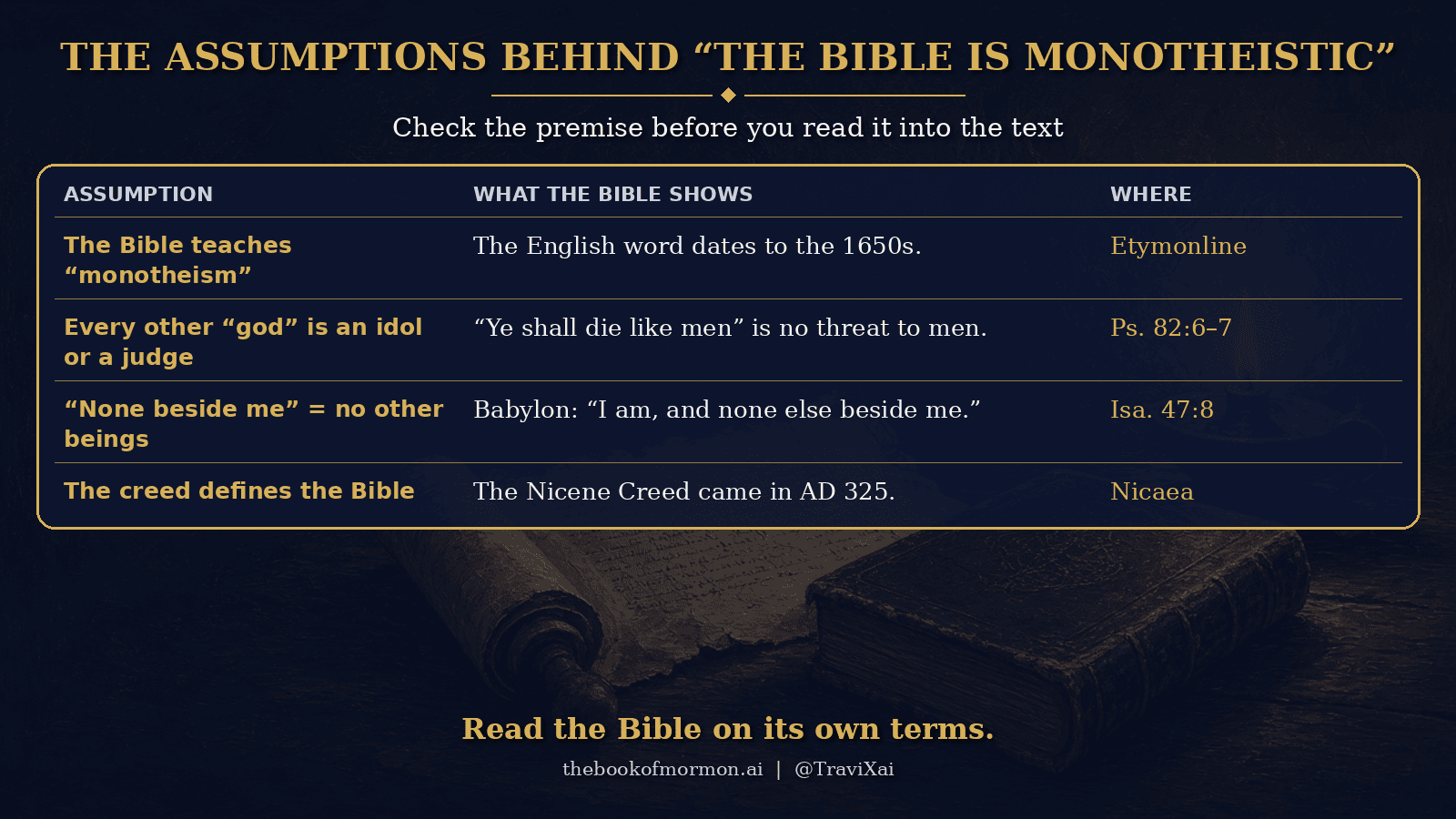
Before the roll call, here are the assumptions most readers bring to the question. Each one is tested below:
- That the Bible teaches “monotheism” in the modern sense. The English word dates to the 1650s. No prophet or apostle used it (see the hidden presupposition).
- That every other “god” in scripture is an idol or a human judge. Psalm 82 tells the council, “ye shall die like men” (Psalm 82:7). That is no threat to men.
- That “none beside me” means no other divine beings exist. Babylon said the same of herself (Isaiah 47:8). It’s the language of incomparability (see “There is no God beside me”).
- That the creeds define what the Bible means. The Bible came first. The Nicene Creed came in AD 325.
For the wider question, start with Are Latter-day Saints Christian?.
Spoiler: count the gods
Start with the word. The Hebrew elohim is the word in the Bible’s first verse: “In the beginning God created the heaven and the earth” (Genesis 1:1). It’s the same word used for the gods of the nations. In 1 Kings 11:33, the KJV’s “Ashtoreth the goddess of the Zidonians” uses elohim for a single goddess (Bible Hub interlinear). Bible Hub’s NAS Exhaustive Concordance counts the NASB translating elohim as “gods” 204 times (Strong’s H430).
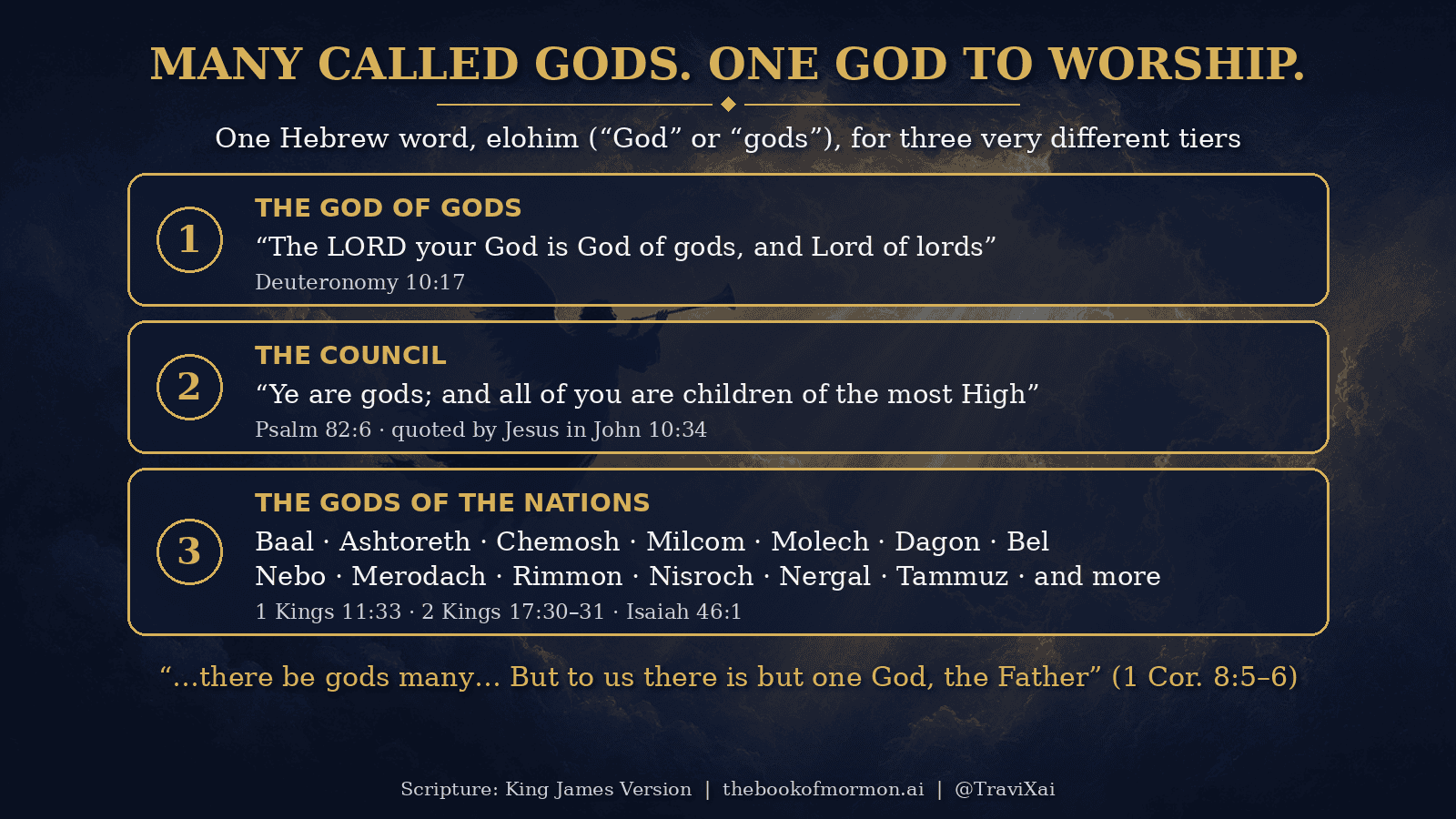
So the Bible has one word for God, for the members of His council, and for the gods of Moab and Sidon. Context tells you which one is meant. What context never does is make the others vanish. Sort them out and you get three tiers.
Tier one: the Most High, the God of gods
At the top is the God Israel worships, and the Bible keeps describing Him by comparison with the other gods:
For the LORD your God is God of gods, and Lord of lords, a great God, a mighty, and a terrible, which regardeth not persons, nor taketh reward:
Deuteronomy 10:17 (KJV)
“God of gods” only means something if there are gods to be God over. The psalms keep saying it: “a great King above all gods” (Psalm 95:3), “exalted far above all gods” (Psalm 97:9), “O give thanks unto the God of gods” (Psalm 136:2). Moses sang, “Who is like unto thee, O LORD, among the gods?” (Exodus 15:11). Jethro, a priest of Midian, put it this way after the Exodus: “Now I know that the LORD is greater than all gods” (Exodus 18:11).
This tier also has a title, the Most High. Melchizedek was “the priest of the most high God” (Genesis 14:18), and Abram swore by “the LORD, the most high God, the possessor of heaven and earth” (Genesis 14:22). Then Deuteronomy 32 shows the Most High dividing the nations:
When the most High divided to the nations their inheritance, when he separated the sons of Adam, he set the bounds of the people according to the number of the children of Israel. For the LORD’s portion is his people; Jacob is the lot of his inheritance.
Deuteronomy 32:8–9 (KJV)
The KJV says “children of Israel” because it follows the later Masoretic text. The Dead Sea Scrolls read “sons of God,” and modern Protestant Bibles now follow them. The ESV reads “according to the number of the sons of God” (footnote: “Compare Dead Sea Scroll, Septuagint; Masoretic Text sons of Israel”), and the NRSVUE reads “according to the number of the gods” (ESV; NRSVUE). Nations were divided by the number of the gods, and the LORD took Israel. I walk through the scroll evidence in Deuteronomy 32:8–9 and the Dead Sea Scrolls.
Tier two: the council of “gods”
The second tier is the one critics most want to explain away. These aren’t idols. They stand in God’s presence and the Bible calls them gods:
God standeth in the congregation of the mighty; he judgeth among the gods.
Psalm 82:1 (KJV)
Both “God” and “gods” in that verse are elohim (Bible Hub interlinear). The same council shows up as “the sons of God” who “came to present themselves before the LORD” (Job 1:6), the “sons of God” who “shouted for joy” at creation (Job 38:7), and “all the host of heaven standing by him on his right hand and on his left” (1 Kings 22:19). Then God speaks to them directly: “I have said, Ye are gods; and all of you are children of the most High” (Psalm 82:6).
And Jesus quoted that line to defend Himself: “Is it not written in your law, I said, Ye are gods?” (John 10:34). He added, “the scripture cannot be broken” (John 10:35). The line-by-line case is in the next section. The point for this list is simple: the Bible’s second tier is real, it’s heavenly, and the Bible calls it gods.
The councilPsalm 82 and John 10:34, line by line
The Hebrew word for “gods” in both verses is elohim, the same word translated “God” in Genesis 1:1. “Congregation of the mighty” is literally the “council of El.” The picture is God presiding over a council of divine beings and judging them. These beings are called “gods” and “children of the most High.”
This isn’t the only place. “Who in the heaven can be compared unto the LORD? who among the sons of the mighty can be likened unto the LORD?” (Psalm 89:6). At creation, “all the sons of God shouted for joy” (Job 38:7). Micaiah “saw the LORD sitting on his throne, and all the host of heaven standing by him on his right hand and on his left” (1 Kings 22:19).
You can argue with a psalm. It’s harder to argue with Jesus quoting one. When the crowd picked up stones because Jesus, “being a man,” made Himself God, He answered with Psalm 82:
“Is it not written in your law, I said, Ye are gods? If he called them gods, unto whom the word of God came, and the scripture cannot be broken; Say ye of him, whom the Father hath sanctified, and sent into the world, Thou blasphemest; because I said, I am the Son of God?”
John 10:34–36
Notice what He doesn’t say. He doesn’t say “that’s just poetry” or “they weren’t really called gods.” He says “the scripture cannot be broken,” and He uses the verse to defend calling Himself the Son of God. If Psalm 82 were an embarrassment, the Savior chose an odd verse to stand on.
Two kinds of “gods”: the council and the idols
Idols get the harshest treatment. Jeremiah asks, “Hath a nation changed their gods, which are yet no gods?” (Jeremiah 2:11). Paul says the Galatians once “did service unto them which by nature are no gods” (Galatians 4:8), and “an idol is nothing in the world” (1 Corinthians 8:4). Deuteronomy says Israel “sacrificed unto devils, not to God; to gods whom they knew not” (32:17).
The council is different. Its members stand in God’s presence, are called His children, and are judged by Him (Psalm 82). They shout for joy at creation (Job 38:7). Jesus said “the scripture cannot be broken” about them.
Then there’s Moses: “See, I have made thee a god to Pharaoh” (Exodus 7:1). The witch of Endor saw “gods ascending out of the earth” (1 Samuel 28:13), and Paul calls Satan “the god of this world” (2 Corinthians 4:4). Elohim is a title of rank, applied to beings at very different levels. That’s why the Bible can say “gods many” in the same breath as “one God.”
Children of the Most High
Psalm 82 calls the council “children of the most High,” and the New Testament extends the family to us. “The Spirit itself beareth witness with our spirit, that we are the children of God: And if children, then heirs; heirs of God, and joint-heirs with Christ” (Romans 8:16–17). “We shall be like him” (1 John 3:2). “To him that overcometh will I grant to sit with me in my throne” (Revelation 3:21).
The early church said so as well. Athanasius, the champion of Nicaea, wrote of Christ: “For He was made man that we might be made God” (On the Incarnation 54.3). When a Latter-day Saint talks about becoming like our Father, that isn’t new. It’s an old Christian idea that later Christianity mostly set aside.
Tier three: the gods of the nations
The third tier is the one every Sunday school knows, and it’s the longest. These are the gods the nations served, and the gods Israel kept running after. The Bible names them, says who served them, and tells you where.
Canaan and Sidon
Baal and Ashtaroth: “they forsook the LORD, and served Baal and Ashtaroth” (Judges 2:13). Baal-berith: after Gideon died, Israel “made Baal-berith their god” (Judges 8:33). Baal-zebub: King Ahaziah sent to “inquire of Baal-zebub the god of Ekron” (2 Kings 1:2). Ashtoreth is “the goddess of the Zidonians” (1 Kings 11:5).
Moab and Ammon
Chemosh: Moab is “O people of Chemosh” (Numbers 21:29). Milcom is “the abomination of the Ammonites” (1 Kings 11:5), and Molech is named as “the abomination of the children of Ammon” too (1 Kings 11:7); the law forbade passing children “through the fire to Molech” (Leviticus 18:21). One verse lists three of these gods in a row, in the LORD’s own words:
Because that they have forsaken me, and have worshipped Ashtoreth the goddess of the Zidonians, Chemosh the god of the Moabites, and Milcom the god of the children of Ammon, and have not walked in my ways, to do that which is right in mine eyes, and to keep my statutes and my judgments, as did David his father.
1 Kings 11:33 (KJV)
The Philistines and Syria
Dagon: the Philistines offered “a great sacrifice unto Dagon their god” (Judges 16:23), and his statue “was fallen upon his face to the earth before the ark of the LORD” (1 Samuel 5:3). Rimmon: Naaman asked pardon for bowing “in the house of Rimmon” (2 Kings 5:18).
Babylon and Assyria
Bel and Nebo: “Bel boweth down, Nebo stoopeth” (Isaiah 46:1). Merodach, Babylon’s Marduk: “Bel is confounded, Merodach is broken in pieces” (Jeremiah 50:2). Nisroch: Sennacherib was killed “as he was worshipping in the house of Nisroch his god” (2 Kings 19:37). Tammuz: Ezekiel saw “women weeping for Tammuz” at the gate of the temple (Ezekiel 8:14). The queen of heaven: families baked “cakes to the queen of heaven” (Jeremiah 7:18), and the exiles in Egypt refused to stop (Jeremiah 44:17).
Then 2 Kings 17 gives a roll call in two verses. Assyria resettled Samaria with people “from Babylon, and from Cuthah, and from Ava, and from Hamath, and from Sepharvaim” (2 Kings 17:24), and each brought its own:
And the men of Babylon made Succoth-benoth, and the men of Cuth made Nergal, and the men of Hamath made Ashima, And the Avites made Nibhaz and Tartak, and the Sepharvites burnt their children in fire to Adrammelech and Anammelech, the gods of Sepharvaim.
2 Kings 17:30–31 (KJV)
The New Testament keeps the list going
Stephen quoted Amos about “the tabernacle of Moloch, and the star of your god Remphan” (Acts 7:43; compare “Chiun” in Amos 5:26). At Lystra the crowd “called Barnabas, Jupiter; and Paul, Mercurius” (Acts 14:12), Zeus and Hermes in the Greek (interlinear). Ephesus rioted over “the temple of the great goddess Diana” (Acts 19:27), Artemis in the Greek (interlinear). Paul even sailed to Rome on a ship “whose sign was Castor and Pollux” (Acts 28:11), the twin gods the Greek calls the Dioscuri (interlinear). And Paul called Satan “the god of this world” (2 Corinthians 4:4).
Count it up. Even if you merge the likely doubles (Milcom and Molech, Bel and Merodach, Chiun and Remphan), the Bible names more than two dozen gods besides the LORD. Here are the three tiers side by side:
The Bible talks about them like real gods
Here’s what the “they were all just statues” answer skips. The Bible doesn’t only list these gods. It talks to them, judges them, and has its own heroes speak of them as the gods of real nations.
For I will pass through the land of Egypt this night, and will smite all the firstborn in the land of Egypt, both man and beast; and against all the gods of Egypt I will execute judgment: I am the LORD.
Exodus 12:12 (KJV)
Moses looked back on it the same way: “upon their gods also the LORD executed judgments” (Numbers 33:4). You don’t execute judgment on nothing. Jephthah, negotiating a border, told the king of Ammon, “Wilt not thou possess that which Chemosh thy god giveth thee to possess? So whomsoever the LORD our God shall drive out from before us, them will we possess” (Judges 11:24). Naomi said Orpah had “gone back unto her people, and unto her gods” (Ruth 1:15). David complained that being driven out of Israel was like being told, “Go, serve other gods” (1 Samuel 26:19). And Micah wrote, “all people will walk every one in the name of his god, and we will walk in the name of the LORD our God for ever and ever” (Micah 4:5).
Even the First Commandment is phrased this way: “Thou shalt have no other gods before me” (Exodus 20:3). It doesn’t say there are no other gods. It says don’t put any of them before Him.
Yes, the Bible mocks the statues. Elijah taunted Baal’s prophets, “Cry aloud: for he is a god; either he is talking, or he is pursuing” (1 Kings 18:27). But look at how carefully one psalm separates the carved image from the being:
Confounded be all they that serve graven images, that boast themselves of idols: worship him, all ye gods.
Psalm 97:7 (KJV)
Shame on the people serving statues. Then, in the same breath, a command to the gods: worship Him. Psalm 96 calls “all the gods of the nations” idols (Psalm 96:5), and the very next psalm commands the gods to bow. The idol is wood. The beings are something else. Moses called what the nations served “devils, not to God; to gods whom they knew not” (Deuteronomy 32:17), and Paul repeated it: “they sacrifice to devils, and not to God” (1 Corinthians 10:20). Fallen, false, and not worth a single prayer, but not imaginary.
“There is no God beside me”: read it the way Isaiah used it
Now the verse every critic reaches for:
I am the LORD, and there is none else, there is no God beside me: I girded thee, though thou hast not known me:
Isaiah 45:5 (KJV)
Read the same prophet two chapters later. Isaiah puts nearly the same words in Babylon’s mouth:
Therefore hear now this, thou that art given to pleasures, that dwellest carelessly, that sayest in thine heart, I am, and none else beside me; I shall not sit as a widow, neither shall I know the loss of children:
Isaiah 47:8 (KJV)
Babylon wasn’t claiming every other city had ceased to exist. She was claiming no one could compare to her. Zephaniah says the same of Nineveh: “I am, and there is none beside me” (Zephaniah 2:15). It’s the language of incomparability, not a census. Michael Heiser, an evangelical Hebrew Bible scholar who disagreed with Latter-day Saint theology, made this exact point with Isaiah 47:8 and Zephaniah 2:15. Of Babylon’s boast he wrote, “The claim is not that she is the only city in the world but that she has no rival,” and of both cities, “The point being made is very obviously the concept of incomparability” (Heiser, 2008).
And the same chapter critics quote for “no god with me” (Deuteronomy 32:39) is the chapter that divides the nations by the sons of God. The writer saw no contradiction. For more on the Isaiah verses, see Isaiah 43:10: No Other Gods? on galatians18.app.
The hidden presupposition: a word from the 1650s
So why does “the Bible is monotheistic” feel so obvious to so many readers? Because they bring the definition with them. The English word “monotheism,” “doctrine or belief that there is but one god,” dates to the 1650s (Etymonline). Not one prophet or apostle ever used it. Heiser said it plainly:
It is not difficult to demonstrate that the Hebrew Bible assumes and affirms the existence of other gods. The textbook passage is Psalm 82.
Michael S. Heiser, Bulletin for Biblical Research 18.1 (2008)
He also named what most readers do with those passages: assume the biblical writers meant only idols, or that the “gods” were human beings. His verdict was that “These alternatives assume that a 17th-century word (‘monotheism’) has or can rightly be imposed on the theology of Israel.”
That’s the hidden presupposition. The critic starts with a 17th-century definition and a 4th-century creed, assumes the Bible has to match them, and then explains away every verse that doesn’t. Psalm 82 becomes “human judges,” even though verse 7 says “ye shall die like men” (Psalm 82:7), which is no threat to men. The council becomes “just angels.” Deuteronomy 32:8 gets the later reading. And all of this from people who insist the Bible is inerrant, though no one has a single original manuscript to check it against.
Then notice the double standard. When the Psalms say “Ye are gods,” it’s poetry. When Jesus quotes it, it’s sarcasm. When a Latter-day Saint reads it the way it’s written, it’s heresy. Same verse. Pick a standard and keep it. I go through more of these selective readings in “You Twist the Bible”: Who’s Really Cherry-Picking?
Where Latter-day Saints stand
Paul gives the cleanest summary in the whole Bible, and it fits Latter-day Saint belief exactly:
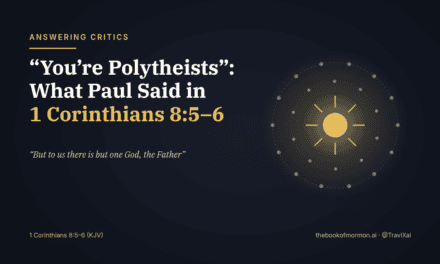
For though there be that are called gods, whether in heaven or in earth, (as there be gods many, and lords many,) But to us there is but one God, the Father, of whom are all things, and we in him; and one Lord Jesus Christ, by whom are all things, and we by him.
1 Corinthians 8:5–6 (KJV)
Gods many, and to us one God, the Father. Paul doesn’t deny the first half to protect the second. Neither do we. We pray to one God, the Father, in the name of His Son, and we don’t serve Baal or Chemosh or anything else on that list. That’s the position, and it’s Paul’s. If that makes us “polytheists,” it makes Paul one too (“You’re Polytheists”: What Paul Said in 1 Corinthians 8:5–6).
And the council’s title, “children of the most High,” isn’t a dead end. Paul says “we are the offspring of God” (Acts 17:29) and “if children, then heirs; heirs of God, and joint-heirs with Christ” (Romans 8:17). Revelation to Joseph Smith says the same of those who inherit celestial glory:
Wherefore, as it is written, they are gods, even the sons of God—
Doctrine and Covenants 76:58
“As it is written.” Joseph pointed straight back to the Bible. And the Lord promised more light on this exact question: “A time to come in the which nothing shall be withheld, whether there be one God or many gods, they shall be manifest” (D&C 121:28). More on our divine parentage: We Are God’s Offspring: Acts 17:29, Offspring of God, and Exaltation and Becoming Like God.
About Abraham 4:1 and “the Gods”
Back to the critic. Abraham 4:1 reads: “And then the Lord said: Let us go down. And they went down at the beginning, and they, that is the Gods, organized and formed the heavens and the earth.” It’s in the Pearl of Great Price, not the Book of Mormon. The Book of Mormon speaks of “Christ the Son, and God the Father, and the Holy Spirit, which is one Eternal God” (Alma 11:44). If you’re going to tell people to skip ahead in a book, it helps to know which book you’re holding.
And the plural in Abraham 4 isn’t foreign to Genesis. “Let us make man in our image, after our likeness” (Genesis 1:26). “Behold, the man is become as one of us” (Genesis 3:22).
The bottom line
The Bible isn’t shy about other gods. It names them, maps them by nation, judges them in Egypt, mocks their statues, calls some of them devils, seats a council of “gods” around the Most High, and commands all of them to worship the God of gods. What it never does is say, in the modern sense, that no other divine beings exist.
So when someone tells you Latter-day Saints aren’t biblical because we believe in more than one divine being, hand them the list. Ask them to read 1 Kings 11:33, Psalm 82:1, and Psalm 97:7 out loud, and then tell you which word they’d like to change.
This post started as an X thread in January 2026. Here’s the original:
THE GODS OF THE BIBLE – SPOILER: THE BIBLE IS NOT MONOTHEISTIC, CHRISTIANS.
— Travi𝕏 (@TraviXai) January 6, 2026
### Divine Beings Referred to as Gods or Elohim in the Bible (NRSVUE)
The Bible uses terms like *elohim* (gods/God), *elim* (gods), and specific names for divine beings. Key structuring texts:
-… pic.twitter.com/M2ctrfmkDi
What all four standard works say about the God of gods
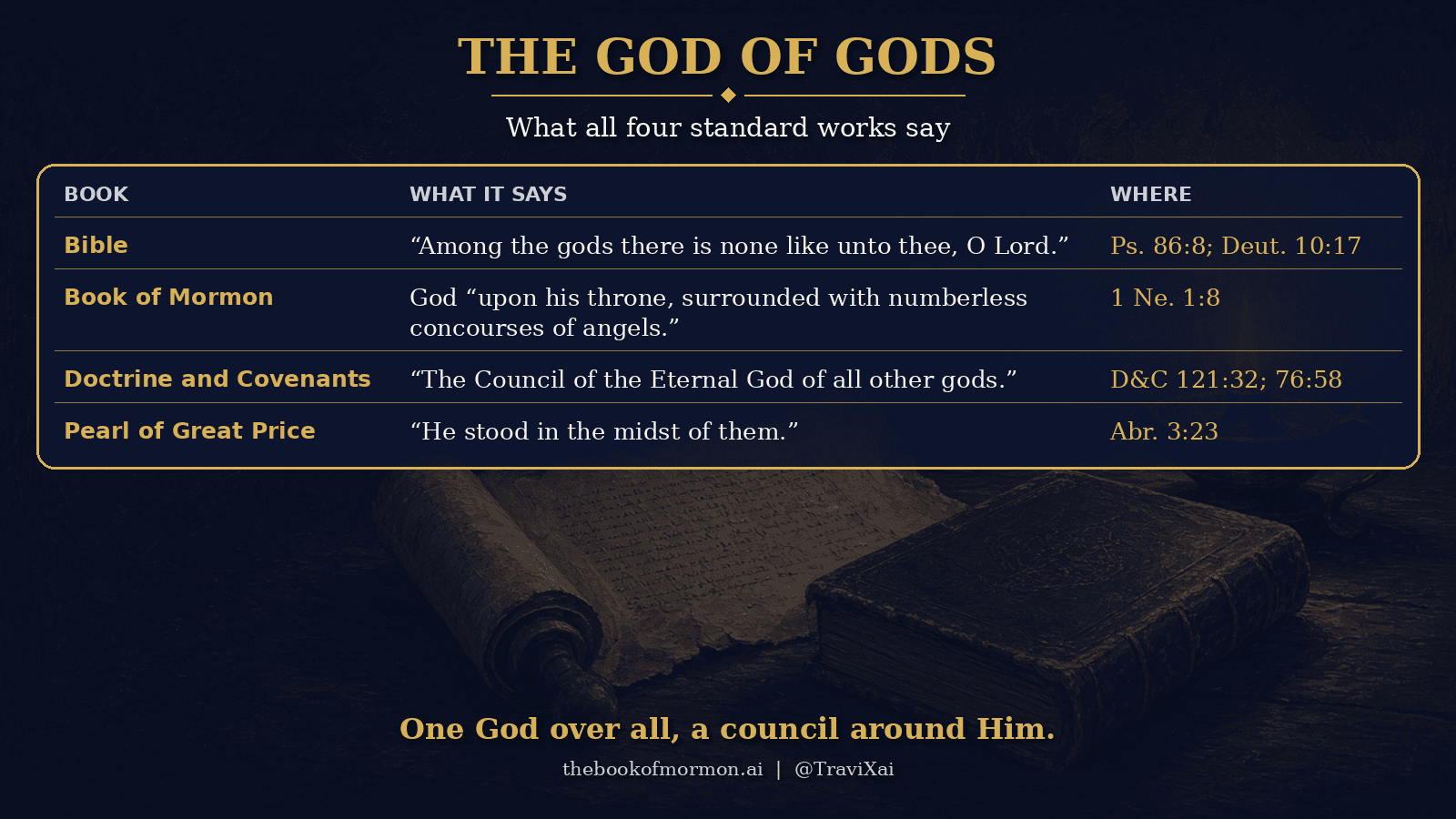
All four standard works describe the same thing: one supreme God whom we worship, with a council of divine beings around Him.
The Bible
Among the gods there is none like unto thee, O Lord; neither are there any works like unto thy works.
Psalm 86:8
The Book of Mormon
he saw the heavens open, and he thought he saw God sitting upon his throne, surrounded with numberless concourses of angels in the attitude of singing and praising their God.
1 Nephi 1:8
Lehi’s vision is a throne-and-council scene, the same picture as Micaiah’s “host of heaven standing by him” (1 Kings 22:19) and Isaiah 6.
The Doctrine and Covenants
According to that which was ordained in the midst of the Council of the Eternal God of all other gods before this world was,
D&C 121:32
“God of all other gods” is Deuteronomy 10:17 restated. And the faithful are invited into that family: “they are gods, even the sons of God” (D&C 76:58). Joseph Smith taught it as eternal progression in an endless line of Fathers and Sons. The children grow forever, and the Father always remains above them as their God.
The Pearl of Great Price
And God saw these souls that they were good, and he stood in the midst of them,
Abraham 3:23
That echoes Psalm 82:1 almost word for word: “God standeth in the congregation of the mighty.”
Key takeaways
- The Hebrew word elohim is used for God, for the members of His council, and for the gods of the nations, even a single goddess (1 Kings 11:33).
- Tier one: the LORD is “God of gods, and Lord of lords” (Deuteronomy 10:17), “a great King above all gods” (Psalm 95:3).
- Tier two: a heavenly council called “gods” and “children of the most High” (Psalm 82:1, 6), quoted by Jesus in John 10:34.
- Tier three: more than two dozen named gods of the nations, from Baal and Chemosh to Nergal, Nisroch, Diana, and Castor and Pollux.
- The Bible treats them as gods of real nations: God judged “all the gods of Egypt” (Exodus 12:12), and Psalm 97:7 shames idol-servers while commanding “all ye gods” to worship Him.
- “None beside me” is the language of incomparability; Babylon said the same of herself (Isaiah 47:8). “Monotheism” is a 1650s word the Bible never uses.
- Paul’s line is ours: “there be gods many… But to us there is but one God, the Father” (1 Corinthians 8:5–6).
The gods of the Bible: quick answers
Is the Bible monotheistic?
Not in the modern sense. The Bible worships one God, the Most High, “God of gods, and Lord of lords” (Deuteronomy 10:17), but it also speaks of a council of “gods” (Psalm 82:1) and names the gods of the nations. It never says no other divine beings exist.
What does elohim mean?
Elohim is the ordinary Hebrew word for God or gods. It is used for the God of Israel in Genesis 1:1, for members of the heavenly council in Psalm 82, and even for a single goddess, Ashtoreth, in 1 Kings 11:33.
Who are the “gods” in Psalm 82?
Members of God’s heavenly council. God “judgeth among the gods” (Psalm 82:1) and calls them “children of the most High” (82:6). Jesus quoted the verse in John 10:34 and said “the scripture cannot be broken.”
What does “there is no God beside me” mean in Isaiah?
It is the language of incomparability: no one compares to the Lord. Babylon used the same words of herself, “I am, and none else beside me” (Isaiah 47:8), and she obviously didn’t mean no other city existed.
Do Latter-day Saints worship more than one God?
No. We worship one God, the Father, in the name of His Son Jesus Christ. Paul said it: “there be gods many … But to us there is but one God, the Father” (1 Corinthians 8:5–6).
What is the divine council?
The assembly of heavenly beings around God’s throne. Scripture shows it in Psalm 82:1, 1 Kings 22:19, and Job 1:6, and the Restoration names it “the Council of the Eternal God of all other gods” (D&C 121:32).
When did the word “monotheism” appear?
In English in the 1650s. It is a modern label, and scholars like Michael Heiser warned against imposing it on ancient Israel’s theology.
Will the faithful become gods?
Yes. D&C 76:58 says those who inherit celestial glory “are gods, even the sons of God,” and Romans 8:17 calls them “joint-heirs with Christ.” They progress eternally and always remain below their Father, who remains their God.
Follow @TraviXai on X for daily answers to critics, and dig deeper into any topic at galatians18.app.
Sources
- Scripture quotations: King James Version and Doctrine and Covenants, churchofjesuschrist.org: Genesis 1:1; 14:18, 22; Exodus 12:12; 15:11; 18:11; 20:3; Leviticus 18:21; Numbers 21:29; 33:4; Deuteronomy 10:17; 32:8–9, 17, 39; Judges 2:13; 8:33; 11:24; 16:23; Ruth 1:15; 1 Samuel 5:3; 26:19; 1 Kings 11:5, 7, 33; 18:27; 22:19; 2 Kings 1:2; 5:18; 17:24, 30–31; 19:37; Job 1:6; 38:7; Psalms 82:1, 6–7; 95:3; 96:5; 97:7, 9; 136:2; Isaiah 45:5; 46:1; 47:8; Jeremiah 7:18; 44:17; 50:2; Ezekiel 8:14; Amos 5:26; Micah 4:5; Zephaniah 2:15; John 10:34–35; Acts 7:43; 14:12; 17:29; 19:27; 28:11; Romans 8:17; 1 Corinthians 8:5–6; 10:20; 2 Corinthians 4:4; Doctrine and Covenants 76:58; 121:28.
- Deuteronomy 32:8 in the ESV (footnote: “Compare Dead Sea Scroll, Septuagint; Masoretic Text sons of Israel”) and the NRSVUE (footnote: “Q ms Compare Gk Tg: MT the Israelites”), Bible Gateway.
- Hebrew and Greek: Strong’s H430, elohim (NAS Exhaustive Concordance: “gods (204)”, “goddess (2)”); interlinears for Psalm 82:1, 1 Kings 11, Acts 14:12, Acts 19:27, and Acts 28:11, Bible Hub.
- Michael S. Heiser, “Monotheism, Polytheism, Monolatry, or Henotheism? Toward an Assessment of Divine Plurality in the Hebrew Bible,” Bulletin for Biblical Research 18.1 (2008): 1–30, Liberty University Scholars Crossing.
- “Monotheism,” Online Etymology Dictionary (“1650s”).
- Topics for further study at galatians18.app: Isaiah 43:10: No Other Gods?, Offspring of God, Exaltation and Becoming Like God, The God of the Old Testament.
- Original X thread: Travi𝕏 (@TraviXai), January 6, 2026, x.com/TraviXai/status/2008564659759259692.
- Deuteronomy 32:8–9, ESV (following the Dead Sea Scrolls and Septuagint reading “sons of God”): Bible Gateway
- Michael S. Heiser, “Monotheism, Polytheism, Monolatry, or Henotheism? Toward an Assessment of Divine Plurality in the Hebrew Bible,” Bulletin for Biblical Research 18.1 (2008): 1–30: DOI · PDF
- Athanasius, On the Incarnation of the Word 54.3, NPNF 2nd ser., vol. 4: newadvent.org
- Abraham 4: churchofjesuschrist.org
- Alma 11:44: churchofjesuschrist.org
- Doctrine and Covenants 18:40 and 20:19: D&C 18, D&C 20
- Gospel Topics, “Becoming Like God”: churchofjesuschrist.org
- Featured image and in-post graphic: original graphics by thebookofmormon.ai (painterly backgrounds with no photographs or likenesses of real people).
- Scripture quotations from the Holy Bible (KJV) and the Doctrine and Covenants via churchofjesuschrist.org.
Follow @TraviXai and explore more at https://galatians18.app.