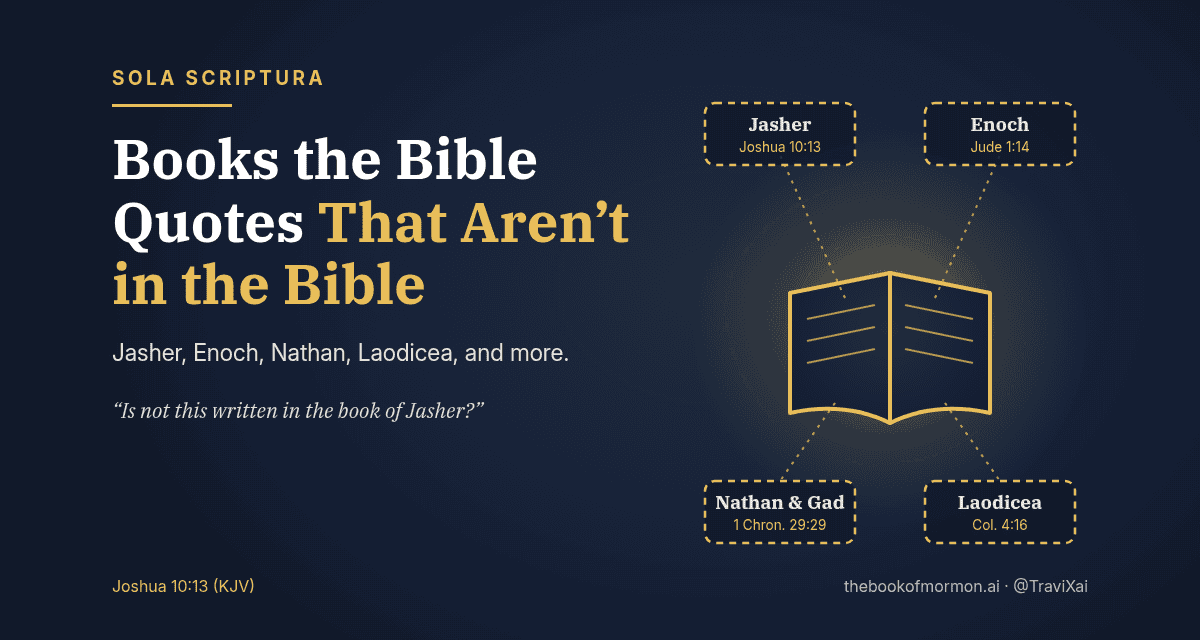

Joshua cites the book of Jasher. Jude quotes Enoch. Paul tells a church to read his letter from Laodicea. The Bible keeps pointing to books that aren’t in it, which tells you something about the claim that the Bible is all there is.
Serious books have footnotes. So does the Bible. Joshua describes the sun standing still and then asks, “Is not this written in the book of Jasher?” Chronicles closes the reign of David by sending you to the books of Nathan and Gad. Jude quotes a prophecy of Enoch, word for word. Paul tells the Colossians to go read his letter “from Laodicea.”
Here’s the catch: you can’t look any of them up. They aren’t in your Bible. This morning I asked which verse teaches sola scriptura (none of the usual eight do). This afternoon, the follow-up I promised: the books the Bible quotes that the Bible doesn’t contain, and what they do to the idea that God’s word begins in Genesis and ends at Revelation 22.
The footnotesA book that cites its sources
The Latter-day Saint Bible Dictionary keeps a running list under “Lost books”: documents “mentioned in the Bible in such a way that it is evident they were considered authentic and valuable but that are not found in the Bible today.” Here is the short version, every reference checked against the King James text.
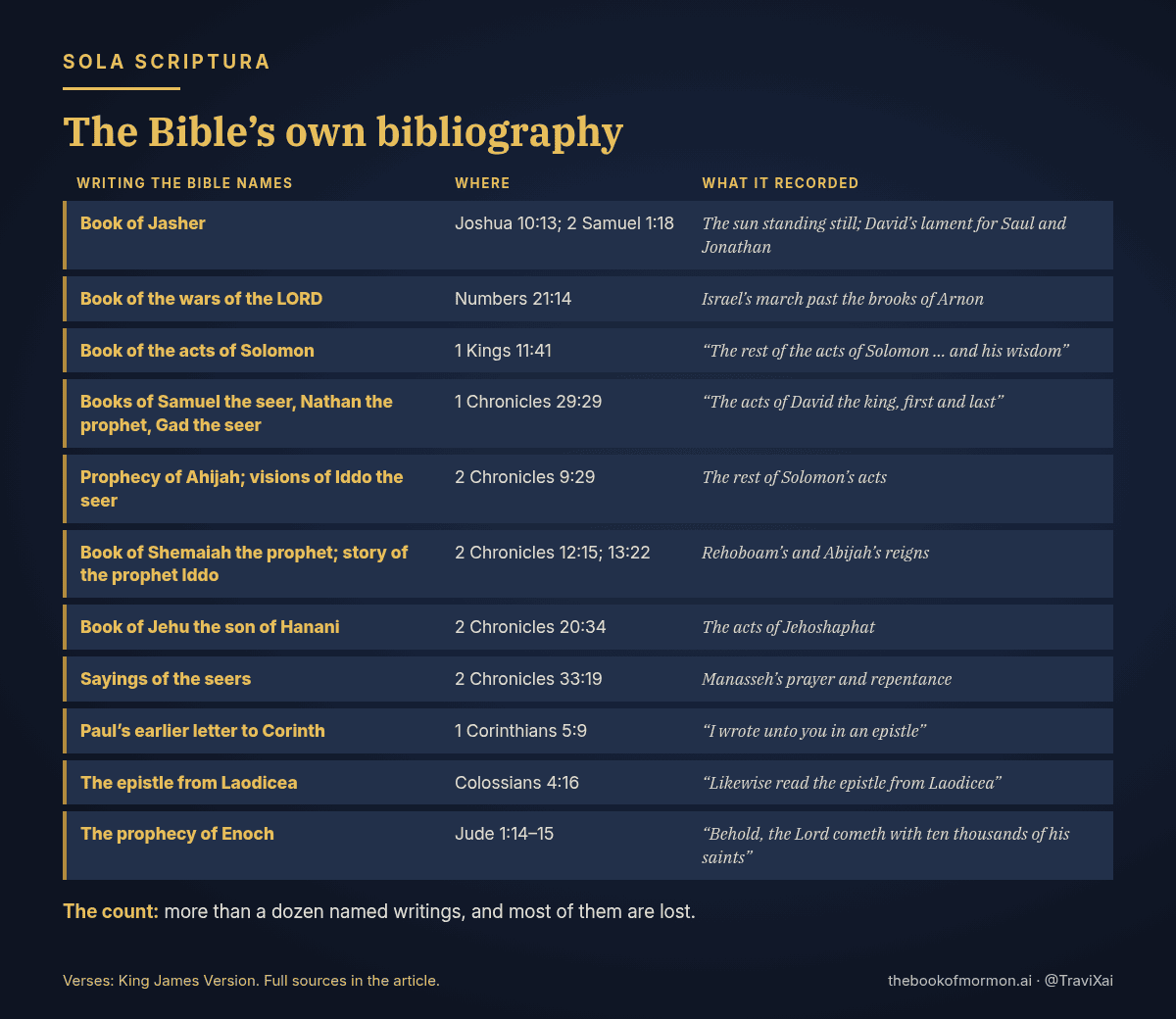
That’s more than a dozen named writings. A few may overlap or survive in another form (more on that below), but the pattern is plain: the Bible was written by people who had more of God’s dealings on their shelves than we have on ours.
JasherThe book Joshua pointed to
The most famous one shows up at the most famous miracle in Joshua:
And the sun stood still, and the moon stayed, until the people had avenged themselves upon their enemies. Is not this written in the book of Jasher? So the sun stood still in the midst of heaven, and hasted not to go down about a whole day.
Joshua 10:13 (KJV)
Notice the move. The author of Joshua doesn’t apologize for Jasher; he appeals to it, the way a preacher says “look it up.” It shows up again when David mourns Saul and Jonathan: “behold, it is written in the book of Jasher” (2 Samuel 1:18). The name means something like “the upright,” and the Bible Dictionary describes it as “an early collection of Jewish national songs and stories of deeds of valor.”
A warning before you buy one online: The “Book of Jasher” sold today is a translation of a much later Hebrew work. Even the Sacred Texts edition says the several books by that name were “all composed much later than Biblical times,” and the Bible Dictionary says the modern versions “do not appear to be the one spoken of in the Bible.” The real one is gone. That’s the point.
The prophets’ booksNathan, Gad, Iddo, and the rest
Chronicles is practically an annotated bibliography. When David’s story ends, the writer sends you elsewhere for the rest:
Now the acts of David the king, first and last, behold, they are written in the book of Samuel the seer, and in the book of Nathan the prophet, and in the book of Gad the seer,
1 Chronicles 29:29 (KJV)
Solomon gets the same treatment: “are they not written in the book of Nathan the prophet, and in the prophecy of Ahijah the Shilonite, and in the visions of Iddo the seer” (2 Chronicles 9:29). Rehoboam’s acts are in “the book of Shemaiah the prophet, and of Iddo the seer concerning genealogies” (2 Chronicles 12:15). Abijah’s are in “the story of the prophet Iddo” (13:22). Jehoshaphat’s are in “the book of Jehu the son of Hanani” (20:34). Manasseh’s repentance is “written among the sayings of the seers” (33:19).
Look at the job titles: prophet, seer, prophet, seer. These weren’t palace scribes. Samuel himself “wrote it in a book, and laid it up before the LORD” (1 Samuel 10:25). Even Moses’ generation had “the book of the wars of the LORD” (Numbers 21:14). And Solomon “spake three thousand proverbs: and his songs were a thousand and five” (1 Kings 4:32). Our book of Proverbs holds a fraction of that.
EnochThe prophecy Jude quoted
The New Testament doesn’t just cite a lost book. It quotes one as prophecy:
And Enoch also, the seventh from Adam, prophesied of these, saying, Behold, the Lord cometh with ten thousands of his saints, To execute judgment upon all, and to convince all that are ungodly among them of all their ungodly deeds which they have ungodly committed, and of all their hard speeches which ungodly sinners have spoken against him.
Jude 1:14–15 (KJV)
Now set that beside 1 Enoch 1:9 in R. H. Charles’s translation: “And behold! He cometh with ten thousands of His holy ones to execute judgement upon all … and to convict all flesh of all the works of their ungodliness which they have ungodly committed, and of all the hard things which ungodly sinners have spoken against Him.” Same order, same phrases, even the triple “ungodly.” Jude didn’t hint. He quoted, and he called it prophecy.
Eleven Aramaic fragments of it turned up among the Dead Sea Scrolls, and the Ethiopian Orthodox Tewahedo Church still has it in its Bible (see the overview here, and Galatians18 on what else was in those caves). Early Christians noticed Jude’s quote. Tertullian, around AD 200, admitted that “the Scripture of Enoch” was “not received by some, because it is not admitted into the Jewish canon either,” and then pointed out that “Enoch possesses a testimony in the Apostle Jude.”
Jude does it twice. Verse 9 tells how “Michael the archangel, when contending with the devil he disputed about the body of Moses.” That story isn’t in the Old Testament. Origen said it came from “The Ascension of Moses,” a “little treatise, of which the Apostle Jude makes mention.” The irony: critics love Jude for “the faith which was once delivered unto the saints” (Jude 1:3), and the same short letter quotes two books outside the canon. (Galatians18 unpacks Jude 3.)
Paul’s lettersThe mail that didn’t make it
Paul’s letters have gaps you can see from inside the letters themselves. Here’s 1 Corinthians referring to an earlier letter:
I wrote unto you in an epistle not to company with fornicators:
1 Corinthians 5:9 (KJV)
That earlier letter is gone. Then there’s Colossians:
And when this epistle is read among you, cause that it be read also in the church of the Laodiceans; and that ye likewise read the epistle from Laodicea.
Colossians 4:16 (KJV)
To be fair, some ancient and modern readers think the Laodicea letter is one we already have, usually Ephesians, circulated from church to church. Maybe. But the early church clearly felt the gap: the Muratorian fragment, an early canon list, warns of a letter “to the Laodiceans … forged under the name of Paul,” and a Latin “Epistle to the Laodiceans” later turned up in some medieval Bibles (background here).
Even Matthew cites a prophecy we can’t find word for word: “that it might be fulfilled which was spoken by the prophets, He shall be called a Nazarene” (Matthew 2:23). The Bible Dictionary suggests it may echo the “Branch” of Isaiah 11:1 (Hebrew netzer), a fair possibility. And John closes his Gospel by admitting the whole record is partial: “the world itself could not contain the books that should be written” (John 21:25).
The objections“Those weren’t scripture anyway”
The usual answer comes fast: “Those were just court records and sources, not inspired scripture. God preserved everything we need.” Three problems.
First, the authors. Nathan was a prophet. Gad was a seer. Ahijah, Iddo, Shemaiah, and Jehu were prophets. Paul was an apostle, and he wrote to Corinth with the same authority before 1 Corinthians as in it. Maybe those writings weren’t meant for us, but the Bible never treats them as unreliable.
Second, “God preserved everything we need” is a reasonable hope, but it’s a claim about the canon, and no verse makes it. No verse lists the books. No prophet announces that the collection is finished. The table of contents in your Bible came from later church decisions, not from a revelation printed inside it.
Third, follow the logic. If the Bible itself shows prophets writing more than we have, then “God spoke, and men wrote it down” never stopped being the pattern. The only question is whether He would do it again. That’s why the “you can’t add to the Bible” argument struggles: the Bible was always the part of the record we kept, not the whole of what God said. (Galatians18’s Continuing Revelation page carries this further.)
A Bible! A Bible!What 2 Nephi 29 saw coming
Nephi saw this argument coming about six centuries before Christ:
And because my words shall hiss forth—many of the Gentiles shall say: A Bible! A Bible! We have got a Bible, and there cannot be any more Bible.
2 Nephi 29:3
And the Lord’s answer reads like a commentary on everything above:
Wherefore, because that ye have a Bible ye need not suppose that it contains all my words; neither need ye suppose that I have not caused more to be written.
2 Nephi 29:10
“I have caused more to be written” is exactly what Joshua, Chronicles, Jude, and Colossians already show. God goes on: “I shall speak unto the Jews and they shall write it; and I shall also speak unto the Nephites and they shall write it” (2 Nephi 29:12). The Book of Mormon follows its own rule, quoting prophets the Bible never names, Zenock, Neum, and Zenos, from the brass plates (1 Nephi 19:10). And it says the purpose of later records is to “establish the truth of the first” and restore “plain and precious things” that were lost (1 Nephi 13:40). Not a rival to the Bible. A witness standing next to it.
For how the canon was assembled, and why no one can name the prophet who closed it, read The Canon Was Never Meant to Close. For the Enoch traditions and Joseph Smith’s Book of Moses, see Let’s talk about Enoch.
SummaryKey takeaways
- The Bible names more than a dozen writings it doesn’t contain, from the book of Jasher (Joshua 10:13) to Paul’s letter from Laodicea (Colossians 4:16).
- Many came from prophets and seers: Nathan, Gad, Ahijah, Iddo, Shemaiah, Jehu.
- Jude quotes the prophecy of Enoch nearly word for word from 1 Enoch 1:9 and calls it prophecy.
- No verse lists the books of the Bible or says God has finished speaking.
- 2 Nephi 29:10: “because that ye have a Bible ye need not suppose that it contains all my words.”
Next time someone says the Bible is all God ever said, hand them Joshua 10:13 and ask kindly: where’s your copy of Jasher? Then read 2 Nephi 29 together. For short answers to drop into a thread, the Galatians18 app has one for almost every verse above. And for more like this every day, follow me on X at @TraviXai.
Sources
- Bible Dictionary, “Lost books” and “Jasher, book of”: Lost books · Jasher (churchofjesuschrist.org)
- 1 Enoch 1:9, trans. R. H. Charles, The Book of Enoch (1917): sacred-texts.com
- The Book of Jasher (1887 edition), with editor’s note on its late origin: sacred-texts.com
- Tertullian, On the Apparel of Women 1.3, Ante-Nicene Fathers, vol. 4: New Advent
- Origen, De Principiis 3.2.1, Ante-Nicene Fathers, vol. 4: New Advent
- The Muratorian Fragment: earlychristianwritings.com
- Background: Book of Enoch · Epistle to the Laodiceans (Wikipedia)
- Scriptures (KJV and Book of Mormon): Joshua 10:12–14 · 2 Samuel 1:17–18 · Numbers 21:14 · 1 Samuel 10:25 · 1 Kings 4:32 · 1 Kings 11:41 · 1 Chronicles 29:29 · 2 Chronicles 9:29 · 2 Chronicles 12:15 · 2 Chronicles 13:22 · 2 Chronicles 20:34 · 2 Chronicles 33:19 · Isaiah 11:1 · Matthew 2:23 · John 21:25 · 1 Corinthians 5:9 · Colossians 4:16 · Jude 1:3, 9, 14–15 · 2 Nephi 29:3–12 · 1 Nephi 19:10 · 1 Nephi 13:40
- Related: Sola Scriptura: Which Verse Teaches It? · The Canon Was Never Meant to Close · Let’s talk about Enoch
- Featured image and “The Bible’s own bibliography” table: original graphics by thebookofmormon.ai (no photographs or likenesses of real people).