

This is the 2026 edition of “The Gods of the Bible – Spoiler: The Bible Is NOT Monotheistic” (January 2026). The original catalogued every being the Bible calls a god. This edition quotes the KJV, separates the divine council from the idols, answers the “no God beside me” verses, and corrects one claim that keeps going around online.
Someone recently told me Latter-day Saints are polytheists and that I should “skip ahead to Abraham 4:1 in the Book of Mormon” to see it. Two problems. First, Abraham 4:1 isn’t in the Book of Mormon. It’s in the Book of Abraham, in the Pearl of Great Price. Second, the Bible was talking about “gods” long before Joseph Smith was born.
So let’s read what the Bible says about gods, in the King James Version, and then see who’s actually out of step with it.
“God standeth in the congregation of the mighty”
Start with the psalm that’s hardest to explain away:
“God standeth in the congregation of the mighty; he judgeth among the gods… I have said, Ye are gods; and all of you are children of the most High. But ye shall die like men, and fall like one of the princes.”
Psalm 82:1, 6–7
The Hebrew word for “gods” in both verses is elohim, the same word translated “God” in Genesis 1:1. “Congregation of the mighty” is literally the “council of El.” The picture is God presiding over a council of divine beings and judging them. These beings are called “gods” and “children of the most High.”
This isn’t the only place. “Who in the heaven can be compared unto the LORD? who among the sons of the mighty can be likened unto the LORD?” (Psalm 89:6). At creation, “all the sons of God shouted for joy” (Job 38:7). Micaiah “saw the LORD sitting on his throne, and all the host of heaven standing by him on his right hand and on his left” (1 Kings 22:19).
Jesus quoted Psalm 82, and didn’t soften it
You can argue with a psalm. It’s harder to argue with Jesus quoting one. When the crowd picked up stones because Jesus, “being a man,” made Himself God, He answered with Psalm 82:
“Is it not written in your law, I said, Ye are gods? If he called them gods, unto whom the word of God came, and the scripture cannot be broken; Say ye of him, whom the Father hath sanctified, and sent into the world, Thou blasphemest; because I said, I am the Son of God?”
John 10:34–36
Notice what He doesn’t say. He doesn’t say “that’s just poetry” or “they weren’t really called gods.” He says “the scripture cannot be broken,” and He uses the verse to defend calling Himself the Son of God. If Psalm 82 were an embarrassment, the Savior chose an odd verse to stand on.
“Who is like unto thee, O LORD, among the gods?”
The Old Testament praises God by comparing Him to the other gods. That only works if there’s something to compare Him with.
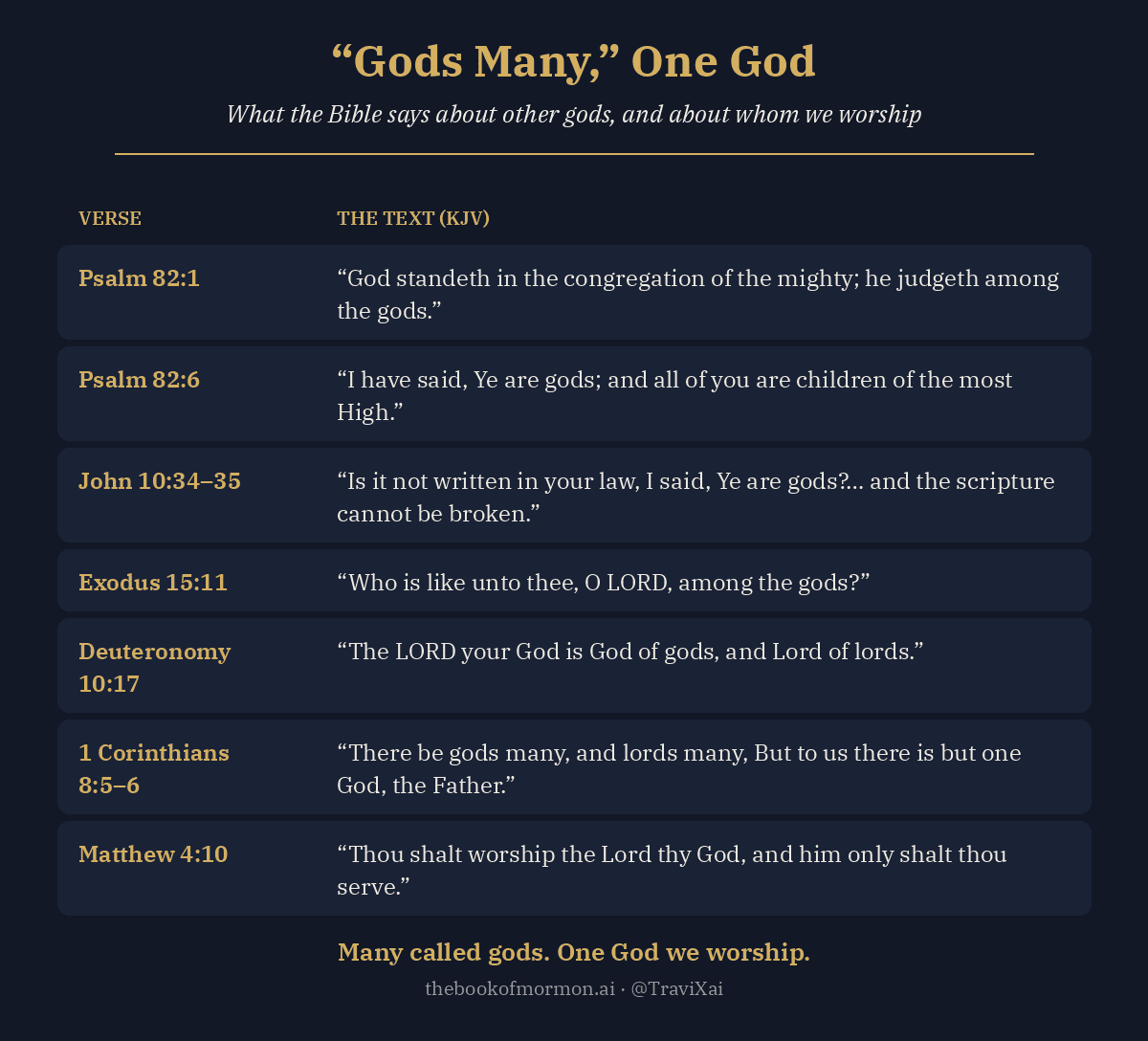
- “Who is like unto thee, O LORD, among the gods?” (Exodus 15:11)
- “For the LORD your God is God of gods, and Lord of lords” (Deuteronomy 10:17)
- “Among the gods there is none like unto thee, O Lord” (Psalm 86:8)
- “For the LORD is a great God, and a great King above all gods” (Psalm 95:3)
- “O give thanks unto the God of gods” (Psalm 136:2)
- “LORD God of Israel, there is no God like thee, in heaven above, or on earth beneath” (1 Kings 8:23)
“God of gods” is a superlative, like “King of kings.” Nobody thinks “King of kings” means the other kings don’t exist. It means He rules over them.
Deuteronomy 32: the sons of God and the nations
The original post quoted Deuteronomy 32:8 from the NRSVUE, and that choice is worth explaining. The KJV, following the medieval Masoretic Hebrew, reads that the Most High “set the bounds of the people according to the number of the children of Israel.” The Dead Sea Scrolls copy 4QDeut-j, about a thousand years older, reads “sons of God” instead. The Greek Septuagint supports that reading too, and modern translations like the ESV now follow it: the Most High “fixed the borders of the peoples according to the number of the sons of God.”
Then verse 9: “For the LORD’S portion is his people; Jacob is the lot of his inheritance.” The nations are divided among the sons of God, and the LORD takes Israel as His own. Later in the same chapter, the scroll 4QDeut-q has a line the Masoretic text lacks, calling on the gods to bow down to Him, and Hebrews 1:6 quotes the Greek form of that line about Christ: “let all the angels of God worship him.” The New Testament reads this chapter as being about Jesus.
But doesn’t the Bible say “there is no God beside me”?
It does, several times:
- “I am the LORD, and there is none else, there is no God beside me” (Isaiah 45:5)
- “Is there a God beside me? yea, there is no God; I know not any” (Isaiah 44:8)
- “The LORD he is God; there is none else beside him” (Deuteronomy 4:35)
- “There is no god with me” (Deuteronomy 32:39)
Look where that last one is. Deuteronomy 32:39 is in the same chapter as the sons of God dividing the nations, and the same chapter that calls the gods to bow down. The writer didn’t think he was contradicting himself. So what did he mean?
The late Michael Heiser, an evangelical Old Testament scholar who disagreed with Latter-day Saint theology, made this case in a well-known 2008 article. He argued that these “no other” statements express the LORD’s incomparability. He is unique in kind, uncreated, sovereign over every other divine being. They aren’t flat denials that any other elohim exist. Heiser’s point was that the same biblical writers affirm both. You can read his paper and decide for yourself (“Monotheism, Polytheism, Monolatry, or Henotheism?”, Bulletin for Biblical Research 18.1).
Context helps too. Isaiah 44:8 (“I know not any”) goes straight into a passage mocking men who carve an idol from the same log they cook dinner with: “They that make a graven image are all of them vanity” (44:9). The contrast is between the living God and blocks of wood.
Two kinds of “gods”: the council and the idols
This is where the original post needed sharpening. The old list put Baal and Chemosh in the same catalog as the council of Psalm 82. The Bible names both, but it doesn’t treat them the same way.
**Idols** get the harshest treatment. Jeremiah asks, “Hath a nation changed their gods, which are yet no gods?” (Jeremiah 2:11). Paul says the Galatians once “did service unto them which by nature are no gods” (Galatians 4:8), and “an idol is nothing in the world” (1 Corinthians 8:4). Deuteronomy says Israel “sacrificed unto devils, not to God; to gods whom they knew not” (32:17).
**The council** is different. Its members stand in God’s presence, are called His children, and are judged by Him (Psalm 82). They shout for joy at creation (Job 38:7). Jesus said “the scripture cannot be broken” about them.
Then there’s Moses: “See, I have made thee a god to Pharaoh” (Exodus 7:1). The witch of Endor saw “gods ascending out of the earth” (1 Samuel 28:13), and Paul calls Satan “the god of this world” (2 Corinthians 4:4). Elohim is a title of rank, applied to beings at very different levels. That’s why the Bible can say “gods many” in the same breath as “one God.”
“Gods many… but to us there is but one God”
Paul put both truths in two verses:
“For though there be that are called gods, whether in heaven or in earth, (as there be gods many, and lords many,) But to us there is but one God, the Father, of whom are all things, and we in him; and one Lord Jesus Christ, by whom are all things, and we by him.”
1 Corinthians 8:5–6
Gods many, and to us one God, the Father. That’s Latter-day Saint belief in a sentence. We worship one God. Jesus said, “Thou shalt worship the Lord thy God, and him only shalt thou serve” (Matthew 4:10). The Lord told the early Saints, “you shall fall down and worship the Father in my name” (D&C 18:40), and taught that He is “the only living and true God, and that he should be the only being whom they should worship” (D&C 20:19). Whatever label you put on that, it’s the pattern Moses, David, Jesus, and Paul used.
Children of the Most High
Psalm 82 calls the council “children of the most High,” and the New Testament extends the family to us. “The Spirit itself beareth witness with our spirit, that we are the children of God: And if children, then heirs; heirs of God, and joint-heirs with Christ” (Romans 8:16–17). “We shall be like him” (1 John 3:2). “To him that overcometh will I grant to sit with me in my throne” (Revelation 3:21).
The early church said so as well. Athanasius, the champion of Nicaea, wrote of Christ: “For He was made man that we might be made God” (On the Incarnation 54.3). When a Latter-day Saint talks about becoming like our Father, that isn’t new. It’s an old Christian idea that later Christianity mostly set aside.
About Abraham 4:1
Back to the critic. Abraham 4:1 reads: “And then the Lord said: Let us go down. And they went down at the beginning, and they, that is the Gods, organized and formed the heavens and the earth.” It’s in the Pearl of Great Price, not the Book of Mormon. The Book of Mormon speaks of “Christ the Son, and God the Father, and the Holy Spirit, which is one Eternal God” (Alma 11:44). If you’re going to tell people to skip ahead in a book, it helps to know which book you’re holding.
And the plural in Abraham 4 isn’t foreign to Genesis. “Let us make man in our image, after our likeness” (Genesis 1:26). “Behold, the man is become as one of us” (Genesis 3:22).
The bottom line
The Bible says there are gods many and lords many. It calls the members of God’s council gods and children of the Most High, and Jesus said that scripture can’t be broken. The same Bible tells us to worship one God, the Father, through one Lord, Jesus Christ. Latter-day Saints believe both halves. Most of our critics only accept one.
Read Psalm 82 and John 10 side by side, then decide who’s following the Bible here.
Come argue Psalm 82 with me on X at @TraviXai. The Galatians 1:8 app has quick answers for the other verses that get thrown at Latter-day Saints.
Sources
- Bible quotations from the King James Version.
- Original post (January 2026): The Gods of the Bible – Spoiler: The Bible Is NOT Monotheistic
- Deuteronomy 32:8–9, ESV (following the Dead Sea Scrolls and Septuagint reading “sons of God”): Bible Gateway
- Michael S. Heiser, “Monotheism, Polytheism, Monolatry, or Henotheism? Toward an Assessment of Divine Plurality in the Hebrew Bible,” Bulletin for Biblical Research 18.1 (2008): 1–30: DOI · PDF
- Athanasius, On the Incarnation of the Word 54.3, NPNF 2nd ser., vol. 4: newadvent.org
- Abraham 4: churchofjesuschrist.org
- Alma 11:44: churchofjesuschrist.org
- Doctrine and Covenants 18:40 and 20:19: D&C 18, D&C 20
- Gospel Topics, “Becoming Like God”: churchofjesuschrist.org