

Frauds tend to come apart over time. Someone finds the source text, a partner confesses, or the “ancient” details turn out to be modern. The Book of Mormon has been under attack since 1830, and the more scholars dig, the stronger the case for it gets.
This page gathers the strongest lines of evidence in one place, with the numbers, the published sources, and the caveats the researchers themselves give. None of this replaces the witness of the Holy Ghost, and the book never asks it to. But if someone tells you there’s “zero evidence,” send them here.
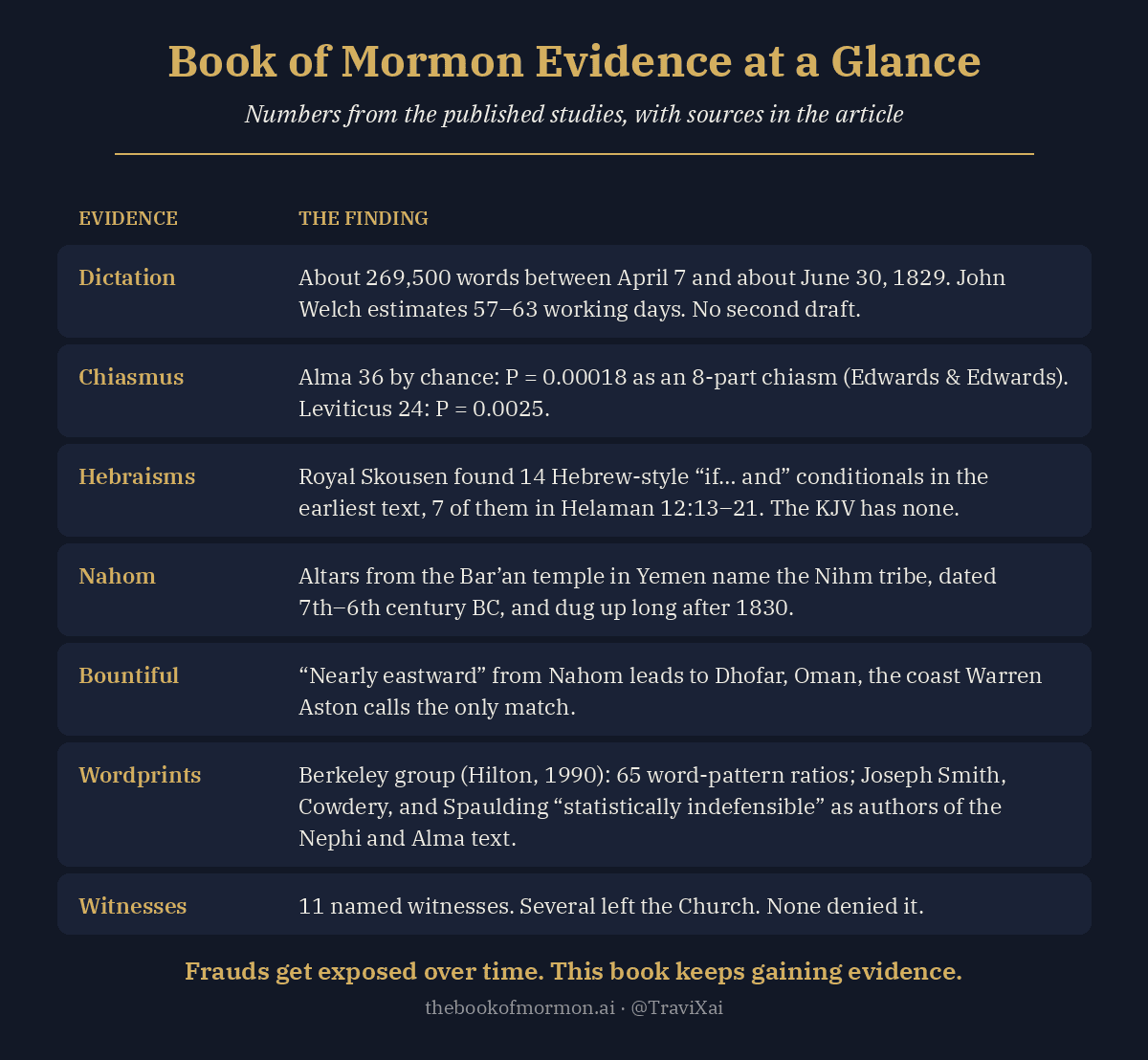
1. One draft, in about sixty working days
The Book of Mormon runs about 269,500 words. Oliver Cowdery started as scribe on April 7, 1829, and the translation was finished by about June 30. That’s 85 days on the calendar. After travel, a move to Fayette, and other interruptions, John Welch estimates about 57 to 63 full working days.
There was no second draft. Royal Skousen, who spent decades on the original manuscript, found “very few signs of any editing or Joseph changing his mind about the translation.” Emma Smith, who was one of the scribes, described him “dictating hour after hour with nothing between us,” and said flatly, “He had neither manuscript nor book to read from” (1879 interview).
The text also keeps track of itself. In Ether 1, Joseph dictated a genealogy of 30 Jaredite names. Over the following chapters, Ether 2 through 11, those rulers come up again in exactly reverse order, with no notes to check against. John Sorenson counted more than 425 geographic relationships among at least 125 locations, and they stay consistent across the book.
Try writing 269,500 words of consistent history, doctrine, and geography in two months, out loud, with no revisions. Then do it in your twenties, with little schooling.
2. Hebrew grammar the KJV doesn’t have
Critics say the Book of Mormon just imitates the King James Bible. Some of its grammar doesn’t come from the KJV at all.
Biblical Hebrew often writes conditionals as “if… and…” where English uses “if… then…” The KJV translators smoothed every one of these into normal English. The earliest Book of Mormon text has them anyway. Royal Skousen identified fourteen, and seven of them run back-to-back in Helaman 12:13–21:
“Yea, and if he saith unto the earth, Move, and it is moved… And behold, also, if he saith unto the waters of the great deep, Be thou dried up, and it is done.”
Helaman 12:13, 16 (earliest text)
Joseph removed most of these extra “and”s himself in the 1837 edition, to make the English read better. That’s a strange thing for an author to do with a Hebraism he planted on purpose. As Skousen put it, these constructions are “a literalistic translation of the Hebrew-language construction, but [do] not occur at all in the King James Bible” (Scripture Central summary).
Stanford Carmack’s research points the same way from another direction. Much of the book’s grammar matches English from the 1500s and 1600s, earlier than the KJV. “Save it were” appears 77 times in the Book of Mormon, and no other text he checked has it even five times (BYU Studies).
3. Alma 36: built as a mirror
Alma 36 is a chiasmus, an inverted parallel structure ancient Hebrew writers used. It opens and closes with keeping the commandments and prospering in the land, and its center is Alma crying out to Jesus for mercy. John Welch first reported chiasmus in the Book of Mormon in BYU Studies in 1969, after first noticing it as a young missionary in Germany.
Is it real or are readers seeing patterns? Physicists Boyd and Farrell Edwards ran the numbers with strict rules for what counts (BYU Studies 43:2):
- Alma 36 as an 8-part chiasm: P = 0.00018. As a 10-part chiasm: P = 0.0000027.
- Leviticus 24:13–23, a celebrated biblical chiasm: P = 0.0025.
- The strongest chiasm in the Doctrine and Covenants: P = 0.52. In the Book of Abraham: P = 0.98.
By their measure, Alma 36 is less likely to be chance than the famous Leviticus example, and nothing in Joseph’s own revelations comes close. The authors are fair about the limits: chiasmus was known to some people in the 1820s, there’s no evidence Joseph knew of it, and the math can’t tell you who designed the structure. It does tell you somebody designed it.
One more detail: Alma 36:22 quotes 22 words of Lehi from 1 Nephi 1:8, word for word. On Welch’s timeline, Alma 36 was dictated around April 24, 1829, and 1 Nephi around June 5, so the quotation came about six weeks before the passage it quotes.
4. Nahom: a place name in stone
Nephi wrote that Ishmael “died, and was buried in the place which was called Nahom,” and that the family then traveled “nearly eastward” (1 Nephi 16:34; 17:1).
In Yemen, the German Archaeological Institute excavated the Bar’an temple near Marib and found altars donated by “Bi’athar son of Sawdum, son of Naw’um, the Nihmite.” The NHM tribal name is right where Nephi’s route turns east, and the altars date to the 7th–6th centuries BC, around Lehi’s time (Aston, JBMS 10/2). Terryl Givens called them “the first actual archaeological evidence for the historicity of the Book of Mormon.”
To be fair: the Nihm name shows up on a few 18th-century European maps, so the name alone isn’t the whole case. What the altars add is the name inscribed in stone in the right region, from the right centuries, excavated long after 1830, along with the eastward turn in Nephi’s route.
5. Bountiful: a green coast in Arabia
“Nearly eastward” from Nahom takes you across Arabia to Dhofar in southern Oman. Nephi describes a place by the sea called Bountiful “because of its much fruit and also wild honey,” with a mountain nearby and timber enough to build a ship (1 Nephi 17:5–8; 18:1). That’s a very specific thing to claim about the Arabian coast in 1829.
Warren Aston explored the coast on foot from Aden northward and calls Dhofar “the only section of the Arabian coast” that matches Nephi’s description. One leading candidate, Khor Kharfot at the mouth of Wadi Sayq, was made an archaeological reserve by Oman’s royal decree in 2021, and excavations resumed in 2022. Aston’s own caveat: the main tower ruin there is probably about a thousand years too late to connect to Lehi’s family (Interpreter 53).
6. Wordprints: many authors, and none of them Joseph
Everyone has a “wordprint,” the unconscious way they use small words like “of,” “the,” and “and.” In the 1980s a group in Berkeley, most of them not Latter-day Saints, spent about 10,000 hours testing the Book of Mormon this way. They used 65 word-pattern ratios on 5,000-word blocks and validated the method first on 26 texts by 9 control authors. Mark Twain didn’t change his wordprint when he wrote in different characters’ voices, and a translator carried over the separate wordprints of the authors he translated.
Their conclusion: “it is statistically indefensible to propose Joseph Smith or Oliver Cowdery or Solomon Spaulding as the author of the 30,000 words” attributed to Nephi and Alma. Nephi and Alma also measured as distinct from each other (Hilton, BYU Studies 30:3, 1990). An earlier BYU study by Larsen, Rencher, and Layton (1980) reached a similar result with different methods.
What about the 2008 Stanford study that pointed to Sidney Rigdon and Solomon Spalding? Its method could only choose from the names on its list, and Joseph Smith wasn’t on it. When researchers rebuilt the method to allow “someone else” as an answer, 93 percent of chapters outside the Isaiah material went to “someone else” (Roper, Fields & Schaalje, JBMS 21/1). Stylometry isn’t a fingerprint, and the researchers say so. But the strongest methods point the same way: many writers, and none of them the usual suspects.
The same picture shows up in John Hilton III’s count of who’s speaking: 149 distinct voices, with the speaker changing more than 1,700 times, and individual habits that stay with each speaker. “My soul delighteth” appears 11 times, and it’s always Nephi (RSC Review, 2024).
7. Writing on metal plates is ancient
“Gold plates? Please.” Sacred writing on metal is well attested in the ancient world. The silver scrolls from Ketef Hinnom in Jerusalem, from around Lehi’s century, carry the priestly blessing of Numbers 6:24–26. They’re the oldest known fragments of biblical text. The Pyrgi tablets from Italy are gold. Darius buried gold and silver plaques in the foundations at Persepolis. The Iguvine Tables are seven bronze plates holding about 4,000 words (Hamblin, FARMS Review 19/1).
Are the plates as described physically workable? Josh Coates modeled more than 4 billion combinations of metals, dimensions, and script sizes against the eyewitness descriptions. About 865,000 worked. The likely profile is an alloy under 20 percent gold, weighing at least 54 pounds, with 187 to 259 plates. He’s clear that this shows plausibility, not proof (Interpreter 66).
8. The witnesses who never recanted
This may be the strongest evidence of all, because it’s eyewitness testimony from people who had every reason to walk it back.
Eleven men signed their names to seeing the plates. The Three Witnesses said an angel showed them. The Eight said they “did handle with our hands” and saw the engravings. Several later left the Church, and some fell out bitterly with Joseph. None of them ever denied what he said he saw.
- David Whitmer, estranged from the Church for about fifty years, wrote in 1881: “I have never at any time denied that testimony or any part thereof.”
- Hiram Page, inactive after 1838, wrote in 1847 that he couldn’t “know a thing to be true in 1830, and know the same thing to be false in 1847.”
- John Whitmer, excommunicated in 1838, wrote in 1876, two years before he died, that he had never heard of any of the witnesses denying their testimony.
- Oliver Cowdery came back in 1848 and testified publicly. Martin Harris testified until he died in 1875.
Historian Steven Harper sorted the witnesses’ own statements from secondhand rumors. Some of the witnesses are on record expressing certainty. None is on record, in his own words, expressing doubt (Religious Educator 11:2).
Where to keep digging
Two places can keep you busy for years:
- Scripture Central’s Evidence library has hundreds of short entries, each with sources.
- The Joseph Smith Papers has the original manuscripts, the witnesses’ documents, and the history, so you can read the primary sources yourself.
You might also like our earlier posts Is the Book of Mormon an Ancient Document?, the so-called “steel” anachronism, and Does DNA Evidence Disprove the Book of Mormon?
The evidence that matters most
Every item above is worth knowing, and every one has a caveat attached by honest researchers. The Book of Mormon itself names a different test. Moroni asks you to read it and “ask God, the Eternal Father, in the name of Christ, if these things are not true,” with a promise: “he will manifest the truth of it unto you, by the power of the Holy Ghost” (Moroni 10:4–5).
The evidence can clear away the objection that the book has to be a fraud. Whether it’s true is something you can ask God about directly.
I’m posting a 10-part Book of Mormon Evidence series on X right now. Follow along at @TraviXai. For the verse critics quote most often, see the Galatians 1:8 app.
Sources
- John W. Welch, “Timing the Translation of the Book of Mormon,” BYU Studies 57:4: byustudies.byu.edu
- Brian C. Hales, “Naturalistic Explanations of the Origin of the Book of Mormon,” BYU Studies 58:3: byustudies.byu.edu
- “Last Testimony of Sister Emma,” Saints’ Herald, Oct. 1, 1879: transcription
- “Book of Mormon Evidence: Extra ‘And’ in Causal, Temporal, and Conditional Clauses,” Scripture Central: scripturecentral.org
- Stanford Carmack, “Book of Mormon Grammar and Translation,” BYU Studies: byustudies.byu.edu
- John W. Welch, “Chiasmus in the Book of Mormon,” BYU Studies 10:1 (1969): byustudies.byu.edu
- Boyd F. Edwards and W. Farrell Edwards, “Does Chiasmus Appear in the Book of Mormon by Chance?,” BYU Studies 43:2: byustudies.byu.edu
- Warren P. Aston, “Newly Found Altars from Nahom,” JBMS 10/2 (2001): scripturecentral.org
- Warren P. Aston, “A Research Note: Continuing Exploration and Research in Oman,” Interpreter 53 (2022): interpreterfoundation.org
- John L. Hilton, “On Verifying Wordprint Studies: Book of Mormon Authorship,” BYU Studies 30:3 (1990): byustudies.byu.edu
- Larsen, Rencher & Layton, “Who Wrote the Book of Mormon? An Analysis of Wordprints,” BYU Studies 20:3 (1980): scholarsarchive.byu.edu
- Roper, Fields & Schaalje, “Stylometric Analyses of the Book of Mormon: A Short History,” JBMS 21/1 (2012): scholarsarchive.byu.edu
- “What Can Stylometry Tell Us about Book of Mormon Authorship?,” Scripture Central KnoWhy #389: scripturecentral.org
- John Hilton III, “The Voices of the Book of Mormon,” RSC Review (Winter 2024): rsc.byu.edu
- William J. Hamblin, “Sacred Writing on Metal Plates in the Ancient Mediterranean,” FARMS Review 19/1 (2007): scripturecentral.org
- Josh Coates, “A Combinatorial Approach to Modeling All Possible Golden Plates,” Interpreter 66 (2025): interpreterfoundation.org
- Steven C. Harper, “Evaluating the Book of Mormon Witnesses,” Religious Educator 11:2 (2010): rsc.byu.edu
- Testimony of the Three and Eight Witnesses: churchofjesuschrist.org
- Moroni 10:4–5: churchofjesuschrist.org