

Every few years someone finds a new problem with the Book of Mormon. Horses. Steel. Barley. A prophet named Alma, which is supposedly a girl’s name. A brother named Sam, which is supposedly a Yankee name. The list gets longer, and it gets read out with a lot of confidence.
The list has also been shrinking for a long time. Matthew Roper, a researcher at Scripture Central, spent years tracking it. He went through more than 1,000 critical publications printed between 1830 and 2024 and pulled out every feature of the Book of Mormon they called an anachronism. He found 226. Then he checked where each one stands today. His study, Anachronisms: Accidental Evidence in Book of Mormon Criticisms, ran as the whole of volume 65 (2025) of Interpreter: A Journal of Latter-day Saint Faith and Scholarship.
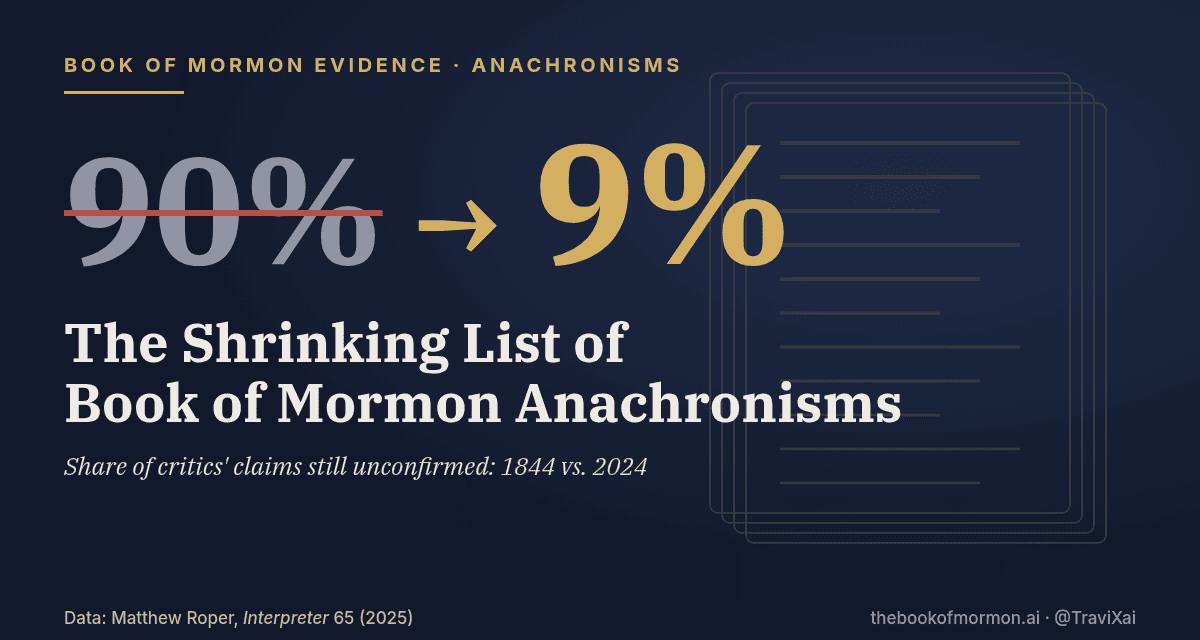
Here’s the headline. When Joseph Smith died in 1844, critics had named 102 problems, and 93 of them were still unconfirmed. Today the list has 226 items, and 21 are unconfirmed. Critics kept adding claims, and the evidence kept crossing them off.
What counts as an anachronism, and how Roper scored them
An anachronism is something out of its time, like a wristwatch on a Roman soldier. Since 1830, critics have pointed at things in the Book of Mormon that, by the knowledge of their day, didn’t belong in the ancient world. As one of Joseph Smith’s former neighbors put it, “No intelligent or well-educated man would have been guilty of so many anachronisms… as characterize every part of the Book of Mormon.”
Roper took those critics at their word. He didn’t rewrite their claims to make them easier to answer. He says so directly: the study “does not attempt to correct or contend with the geographic or demographic assumptions held by those who have proposed anachronisms.” If a critic assumed the book covered the whole hemisphere, Roper counted evidence from the whole hemisphere. If the critic said “no steel in the Old World,” he looked in the Old World.
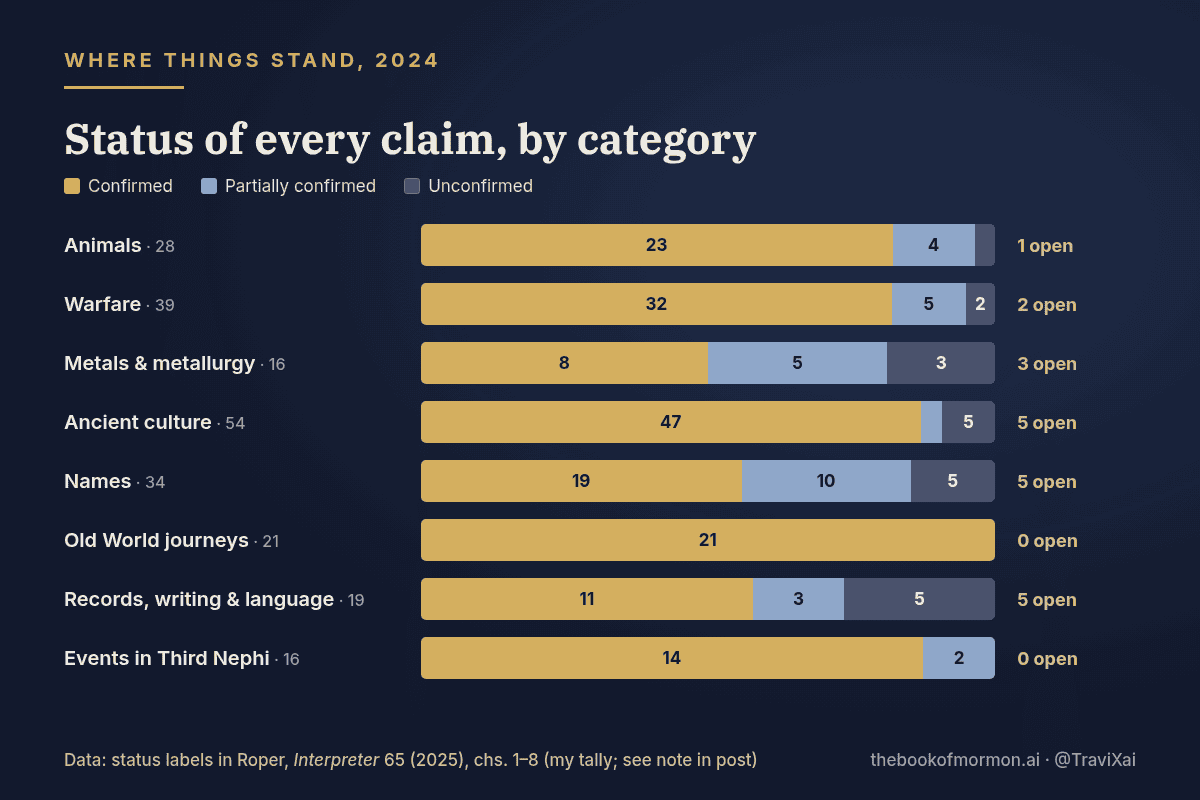
He sorted the 226 claims into eight categories: animals, warfare, metals and metallurgy, ancient culture, names, Old World journeys, records and writing, and the destruction in Third Nephi. Each claim got one of three labels:
- Confirmed: “When an item from the Book of Mormon that was once thought to be out of place turns up in the historical, archaeological, or linguistic record.”
- Partially confirmed: “When the available data isn’t conclusive but is trending towards confirmation.”
- Unconfirmed: “When no known data directly supports an identified feature of the text.”
One detail matters a lot. The labels describe the status of the textual feature, not the critic’s claim. “Confirmed” next to “barley” means barley is confirmed. It doesn’t mean the claim against barley is.
Then he tracked every item across three eras: 1830–1844 (Joseph Smith’s lifetime), 1845–1965, and 1966–2024. That lets you watch the score change over time.
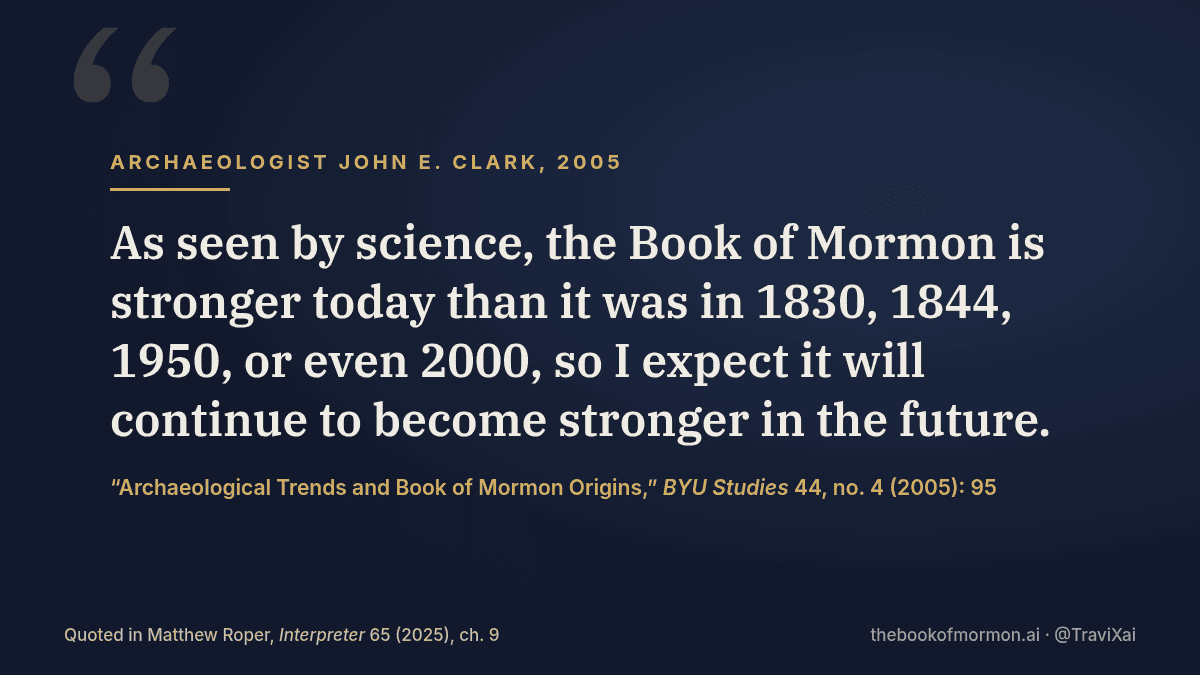
Roper built on archaeologist John E. Clark, who had checked sixty supposed blunders from three nineteenth-century critics and “found that about 60 percent of those criticisms have been resolved in favor of the book” (BYU Studies 44, no. 4, 2005). Clark called that sample only a rough indicator. Roper’s study is the fuller catalog.
Roper calls the result “accidental evidence,” because “it comes about as the unintended byproduct of our critics’ efforts to discredit the Book of Mormon. They point us to look more closely at certain subjects and lead us inadvertently to new discoveries that can support the book.”
The report card: three eras
These are the numbers from Roper’s concluding chapter. Each era is cumulative. It counts every claim made up to that point and gives its status at the end of the era.
| Era | Claims | Confirmed | Partial | Unconfirmed | % unconfirmed |
|---|---|---|---|---|---|
| 1830–1844 (Joseph Smith’s lifetime) | 102 | 7 | 2 | 93 | 91% (Roper: 90.2%) |
| 1845–1965 (cumulative) | 168 | 36 | 10 | 122 | 73% |
| 1966–2024 (cumulative, today) | 226 | 174 | 31 | 21 | 9.29% |
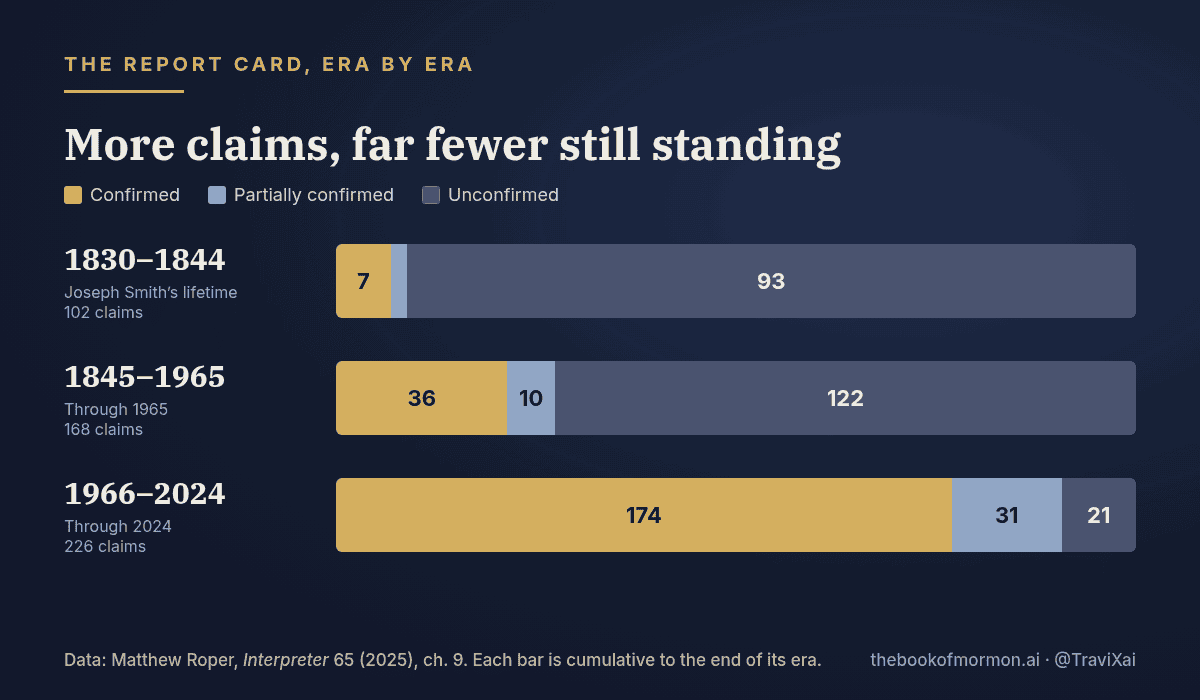
In his words: “Whereas 90.2% of the items remained unconfirmed in 1844, today that figure has dropped to a meager 9.29%.” (The 2024 figure checks out exactly: 21 of 226. For 1844, 93 of 102 works out to 91.2%, so the printed 90.2% looks like a small slip. It doesn’t change anything. It’s roughly nine in ten either way.)
Through 1965 the book still looked bad on this measure, with 122 of 168 claims unconfirmed. Most of the movement came after that. Roper’s key finding is that “allegedly problematic features of the Book of Mormon text have strongly trended towards confirmation or partial confirmation, especially in the past fifty-eight years.”
The share that’s fully confirmed went from about 7 percent in 1844 to about 77 percent in 2024. Add the partial confirmations and it’s about 91 percent.
Category by category: what got crossed off
Roper gives every item its own entry: the critics’ claim (often quoted), a short response, and a status. Here are a few from each chapter, with the status exactly as he gives it.
Animals (28 claims)
- Honeybees: confirmed. Critics said honeybees were unknown before Columbus. Roper points out that the Jaredites kept bees in the Old World (Ether 2:3) and the text never says they brought them across. Even so, stingless bees “were well known in Mesoamerica from an early period.”
- Chickens: confirmed. Jesus’s image of a hen gathering her chickens (3 Nephi 10:5–6) was called out of place. Turkeys were domesticated early, and when the Spanish arrived they called them chickens.
- Elephants in Book of Mormon times: partially confirmed. Dwarf mammoths on Wrangel Island date to about 7,000–4,000 years ago. A mammoth bone from Sandy, Utah, gave a date of 5,985 BP.
- Horses in Book of Mormon times: partially confirmed. Ancient DNA shows horses in Alaska as late as 5600 BC. At Rancho Carabanchel in Mexico, horse remains were found in layers with dates that include 548–400 BC and AD 73–226. Collagen wasn’t available to date the bones themselves, so Roper only gives a partial.
Roper is upfront about one thing in this chapter. Some animal words could be “loan-shifts,” where Old World names get applied to similar New World animals. He scores the most persuasive ones as confirmed but flags them as loan-shift in his tables “because others may differ.” The one unconfirmed animal item is native traditions of asses.
Warfare (39 claims)
- Swords: confirmed. The Aztec macuahuitl was hardwood edged with obsidian. Spanish soldiers called it a sword, and so do modern scholars.
- Laban’s steel sword: confirmed. A meter-long sword from Vered Jericho dates to the time of King Josiah. Analysis showed it was made of “mild steel,” with the iron “deliberately hardened into steel.”
- Fortifications: confirmed. Archaeology now shows many Mesoamerican fortifications like the ones in Alma 48–50, some from Book of Mormon times (Fortifications). Roper’s bibliography leans on John L. Sorenson’s side-by-side comparisons.
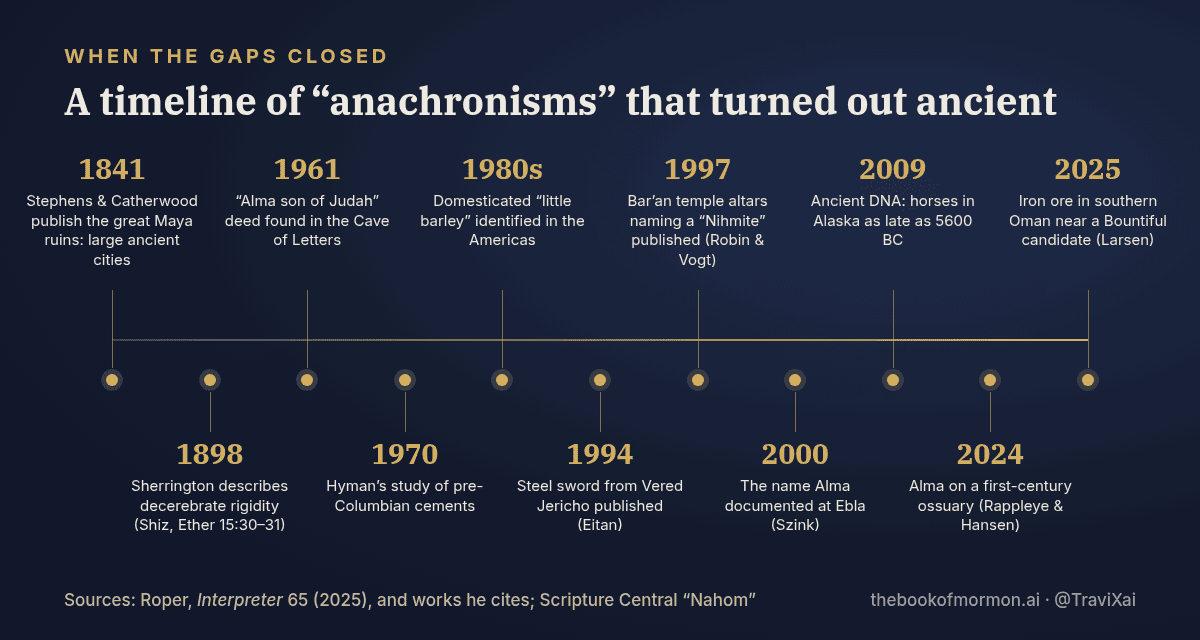
- Shiz’s death (Ether 15:30–31): confirmed. Critics laughed at a beheaded man who struggled for breath. The account fits decerebrate rigidity, which wasn’t “documented scientifically until 1898,” sixty-eight years after the Book of Mormon was published.
Still open: steel swords in the New World and physical remains of Book of Mormon battles.
Metals and metallurgy (16 claims)
- Steel in Nephi’s world: confirmed. In tests on more than sixty Iron Age objects from Israelite sites, “almost all were made of steel.”
- Metal money: confirmed. Critics said “never metallic money” among the Maya. Several kinds of metal money, including axe-monies, were used in Mesoamerica and South America before Columbus.
- Iron: confirmed. Natural and meteoric iron were known in ancient America “from as early as Olmec times.”
This is the weakest chapter for the book, and Roper says so. It has 8 confirmed, 5 partial, and 3 unconfirmed: iron smelting, steel, and silver money in the New World.
Ancient culture (54 claims)
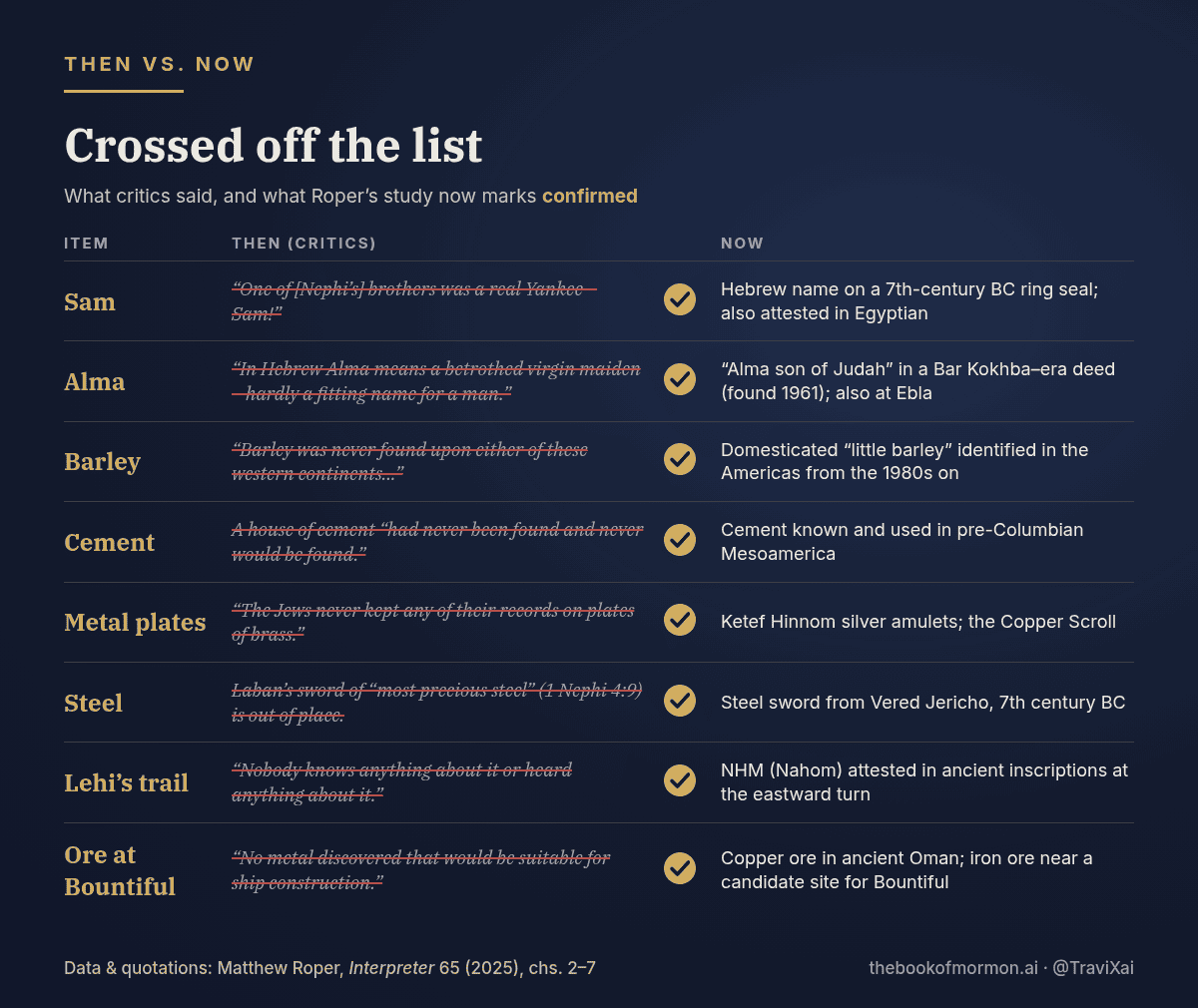
- Cement: confirmed. As a young man, Heber J. Grant was mocked by a doctoral graduate who said a house of cement “had never been found and never would be found.” Grant answered: “If my children do not find cement houses, I expect that my grandchildren will.” Today Roper simply writes, “Cement was indeed known in pre-Columbian Mesoamerica… and archaeologists have now confirmed it.” See Scripture Central’s Cement evidence page.
- Barley: confirmed. “Barley was never found upon either of these western continents until imported by Europeans,” one critic wrote. Starting in the 1980s, researchers identified domesticated “little barley” at pre-Columbian sites. One find was called “the first ever found in the New World.”
- “Jew” before the exile: confirmed. Critics said the term came centuries after Nephi. The Prism of Sennacherib mentions “Hezekiah the Jew.”
- Temples outside Jerusalem: confirmed. Arad, Elephantine, and now Tel Moẓa, “only a few miles from Jerusalem itself.”
Other confirmations here lean on legal and textual work. John W. Welch’s research on ancient Israelite homicide law is among the sources behind the “confirmed” for the slaying of Laban (see Scripture Central’s Slaying of Laban page). Five items here are still unconfirmed, and wheat is one of them.
Names (34 claims)
- Sam: confirmed. “One of [Nephi’s] brothers was a real Yankee—Sam!” one critic sneered in the 1800s. The name appears in ancient Egyptian and on a Hebrew ring seal from the seventh century BC.
- Alma: confirmed. “In Hebrew Alma means a betrothed virgin maiden—hardly a fitting name for a man,” went another claim. Then a deed naming Alma ben Yehudah (Alma son of Judah) turned up in the Cave of Letters in 1961, from the time of the Bar Kokhba revolt. Terrence Szink found the name at Ebla, and Neal Rappleye and Allen Hansen added a first-century ossuary. See Wordplay on Alma.
- Irreantum and Shazer: confirmed. Nephi says Irreantum means “many waters” (1 Nephi 17:5). It has a plausible South Arabian etymology, “place of abundant watering.” Shazer can be read as “young gazelle,” which fits a hunting scene.
Names have the most partial confirmations of any category: 10, including Moroni, Helaman, Zeniff, and Gadianton. Five are unconfirmed.
Old World journeys (21 claims)
This is where the list ran out. All 21 claims are now confirmed.
- “Nobody knows anything about it”: confirmed. A critic once said that after Jerusalem, Nephi’s account “takes you out into the wilderness and you remain in the wilderness, and nobody knows anything about it or heard anything about it.” Then Nahom turned up. Roper writes, “The existence of a place known as NHM is now verified by ancient inscriptions.” Three altars from the Bar’an temple in Marib, Yemen, were dedicated by “Bi’athtar, son of Sawdum, son of Naw’um, the Nihmite.” The excavators, Burkhard Vogt’s German Archaeological Institute team, date the temple phase where the inscription was found to the 7th–8th centuries BC. Christian Robin and Vogt published the altars in 1997. South Arabian specialists read nhmyn as “from NHM,” and one places Bi’athtar in “the Nihm region, west of Mārib” (Scripture Central, “Nahom”). S. Kent Brown (1999) and Warren P. Aston (2001) brought the altars to Latter-day Saint readers.
- Eastward turn: confirmed. Nephi says that from Nahom they traveled “nearly eastward” (1 Nephi 17:1). NHM sits at an eastward bend in the incense trail, and the Bountiful candidates lie almost due east (Eastward Turn).
- Bountiful: confirmed. “Research has verified the existence of a fertile region—the Dhofar region—that matches Nephi’s description.” That draws heavily on Warren Aston’s fieldwork in Oman (Bountiful).
- Ore: confirmed. One critic said no metal “suitable for ship construction” had been found anywhere near. Oman was a well-known copper source in antiquity, and Bradley Larsen reported iron ore in southern Oman near a candidate site for Bountiful in 2025.
Records, writing, and language (19 claims)
- Metal plates: confirmed. Apostle John Taylor reported in 1843 being told it was “almost impossible” that plates had been used anciently. Since then, “thousands of examples of metal plates have been recovered.”
- Israelites writing on metal: confirmed. “The Jews never kept any of their records on plates of brass,” one critic wrote. The silver Ketef Hinnom amulets from before the first temple fell and the Copper Scroll from the Dead Sea Scrolls caves answer that.
- Reformed Egyptian: confirmed. Modified Egyptian scripts like hieratic and Demotic “are now well-known.”
- Hiding up records: confirmed. Burying sacred records for a later day “is now a well-attested ancient and pre-modern historical practice.”
This chapter has five of the unconfirmed items, all in the New World: metal plates with writing, Egyptian inscriptions, Hebrew inscriptions, inscriptions with Book of Mormon names, and inscriptions with Book of Mormon text.
Events in Third Nephi (16 claims)
- Three days of darkness: confirmed. The 1835 eruption of Cosegüina in Nicaragua brought forty-four hours of thick darkness, and other accounts mention three days.
- Sunken cities: confirmed. Liquefaction during the 1692 earthquake sank much of Port Royal, Jamaica.
There are 14 confirmed, 2 partial, and none unconfirmed.
What’s still open
Here are the 21 items Roper scores as unconfirmed:
- Animals: native traditions of asses.
- Warfare: steel swords (New World); remains of Book of Mormon battles.
- Metals: iron smelting, steel, and silver money (New World).
- Culture: pre-Columbian Christians; New World synagogues; identified Book of Mormon cities; heliocentric astronomy (Helaman 12:15); wheat.
- Names: Com, Kim, Jonas, Timothy, Ether.
- Writing: metal plates with writing, Egyptian or reformed Egyptian inscriptions, Hebrew inscriptions, inscriptions with Book of Mormon names, and inscriptions with Book of Mormon text (all New World).
Some of these are real questions, and Roper says so. On wheat: “No examples of pre-Columbian wheat have thus far been identified by archaeologists.”
Nearly every open item is a New World physical find: an inscription, a metal object, a grain, a named city. Those are exactly the things that survive worst in humid tropical soil and that archaeologists have barely sampled. A few are names, which may never show up in surviving records at all.
Why “we haven’t found it” is weak
Roper quotes Kenneth Kitchen, the Egyptologist who is not a Latter-day Saint, warning Bible readers against the habit of saying:
“we did not find it, so it never existed!” instead of the more proper formulation: “evidence is currently lacking; we may have missed it or it may have left no trace; particularly when 5 percent of a mound is dug, leaving 95 percent or more untouched, unknown, and so, not in evidence.”
Kenneth A. Kitchen, quoted in Roper, ch. 9
John E. Clark puts the same point as a matter of logic:
What at first appear to be “negative items” may prove to be positive ones in hiding. “Missing” evidence focuses further research, but it lacks compelling logical force in arguments because it represents the absence of information rather than secure evidence.
John E. Clark, “Archaeological Trends and Book of Mormon Origins,” 94
Clark also notes that “verification is a one-way street in this instance.” Once barley is found, it stays found. A missing item can still turn up. The record backs him up: critics said barley, cement, metal plates, and steel would never be found, and every one of them was.
Hugh Nibley saw the pattern decades ago. Criticism, he wrote, forces Latter-day Saints “to take a closer look at what they have, with the usual result of putting those scriptures in a much stronger position than they were before.”
“Isn’t ‘confirmed’ too loose?”
That’s a fair question, and it’s worth taking seriously. Several of the confirmations are general. Finding fortifications in Mesoamerica doesn’t prove a particular Nephite fort existed, and an attested Hebrew name doesn’t prove a particular Nephite.
That’s what the study is measuring, though. Each claim was “X couldn’t have existed in the ancient world.” If X turns up in the right place and period, the claim fails, even if no one finds a Nephite’s name on it. Roper defines his terms before he scores anything. “Confirmed” means the feature appears in the historical, archaeological, or linguistic record. When the data trends that way but isn’t conclusive, he uses “partially confirmed,” and he gives 31 of those. Horses, elephants, bows and arrows in Book of Mormon times, and Moroni as a name all get partials, not full confirmations. He flags loan-shift scoring in the animal chapter so readers can discount it if they like. He also limits his own claims. The data “only represents an evaluation of the status of anachronisms as framed by critics,” and he takes no side on any geographic model.
If you disagree with some of his calls, move a dozen confirmations to partial. The numbers shift a little, and the direction doesn’t change.
Why the direction matters
Clark framed the test plainly. If Joseph Smith wrote the book, it is “tethered to its nineteenth-century background,” and its details should match what was known or guessed in 1829. If the book is ancient, “one would expect confirmations of the book’s claims to increase as modern scholarship reveals more about the ancient world.” He quotes Noel Reynolds:
While a book might conceivably be made to look authentic by matching the standard knowledge at the time of its production, it would gradually become less persuasive as more and more is learned about the times it claims to describe. On the other hand, truly authentic ancient documents would continue to look ancient, even in light of new discoveries and new expectations.
Noel B. Reynolds, quoted in Clark, “Archaeological Trends,” 86
That’s the argument. A frontier fraud should have looked fine in 1830 and worse every decade after, as archaeology caught up with it. The Book of Mormon did the reverse. It looked worst in 1844, when 93 of 102 claims were unconfirmed, and best today, with 21 of 226 open. Clark’s verdict was that “the overall trend in the data over the past 175 years fits the expectations for the Book of Mormon as history rather than hoax.” Roper’s 2025 data, with twenty more years and a much bigger sample, points the same way. He closes: “Only time will tell, but in this particular area, time seems to favor the Book of Mormon.”
None of this replaces faith, and Roper opens with a reminder from Elder Neal A. Maxwell: “enough plausible evidence will come forth to prevent scoffers from having a field day, but not enough to remove the requirement of faith.” The evidence takes away the excuse. It doesn’t take away the question. The book makes the same offer it always has: read it, and “ask God, the Eternal Father, in the name of Christ, if these things are not true” (Moroni 10:4). The Bible makes the same promise: “If any of you lack wisdom, let him ask of God, that giveth to all men liberally, and upbraideth not; and it shall be given him” (James 1:5, KJV).
For more on the strongest positive evidence, from Hebraisms to chiasmus to the witnesses, see The Best Book of Mormon Evidences, in One Place.
Watch: the study in a few minutes
Saints Unscripted summarized Roper’s earlier 2019 count in this short, fun video, the one FAIR links on its anachronism page. Its numbers come from that earlier presentation, so they’re a bit lower than the 2025 totals above. The trend is the same.
Kyler Rasmussen’s “Interpreting Interpreter” series has walked through each of Roper’s chapters. Here’s his take on warfare:
Credit where it’s due
This post summarizes other people’s hard work. Thanks to:
- Matthew Roper (Scripture Central) for compiling, scoring, and publishing all 226 claims in Anachronisms: Accidental Evidence in Book of Mormon Criticisms.
- Scripture Central’s research staff, including Neal Rappleye, John Thompson, Ryan Dahle, and Paul Bryner, whom Roper thanks for comments and source checking, and for the Book of Mormon Evidence series cited throughout.
- The Interpreter Foundation for publishing the study free online, and Wade Ardern for its preface.
- John E. Clark, archaeologist, whose “Archaeological Trends and Book of Mormon Origins” (2005) and earlier charts started this approach.
- Kirk Magleby, Roper’s co-presenter on “Time Vindicates the Prophet” at the 2019 FAIR Conference, and FAIR for its anachronisms page.
- Warren P. Aston for decades of fieldwork on Nahom and Bountiful, including “A History of NaHoM” and “Newly Found Altars from Nahom”.
- S. Kent Brown for “New Light: ‘The Place that was Called Nahom'” (1999) and Journey of Faith.
- Burkhard Vogt and the German Archaeological Institute (DAI) for excavating the Bar’an temple at Marib, where the Nihmite altars were found, and Christian Robin, who co-published them in 1997.
- John L. Sorenson for Mormon’s Codex (2013) and An Ancient American Setting for the Book of Mormon, which Roper relies on throughout.
- John W. Welch for his work on the law behind the slaying of Laban, and for chiasmus (covered here).
- Brant A. Gardner for Traditions of the Fathers: The Book of Mormon as History (2015), in Roper’s general bibliography.
- Hugh Nibley, whose pioneering work, starting with Lehi in the Desert (1952), Roper calls “the impetus for many subsequent scholarly studies.”
- Terrence L. Szink (Alma at Ebla), Neal Rappleye and Allen Hansen (Alma as a Semitic name), Gregory Smith (fainting from blood loss), and Bradley R. Larsen (“Finding Nephi’s Ore”).
- Saints Unscripted and Kyler Rasmussen for making all this watchable.
A note on my category chart: I tallied the status labels across Roper’s eight chapters and got 227 entries (175 confirmed, 31 partial, 21 unconfirmed). His concluding chapter reports 226 and 174. The unconfirmed and partial counts match exactly, so the one-item gap is a confirmed entry and doesn’t touch anything still open. The era figures above use his official totals.
For more like this, follow me on X at @TraviXai. And if someone answers all of this with Galatians 1:8, the Galatians 1:8 app has that conversation covered.
Sources
- Matthew Roper, “Anachronisms: Accidental Evidence in Book of Mormon Criticisms — Introduction,” Interpreter 65 (2025): 1–8: interpreterfoundation.org
- Roper, Chapter 1, Book of Mormon Animals (65: 9–50): interpreterfoundation.org
- Roper, Chapter 2, Warfare (65: 51–92): interpreterfoundation.org
- Roper, Chapter 3, Metals and Metallurgy: interpreterfoundation.org
- Roper, Chapter 4, Ancient Culture: interpreterfoundation.org
- Roper, Chapter 5, Book of Mormon Names: interpreterfoundation.org
- Roper, Chapter 6, Old World Journeys by Land and Sea: interpreterfoundation.org
- Roper, Chapter 7, Records, Writing, and Language: interpreterfoundation.org
- Roper, Chapter 8, Events in Third Nephi: interpreterfoundation.org
- Roper, Chapter 9, Concluding Observations (65: 239–280): interpreterfoundation.org
- John E. Clark, “Archaeological Trends and Book of Mormon Origins,” BYU Studies 44, no. 4 (2005): 83–104: scholarsarchive.byu.edu
- FAIR, “Principles for assessing anachronisms” (Clark’s charts; Roper’s 2019 update: 205 claims, 141 confirmed, 26 trending, 38 unconfirmed): fairlatterdaysaints.org
- Scripture Central, “Nahom”: scripturecentral.org
- Scripture Central, “Bountiful”: scripturecentral.org
- Scripture Central, “Eastward Turn”: scripturecentral.org
- Scripture Central, “Overview of Lehi’s Journey”: scripturecentral.org
- Scripture Central, “Cement,” and KnoWhy 174: evidence, KnoWhy
- Scripture Central, “Wordplay on Alma”: scripturecentral.org
- Scripture Central, “Slaying of Laban”: scripturecentral.org
- Warren P. Aston, “A History of NaHoM,” BYU Studies Quarterly 51, no. 2 (2012): 78–98: scholarsarchive.byu.edu
- Warren P. Aston, “Newly Found Altars from Nahom,” Journal of Book of Mormon Studies 10, no. 2 (2001): 56–61: scripturecentral.org
- Neal Rappleye and Allen Hansen, “More Evidence for Alma as a Semitic Name,” Interpreter 62 (2024): interpreterfoundation.org
- Bradley R. Larsen, “Finding Nephi’s Ore,” Interpreter 63 (2025): interpreterfoundation.org
- Moroni 10:4: churchofjesuschrist.org; James 1:5 (KJV): churchofjesuschrist.org