

Critics love calling Joseph Smith “the American Muhammad.” Line up the traits that actually define Islam, a closed canon, a final prophet, and a God with no body, and see whose church really matches.
Home › Answering Critics › Start here: Are Latter-day Saints Christian? · The CES Letter: A Faithful Response
Joseph Smith is not “the American Muhammad.” The one shared trait, an angelic visitor, also fits Mary and John the Revelator. Islam’s defining claims are a sealed line of prophets, a closed heaven, and a God with no body, and those are what modern creedal Christianity shares with Islam. Joseph taught the opposite: living prophets, ongoing revelation, and Jesus Christ as the literal Son of God.
If you’ve spent five minutes defending your faith online as a Latter-day Saint, you’ve heard some version of it: “Joseph Smith is just another Muhammad.” A man says an angel came. A new book shows up. Case closed.
The line isn’t new. When Josiah Quincy, a Harvard-educated Bostonian and future mayor of Boston, visited Nauvoo in May 1844, he called Joseph “this bourgeois Mohammed” in his memoir (Figures of the Past, 1883). The jab is almost two hundred years old.
Here’s my problem with it. Compare one trait and you can make anything look like anything. Compare all the traits that make Islam Islam, and the closest match isn’t Joseph Smith. It’s the modern Christianity making the accusation.
By “modern Christianity” I mean mainstream Protestant and evangelical churches, which is where this argument usually comes from. Catholic and Orthodox Christians answer some of these questions differently, and I won’t speak for them.
Check the assumptions first
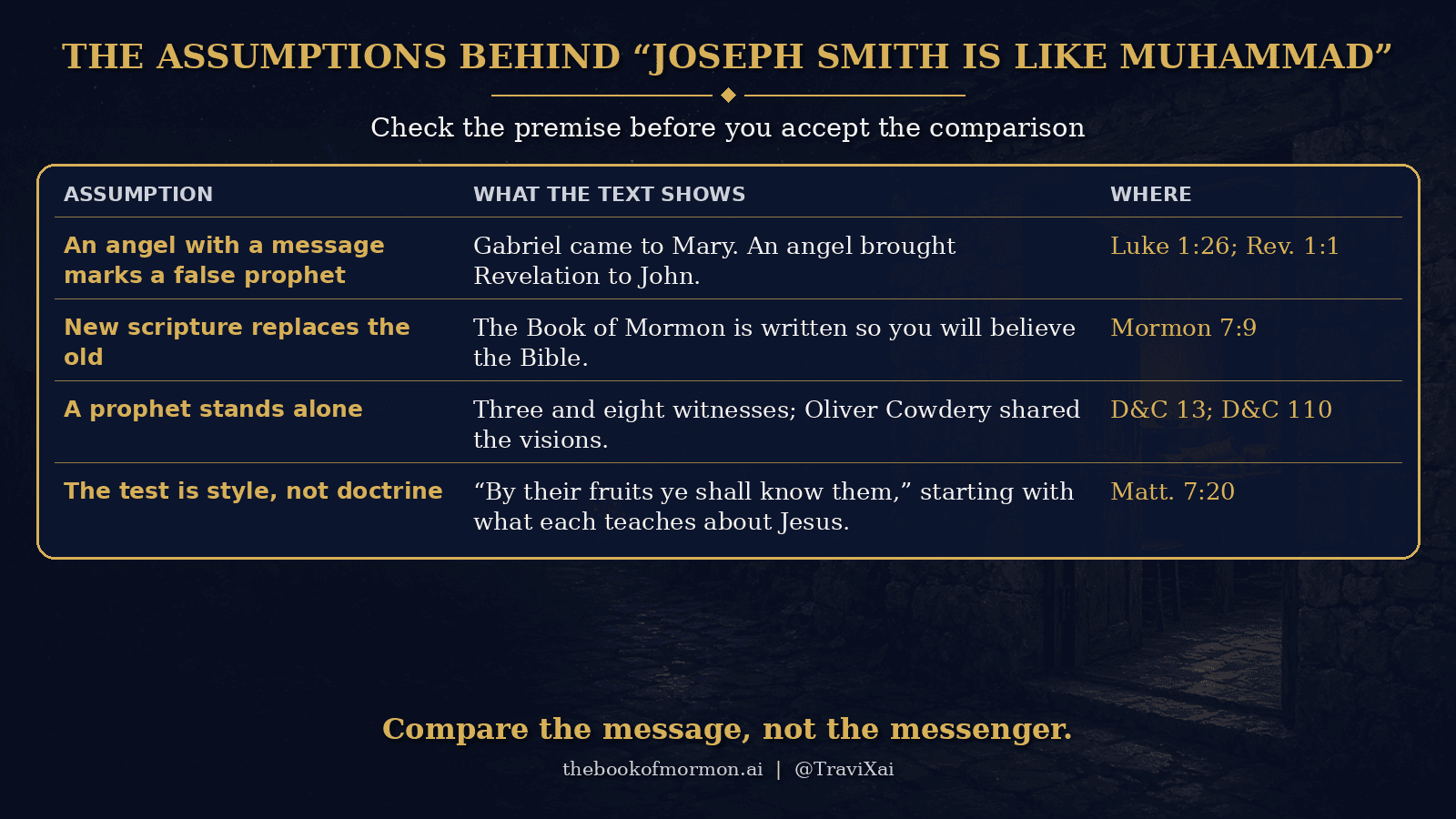
The “American Muhammad” line only works if you accept a few assumptions without looking at them. Here they are:
- That an angel with a message marks a false prophet. Then Mary, Zacharias, and John the Revelator fail the test too (Luke 1:26; Revelation 1:1). A messenger proves nothing either way. The message does.
- That new scripture replaces the old. That’s the Islamic pattern, not ours. The Book of Mormon says it was written “for the intent that ye may believe that,” meaning the Bible, “and if ye believe that ye will believe this also” (Mormon 7:9).
- That a prophet stands alone. Joseph didn’t. Three witnesses saw the angel and the plates, eight more handled the plates, and Oliver Cowdery was with Joseph when John the Baptist restored the priesthood (D&C 13) and when Christ, Moses, Elias, and Elijah appeared in the Kirtland Temple (D&C 110).
- That the comparison is about style instead of doctrine. Jesus gave the test: “by their fruits ye shall know them” (Matthew 7:20). The first fruit to check is what each prophet teaches about Jesus.
- That the critic’s own position isn’t on the table. A closed canon, a final prophet, and a God with no body are Islamic positions, and the sections below show who actually shares them.
For the Bible’s own tests applied to the Church as a whole, see Are Latter-day Saints Christian? and Is Joseph Smith in the Bible?.
One trait doesn’t make a match
Yes, Joseph Smith said an angel came to him. And yes, Muslims believe the angel Gabriel brought the Qur’an to Muhammad between 610 and 632 (Britannica, “Qurʾān”). That’s the whole case. One shared trait.
Now try that standard on the Bible. An angel appeared to Zacharias in the temple. Then Luke says this:
And in the sixth month the angel Gabriel was sent from God unto a city of Galilee, named Nazareth,
Luke 1:26 (KJV)
Same angel, by name. Nobody thinks that makes Mary a Muslim or Luke’s Gospel a Qur’an. The last book of the Bible came the same way: “he sent and signified it by his angel unto his servant John” (Revelation 1:1). Nobody calls John a Muhammad either. So the question was never whether a messenger came. It’s what the message says, and what kind of religion it builds. I walked through what each message says about Jesus in Are Latter-day Saints Just Like Muslims? Apply the Bible’s Own Test. Here, let’s line up the rest.
Trait one: the heavens are closed
The defining claim of Islam is finality. The Qur’an calls Muhammad the last prophet:
Muḥammad is not the father of [any] one of your men, but [he is] the Messenger of Allāh and seal [i.e., last] of the prophets. And ever is Allāh, of all things, Knowing.
Qur’an 33:40 (Sahih International)
And it declares the religion complete:
This day I have perfected for you your religion and completed My favor upon you and have approved for you Islām as religion.
Qur’an 5:3 (Sahih International)
Now read the Westminster Confession of Faith (1646), one of the most influential Protestant statements of doctrine ever written. After explaining why God had His word put in writing, chapter 1 ends its first paragraph like this:
those former ways of God’s revealing his will unto his people being now ceased.
Westminster Confession of Faith 1.1
Different book, same conclusion. God has said His last word, and no one will hear from Him the way the prophets did. That’s the Islamic position on revelation, and it’s the evangelical one. Joseph Smith taught the opposite:
We believe all that God has revealed, all that He does now reveal, and we believe that He will yet reveal many great and important things pertaining to the Kingdom of God.
Articles of Faith 1:9
The Book of Mormon tells Bible believers they “need not suppose that it contains all my words” (2 Nephi 29:10). That isn’t Muhammad’s pattern. It’s the Bible’s:
Surely the Lord GOD will do nothing, but he revealeth his secret unto his servants the prophets.
Amos 3:7 (KJV)
The New Testament church had living prophets after the resurrection. Agabus “signified by the Spirit that there should be great dearth throughout all the world” (Acts 11:28), and it came to pass. Closed heavens came later, and they came from men. More: The Canon Was Never Meant to Close, Continuing Revelation and an Open Canon, and Hebrews 1: No More Prophets After Jesus?
Trait two: when the prophets stop, the scholars take over
When the prophets stop, somebody still has to answer the questions. In Islam, the hadith, the reports of Muhammad’s sayings and actions, became “an important source, second only to the Qurʾān, for law, ritual, and creed,” and scholars built schools of legal interpretation around them (Britannica, “Hadith”). Protestant churches fill the same gap with creeds and confessions written by scholars centuries after the last apostle died. Neither system claims a living prophet wrote them.
Paul described a very different system:
And he gave some, apostles; and some, prophets; and some, evangelists; and some, pastors and teachers;
Ephesians 4:11 (KJV)
For how long? “Till we all come in the unity of the faith” (Ephesians 4:13). Look around. Thousands of denominations reading the same Bible and still arguing about baptism, grace, and the nature of God is not unity. It’s exactly what Paul said apostles and prophets would prevent: being “tossed to and fro, and carried about with every wind of doctrine” (Ephesians 4:14). Paul’s church was “built upon the foundation of the apostles and prophets, Jesus Christ himself being the chief corner stone” (Ephesians 2:20).
The Church of Jesus Christ of Latter-day Saints has apostles and prophets today. The closed-heaven churches have scholars, the same way Islam does. See Sola Scriptura: Which Verse Teaches It? and Living Prophets.
Trait three: a God with no body
Here’s how the Qur’an describes God (see also Qur’an 112:4, “Nor is there to Him any equivalent”):
There is nothing like unto Him, and He is the Hearing, the Seeing.
Qur’an 42:11 (Sahih International)
And here’s how the Westminster Confession describes God:
a most pure spirit, invisible, without body, parts, or passions;
Westminster Confession of Faith 2.1
Put those side by side and it’s hard to tell the Muslim creed from the Protestant one. Now open the Bible. Man was made “in the image of God” (Genesis 1:27), and then:
And the Lord spake unto Moses face to face, as a man speaketh unto his friend.
Exodus 33:11 (KJV)
And said, Behold, I see the heavens opened, and the Son of man standing on the right hand of God.
Acts 7:56 (KJV)
Stephen saw the Son standing at the right hand of God. Joseph Smith taught the God Stephen saw:
The Father has a body of flesh and bones as tangible as man’s; the Son also; but the Holy Ghost has not a body of flesh and bones, but is a personage of Spirit.
Doctrine and Covenants 130:22
On this trait, Joseph stands with Moses and Stephen. The creeds stand with the Qur’an. More at An Embodied God.
Trait four: who is Jesus?
This is where Islam and Christianity split hardest, and it sinks the comparison for good.
The Messiah, Jesus the son of Mary, was but a messenger of Allāh and His word which He directed to Mary and a soul [created at a command] from Him. … Exalted is He above having a son.
Qur’an 4:171 (Sahih International)
The Qur’an also says of Jesus, “they did not kill him, nor did they crucify him” (Qur’an 4:157). Now hear how the Restoration began:
One of them spake unto me, calling me by name and said, pointing to the other—This is My Beloved Son. Hear Him!
Joseph Smith—History 1:17
And we talk of Christ, we rejoice in Christ, we preach of Christ, we prophesy of Christ, and we write according to our prophecies, that our children may know to what source they may look for a remission of their sins.
2 Nephi 25:26
On the question that matters most, Joseph Smith stands with the Bible, and with every Christian making the accusation. If “a new prophet and an angel” makes Joseph a Muhammad, then “Jesus is the Son of God, crucified and risen” should make him a Christian. Critics don’t get to count the first trait and skip the most important one. See Do Latter-day Saints Deny That Jesus Is God?
Restoration, not replacement
Islam teaches that the Qur’an came “confirming that which preceded it of the Scripture and as a criterion over it” (Qur’an 5:48, Sahih International). The final book sits in judgment over the earlier ones. Joseph Smith never claimed the Book of Mormon replaced the Bible. It tells its readers to believe the Bible:
For behold, this is written for the intent that ye may believe that; and if ye believe that ye will believe this also;
Mormon 7:9
And Joseph never claimed to start a new religion. He claimed to restore the church Jesus had already organized, after the “falling away” Paul said had to come first (2 Thessalonians 2:3), in the times Peter foretold:
Whom the heaven must receive until the times of restitution of all things, which God hath spoken by the mouth of all his holy prophets since the world began.
Acts 3:21 (KJV)
Restoration takes authority, and the Bible says you can’t take that on yourself: “no man taketh this honour unto himself, but he that is called of God, as was Aaron” (Hebrews 5:4). So the priesthood came back the way it left, from those who held it. John the Baptist laid his hands on Joseph Smith and Oliver Cowdery and said:
Upon you my fellow servants, in the name of Messiah I confer the Priesthood of Aaron, which holds the keys of the ministering of angels, and of the gospel of repentance, and of baptism by immersion for the remission of sins;
Doctrine and Covenants 13:1
Even Harold Bloom, the Yale literary critic who never believed Joseph was a prophet, compared the two men and landed on the word that matters (The Yale Review):
Smith’s genius for restoration exceeded that of Mohammed, and the religious necessity and sincerity of Smith’s vision are beyond doubt.
Harold Bloom, “The Religion-Making Imagination of Joseph Smith”
Compare the Reformation. Luther and Calvin never claimed an angel or restored priesthood. They broke from Rome and built churches on their own reading of the Bible, and those churches kept splitting. That’s reform by scholarship. Joseph claimed restoration by revelation, with authority from heaven. If one of those looks like starting over, it isn’t the one claiming the original church came back. More: The Great Apostasy in the New Testament’s Own Words, The Great Apostasy, and Restoration of the Priesthood.
One man alone? Not Joseph
Joseph didn’t claim God dictated a brand-new book to him. He said he translated an ancient record written by prophets. And he didn’t ask anyone to take his word alone. Three men signed this:
And we declare with words of soberness, that an angel of God came down from heaven, and he brought and laid before our eyes, that we beheld and saw the plates, and the engravings thereon;
The Testimony of Three Witnesses
Eight more said they handled the plates. That’s eleven named witnesses, and none of them ever denied what they said they saw, even the ones who left the Church (The Witnesses Who Never Recanted; The Three and Eight Witnesses).
Now apply “one man and an angel” to the Bible. On Sinai, God said “Moses alone shall come near the LORD” (Exodus 24:2), and Moses received the tablets on the mount. Paul said his gospel came “by the revelation of Jesus Christ” (Galatians 1:12), and the men with him on the road were left “hearing a voice, but seeing no man” (Acts 9:7). John’s Revelation names no other witness. If a lone prophet with a heavenly messenger is the mark of a Muhammad, the critic has to throw out half his Bible first. Joseph is the one with eleven signatures. For how the “con man” version holds up, see Was Joseph Smith a Con Man?
A word about our Muslim neighbors
None of this is an attack on Muslims. Many of my Muslim neighbors pray more faithfully and give more generously than plenty of people who claim to follow Christ. Muslims also know their faith isn’t ours. Ask one whether Jesus is the Son of God who died for our sins and rose again, and you’ll get a clear no.
This is about a double standard, not about people. Critics borrow Islam as an insult and never check which of its core claims they share.
So who’s really like Muhammad?
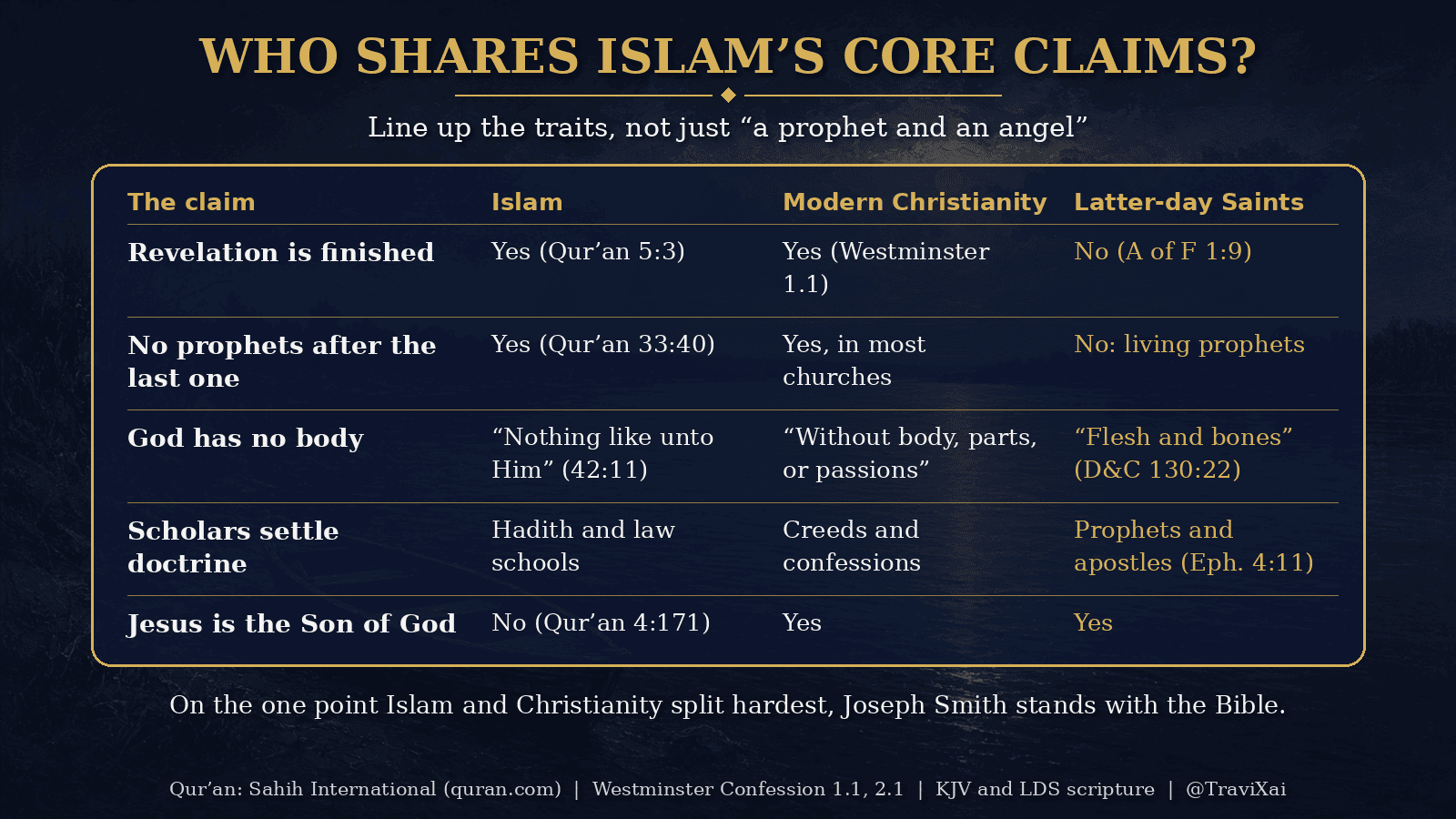
Run the list. Finished revelation, a last prophet already come, a God with no body, scholars instead of prophets: Islam and modern Christianity share every one. The only place Joseph and Muhammad line up is that an angel came, and that same line puts Joseph next to Zacharias, Mary, and John. On the line that matters most, who Jesus is, Joseph stands with the Bible against the Qur’an.
So the next time someone calls Joseph Smith the American Muhammad, ask which of Islam’s defining beliefs they hold: a finished revelation, no more prophets, a God with no body. Then ask which ones Joseph taught. Let them decide who’s closer. For the full trait-by-trait chart, see Line Them Up: The New Testament Church, Islam, and the Closed Heavens.
The Restoration isn’t a new beginning. It’s a return to what God set up in the first place: apostles, prophets, revelation, and a living Christ who still leads His Church.
What all four standard works say about Jesus
The deepest difference between Joseph Smith and Muhammad is Jesus. The Qur’an says “The Messiah, Jesus the son of Mary, was but a messenger of Allāh” (Qur’an 4:171, Sahih International). All four standard works Joseph gave the world say the opposite.
The Bible
Thou art the Christ, the Son of the living God.
Matthew 16:16
The Book of Mormon
And we talk of Christ, we rejoice in Christ, we preach of Christ, we prophesy of Christ, and we write according to our prophecies, that our children may know to what source they may look for a remission of their sins.
2 Nephi 25:26
The Doctrine and Covenants
And now, after the many testimonies which have been given of him, this is the testimony, last of all, which we give of him: That he lives! For we saw him, even on the right hand of God; and we heard the voice bearing record that he is the Only Begotten of the Father.
D&C 76:22–23
The Pearl of Great Price
One of them spake unto me, calling me by name and said, pointing to the other—This is My Beloved Son. Hear Him!
Joseph Smith—History 1:17
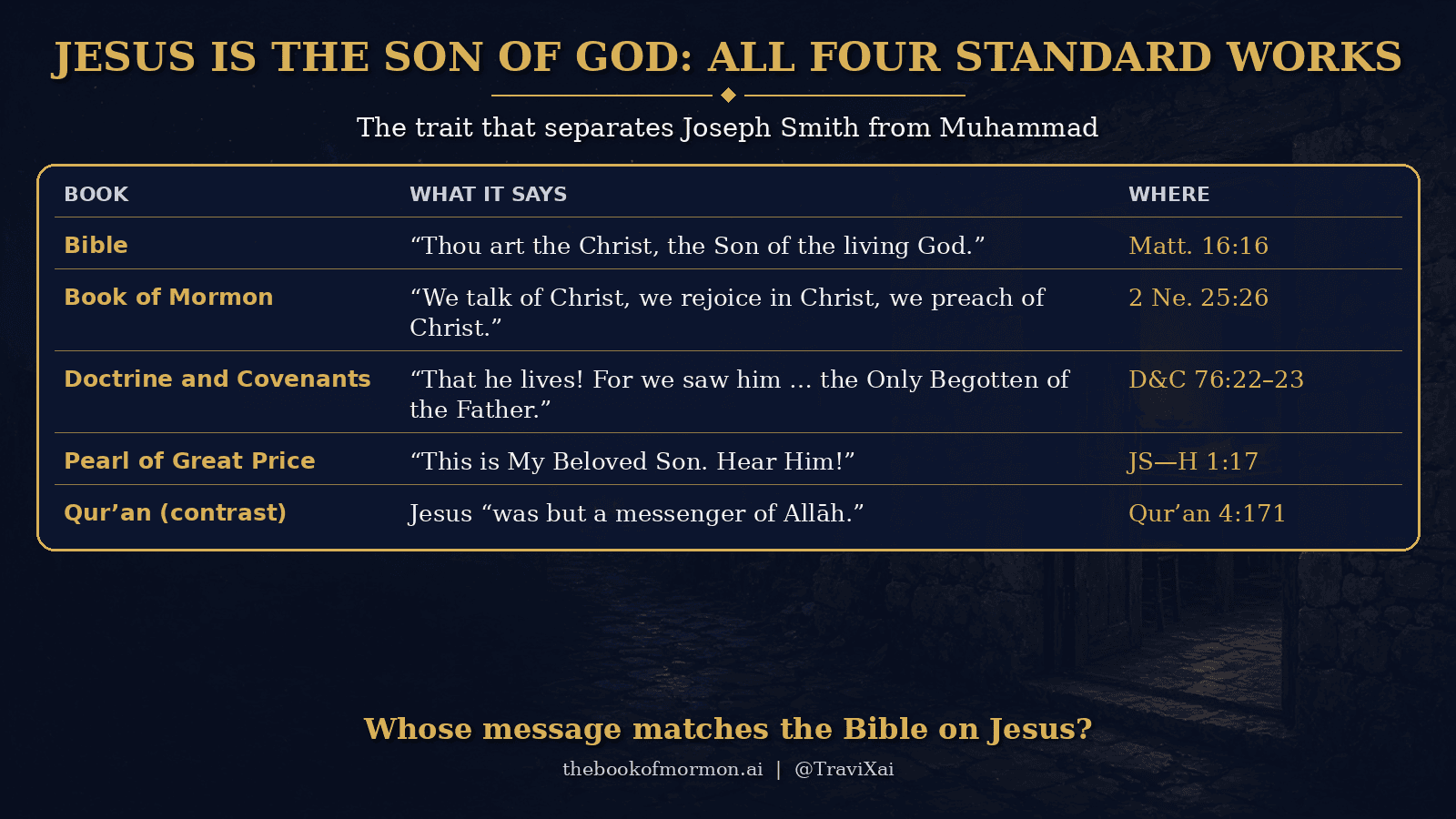
A prophet whose first vision was the Father introducing His Son, and whose scriptures all testify that Jesus is the Christ, is not following Muhammad’s pattern. For more on who Latter-day Saints worship, see Do Latter-day Saints believe Jesus is God? and Do Latter-day Saints worship Joseph Smith?.
Key takeaways
- Calling Joseph Smith “the American Muhammad” rests on one trait: an angel came. By that standard, Mary (Luke 1:26) and John (Revelation 1:1) fail too.
- Islam’s defining claim is finality: Muhammad is the “seal [i.e., last] of the prophets” (Qur’an 33:40). The Westminster Confession says God’s former ways of revealing His will are “now ceased.” Joseph taught that God “will yet reveal many great and important things.”
- With no living prophets, Islam turned to hadith and scholars, and Protestantism turned to creeds and confessions. Paul gave the Church apostles and prophets “till we all come in the unity of the faith.”
- The Qur’an says “there is nothing like unto Him,” and the Westminster Confession says God is “without body, parts, or passions.” Joseph taught the God Moses spoke with face to face and Stephen saw.
- On who Jesus is, Joseph stands with the Bible: “This is My Beloved Son. Hear Him!” The Qur’an denies that Jesus is God’s Son and denies the crucifixion.
- Joseph claimed restoration of Christ’s original church with authority from heaven, backed by eleven witnesses. That isn’t a new religion replacing the Bible. It’s the Bible’s pattern returning.
Joseph Smith and Muhammad: quick answers
Why do critics compare Joseph Smith to Muhammad?
Because both reported an angel and both produced scripture. That’s one trait. By that rule Mary (Luke 1:26) and John (Revelation 1:1) would qualify too. A real comparison has to line up every defining trait, not just one.
What does Islam teach that Latter-day Saints reject?
That Muhammad is the “seal of the prophets” (Qur’an 33:40), that Jesus is not God’s Son, and that He was not crucified. Latter-day Saints teach the opposite on every point: living prophets, Jesus as the Only Begotten Son, and His death and resurrection. See the 1 John 4 test.
Who actually shares more with Islam?
Any church that says revelation has ceased and God is “without body, parts, or passions.” Both are Westminster Confession language, and both match Islam better than they match the Restoration. Line them up in the New Testament Church vs. Islam, trait by trait.
Are Latter-day Saints Christians?
Yes. We worship God the Father in the name of Jesus Christ, accept the Bible, and teach salvation only through Him. See Are Latter-day Saints Christian?.
Did Joseph Smith claim to be the last prophet?
No. Muhammad is called the “seal of the prophets” (Qur’an 33:40). Joseph taught the opposite: God “will yet reveal many great and important things” (Articles of Faith 1:9), and prophets have led the Church since his death.
Does the Book of Mormon replace the Bible?
No. It says it was written so that readers would believe the Bible, “and if ye believe that ye will believe this also” (Mormon 7:9). Latter-day Saints read both.
What does the Qur’an say about Jesus that Latter-day Saints reject?
It says Jesus “was but a messenger of Allāh” (Qur’an 4:171) and denies that God has a son. Every Latter-day Saint book of scripture testifies that Jesus is the Son of God (Matthew 16:16; D&C 76:23; JS—H 1:17).
Who first called Joseph Smith a “Mohammed”?
The comparison is old. Josiah Quincy, a future mayor of Boston, met Joseph in Nauvoo in 1844 and later called him “this bourgeois Mohammed” in his memoir, Figures of the Past (1883).
Follow @TraviXai on X for daily answers to critics, and dig deeper into any topic at galatians18.app.
Sources
- Scripture quotations: King James Version, Book of Mormon, Doctrine and Covenants, and Pearl of Great Price, churchofjesuschrist.org: Genesis 1:27; Exodus 24:2; 33:11; Amos 3:7; Luke 1:26; Acts 3:21; 7:56; 9:7; 11:28; Galatians 1:12; Ephesians 2:20; 4:11–14; 2 Thessalonians 2:3; Hebrews 5:4; Revelation 1:1; 2 Nephi 25:26; 29:10; Mormon 7:9; Doctrine and Covenants 13:1; 130:22; Joseph Smith—History 1:17; Articles of Faith 1:9; The Testimony of Three Witnesses.
- Qur’an quotations: Sahih International translation, quran.com: 4:157, 4:171, 5:3, 5:48, 33:40, 42:11, 112:4.
- Westminster Confession of Faith (1646), chapters 1.1 and 2.1, Orthodox Presbyterian Church edition.
- “Qurʾān,” Encyclopaedia Britannica, britannica.com/topic/Quran (revelation through Gabriel, 610–632); Asma Sayeed, “Hadith,” Encyclopaedia Britannica, britannica.com/topic/Hadith (“second only to the Qurʾān, for law, ritual, and creed”; schools of legal interpretation).
- Josiah Quincy, Figures of the Past, from the Leaves of Old Journals (Boston: Roberts Brothers, 1883), “Joseph Smith at Nauvoo,” p. 387, transcription with page numbers.
- Harold Bloom, “The Religion-Making Imagination of Joseph Smith,” The Yale Review, yalereview.org (essay version of his 1990 University of Utah lecture; later in The American Religion, 1992).
- Topics for further study at galatians18.app: Continuing Revelation and an Open Canon, Hebrews 1: No More Prophets After Jesus?, Living Prophets, An Embodied God, Do Latter-day Saints Deny That Jesus Is God?, The Great Apostasy, Restoration of the Priesthood, The Three and Eight Witnesses.
- Related on this blog: Line Them Up, Are Latter-day Saints Just Like Muslims?, Was Joseph Smith a Con Man?, What Non-LDS Scholars Really Think of Joseph Smith, The Canon Was Never Meant to Close, Sola Scriptura: Which Verse Teaches It?, The Great Apostasy in the New Testament’s Own Words, The Witnesses Who Never Recanted.
- Featured image and in-post graphic: original graphics by thebookofmormon.ai (painterly backgrounds with no photographs or likenesses of real people).
- Scripture quotations from the Holy Bible (KJV), the Book of Mormon, the Doctrine and Covenants, and the Pearl of Great Price via churchofjesuschrist.org. Qur’an quotations from the Sahih International translation via quran.com.
Follow @TraviXai and explore more at https://galatians18.app.