

“Con man” takes about three seconds to type. Testing it takes longer. You have to read the court records, follow the money, and listen to the people who knew Joseph Smith best, including the ones who left him. You also have to deal with the historians who don’t believe he was a prophet and still won’t call him a fraud.
So let’s do the reading. A con needs a payoff, a getaway, and partners who keep quiet only while it pays. Run Joseph Smith’s life against that and the theory falls apart.
The money-digging story, in Joseph’s own words
Critics usually start with treasure digging as if it were a secret dug out of an archive. It wasn’t hidden. Joseph published it himself in his 1838 history:
“In the month of October, 1825, I hired with an old gentleman by the name of Josiah Stoal… After I went to live with him, he took me, with the rest of his hands, to dig for the silver mine, at which I continued to work for nearly a month, without success in our undertaking, and finally I prevailed with the old gentleman to cease digging after it. Hence arose the very prevalent story of my having been a money-digger.”
Joseph Smith—History 1:56
That’s an odd way to run a con. The hired hand talked his employer into quitting the job that was paying him.
The setting matters too. Alan Taylor, a two-time Pulitzer Prize winner who isn’t a Latter-day Saint, studied treasure seeking in the early American Northeast. He described a world “where treasure-seekers were neither fools nor deceivers, where treasure-seeking was part of an attempt to recapture the simplicity and magical power associated with apostolic Christianity.” His conclusion: “Mormonism’s founders were deeply and enthusiastically involved in folk magic but that this does not undermine the sincerity of the Mormon faith.”
Taylor grants that the folk practices were real. What he rejects is the cheap version of the story, where the practices prove a scam.
The 1826 hearing: the “victim” testified for the defense
In March 1826, Peter Bridgman, Josiah Stowell’s nephew, filed a complaint calling Joseph “a disorderly person and an imposter.” The case went before Justice Albert Neely in Bainbridge, New York.
The man who had paid Joseph was Stowell himself, and he testified for Joseph. The published docket entry has him swearing that Joseph “never deceived him.” In the other main account, Stowell tells the court, “I positively know it to be true.” The relative brought the complaint. The supposed victim wouldn’t play along.
What was the verdict? Here it pays to be careful, the way the Joseph Smith Papers are careful. The published docket says guilty. Another account says the court discharged him. The justice’s itemized bill has no charge for a record of conviction, and there’s no evidence Joseph was jailed. The editors’ summary: this “strongly suggests that Neely did not convict JS,” but “the lack of verifiable contemporary records renders tentative any conclusion about the case’s outcome.” Legal historian Gordon Madsen concludes that Joseph was acquitted.
So the honest version is that the outcome is uncertain, and the only person with a legal reason to complain said he hadn’t been cheated. That’s a thin foundation for “con man.”
1830: two trials, two discharges
After the Church was organized in April 1830, opponents in Broome County brought the old charge back. Joseph was tried in South Bainbridge, Chenango County, on June 29, 1830 and discharged. He was arrested again right away, tried in Colesville, Broome County, on June 30, and discharged again.
The Joseph Smith Papers note that he “was not convicted” either time, and that the charges were probably too old to prosecute under New York’s two-year statute of limitations (introduction to the New York cases). His enemies had two courts and two chances, and they came away with nothing.
Kirtland Safety Society: a con man who lost his shirt
The other favorite is the Kirtland Safety Society, the bank that failed in 1837. A bank failed, so there must be a swindle.
Look at the timeline in the Joseph Smith Papers. The society was organized in November 1836, during a boom. It couldn’t get a charter from the Ohio legislature and reorganized in January 1837. Then the Panic of 1837 hit, with bank runs and banks suspending payment across the country. The editors name the panic as “one of the central reasons the bank failed,” along with outside opposition and severe funding problems.
Joseph resigned as an officer by July 1837. The new officers made more loans, the notes lost value, and by August Joseph published a notice warning the public not to accept the society’s notes.
Then follow the money to where it went, which wasn’t his pocket:
- He was a party to at least 22 civil suits in Geauga County between June 1837 and January 1838, mostly creditors trying to collect.
- Unable to make payments, he “lost much of the land he had contracted to buy” (Financial Records introduction).
- He personally took on the debts of the Church’s Kirtland stores. In 1842 he filed for bankruptcy, and his debts were never discharged (bankruptcy application).
- When he was killed in 1844, the debts were still there. It took eight years to settle his estate.
A swindler who comes out of the swindle broke, sued, and still in debt at his death wasn’t very good at swindling.
The ledger: what he actually got
Every con has a payoff, so let’s tally his.
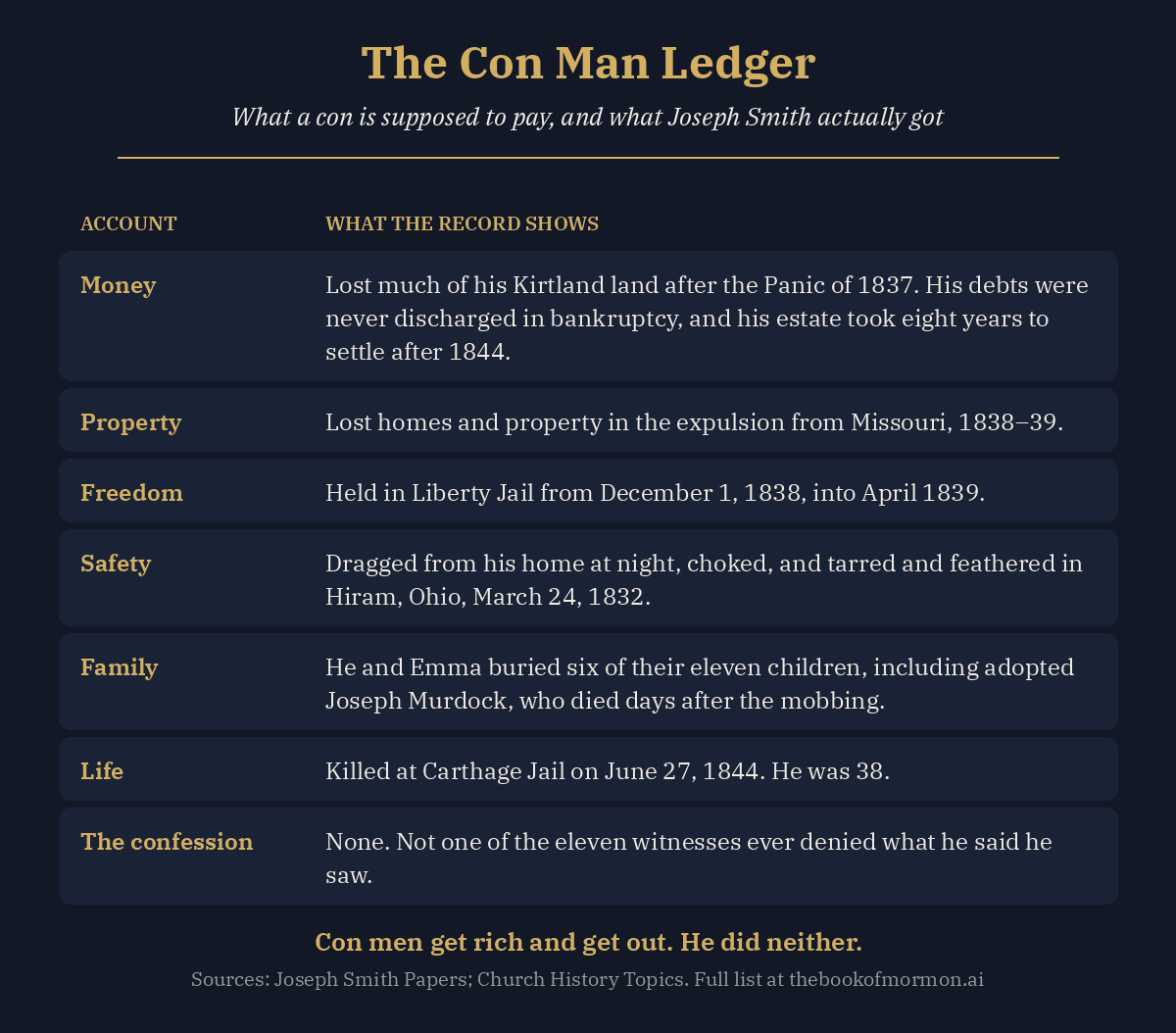
- **Safety.** On the night of March 24, 1832, a mob dragged him out of the house in Hiram, Ohio, choked him, and tarred and feathered him.
- **Family.** Joseph and Emma had eleven children, two of them adopted twins, and six died as infants (Joseph and Emma Hale Smith Family). One of the twins, Joseph Murdock Smith, was sick the night of the Hiram mobbing. Emma later said the mob “left the door open when they went out with him, the child relapsed and died” (1879 interview).
- **Freedom.** He was held in Liberty Jail from December 1, 1838, into April 1839, through a Missouri winter, after the governor ordered the Saints driven from the state.
- **Property.** He lost his home and land, first in Ohio and then in the expulsion from Missouri.
- **Life.** He went to Carthage in June 1844 saying, “I am going like a lamb to the slaughter; but I am calm as a summer’s morning” (D&C 135:4). He was shot there on June 27. He was 38.
He didn’t run. Con men run when it falls apart, and that’s what makes them con men. Joseph had chances to disappear and kept walking back into it.
His partners paid too. Martin Harris mortgaged his farm on August 25, 1829, to guarantee $3,000 for printing 5,000 copies of the Book of Mormon, and the farm was later sold to pay it (Joseph Smith Papers).
The partners who never talked
Cons fall apart when the insiders turn on each other, and plenty of Joseph’s insiders turned on him. Oliver Cowdery, David Whitmer, and Martin Harris, the Three Witnesses, all left the Church. Several of the Eight Witnesses drifted away too. If the plates were a prop, any of them could have said so and been believed by everyone around them.
None of them did. David Whitmer spent fifty years estranged from the Church and wrote in 1881: “I have never at any time denied that testimony or any part thereof.” Cowdery came back in 1848 and testified publicly. Harris testified until he died in 1875.
Then there’s Emma. She lived with Joseph through all of it, outlived him by nearly 35 years, and didn’t go west with Brigham Young. Near the end of her life, asked whether Joseph could have dictated the book from a manuscript he’d written or read beforehand, she answered:
“Joseph Smith… could neither write nor dictate a coherent and well-worded letter, let alone dictate a book like the Book of Mormon.”
“Last Testimony of Sister Emma,” Saints’ Herald, October 1, 1879 (transcription)
Some scholars read that as exaggeration, and fair enough: Joseph wrote plenty of coherent letters. Her point stands either way. The person in the room said the book didn’t come from him.
What the non-LDS historians actually say
The best test of “con man” is to ask the experts who have no stake in defending him. These scholars are not Latter-day Saints, and most think Joseph was wrong about his claims. Even so, they don’t call him a con man.
**Jan Shipps**, a lifelong Methodist and the leading non-LDS historian of the faith, put the problem in one sentence: “For if Joseph Smith were a knave, then those who joined him were dupes; if he were a madman, those who joined him were fools.” She said Fawn Brodie’s fraud thesis “seemed ‘intuitively wrong to me.'”
**Harold Bloom** of Yale, who called himself “a Jewish Gnostic,” wrote that “the religious necessity and sincerity of Smith’s vision are beyond doubt,” and called him “an authentic religious genius.” Bloom didn’t believe Joseph was a prophet. He just couldn’t make him a fake.
**Robert Remini**, the Andrew Jackson biographer, put it plainly in 2002: “I really do believe that he believed himself to be a prophet of God.”
**Josiah Quincy**, a Harvard-educated Bostonian who met Joseph in Nauvoo in May 1844 and was openly scornful of his claims, still wrote: “Fanatic, imposter, charlatan, he may have been; but these hard names furnish no solution to the problem he presents to us.” Quincy also suggested a future textbook might name Joseph Smith as the American of his century who “exerted the most powerful influence upon the destinies of his countrymen.”
**Daniel Walker Howe**, whose What Hath God Wrought won the Pulitzer Prize, wrote that the Book of Mormon “should rank among the great achievements of American literature,” and that critics, “dismissing the work as a fraud, have been more likely to ridicule than read it.”
**Charles Dickens** boarded an emigrant ship of about 800 Latter-day Saint converts in 1863, planning “to bear testimony against them if they deserved it.” What he wrote afterward: “to my great astonishment they did not deserve it.” (That’s about the converts, not Joseph, but it’s the same theory tested on the followers.)
Then there’s **Fawn Brodie**, his harshest biographer. She believed he started as a conscious impostor, and that’s in the same passage. Still, she granted him “a highly compensated but nevertheless very real sincerity,” and called his church “a real religious creation.”
When even the prosecution’s best witness admits the defendant was sincere, the theory is in trouble.
The verdict
Put it together. The money-digging story came from Joseph himself. The 1826 complainant was a relative, and the man who paid Joseph testified for him. The 1830 cases ended in two discharges. The bank failed during a national panic, and Joseph came out of it sued and in debt. He was beaten, jailed, and killed, and he buried six children along the way. His partners left him and still never denied what they saw. And the scholars with no reason to defend him reach for “genius,” “sincerity,” and “a phenomenon to be explained,” not “con man.”
You can conclude Joseph Smith was mistaken. That’s a real argument, and you can make it. “Con man” isn’t one. It’s the conclusion of someone who never checked the ledger.
If you want to go further, read the primary documents yourself at the Joseph Smith Papers. Then read the Book of Mormon and ask God about it (Moroni 10:4–5). That costs a lot less than it cost him.
For more like this, follow me on X at @TraviXai. If someone quotes Galatians 1:8 at you next, the Galatians 1:8 app has the answers ready.
Sources
- Joseph Smith—History 1:56: churchofjesuschrist.org
- Introduction to State of New York v. JS–A (1826), Joseph Smith Papers: josephsmithpapers.org
- Gordon A. Madsen, “Being Acquitted of a ‘Disorderly Person’ Charge in 1826,” in Sustaining the Law (BYU Studies): byustudies.byu.edu
- 1826 docket text (as published): Wikisource
- Introduction to Joseph Smith’s New York and Pennsylvania Legal Cases (1830 trials): josephsmithpapers.org
- Introduction to the Kirtland Safety Society: josephsmithpapers.org
- Financial Panic of 1837: josephsmithpapers.org
- Introduction to the Financial Records Series: josephsmithpapers.org
- Joseph Smith’s Application for Bankruptcy: josephsmithpapers.org
- Martin Harris pledged farm to E. B. Grandin: josephsmithpapers.org
- Liberty Jail (Church History Topics): churchofjesuschrist.org
- Joseph and Emma Hale Smith Family (Church History Topics): churchofjesuschrist.org
- Doctrine and Covenants 135: churchofjesuschrist.org
- “Last Testimony of Sister Emma,” Saints’ Herald 26 (Oct. 1, 1879): FAIR transcription
- Alan Taylor, “Rediscovering the Context of Joseph Smith’s Treasure Seeking,” Dialogue 19, no. 4 (1986): 18–28: PDF
- Jan Shipps, Sojourner in the Promised Land (2000), as quoted in the Salt Lake Tribune: sltrib.com
- Harold Bloom, “The Religion-Making Imagination of Joseph Smith,” The Yale Review: yalereview.org
- Robert V. Remini interview, Deseret News, Oct. 13, 2002: deseret.com
- Josiah Quincy, Figures of the Past (1883), pp. 376–77: transcription
- Daniel Walker Howe, What Hath God Wrought (Oxford, 2007), p. 314: Google Books
- Charles Dickens, The Uncommercial Traveller, ch. 22, “Bound for the Great Salt Lake”: Project Gutenberg
- Fawn M. Brodie, No Man Knows My History, 2nd ed. (1971), pp. viii, 85: Internet Archive
- David Whitmer’s 1881 statement and the witnesses: Steven C. Harper, “Evaluating the Book of Mormon Witnesses,” Religious Educator 11, no. 2 (2010): rsc.byu.edu