
Ask the internet what scholars think of Joseph Smith and you’ll get a confident answer: “Every historian knows he was a fraud.”
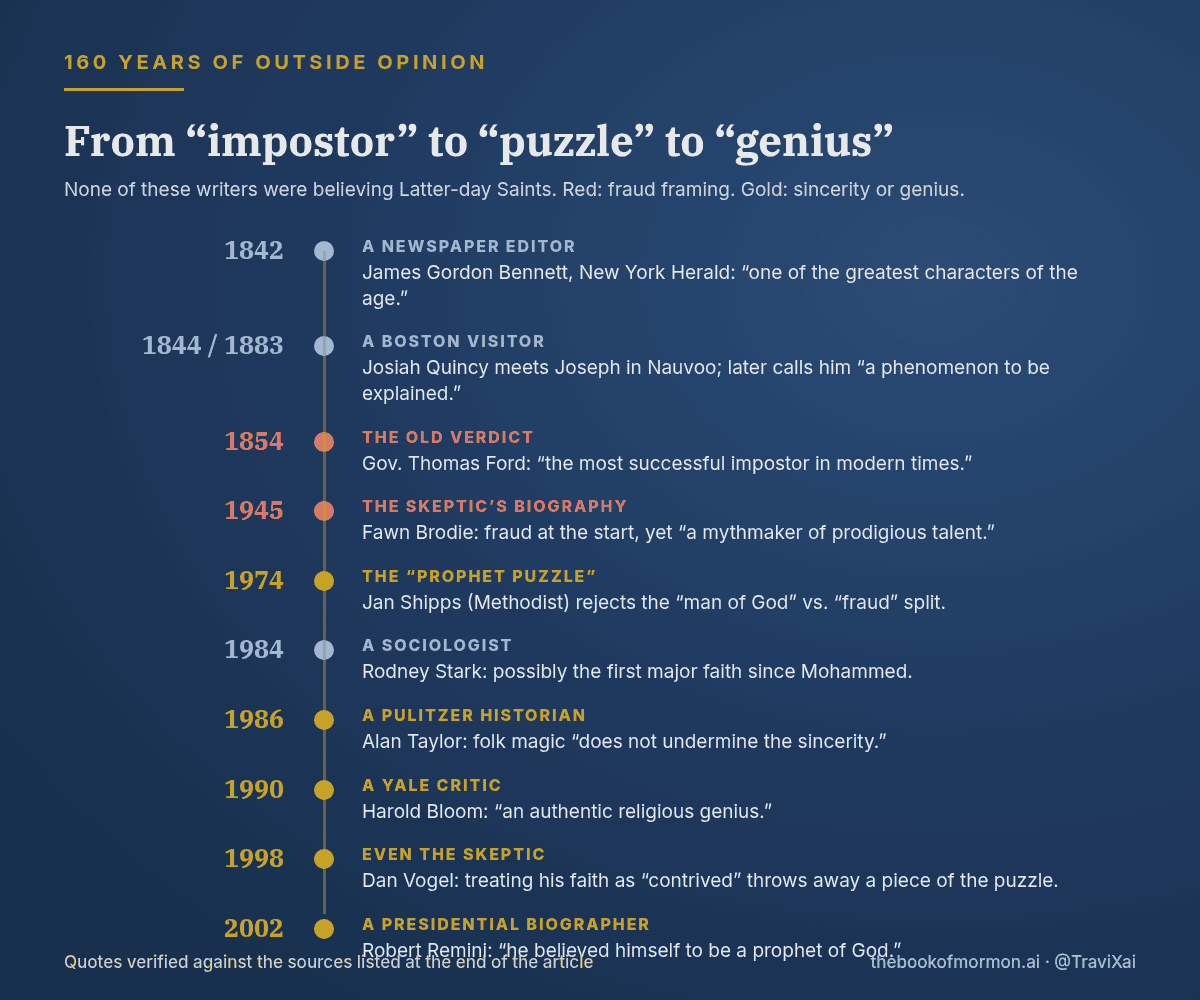
Ask the historians, and you get something far more interesting. Over the last fifty years, the scholars with no reason to defend him, including Methodists, Jews, Lutherans, and outright skeptics, have largely stopped calling him a simple fraud. The words they reach for now are “puzzle,” “phenomenon,” and “genius.”
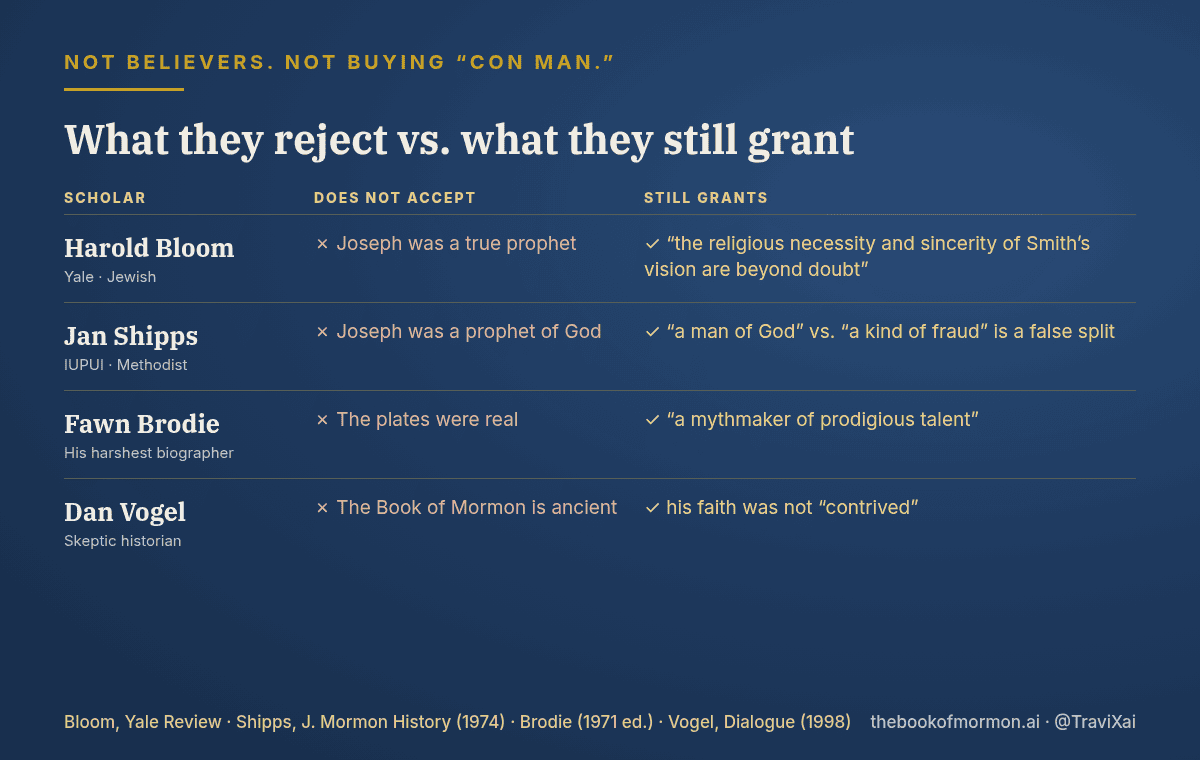
None of them think he was a prophet. That’s what makes their verdict worth reading.
We already tested the “con man” charge itself (court cases, money, motive) in Was Joseph Smith a Con Man? This post asks a different question: when outside scholars look at Joseph as a religious figure, what do they actually see?
The old verdict: “impostor”
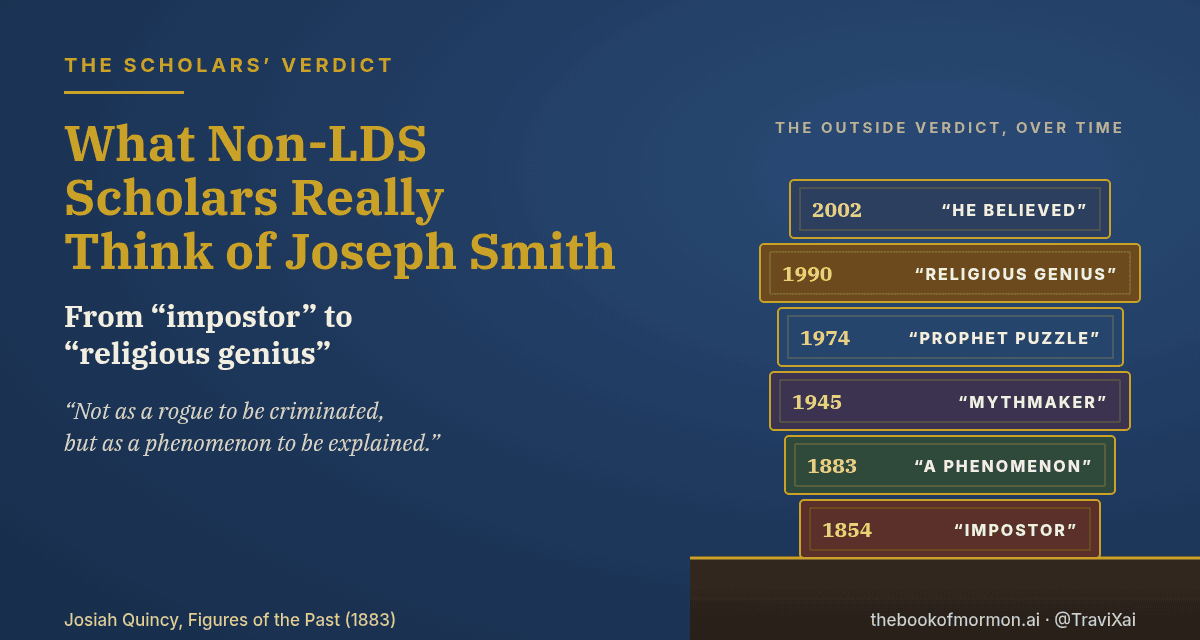
For most of the 1800s, the outside answer was simple. Thomas Ford, the Illinois governor in office when Joseph was killed at Carthage, wrote the obituary most Americans believed:
“Thus fell Joe Smith, the most successful impostor in modern times; a man who, though ignorant and coarse, had some great natural parts which fitted him for temporary success…”
Thomas Ford, A History of Illinois (1854), p. 360
That story still runs the comment sections. Harold Bloom of Yale, in an essay based on his 1990 lecture at the University of Utah, said most Americans who had heard of Joseph at all “remember him as a fascinating scamp or charlatan who invented the story of the Angel Moroni and the gold plates and then forged the Book of Mormon as a follow-up.”
Even then, not every outsider bought it. Josiah Quincy, a Harvard-educated Bostonian who later became mayor of Boston, visited Nauvoo in May 1844, six weeks before Carthage. He had no sympathy for Joseph’s claims, yet in his 1883 memoir he wrote that Joseph’s influence “throws him into relief before us, not as a rogue to be criminated, but as a phenomenon to be explained.”
That’s the shift in one sentence. “Rogue” ends the conversation. “Phenomenon” starts it.
1974: Jan Shipps names the “Prophet Puzzle”
The modern turn has a date. In 1974, Jan Shipps, a lifelong Methodist who later became the first non-LDS president of the Mormon History Association, published “The Prophet Puzzle” in the first volume of the Journal of Mormon History.
She described the problem bluntly:
“What we have in Mormon historiography is two Josephs: the one who started out digging for money and when he was unsuccessful, turned to propheteering, and the one who had visions and dreamed dreams, restored the church, and revealed the will of the Lord to a sinful world.”
Jan Shipps, “The Prophet Puzzle” (1974), as quoted by Dan Vogel
Shipps called this split, “Joseph Smith as a man of God and Joseph Smith as a kind of fraud,” a dead end, and asked historians for one integrated person instead. Her challenge set the agenda for a generation: “The mystery of Mormonism cannot be solved until we solve the mystery of Joseph Smith.”
Notice what she did with the seer stone, the detail critics treat as a punchline. Shipps concluded that his use of the stone “played an important role in his spiritual development.” Not a prop for a scam, but part of a religious life. (For the background, see Seer Stones in Joseph Smith’s World on Galatians18.)
Alan Taylor, a historian who later won two Pulitzer Prizes, pushed the same direction in 1986. Studying treasure seeking in the early American Northeast, he wrote that “Joseph was after something more than mere material wealth,” and that “never in his life did Joseph Smith do anything by halves, always plunging forward with apparently boundless enthusiasm, conviction, and energy.” Taylor accepts that the folk-magic practices were real; he rejects the idea that they prove a hustle. Galatians18 covers that worldview in Magic, Folk Religion, and Joseph Smith.
Even the skeptics moved
The strongest sign of the shift isn’t the friendly scholars. It’s the hostile ones.
Fawn Brodie’s 1945 biography, No Man Knows My History, is still the critics’ favorite book. Brodie believed Joseph began as a deliberate impostor, and she says so. But read her own preface:
“The source of his power lay not in his doctrine but in his person, and the rare quality of his genius was due not to his reason but to his imagination. He was a mythmaker of prodigious talent.”
Fawn M. Brodie, No Man Knows My History, 2nd ed. (1971), p. ix
“Genius” and “prodigious talent” from the prosecution’s star witness.
Then came the critics who thought Brodie had gone too far. Robert Hullinger, a Lutheran minister, wrote that “even if one believes that Joseph Smith was at best a scoundrel, one still must account for the Book of Mormon.” And Dan Vogel, a skeptical biographer of Joseph and editor of Early Mormon Documents, criticized Brodie directly. Those who “fail to recognize a deeply spiritual dimension to Smith’s character, or who count his profession of religion as contrived,” he wrote, “throw away a major piece of the prophet puzzle.”
To be fair to Vogel, he still thinks Joseph deceived people; his theory is a “pious fraud” who sincerely believed in his mission. But look at where the argument now stands. Even among skeptics, the debate is no longer “Was Joseph religious?” It’s “What kind of religious man was he?” That’s a long way from “most successful impostor in modern times.”
The shift isn’t finished, and we won’t pretend it is. Richard Bushman, a Latter-day Saint biographer, wrote in the 2000s that “many informed academics think of Joseph as a shady character” and that Brodie “has shaped the view of the Prophet for half a century.” But the specialists, the people who actually work in the documents, have moved.
“Religious genius”: the intellect question
Once scholars stopped asking whether Joseph was faking, a new question took over: how did a farm boy with little schooling do all this?
Harold Bloom, the Yale literary critic who described himself as “a Jewish Gnostic,” gave the most famous answer. He opened his essay with a disclaimer: “I am in no position to judge Joseph Smith as a revelator, but as a student of the American imagination I observe that his achievement as national prophet and seer is unique in our history.” He went on to call Joseph “the most gifted and authentic of all American prophets,” and closed with this:
“If one decides that Joseph Smith was no prophet, let alone king of the Kingdom of God, then one’s dominant emotion toward him must be wonder. There is no other figure remotely like him in our entire national history, and it is unlikely that anyone like him ever can come again.”
Harold Bloom, “The Religion-Making Imagination of Joseph Smith,” The Yale Review
Bloom wasn’t a cheerleader. In the same essay he says Joseph “did not excel as a writer or as a theologian,” and Bloom admitted elsewhere that he found the Book of Mormon tedious. His praise is for Joseph’s vision of God and humanity, not for every page. That makes it more credible, not less.
Robert Remini, the Andrew Jackson biographer and former Historian of the U.S. House of Representatives, wrote a short biography of Joseph in 2002. He described “a man of little formal education but of striking intellectual power” who “produced a vast amount of religious writing that has influenced millions around the world.” He also called him “a man of compelling charisma, charm, and persuasiveness, a man absolutely convinced that his religious authority came directly from God.”
Josiah Quincy had already put the question in 1883: “Born in the lowest ranks of poverty, without book-learning and with the homeliest of all human names, he had made himself at the age of thirty-nine a power upon earth.”
His neighbors’ question is an old one. The people of Nazareth asked it about Jesus: “Whence hath this man this wisdom, and these mighty works?” (Matthew 13:54).
Influence: “a power upon earth”
The other thing outside scholars agree on is size. James Gordon Bennett, editor of the New York Herald, wrote in 1842, half tongue-in-cheek, that “this Joe Smith is undoubtedly one of the greatest characters of the age.” Remini later called Joseph “unquestionably the most important reformer and innovator in American religious history.”
In 1984, sociologist Rodney Stark looked at the movement’s growth and wrote that Latter-day Saints “stand on the threshold of becoming the first major faith to appear on earth since the Prophet Mohammed rode out of the desert.” His growth projections haven’t held up, but a leading sociologist of religion put the question on the table.
Honoring that influence isn’t worship, by the way. Latter-day Saints revere Joseph as a prophet, not as a god. (Galatians18 answers that charge in Do Mormons Worship Joseph Smith?)
“So what? None of them believe him.”
You might think: “This proves nothing. Every one of these scholars rejects Joseph’s claims. Calling him a ‘genius’ is just a polite way of saying he made it all up.”
But that misreads what a historian is doing. Bloom said outright that he was “in no position to judge Joseph Smith as a revelator.” Remini wrote as a historian, not as a judge of revelation. Historians set aside whether God spoke. What they can judge is whether the cheap explanations fit the evidence, and there the trend is clear: “fraud” keeps failing.
And “genius” has its own problem. It can explain a gifted mind. It has a harder time explaining eleven witnesses who said they saw the plates and never retracted, even after several of them broke with Joseph (see The Three and Eight Witnesses). It has a hard time explaining Emma, who wrote for him and said he dictated with “neither manuscript nor book to read from” (we covered her last testimony earlier today). Every natural theory that gets specific hits the same wall, which is why the “someone else wrote it” theories keep collapsing too (Part 3 of our evidence series).
The scholars took the first step: Joseph wasn’t faking. The remaining question is the one Shipps said everything else depends on. If he wasn’t lying, and the theories about him keep breaking down, then what did he actually see?
The angel said this would happen
There’s one more thing worth noticing. In 1823, by Joseph’s own account, the angel Moroni told a seventeen-year-old farm boy that his “name should be had for good and evil among all nations, kindreds, and tongues, or that it should be both good and evil spoken of among all people” (Joseph Smith—History 1:33).
Look back at the timeline above. “Impostor” and “genius.” “Fraud” and “phenomenon.” Two centuries of argument, still not settled, still not going away. (We traced that prophecy in His Name Had for Good and Evil.)
The best advice on the subject came from a scholar too. When the council in Jerusalem wanted to silence the apostles, Gamaliel, “a doctor of the law, had in reputation among all the people,” told them to wait:
“Refrain from these men, and let them alone: for if this counsel or this work be of men, it will come to nought: But if it be of God, ye cannot overthrow it; lest haply ye be found even to fight against God.”
Acts 5:38–39
Joseph’s critics have had about two hundred years to watch his work come to nought. The scholars have watched it too, and most of them have stopped saying “fraud.” They don’t always say “prophet.” But “phenomenon to be explained” is an honest place to start, and the best way to finish the explanation is the way Joseph himself started, by asking God (James 1:5). Read the Book of Mormon and ask (Moroni 10:4–5).
Sources
- Josiah Quincy, Figures of the Past (Boston, 1883), “Joseph Smith at Nauvoo,” pp. 376–400: transcription with page numbers
- Thomas Ford, A History of Illinois (1854), p. 360: Internet Archive
- Harold Bloom, “The Religion-Making Imagination of Joseph Smith,” The Yale Review (essay version of his 1990 University of Utah lecture): yalereview.org
- Jan Shipps, “The Prophet Puzzle: Suggestions Leading Toward a More Comprehensive Interpretation of Joseph Smith,” Journal of Mormon History 1 (1974), quoted in Dan Vogel, “‘The Prophet Puzzle’ Revisited,” Dialogue 31, no. 3 (1998): dialoguejournal.com (also the source for the Hullinger and Vogel quotes)
- Jan Shipps on the seer stone (1974, p. 14), as quoted in Alan Taylor, “Rediscovering the Context of Joseph Smith’s Treasure Seeking,” Dialogue 19, no. 4 (1986): 18–28: PDF
- Jan Shipps obituary and background, Salt Lake Tribune (2025): sltrib.com
- Fawn M. Brodie, No Man Knows My History, 2nd ed. (1971), Preface: Internet Archive
- Robert V. Remini, Joseph Smith (Penguin Lives, 2002), pp. 87, 180, as quoted in Newell G. Bringhurst’s review, Dialogue: dialoguejournal.com; “most important reformer and innovator,” and Richard Bushman’s “shady character” remark, both as quoted by Alex Beam, The American Scholar (2014): theamericanscholar.org
- James Gordon Bennett, New York Weekly Herald (April 9, 1842): transcription
- Rodney Stark, “The Rise of a New World Faith,” Review of Religious Research 26 (1984), reprinted by BYU’s Religious Studies Center: rsc.byu.edu
- KJV: Acts 5, Matthew 13, James 1; Joseph Smith—History 1; Moroni 10
- Video: Scripture Central, “Evidences of the Book of Mormon: Complexity”: youtube.com
When someone tells you “every historian knows he was a fraud,” ask which historians they mean, and whether they’ve read Shipps, Bloom, or even Brodie’s own preface. For short, sourced answers to the other arguments critics use most, try Galatians18.
Follow me on X for more: @TraviXai.