
Critics have a favorite theory about the Book of Mormon: Joseph Smith had a manuscript tucked away somewhere. A Bible, a novel, a stack of notes. Something he was quietly reading from.
There was one person in a position to know. She sat at the table with him “day after day,” pen in hand. If there was a hidden book, she would have tripped over it.
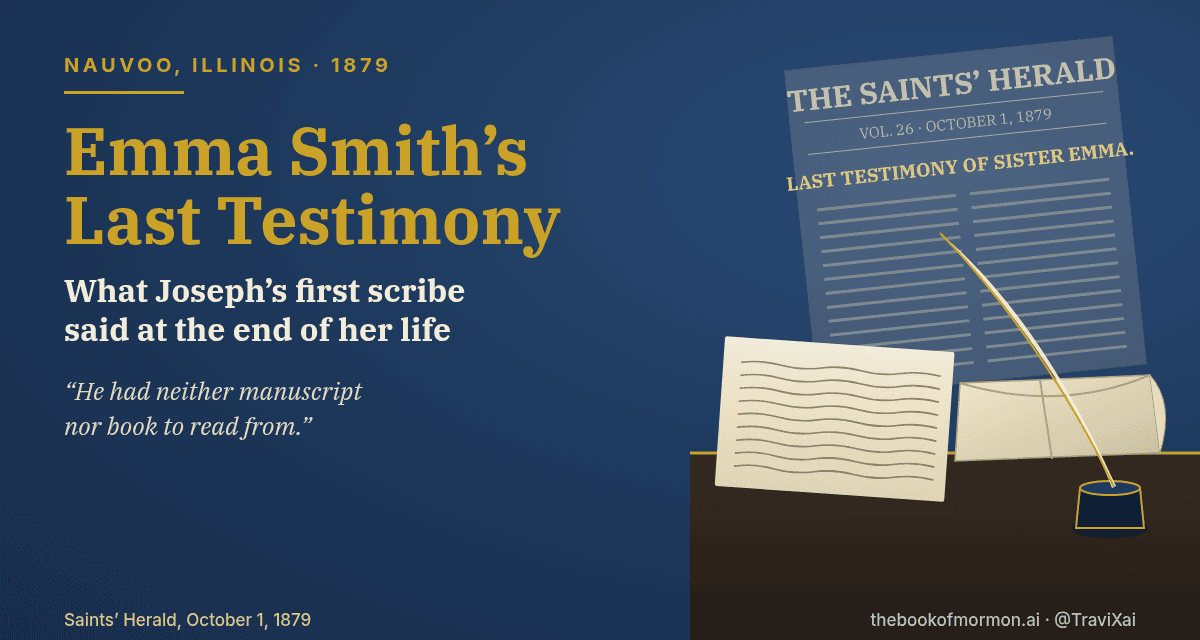
Her name was Emma Hale Smith, and fifty years later, a few months before she died, her son asked her straight out.
If you’re new here, start with Was Joseph Smith a Con Man? This post zooms in on one witness that article only touches.
The interview nobody in Utah arranged
In February 1879, Joseph Smith III, Emma’s son and president of the Reorganized Church of Jesus Christ of Latter Day Saints, traveled to Nauvoo, Illinois. He arrived on the 4th and stayed until the 10th. He brought a list of questions that leaders of his church had written and agreed on in advance.
Why? Because, as he wrote in the introduction, people kept throwing his mother’s name at him:
“Ask your mother, she knows.” “Why don’t you ask your mother; she dare not deny these things.” “You do not dare to ask your mother!”
Joseph Smith III, introduction to “Last Testimony of Sister Emma”
So he asked her. Her husband, Lewis C. Bidamon, was in the room for most of it. Before Joseph III left, he read every question and answer back to her, and she affirmed them. Emma died in Nauvoo on April 30, 1879. Because she died so soon after giving the answers, the Saints’ Herald printed them on October 1, 1879, under the title “Last Testimony of Sister Emma.”
Notice who isn’t in this story: Brigham Young, Salt Lake City, or anyone from The Church of Jesus Christ of Latter-day Saints. Brigham had died in 1877, and Emma had been estranged from him and the Saints in Utah for decades. This interview came from the other branch of the family.
What she said about the translation
Here’s her answer to “What of the truth of Mormonism?” Every word below is from the published text.
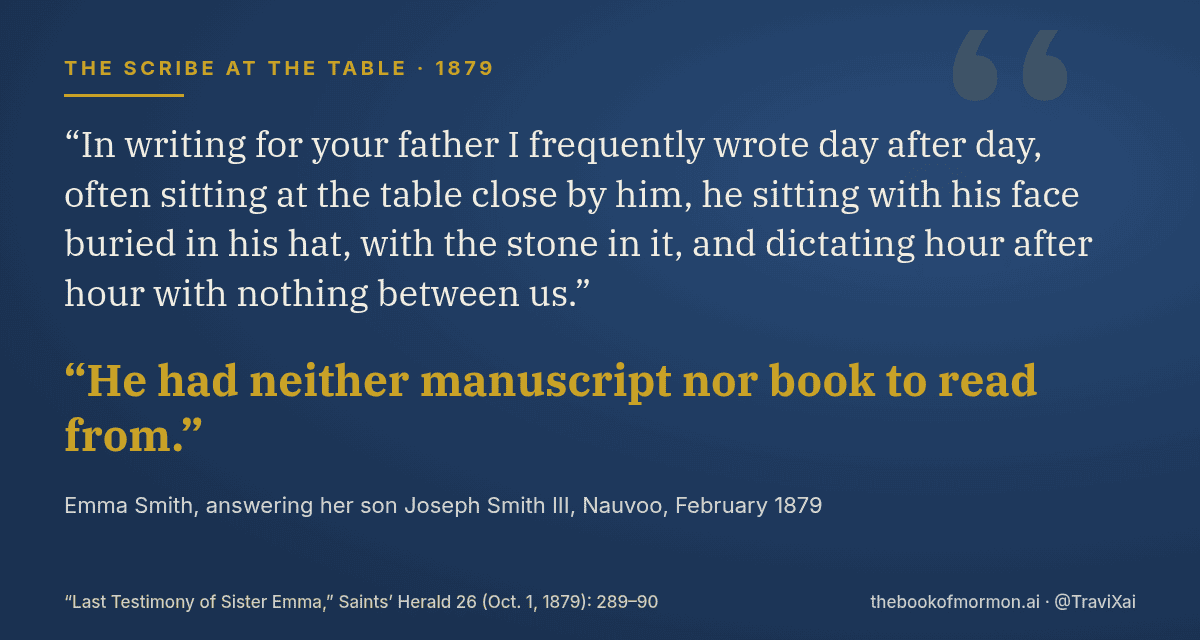
“I know Mormonism to be the truth; and believe the Church to have been established by divine direction. I have complete faith in it. In writing for your father I frequently wrote day after day, often sitting at the table close by him, he sitting with his face buried in his hat, with the stone in it, and dictating hour after hour with nothing between us.”
Then came the question critics still ask today: did he have a book or manuscript he was reading from?
“He had neither manuscript nor book to read from.”
Her son pushed: could he have had one without her knowing?
“If he had had anything of the kind he could not have concealed it from me.”
That detail about the hat matters, and we’ll come back to it. (Galatians18 covers the “rock in a hat” objection in Did Joseph Use a Seer Stone in a Hat?, including the Urim and Thummim in the high priest’s breastplate, Exodus 28:30.)
The plates in a linen cloth
Joseph III asked whether Joseph actually had the plates while she was writing. Her answer is one of the most physical descriptions of the plates we have:
“The plates often lay on the table without any attempt at concealment, wrapped in a small linen table cloth, which I had given him to fold them in. I once felt of the plates, as they thus lay on the table, tracing their outline and shape. They seemed to be pliable like thick paper, and would rustle with a metallic sound when the edges were moved by the thumb, as one does sometimes thumb the edges of a book.”
She never unwrapped them. “I was satisfied that it was the work of God,” she said, “and therefore did not feel it to be necessary to do so.” Bidamon, who was not a member of the Church, asked if Joseph had forbidden her to look. “I do not think he did,” she said. She moved them around the table “as it was necessary in doing my work.”
That’s not a staged vision. That’s a woman working around a bundle wrapped in her own tablecloth. For the other eleven people who said they saw or handled the plates, see The Gold Plates on Galatians18.
“Could neither write nor dictate a coherent and well-worded letter”
The sharpest question came next: could Joseph have written the book first, or read it out of some book, and then dictated it to his scribes? Joseph III noted that for the first time in the interview, his mother used her husband’s name instead of “your father”:
“Joseph Smith … could neither write nor dictate a coherent and well-worded letter, let alone dictate a book like the Book of Mormon. And, though I was an active participant in the scenes that transpired, and was present during the translation of the plates, and had cognizance of things as they transpired, it is marvelous to me, ‘a marvel and a wonder,’ as much so as to anyone else.”
And her final word on where the book came from:
“My belief is that the Book of Mormon is of divine authenticity—I have not the slightest doubt of it. I am satisfied that no man could have dictated the writing of the manuscripts unless he was inspired; for, when acting as his scribe, your father would dictate to me hour after hour; and when returning after meals, or after interruptions, he would at once begin where he had left off, without either seeing the manuscript or having any portion of it read to him.”
She added: “It would have been improbable that a learned man could do this; and, for one so ignorant and unlearned as he was, it was simply impossible.”
Lunch break, come back, pick up mid-sentence, no notes, no reading back. Ask any author how that works on a first draft of a 500-page book.
She had every reason to say otherwise
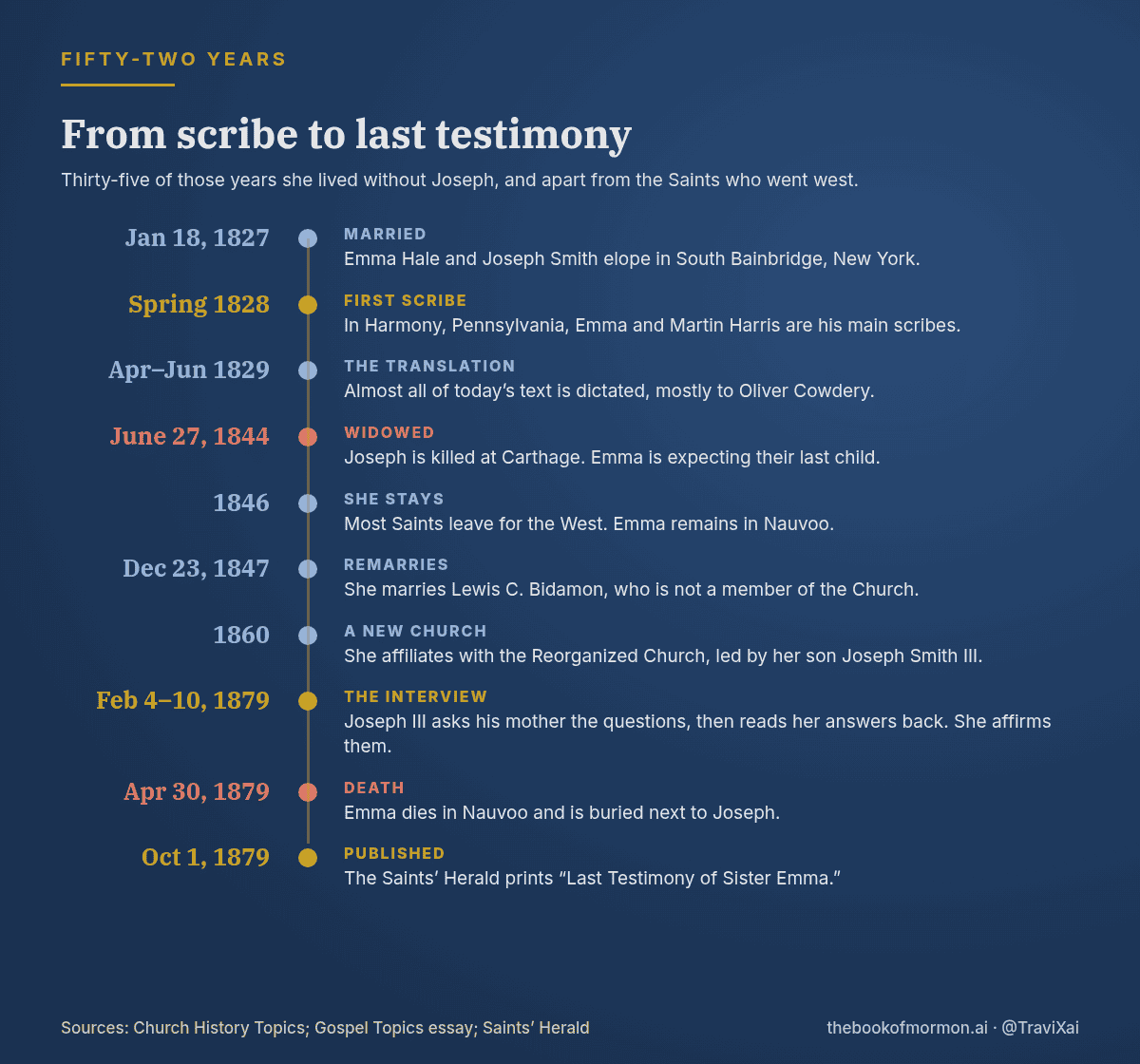
Look at what following Joseph had cost Emma. Her family opposed the marriage, and after 1830 she never saw her parents again. She buried a newborn son in Pennsylvania in 1828, during the translation years. Mobs, jails, and forced moves followed her from New York to Ohio to Missouri to Illinois. Her husband was killed at Carthage in 1844 while she was expecting their last child. (We covered those last days in Carthage: Why Joseph Walked In “Like a Lamb to the Slaughter”.)
Then she stayed behind. When most of the Saints went west in 1846, Emma remained in Nauvoo. She argued with Brigham Young over property and debts. She married a man who wasn’t a member. She joined her son’s church in 1860. Some called her an apostate, and she answered that too: “I have been called apostate; but I have never apostatized nor forsaken the faith I at first accepted.”
If the Book of Mormon was a fraud, Emma was its first victim. She had decades to say it, and a bitter split with the leader of the largest church built on her husband’s work. One sentence from her (“he read it out of a book”) would have done more damage than every critic of the 1800s put together. She never said it. She said the opposite, to the end.
She also knocked out a popular theory along the way. Asked about Sidney Rigdon, she said the book “had been translated and published some time before” she met him, and that Rigdon “did not become acquainted with Joseph and me till after the Church was established in 1830.” For why the “someone else wrote it” theories keep failing, see Book of Mormon Evidence, Part 3 of 10: The “Someone Else” Problem.
“But she denied polygamy in the same interview”
You might think: “Same interview, she said Joseph had no other wives. That’s false. So why trust anything else she said?”
But start by granting the point, because it’s true. Emma told her son there was “no revelation on either polygamy or spiritual wives” and that Joseph “had no other wife but me.” The historical record says otherwise. The Church’s own history says Joseph married additional wives, and that in early 1843 Emma “appears to have accepted plural marriage and personally consented to and witnessed Joseph’s marriages to four women.” By July she had turned against it and burned a copy of the revelation. We don’t hide that. Galatians18 walks through it in Plural Marriage in Kirtland and Nauvoo.
So her polygamy answer is wrong. Why she gave it, we can’t say for sure. It was the most painful subject of her life, Joseph III’s church taught that Joseph never practiced it, and it was her husband’s memory on the line. Any of those could push a witness away from the facts.
Now test the translation answer the same way, and it comes out differently:
- It’s corroborated. Martin Harris and Oliver Cowdery, who also wrote for Joseph, describe dictation through the interpreters or a seer stone. The surviving original manuscript shows a scribe hearing words, not copying them: “weed” written where the text should say “reed” (1 Nephi 17:48).
- It’s embarrassing. A woman polishing a legend doesn’t volunteer that her husband translated with his face in a hat. Critics still mock that detail today. She said it anyway.
- It’s consistent. Bidamon, a non-member who lived with her for over thirty years, said her answers on the translation were “substantially what she had always stated in regard to it.”
- It’s firsthand. Plural marriage was kept quiet, and it’s plain from the record that Joseph didn’t tell her everything. The translation happened at her kitchen table, with her holding the pen.
“In the mouth of two or three witnesses shall every word be established” (2 Corinthians 13:1). On the translation, Emma isn’t a lone voice. She’s one of several scribes, and the manuscript itself agrees with them. Witnesses get weighed claim by claim. Throw out every witness who got one thing wrong and you’ll have very little history left. (More on the scribes and witnesses in our roundup, The Best Book of Mormon Evidences, in One Place.)
Her last word
David Whitmer, one of the Three Witnesses, was still alive in 1879. Joseph III asked her what she thought of him. “David Whitmer I believe to be an honest and truthful man,” she said. “I think what he states may be relied on.” Whitmer had left the Church decades earlier, and like Emma, he never denied the Book of Mormon. (See The Three and Eight Witnesses on Galatians18.)
Emma Smith had every chance to walk away from the story, and she did walk away from Brigham Young. She never walked away from the book. At the end of her life, the woman who held the pen said Joseph had no manuscript, no book, and no way to do it on his own.
Sources
- Joseph Smith III, “Last Testimony of Sister Emma,” Saints’ Herald 26, no. 19 (October 1, 1879): 289–90. Full text: FAIR; reprint from BYU’s Religious Studies Center: rsc.byu.edu (PDF). Quotes follow the BYU reprint; the FAIR transcription differs by a word or two in places (for example “could” for “would” in “he would at once begin”).
- Church History Topics, “Emma Hale Smith” (life, family, Nauvoo, Bidamon, the Reorganized Church, 1843 plural marriages, death): churchofjesuschrist.org
- Gospel Topics Essays, “Book of Mormon Translation” (scribes, seer stone and hat, Martin Harris, Oliver Cowdery, the original manuscript’s “weed”/”reed” error): churchofjesuschrist.org
- Gospel Topics Essays, “Plural Marriage in Kirtland and Nauvoo”: churchofjesuschrist.org
- KJV: 2 Corinthians 13
- Video: Scripture Central, “Why Was Emma Smith a Witness to the Book of Mormon? (Knowhy #386)”: youtube.com
When a critic says Joseph read the Book of Mormon out of a hidden book, Galatians18 has short, sourced answers to that and the other arguments critics use most.
Follow me on X for more: @TraviXai. And next time someone says “ask Emma,” tell them somebody did.