
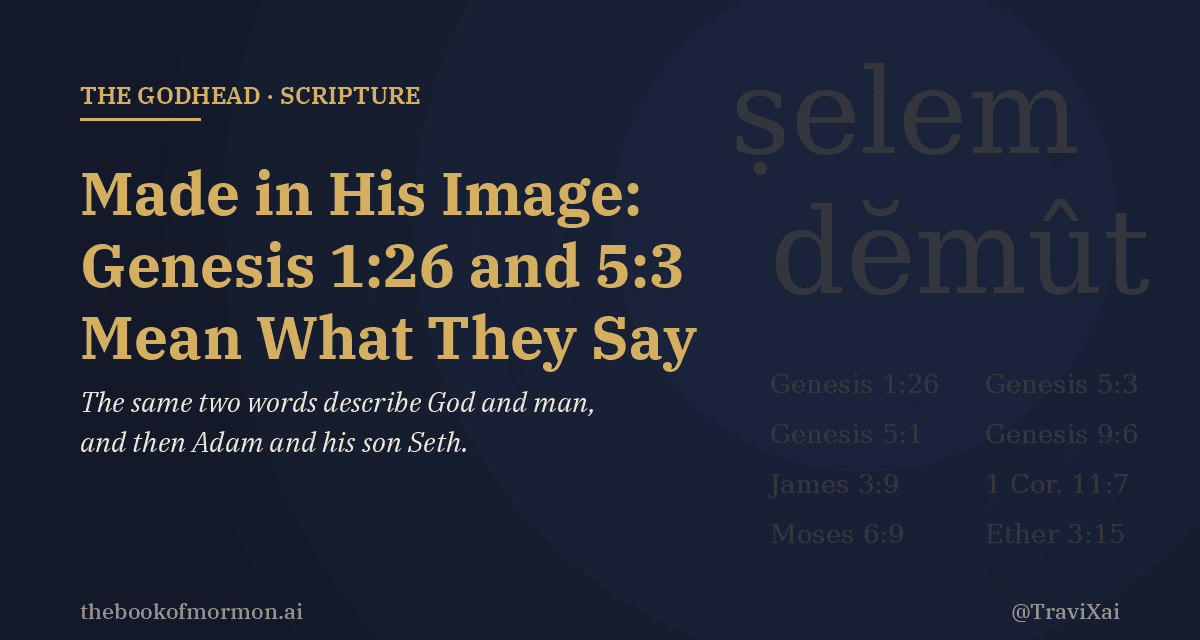

Genesis 1:26 is the first thing God ever says about us, and it’s usually the first thing explained away. “Let us make man in our image, after our likeness.” Ask what “image” means and you’ll hear: reason, free will, dominion, a conscience. Anything but the plain sense.
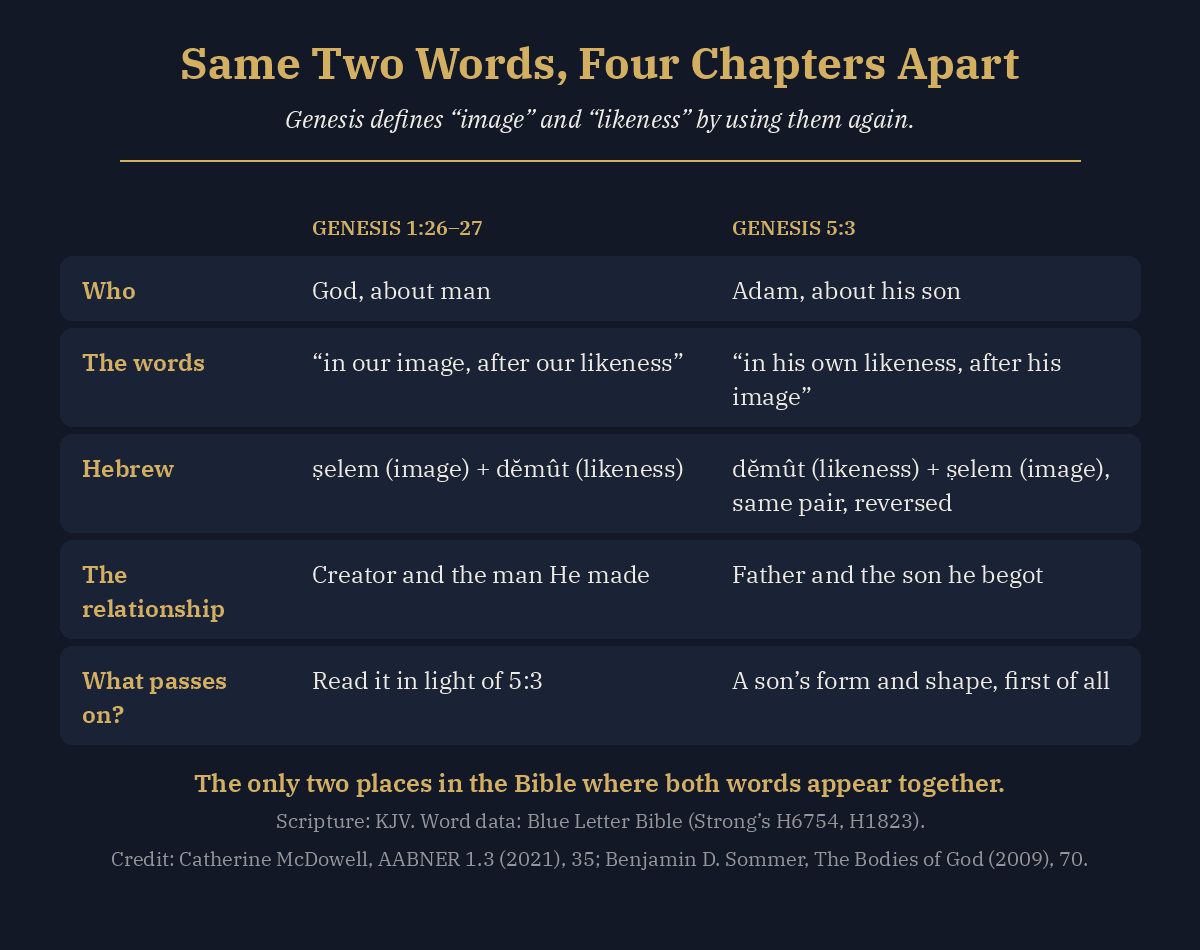
There’s an easy way to settle it. Let Genesis define its own words. Four chapters later, the same two words come back, and this time they describe a father and his son.
This picks up where my last article, God Has a Body: The Verses vs. John 4:24, left off. That one covered “God is a Spirit” and the prophets who saw God. This one stays in Genesis.
Two Hebrew words: ṣelem and dĕmût
And God said, Let us make man in our image, after our likeness: and let them have dominion over the fish of the sea… So God created man in his own image, in the image of God created he him; male and female created he them.
Genesis 1:26–27
“Image” is the Hebrew ṣelem (often spelled tselem). “Likeness” is dĕmût (demut). Before deciding what they mean in Genesis 1, look at how the rest of the Old Testament uses them.
The KJV translates ṣelem 17 times, as “image” 16 times. Outside Genesis it names things like these:
- “destroy all their molten images” (Numbers 33:52), cast idols.
- “images of your emerods, and images of your mice” (1 Samuel 6:5), the gold models the Philistines sent back with the ark (6:11).
- “men pourtrayed upon the wall, the images of the Chaldeans pourtrayed with vermilion” (Ezekiel 23:14).
Dĕmût works the same way. When King Ahaz saw an altar in Damascus, he sent the priest “the fashion of the altar, and the pattern of it” (2 Kings 16:10). “Fashion” is dĕmût: a model you could build from. The bronze sea in Solomon’s temple rested on “the similitude of oxen” (2 Chronicles 4:3). Those painted Chaldeans looked “after the manner of the Babylonians” (Ezekiel 23:15). In plain English, they looked Babylonian.
To be fair, ṣelem can be figurative. Psalm 39:6 says every man “walketh in a vain shew,” and “vain shew” is ṣelem. Strong’s ties the word to a root meaning “to shade.” But even a shadow has an outline.
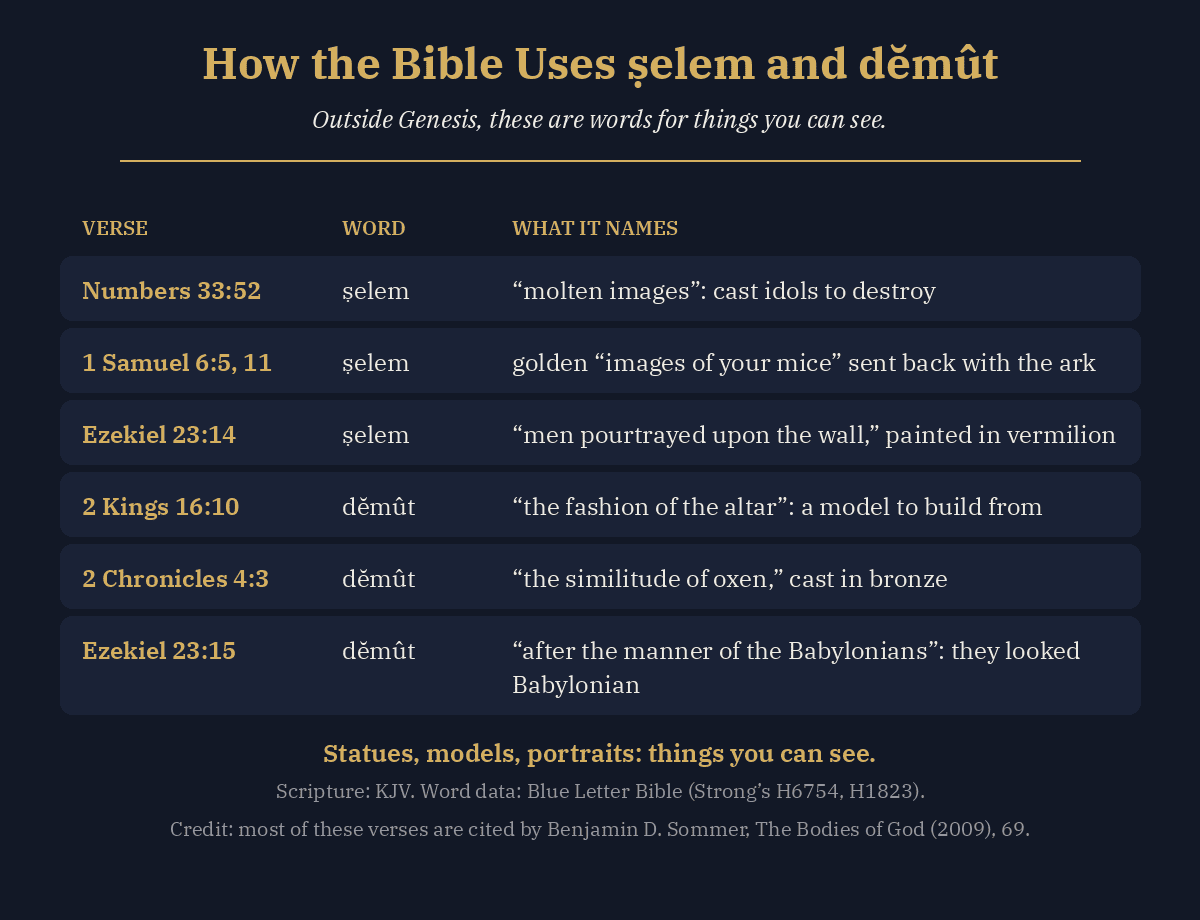
Benjamin D. Sommer, a Jewish Bible scholar at the Jewish Theological Seminary and doesn’t share Latter-day Saint theology, reaches the same conclusion from the same verses: “The terms used in Genesis 1.26–27, demut and ṣelem, then, pertain specifically to the physical contours of God.” They are used, he writes, “to refer to visible, concrete representations of physical objects, as verses such as 2 Kings 16.10, Ezekiel 23.14–15, 1 Samuel 6.4–5, and 2 Chronicles 4.3 make clear” (The Bodies of God and the World of Ancient Israel, 2009, p. 69).
Archaeology agrees. A ninth-century BC statue found at Tell Fekheriyeh in Syria carries an Assyrian and Aramaic inscription. As Old Testament scholar Catherine McDowell describes it, the inscription calls the statue the “image” (Aramaic ṣlm) and “likeness” (dmwt) of the governor it portrays. Same two words, carved on a stone man.
Genesis 5:3: the same words for a father and a son
Now the key passage:
This is the book of the generations of Adam. In the day that God created man, in the likeness of God made he him; Male and female created he them; and blessed them, and called their name Adam, in the day when they were created. And Adam lived an hundred and thirty years, and begat a son in his own likeness, after his image; and called his name Seth.
Genesis 5:1–3
Same two words, in reverse order. Adam stands to Seth as God stands to Adam. McDowell, an evangelical Old Testament professor (Palm Beach Atlantic University, formerly Gordon-Conwell), points out that “aside from Genesis 1, the only other biblical text where [ṣelem] and [dĕmût] appear together is in Gen 5:3.” Her conclusion: “just as [these terms] identify Seth as Adam’s son, the same terms in Gen 1:26–27 identify humanity as God’s ‘son’ (or child)” (AABNER 1.3, 2021, p. 35).
So what did Seth get from Adam? Sommer answers bluntly: “when a human fathers a child, he is first of all endowing the child with his basic shape. Humans have no ability to bestow abstract attributes or ethical qualities at birth to their offspring.” And: “It strains credulity to argue that P uses these terms differently in 5.1, 9.6, and 1.26–7” (p. 70). (“P” is the scholarly label for the author of these chapters.)
Nobody reads Genesis 5:3 and decides Seth inherited Adam’s capacity for abstract reasoning but not his face. If “in his own likeness, after his image” means a son who looks like his father, Genesis 1:26 means the same thing.
The image survives: Genesis 9:6 and James 3:9
After the Flood, God gives a law about murder:
Whoso sheddeth man’s blood, by man shall his blood be shed: for in the image of God made he man.
Genesis 9:6
The reason given for protecting a human life is the image. Sommer reads it the obvious way: these verses “maintain that human beings are a sort of statue of God; it is for this reason that 9.6 insists their blood should not be shed” (p. 70). You can’t shed the blood of an abstraction.
James makes the same point in the New Testament:
Therewith bless we God, even the Father; and therewith curse we men, which are made after the similitude of God.
James 3:9
Two details. First, “similitude” is homoiōsis, the same word the Greek Old Testament (the Septuagint) uses for “likeness” in Genesis 1:26, and its only appearance in the New Testament. Second, the likeness belongs to “God, even the Father.” James isn’t speaking of Christ’s incarnation. He means the Father.
Paul calls man “the image and glory of God” (1 Corinthians 11:7), in a passage about whether a head is covered in worship. It’s telling that Paul’s “image” language comes up in an argument about a visible head.
The other readings, taken fairly
There are three common alternatives. Latter-day Saints don’t reject any of them. We reject the word “only.”
Reason. Thomas Aquinas placed the image in the mind. To his credit, he states the opposing case honestly: “an image seems to apply principally to the shape of a thing. But shape belongs to the body.” His reply is that the upright human body reflects the image “by way of a trace” (Summa Theologiae I, q. 93, a. 6). Yet when Aquinas explains what a perfect image is, he reaches for Genesis 5:3’s picture: “the image of the king is in his son, who is of the same nature as himself” (q. 93, a. 1).
Dominion. Verse 26 says “Let us make man in our image… and let them have dominion.” Dominion is what the image-bearer does. It isn’t what the image is. Sommer grants that royal readings are “contextually defensible,” but adds that any such reading “supplements the terms’ basic, physical meaning without superseding it” (p. 70).
Moral nature. Paul speaks of the new man “renewed in knowledge after the image of him that created him” (Colossians 3:10). Character is part of the image; nobody denies that. But Genesis 9:6 and James 3:9 apply the image to sinners: murder victims, and the people we curse. If it survives sin, it can’t be the same thing as righteousness.
“No similitude.” Critics cite Deuteronomy 4:15: “ye saw no manner of similitude on the day that the LORD spake unto you in Horeb.” Read verse 16: the point is “Lest ye… make you a graven image.” Israel saw fire and heard a voice, so they had no form to copy. But the same Hebrew word for “similitude,” temûnâ, is what God says Moses did see: “the similitude of the LORD shall he behold” (Numbers 12:8). David hoped for it: “I shall be satisfied, when I awake, with thy likeness” (Psalm 17:15). Not seeing a form at Horeb doesn’t mean there was none.
Isaiah 40:18 (“what likeness will ye compare unto him?”) is answered by verse 19: “The workman melteth a graven image.” Isaiah is mocking idols, not human beings.
The plain reading came first, historically too. Before his conversion, Augustine assumed Christians read “man made after the image of Him that created him” to mean God was “bounded by human form,” and he admits he then had “not the faintest or dimmest suspicion” what a spiritual substance was (Confessions 6.3.4). Philosopher David L. Paulsen calls Augustine and Origen “reluctant witnesses” and argues that “ordinary Christians for at least the first three centuries of the current era commonly (and perhaps generally) believed God to be corporeal” (Harvard Theological Review 83:2, 1990, pp. 105–116). People had to be taught out of Genesis 1:26’s plain sense.
What the Restoration restored
Joseph Smith’s inspired translation, now the Book of Moses, removes the guesswork about whose image. “And I, God, said unto mine Only Begotten, which was with me from the beginning: Let us make man in our image… And I, God, created man in mine own image, in the image of mine Only Begotten created I him” (Moses 2:26–27).
And it reads Genesis 5 exactly the way Sommer does:
In the day that God created man, in the likeness of God made he him; In the image of his own body, male and female, created he them… And Adam lived one hundred and thirty years, and begat a son in his own likeness, after his own image, and called his name Seth.
Moses 6:8–10
“In the image of his own body.” Joseph Smith dictated that in 1830, long before a Syrian farmer turned up the Tell Fekheriyeh statue in 1979.
The Book of Mormon, translated the year before, has the premortal Christ say it to the brother of Jared: “Seest thou that ye are created after mine own image? Yea, even all men were created in the beginning after mine own image. Behold, this body, which ye now behold, is the body of my spirit; and man have I created after the body of my spirit” (Ether 3:15–16). And Doctrine and Covenants 130:22 completes it: the Father “has a body of flesh and bones as tangible as man’s.”
Stephen O. Smoot makes the scholarly case for this reading of Genesis 1 at the 2025 FAIR conference:
Next: “We are the offspring of God”
Paul made the same argument in Athens. “For we are also his offspring. Forasmuch then as we are the offspring of God, we ought not to think that the Godhead is like unto gold, or silver, or stone” (Acts 17:28–29). God is not like the idol, because He is like His children. That verse, and the Greek word behind “offspring,” is the next article.
The bottom line
Genesis tells you what “image” and “likeness” mean by using them for Seth. If a son made in his father’s likeness, after his image, looks like his father, then a man made in God’s image, after His likeness, tells you something true about what God looks like. The words mean what they say. The rest of the Old Testament says so, a stone statue from Syria says so, and the Restoration said so first.
Credit where it’s due
- Benjamin D. Sommer (Jewish Theological Seminary), whose The Bodies of God and the World of Ancient Israel makes the Genesis 5:3 argument better than anyone. Thank you.
- Catherine McDowell (Palm Beach Atlantic University), for her open-access article on Genesis 1–2 and the Tell Fekheriyeh inscription.
- A. R. Millard and P. Bordreuil, who published the Tell Fekheriyeh statue.
- David L. Paulsen (BYU), for decades of work on early Christian belief in an embodied God.
- Scripture Central, whose KnoWhy #627 pointed me to Sommer.
- Stephen O. Smoot and FAIR, for the conference talk above.
- Blue Letter Bible for its free lexicons, and New Advent, J. G. Pilkington, and the Fathers of the English Dominican Province for Augustine and Aquinas in English.
I argue this daily on X. Follow me at @TraviXai. And when someone pulls out Galatians 1:8 to end the conversation, the Galatians 1:8 app is built for exactly that.
Sources
- Bible quotations from the King James Version.
- Strong’s H6754 (ṣelem) and H1823 (dĕmût), with KJV usage: H6754, H1823; Strong’s H8544 (temûnâ): H8544; Strong’s G3669 (homoiōsis): G3669 (Blue Letter Bible)
- Septuagint, Genesis 1:26: StudyLight interlinear
- Benjamin D. Sommer, The Bodies of God and the World of Ancient Israel (Cambridge University Press, 2009), 69–70: Cambridge
- Catherine McDowell, “Human Identity and Purpose Redefined: Gen 1:26–28 and 2:5–25 in Context,” Advances in Ancient, Biblical, and Near Eastern Research 1, no. 3 (2021): 29–44: AABNER (open access)
- A. R. Millard and P. Bordreuil, “A Statue from Syria with Assyrian and Aramaic Inscriptions,” Biblical Archaeologist 45, no. 3 (1982): 135–141: doi.org/10.2307/3209808
- David L. Paulsen, “Early Christian Belief in a Corporeal Deity: Origen and Augustine as Reluctant Witnesses,” Harvard Theological Review 83, no. 2 (1990): 105–116: Cambridge
- Augustine, Confessions 6.3.4 (trans. J. G. Pilkington): newadvent.org
- Thomas Aquinas, Summa Theologiae I, q. 93, aa. 1 and 6: newadvent.org
- Scripture Central, “Why Were Man and Woman Created in the Image of God?” KnoWhy #627 (2023): scripturecentral.org
- Moses 2:26–27: churchofjesuschrist.org; Moses 6:8–10: churchofjesuschrist.org
- Ether 3:15–16: churchofjesuschrist.org
- Doctrine and Covenants 130:22: churchofjesuschrist.org
- Video: “Genesis 1 and Joseph Smith’s Cosmology,” Stephen O. Smoot, FAIR: YouTube