
Every con man has an exit plan. When the story falls apart, he skips town, changes his name, and starts over somewhere the newspapers haven’t reached.
In June 1844 Joseph Smith had his exit. He was across the Mississippi River in Iowa, out of Illinois’ reach, with provisions on the floor ready to pack and horses ordered for the trip west. And he turned the boat around.
Four days later he was dead in Carthage, Illinois, with his brother Hyrum beside him. That’s one of the hardest facts in the record for anyone who thinks he made it all up.
Our Was Joseph Smith a Con Man? mentions Carthage in a couple of lines, and Joseph Smith’s Fulfilled Prophecies (2026 Edition) promised this one would get its own post. Here it is.
How it started: the Nauvoo Expositor
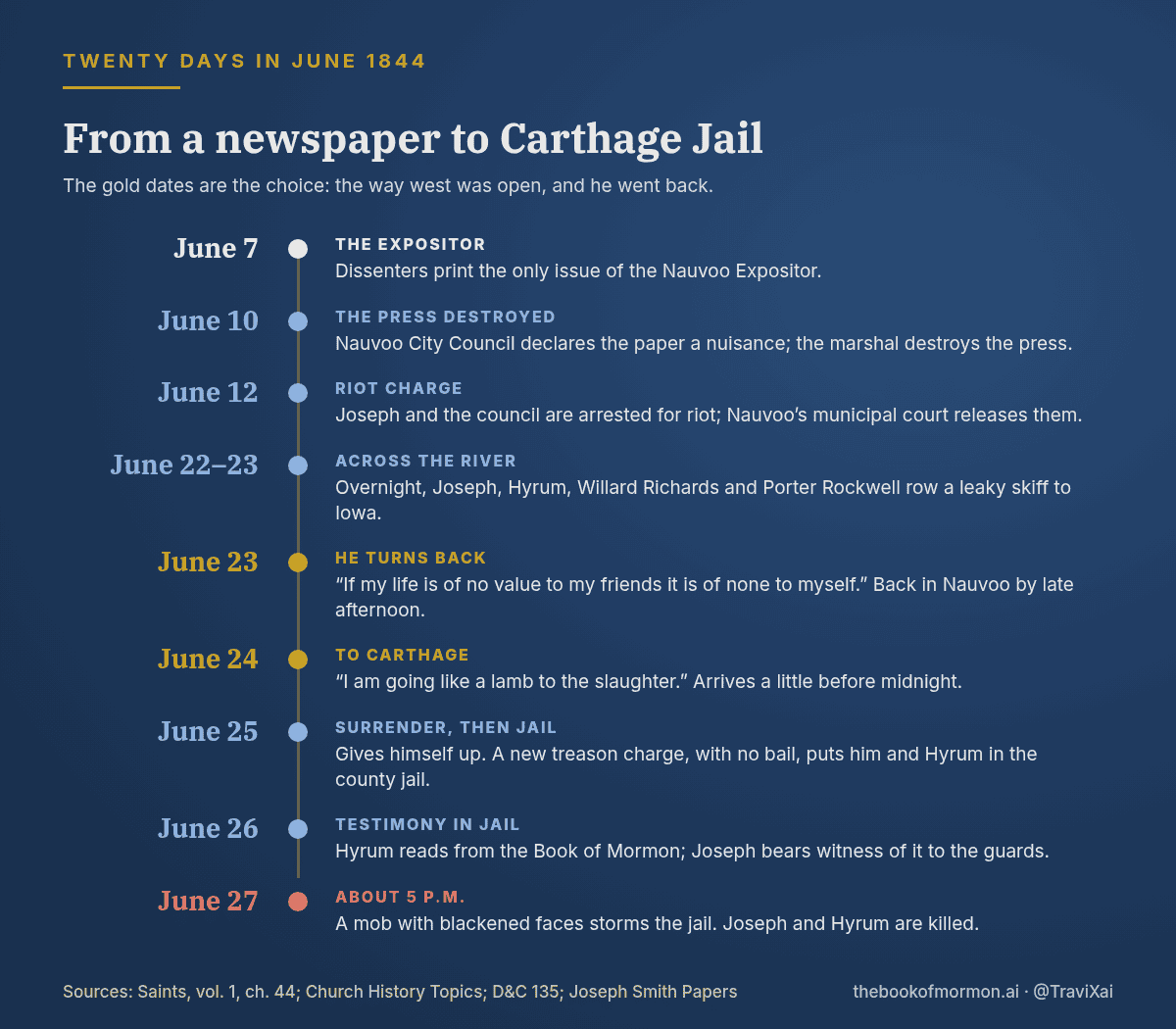
On June 7, 1844, a group of dissenters, including William Law, a former counselor in the First Presidency, published the first and only issue of the Nauvoo Expositor. It attacked plural marriage, Joseph’s teachings on the nature of God, and his mixing of church and civic authority.
On June 10 the Nauvoo City Council declared the paper a public nuisance, and Joseph, as mayor, ordered the marshal to destroy the press. The council feared the paper would stir up the kind of mob violence the Saints had already survived in Missouri.
Was that legal? The First Amendment didn’t bind cities and states until after the Fourteenth Amendment (1868), and nuisance law gave the council some ground. But as the Church’s own history puts it, “Scholars have concluded that the Nauvoo City Council acted legally to destroy copies of the newspaper but may have exceeded its authority by destroying the press itself.” Governor Thomas Ford thought it was flatly wrong.
So yes, the press is what brought the charges. Now watch what Joseph did once they came.
Two charges and a governor’s promise
On June 12, Joseph and the council were arrested for riot. Nauvoo’s municipal court released them, which made his opponents angrier. Armed men gathered in Carthage, talking of marching on Nauvoo, and Joseph put the city under martial law.
Governor Ford wanted the riot charge tried in Carthage, the county seat, about eighteen miles southeast of Nauvoo. If Joseph and the others gave themselves up, Ford promised to protect them. Carthage was swarming with men who hated the Saints, and Joseph doubted the promise would hold.
So on the night of June 22, after saying goodbye to his family, he got into a leaky skiff with Hyrum, Willard Richards, and Porter Rockwell. Porter rowed while the others bailed water with their boots. By morning on June 23 they were in Iowa Territory, and Joseph sent Porter back to bring horses. The plan was to head west.
“If my life is of no value to my friends”
You might think: “So he did run. Case closed.”
But look at what happened next. That same day, word came that the governor meant to occupy Nauvoo with troops until Joseph and Hyrum gave themselves up. Emma sent messengers asking him to come back. Some of them called him a coward, a shepherd who runs when the wolves come and leaves the sheep.
Joseph’s answer, as recorded in the History of the Church: “If my life is of no value to my friends it is of none to myself.”
He asked Porter, then Hyrum, what to do. Hyrum said, “Let us go back and give ourselves up, and see the thing out.”
Joseph’s reply is the line that matters most here: “If you go back I will go with you, but we shall be butchered.”
He said that before he got in the boat. He told his brother, out loud, that going back meant dying, and he went back anyway. Hyrum answered, “If we live or have to die, we will be reconciled to our fate.” By late that afternoon they were home in Nauvoo.
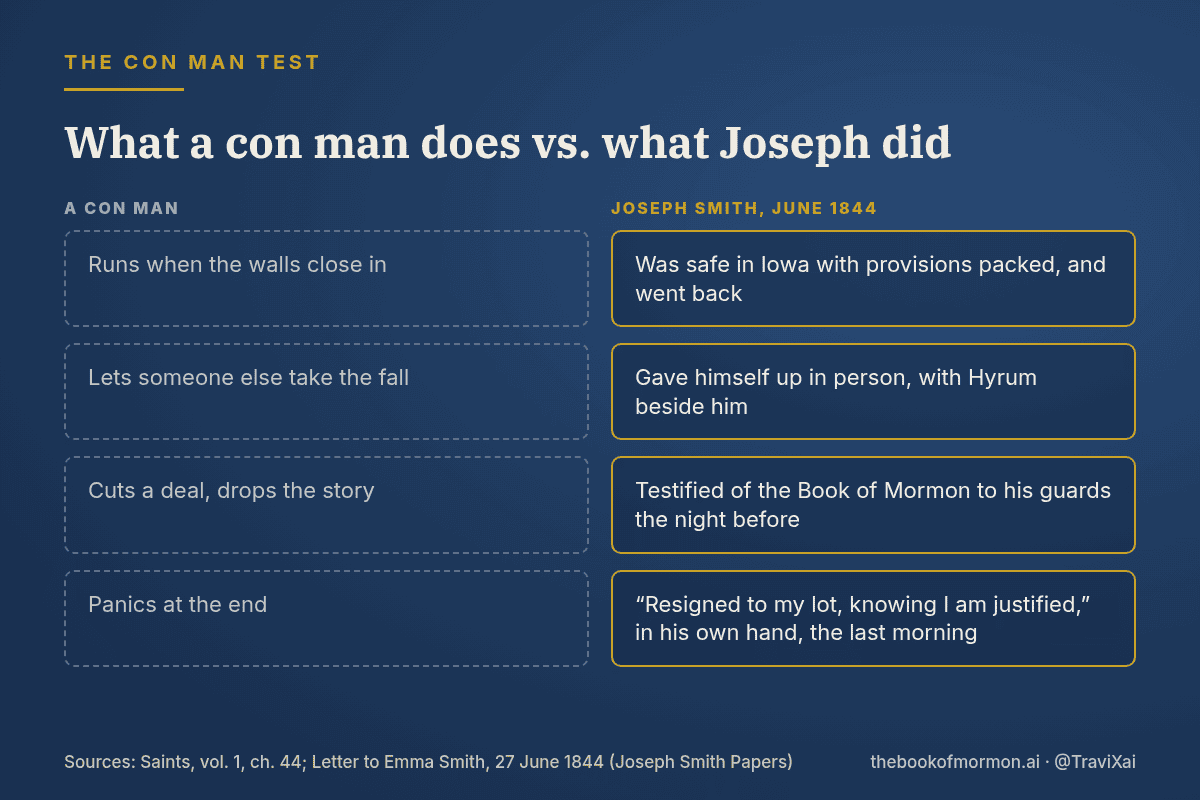
A man running a scam doesn’t go back to a mob he expects to kill him. Joseph was safe, and he left safety.
“Like a lamb to the slaughter”
Early on June 24, Joseph kissed his children goodbye and rode for Carthage. Doctrine and Covenants 135, the martyrdom announcement first printed in the 1844 edition, records what he said:
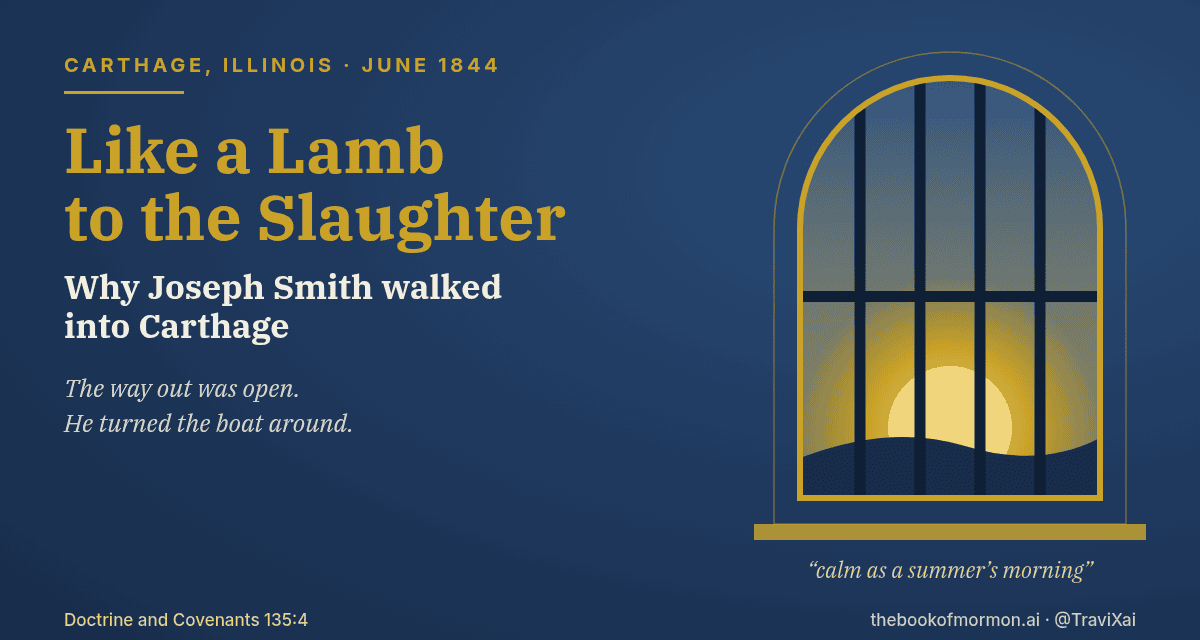
“I am going like a lamb to the slaughter; but I am calm as a summer’s morning; I have a conscience void of offense towards God, and towards all men. I shall die innocent, and it shall yet be said of me—he was murdered in cold blood.”
Doctrine and Covenants 135:4
Bible readers hear the echoes. Isaiah: “he is brought as a lamb to the slaughter, and as a sheep before her shearers is dumb, so he openeth not his mouth” (Isaiah 53:7). Jeremiah: “But I was like a lamb or an ox that is brought to the slaughter” (Jeremiah 11:19). Paul, on trial before Felix: “And herein do I exercise myself, to have always a conscience void of offence toward God, and toward men” (Acts 24:16).
Those aren’t the words of a man working an angle. They’re the words of a man who recognized the road the prophets walked.
The same morning, D&C 135 says, Hyrum read a passage near the end of Ether 12 in the Book of Mormon and turned down the page on it. It’s Moroni’s farewell: “thou hast been faithful; wherefore thy garments shall be made clean” (Ether 12:37). Hyrum folded the corner of a page in the book critics say his brother invented, on the morning he rode out to die for it.
Carthage Jail
They reached Carthage a little before midnight on June 24, to jeers from the militia on the square. The next morning Joseph and Hyrum surrendered to a constable and were released to await trial on the riot charge. Then two of William Law’s associates filed a new complaint: treason against Illinois, for declaring martial law. Treason was a capital charge, so no bail. The brothers went to the county jail.
On the evening of June 26, in an upstairs room of the jail, Hyrum read aloud from the Book of Mormon, and Joseph bore witness to the guards that it was true, that the gospel of Jesus Christ had been restored, and that angels still ministered to people.
Hyrum isn’t a side character here. His name is on the Testimony of Eight Witnesses printed in every copy of the Book of Mormon: “we have seen and hefted, and know of a surety that the said Smith has got the plates.” Fifteen years later he was reading from that book in a jail cell. (More on the witnesses: The Three and Eight Witnesses on Galatians18.)
If the plates were a prop, Hyrum knew it. If the book was a fraud, Joseph knew it. Either man could have ended the whole thing with one sentence. Neither did.
June 27, 1844
On the morning of the 27th, Joseph sent Emma a letter in Willard Richards’ handwriting, then added a postscript in his own:
“I am very much resigned to my lot knowing I am justified and have done the best that could be done give my love to the children and all my Friends … and as for treason I know that I have not commited any and they cannot prove one apearance of any thing of the kind.”
Joseph Smith to Emma Smith, June 27, 1844 (Joseph Smith Papers)
Governor Ford went to Nauvoo that day, leaving the prisoners under a small guard of Carthage Greys, the unit that had jeered them on the square. That afternoon only Willard Richards and John Taylor were still in the room with Joseph and Hyrum. Taylor sang “A Poor Wayfaring Man of Grief,” a hymn about a stranger who turns out to be the Savior. Hyrum asked him to sing it again.
At about five o’clock, a mob with painted faces rushed the jail. D&C 135:1 puts it at “from 150 to 200 persons.” Hyrum was shot first, through the door, and fell saying, “I am a dead man!” Joseph fired a pistol that visitors had smuggled in that day, then went for the window and was shot there, crying, “O Lord my God!” John Taylor was hit by four balls and survived. Willard Richards escaped, as D&C 135:2 says, “without even a hole in his robe.” Joseph was 38. Hyrum was 44.
You might think: “He had a gun, so he’s no martyr.”
But a man murdered in a jail by a mob is murdered whether or not he tried to defend his brother. Peter carried a sword (John 18:10), and nobody demotes Peter. Galatians18 answers that one directly in The Martyrdom of Joseph Smith.
Why this matters for the “con man” charge
The con man theory needs Joseph to know the plates and the angel were invented. Fine. Then put that man in Iowa on June 23, 1844, with the West in front of him.
A con man’s whole skill is protecting himself. Joseph said “we shall be butchered” and went back anyway, with the brother who had signed his name as a witness to the plates. In the jail, with a treason charge and a mob outside, he spent his last evenings testifying of the Book of Mormon, not bargaining it away. He never recanted it. Neither did Hyrum.
People die for mistaken beliefs, sure. But Joseph wasn’t a follower who’d been told something. He was the source. If it was a lie, he was the one man on earth who knew for certain, and he walked toward a mob instead of saying so. That’s the part the fraud theory can’t carry.
And he saw it coming: “we shall be butchered” was said before it happened. For more of what he said would happen and did, see Joseph’s Prophecies That Came True on Galatians18, and our post on JS-H 1:33, the prophecy that his name would be “had for good and evil” among all nations.
The testament is in force
Right after Moroni’s farewell, D&C 135:5 adds: “The testators are now dead, and their testament is in force.” That echoes Hebrews: “For where a testament is, there must also of necessity be the death of the testator” (Hebrews 9:16).
A will is settled when the man who wrote it dies without changing it. Joseph and Hyrum had every chance to change theirs. They had a way west. They took the boat back.
“Greater love hath no man than this, that a man lay down his life for his friends” (John 15:13). Joseph’s version, on a riverbank in Iowa: “If my life is of no value to my friends it is of none to myself.”
Sources
- Doctrine and Covenants 135 (the martyrdom announcement; the “lamb to the slaughter” statement; Hyrum and Ether 12; times, numbers, ages): churchofjesuschrist.org
- Saints, vol. 1, ch. 44, “A Lamb to the Slaughter” (the river crossing, the return, the jail, June 27): churchofjesuschrist.org
- Church History Topics, “Nauvoo Expositor” (the paper, the council’s reasons, the legal question, the riot charge): churchofjesuschrist.org
- History of the Church, vol. 6, ch. 29, pp. 548–550 (June 23, 1844: “If my life is of no value to my friends it is of none to myself”; “we shall be butchered”): byustudies.byu.edu
- Joseph Smith Papers, “Letter to Emma Smith, 26–27 June 1844” (Joseph’s postscript in his own hand): josephsmithpapers.org
- Joseph Smith Papers, “Introduction to Documents, Volume 15: 16 May–28 June 1844”: josephsmithpapers.org
- The Testimony of Eight Witnesses: churchofjesuschrist.org
- Ether 12: churchofjesuschrist.org
- KJV: Isaiah 53, Jeremiah 11, Acts 24, John 15, John 18, Hebrews 9
- Further reading: Dallin H. Oaks, “The Suppression of the Nauvoo Expositor,” Utah Law Review 9, no. 4 (Winter 1965): 862–903; Dallin H. Oaks and Marvin S. Hill, Carthage Conspiracy (University of Illinois Press, 1979). Both are cited in the Church History Topics article above.
- Video: Scripture Central, “Why was Joseph Smith Murdered? (Knowhy #624)”: youtube.com
When someone tells you Joseph Smith was just a con man, Galatians18 has short, sourced answers to the arguments critics use most.
Follow me on X for more: @TraviXai. And if a critic says Joseph ran, ask them which direction the boat was going on June 23.