
Ask a critic for Joseph Smith’s failed prophecies and you’ll get a list. Ask for the fulfilled ones and you’ll often get a shrug and “lucky guess.” So let’s do it the hard way: the Bible’s own test, the earliest record we have, and a straight answer on which claims are rock solid and which lean on memory.
This is a 2026 update of our earlier post, The Most Convincing Fulfilled Prophecies of Joseph Smith (June 1, 2026). This edition adds the Stephen A. Douglas prophecy, the Rocky Mountains, and the Book of Mormon going to the nations, and it grades every item by how early its record is.
The test: did it come to pass, and when was it written down?
Moses gave Israel a simple check:
When a prophet speaketh in the name of the Lord, if the thing follow not, nor come to pass, that is the thing which the Lord hath not spoken, but the prophet hath spoken it presumptuously: thou shalt not be afraid of him.
Deuteronomy 18:22
Jeremiah adds the other side: “when the word of the prophet shall come to pass, then shall the prophet be known, that the Lord hath truly sent him” (Jeremiah 28:9).
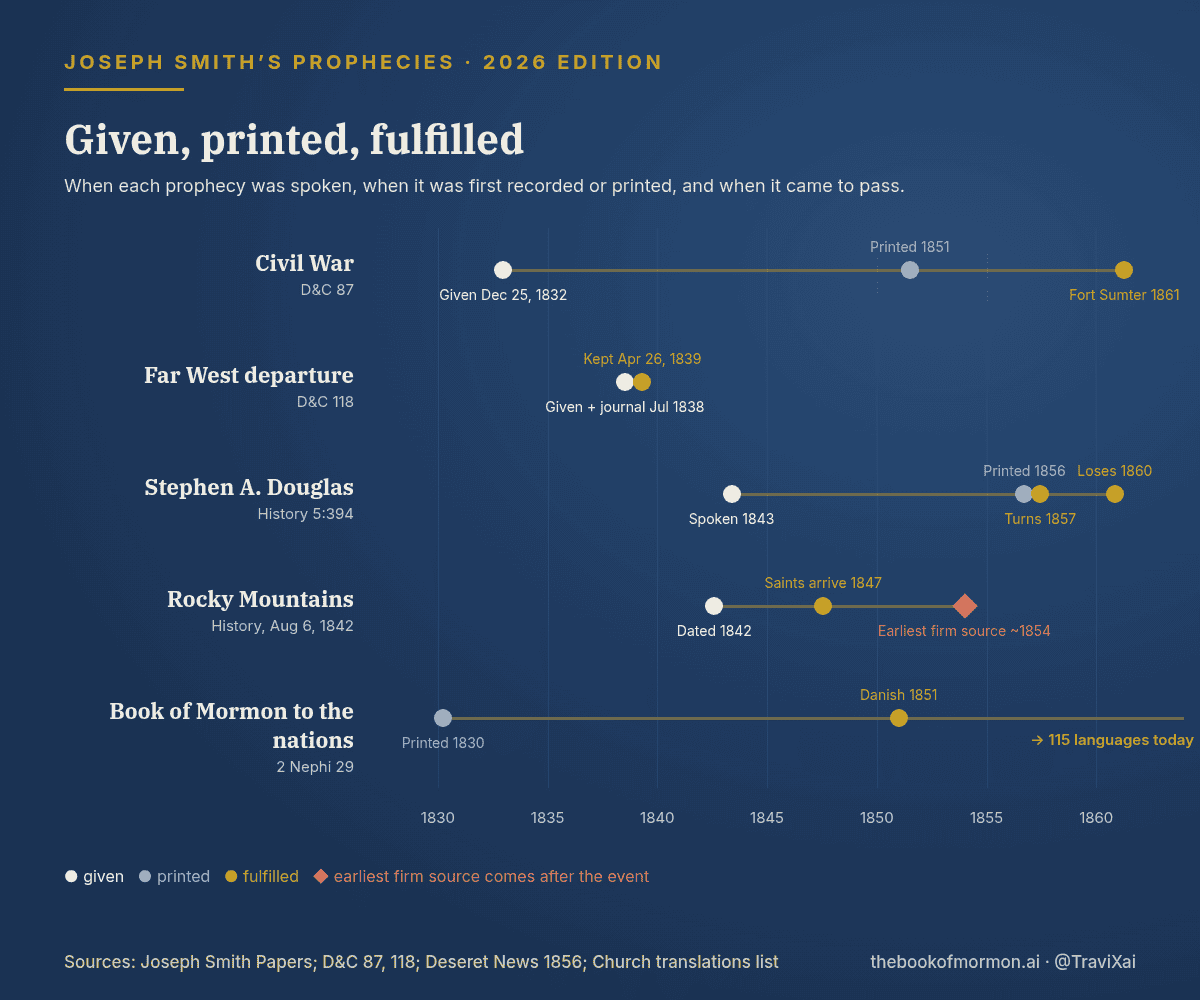
There’s a second question the Bible doesn’t have to ask about itself but historians always ask about Joseph: when was the prophecy written down, and when was it published? A prediction first recorded after the event proves nothing. A prediction in print a decade early is a different animal. So every item below gets three dates: spoken, recorded or printed, fulfilled.
1. The Civil War, from a Christmas Day revelation (D&C 87)
On December 25, 1832, near Kirtland, Ohio, Joseph dictated this:
Verily, thus saith the Lord concerning the wars that will shortly come to pass, beginning at the rebellion of South Carolina, which will eventually terminate in the death and misery of many souls; And the time will come that war will be poured out upon all nations, beginning at this place. For behold, the Southern States shall be divided against the Northern States, and the Southern States will call on other nations, even the nation of Great Britain, as it is called…
Doctrine and Covenants 87:1–3
Verse 4 adds that “slaves shall rise up against their masters, who shall be marshaled and disciplined for war.”
The record. The Joseph Smith Papers report that Frederick G. Williams copied it into Revelation Book 2 between late January and late February 1833, and John Whitmer made another copy in Revelation Book 1. Franklin D. Richards printed it in Liverpool in 1851 in the first Pearl of Great Price. That’s ten years before Fort Sumter.
The fulfillment. The war began April 12, 1861, when Confederate guns fired on Fort Sumter in Charleston Harbor, South Carolina. South against North. The Confederacy sent envoys to court Great Britain. And by the war’s end, roughly 179,000 Black men had served in the Union Army, per the National Archives. Marshaled and disciplined for war.
A Philadelphia paper noticed before Latter-day Saints had to point it out. On May 5, 1861, the Sunday Mercury printed the prophecy from that 1851 pamphlet and wrote, “In view of our present troubles, this prediction seems to be in progress of fulfilment, whether Joe Smith was a humbug or not.” It ended: “Have we not had a prophet among us?”
The fair objection. South Carolina was already in the news. It had passed its nullification ordinance in November 1832, and President Jackson answered with a proclamation in December. So wasn’t this obvious? Only if you stop reading in 1832. The crisis ended in 1833 with a compromise tariff. No war came. Anyone guessing from the headlines would have looked wrong within months. Joseph didn’t retract it. On April 2, 1843, with no crisis on the front page, he said it again:
I prophesy, in the name of the Lord God, that the commencement of the difficulties which will cause much bloodshed previous to the coming of the Son of Man will be in South Carolina. It may probably arise through the slave question.
Doctrine and Covenants 130:12–13
One honest note: verses 2–3 and 6 reach past 1861 to war “poured out upon all nations.” Latter-day Saints read that as a process that began in South Carolina, not a single event, so the American part is what you can check against a calendar. That part checks out.
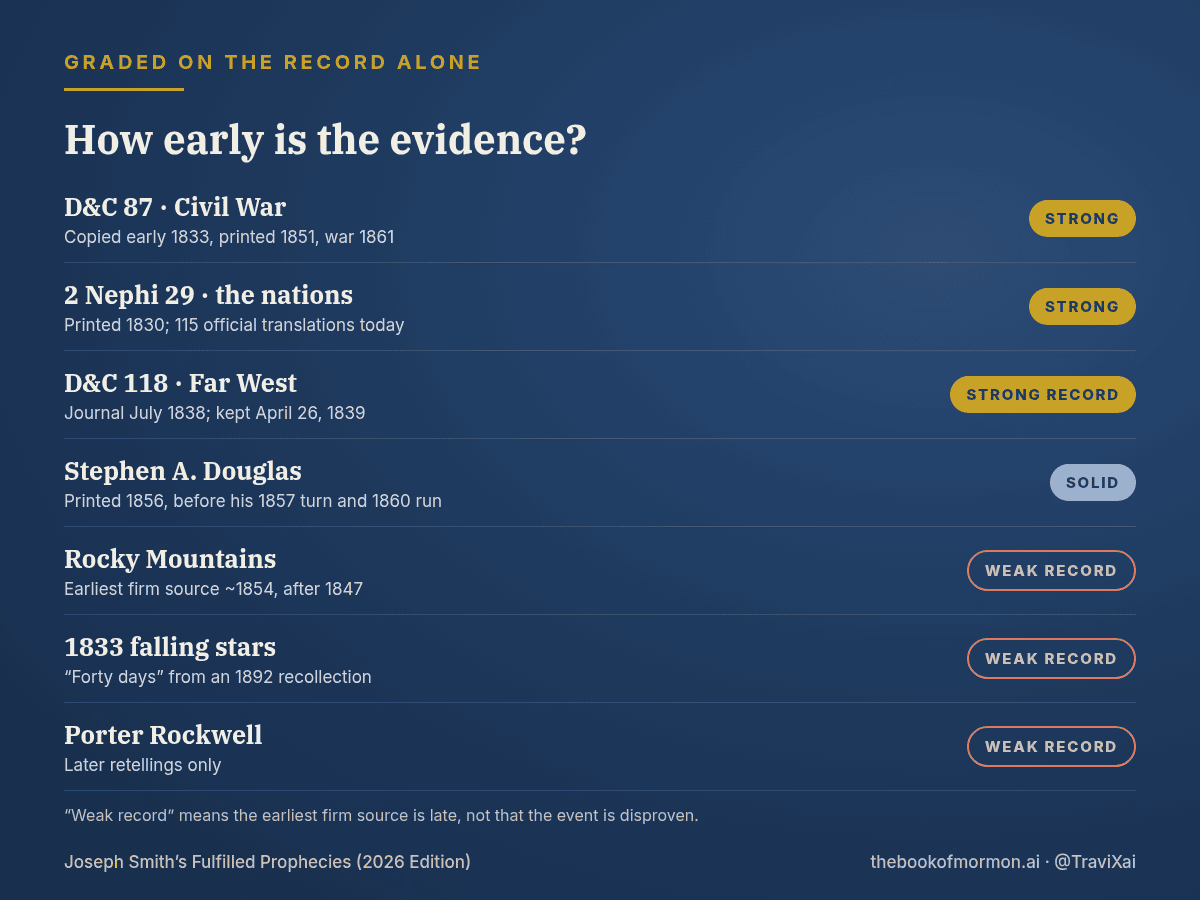
Grade: strong. Contemporary manuscript, printed a decade early, named state, named sides, named foreign power.
2. The Twelve leave from Far West on a set date (D&C 118)
On July 8, 1838, a revelation told the Twelve Apostles to “take leave of my saints in the city of Far West, on the twenty-sixth day of April next, on the building-spot of my house” (D&C 118:5). It was copied into Joseph’s journal that day.
Then everything fell apart. By early 1839 the Saints had been driven out of Missouri, Joseph had spent the winter in Liberty Jail, and returning to Far West was dangerous. On April 26, 1839, Brigham Young, Wilford Woodruff, and other apostles rode back in, held the meeting at the temple site, and left. Woodruff recorded it in his journal.
A critic will say the apostles fulfilled it themselves. True, and that’s the point of a commandment. What it shows is a specific date and place, set ten months ahead, honored at real risk. Grade: strong record, modest as prediction.
3. Stephen A. Douglas and the presidency (1843)
On May 18, 1843, Joseph dined in Carthage, Illinois, with Judge Stephen A. Douglas. The account in Joseph’s history ends with this:
Judge, you will aspire to the presidency of the United States; and if ever you turn your hand against me or the Latter-day Saints, you will feel the weight of the hand of Almighty upon you; and you will live to see and know that I have testified the truth to you; for the conversation of this day will stick to you through life.
History of the Church 5:394
The record. This one has a weakness, and you should hear it from me first. The history credits William Clayton’s journal, but the published portions of Clayton’s diary for that day don’t contain the prophecy, only the line that Douglas “appears very friendly.” What we can prove is the print date: the account ran in the Deseret News on September 24, 1856, then in the Millennial Star in 1859.
The fulfillment. On June 12, 1857, less than nine months after that printing, Douglas gave a speech in Springfield calling on Congress to “apply the knife and cut out this loathsome, disgusting ulcer,” meaning Utah. In 1860 he finally won the presidential nomination of the northern Democrats and lost badly, carrying only Missouri and part of New Jersey in the Electoral College. He died on June 3, 1861, at 48.
Grade: solid. The original wording is uncertain, but the prophecy was public before Douglas turned and before he ran.
4. “A mighty people in the midst of the Rocky Mountains” (1842)
This is the most famous one, and the one I’d use most carefully. Joseph’s history, under August 6, 1842, reads: “I prophecied that the Saints would continue to suffer much affliction and would be driven to the Rocky Mountains… and some of you will live to go, and assist in making settlements and build cities and see the Saints become a mighty people in the midst of the Rocky Mountains.”
The record. The Joseph Smith Papers transcript of volume D-1 shows that passage as an insertion in Thomas Bullock’s hand, and it lists the source as Anson Call’s statement from about 1854. Bullock began that volume in July 1845, and nobody can say exactly when the line went in. Either way, the earliest firm source is after the Saints reached the Salt Lake Valley in 1847. As proof of foreknowledge, that’s weak, and I won’t oversell it.
What is contemporary: on February 20, 1844, Joseph’s journal records (spelling original), “I instructed the 12 to send out a delegation— & investigate the Locations of Californnia & oregon & find a good Location where we can remove after the Temple is completed.” So Joseph was clearly looking west before his death. Grade: weak as a prediction, real as a direction.
5. The Book of Mormon goes to the nations
In 1830, a 24-year-old farmer with a handful of believers had 5,000 copies of a book printed in Palmyra, New York. Inside it, the Lord says:
my words shall hiss forth unto the ends of the earth, for a standard unto my people, which are of the house of Israel; And because my words shall hiss forth—many of the Gentiles shall say: A Bible! A Bible! We have got a Bible, and there cannot be any more Bible.
2 Nephi 29:2–3
Both halves came true. The “A Bible! A Bible!” reply is the first thing many people say about the Book of Mormon. And the “ends of the earth” part: the Church’s own translations list shows 115 official translations and 21 more in selections, starting with Danish in 1851, and it says 192 million copies have been printed.
In 1842 Joseph said the same thing in the Times and Seasons: “no unhallowed hand can stop the work from progressing… till it has penetrated every continent, visited every clime, swept every country, and sounded in every ear.” That’s a bold claim from a people driven out of Missouri three years earlier.
Daniel gives the frame Latter-day Saints have always used. He saw “a stone… cut out without hands” that “became a great mountain, and filled the whole earth,” and he explained it: “the God of heaven set up a kingdom, which shall never be destroyed” (Daniel 2:34–35, 44). That’s context, not a Joseph Smith prophecy, but it tells you what kind of growth to expect: small, then everywhere. (The angel’s 1823 promise that Joseph’s name would be “had for good and evil among all nations” fits here too. It gets its own article soon.)
Grade: strong. The text was in print in 1830. The fulfillment is on bookstore shelves in Danish, Tagalog, and Swahili.
What I downgraded from the June list
A 2026 edition should be more careful than the first one, so two items from June move down:
- The 1833 falling stars. Joseph’s own journal for November 13, 1833, records the meteor storm and calls it a sign. The “Forty days shall not pass” prediction comes from Philo Dibble’s recollection in the Juvenile Instructor in 1892, almost sixty years later. A sincere memory, maybe, but not a record you can lean on.
- Porter Rockwell’s protection. A great story, but I couldn’t find it in a record made at the time. It comes down through later retellings.
Neither one is disproven. They just don’t belong in the same bucket as D&C 87.
So where does that leave a skeptic?
With a choice. Throw out every prophecy with a late source, and you still have a Christmas Day revelation copied in early 1833, printed in 1851, naming South Carolina, the North-South split, Britain, and armed former slaves, and a newspaper in 1861 asking whether America had had a prophet in it. You still have a book whose own pages predicted both its global spread and the “We have got a Bible” reply.
Deuteronomy 18:22 asks one question. For these, the answer is yes. (If you want the hardest one, the prophecy Joseph made about walking into Carthage, that’s coming in its own post.)
Sources
- Doctrine and Covenants 87: churchofjesuschrist.org
- Doctrine and Covenants 130:12–13: churchofjesuschrist.org
- Doctrine and Covenants 118: churchofjesuschrist.org
- 2 Nephi 29: churchofjesuschrist.org
- Deuteronomy 18 (KJV): churchofjesuschrist.org; Jeremiah 28: churchofjesuschrist.org; Daniel 2: churchofjesuschrist.org
- Joseph Smith Papers, “Revelation, 25 December 1832 [D&C 87],” historical introduction: josephsmithpapers.org
- Scott C. Esplin, “‘Have We Not Had a Prophet Among Us?’: Joseph Smith’s Civil War Prophecy,” in Civil War Saints, ed. Kenneth L. Alford (Religious Studies Center and Deseret Book, 2012), 41–59, quoting the Philadelphia Sunday Mercury, May 5, 1861: rsc.byu.edu
- National Archives, “Black Soldiers in the U.S. Military During the Civil War”: archives.gov
- Joseph Smith Papers, “Revelation, 8 July 1838–A [D&C 118],” historical introduction: josephsmithpapers.org
- “Appendix 1: Comparison of William Clayton’s Diary and History of the Church,” in James B. Allen, No Toil Nor Labor Fear: The Story of William Clayton (BYU Studies): byustudies.byu.edu
- Kenneth L. Alford and William P. MacKinnon, “What’s in a Name? The Establishment of Camp Douglas,” in Civil War Saints (quoting Douglas’s June 12, 1857 speech): rsc.byu.edu
- Joseph Smith Papers, History, 1838–1856, volume D-1, p. 1362 (6 August 1842 entry and source note): josephsmithpapers.org
- Joseph Smith Papers, Journal, 20 February 1844: josephsmithpapers.org
- Joseph Smith Papers, “Church History,” Times and Seasons, 1 March 1842: josephsmithpapers.org
- Joseph Smith Papers, Journal, 1832–1834, 13 November 1833: josephsmithpapers.org
- Book of Mormon translations list: churchofjesuschrist.org; copies printed: churchofjesuschrist.org
Want these in a quick, shareable format? The Galatians18 topic page on Joseph’s fulfilled prophecies has them ready for your next conversation.
Follow me on X for more: @TraviXai. And if a critic hands you a “failed prophecy” list, send it my way. I’ll grade those by the same test.