
When Peter tried to blend into the crowd at the high priest’s palace, it didn’t work. “Surely thou also art one of them; for thy speech bewrayeth thee” (Matthew 26:73, KJV). People give themselves away by how they talk, and mostly through the small habits they never think about. In the 1980s a group of scientists in Berkeley, California, set out to measure that kind of habit in the Book of Mormon. They wanted to know whether the habits matched Joseph Smith or someone else.
In this series: Book of Mormon Evidence (10 parts)
- Part 1: 149 Voices
- Part 2: The Berkeley Wordprint Test (you are here)
- Part 3: The “Someone Else” Problem (coming soon)
- Part 4: The Wordprint Track Record (coming soon)
- Part 5: One Draft (coming soon)
- Part 6: Older Than King James (coming soon)
- Part 7: Alma 36, Built as a Mirror (coming soon)
- Part 8: Nahom (coming soon)
- Part 9: Could the Plates Work? (coming soon)
- Part 10: The Witnesses Who Never Recanted (coming soon)
This started as a post on X, Part 2 of my 10-part Book of Mormon Evidence series. This is the longer version, with the method, the controls, and the fine print. If you missed it, start with Part 1: 149 Voices.
What a wordprint is
A wordprint is the statistical fingerprint in a writer’s use of “noncontextual” words. John L. Hilton, the statistician who wrote up the Berkeley study, describes them as words “like the, and, a, of, etc.” that “are often capable of being interchanged or even dropped without a loss of overall meaning.” Readers skim past them and writers don’t plan them. Hilton says they “typically make up 20 to 45% of the total text,” which gives a statistician a lot to count.
The field had a famous early win. In 1964 the statisticians Frederick Mosteller and David L. Wallace used rates of these small words to settle the disputed Federalist Papers, showing that James Madison wrote the anonymous essays and that the other two candidates were “overwhelmingly excluded.”
Then the Book of Mormon got its turn. In 1980 Wayne A. Larsen, Alvin C. Rencher, and Tim Layton published “Who Wrote the Book of Mormon? An Analysis of Wordprints” in BYU Studies. Hilton credits them with coining the word wordprint. They concluded that the book was written in “distinct authorship styles” and that none of the nineteenth-century candidates they tested “resemble Book of Mormon authors in style” (as summarized in Scripture Central’s KnoWhy #389). A big claim from a BYU team raises an obvious question: can anyone else reproduce it?
A skeptical team in Berkeley
Hilton, the grandfather of the John Hilton III from Part 1, joined a small group of scientists in northern California who wanted to check exactly that. He writes that the “Berkeley Group” had “major contributors from different scientific disciplines and differing religious persuasions.” They began in the fall of 1980.
Hilton was the main Latter-day Saint contributor, and he didn’t come in as a cheerleader:
“As the major LDS contributor in the group, I was little different from my agnostic and Jewish colleagues: each of us seriously questioned whether objective measurement could determine who did or did not write a controversial document like the Book of Mormon.”
John L. Hilton, BYU Studies 30:3 (1990)
“Therefore, armed with a healthy skepticism,” the group set out to recalculate the earlier results and fix any flaws. Most of them doubted that stable wordprints could be measured at all, so instead of reusing Larsen, Rencher, and Layton’s assumptions, they wrote “a completely new set of computer codes.” They thought it would take a year. It wasn’t until September 1987, “after perhaps 10,000 hours of work,” that the paper was done.
They also listened to the critics. D. James Croft, a University of Utah statistician and a believer, had warned in 1981 that “it would be best to reserve judgment” on whether multiple authorship could be proved. The Berkeley group kept in close contact with him and built the new method around his objections.
A tougher method
Hilton lists six changes from earlier Book of Mormon wordprint work. In plain English:
- They used 65 word-pattern ratios recommended by the Scottish stylometrist A. Q. Morton instead of simple word rates.
- They dropped the usual assumption that word counts follow a normal bell curve and used a nonparametric test (Mann-Whitney) that doesn’t need it.
- They compared just two texts at a time, in blocks of about 5,000 words.
- They worked from the earliest available manuscripts, and they cut out the repetitive phrase “and it came to pass” and significant quotations from the King James Bible, since either would skew the counts.
- They checked the whole method against texts whose authors nobody disputes before they measured the Book of Mormon.
The method gives a score called rejections. That’s the number of word patterns on which two texts differ in a statistically significant way. More rejections means the two texts were less likely to come from the same writer.
The controls: Twain, Heinlein, and a translator
This is my favorite part, because it’s where they tried to break their own method. Hilton reports “325 diverse wordprint tests” on “26 noncontroversial 5000-word texts” by “nine different control authors.” The controls included Mark Twain, Samuel Johnson, Robert Heinlein, Oliver Cowdery, and Joseph Smith himself, in essays, narratives, letters, and fiction.
Texts by the same author peaked at about 2 rejections. Texts by different authors peaked at about 7. Hilton’s rule of thumb: when a disputed 5,000-word text “measures 7 or more rejections, the two texts are very likely not written by the same author.” Between 1 and 6, the two distributions overlap, and the test can’t settle it either way.
Two of the controls go right at the usual objections.
“A good writer can fake different voices.” The group tested Heinlein’s The Number of the Beast, in chapters where he writes in first person as two different characters, and Twain’s paired “Extracts from Adam’s Diary” and “Eve’s Diary.” Hilton describes the Adam piece as “a spoofing translation, likely a satire on the Book of Mormon.” His finding was that “most highly skilled authors (e.g. Twain, Johnson, Heinlein, etc.), when intentionally trying to imitate the writings of different persons, are unable to successfully change their own free-flow noncontextual word patterns enough to simulate a different wordprint.” In other words, a great novelist can make his characters sound different to you, but not to the word counts.
“It’s a translation, so you’d only measure Joseph.” The group tested German authors, Heinrich von Kleist and Christoph M. Wieland, as translated into English by one academic translator, Harry Steinhauer. They also tested his own English writing. Each translated author stayed consistent with himself, each was “clearly separable from the others,” and the translator’s own English differed from all of them. They later added three more German novella authors from the same translator and got the same result. Hilton’s conclusion: in a close translation, “the uniqueness of an original author’s wordprint can actually survive the translation process.”
That matters for a book that calls itself a translation. Moroni says the record was written “in the characters which are called among us the reformed Egyptian” (Mormon 9:32), and Joseph Smith rendered it in English. If the translator’s voice wiped out every original author, you’d expect one wordprint across the whole book. That’s not what they found.
Then the Book of Mormon
To keep it conservative, the group compared the two Book of Mormon writers with the most material in the same genre: Nephi and Alma, using three 5,000-word blocks of each man’s teaching passages. They then compared both against texts by Joseph Smith (his own letters and his dictated history), Oliver Cowdery (signed articles from the Messenger and Advocate), and Solomon Spaulding (his “Manuscript Story”).
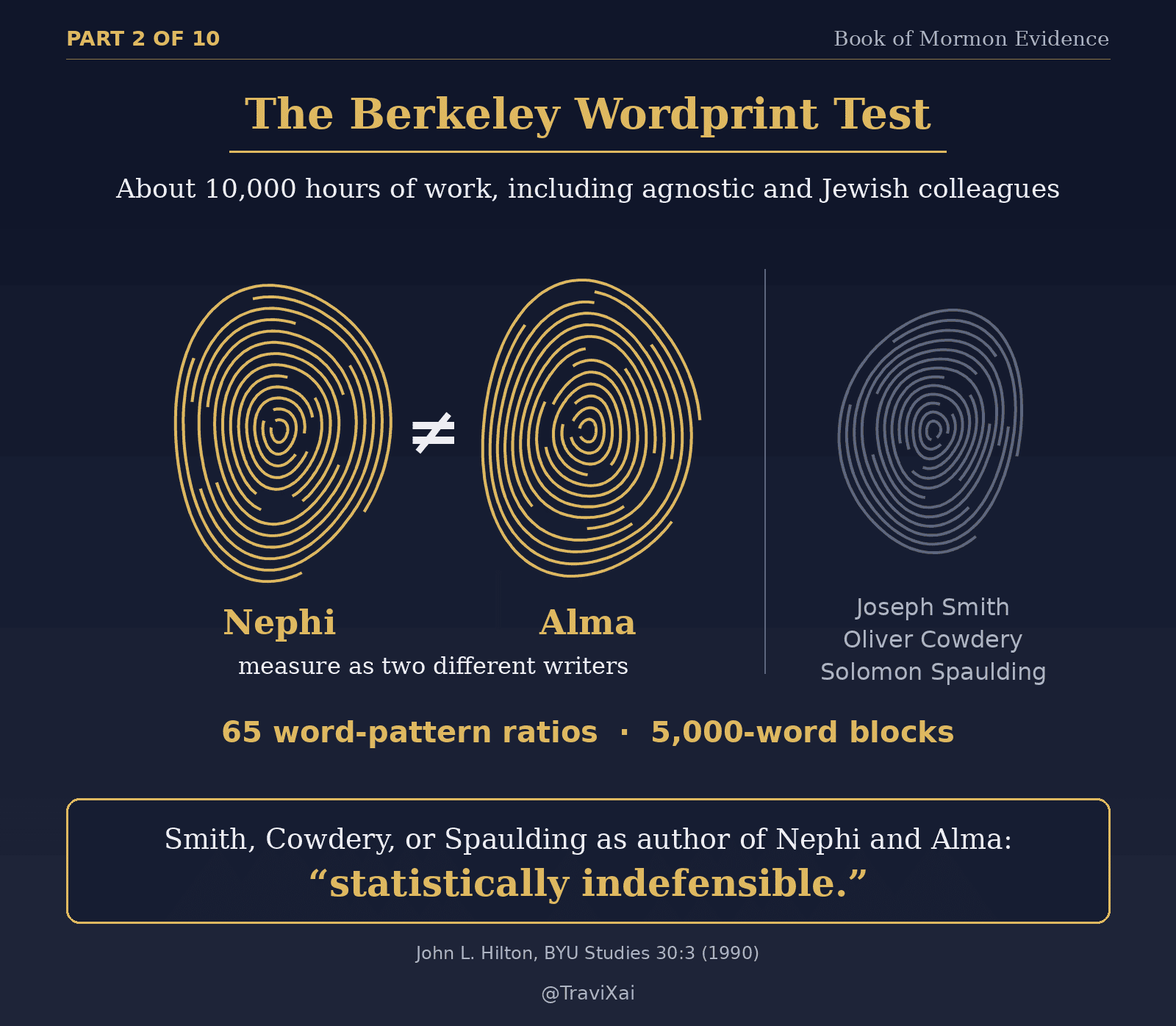
Nephi against Nephi and Alma against Alma behaved like the same-author controls, with 1 to 5 rejections. Nephi against Alma looked like two different people. In eight of nine tests the count was 5 or more, and four tests hit 7, 8, 9, and 10. Hilton puts those four at greater than 99.5%, 99.9%, 99.99%, and 99.997% confidence that Nephi’s texts “were written by a different author than wrote Alma.”
Here’s every test from Hilton’s table 1:
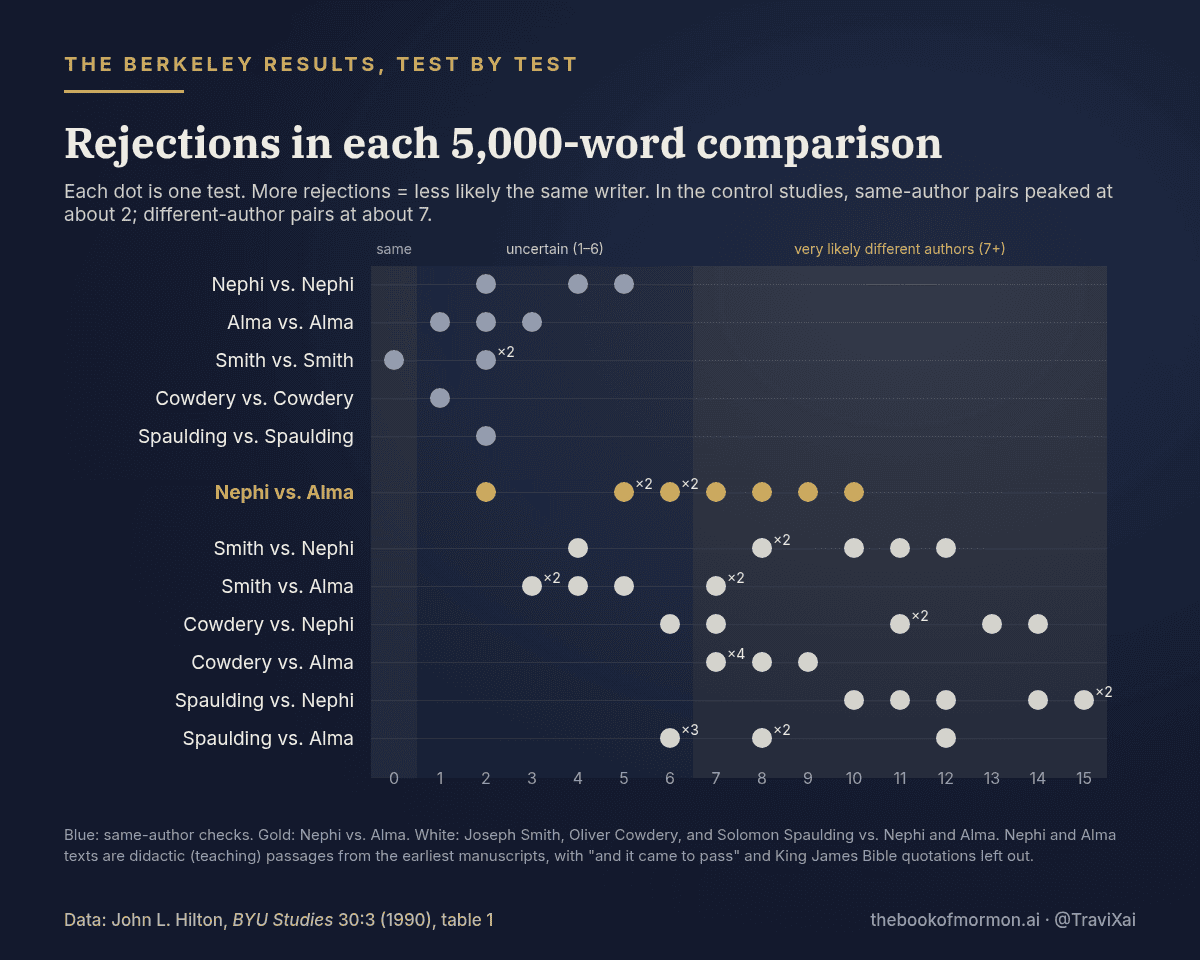
To be fair, not every pairing is a blowout. Joseph Smith against Alma is the closest: 3, 3, 4, 5, 7, 7. Even so, every one of those tests came in at or above the highest Alma-against-Alma score (3), and two crossed the 7 line. Joseph against Nephi ran 4 to 12, and Spaulding against Nephi ran 10 to 15. Spaulding is the old favorite of the “someone else wrote it” theory, and he isn’t close.
Hilton’s conclusion:
“It is statistically indefensible to propose Joseph Smith or Oliver Cowdery or Solomon Spaulding as the author of the 30,000 words from the Book of Mormon manuscript texts attributed to Nephi and Alma.”
Nephi and Alma “have wordprints unique to themselves and measure statistically independent from each other in the same fashion that other uncontested authors do.” His summary: “the Book of Mormon measures multiauthored, with authorship consistent to its own internal claims.”
That’s what the book says about itself. Its title page calls it “an abridgment of the record of the people of Nephi,” and Mormon says he’s working from records “delivered into my hands” (Words of Mormon 1:3).
What it does and doesn’t prove
Hilton was clear about the limits, and so am I. Wordprinting, he wrote, “cannot prove the holiness of the Book of Mormon. The understanding that the Book of Mormon has a divine origin is obtainable only by developing faith.” But “while valid and objective wordprinting is no substitute for faith, wordprinting can, nevertheless, bolster the establishment of faith by rigorously demonstrating factual information about the book.”
That’s the right order. The book’s own test is Moroni 10:4: “ask God, the Eternal Father, in the name of Christ, if these things are not true.” What the Berkeley study does is take one popular answer off the table: the idea that the book is one 1820s writer’s voice wearing different costumes. Scripture Central’s KnoWhy #389 calls it “a landmark study on Book of Mormon authorship,” and notes that Utah State University researchers “essentially reproduced” its results in 2006 using a different method.
For the rest of the evidence in one place, see The Best Book of Mormon Evidences, in One Place.
Watch: stylometry and Book of Mormon authorship
In this Scripture Central Courses video, statistician Paul Fields explains how stylometry works and what it shows about who did, and didn’t, write the Book of Mormon.
Next: The “Someone Else” Problem
In 2008 a team published a stylometry study claiming the Book of Mormon’s style best matched Sidney Rigdon and Solomon Spaulding. What happens when a method can only choose from the names it was handed? That’s Part 3: The “Someone Else” Problem, coming tomorrow.
Credit where it’s due
Thanks to:
- John L. Hilton, the BYU statistician who wrote up the study, and the Berkeley Group, including Kenneth D. Jenkins, whom Hilton credits with “seven years of critical work,” and the agnostic and Jewish colleagues who were willing to test the question.
- Wayne A. Larsen, Alvin C. Rencher, and Tim Layton for the 1980 study that started it, and D. James Croft for the critique that made the follow-up better.
- BYU Studies for keeping the article free online, and Scripture Central for KnoWhy #389 and the video above.
For more like this, follow me on X at @TraviXai. And if someone answers all this with Galatians 1:8, the Galatians 1:8 app is ready for that conversation.
Sources
- John L. Hilton, “On Verifying Wordprint Studies: Book of Mormon Authorship,” BYU Studies 30, no. 3 (1990): 89–108 (method, controls, appendix 3, table 1, conclusions): byustudies.byu.edu (PDF)
- Wayne A. Larsen, Alvin C. Rencher, and Tim Layton, “Who Wrote the Book of Mormon? An Analysis of Wordprints,” BYU Studies 20, no. 3 (1980): 225–51: byustudies.byu.edu
- “What Can Stylometry Tell Us about Book of Mormon Authorship?” Scripture Central KnoWhy #389 (August 20, 2020): scripturecentral.org
- Scriptures: Matthew 26:73 (KJV): Matthew 26; Book of Mormon Title Page; Words of Mormon 1; Mormon 9:32; Moroni 10:4
- Previous in the series: Part 1: 149 Voices
- The original X post: x.com/TraviXai