
Picture the setting. September 1823. A 17-year-old farm boy with little schooling, no church, and no book is praying in his family’s home near Palmyra, New York. An angel appears and tells him, among other things, that the whole world is going to talk about him.
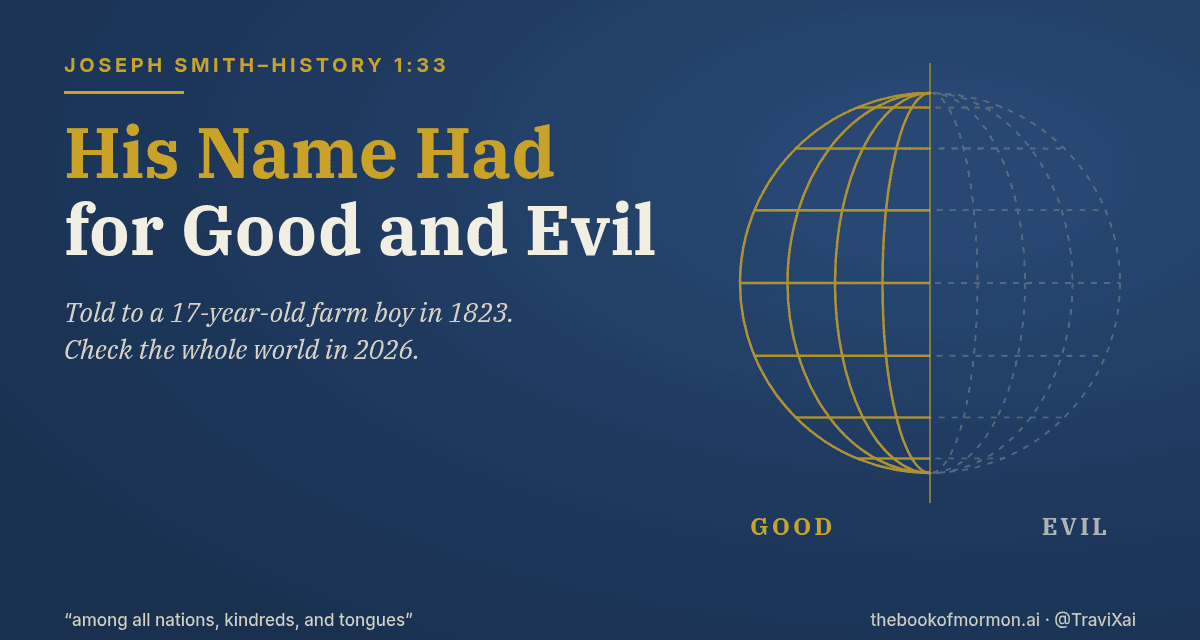
Not just his neighbors. “All nations, kindreds, and tongues.” And not just kindly. Good and evil, both.
That’s a strange thing to promise a nobody. It’s an even stranger thing for a nobody to write down and publish. Two centuries later, you can check it.
Our Joseph Smith’s Fulfilled Prophecies (2026 Edition) covers the Civil War revelation, Far West, Stephen A. Douglas, and more. This post is the deep dive on one prophecy it only mentions in passing.
The prophecy, word for word
Here is how Joseph tells it:
He called me by name, and said unto me that he was a messenger sent from the presence of God to me, and that his name was Moroni; that God had a work for me to do; and that my name should be had for good and evil among all nations, kindreds, and tongues, or that it should be both good and evil spoken of among all people.
Joseph Smith–History 1:33
Notice three things. It’s global: nations, kindreds, and tongues, which means peoples and languages. It’s lasting: nobody talks about a forgotten name. And it’s split: good and evil. An impostor writing his own press release would have kept the first half and dropped the second.
Joseph already knew what “evil spoken of” felt like. Describing the years after his First Vision, he wrote that “though I was an obscure boy, only between fourteen and fifteen years of age, and my circumstances in life such as to make a boy of no consequence in the world, yet men of high standing would take notice sufficient to excite the public mind against me” (JS-H 1:22). A boy of no consequence. That’s the starting line.
When it was written down and printed
A prophecy only counts if it’s on paper before the fulfillment. So here’s the paper trail.
- 1838–39: The account was written into Joseph’s official history, which “he and his scribes prepared in 1838–39,” according to the introduction to the Pearl of Great Price. The history itself dates its own writing to “[1838] the eighth year since the organization of the said Church” (JS-H 1:2).
- March 15, 1842: The history began running in the Times and Seasons in Nauvoo, Illinois. The Moroni chapter, with this exact promise, was on page 753 of the April 15, 1842 issue.
- 1851: Franklin D. Richards included it in the first Pearl of Great Price, printed in Liverpool. In 1880 the Church accepted the Pearl of Great Price as scripture.
One honest note, because critics will raise it. The 1842 printing names the angel “Nephi,” not Moroni. The Church’s own history topic on the Angel Moroni explains that the slip traces to a clerk, James Mulholland, whose 1839 draft the early printings copied. Joseph had already named Moroni in a revelation published in the 1835 Doctrine and Covenants, and later historians corrected the manuscript. In the Church’s words, “No evidence indicates that Joseph Smith ever called the angel ‘Nephi.'” The name of the messenger changed in one manuscript. The promise didn’t change in any.
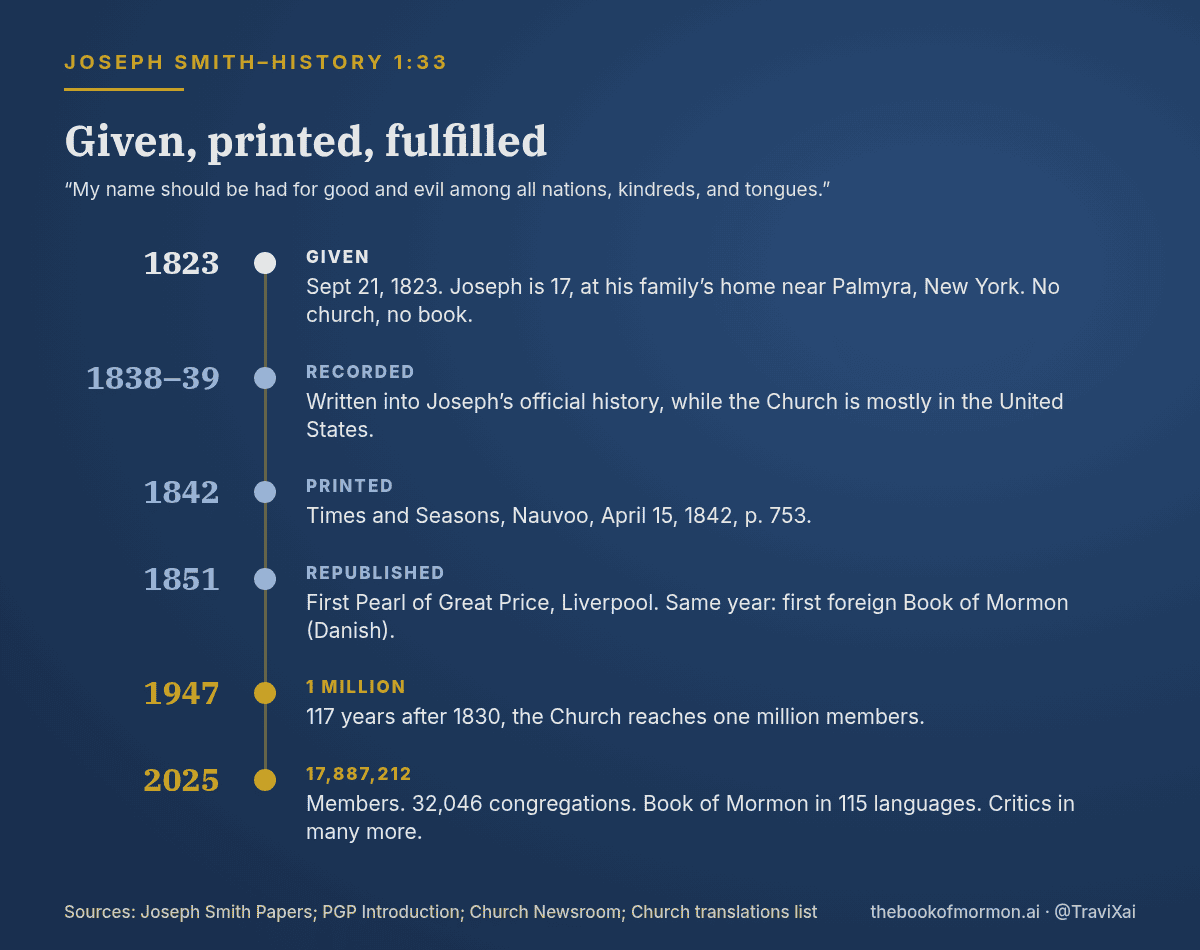
Now look at what the world looked like when it was printed. In 1842 the Book of Mormon existed in exactly one language, English. The first translation, Danish, came in 1851. The Church Newsroom notes that it took 117 years, until 1947, for the Church to grow from its first six members to one million. “All nations, kindreds, and tongues” wasn’t a description of 1842. It was a bet against it.
The good half: a name in every tongue
Here’s where things stand, using only the Church’s own published figures:
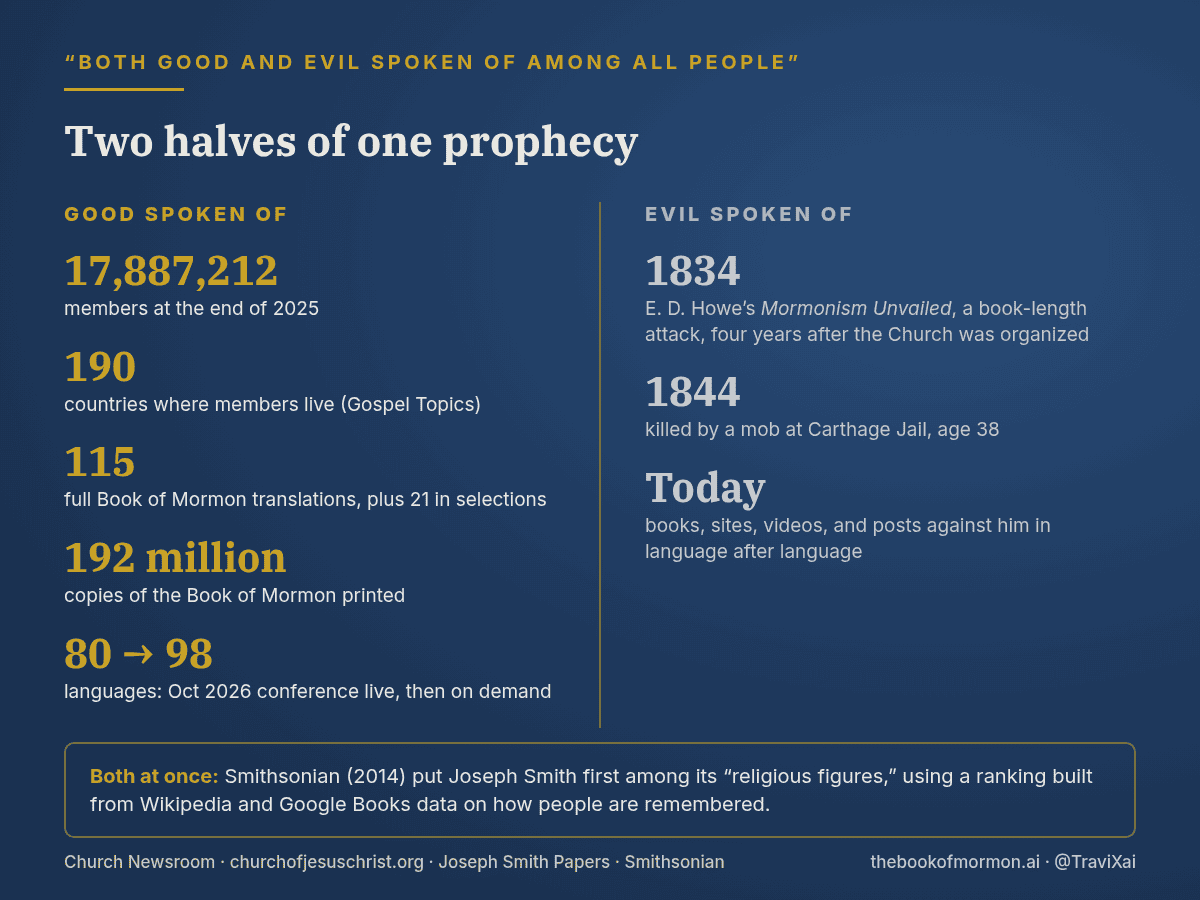
- 17,887,212 members at the end of 2025, in 32,046 congregations, with 204 temples in operation (2025 Statistical Report, April 2026).
- Members “live in 190 countries and speak over 120 languages,” according to the Church’s Gospel Topics article on diversity and unity. Members living outside the United States outnumbered those inside it in 1996.
- The Book of Mormon, the book Moroni told Joseph about in the very next verse, now has 115 official translations, plus 21 more in selections and 26 translations in progress, per the Church’s translations list. The Church says 192 million copies have been printed.
- This month’s general conference, October 3–4, 2026, was streamed live in 80 languages, with the talks available afterward in up to 98.
Every one of those copies and broadcasts carries the name of the 17-year-old. That’s “tongues” in the literal sense.
Joseph heard the same promise again in March 1839, from a jail cell in Liberty, Missouri:
The ends of the earth shall inquire after thy name, and fools shall have thee in derision, and hell shall rage against thee; While the pure in heart, and the wise, and the noble, and the virtuous, shall seek counsel, and authority, and blessings constantly from under thy hand.
Doctrine and Covenants 122:1–2
Again, both halves. Inquiry and derision. Said to a prisoner whose people had just been driven out of a state.
The evil half: the critics are part of the fulfillment
The other half came true just as fast. In 1834, four years after the Church was organized, E. D. Howe published Mormonism Unvailed, a book-length attack on Joseph and the Book of Mormon. In 1844, at 38, Joseph was killed by a mob at Carthage Jail.
And it never stopped. Today you can find books, websites, documentaries, and endless posts against Joseph Smith in language after language. Every one of them is doing what verse 33 said would be done.
That’s the part critics don’t love to hear. You can’t spend decades speaking evil of Joseph Smith in many nations and tongues without fulfilling a prophecy that said someone would. Every “Joseph Smith was a fraud” post is a fresh timestamp on JS-H 1:33.
Even an outsider who didn’t believe him saw the puzzle. Josiah Quincy, a Harvard-educated Bostonian who later served as mayor of Boston, met Joseph in Nauvoo in May 1844 and wasn’t a fan. He still wrote:
Fanatic, imposter, charlatan, he may have been; but these hard names furnish no solution to the problem he presents to us. Fanatics and impostors are living and dying every day, and their memory is buried with them; but the wonderful influence which this founder of a religion exerted and still exerts throws him into relief before us, not as a rogue to be criminated, but as a phenomenon to be explained.
Josiah Quincy, Figures of the Past (1883), pp. 376–77
Hard names and lasting influence in one paragraph. Quincy was describing JS-H 1:33 without meaning to.
Want a modern measure? In 2014 Smithsonian magazine published “The 100 Most Significant Americans of All Time,” based on a ranking by Steven Skiena and Charles B. Ward that drew on Wikipedia and data from 15 million books Google has scanned. The magazine explained that their rankings “account not only for what individuals have done, but also for how well others remember and value them for it.” Joseph Smith came first on its list of religious figures. And Wikipedia, which praises no one on purpose, carries an article on him in 94 language editions, according to Wikidata.
“Anyone could have predicted that”
Could they? Let’s take the usual objections one at a time.
“It’s vague.” It names a scope (all nations, kindreds, and tongues), a duration (long enough for the whole world to hear), and a split verdict. Most people in 1823 who claimed to see angels were forgotten in a generation. Quincy said it himself: their memory is buried with them. The prophecy bet that this one wouldn’t be.
“He made it come true by sending missionaries.” Missionaries can spread a name. They can’t make the world argue about it. The “evil spoken of” half isn’t something the Church wanted or could manufacture, and it showed up on schedule anyway.
“It was written down in 1838, after he was already controversial.” True, and fair to say. By 1838 Joseph had plenty of local enemies. But in 1838 the Church was almost entirely in the United States and Canada, with its first missionaries in England only since 1837, and its scripture existed only in English. Local trouble in Missouri is not “all nations, kindreds, and tongues.” The global part, the part that’s hard to guess, was still far off.
The Bible gives this pattern a name. Paul described true servants of God as going “by honour and dishonour, by evil report and good report: as deceivers, and yet true” (2 Corinthians 6:8). Jesus warned, “Woe unto you, when all men shall speak well of you! for so did their fathers to the false prophets” (Luke 6:26). And the Jewish leaders in Rome told Paul, “as concerning this sect, we know that every where it is spoken against” (Acts 28:22). Everywhere spoken against was a mark of the early Church, too.
What to do with it
Next time someone hands you the worst thing they’ve read about Joseph Smith, you don’t have to be rattled. You can say, kindly, “He was told that would happen when he was 17. Thanks for helping.”
Then talk about the good half. Hand them the Book of Mormon in their own language. There’s a good chance it exists.
Jesus said it plainly: “Blessed are ye, when men shall revile you, and persecute you, and shall say all manner of evil against you falsely, for my sake” (Matthew 5:11). A promise that includes the reviling isn’t weakened by the reviling. It’s confirmed by it.
Sources
- Joseph Smith–History 1 (verses 2, 22, 33): churchofjesuschrist.org
- Introduction to the Pearl of Great Price (1838–39 history; Times and Seasons from March 15, 1842; 1851 first edition; 1880 canonization): churchofjesuschrist.org
- Joseph Smith Papers, “Times and Seasons, 15 April 1842,” p. 753: josephsmithpapers.org
- Church History Topics, “Angel Moroni” (the “Nephi” clerical error): churchofjesuschrist.org
- Doctrine and Covenants 122: churchofjesuschrist.org
- 2025 Statistical Report (members, congregations, temples): newsroom.churchofjesuschrist.org
- Church Newsroom, Facts and Statistics (six members to one million by 1947): newsroom.churchofjesuschrist.org
- Gospel Topics, “Diversity and Unity in The Church of Jesus Christ of Latter-day Saints” (190 countries, 120+ languages, 1996): churchofjesuschrist.org
- Book of Mormon translations list (115 official, 21 selections, 26 in progress; Danish 1851): churchofjesuschrist.org; 192 million copies: churchofjesuschrist.org
- October 2026 General Conference (80 languages live, up to 98 after): churchofjesuschrist.org
- Joseph Smith Papers, “Eber Dudley Howe” (Mormonism Unvailed, 1834): josephsmithpapers.org
- Josiah Quincy, Figures of the Past, from the Leaves of Old Journals (Boston: Roberts Brothers, 1883), “Joseph Smith at Nauvoo,” pp. 376–77: transcription with page numbers
- Smithsonian, “Meet the 100 Most Significant Americans of All Time” (2014): smithsonianmag.com; Church News, “Joseph Smith, Brigham Young rank first and third in magazine’s list of significant religious figures” (Jan 9, 2015): thechurchnews.com
- Wikidata, Joseph Smith (Q47102), Wikipedia language links (checked Oct 19, 2026): wikidata.org
- 2 Corinthians 6, Luke 6, Acts 28, Matthew 5 (KJV): 2 Cor 6, Luke 6, Acts 28, Matthew 5
Need a quick answer the next time someone brings up Joseph Smith? Galatians18 has short comebacks to the arguments critics use most.
Follow me on X for more: @TraviXai. And if you’ve seen Joseph’s name spoken of, good or evil, in a language I haven’t listed, send it my way.