
Compare every trait, not just one. The Church of Jesus Christ of Latter-day Saints matches the New Testament Church; the closed heavens are what modern Christianity shares with Islam.
A while back I wrote about the claim that “Latter-day Saints are just like Muslims.” That comparison falls apart the moment you ask what the angel actually said about Jesus. The angel who came to Joseph Smith pointed him to Jesus Christ, the Son of God, crucified and risen. The message Islam teaches denies both.
Some critics came back with a better version of the argument: “Fine, but you both still have a prophet who brought new scripture through an angel.”
Okay. Let’s take that standard seriously. If sharing traits is what makes two faiths alike, then we should compare all the traits, not just one. And we should include the one church everyone agrees is the standard: the Church Jesus Christ organized in the New Testament.
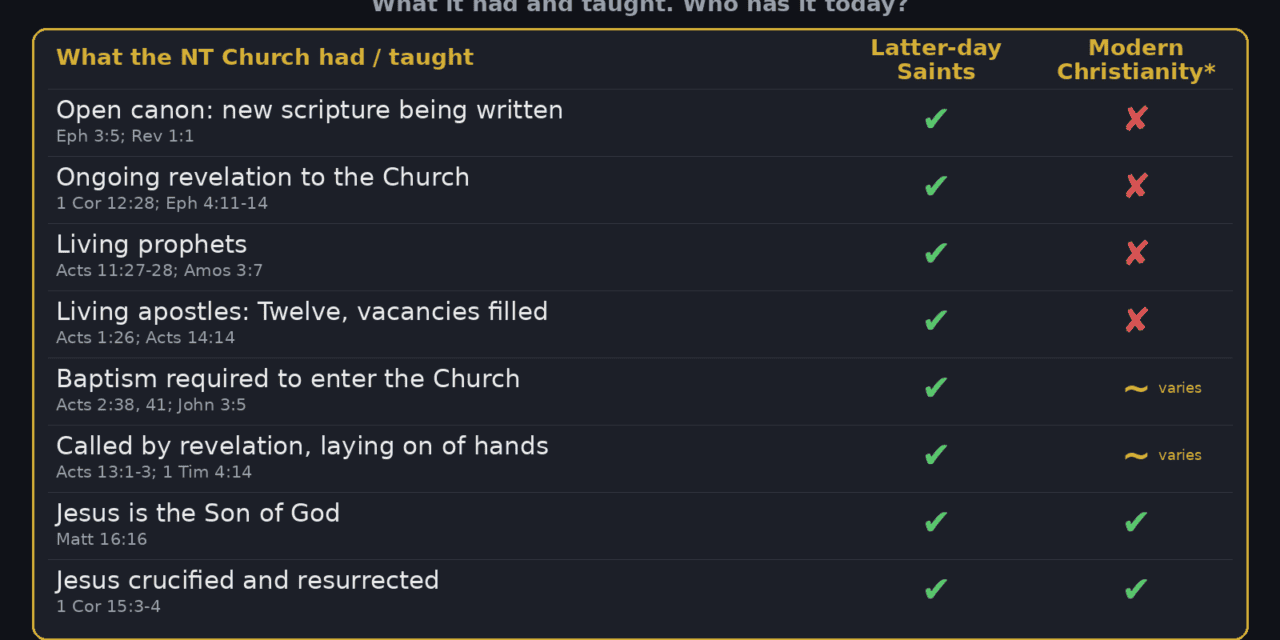
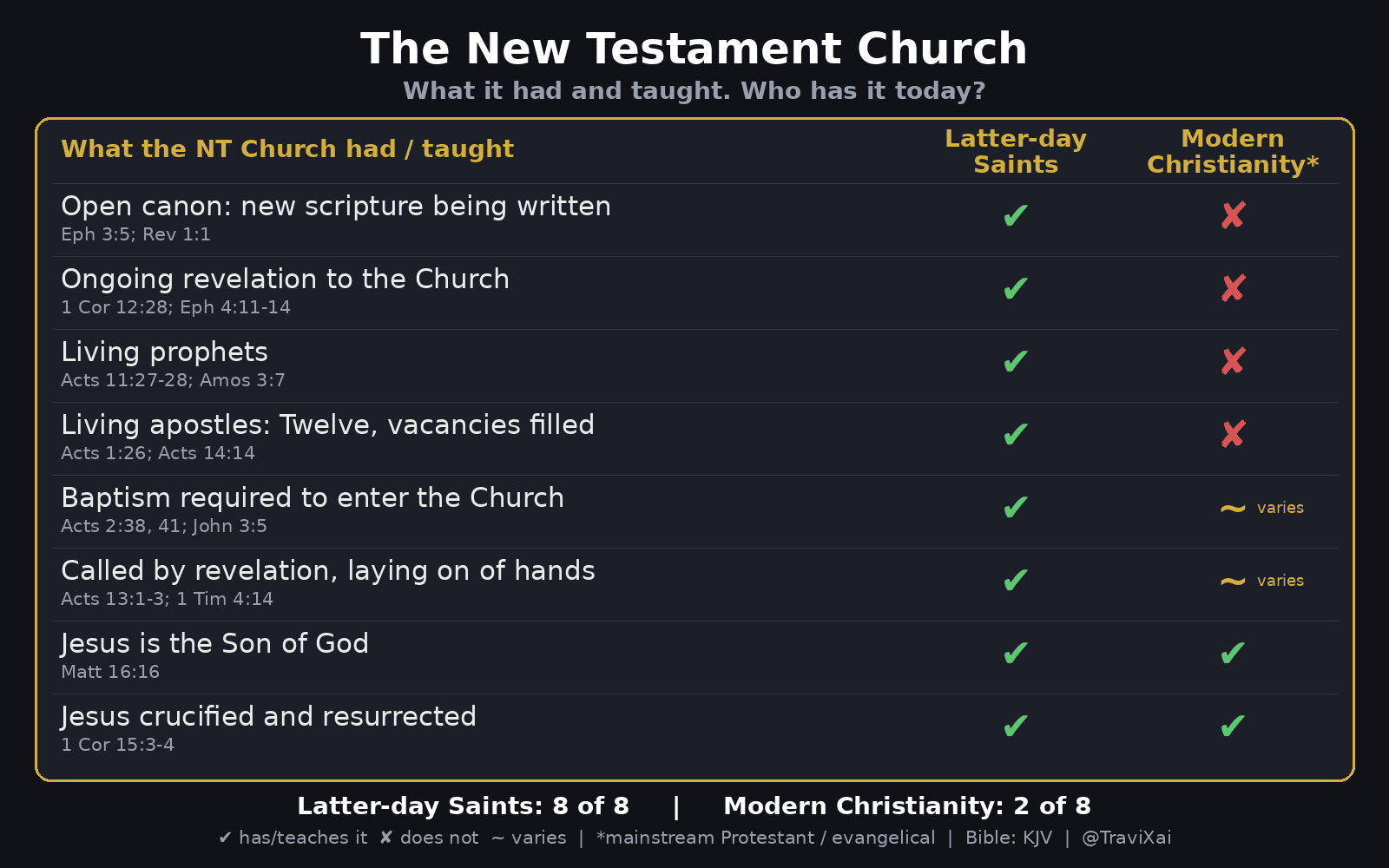
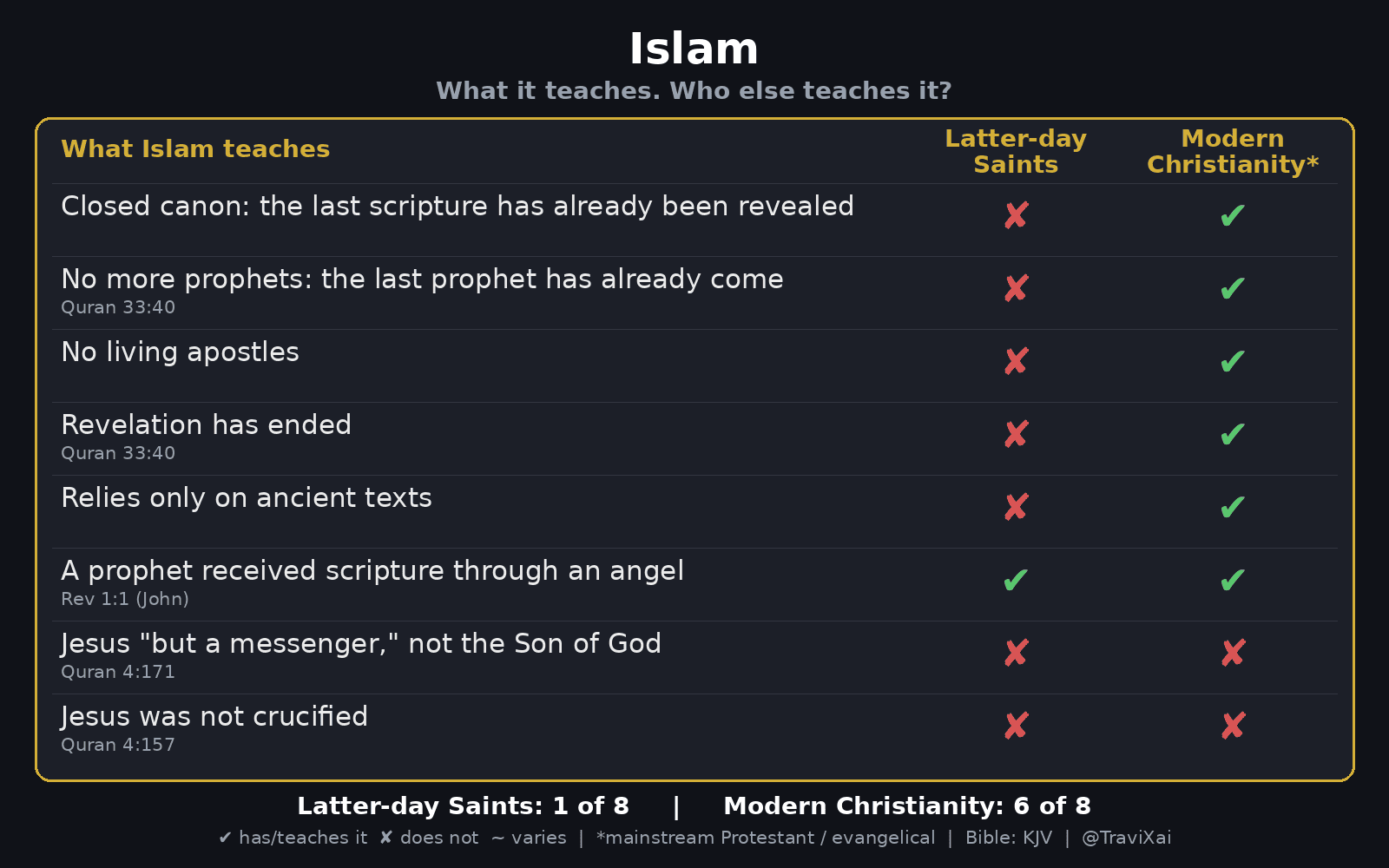
That is what these two charts do. The first lists what the New Testament Church had and taught, and asks who has those things today. The second lists what Islam teaches, and asks who else teaches it. In both, the two columns are The Church of Jesus Christ of Latter-day Saints and modern Christianity.
The two charts cover the core eight traits on each side. This article goes deeper. After walking through every row, I’ll add more of what the New Testament Church had that Latter-day Saints still have, and more of what modern Christianity shares with Islam. I’ll only include things I think are fair and accurate, and I’ll say “varies” where Christians disagree with each other.
A quick note on terms before we start. When I say “modern Christianity” I mean mainstream Protestant and evangelical Christianity, the tradition most of my Christian friends belong to and the one most of these critics speak from. Christianity is broad. Catholic and Orthodox Christians, for example, have their own views on apostolic succession and ordination, and I don’t want to overclaim. That is why one row is marked “varies.” Bible quotes are from the King James Version.
Chart 1: The New Testament Church
1. An open canon: new scripture being written
The New Testament did not fall from the sky as a finished book. It was being written while the Church was alive. Paul tells the Ephesians that the mystery of Christ, “in other ages was not made known unto the sons of men, as it is now revealed unto his holy apostles and prophets by the Spirit” (Ephesians 3:5). Notice the word “now.” Revelation was arriving in Paul’s own day.
The very last book of the Bible opens the same way: “The Revelation of Jesus Christ, which God gave unto him, to shew unto his servants things which must shortly come to pass” (Revelation 1:1). That is new scripture, given by revelation, decades after the resurrection.
Latter-day Saints believe the canon is still open. We have the Bible, and we also have the Book of Mormon, the Doctrine and Covenants, and the Pearl of Great Price, and we believe God “will yet reveal many great and important things.” That is a check.
Most of modern Christianity teaches that the canon is closed. No new scripture will ever be added. Whatever you think of that position, it is not how the New Testament Church operated. That is an X.
2. Ongoing revelation to the Church
Revelation was not a one-time event for the early Saints. It was built into how the Church was organized. Paul writes, “God hath set some in the church, first apostles, secondarily prophets, thirdly teachers” (1 Corinthians 12:28). In Ephesians he explains that Christ “gave some, apostles; and some, prophets; and some, evangelists; and some, pastors and teachers” (Ephesians 4:11).
And he tells us why: “For the perfecting of the saints, for the work of the ministry, for the edifying of the body of Christ: Till we all come in the unity of the faith, and of the knowledge of the Son of God” (Ephesians 4:12-13). The purpose is so “that we henceforth be no more children, tossed to and fro, and carried about with every wind of doctrine” (Ephesians 4:14).
Have we all come to the unity of the faith? Look around. We are not there yet. Latter-day Saints believe God still guides His Church by revelation, through the offices Paul named. Check.
Modern Christianity generally teaches that this kind of revelation to the Church ended with the apostles. X.
3. Living prophets
The New Testament Church did not just honor dead prophets. It had living ones. “And in these days came prophets from Jerusalem unto Antioch. And there stood up one of them named Agabus, and signified by the Spirit that there should be great dearth throughout all the world” (Acts 11:27-28). Agabus is a prophet in the Church, after the resurrection, foretelling a real famine.
This fits the pattern God set long before. “Surely the Lord GOD will do nothing, but he revealeth his secret unto his servants the prophets” (Amos 3:7).
Latter-day Saints sustain a living prophet today. Check. Modern Christianity teaches there are no prophets in that sense today. X.
4. Living apostles: the Twelve, with vacancies filled
When Judas was gone, the apostles did not decide the Twelve was a one-generation thing. They filled the seat. “And they gave forth their lots; and the lot fell upon Matthias; and he was numbered with the eleven apostles” (Acts 1:26).
And it didn’t stop there. Later, “the apostles, Barnabas and Paul” are named together (Acts 14:14). Neither was one of the original Twelve. The apostleship continued past the first group.
Latter-day Saints have a Quorum of the Twelve Apostles today, and when a seat is vacant, it is filled. Check. Modern Christianity teaches the apostolic office ended with the first generation. X.
5. Baptism required to enter the Church
In the New Testament, baptism was how people entered the Church. On the day of Pentecost, Peter told the crowd, “Repent, and be baptized every one of you in the name of Jesus Christ for the remission of sins, and ye shall receive the gift of the Holy Ghost” (Acts 2:38). And “they that gladly received his word were baptized: and the same day there were added unto them about three thousand souls” (Acts 2:41). Jesus Himself taught, “Except a man be born of water and of the Spirit, he cannot enter into the kingdom of God” (John 3:5).
Latter-day Saints teach that baptism by proper authority is required to enter the Church and the kingdom of God. Check.
Modern Christianity varies here, and I want to be fair. Many evangelicals see baptism as an important act of obedience that follows salvation, not something required to enter. Others, like Catholics and Lutherans, teach that baptism is necessary. So this one is marked “varies,” not an X.
6. Called by revelation and the laying on of hands
How did men receive authority in the New Testament Church? They didn’t just feel inclined, and they didn’t simply graduate from a school. They were called by revelation and set apart by those with authority. “As they ministered to the Lord, and fasted, the Holy Ghost said, Separate me Barnabas and Saul for the work whereunto I have called them. And when they had fasted and prayed, and laid their hands on them, they sent them away” (Acts 13:2-3).
Paul reminds Timothy of the same thing: “Neglect not the gift that is in thee, which was given thee by prophecy, with the laying on of the hands of the presbytery” (1 Timothy 4:14). By prophecy, and by the laying on of hands.
Latter-day Saints receive priesthood and callings the same way: called by inspiration and set apart by the laying on of hands by those holding authority. Check.
Here I want to be fair. Many Christian traditions do practice ordination with the laying on of hands, and some take it very seriously. Others don’t. So this one is marked “varies,” not an X. I would rather undercount than overclaim.
7. Jesus is the Son of God
Peter’s great confession: “Thou art the Christ, the Son of the living God” (Matthew 16:16).
This is where Latter-day Saints and modern Christianity stand together. Both check. I’m glad to say it plainly, and I mean it.
8. Jesus was crucified and resurrected
Paul gives the heart of the gospel: “For I delivered unto you first of all that which I also received, how that Christ died for our sins according to the scriptures; And that he was buried, and that he rose again the third day according to the scriptures” (1 Corinthians 15:3-4).
Again, both check. We share this, and we celebrate it together every Easter.
Chart 1 count
Latter-day Saints: 8 of 8.
Modern Christianity: 2 of 8, with two that vary.
The two shared checks are the most important truths there are: who Jesus is, and what He did. I don’t minimize them. But the other six rows are about how Christ organized His Church, and on those, the pattern is clear.
Chart 2: Islam
Now let’s run the same test on the other side. If the critic wants to say Latter-day Saints are “like Muslims,” let’s list what Islam actually teaches and see who else teaches it.
I want to be respectful here. I have Muslim friends, and I’m not mocking anyone’s faith. I’m describing what the Quran says in its own words.
1. A closed canon: the last scripture has already been revealed
Islam teaches that the Quran is the final revelation. Nothing comes after it. This is grounded in Quran 33:40, which calls Muhammad the “seal of the prophets.”
Latter-day Saints teach the opposite: an open canon. X.
Modern Christianity teaches the canon is closed. Different book, same idea: nothing new is coming. Check.
2. No more prophets: the last prophet has already come
Quran 33:40 again: Muhammad is “the seal of the prophets,” understood in Islam to mean the last. No prophet will come after him.
Latter-day Saints believe in living prophets. X.
Modern Christianity teaches there are no more prophets after the apostolic age. Check. The reasoning is different, but the conclusion is the same.
3. No living apostles
Islam has no apostles leading the faith today. Latter-day Saints do. X. Modern Christianity does not. Check.
4. Revelation has ended
Because the seal of the prophets has come (Quran 33:40), revelation of new scripture to the community has ended.
Latter-day Saints: X. We believe God still speaks.
Modern Christianity: Check. It also teaches that revelation of that kind ended long ago.
5. Relies only on ancient texts
With no living prophets, no apostles, and no new revelation, what’s left is the text. Islam relies on its ancient scripture, interpreted by scholars.
Latter-day Saints treasure ancient scripture, but we don’t rely only on it. We also have living prophets and continuing revelation. X.
Modern Christianity relies on the Bible alone, interpreted by scholars and pastors. Check.
6. A prophet received scripture through an angel
Here’s the one trait the critics point to. Islam teaches that Muhammad received the Quran through the angel Gabriel. Latter-day Saints believe Joseph Smith was visited by the angel Moroni. Check for us. I’ll own it.
But that’s not an Islamic trait. It’s a biblical one. “The Revelation of Jesus Christ, which God gave unto him… and he sent and signified it by his angel unto his servant John” (Revelation 1:1). The last book of the New Testament came to a prophet through an angel.
Modern Christianity believes this too. Every Bible-believing Christian accepts that John received the book of Revelation through an angel. Check.
So the one thing we share with Islam, every Christian shares with Islam, because it comes straight from the Bible.
7. Jesus is “but a messenger,” not the Son of God
Quran 4:171 says, “The Messiah, Jesus the son of Mary, was but a messenger of Allāh,” and adds, “Exalted is He above having a son” (Sahih International).
Latter-day Saints: X. Jesus is the Son of God.
Modern Christianity: X. Same.
This is where the angel test from my earlier post matters. If two religions have a prophet visited by an angel, the question is what the angel taught. One message testifies Jesus is the Son of God. The other denies it.
8. Jesus was not crucified
Quran 4:157 says, “they did not kill him, nor did they crucify him; but [another] was made to resemble him to them” (Sahih International).
Latter-day Saints: X. We testify He was crucified and rose again the third day (1 Corinthians 15:3-4).
Modern Christianity: X. Same.
Chart 2 count
Latter-day Saints: 1 of 8.
Modern Christianity: 6 of 8.
And look at what those six are. Closed canon. No more prophets. No living apostles. Revelation has ended. Only ancient texts. Five of those six are the same idea: God has stopped talking. The sixth, an angel bringing scripture, is something we all share with the Bible.
Going deeper: more of what the New Testament Church had
The chart covers eight traits. But the New Testament says a lot more about how Christ’s Church was organized and what it taught. Here are more, with the verses, so you can check them yourself.
The Seventy
Jesus didn’t only call the Twelve. “After these things the Lord appointed other seventy also, and sent them two and two before his face into every city and place, whither he himself would come” (Luke 10:1). They came back rejoicing: “Lord, even the devils are subject unto us through thy name” (Luke 10:17).
Latter-day Saints have Seventies today, called to serve under the direction of the Twelve. Most Christian churches have no office of Seventy at all.
Bishops, elders, and deacons
Paul lays out local offices in the Church. “If a man desire the office of a bishop, he desireth a good work” (1 Timothy 3:1). “Likewise must the deacons be grave” (1 Timothy 3:8). He told Titus to “ordain elders in every city” (Titus 1:5), and Paul and Barnabas “ordained them elders in every church, and had prayed with fasting” (Acts 14:23).
Latter-day Saints have bishops over local congregations, elders, and deacons, all ordained. To be fair, many Christian churches have some of these offices too, by different names and with different structures. This is one where Christians vary. But the full set, bishop, elder, and deacon, ordained by the laying on of hands, is right there in the Church of Jesus Christ today.
The gift of the Holy Ghost by the laying on of hands
In Samaria, people had been baptized, but they had not yet received the Holy Ghost. So Peter and John came. “Then laid they their hands on them, and they received the Holy Ghost. And when Simon saw that through laying on of the apostles’ hands the Holy Ghost was given, he offered them money” (Acts 8:17-18). In Ephesus it happened again: “when Paul had laid his hands upon them, the Holy Ghost came on them” (Acts 19:6).
Notice the order. Baptism first, then the gift of the Holy Ghost by the laying on of hands, from those with authority. Simon could see it, and he wanted to buy that authority. He couldn’t.
Latter-day Saints do exactly this. After baptism, every member is confirmed and receives the gift of the Holy Ghost by the laying on of hands. Our fourth Article of Faith lists it among the first principles and ordinances of the gospel: “Laying on of hands for the gift of the Holy Ghost.” Some Christian traditions have confirmation; many evangelical churches have no such ordinance. Varies.
Baptism for the dead
Paul, arguing for the resurrection, mentions a practice the Corinthians knew about: “Else what shall they do which are baptized for the dead, if the dead rise not at all? why are they then baptized for the dead?” (1 Corinthians 15:29).
Scholars debate what Paul meant, and I’ll be honest that Christians read this verse many different ways. But the plain reading is that people in the early Church were being baptized on behalf of the dead, and Paul used it as evidence for the resurrection without condemning it. Latter-day Saints perform baptisms for the dead in temples today, so that everyone who ever lived can accept the gospel. Modern Christianity does not practice it.
Evangelists
Ephesians 4:11 lists “evangelists” among the offices Christ gave. Latter-day Saints understand an evangelist as a patriarch, a man ordained to give blessings, much like the patriarchs of the Old Testament blessed their children. In most churches today “evangelist” just means a traveling preacher. Either way, Latter-day Saints have an ordained office that fills that line in Paul’s list.
Anointing the sick with oil
James gives clear instructions: “Is any sick among you? let him call for the elders of the church; and let them pray over him, anointing him with oil in the name of the Lord: And the prayer of faith shall save the sick” (James 5:14-15). The Twelve did the same: they “anointed with oil many that were sick, and healed them” (Mark 6:13).
This is something Latter-day Saints do all the time. Elders anoint with consecrated oil and give a priesthood blessing. Some Christian traditions also anoint the sick, and I’m glad they do. Many don’t. Varies.
God is the Father of our spirits
Hebrews draws a direct comparison: “we have had fathers of our flesh which corrected us, and we gave them reverence: shall we not much rather be in subjection unto the Father of spirits, and live?” (Hebrews 12:9). And Paul says, “The Spirit itself beareth witness with our spirit, that we are the children of God” (Romans 8:16).
Latter-day Saints take that literally. God is the Father of our spirits, and we are His children. Many Christians speak of God as Father in a more figurative or adoptive sense.
Heirs of God, joint-heirs with Christ
Paul keeps going: “And if children, then heirs; heirs of God, and joint-heirs with Christ; if so be that we suffer with him, that we may be also glorified together” (Romans 8:17). Peter says God’s promises are given so “that by these ye might be partakers of the divine nature” (2 Peter 1:4). And Jesus promises, “To him that overcometh will I grant to sit with me in my throne, even as I also overcame, and am set down with my Father in his throne” (Revelation 3:21).
Latter-day Saints believe God’s children can grow to become like Him, by His grace, through Christ. Eastern Orthodox Christians have a long tradition of theosis that touches on this, so it isn’t only us. But most evangelicals reject the idea that we can become like God in that sense. Varies, and on the evangelical side, mostly no.
Degrees of glory
Paul describes the resurrection with different glories: “There are also celestial bodies, and bodies terrestrial: but the glory of the celestial is one, and the glory of the terrestrial is another. There is one glory of the sun, and another glory of the moon, and another glory of the stars: for one star differeth from another star in glory. So also is the resurrection of the dead” (1 Corinthians 15:40-42). He also says he knew a man “caught up to the third heaven” (2 Corinthians 12:2). A third heaven implies more than one.
Latter-day Saints teach three degrees of glory: celestial, terrestrial, and telestial. Most of modern Christianity teaches heaven and hell, with nothing like Paul’s sun, moon, and stars.
The Church carries Christ’s name
Paul wrote “Unto the church of God which is at Corinth” (1 Corinthians 1:2), and “The churches of Christ salute you” (Romans 16:16). The Church belonged to God and to Christ, and it was called that.
The Church I belong to is named The Church of Jesus Christ of Latter-day Saints. Many Christian churches also carry Christ’s name, and I’m not claiming we’re the only ones. But we do.
A lay ministry
Paul said to the elders of Ephesus, “I have coveted no man’s silver, or gold, or apparel. Yea, ye yourselves know, that these hands have ministered unto my necessities… It is more blessed to give than to receive” (Acts 20:33-35).
In the Church of Jesus Christ, local bishops, teachers, and leaders serve without pay. They hold regular jobs and serve in their spare time, like Paul working with his own hands. Most churches have paid pastors. There’s nothing wrong with supporting a pastor, and plenty of good pastors work hard for little. But the unpaid local ministry is a real point of resemblance to Paul.
Fasting, and caring for the poor together
The early Church fasted when calling leaders (Acts 13:2-3; 14:23). And “all that believed were together, and had all things common; And sold their possessions and goods, and parted them to all men, as every man had need” (Acts 2:44-45).
Latter-day Saints fast once a month and give the money we would have spent on those meals as a fast offering to care for the poor, handled by the local bishop. Many Christians fast and give generously. Varies, but the organized pattern is there.
Temple worship
The first Christians did not stop going to the temple. “They, continuing daily with one accord in the temple” (Acts 2:46). “Now Peter and John went up together into the temple at the hour of prayer” (Acts 3:1).
Latter-day Saints build and worship in temples today. Modern Christianity has churches, but no temples.
Councils of apostles and elders, guided by the Spirit
When a big doctrinal question came up, the Church didn’t take a vote of scholars. “The apostles and elders came together for to consider of this matter” (Acts 15:6). Their answer opened, “For it seemed good to the Holy Ghost, and to us” (Acts 15:28).
That’s how the Church of Jesus Christ is led today: councils of apostles, seeking revelation. Modern Christianity, without living apostles, settles questions through scholarship, denominations, and votes.
Priesthood authority from God
“And no man taketh this honour unto himself, but he that is called of God, as was Aaron” (Hebrews 5:4). Authority has to be given. You can’t take it.
Our fifth Article of Faith says it this way: “We believe that a man must be called of God, by prophecy, and by the laying on of hands by those who are in authority, to preach the Gospel and administer in the ordinances thereof.” Many Protestant churches teach the “priesthood of all believers” instead, where no special conferral is needed. Catholics and Orthodox teach ordained priesthood through succession. Varies.
The Father and the Son are distinct
When Stephen was dying, he “looked up stedfastly into heaven, and saw the glory of God, and Jesus standing on the right hand of God, And said, Behold, I see the heavens opened, and the Son of man standing on the right hand of God” (Acts 7:55-56).
Stephen saw Jesus standing next to the Father. Latter-day Saints teach that the Father and the Son are distinct, glorified beings. D&C 130:22 says, “The Father has a body of flesh and bones as tangible as man’s; the Son also.” Christians understand Stephen’s vision in different ways, and I respect that. But what he described lines up naturally with what we teach.
Going deeper: more of what modern Christianity shares with Islam
Now the other side. I want to be careful here. I’m not saying modern Christianity is Islam, or that my Christian friends worship differently than they say they do. I’m saying that on certain specific ideas, mainstream Protestant and evangelical teaching lands in the same place Islam does, and not where the New Testament Church was.
God has no body
The Westminster Confession, one of the most influential Protestant statements of faith, describes God as “a most pure spirit, invisible, without body, parts, or passions” (Westminster Confession 2.1). Islam teaches that God is utterly unlike His creation: “There is nothing like unto Him” (Quran 42:11, Sahih International).
The reasons and wording differ, but both land on a God who has no body and is completely unlike us. Latter-day Saints teach that the Father has a glorified body (D&C 130:22), and that we were made in His image.
We can never become like God
Islam’s central teaching is tawhid, God’s absolute oneness, and its greatest sin is shirk, associating anything with God. “Indeed, Allāh does not forgive association with Him” (Quran 4:48). Surah 112 ends, “Nor is there to Him any equivalent” (Quran 112:4).
Most evangelical Christians also teach that humans can never become like God in any real sense, and many call the Latter-day Saint teaching blasphemy. That’s a real point of agreement with Islam, and it stands against Paul’s “joint-heirs with Christ” (Romans 8:17) and Peter’s “partakers of the divine nature” (2 Peter 1:4). This varies, since Orthodox Christians teach theosis, but for mainstream evangelicals it holds.
The book is complete and sufficient, forever
Islam teaches the Quran is God’s final and complete word. The Westminster Confession says of scripture: “unto which nothing at any time is to be added, whether by new revelations of the Spirit, or traditions of men” (Westminster Confession 1.6).
Both draw a line around a finished book and say nothing more will ever come from God to add to it. Neither book itself says God would stop speaking. The New Testament Church lived the opposite way.
Scholars interpret the ancient text
With no living prophet, someone still has to tell you what the text means. In Islam, that role falls to the scholars, the ulama. In modern Christianity, it falls to pastors, seminaries, and theologians.
I have real respect for scholars on both sides. Many are sincere and brilliant. But in both systems, the final word on what God means comes from human study of ancient words, not from a living apostle who can say, “it seemed good to the Holy Ghost, and to us” (Acts 15:28).
A new prophet is false by definition
In Islam, anyone claiming to be a prophet after Muhammad is rejected on that basis alone, because of Quran 33:40. In much of modern Christianity, anyone claiming to be a prophet who brings new scripture is rejected on that basis alone, because the canon is closed.
Notice: in both, the claim is judged false before anyone looks at what the prophet actually taught. The Bible gives a different test. Jesus said, “by their fruits ye shall know them” (Matthew 7:20), and John says to test whether a spirit confesses that Jesus Christ is come in the flesh (1 John 4:2). I covered that test in my earlier post on this subject: Are Latter-day Saints Just Like Muslims? Apply the Bible’s Own Test.
Adding it up
If you put these next to the charts, the pattern gets stronger, not weaker. The Church of Jesus Christ of Latter-day Saints keeps matching the New Testament Church: Seventies, bishops and elders, the gift of the Holy Ghost by laying on of hands, baptism for the dead, anointing the sick, temples, councils of apostles, priesthood called of God. And where modern Christianity matches Islam, it’s on the same family of ideas: a bodiless God no one can become like, a finished book, scholars instead of prophets, and no room for anyone new to speak for God.
So line them up
The Church of Jesus Christ of Latter-day Saints matches the New Testament Church on 8 of 8 traits. It matches Islam on 1 of 8, and that one trait is shared with John the Revelator and with every Bible-believing Christian.
Modern Christianity matches the New Testament Church on 2 of 8, the Son of God and the cross and resurrection, which we share and celebrate together. It matches Islam on 6 of 8, and five of those six are the closed heavens.
That’s not my standard. That’s the critic’s standard. They said shared traits make two faiths alike. I just ran the whole list instead of one row.
What about Revelation 22:18 and Hebrews 1:1-2?
When I bring this up, the most common reply is that the Bible itself closed the canon. Two verses get quoted.
The first is Revelation 22:18, which warns against adding to “the prophecy of this book.” But “this book” is the book of Revelation. John wrote it before the New Testament was collected into one volume. The verse protects John’s prophecy from tampering. It says nothing about God never calling another prophet. Moses gave a similar warning in Deuteronomy, and God kept sending prophets for centuries afterward.
The second is Hebrews 1:1-2: God, who spoke “in time past unto the fathers by the prophets, Hath in these last days spoken unto us by his Son.” That’s beautiful, and true. Christ is the fullest revelation of the Father. But the same New Testament that contains Hebrews also shows prophets like Agabus speaking after the resurrection (Acts 11:27-28) and apostles still being called (Acts 14:14). Christ speaking doesn’t end prophets. Christ is the one who calls them (Ephesians 4:11).
Neither verse says God would stop speaking.
The real fallacy: cherry picking
This is the problem with the “just like Muslims” argument. It’s cherry picking. Pick the one trait that looks foreign, ignore everything else, and call it a match.
Run the full comparison by the critic’s own standard and the result flips. The trait that actually lines up with Islam isn’t an angel. It’s the closed heavens.
A fair question
This isn’t an attack on my Christian friends or on Muslims. I’m grateful for every person who loves Jesus Christ, and I respect sincere people of every faith who are trying to follow God.
I’m just asking a fair question. If the New Testament Church had apostles, prophets, and ongoing revelation, why would Christ’s Church today have less?
“Surely the Lord GOD will do nothing, but he revealeth his secret unto his servants the prophets” (Amos 3:7).
He still does.