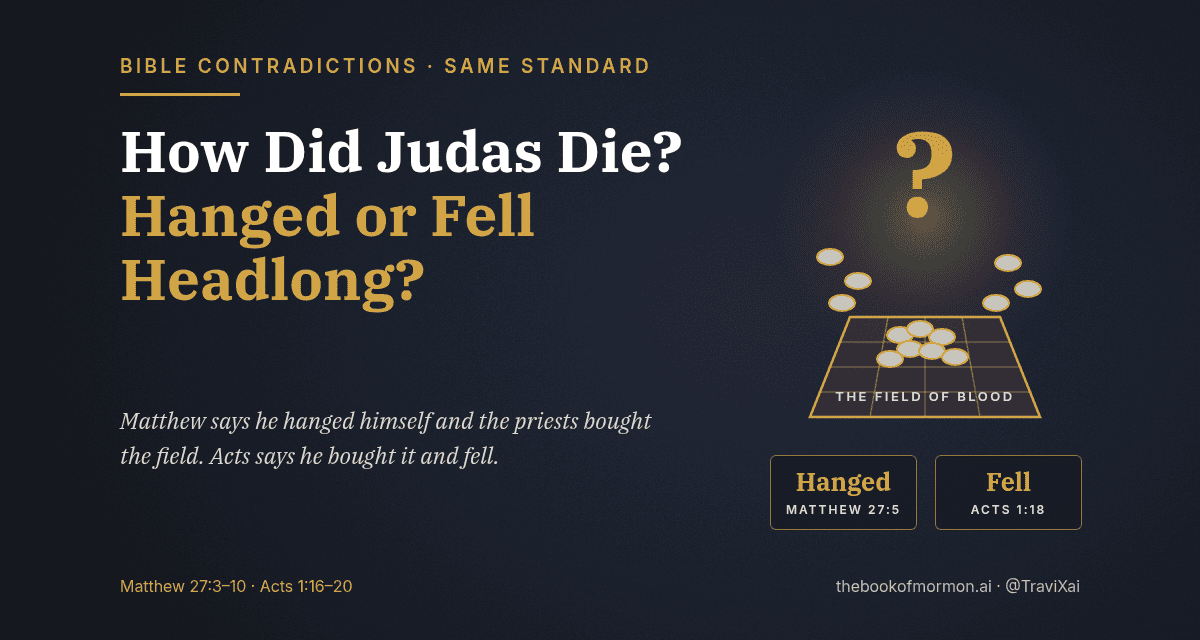

Matthew says Judas hanged himself and the priests bought the field. Acts says Judas bought the field and fell headlong. Bible defenders glue the two together with a detail neither text contains, then refuse the Book of Mormon the same courtesy.
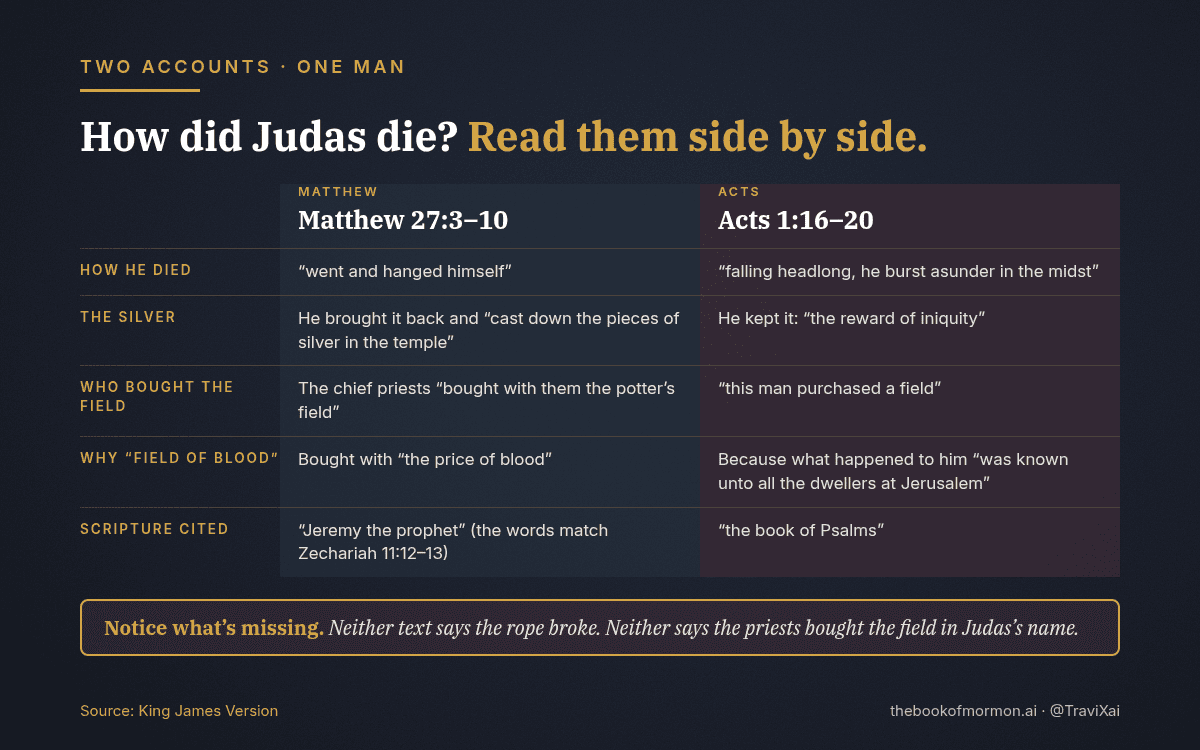
How did Judas die? Most Christians will answer without blinking: he hanged himself. That’s Matthew. Now open Acts and read how Peter tells it. No rope. No tree. Judas buys a field, falls headlong, and bursts open. Same man, same betrayal, same field of blood, and two very different endings.
I’m not here to attack the Bible. I love it, and I believe it. I’m here to show you how Bible defenders handle this one, because it’s the exact move they say Latter-day Saints aren’t allowed to make with the Book of Mormon.
Exhibit AMatthew: he hanged himself
Matthew tells the story right after Jesus is handed over to Pilate. Judas sees that Jesus “was condemned,” and he “repented himself, and brought again the thirty pieces of silver to the chief priests and elders” (Matthew 27:3). He confesses, “I have sinned in that I have betrayed the innocent blood,” and they brush him off: “What is that to us? see thou to that” (27:4). Then:
And he cast down the pieces of silver in the temple, and departed, and went and hanged himself.
Matthew 27:5 (KJV)
Notice what happens to the money. Judas gives it back. He throws it on the temple floor. The priests pick it up and decide “it is not lawful for to put them into the treasury, because it is the price of blood” (27:6). So they buy something with it:
And they took counsel, and bought with them the potter’s field, to bury strangers in. Wherefore that field was called, The field of blood, unto this day.
Matthew 27:7–8 (KJV)
So in Matthew, Judas hangs himself, the chief priests buy the field, and it’s called the field of blood because it was bought with blood money.
Exhibit BActs: he fell headlong
Acts 1 picks up the story weeks later, when the apostles gather to replace Judas. Peter says the scripture “must needs have been fulfilled, which the Holy Ghost by the mouth of David spake before concerning Judas” (Acts 1:16). Then comes a parenthetical aside about what happened to him:
Now this man purchased a field with the reward of iniquity; and falling headlong, he burst asunder in the midst, and all his bowels gushed out.
Acts 1:18 (KJV)
And it was known unto all the dwellers at Jerusalem; insomuch as that field is called in their proper tongue, Aceldama, that is to say, The field of blood.
Acts 1:19 (KJV)
Read those next to Matthew and count the differences. In Matthew, Judas returns the silver. In Acts, he spends it: “this man purchased a field.” In Matthew, the priests are the buyers. In Acts, Judas is. In Matthew, he hangs. In Acts, he falls headlong and bursts open. Even the name of the field gets a different reason. Matthew says it’s called the field of blood because it was bought with “the price of blood.” Acts ties the name to what happened to Judas there, and how everyone in Jerusalem heard about it.
The patchThe rope that isn’t there
So how do inerrancy defenders handle it? GotQuestions offers what it calls “a simple reconciliation of the facts”:
Judas hanged himself in the potter’s field (Matthew 27:5), and that is how he died. Then, after his body had begun to decay and bloat, the rope broke, or the branch of the tree he was using broke, and his body fell, bursting open on the land of the potter’s field (Acts 1:18–19).
GotQuestions, “How did Judas die?”
It’s a creative story. Now go back and read Matthew 27:5. It doesn’t say he hanged himself in the potter’s field. The priests hadn’t even bought the field yet. It says nothing about decay, bloating, a rope, or a branch. Acts doesn’t mention any of that either. That detail isn’t in either text. Someone had to invent it to glue the two accounts together.
Answers in Genesis goes the same way, suggesting the body fell “due to the branch he hung on or the rope itself breaking.” And it’s refreshingly honest about why it has to: “Since the Bible is inerrant, Judas cannot have died by hanging and died by falling and bursting open.” The conclusion comes first. The rope comes second.
The rope doesn’t fix the field
Even if you grant the rope, it still doesn’t settle who bought the field. Matthew says the priests did. Acts says “this man purchased a field.” GotQuestions has an answer for that too: “Judas may not have purchased the field personally, but he provided the money for the transaction and could then be said to be the purchaser.” Maybe. But Matthew’s Judas didn’t provide anything. He threw the money back and walked away. You have to supply a second missing detail to make the first one work.
Even the early church didn’t have one settled story. A fragment attributed to Papias, an early Christian writer of the 100s, gives a third version. Judas didn’t hang at all. His body swelled until “he could not pass where a chariot could pass easily,” and “he was crushed by the chariot, so that his bowels gushed out” (Fragments of Papias, New Advent). Interestingly, the ESV footnotes “falling headlong” in Acts 1:18 with “Or swelling up.”
A possible excuse isn’t evidence. It’s more likely the text means what it says.
Is it logically possible that the rope broke? Sure. But “possible to harmonize” isn’t the same thing as “probably true.” Even The Gospel Coalition, which defends the Bible, opens by admitting that “Matthew and Luke provide quite different accounts of Judas’s demise.”
The prophecy”Jeremy the prophet”
And Matthew isn’t done. Right after the field, he cites a prophecy:
Then was fulfilled that which was spoken by Jeremy the prophet, saying, And they took the thirty pieces of silver, the price of him that was valued, whom they of the children of Israel did value; And gave them for the potter’s field, as the Lord appointed me.
Matthew 27:9–10 (KJV)
“Jeremy” is Jeremiah. The trouble is that the thirty pieces of silver and the potter are in Zechariah:
And the Lord said unto me, Cast it unto the potter: a goodly price that I was prised at of them. And I took the thirty pieces of silver, and cast them to the potter in the house of the Lord.
Zechariah 11:13 (KJV)
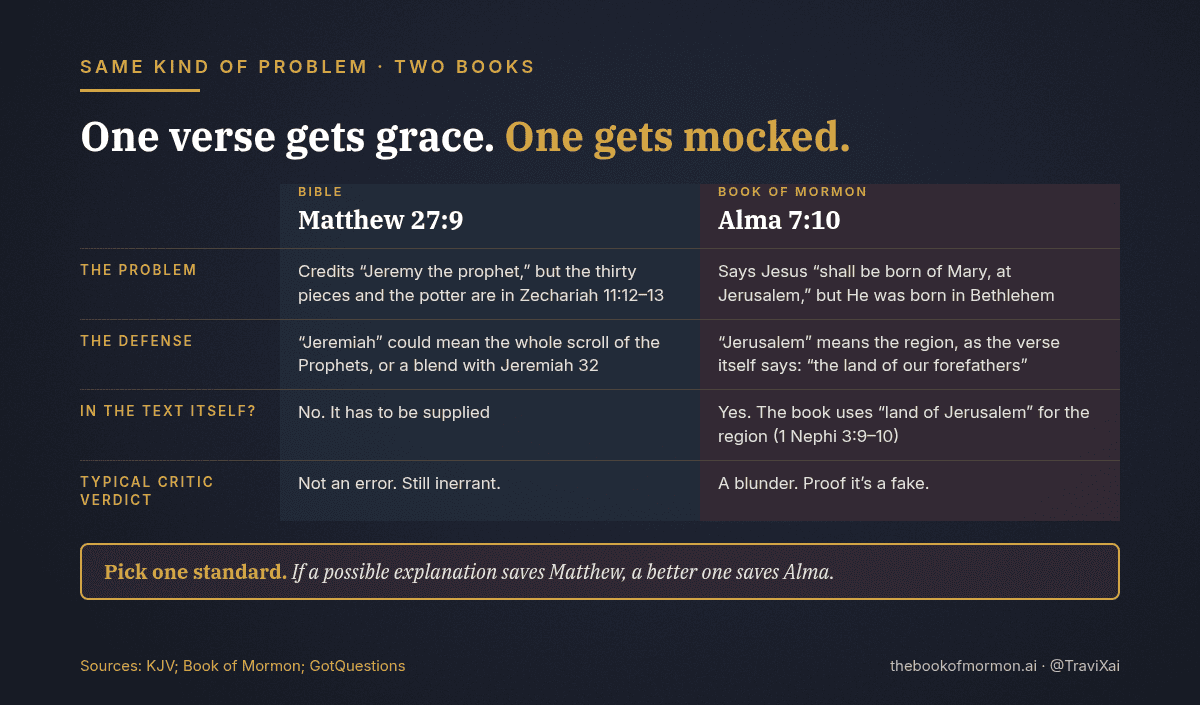
GotQuestions asks the question straight up: “Is this a case of an error in the Bible?” It admits “the prophecy that Matthew alludes to regarding 30 pieces of silver is most likely from Zechariah 11:12–13.” Its leading answer is that the Prophets section of the Hebrew Bible started with Jeremiah, so “Jeremiah” could mean the whole “Jeremiah Scroll.” Another is a blend: Jeremiah visits a potter’s house (Jeremiah 18:2) and buys a field (Jeremiah 32:9). But the same page admits “it is difficult to find a particular prediction in Jeremiah that would fit the reference to 30 pieces of silver.”
The scribes noticed too. According to Bruce Metzger’s Textual Commentary on the Greek New Testament, “Jeremiah” is the firmly established reading, but because the passage “is not to be found in Jeremiah, but seems to come from Zechariah,” some copyists swapped in “Zechariah,” and others “omit the name entirely.” When the people copying your Bible start fixing it, you can’t pretend there was nothing to fix.
The standardNow do Alma 7:10
Now flip it. In the Book of Mormon, Alma prophesies that the Savior “shall be born of Mary, at Jerusalem which is the land of our forefathers” (Alma 7:10). Critics have pointed at that verse for nearly two hundred years: Jesus was born in Bethlehem, so Joseph Smith blew it.
But look at the defense. Alma doesn’t say “in the city of Jerusalem.” He says “at Jerusalem which is the land of our forefathers.” The Book of Mormon uses “the land of Jerusalem” for the region from its first pages, where Nephi and his brothers “go up to the land of Jerusalem” (1 Nephi 3:9–10). Bethlehem is only a few miles from the city. That explanation comes right out of the text itself. I lay it out in Born at Jerusalem: Why Alma 7:10 Points Toward an Ancient Book.
So which is it? Matthew writes “Jeremy” where the words are Zechariah’s, and the defender says “Jeremiah Scroll,” an explanation the verse never gives, and calls it inerrant. Alma writes “at Jerusalem which is the land of our forefathers,” explains itself in the same breath, and gets called a fraud. If a Latter-day Saint answered a Book of Mormon problem by saying “maybe the rope broke,” you’d laugh them off the internet. Yeah, mmm hmm. Do better.
What a Latter-day Saint does with Judas
I don’t need a rope. Article of Faith 8 says, “We believe the Bible to be the word of God as far as it is translated correctly.” The Book of Mormon’s title page says the same about itself: “if there are faults they are the mistakes of men” (title page). We said up front that books copied by men can carry the marks of men.
Joseph Smith did put the two accounts together, and he did it in the open. His inspired revision of the Bible reads that Judas “hanged himself on a tree. And straightway he fell down, and his bowels gushed out, and he died” (JST, Matthew 27:6). The BYU Religious Studies Center calls the Judas accounts “an obvious inconsistency in the New Testament.” Critics love to mock the Joseph Smith Translation as a man rewriting the Bible. Yet GotQuestions adds a breaking rope and calls it “a simple reconciliation.” Joseph claimed revelation and printed his changes as a revision. The inerrantist adds details in a footnote and says the text never needed help.
The Chicago Statement on Biblical Inerrancy even has a rule for this. Article XIV: “We deny that alleged errors and discrepancies that have not yet been resolved vitiate the truth claims of the Bible.” That isn’t a standard. That’s a hall pass. And 2 Timothy 3:16 never said what they need it to say. It says scripture is “given by inspiration of God” and “profitable.” Inspired and profitable, yes. Inerrant? It doesn’t say that.
The Bible isn’t God. If it were perfect, people would worship it and not have to turn to the True God. How do I know it’s true anyway? The same way I know the Book of Mormon is true. God told me, and I choose to believe Him. So harmonize Judas if you want. Just give Alma, and Joseph Smith, the same courtesy. They both pass, or they both fail.
SummaryKey takeaways
- Matthew 27:5 says Judas “went and hanged himself.” Acts 1:18 says “falling headlong, he burst asunder in the midst.”
- Matthew says Judas threw the silver back and the chief priests “bought with them the potter’s field.” Acts says “this man purchased a field.”
- The popular fix (the rope or branch broke, and the priests bought the field in his name) isn’t in either text. A possible excuse isn’t evidence.
- Matthew 27:9 credits “Jeremy the prophet,” but the thirty pieces and the potter are in Zechariah 11:12–13. Some ancient scribes changed the name or dropped it.
- Critics accept “Jeremiah Scroll” for Matthew 27:9 but reject the Book of Mormon’s own “land of Jerusalem” for Alma 7:10. Pick one standard.
Next time someone says one Book of Mormon verse proves the whole book is fake, ask them how Judas died. For quick, sourced answers on apparent Bible contradictions, Bible inerrancy, and the Joseph Smith Translation, open Galatians18. And for more like this every day, follow me on X at @TraviXai.
Sources
- Bible (KJV, churchofjesuschrist.org): Matthew 26:15 · Matthew 27:3–10 · Acts 1:16–20 · Zechariah 11:12–13 · Jeremiah 18:2 · Jeremiah 32:7–9 · 2 Timothy 3:16
- GotQuestions: “How did Judas die?” · “Why does Matthew 27:9 attribute the prophecy to Jeremiah when it is from Zechariah?” · “Is Zechariah 11:12–13 a Messianic prophecy?”
- Answers in Genesis: “How Did Judas Die?”
- The Gospel Coalition: “Judas’s Demise in Matthew 27 and Acts 1. Do They Contradict?”
- Bruce M. Metzger, A Textual Commentary on the Greek New Testament, on Matthew 27:9: BibliaPlus
- Papias, Fragment III (Ante-Nicene Fathers): Fragments of Papias, New Advent
- Acts 1:18 in the ESV, with footnote: Bible Gateway
- The Chicago Statement on Biblical Inerrancy (1978), Article XIV
- Book of Mormon: Title page · 1 Nephi 3:9–10 · Alma 7:10
- Joseph Smith Translation: JST, Matthew 27:3–6 · BYU Religious Studies Center, “Restoring the Doctrine”
- Pearl of Great Price: Articles of Faith 1:8
- Galatians18: Apparent Biblical Contradictions · Is the Bible Infallible? · The Joseph Smith Translation
- Featured image and comparison charts: original graphics by thebookofmormon.ai (no photographs or likenesses of real people).