
Critics say one error would prove the Book of Mormon false. The Bible tells the story of David’s census twice, and the two accounts differ on who moved David, how many men were counted, how long the famine would last, and what David paid. Here is how evangelical scholars handle it, and why Latter-day Saints were never worried.
Here’s a test critics love to run on the Book of Mormon: find one mistake, and the whole book falls. God doesn’t make errors, so a book with an error can’t be from God. It sounds tidy. Now run that same test on a single chapter of the Bible and see who’s still standing.
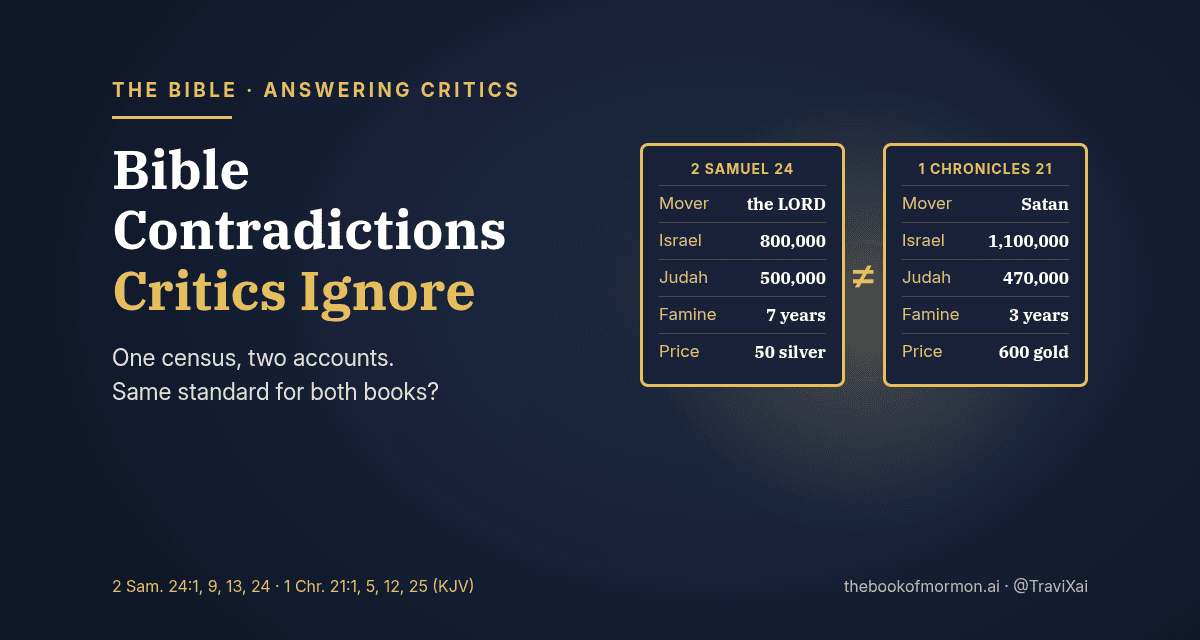
Second Samuel 24 and First Chronicles 21 tell the same story: King David numbers Israel, God is displeased, a plague follows, and David buys a threshing floor where the temple will later stand. Side by side, they differ in four places. Evangelical scholars have answers, and some are good. The point is what those answers concede.
The double standard“One mistake and it’s a fraud”
You’ve heard it: the Book of Mormon has been corrected since 1830, so it isn’t from God. The standard is perfection, and anything less is a fraud.
Nobody applies that standard to the Bible, because the Bible can’t meet it either, and never claims to. As Reformed scholar Iain Duguid notes for Ligonier Ministries, “the Chronicler uses Samuel-Kings as his basic source material for Israel’s history, and in many places quotes it verbatim,” while elsewhere he “reshapes the material” to bring out points for his own audience (Ligonier). So we have two inspired accounts of one event, one drawing on the other, and they still don’t match.
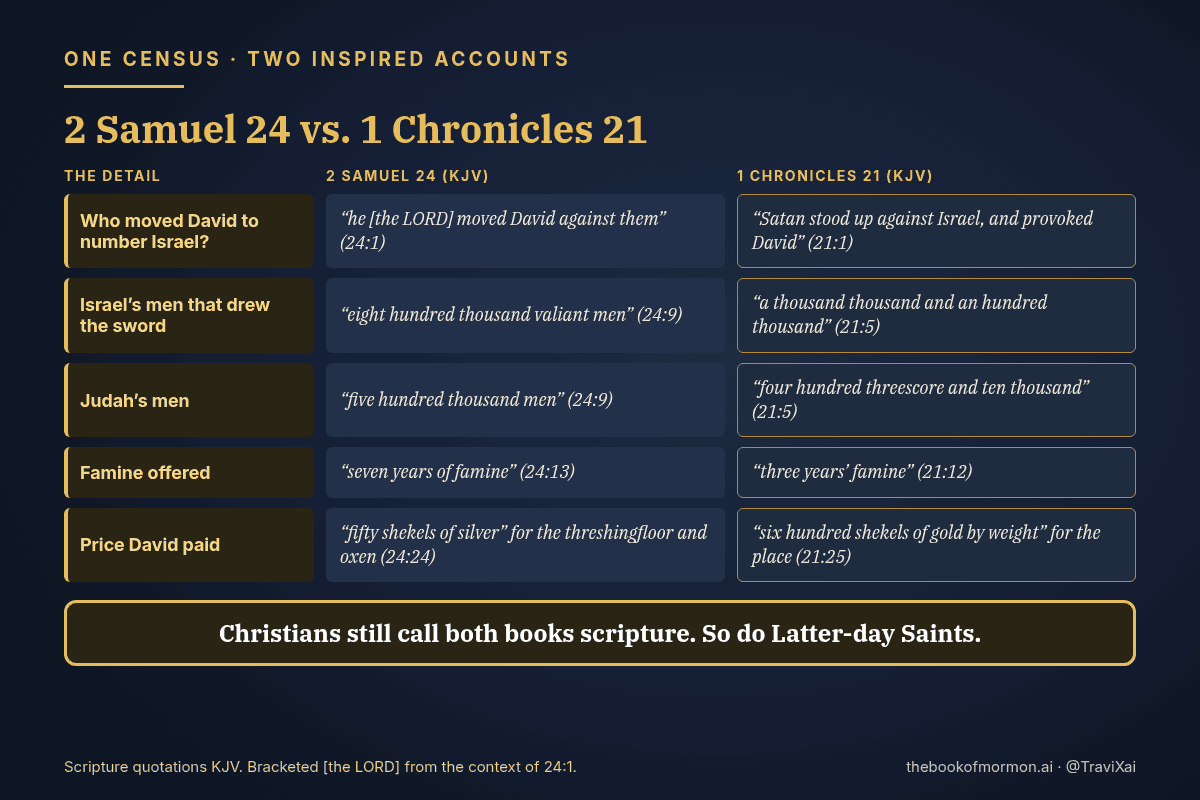
Who moved David?The LORD or Satan
And again the anger of the LORD was kindled against Israel, and he moved David against them to say, Go, number Israel and Judah.
2 Samuel 24:1 (KJV)
And Satan stood up against Israel, and provoked David to number Israel.
1 Chronicles 21:1 (KJV)
In one account the LORD moves David. In the other, Satan does. It’s the most famous of the four, and James says God “tempteth” no man (James 1:13).
The usual evangelical answer: God permitted what Satan did. GotQuestions says “sometimes God sovereignly permits Satan to act,” and points out that the Hebrew verb in 2 Samuel 24:1 has no stated subject (GotQuestions). Duguid says the Chronicler “wanted to clarify one aspect of the story, which is the role of Satan as the intermediary,” and quotes Martin Luther: the devil is “God’s devil” (Ligonier).
That’s a reasonable reading. My own Bible goes further. The Latter-day Saint edition of the King James Version has a footnote on 2 Samuel 24:1: “Apparently something is missing, and ‘Satan’ should be the antecedent of ‘he.’ See 1 Chr. 21:1” (2 Samuel 24:1, footnote a). Notice the word missing. A Latter-day Saint can say the text may have lost something without anyone’s faith collapsing.
The head count800,000 or 1,100,000
And Joab gave up the sum of the number of the people unto the king: and there were in Israel eight hundred thousand valiant men that drew the sword; and the men of Judah were five hundred thousand men.
2 Samuel 24:9 (KJV)
And Joab gave the sum of the number of the people unto David. And all they of Israel were a thousand thousand and an hundred thousand men that drew sword: and Judah was four hundred threescore and ten thousand men that drew sword.
1 Chronicles 21:5 (KJV)
Same report, a gap of 300,000 for Israel and 30,000 for Judah. The best-known harmonization comes from evangelical scholar Gleason Archer: Samuel counts only the battle-seasoned “mighty men,” and “in addition there may have been 300,000 more men of military age who served in the reserves” (Encyclopedia of Bible Difficulties, pp. 188–189, as quoted by Jonathan McLatchie). For Judah, defenders point out that Chronicles says Joab didn’t count Levi and Benjamin (1 Chronicles 21:6) and that “neither was the number put in the account of the chronicles of king David” (1 Chronicles 27:24).
Possible. But McLatchie, a Christian apologist, calls this “one of the trickier ones to harmonize” and adds that “it is difficult to say much with certainty.” That’s honest. It’s also the kind of answer critics never accept from a Latter-day Saint.
The famineSeven years or three
The prophet Gad brings David three choices. Samuel and Chronicles agree on two of them, three months of fleeing and three days of pestilence, and disagree on the first:
Shall seven years of famine come unto thee in thy land?
2 Samuel 24:13 (KJV)
Either three years’ famine; or three months to be destroyed before thy foes…
1 Chronicles 21:12 (KJV)
Open an ESV and you won’t find “seven” in 2 Samuel 24:13. It reads “three years of famine,” with the footnote “Compare 1 Chronicles 21:12, Septuagint; Hebrew seven” (Bible Gateway). In other words, one of the most popular evangelical translations sets the Hebrew aside here and follows the Greek.
Others keep the Hebrew and harmonize. McLatchie notes there had already been a three-year famine (2 Samuel 21:1) and the census took “nine months and twenty days” (2 Samuel 24:8), so three years, plus about one, plus three more, makes “a famine totaling about seven years” (McLatchie). Creative. But either a scribe changed a number, or the reader must supply arithmetic the text doesn’t give. Neither is a flawless text that needs no help.
The priceSilver or gold
So David bought the threshingfloor and the oxen for fifty shekels of silver.
2 Samuel 24:24 (KJV)
So David gave to Ornan for the place six hundred shekels of gold by weight.
1 Chronicles 21:25 (KJV)
Fifty shekels of silver, or six hundred of gold? The common answer is two purchases: the threshing floor and oxen in Samuel, the whole site in Chronicles, where David declares, “This is the house of the LORD God” (1 Chronicles 22:1) and where Solomon later built the temple (2 Chronicles 3:1). That’s a fair reading.
But not every Bible-believing commentator thought so. Ellicott’s Commentary for English Readers, a standard Victorian reference, said flatly: “In one of them the statement of price must have been altered in transcription” (Bible Hub). The Encyclopedia of the Bible on Bible Gateway lists the options as “(1) a copyist’s mistake; (2) two prices for two items… or (3) two purchases of land were made by David” (Bible Gateway). Copyist error is option one.
Second Kings says Ahaziah was “two and twenty years old” when he began to reign (2 Kings 8:26); Second Chronicles says “forty and two” (2 Chronicles 22:2). His father took the throne at thirty-two and reigned eight years (2 Chronicles 21:20), so forty-two would make the son older than his father. The NIV prints “twenty-two” in Chronicles and footnotes it: “Some Septuagint manuscripts and Syriac (see also 2 Kings 8:26); Hebrew forty-two” (Bible Gateway). (Galatians18 has a page on apparent biblical contradictions.)
The fine printWhat the harmonizers concede
Here’s the part critics skip. The strongest modern statement of inerrancy, the 1978 Chicago Statement, already makes room for all of this. Article XIII denies “that inerrancy is negated by Biblical phenomena such as a lack of modern technical precision, irregularities of grammar or spelling… the use of hyperbole and round numbers, the topical arrangement of material, variant selections of material in parallel accounts, or the use of free citations.” Article XIV goes further: “We deny that alleged errors and discrepancies that have not yet been resolved vitiate the truth claims of the Bible” (Chicago Statement).
Round numbers, differing parallel accounts, and unsolved problems are all allowed, and none sinks the book. And as I showed with Psalm 145’s missing verse, the same document says inspiration applies only to the original manuscripts, which no one has.
Compare the older Westminster Confession (1646), which says the Hebrew and Greek were “by His singular care and providence kept pure in all ages” (Westminster Confession 1.8). Then open the ESV to 2 Samuel 24:13 and read “Hebrew seven.” The modern statement has quietly retreated from “kept pure in all ages” to the lost originals. See Galatians18 on whether the Bible is infallible, and my post Sola Scriptura: Which Verse Teaches It?
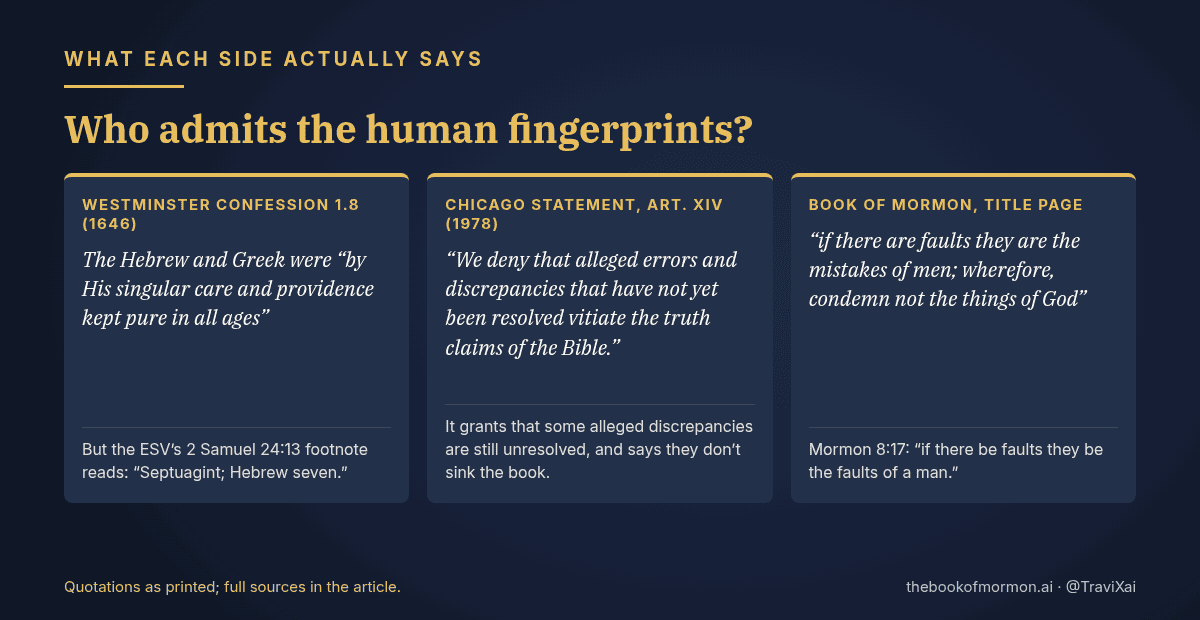
The Book of Mormon“The mistakes of men”
Latter-day Saints never needed any of that fine print. The Book of Mormon put its own on the title page:
And now, if there are faults they are the mistakes of men; wherefore, condemn not the things of God, that ye may be found spotless at the judgment-seat of Christ.
Book of Mormon, title page
Moroni says it again: “And if there be faults they be the faults of a man” (Mormon 8:17). And again: “Condemn me not because of mine imperfection… but rather give thanks unto God that he hath made manifest unto you our imperfections, that ye may learn to be more wise than we have been” (Mormon 9:31).
Article of Faith 8 applies the same humility to the Bible: “We believe the Bible to be the word of God as far as it is translated correctly” (Articles of Faith 1:8). That isn’t a dodge. It is what the ESV and NIV footnotes are already telling you. It’s one reason Joseph Smith worked through the Bible in the Joseph Smith Translation.
Inspired doesn’t mean inerrant. Paul said “All scripture is given by inspiration of God, and is profitable” (2 Timothy 3:16). Profitable, not flawless in every copy. Prophets, scribes, and translators are human, which is why God keeps speaking (see The Canon Was Never Meant to Close and Revelation 22:18 and “This Book”).
One ruleThe same charity for both books
I’m not tearing down anyone’s Bible. I love it. Samuel and Chronicles are both scripture to me, numbers and all.
All I ask is one rule for both books. If “God permitted Satan” is a fair answer for 2 Samuel 24:1, then patient, good-faith reading is fair for a hard verse in Alma. If a scribe can turn three into seven without making Samuel false, then spelling and grammar fixes between editions don’t make the Book of Mormon false.
A critic can keep the Bible and drop the perfection test, or keep the test and lose the Bible with it. He can’t keep both.
SummaryKey takeaways
- Who moved David: “the LORD” (2 Samuel 24:1) or “Satan” (1 Chronicles 21:1). The usual answer is that God permitted Satan; the Latter-day Saint KJV footnote says “apparently something is missing.”
- The count: 800,000 and 500,000 (24:9) vs. 1,100,000 and 470,000 (21:5). Archer’s reserves theory is possible, not certain.
- The famine: seven years (24:13) vs. three (21:12). The ESV follows the Septuagint’s “three” and footnotes “Hebrew seven.”
- The price: 50 shekels of silver (24:24) vs. 600 of gold (21:25). Two purchases, or, as Ellicott said, a price “altered in transcription.”
- The Chicago Statement allows round numbers and unresolved “alleged errors.” The Book of Mormon said it first: “the mistakes of men.”
Next time someone says one mistake would sink the Book of Mormon, don’t argue. Hand them 2 Samuel 24 and 1 Chronicles 21 and ask who moved David. Then ask if they’ll give both books the same grace. For quick, sourced answers on this and many other verses, open Galatians18. And for more like this every day, follow me on X at @TraviXai.
Sources
- Scriptures (KJV and Latter-day Saint scriptures, churchofjesuschrist.org, including the footnotes to 2 Samuel 24:1): 2 Samuel 24:1–25 · 1 Chronicles 21:1–26 · 1 Chronicles 22:1 · 1 Chronicles 27:24 · 2 Samuel 21:1 · 2 Kings 8:26 · 2 Chronicles 21:20 · 2 Chronicles 22:2 · 2 Chronicles 3:1 · James 1:13 · 2 Timothy 3:16 · Mormon 8:17 · Mormon 9:31 · Articles of Faith 1:8 · Book of Mormon title page
- Iain Duguid, “Who Called David’s Census—God or Satan?”, Ligonier Ministries: learn.ligonier.org
- “Why was God so angry at David for taking the census?”, GotQuestions.org: gotquestions.org
- Jonathan McLatchie, “Investigating Alleged Contradictions in the Old Testament” (quoting Gleason L. Archer, An Encyclopedia of Bible Difficulties, 1982, pp. 188–189): jonathanmclatchie.com
- ESV, 2 Samuel 24:13 with footnote: Bible Gateway · NIV, 2 Chronicles 22:2 with footnote: Bible Gateway
- Ellicott’s Commentary for English Readers on 2 Samuel 24:24: Bible Hub · “Araunah,” Encyclopedia of the Bible: Bible Gateway
- Chicago Statement on Biblical Inerrancy (1978), Articles XIII–XIV: reformed.org · Westminster Confession of Faith (1646) 1.8: Ligonier
- Related on this site: Psalm 145 and the Missing Verse · Sola Scriptura: Which Verse Teaches It? · Revelation 22:18 and “This Book” · The Canon Was Never Meant to Close
- Galatians18: Apparent Biblical Contradictions · Is the Bible Infallible? · The Joseph Smith Translation
- Featured image and both charts: original graphics by thebookofmormon.ai (no photographs or likenesses of real people).