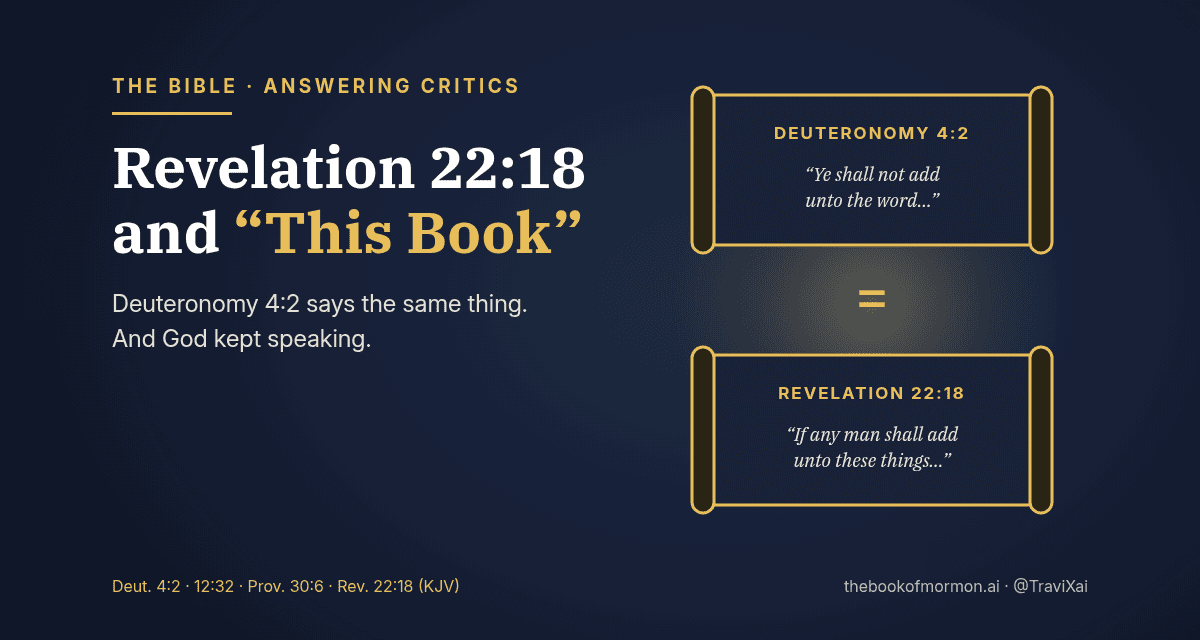

“If any man shall add unto these things…” gets quoted as proof that God stopped speaking. Moses said nearly the same thing centuries earlier, and God kept right on talking. Here’s what “this book” means, and why the warning binds men, not God.
Mention the Book of Mormon online and someone will paste Revelation 22:18 before you finish your sentence. It’s been quoted at me on X more than once this month. The argument is short: the Bible ends with a warning not to add to it, the Book of Mormon adds to it, so the Book of Mormon is cursed.
It sounds airtight until you read the verse slowly and turn back to Deuteronomy. I touched on this in Part IX of The Canon Was Never Meant to Close. This post stays with the verse and its twin in Moses, because the best commentary on Revelation 22:18 is Deuteronomy 4:2 and everything God said after it.
The charge“You can’t add to the Bible”
For I testify unto every man that heareth the words of the prophecy of this book, If any man shall add unto these things, God shall add unto him the plagues that are written in this book: And if any man shall take away from the words of the book of this prophecy, God shall take away his part out of the book of life, and out of the holy city, and from the things which are written in this book.
Revelation 22:18–19 (KJV)
The critic’s reading needs three things: “this book” must mean the whole Bible, Revelation must be the final word God ever gave, and the warning must restrict God, not just people. Fail any one and the argument collapses. It fails all three.
“This book”What John was actually writing
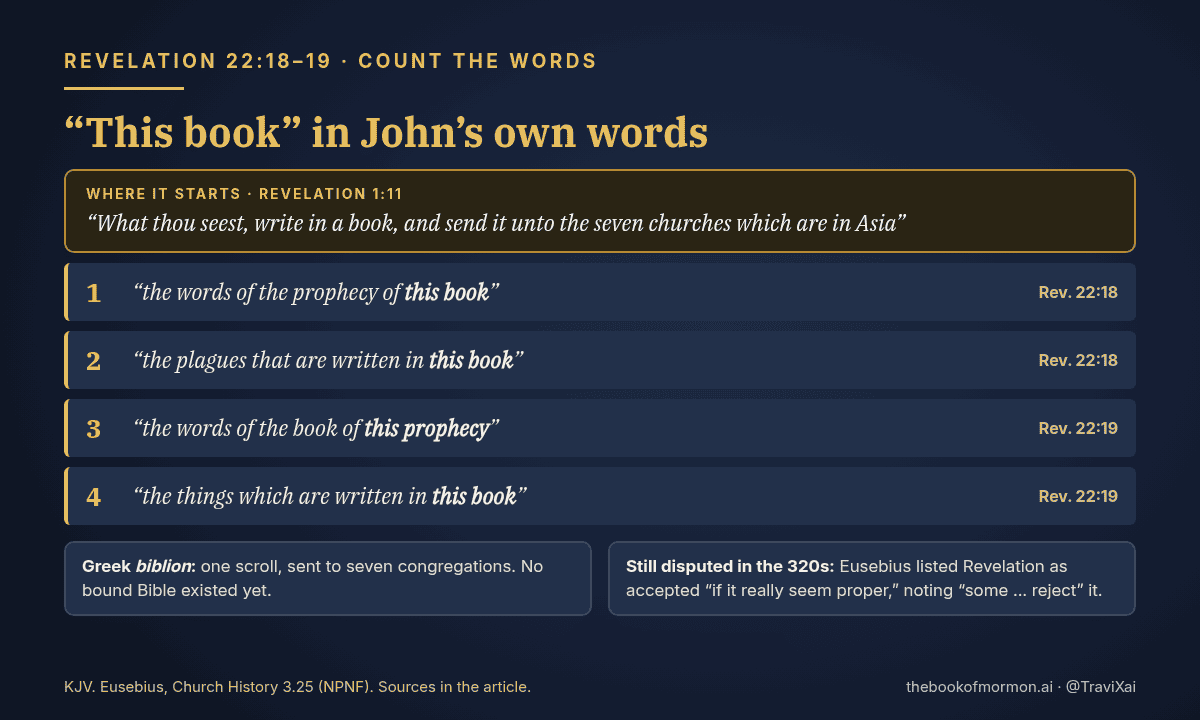
Start where John starts. In the first chapter, the Lord tells him: “What thou seest, write in a book, and send it unto the seven churches which are in Asia” (Revelation 1:11). The word is biblion, a scroll or written document (interlinear). One document, mailed to seven congregations in what is now Turkey.
John then calls it “this prophecy” from start to finish. “Blessed is he that readeth, and they that hear the words of this prophecy” (1:3). “Blessed is he that keepeth the sayings of the prophecy of this book” (22:7). “Seal not the sayings of the prophecy of this book” (22:10). In verses 18 and 19 alone he says “this book” four times, and the Greek is the same biblion (interlinear). He even points to “the plagues that are written in this book,” the plagues he had just described, not anything in Leviticus or Luke.
There was no bound Bible for “this book” to refer to. The New Testament books were separate scrolls in separate cities, and Christians spent centuries deciding which ones belonged. Revelation was one of the slowest. In the 320s the historian Eusebius listed it among the accepted writings only “if it really seem proper,” and in the same passage he put it on his list of rejected books, “if it seem proper,” adding that “some, as I said, reject” it (Church History 3.25).
John could not have been sealing a collection that, two centuries later, still couldn’t agree whether his own book was in it.
Last in the bindingNot necessarily last in time
Revelation sits last in your Bible because of how the books were later arranged, not because it was written last. Irenaeus, writing around AD 180, said John’s vision was seen “towards the end of Domitian’s reign” (Against Heresies 5.30.3), and Revelation is commonly dated to about AD 95 (overview). The Gospel of John is generally dated to the same decade, with the scholarly consensus at AD 90–100 (overview).
Nobody can prove which one John finished first, and I won’t pretend to. But the critic needs Revelation to be the last inspired word ever written, and the evidence doesn’t give him that. If John wrote his Gospel or letters after Patmos, the critic’s reading has John breaking his own rule.
Moses said it firstDeuteronomy 4:2 and 12:32
Now turn to the passage John’s warning echoes. Moses, on the plains of Moab:
Ye shall not add unto the word which I command you, neither shall ye diminish ought from it, that ye may keep the commandments of the Lord your God which I command you.
Deuteronomy 4:2 (KJV)
And again, eight chapters later:
What thing soever I command you, observe to do it: thou shalt not add thereto, nor diminish from it.
Deuteronomy 12:32 (KJV)
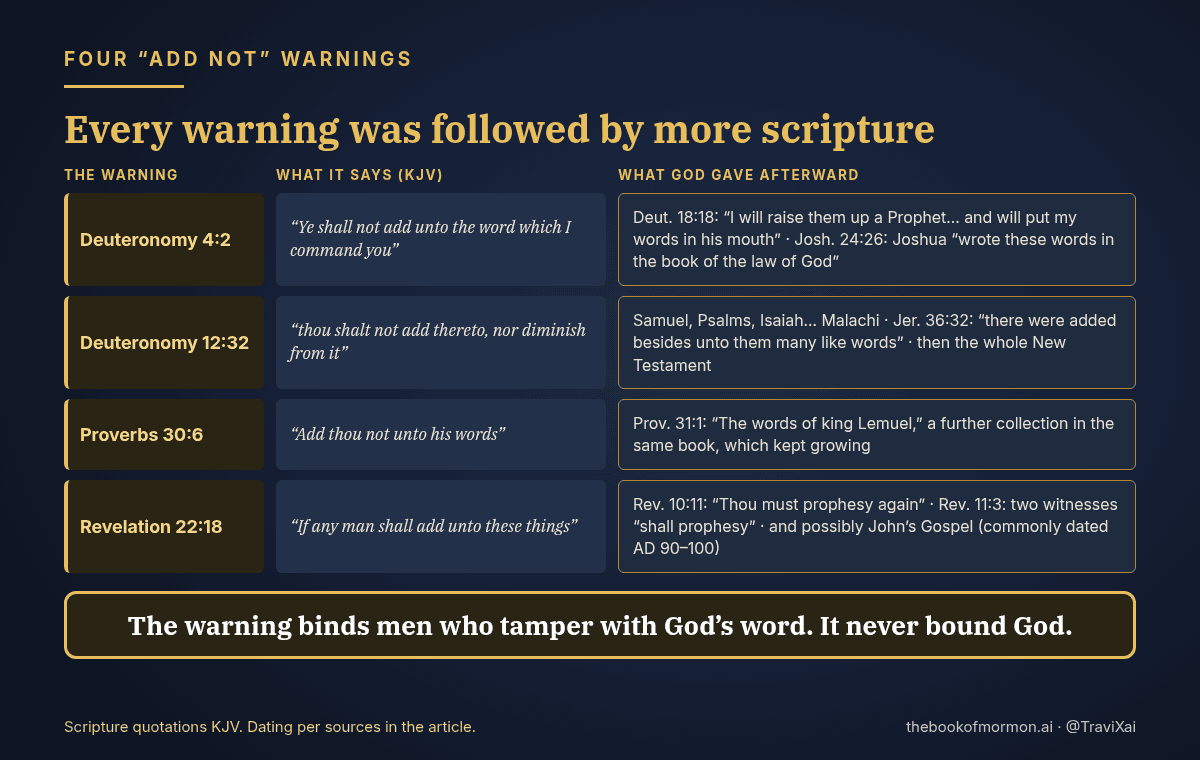
Same structure as Revelation 22: don’t add, don’t take away. If those words in Revelation mean no more scripture, they mean the same in Deuteronomy, and the canon closed in the Bible’s fifth book.
I’ve asked critics on X this question directly: does Deuteronomy 4:2 make Joshua through Revelation illegal additions? I’m still waiting for a yes. Galatians18 makes the same point in its short answer on Revelation 22 and “You can’t add to the Bible”: if “do not add” in Moses closed the canon, you have no New Testament.
After the warningWhat God did next
Here’s the part critics skip: Moses himself kept talking. Deuteronomy 4:2 is followed by thirty more chapters of commandments. And in chapter 18, Moses tells Israel to expect more revelation, not less:
I will raise them up a Prophet from among their brethren, like unto thee, and will put my words in his mouth; and he shall speak unto them all that I shall command him.
Deuteronomy 18:18 (KJV)
“My words in his mouth.” The same God who said “ye shall not add” promised to send a prophet with new words, and told Israel to hearken to him.
Then Moses died, and his successor did what the critic says is forbidden: “Joshua wrote these words in the book of the law of God” (Joshua 24:26). After Joshua came Samuel, David, Isaiah, Jeremiah, Malachi, and then the entire New Testament.
One more example settles who the warning restricts. King Jehoiakim burned Jeremiah’s scroll, and God had Jeremiah write it again:
Then took Jeremiah another roll, and gave it to Baruch the scribe, the son of Neriah; who wrote therein from the mouth of Jeremiah all the words of the book which Jehoiakim king of Judah had burned in the fire: and there were added besides unto them many like words.
Jeremiah 36:32 (KJV)
“There were added besides unto them many like words.” God added to a book of prophecy. A king subtracted from it, and he’s the one Scripture condemns.
Proverbs 30:6A warning inside a growing book
The third proof text usually comes along too:
Add thou not unto his words, lest he reprove thee, and thou be found a liar.
Proverbs 30:6 (KJV)
“Add thou not”: it’s a warning against putting your words in God’s mouth. And look at where it sits. Proverbs 30 is “the words of Agur the son of Jakeh” (Proverbs 30:1), a collection added to Solomon’s proverbs. Right after it comes another one, “The words of king Lemuel” (Proverbs 31:1). Earlier, the book says its chapters 25–29 are proverbs “which the men of Hezekiah king of Judah copied out” (Proverbs 25:1), roughly two centuries after Solomon.
So the warning against adding to God’s words sits inside a book that kept growing after the verse was written.
Who it bindsMen, not God
Read Revelation 22:18 one more time: “I testify unto every man that heareth.” The audience is the hearers and copyists of John’s scroll. Every copy was made by hand, and ancient writers guarded against scribes “improving” their texts. The Letter of Aristeas says the Jews of Alexandria laid a curse on anyone who changed the Greek translation of the Law (overview). Irenaeus closed one of his treatises with: “I adjure you who may copy this book … to compare what you shall write, and correct it carefully by this manuscript” (Eusebius, Church History 5.20.2). Nobody thinks Irenaeus was forbidding God to speak.
Revelation itself expects more prophecy after John. An angel tells him, “Thou must prophesy again before many peoples, and nations, and tongues, and kings” (Revelation 10:11). The Lord promises “my two witnesses, and they shall prophesy” (Revelation 11:3). And at the end, the angel calls himself one “of thy brethren the prophets” (Revelation 22:9). A book that foresees future prophets can’t be the verse that abolishes them.
Does the Book of Mormon “add unto these things”? It doesn’t change a word of John’s prophecy. It’s a separate record, the way Isaiah is separate from Deuteronomy.
The bigger claimNo verse closes the canon
Without Revelation 22:18, the larger claim has nothing to stand on. No verse says the canon is closed, lists the books, or announces that revelation would stop. The list came from men: Athanasius’s Easter letter of AD 367 and the councils of Hippo (393) and Carthage (397), which I documented in The Canon Was Never Meant to Close. When critics remind me the word “Bible” isn’t in the Bible, I agree. Neither is the idea of a closed canon. Both came from councils, not from scripture. (More in Sola Scriptura: Which Verse Teaches It? and Books the Bible Quotes That Aren’t in the Bible.)
The apostles had no plans to close it, because they loved revelation:
Quench not the Spirit. Despise not prophesyings. Prove all things; hold fast that which is good.
1 Thessalonians 5:19–21 (KJV)
Christ “gave some, apostles; and some, prophets … Till we all come in the unity of the faith” (Ephesians 4:11–13). Amos said, “Surely the Lord God will do nothing, but he revealeth his secret unto his servants the prophets” (Amos 3:7). A council of bishops closing the canon is what you’d expect after the apostles and prophets were gone. It is not what the apostles taught. Galatians18 walks through the Bible’s case for continuing revelation and living prophets, and in my Galatians 1:8 post I showed that Paul’s curse tests the message, not whether God may speak again.
SummaryKey takeaways
- “This book” is John’s prophecy, the scroll he was told to “send it unto the seven churches” (Revelation 1:11). Revelation’s own place in the canon was still disputed in the 300s.
- Revelation is last in the binding, not provably last in time (about AD 95; John’s Gospel, AD 90–100).
- Moses gave the same warning (Deuteronomy 4:2; 12:32), then promised a prophet with God’s words in his mouth (18:18).
- God added “many like words” to Jeremiah’s scroll (Jeremiah 36:32).
- The warning binds “every man that heareth,” not God. Revelation itself foresees more prophecy (10:11; 11:3).
Next time someone posts Revelation 22:18 at you, don’t argue about John. Ask about Moses: did Deuteronomy 4:2 make the rest of the Bible an illegal addition? Whatever they answer about Moses answers John too. For quick, sourced replies on this verse and many others, open Galatians18. And for more like this every day, follow me on X at @TraviXai.
Sources
- Scriptures (KJV, churchofjesuschrist.org): Revelation 22:7–19 · Revelation 1:1–11 · Revelation 10:11 · Revelation 11:3 · Deuteronomy 4:2 · Deuteronomy 12:32 · Deuteronomy 18:15–19 · Joshua 24:26 · Jeremiah 36:28–32 · Proverbs 25:1 · Proverbs 30:1–6 · Proverbs 31:1 · 1 Thessalonians 5:19–21 · Ephesians 4:11–13 · Amos 3:7
- Greek interlinear (Bible Hub): Revelation 1:11 · Revelation 22:18
- Eusebius, Church History 3.25 (Revelation among the accepted and the rejected books) and 5.20.2 (Irenaeus’s note to copyists), NPNF translation: New Advent, Book 3 · New Advent, Book 5
- Irenaeus, Against Heresies 5.30.3 (vision seen “towards the end of Domitian’s reign”), ANF translation: New Advent
- Dating: Wikipedia, “Book of Revelation” (commonly dated about AD 95) · Wikipedia, “Gospel of John” (scholarly consensus AD 90–100)
- The curse on altering the Greek Law: Wikipedia, “Letter of Aristeas”
- Related on this site: The Canon Was Never Meant to Close · Sola Scriptura: Which Verse Teaches It? · Books the Bible Quotes That Aren’t in the Bible · Galatians 1:8 in Context (2026 Edition)
- Galatians18: Revelation 22: You Can’t Add to the Bible? · Continuing Revelation and an Open Canon · Living Prophets
- Featured image and both charts: original graphics by thebookofmormon.ai (no photographs or likenesses of real people). Greek as printed in the Bible Hub interlinear.