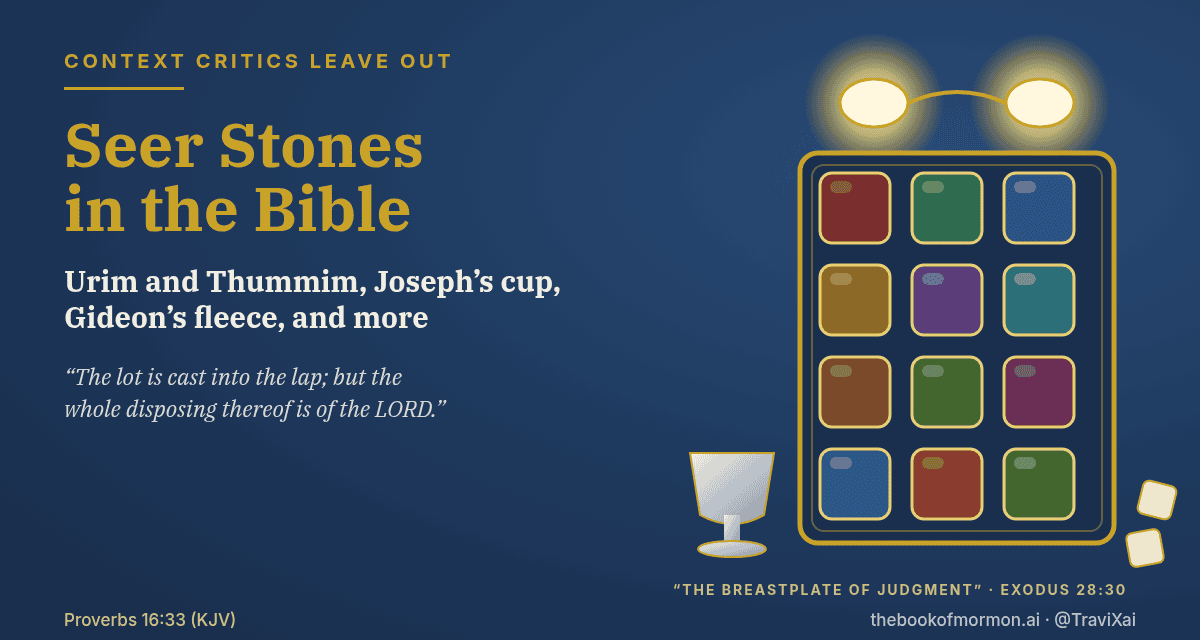

Critics mock Joseph Smith's seer stone as "a rock in a hat." The Bible tells a different story: Urim and Thummim in the high priest's breastplate, Joseph of Egypt's silver cup, Gideon's fleece, apostles casting lots, Aaron's rod, the brass serpent, and Jesus healing with clay. Here is the context critics leave out, plus what the witnesses in the room actually described.
“A rock in a hat.”
Four words, and a critic thinks the debate is over. Joseph Smith looked into a stone to translate the Book of Mormon, so it must be the occult. Case closed.
Except the case was never opened. Open the King James Bible and you’ll find a high priest consulting stones in a breastplate, a patriarch with a silver divining cup, a judge testing God with a wet fleece, apostles choosing a replacement by lot, a bronze snake on a pole, and Jesus Christ healing a blind man with mud He made from His own spit.
None of that makes the Bible occult. It does make “rock in a hat” a lot less clever.
Short version on Galatians18: Did Joseph Use a Seer Stone in a Hat?
The objection, stated fairly
Critics usually point to Deuteronomy 18. Fair enough:
“There shall not be found among you any one that maketh his son or his daughter to pass through the fire, or that useth divination, or an observer of times, or an enchanter, or a witch.”
Deuteronomy 18:10
So the Bible forbids divination. Agreed. But the same five books also command a sacred instrument for getting answers from God. Moses didn’t contradict himself. His line was never “objects bad.” It was about the source: who are you asking, and who is answering?
Keep that question handy. The Bible keeps asking it.
Exhibit A: Urim and Thummim in the high priest’s breastplate
When God designed the high priest’s clothing, He put a revelation instrument right over Aaron’s heart:
“And thou shalt put in the breastplate of judgment the Urim and the Thummim; and they shall be upon Aaron’s heart, when he goeth in before the LORD: and Aaron shall bear the judgment of the children of Israel upon his heart before the LORD continually.”
Exodus 28:30
Moses did it at Aaron’s consecration (Leviticus 8:8). And this was no museum piece. When Joshua succeeded Moses, God tied Israel’s marching orders to it:
“And he shall stand before Eleazar the priest, who shall ask counsel for him after the judgment of Urim before the LORD: at his word shall they go out, and at his word they shall come in.”
Numbers 27:21
When King Saul lost his way, “the LORD answered him not, neither by dreams, nor by Urim, nor by prophets” (1 Samuel 28:6). Dreams, Urim, prophets. Three normal channels of revelation in one breath, and nobody flinches.
After the exile, priests who couldn’t prove their genealogy were told “that they should not eat of the most holy things, till there stood up a priest with Urim and with Thummim” (Ezra 2:63).
What exactly were they? Commentators disagree. The Church’s essay on translation notes that “several ancient sources state that the instrument involved stones that lit up or were divinely illumined.” What we know for sure is that God used them.
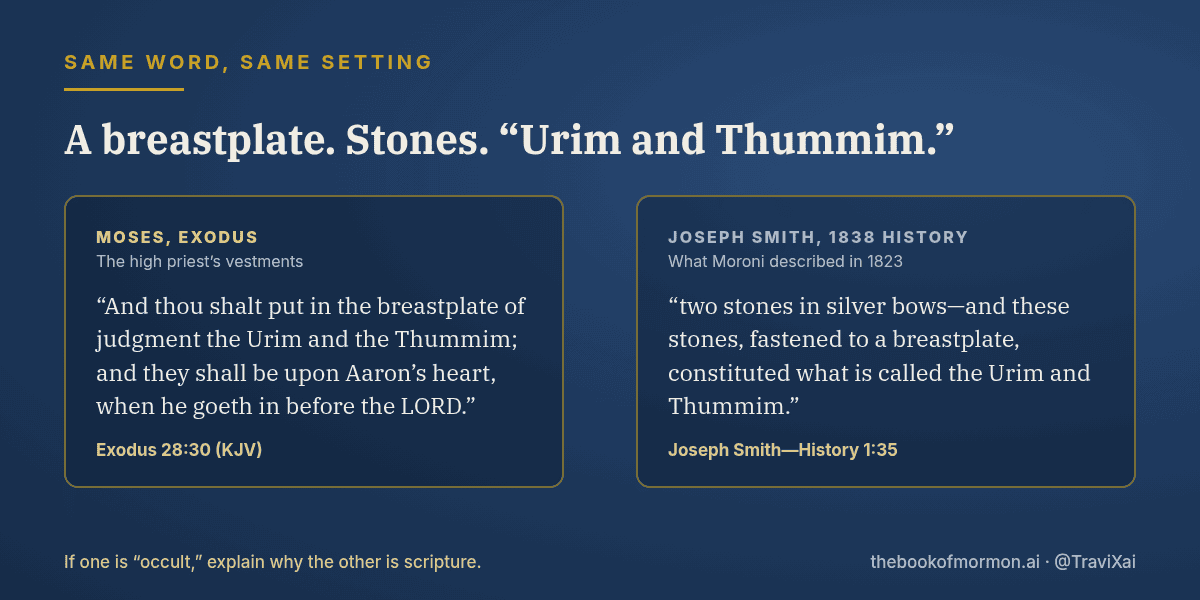
Now set that beside Joseph Smith’s description of what the angel Moroni told him in 1823: “there were two stones in silver bows—and these stones, fastened to a breastplate, constituted what is called the Urim and Thummim.” He added that “the possession and use of these stones were what constituted ‘seers’ in ancient or former times” (Joseph Smith—History 1:35).
That word isn’t Joseph’s invention either. The Bible itself explains it: “he that is now called a Prophet was beforetime called a Seer” (1 Samuel 9:9).
Exhibit B: Joseph’s silver cup
This one surprises people. When Joseph of Egypt tested his brothers, he had his silver cup hidden in Benjamin’s sack. Then he sent his steward after them with a script:
“Is not this it in which my lord drinketh, and whereby indeed he divineth? ye have done evil in so doing.”
Genesis 44:5
When the brothers were dragged back, Joseph said it himself: “wot ye not that such a man as I can certainly divine?” (Genesis 44:15).
To be fair, this is a staged test, and Genesis never shows Joseph using the cup. But Genesis also never apologizes. The man God used to save his family talks openly about divining with a cup, and the narrator moves on.
If that line were in the Book of Mormon, we’d never hear the end of it. It’s in Genesis, so it gets a pass. That’s a double standard.
Exhibit C: Gideon’s fleece
Gideon wanted to know if God really meant to save Israel through him. So he set out a physical object and asked for a sign:
“Behold, I will put a fleece of wool in the floor; and if the dew be on the fleece only, and it be dry upon all the earth beside, then shall I know that thou wilt save Israel by mine hand, as thou hast said.”
Judges 6:37
It worked. He “wringed the dew out of the fleece, a bowl full of water” (6:38). Then he asked God to reverse it, dry fleece and wet ground, “and God did so that night: for it was dry upon the fleece only, and there was dew on all the ground” (6:40).
A man, a piece of wool, and a question for God. Twice. God had two chances to object. He answered instead.
Exhibit D: Lots, a rod, a brass serpent, and mud
The list keeps going.
Lots. When the apostles needed to replace Judas, they prayed, “Thou, Lord, which knowest the hearts of all men, shew whether of these two thou hast chosen,” and then “they gave forth their lots; and the lot fell upon Matthias” (Acts 1:24, 26). Proverbs explains the theology: “The lot is cast into the lap; but the whole disposing thereof is of the LORD” (Proverbs 16:33).
Aaron’s rod. God settled a dispute over the priesthood by making Aaron’s rod bud overnight: it “brought forth buds, and bloomed blossoms, and yielded almonds” (Numbers 17:8). God had it kept “for a token against the rebels” (17:10), and Hebrews puts it inside the ark of the covenant (Hebrews 9:4).
The brass serpent. When fiery serpents struck Israel, God told Moses, “Make thee a fiery serpent, and set it upon a pole: and it shall come to pass, that every one that is bitten, when he looketh upon it, shall live” (Numbers 21:8). Jesus Himself used it as a type of His crucifixion: “as Moses lifted up the serpent in the wilderness, even so must the Son of man be lifted up” (John 3:14).
Clay and spittle. Jesus often healed with a word. With the man born blind, “he spat on the ground, and made clay of the spittle, and he anointed the eyes of the blind man with the clay,” and sent him to wash. “He went his way therefore, and washed, and came seeing” (John 9:6–7).
Even Paul’s handkerchiefs carried healing: “the diseases departed from them” (Acts 19:12).
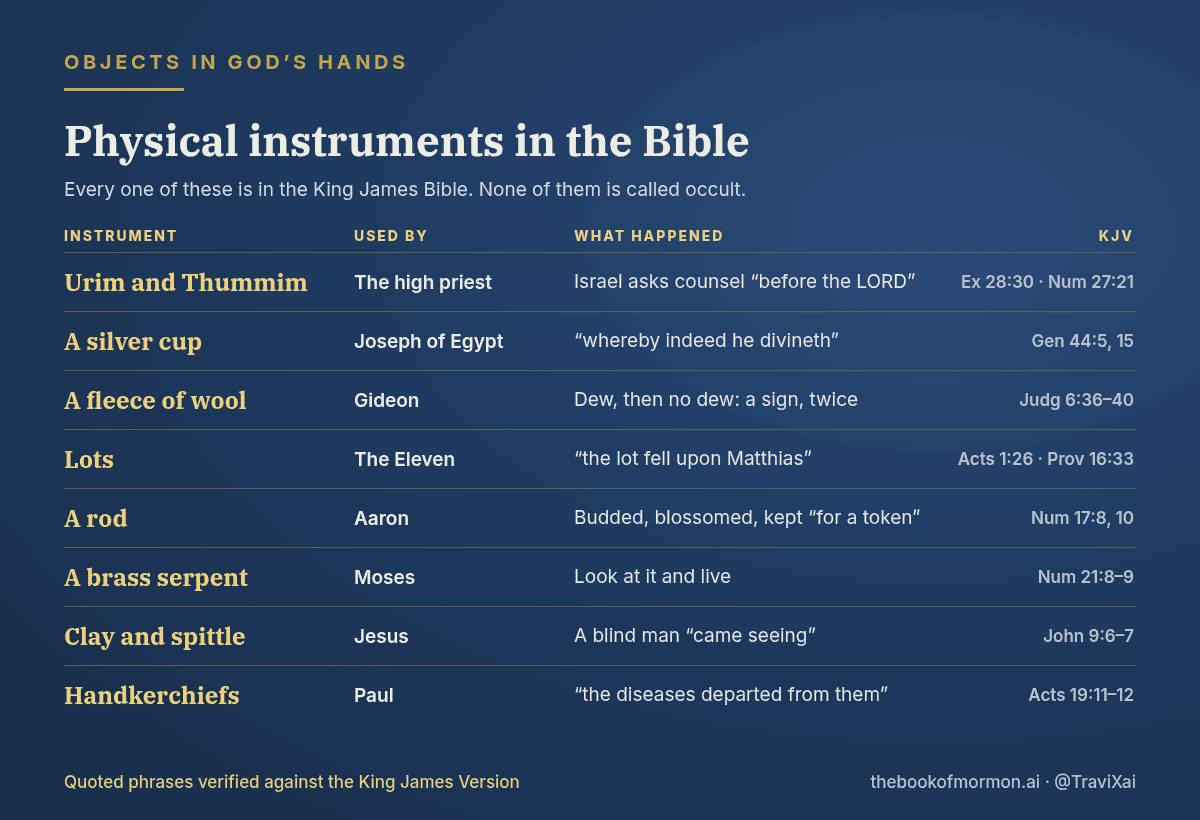
The Church’s translation essay makes the same point, listing “the rod of Aaron, a brass serpent, holy anointing oils, the Ark of the Covenant, and even dirt from the ground mixed with saliva to heal the eyes of a blind man.”
Same object, different source: the Bible’s own test
Here’s the part critics really leave out: the object was never the test.
In Pharaoh’s court, Aaron threw down his rod and it became a serpent. Then Pharaoh’s magicians “did in like manner with their enchantments. For they cast down every man his rod, and they became serpents: but Aaron’s rod swallowed up their rods” (Exodus 7:11–12). Same object, same visible result, different source. The difference wasn’t the stick.
The brass serpent proves it from the other direction. Centuries later, King Hezekiah “brake in pieces the brasen serpent that Moses had made: for unto those days the children of Israel did burn incense to it” (2 Kings 18:4). The object God commanded became a problem only when people worshipped it.
So “Was there a physical object?” is the wrong question. The Bible’s question is “Who gave the answer, and what did it produce?” Jesus gave us the test: “Wherefore by their fruits ye shall know them” (Matthew 7:20).
What Joseph actually did, according to people in the room
Joseph never hid this, and neither does the Church. Its Gospel Topics essay says plainly that Joseph used two instruments, the “interpreters” found with the plates and a seer stone, and that “Joseph placed either the interpreters or the seer stone in a hat, pressed his face into the hat to block out extraneous light, and read aloud the English words that appeared on the instrument.”
That description comes from witnesses, including people with no motive to protect Joseph’s later church.
Emma Smith, who stayed in Illinois and never followed the Saints west, told her son in 1879:
“In writing for your father I frequently wrote day after day, often sitting at the table close by him, he sitting with his face buried in his hat, with the stone in it, and dictating hour after hour with nothing between us.”
“Last Testimony of Sister Emma,” Saints’ Herald, 1879
She added: “He had neither manuscript nor book to read from.” (We covered her full interview in Emma Smith’s Last Testimony.)
David Whitmer, one of the Three Witnesses, had left the Church in 1838. Nearly fifty years later he published a pamphlet explaining why he disagreed with Joseph’s later direction, and he still described the translation this way:
“Joseph Smith would put the seer stone into a hat, and put his face in the hat, drawing it closely around his face to exclude the light; and in the darkness the spiritual light would shine. A piece of something resembling parchment would appear, and on that appeared the writing.”
David Whitmer, An Address to All Believers in Christ (1887)
His conclusion: it was “translated by the gift and power of God, and not by any power of man.”
Oliver Cowdery, the principal scribe, testified in 1831 that Joseph found with the plates “two transparent stones, resembling glass, set in silver bows,” and that “by looking through these, he was able to read in English, the reformed Egyptian characters.”
The hat wasn’t a magic prop. It blocked the light, like cupping your hands around a phone screen in the sun. And the Book of Mormon itself already had a word for a person who used such an instrument by God’s command: “whosoever is commanded to look in them, the same is called seer” (Mosiah 8:13).
“But he used a stone to look for treasure first”
Yes, and the Church says so. The essay acknowledges that “as a young man during the 1820s, Joseph Smith, like others in his day, used a seer stone to look for lost objects and buried treasure,” and that he later “learned that he could use this stone for the higher purpose of translating scripture.”
That history gets its own posts next: treasure seeking in 1820s New England, then the 1826 hearing. (For the cultural backdrop in brief, see Galatians18’s Magic, Folk Religion, and Joseph Smith and Seer Stones in Joseph Smith’s World.)
The real question
The critic’s case only works if you skip the Bible. Put the verses back and “rock in a hat” becomes a harder question: why are the Urim and Thummim scripture in Exodus and “occult” in Harmony, Pennsylvania?
Fruit is the Bible’s test. Apply it. What came out of Joseph’s instrument wasn’t a treasure map or a fortune. It was a book of more than 500 pages testifying of Jesus Christ. Read it, and judge the tree by its fruit.
Sources
- KJV texts (Church edition): Exodus 28:30 · Leviticus 8:8 · Numbers 27:21 · 1 Samuel 28:6 · 1 Samuel 9:9 · Ezra 2:63 · Genesis 44 · Judges 6:36–40 · Acts 1:23–26 · Proverbs 16:33 · Numbers 17:8–10 · Numbers 21:8–9 · John 9:6–7 · Exodus 7:11–12 · 2 Kings 18:4 · Deuteronomy 18:10
- Gospel Topics Essays, “Book of Mormon Translation” (two instruments, hat accounts, Cowdery 1831, Harris, the biblical instruments list, treasure seeking): churchofjesuschrist.org
- Joseph Smith—History 1:35: churchofjesuschrist.org
- Mosiah 8:13: churchofjesuschrist.org
- Joseph Smith III, “Last Testimony of Sister Emma,” Saints’ Herald 26 (October 1, 1879): 289–90. BYU Religious Studies Center reprint (PDF) · FAIR transcription
- David Whitmer, An Address to All Believers in Christ (Richmond, Missouri, 1887): Internet Archive scan
- Joseph Smith Papers, “Seer Stone” topic page: josephsmithpapers.org
- Video: Scripture Central, Knowhy #417: youtube.com
Faithful Latter-day Saints read these sources in more than one way. Our article How the Book of Mormon Was Translated: The Case for the Urim and Thummim weighs Joseph Smith’s and Oliver Cowdery’s firsthand accounts most heavily and concludes he translated with the Nephite interpreters. It is a different faithful view, and it is fine to hold too.
When someone tells you a stone can’t be part of revelation, hand them Exodus 28:30. For short, sourced answers to this and the other arguments critics use most, visit Galatians18.
Follow me on X for more: @TraviXai. And the next time you hear “rock in a hat,” ask which breastplate they’d like to start with.