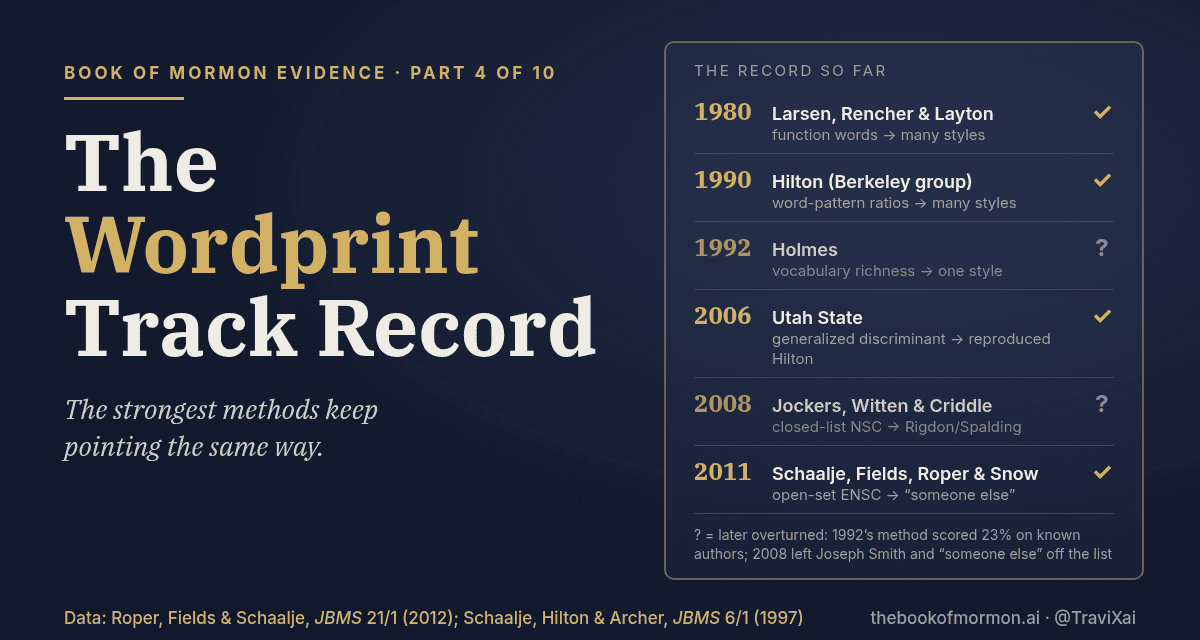

Forty years of Book of Mormon wordprint studies, misses included. Function words and word-pattern ratios keep finding many distinct authors and no match for Joseph Smith. The one study that found a single author used a method that picked the right known author only 23% of the time. Part 4 of 10.
“One witness shall not rise up against a man for any iniquity, or for any sin, in any sin that he sinneth: at the mouth of two witnesses, or at the mouth of three witnesses, shall the matter be established” (Deuteronomy 19:15, KJV). That’s a good rule for scripture, and it’s a good rule for statistics. One study is a data point. A string of studies by different people, using different methods, is a track record. Book of Mormon wordprint research now has more than forty years of one, including a study that concluded Joseph Smith wrote the book. So let’s look at the whole record, the misses included.
In this series: Book of Mormon Evidence (10 parts)
- Part 1: 149 Voices
- Part 2: The Berkeley Wordprint Test
- Part 3: The “Someone Else” Problem
- Part 4: The Wordprint Track Record (you are here)
- Part 5: One Draft (coming soon)
- Part 6: Older Than King James (coming soon)
- Part 7: Alma 36, Built as a Mirror (coming soon)
- Part 8: Nahom (coming soon)
- Part 9: Could the Plates Work? (coming soon)
- Part 10: The Witnesses Who Never Recanted (coming soon)
This started as a post on X, Part 4 of my 10-part Book of Mormon Evidence series. This is the longer version. If you missed it, Part 3: The “Someone Else” Problem covers the 2008 Stanford study and the fix that came after it.
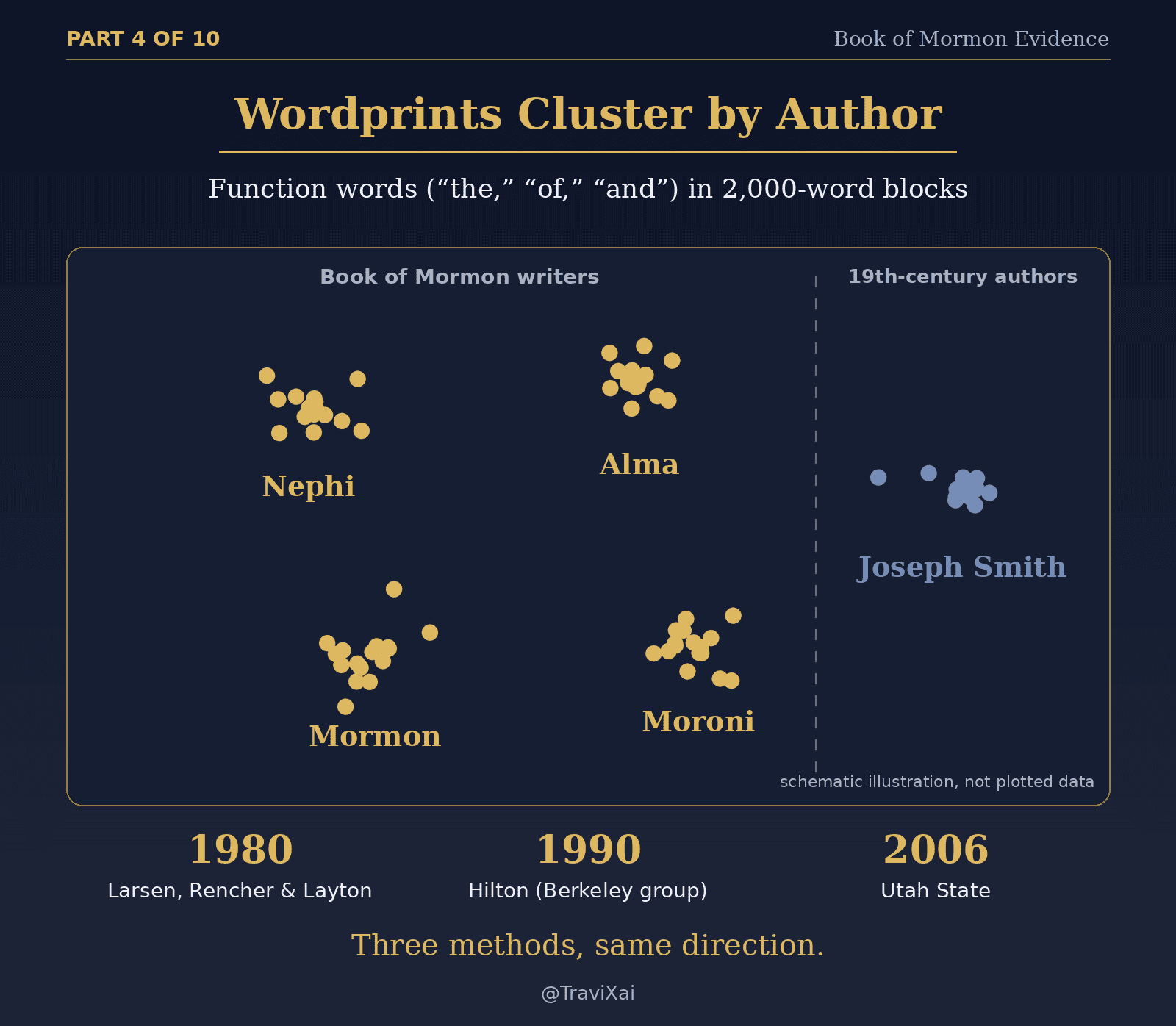
1980: the first computer wordprint
The first big computer wordprint study of the Book of Mormon was “Who Wrote the Book of Mormon? An Analysis of Wordprints,” by Wayne A. Larsen, Alvin C. Rencher, and Tim Layton, published in BYU Studies in 1980. They took their cue from the statisticians Frederick Mosteller and David Wallace, who had used small “noncontextual” words to settle who wrote the disputed Federalist Papers.
Noncontextual words are the little words that hold sentences together: “the,” “of,” “and,” “with,” “without.” Writers use them by habit, not by plan, which makes them hard to fake. The Larsen team sorted the Book of Mormon by speaker and writer, then counted 38 of these words in blocks of text. In the 1980 paper the 24 Book of Mormon authors they tested were split into 251 blocks of about 1,000 words each.
They ran three different statistical techniques (multivariate analysis of variance, cluster analysis, and discriminant analysis) and compared the Book of Mormon writers against six nineteenth-century candidates: Joseph Smith, Sidney Rigdon, Solomon Spaulding, Oliver Cowdery, W. W. Phelps, and Parley P. Pratt.
Their findings, in their own words:
- “Distinct authorship styles can be readily distinguished within the Book of Mormon.”
- “The nineteenth-century authors do not resemble Book of Mormon authors in style.”
On their plots, the Book of Mormon writers and the nineteenth-century writers “could be cleanly separated by a straight line,” which they called “an extremely rare occurrence in discriminant analysis studies.”
They also asked the obvious question. If one man wrote it, how did he keep dozens of word rates varying by speaker, shuffled across the whole book, “more than a century before scholars realized that word frequencies might vary with authors”?
To be fair, the 1980 paper also said, “our study has shown conclusively that there were many authors who wrote the Book of Mormon.” Even its friends call that “somewhat overstated.” Roper, Fields, and Schaalje, writing in 2012, still say “it is hard to disagree” with the main conclusion. A first study makes a claim. Later studies decide whether it holds.
1990 and 2006: the recounts
The first recount came from Berkeley. John L. Hilton led a group that Scripture Central describes as “most of whom were not LDS.” They threw out the 1980 method and built their own, using 65 word-pattern ratios in 5,000-word blocks with a large set of control texts. I covered that study in Part 2. Its conclusion: “it is statistically indefensible to propose Joseph Smith or Oliver Cowdery or Solomon Spaulding as the author” of the Nephi and Alma texts it tested.
The second came from Utah State University. In 2006 Todd K. Moon, Peg Howland, and Jacob H. Gunther presented a study at a SIAM data-mining conference using generalized discriminant analysis, which extends the method the Larsen team used. According to the 2012 review, it reproduced the Berkeley results again.
That makes three teams and three methods, and all of them landed in the same place.
The study that disagreed
Not every study agreed. For his doctoral dissertation at Bristol Polytechnic in 1985, David Holmes analyzed the Book of Mormon with five measures of “vocabulary richness.” These include how often a writer uses a word only once or only twice in a text. He published the work in 1992 in the Journal of the Royal Statistical Society.
Holmes found “no real difference between Alma’s richness of vocabulary and Mormon’s richness of vocabulary,” and wrote, “This study has therefore not found any evidence of multiple authorship within the Book of Mormon itself.” Scripture Central’s summary puts it plainly: “He concluded that Joseph Smith himself wrote the text.”
It’s a real, peer-reviewed study, so it deserves more than a wave of the hand. One detail stands out. According to the 2012 review, Holmes found that “the Joseph Smith texts clustered together.” Joseph’s own diaries and histories stood apart. What Holmes grouped with the Book of Mormon was the Doctrine and Covenants and the Book of Abraham, texts Joseph presented as revelation and translation.
The bigger issue is the logic. Roper, Fields, and Schaalje point out that Holmes’s conclusion is an argument from silence: “I did not find a difference so there must not be a difference.” A smoke detector with a dead battery doesn’t prove the house isn’t on fire. Before you trust a tool’s silence, you have to know whether the tool can hear anything.
Test the tool before you trust the verdict
“A false balance is abomination to the LORD: but a just weight is his delight” (Proverbs 11:1). Before you weigh the Book of Mormon, check the scale.
That’s what G. Bruce Schaalje, John L. Hilton, and John B. Archer did in a 1997 paper in the Journal of Book of Mormon Studies. They took all three kinds of measures (Holmes’s vocabulary richness, Larsen’s word rates, and Hilton’s word-pattern ratios), ran them through one statistical method so nobody’s math got special treatment, and pointed them at 5,000-word texts whose authors nobody disputes: Mark Twain, Samuel Johnson, Robert Heinlein, Oliver Cowdery, Joseph Smith, and the scholar and translator Harry Steinhauer.
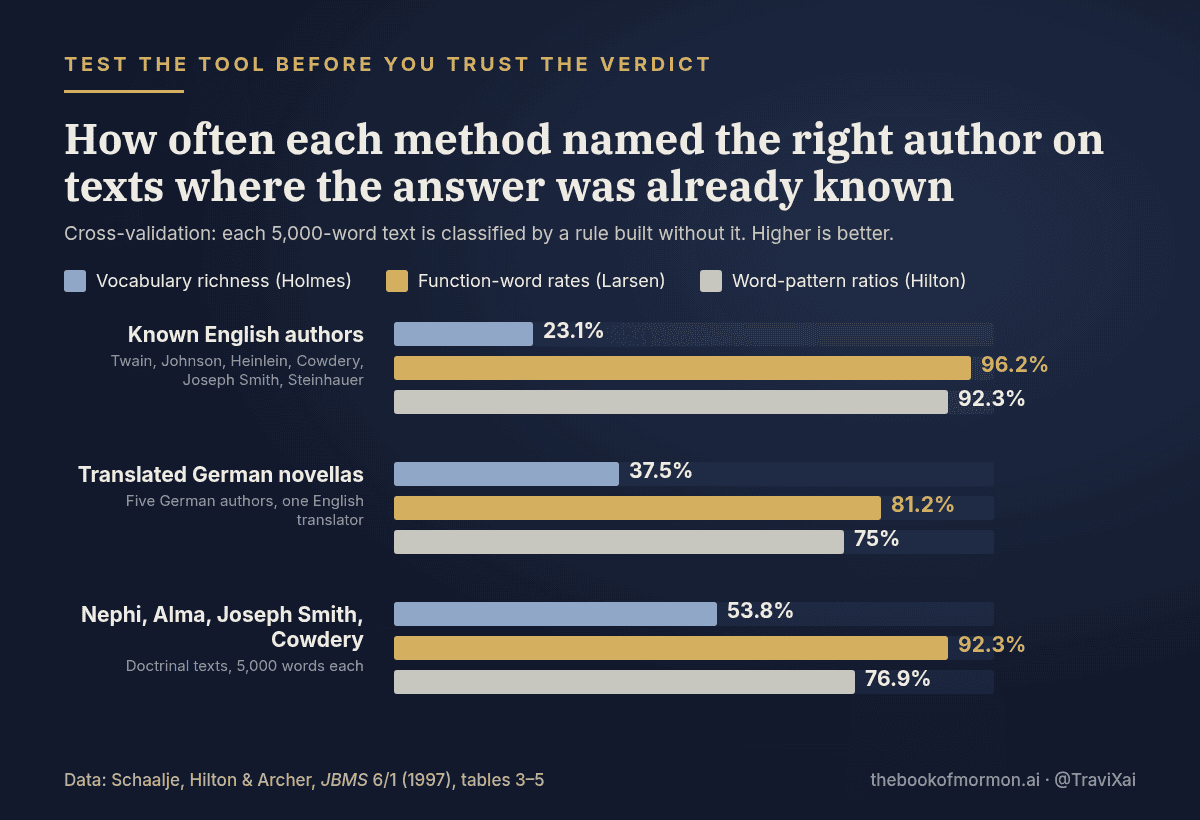
When each text had to be identified by a rule built without it, here is how often each method named the right author:
- Vocabulary richness: 23.1 percent
- Function-word rates: 96.2 percent
- Word-pattern ratios: 92.3 percent
Vocabulary richness got the right author less than a quarter of the time. The authors note that it couldn’t even separate “texts written in such different genres and time periods as those attributed to Samuel Johnson and Robert Heinlein.” By that measure, an eighteenth-century dictionary maker and a twentieth-century science-fiction writer look like the same person.
What a translator does to a wordprint
The most interesting test in the 1997 paper used translations. Steinhauer had translated German novellas by several different authors into English. Vocabulary richness found that the translated texts of four of those authors “were indistinguishable.” Function words and word-pattern ratios still told them apart.
Then they tried the King James New Testament, a translation from Greek. Other than the Gospel of John, vocabulary richness found “few differences attributable to authors.” If you went by vocabulary richness alone, you might decide one person wrote most of the New Testament.
Finally, they tested Nephi and Alma, along with Joseph Smith and Oliver Cowdery. The pattern held. Nephi and Alma looked alike on vocabulary richness but were distinct from each other on function words and word-pattern ratios. Joseph and Oliver were distinct from both.
That is exactly what you’d expect from a book written by many authors and translated by one man. One translator supplies the English vocabulary, so the vocabulary looks uniform. The deeper habits of each writer still show through. The authors concluded that this pattern “is completely consistent with Joseph Smith’s educational level and his account of the translation process.”
Holmes himself later found the limits of the method. In a 1995 reanalysis of the Federalist Papers with R. S. Forsyth, he found vocabulary richness measures “comparatively less effective discriminators of authorship than noncontextual word frequencies,” as the 2012 review summarizes it. The stylometrist David L. Hoover went further in 2003: “The basic assumption that underlies it is false.”
The scorecard
- 1980, Larsen, Rencher & Layton (function words): many distinct styles; nineteenth-century candidates don’t match.
- 1990, Hilton and the Berkeley group (word-pattern ratios): same conclusion with a new method and large controls.
- 1992, Holmes (vocabulary richness): no difference found. The method was later shown to pick the right known author 23 percent of the time.
- 2006, Utah State (generalized discriminant analysis): reproduced Hilton’s results.
- 2008, Jockers, Witten & Criddle (closed-list classification): pointed to Rigdon and Spalding, with Joseph Smith and “none of the above” left off the list (see Part 3).
- 2011, Schaalje, Fields, Roper & Snow (open-set classification): with “someone else” allowed, most chapters went there.
The two studies that pointed to a nineteenth-century author both had problems that were found and documented. The methods that passed their tests on known texts all point the same way. In Scripture Central’s words, “when viewed collectively, there is plenty of corroborating data to confirm the most fundamental conclusions of these studies.”
The objections, answered up front
You might think this is BYU checking BYU’s work. But the Berkeley group was mostly not LDS, the 2006 recount came from Utah State, and the 1997 test used Holmes’s own measures on texts anyone can check. Twain and Heinlein don’t belong to any church’s research team.
You might think a gifted writer could fake many voices. But faking vocabulary is one thing. Faking dozens of function-word rates, author by author, across a book dictated without a second draft, is another. That’s also why borrowed phrases are a different question. Phrase-matching claims like the Late War theory count shared wording, while wordprints measure the unconscious habits underneath it.
You might think I’m saying a computer proved the Book of Mormon true. But the researchers are clear that it can’t. Roper, Fields, and Schaalje note that although stylometry is sometimes called wordprint analysis, “implying that it is a linguistic equivalent to fingerprint analysis,” it “does not have the same identifying capability.” The most it can say is that a text was “more likely written by author X than by author Y.”
What the record does and doesn’t show
Stylometry can’t name the ancient authors, and it can’t tell you whether an angel showed Joseph Smith the plates. What forty years of it can say is narrower and still important. The book shows many distinct writing styles, those styles line up with the writers the book names, and the usual nineteenth-century suspects, Joseph included, don’t match. The 2012 review ends this way: “the claims thus far put forward for alternative authorship of the Book of Mormon, other than as described by Joseph Smith, are untenable.”
That should at least retire the line that the book is obviously a nineteenth-century novel. Paul’s advice still fits: “Prove all things; hold fast that which is good” (1 Thessalonians 5:21). The wordprint record is one way of proving. The book invites a better one, which is reading it and asking God.
Watch: the short version
Scripture Central’s short video on the same history, from the 1980 study to the 2011 fix.
Next: One Draft
About 269,500 words, dictated in roughly three months. Part 5: One Draft looks at the translation timeline, coming tomorrow.
Credit where it’s due
Thanks to Larsen, Rencher, and Layton for starting the field; to Hilton, Schaalje, Archer, Fields, and Roper for testing the tools on known texts before trusting them; to David Holmes for a serious published challenge that made everyone measure the methods themselves; and to Scripture Central for the KnoWhy and video.
For more like this, follow me on X at @TraviXai. And if someone answers all this with Galatians 1:8, the Galatians 1:8 app is ready for that conversation.
Sources
- Wayne A. Larsen, Alvin C. Rencher, and Tim Layton, “Who Wrote the Book of Mormon? An Analysis of Wordprints,” BYU Studies 20, no. 3 (1980): 225–51: scholarsarchive.byu.edu (BYU Studies)
- John L. Hilton, “On Verifying Wordprint Studies: Book of Mormon Authorship,” BYU Studies 30, no. 3 (1990): 89–108: byustudies.byu.edu
- David I. Holmes, “A Stylometric Analysis of Mormon Scripture and Related Texts,” Journal of the Royal Statistical Society, Series A 155, no. 1 (1992): 91–120: doi:10.2307/2982671
- G. Bruce Schaalje, John L. Hilton, and John B. Archer, “Comparative Power of Three Author-Attribution Techniques for Differentiating Authors,” Journal of Book of Mormon Studies 6, no. 1 (1997): 47–63: scholarsarchive.byu.edu (full text)
- Matthew Roper, Paul J. Fields, and G. Bruce Schaalje, “Stylometric Analyses of the Book of Mormon: A Short History,” Journal of Book of Mormon Studies 21, no. 1 (2012): 28–45: scholarsarchive.byu.edu (PDF)
- “What Can Stylometry Tell Us about Book of Mormon Authorship?” Scripture Central KnoWhy #389 (2020): scripturecentral.org
- Scriptures: Deuteronomy 19:15, Proverbs 11:1, 1 Thessalonians 5:21 (KJV)
- Previous in the series: Part 3: The “Someone Else” Problem
- The original X post: x.com/TraviXai