


Critics have laughed at Alma 7:10 since 1831. Read the verse closely and look at who’s speaking, who’s listening, and how ancient texts talk about Jerusalem, and the “mistake” starts to look like evidence.
The most famous “gotcha” in the Book of Mormon is probably this verse:
“And behold, he shall be born of Mary, at Jerusalem which is the land of our forefathers, she being a virgin, a precious and chosen vessel, who shall be overshadowed and conceive by the power of the Holy Ghost, and bring forth a son, yea, even the Son of God.” (Alma 7:10)
The critics’ version is simple. Jesus was born in Bethlehem. Any Sunday School kid knows that. The Book of Mormon says Jerusalem. So Joseph Smith made a mistake, and the book is a fraud.
It’s an old argument. Alexander Campbell, one of the first critics to write a full review of the Book of Mormon, put it in print in February 1831 (“Delusions,” Millennial Harbinger, p. 93), less than a year after the book came out. Almost 200 years later, it still shows up in replies.
The argument only works if you skip almost everything about the verse. Who’s speaking, who he’s talking to, when, what those people knew, what the words “at” and “land of” mean, and how ancient writers actually talked about Jerusalem. Put those back and the verse reads very differently.
Part 1: Who’s talking, and to whom?
The speaker: Alma the Younger
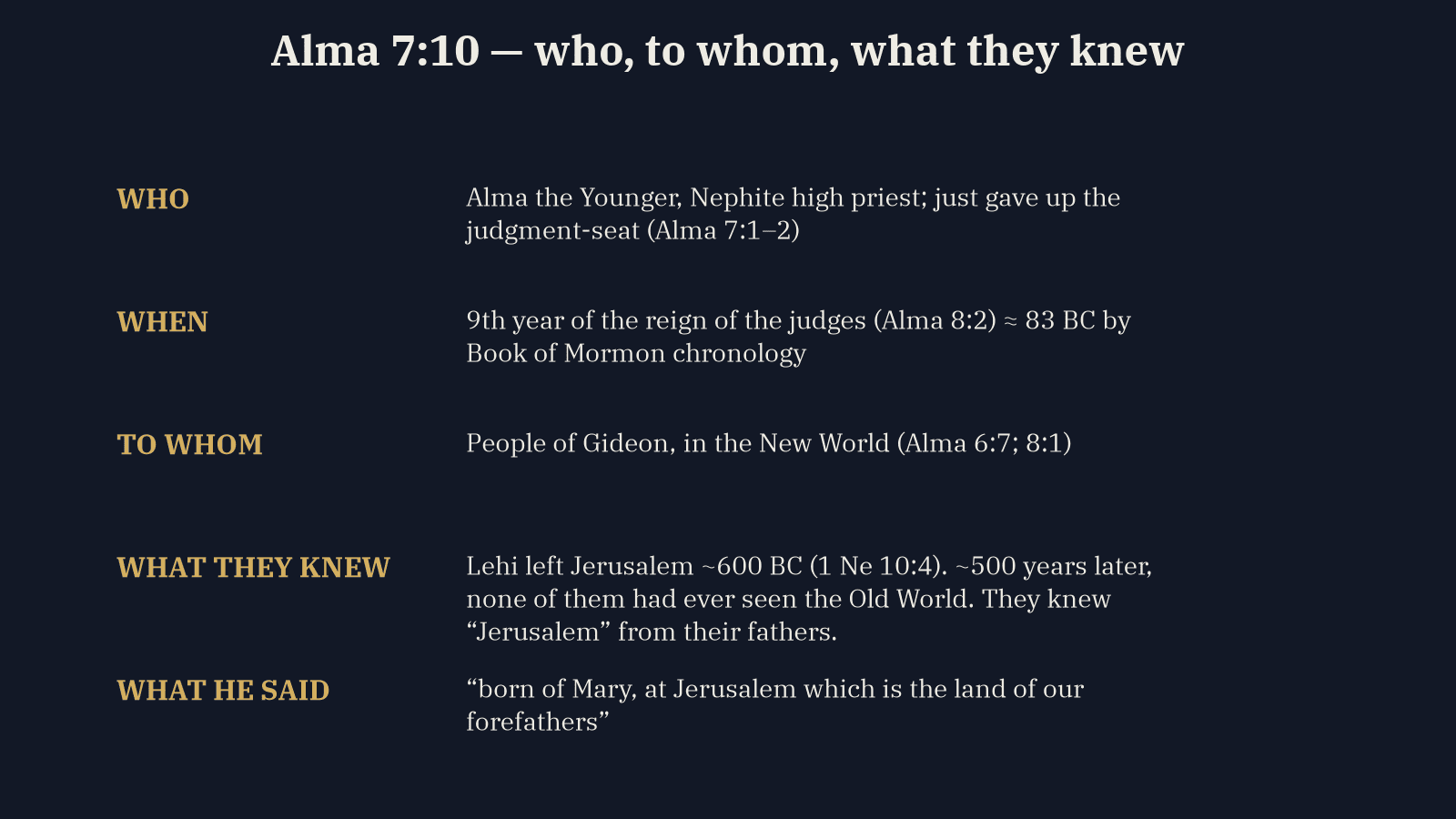
Alma 7 is a sermon by Alma the Younger, the Nephite high priest who had just handed the judgment-seat to someone else so he could preach full time (Alma 4:16–20; 7:1–2). He tells his listeners it’s “the first time that I have spoken unto you by the words of my mouth” (Alma 7:1).
When? Alma 8:1–2 says that after teaching the people of Gideon he went home, “and thus ended the ninth year of the reign of the judges over the people of Nephi.” The reign of the judges began about 91 BC by the Book of Mormon’s own chronology (the footnote dates in the current edition), so the sermon lands around 83 BC.
The audience: the people of Gideon
Alma had gone “over upon the east of the river Sidon, into the valley of Gideon” (Alma 6:7). These are Nephites. They live in the Americas. Their ancestors were born there, and so were their grandparents’ grandparents.
How far back does that go? Lehi’s family left Jerusalem in “the first year of the reign of Zedekiah, king of Judah” (1 Nephi 1:4), and Nephi says the Messiah would come “six hundred years from the time that my father left Jerusalem” (1 Nephi 10:4). By Alma’s day that’s more than 500 years. Twenty-plus generations.
Not one person in that valley had ever seen Judea. Not one had ever walked from Jerusalem to anywhere. What they had was records: the brass plates, Nephi’s writings, and the stories their fathers told. And in those records, the old country has a name.
Part 2: “At Jerusalem which is the land of our forefathers”
Read the clause slowly. Alma doesn’t say “in the city of Jerusalem.” He says “at Jerusalem,” and then explains what he means: “which is the land of our forefathers.”
He’s not naming a street address. He’s naming the homeland. The “land of our forefathers” is the country Lehi came from, the place every Nephite knew by one name.
The word “at” matters too. In English, “at” often means “in the area of” rather than “inside.” When we say a soldier is “stationed at Fort Bragg” or a family “lives at Lake Tahoe,” we don’t mean one building. We mean the area.
Part 3: The Book of Mormon treats “the land of Jerusalem” as a region
This isn’t one stray phrase in Alma. The Book of Mormon uses “land of Jerusalem” over and over, and it consistently means the region around the city, not the city itself.
The clearest case is right at the start. Lehi’s sons are sent back for the brass plates:
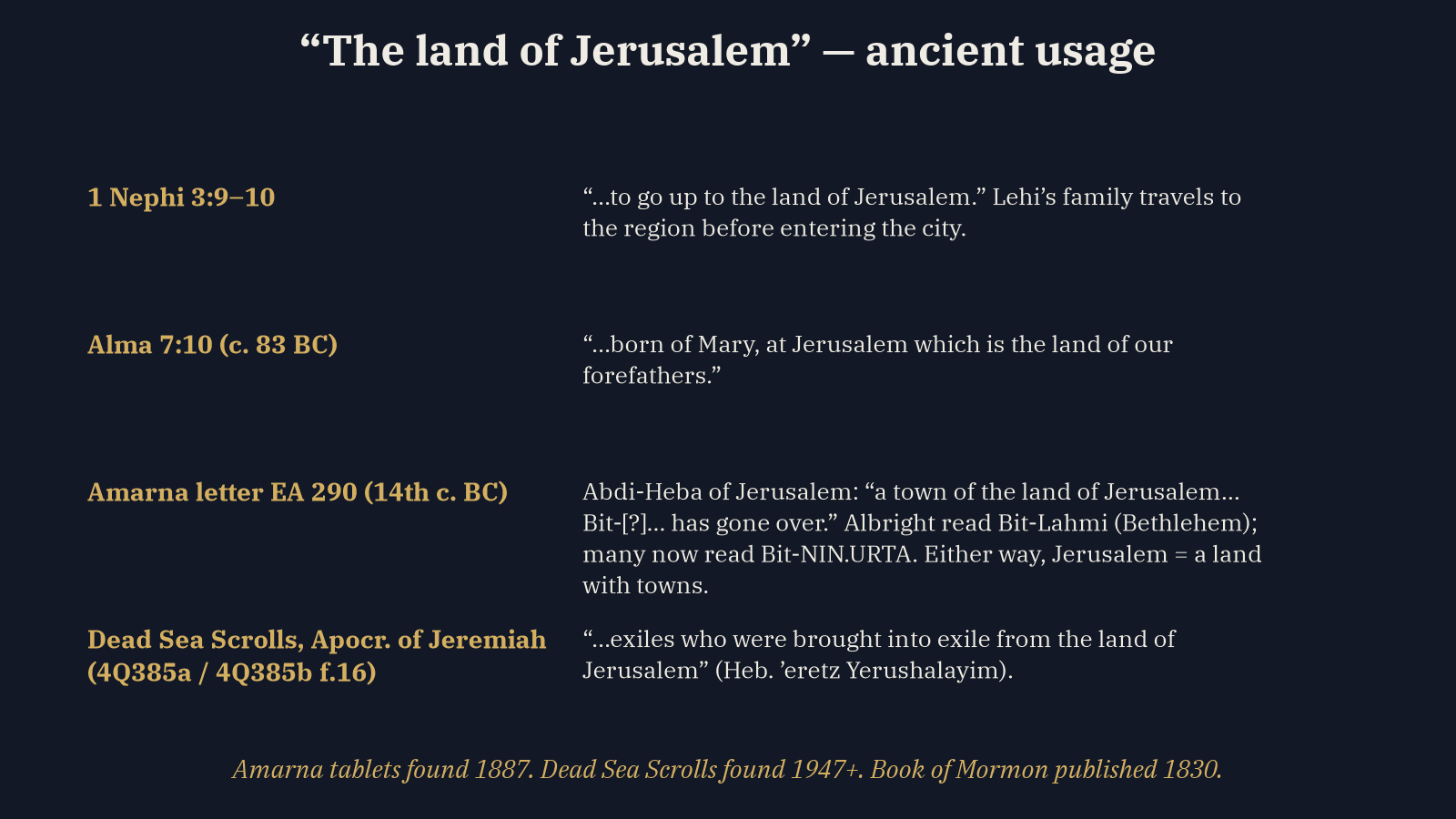
“And I, Nephi, and my brethren took our journey in the wilderness, with our tents, to go up to the land of Jerusalem. And it came to pass that when we had gone up to the land of Jerusalem, I and my brethren did consult one with another.” (1 Nephi 3:9–10)
They’ve arrived in the “land of Jerusalem,” but they still aren’t in the city. They cast lots, and Laman goes to Laban’s house (1 Nephi 3:11). Later, after Laban takes their gold and silver, they go “down to the land of our inheritance” to gather their family’s wealth (1 Nephi 3:16, 22) and then “went up again unto the house of Laban” (1 Nephi 3:23). Lehi’s family estate was in the land of Jerusalem, but outside the walls.
So by the time we get to Alma 7, the Book of Mormon has been using “Jerusalem” as both a city and a land for hundreds of pages. Alma, a Nephite, is speaking Nephite. And the Nephites did the same thing with their own places: there’s a land of Zarahemla and a city of Zarahemla, a land of Nephi and a city of Nephi, a land of Gideon and a city of Gideon. In Alma 8:7 the text even explains that “it was the custom of the people of Nephi to call their lands, and their cities… after the name of him who first possessed them.”
A city-and-land of the same name is how this whole book thinks about geography. Robert F. Smith pointed out that the King James Bible gives Joseph almost nothing to copy here: the closest thing is 2 Samuel 5:6, “the king and his men went to Jerusalem unto the Jebusites, the inhabitants of the land.” Hardly a model for a whole system of city-lands.
Part 4: Ancient texts that talk the same way
Here’s where it gets interesting. In 1829 nobody had good evidence that people in the ancient world called the territory around Jerusalem “the land of Jerusalem.” Now we have some.
The Amarna letters (14th century BC)
In 1887, a large archive of clay tablets turned up at Tell el-Amarna in Egypt. They’re diplomatic letters, mostly in Akkadian, sent to the pharaohs Amenhotep III and Akhenaten by kings and governors across the Near East. Several come from Abdi-Heba, the ruler of Jerusalem, centuries before David.
Abdi-Heba writes of Jerusalem as a land. EA 287 has the pharaoh placing his name “in Jerusalem forever,” so “he cannot abandon it—the land of Jerusalem.” And in EA 290 he complains:
“And now, moreover, a town of the land of Jerusalem… a city of the king, has deserted to where the men of Keilah are.” (EA 290, adapted from the Oracc online edition)
What town? This is where we need to be careful. The name is written with a logogram that has been read different ways:
- W. F. Albright read it as Bit-Lahmi, and called it “an almost certain reference to the town of Bethlehem, which thus appears for the first time in history” (in Pritchard, Ancient Near Eastern Texts). Book of Mormon Central/Scripture Central follows that reading and lists other non-LDS scholars who accept it.
- Many Assyriologists read it as Bit-NIN.URTA, “house of Ninurta.” Bob Becking’s 2023 Anchor Yale Bible commentary on Micah says the Bethlehem identification “is uncertain,” and notes Koch’s view that it’s Baalah/Kiriath-Jearim, about 18 km west of Jerusalem.
So don’t let anyone tell you the Amarna letters name Bethlehem as a fact. That’s disputed. But notice what isn’t disputed: Jerusalem’s own king calls his territory “the land of Jerusalem,” and talks about other towns as belonging to it. If the town is Bethlehem, the parallel to Alma 7:10 is almost perfect. If it’s Kiriath-Jearim, eleven miles out, then “the land of Jerusalem” reached even farther, and Bethlehem, at five miles, is comfortably inside it. Either reading supports the use of language that critics in 1831 thought was a blunder.
Hugh Nibley pointed to this letter back in 1957 (An Approach to the Book of Mormon), and Robert F. Smith developed it in Reexploring the Book of Mormon (FARMS, 1992, pp. 170–172).
The Dead Sea Scrolls (found starting in 1947)
Among the Qumran fragments is a group of texts about the prophet Jeremiah, usually called the Apocryphon of Jeremiah (Robert Eisenman and Michael Wise called it “Pseudo-Jeremiah” in 1992). One fragment reads:
“[… and] Jeremiah the prophet [went] from before YHWH, [… the] exiles who were brought into exile from the land of Jerusalem…” (García Martínez and Tigchelaar, The Dead Sea Scrolls Study Edition, 1999)
The Hebrew is me’eretz Yerushalayim, “from the land of Jerusalem.” The fragment has been labeled differently in different editions (4Q385, 4Q385a, and 4Q385b frag. 16 all show up), so if you look it up, check which edition you’re reading.
Two honest caveats. First, this text doesn’t mention Bethlehem or Jesus. Second, critics argue “land of Jerusalem” there might mean little more than the city. Eisenman and Wise read it more broadly, as the area around Jerusalem that made up Judah after the exile. Either way, here’s a Jewish text, about Lehi’s own contemporary Jeremiah, using the exact phrase the Book of Mormon uses. That’s what Joseph supposedly got wrong.
Archaeology: Bethlehem tied to Jerusalem
In 2012 a small clay seal impression (a bulla) found in the City of David excavations in Jerusalem was published by Ronny Reich (Israel Exploration Journal 62, 2012). His reading includes the name Bethlehem, and he dated it to the 8th–7th century BC, close to Lehi’s time, and took it as a tax shipment from Bethlehem to the king in Jerusalem. Neal Rappleye at Book of Mormon Central drew the connection to Alma 7:10. Here too, be careful: Becking calls the “Bethlehem” reading “far from certain.” It’s interesting. It’s not a slam dunk.
The bigger point doesn’t depend on any one artifact. Bethlehem was a small town in the hills just south of Jerusalem, in the orbit of the capital. In Lehi’s day it was David’s hometown and not much else.
Part 5: How far is Bethlehem from Jerusalem?
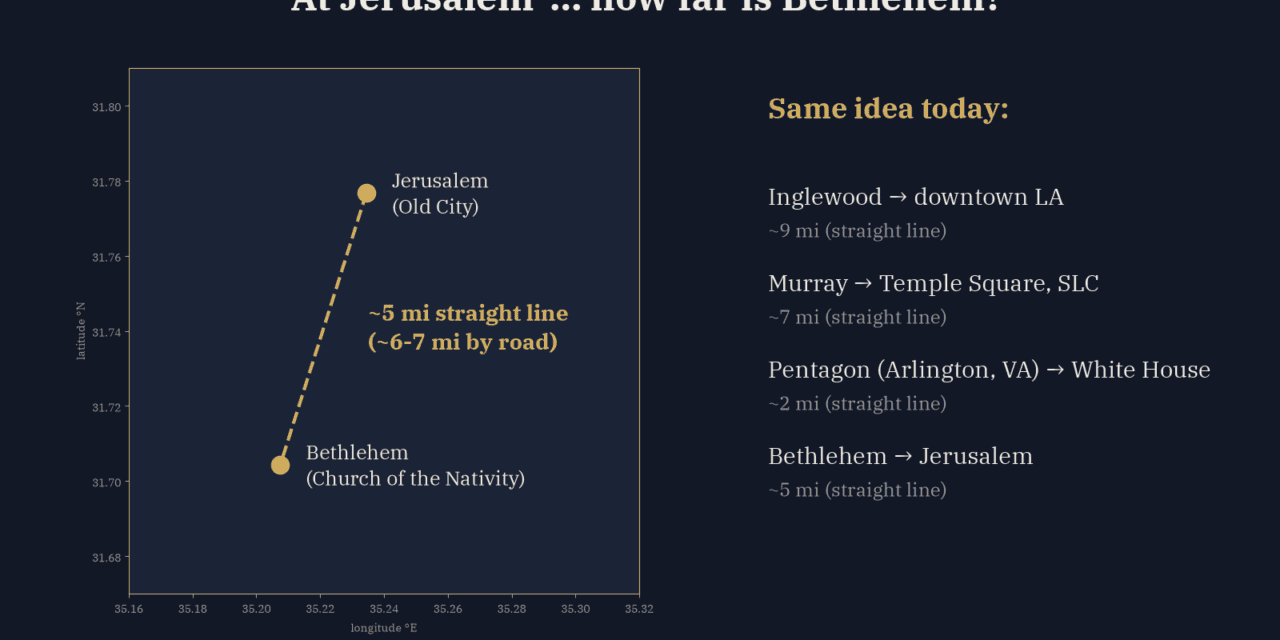
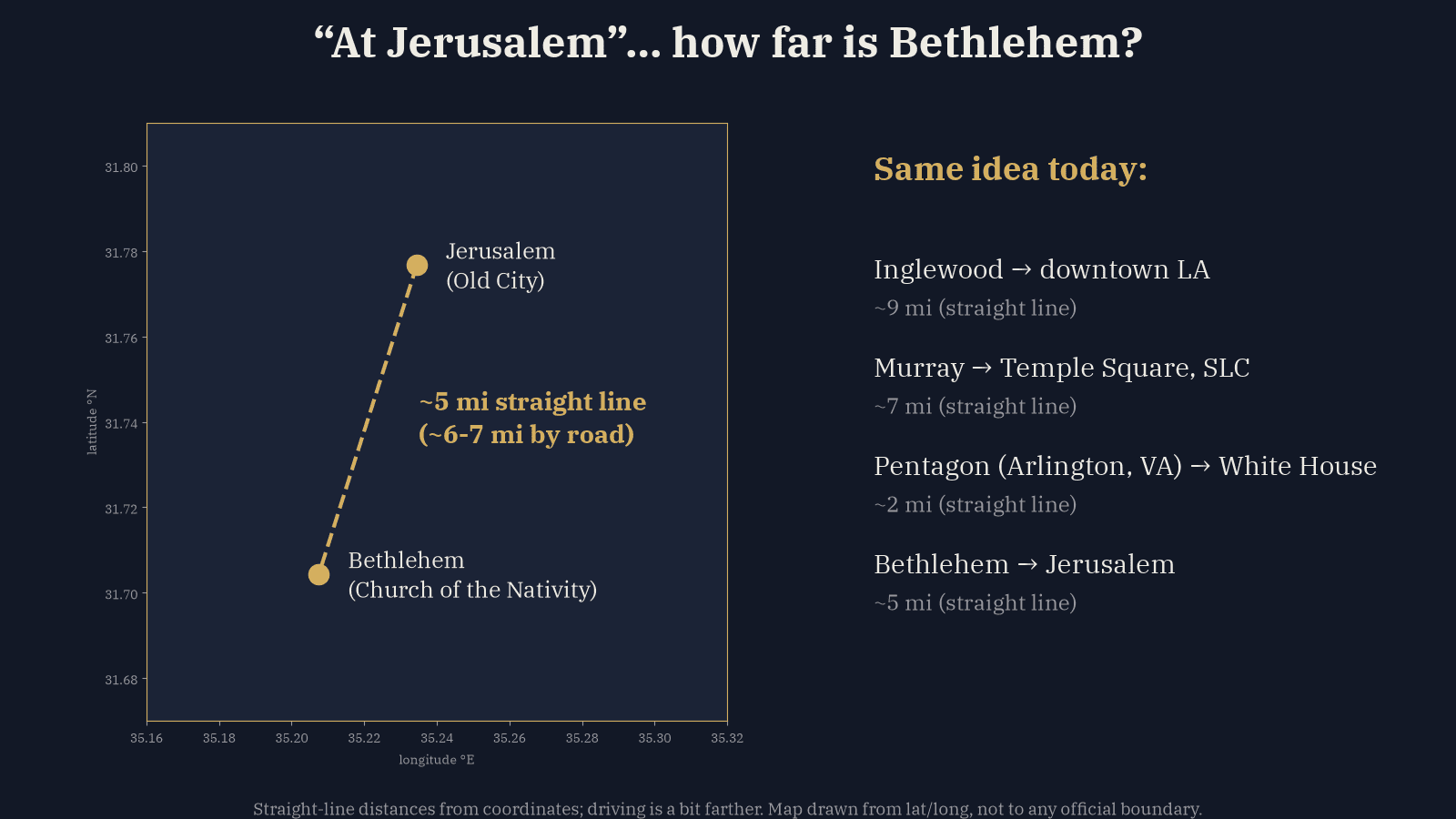
Not far. From the Church of the Nativity in Bethlehem to the Old City of Jerusalem is about 5 miles (8.4 km) in a straight line. Online route planners put the drive at about 6–7 miles (10–11 km), around 10–15 minutes without traffic. Today the edges of the two cities almost touch.
Here’s what that looks like at home:
- Inglewood to downtown Los Angeles: about 9 miles. Plenty of people born in Inglewood would tell you they were “born in LA.”
- Murray to Temple Square in Salt Lake City: about 7 miles. Nobody from out of state blinks at “I’m from Salt Lake.”
- The Pentagon (Arlington, Virginia) to the White House: about 2 miles. People say it’s “in DC” all the time, and it isn’t.
(Straight-line distances, measured from coordinates.)
Bethlehem is closer to Jerusalem than Murray is to Temple Square. If you were describing it to someone who’d never been to Judea, “at Jerusalem” is about as natural as it gets.
Part 6: What Joseph Smith knew in 1829 vs. what Alma knew in 83 BC
This is the part critics never deal with.
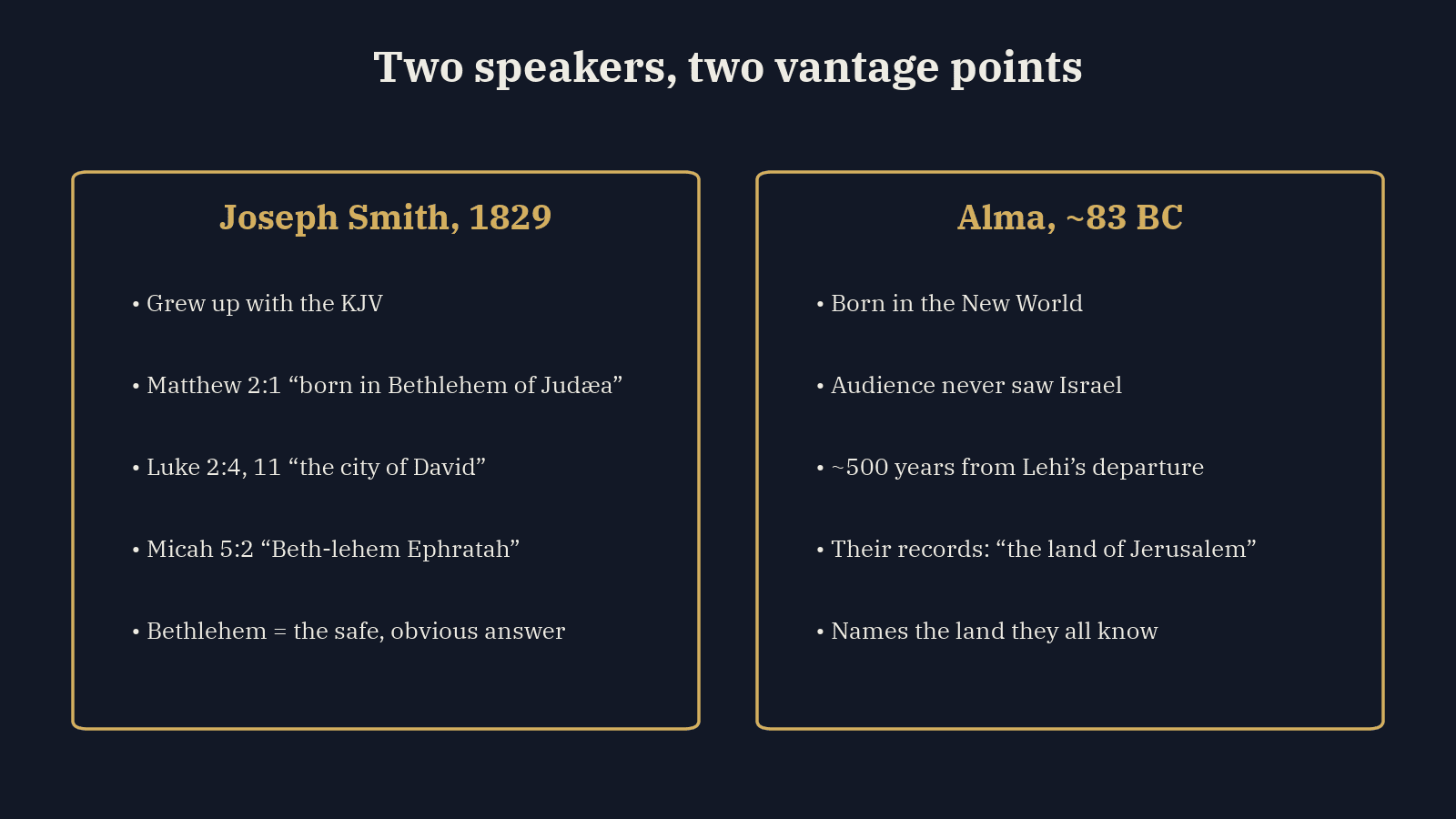
Joseph Smith, 1829
Joseph grew up in a Bible-reading family in upstate New York, in the middle of the revivals of the Second Great Awakening. The King James Bible was the book in his world. And the King James Bible is crystal clear about Bethlehem:
- Matthew 2:1: “Now when Jesus was born in Bethlehem of Judæa in the days of Herod the king…”
- Matthew 2:5–6: the scribes tell Herod, “In Bethlehem of Judæa,” quoting the prophet.
- Micah 5:2: “But thou, Beth-lehem Ephratah, though thou be little among the thousands of Judah, yet out of thee shall he come forth unto me that is to be ruler in Israel.”
- Luke 2:4: Joseph went “unto the city of David, which is called Bethlehem.”
- Luke 2:11: “For unto you is born this day in the city of David a Saviour, which is Christ the Lord.”
- John 7:42: “Hath not the scripture said, That Christ cometh of the seed of David, and out of the town of Bethlehem, where David was?”
Every Christmas sermon he ever heard said Bethlehem. (One footnote: “O Little Town of Bethlehem,” the carol everyone thinks of, wasn’t written until 1868, so leave that one out. But the Bible verses were in every house.)
If Joseph was making up a book to pass as ancient scripture, “Bethlehem” is the easiest word in the whole project. It’s the most famous birthplace in history. Getting it “right” costs nothing. Getting it “wrong” hands every Protestant minister in America a free punchline, which is exactly what Campbell did within months.
A forger trying to sound biblical writes Bethlehem. A forger who knows a lot writes Bethlehem and throws in Ephratah to show off.
Alma, about 83 BC
Now put yourself in Alma’s place.
You’re a Nephite high priest. You were born in the Americas. So was everyone listening to you. The old country is five centuries and an ocean away. Nobody has been there. Nobody is going there.
What do your records say about it? They talk about “the land of Jerusalem.” Lehi lived in the land of Jerusalem. Nephi went up to the land of Jerusalem. The Jews at Jerusalem rejected Lehi. Jerusalem was destroyed (2 Nephi 1:4). It’s the place your fathers left.
Do your people care about a small village south of the capital? The Nephites weren’t a Davidic monarchy. They didn’t have a royal line from Judah to trace back to David’s hometown. The brass plates held “the prophecies of the holy prophets” down to Zedekiah’s reign, plus prophecies of Jeremiah (1 Nephi 5:13), but Alma’s goal isn’t to give a trivia answer. It’s to tell his people that the Son of God will be born in their homeland, the land of their fathers, to a virgin named Mary.
So he does what every real person does when talking to people about a faraway place. He names the place they know.
Who would say “at Jerusalem”?
Think about how this works today. If you grew up in Utah and you’re telling a friend in Brazil where your cousin was born, you probably don’t say “Murray.” You say “Salt Lake.” If you’re a missionary in Japan explaining where you’re from, you say “near Los Angeles,” not “Inglewood.” Speakers simplify geography for audiences who don’t know the local map. Everyone does it.
Now flip it. Which is more suspicious: an ancient prophet speaking like an ancient prophet would to his actual audience? Or a 19th-century writer, with Matthew 2 open, deliberately putting the “wrong” birthplace into his fake ancient book?
The critic’s theory needs Joseph to be smart enough to dictate a 500-page book with complex internal geography, chronology, and names, but too dumb to know the single most famous fact about the birth of Jesus. And, by luck, the “mistake” he made just happens to match how Jerusalem’s ancient rulers and a Dead Sea Scroll talked about their land, in texts nobody would find until 1887 and 1947.
Part 7: Putting it in order
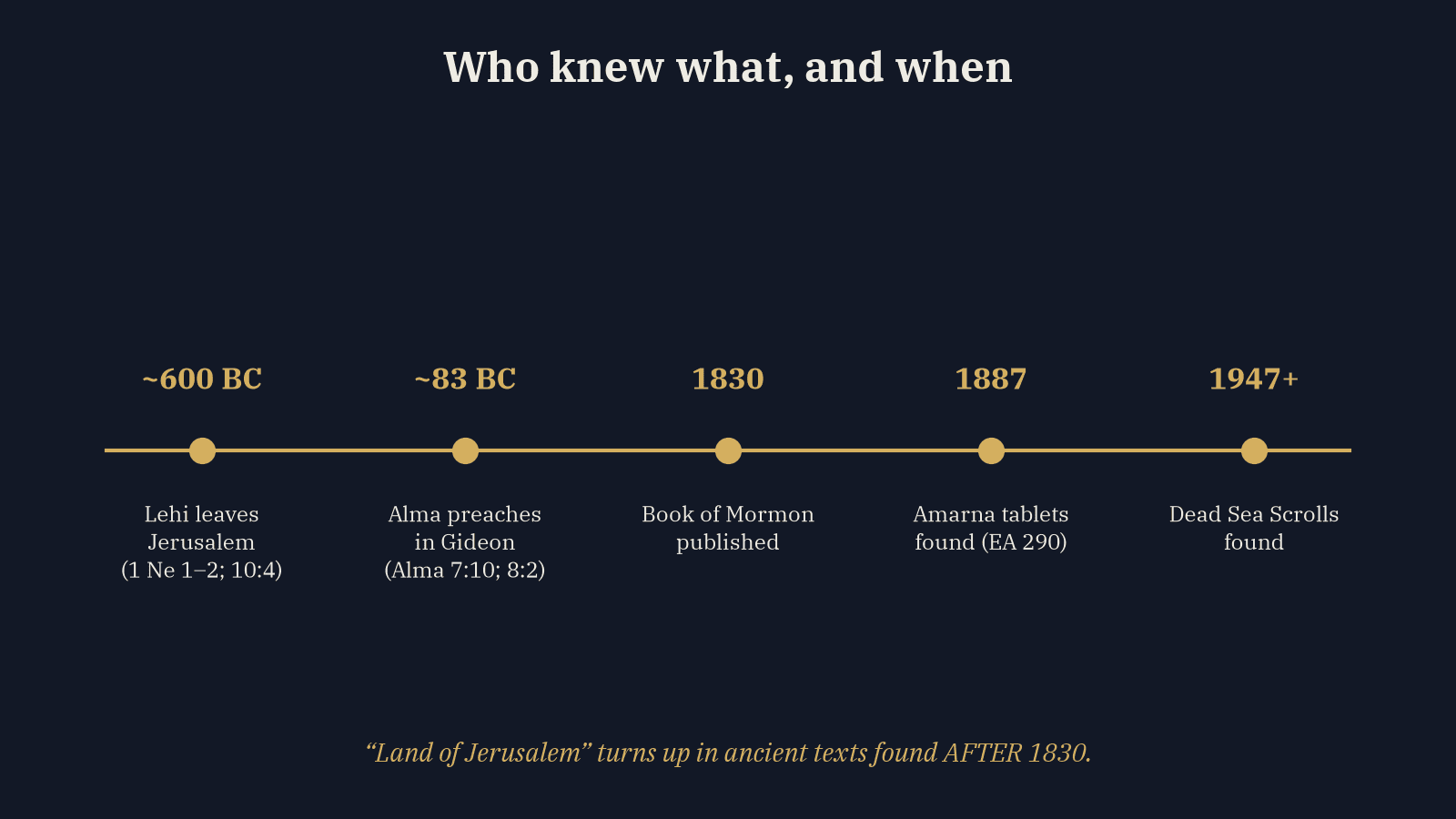
Lay the dates side by side:
- ~600 BC: Lehi leaves Jerusalem (1 Nephi 1–2; 10:4).
- ~83 BC: Alma preaches in Gideon: “at Jerusalem which is the land of our forefathers” (Alma 7:10; 8:2).
- 1830: The Book of Mormon is published.
- 1831: Alexander Campbell mocks the verse.
- 1887: The Amarna tablets are found, with “the land of Jerusalem.”
- 1947 onward: The Dead Sea Scrolls are found, including “the land of Jerusalem” in a Jeremiah text.
The evidence for the phrase came out after the book. That’s the opposite of how frauds usually age.
Part 8: What the critics still say, and fair answers
“Alma could have just said Bethlehem. Prophets are specific.” Sometimes. Micah was. But Alma 7:10 isn’t trying to be Micah 5:2. It’s identifying the homeland and the mother. In the same verse, Alma gives the mother’s name, Mary, and the virgin birth. That’s more specific than most Old Testament messianic prophecies.
“The Amarna town isn’t Bethlehem.” Maybe not. We said so above. The argument doesn’t need it to be. The point is the term “land of Jerusalem” and its use for territory beyond the city walls.
“The Dead Sea Scroll phrase just means the city.” Possibly, though Eisenman and Wise read it more broadly. Even on the narrowest reading, the phrase exists in an ancient Jewish text about Jeremiah’s time, which is the period the Book of Mormon claims to come from. The 1831 objection was that the phrasing was un-biblical and a sign of ignorance. The phrase turns out to be ancient.
“It’s just one verse.” It isn’t. About 80 years later, unbelieving Nephites argue, “why will he not show himself in this land as well as in the land of Jerusalem?” (Helaman 16:19). Even the skeptics in the book talk about the birth happening in “the land of Jerusalem.” That’s a pattern in the text, not a slip.
Bottom line
Read Alma 7:10 the way the Book of Mormon reads itself. A Nephite high priest in about 83 BC, talking to people born in the New World five centuries after Lehi left, tells them the Son of God will be born of Mary “at Jerusalem which is the land of our forefathers.” He names the land they know, the way their own records always name it. Bethlehem is five miles from Jerusalem. Ancient texts found long after 1830 talk about “the land of Jerusalem” the same way.
Joseph Smith knew where Jesus was born. Everybody did. If he were writing a fake, that’s the one fact he would have made sure to get “right.” The book doesn’t do what a forger would do. It does what an ancient speaker would do.
Read it for yourself, and then ask God about it (Moroni 10:3–5).
- Alma 6:7; 7:1–10; 8:1–2, 7; 1 Nephi 1:4; 3:9–22; 10:4; 2 Nephi 1:4 (churchofjesuschrist.org).
- KJV: Matthew 2:1–6; Micah 5:2; Luke 2:4, 11; John 7:42; 2 Samuel 5:6.
- Alexander Campbell, “Delusions,” Millennial Harbinger (Feb. 7, 1831), 93.
- EA 290, Oracc Akkadian of the Amarna letters, online edition (P271092).
- W. F. Albright, trans., “The Amarna Letters,” in James B. Pritchard, ed., The Ancient Near East: An Anthology of Texts and Pictures.
- Bob Becking, Micah (Anchor Yale Bible 24I; Yale, 2023), 184.
- Florentino García Martínez and Eibert Tigchelaar, The Dead Sea Scrolls Study Edition (Brill, 1999), 773.
- Robert Eisenman and Michael Wise, The Dead Sea Scrolls Uncovered (1992), 57–58.
- Ronny Reich, “A Fiscal Bulla from the City of David,” Israel Exploration Journal 62.2 (2012): 200–205.
- Hugh Nibley, An Approach to the Book of Mormon (1957; CWHN 6).
- Robert F. Smith, “The Land of Jerusalem: The Place of Jesus’ Birth,” in John W. Welch, ed., Reexploring the Book of Mormon (FARMS, 1992), 170–172.
- Scripture Central (Book of Mormon Central), “If Jesus was born in Bethlehem, why does Alma say he would be born at Jerusalem?” (2018); “Why does the Book of Mormon refer to the ‘land of Jerusalem’?”
- Insights (FARMS), “Revisiting the Land of Jerusalem via the Dead Sea Scrolls,” BYU ScholarsArchive.


