
If you’ve ever argued with a Book of Mormon critic, you know the checklist. “There’s no archaeology.” “Where are the plates?” “Joseph made it up.” “There’s anachronisms.” “The text has changed.” “DNA disproves it.” It comes out fast, like it was memorized, because usually it was.
Here’s what almost nobody notices. Most of the people firing that checklist are Bible believers. And almost EVERY item on it applies to the Bible just as much, and some of them more. So let’s be fair and do what the critic never does. Take each argument, apply it to both books, and see who survives.
One thing first. I love the Bible. Latter-day Saints believe “the Bible to be the word of God as far as it is translated correctly” (Article of Faith 8). I’m not here to tear it down. I’m here to show that the critic’s standard, if he actually believed it, would tear down HIS book first. Then in Part B we’ll look at what the Book of Mormon has that the Bible simply doesn’t.
Part A: The arguments that cut both ways
1. “There’s no archaeological evidence”
This is the big one. “Show me a Nephite city. Show me Zarahemla.” Fair question. Now let’s ask the same question about the Exodus and the conquest of Canaan.
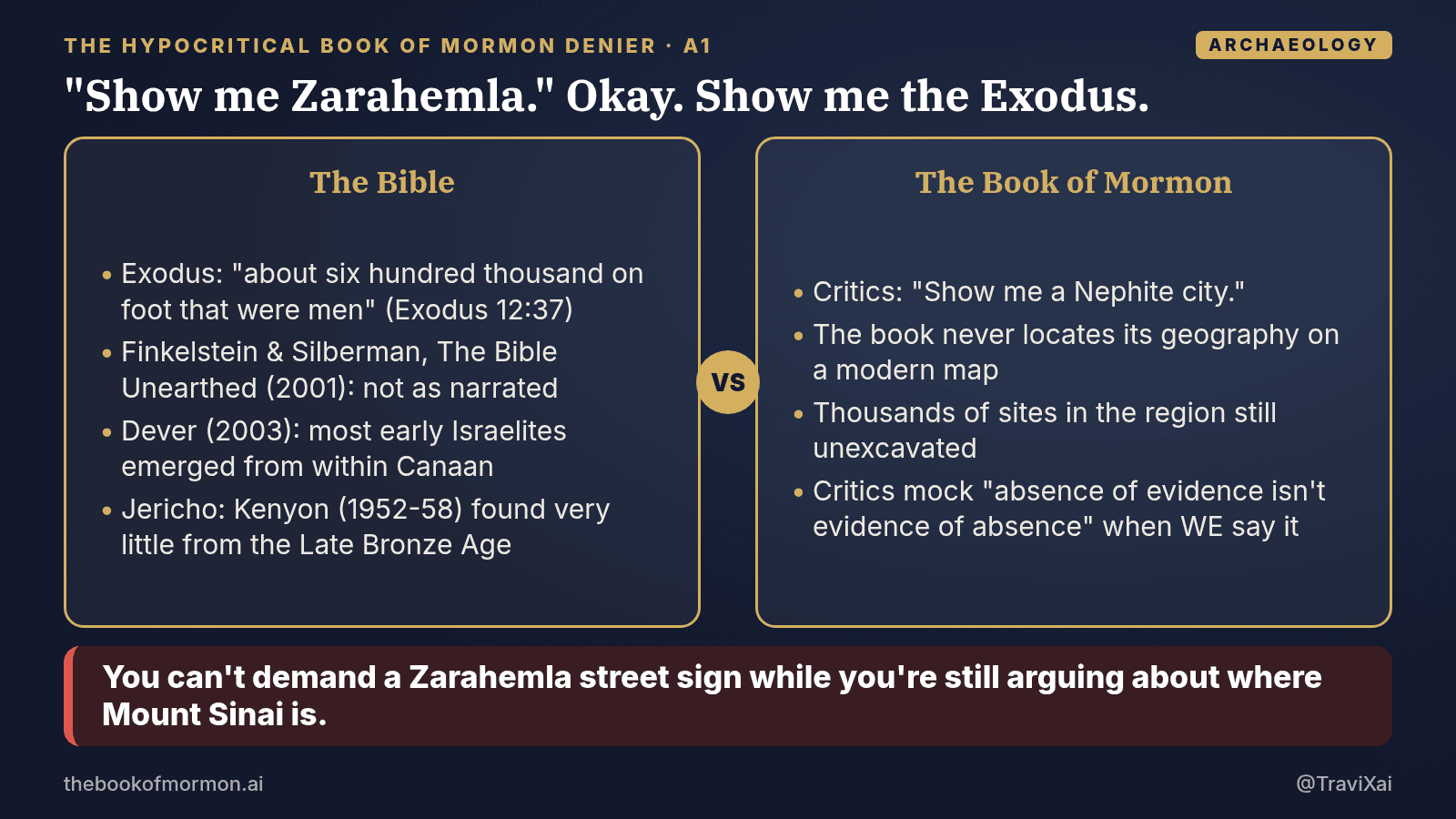
Mainstream archaeology, not anti-Christian activists, mainstream academic archaeology, has struggled for decades to find evidence of “about six hundred thousand on foot that were men, beside children” (Exodus 12:37, KJV) leaving Egypt and wandering forty years in Sinai. Israel Finkelstein of Tel Aviv University and Neil Asher Silberman put it bluntly in The Bible Unearthed (2001). They argued the Exodus as described didn’t happen at the time and in the way the Bible narrates. William Dever, who is far more sympathetic to an early Israel, still concluded in Who Were the Early Israelites and Where Did They Come From? (2003) that most early Israelites emerged from within Canaan rather than arriving in a massive invasion. Jericho is the classic case. Kathleen Kenyon dug there from 1952 to 1958 and found very little dating to the Late Bronze Age, the period usually assigned to Joshua.
To be fair, there ARE scholars who defend the Bible’s history. Kenneth Kitchen’s On the Reliability of the Old Testament (2003) is a serious one, and Egyptologist James Hoffmeier has argued for the plausibility of Israel in Egypt. And yes, some finds confirm the Bible. The Merneptah Stele (about 1208 BC) names “Israel,” and the Tel Dan inscription found in 1993-94 mentions the “house of David.”
But look at what Bible believers do with this. They say the record is incomplete. They say we may have the wrong dates or the wrong sites. They say the desert doesn’t preserve campsites. They say absence of evidence isn’t evidence of absence. Every single one of those is reasonable. And every single one is something critics mock when we say it about the Book of Mormon, a record of a people whose geography the book itself never locates on a modern map, in a region where thousands of sites are still unexcavated.
You can’t demand a Zarahemla street sign while you’re still arguing about where Mount Sinai is.
2. “Anachronisms!”
We just did a whole article on this, so I’ll keep it short. The Bible has camels in Abraham’s day centuries before the archaeology shows domestic camels in the region, Philistines before the Philistines arrived, Ur “of the Chaldees” before the Chaldeans, a city named Dan before it was renamed Dan, and the KJV gives us Easter, unicorns, candles and a “bow of steel.” All with exact verses and sources in Anachronisms in the Bible (KJV Edition) (publishing November 1).
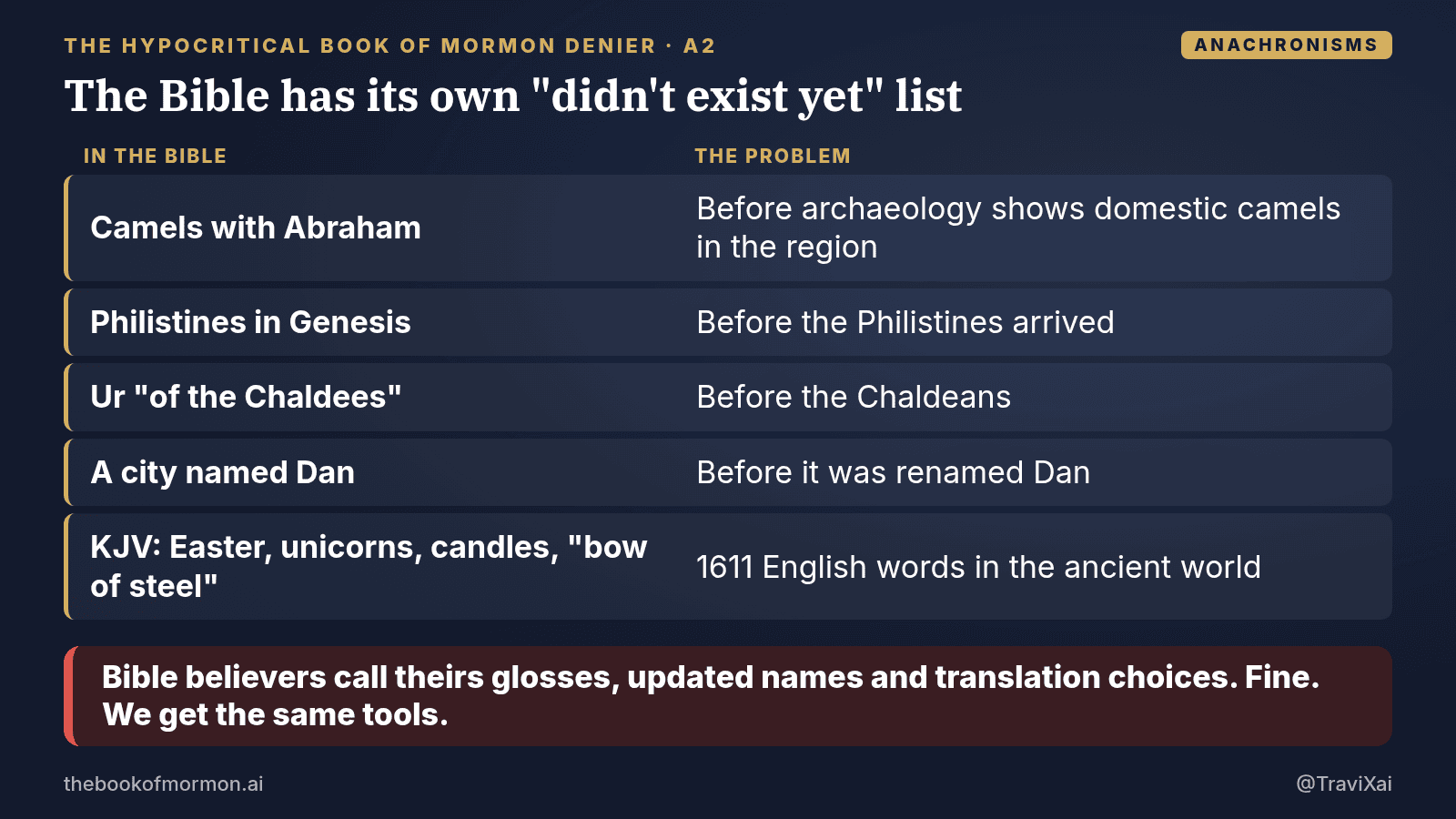
Meanwhile the Book of Mormon list has been shrinking for two hundred years, as documented in The Shrinking List of Book of Mormon Anachronisms. Bible believers explain theirs as later glosses, updated names and translation choices. Fine. We get those same tools.
3. “There’s no original manuscript”
Critics: “Where are the plates? Where’s the original? You can’t check it!”
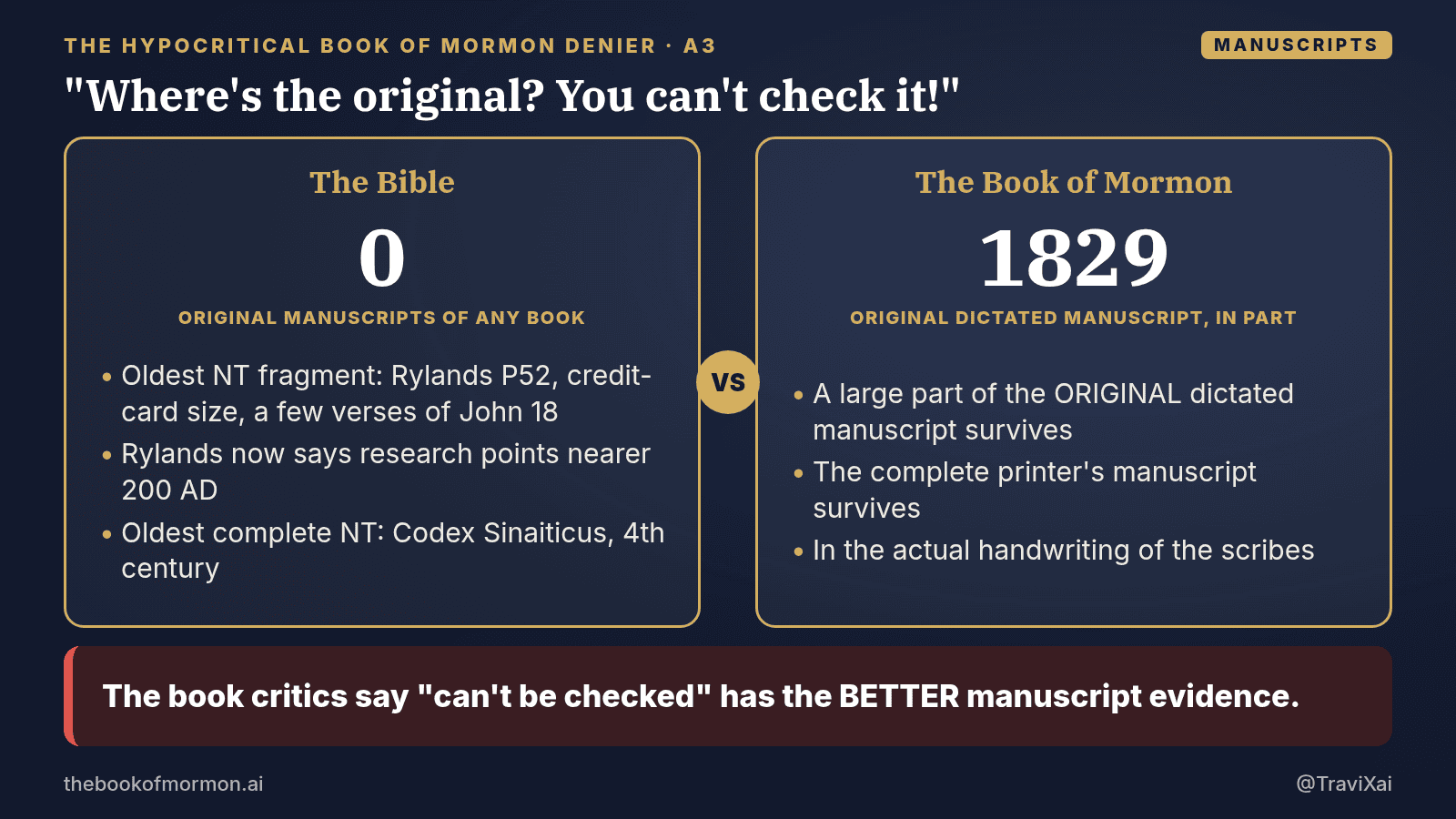
There are ZERO original manuscripts, the autographs, of ANY book of the Bible. Not one. Not a single page Moses, Isaiah, Matthew or Paul ever touched. What we have are copies of copies. The oldest Hebrew Bible manuscripts are among the Dead Sea Scrolls, centuries after the books were first written. The oldest New Testament fragment usually cited, the John Rylands Papyrus P52, is a scrap about the size of a credit card with a few verses of John 18, dated by its first editor to the first half of the 2nd century, and the Rylands Library itself now says recent research points nearer to 200 AD. The oldest complete New Testament, Codex Sinaiticus, is from the 4th century.
Now compare the Book of Mormon. You’ll see in Part B that we have a large part of the ORIGINAL dictated manuscript from 1829, and the complete printer’s manuscript, in the actual handwriting of the scribes. The book whose “original” critics say we can’t check is the one with the BETTER manuscript evidence.
4. “Missing artifacts: where are the plates?”
Where are the tablets of the Ten Commandments? Moses broke the first set, and the second set disappeared with the Ark of the Covenant. Where is the Ark? Where is Aaron’s rod? Where is the brass serpent? Where is the original temple? I won’t repeat the whole argument here, because we laid it out in Moses Broke the Tablets: The Double Standard on Missing Plates. The short version: Bible believers have NO problem believing in sacred objects nobody can produce today. They just won’t extend that to us.
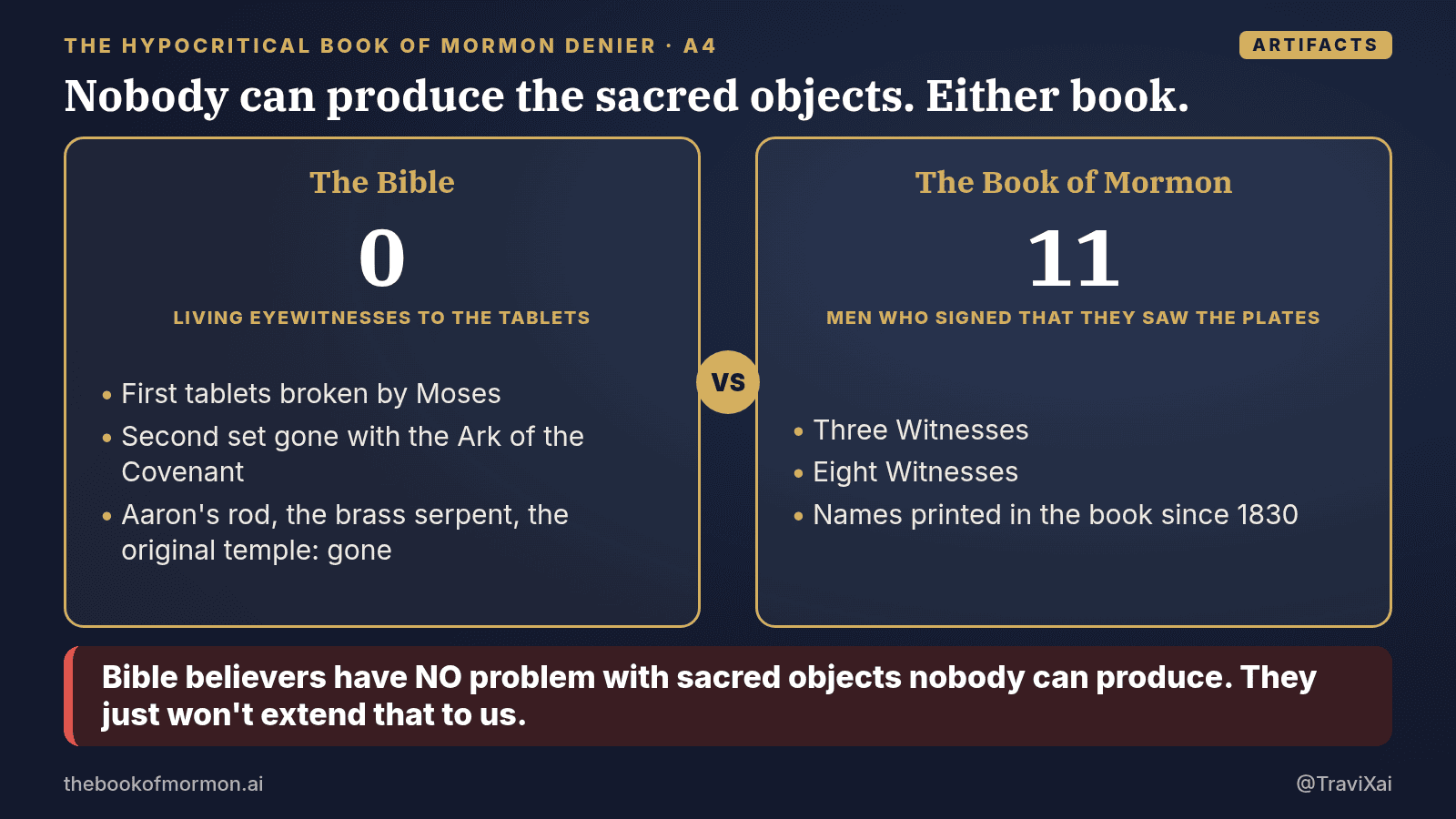
And here’s the difference. Nobody alive saw the tablets. ELEVEN men signed their names saying they saw the plates. More on that in Part B.
5. “Anonymous authors” and disputed authorship
Critics say Joseph Smith wrote the Book of Mormon himself, or stole it from Spaulding, or Sidney Rigdon helped, and so on. Fine, let’s talk about authorship.
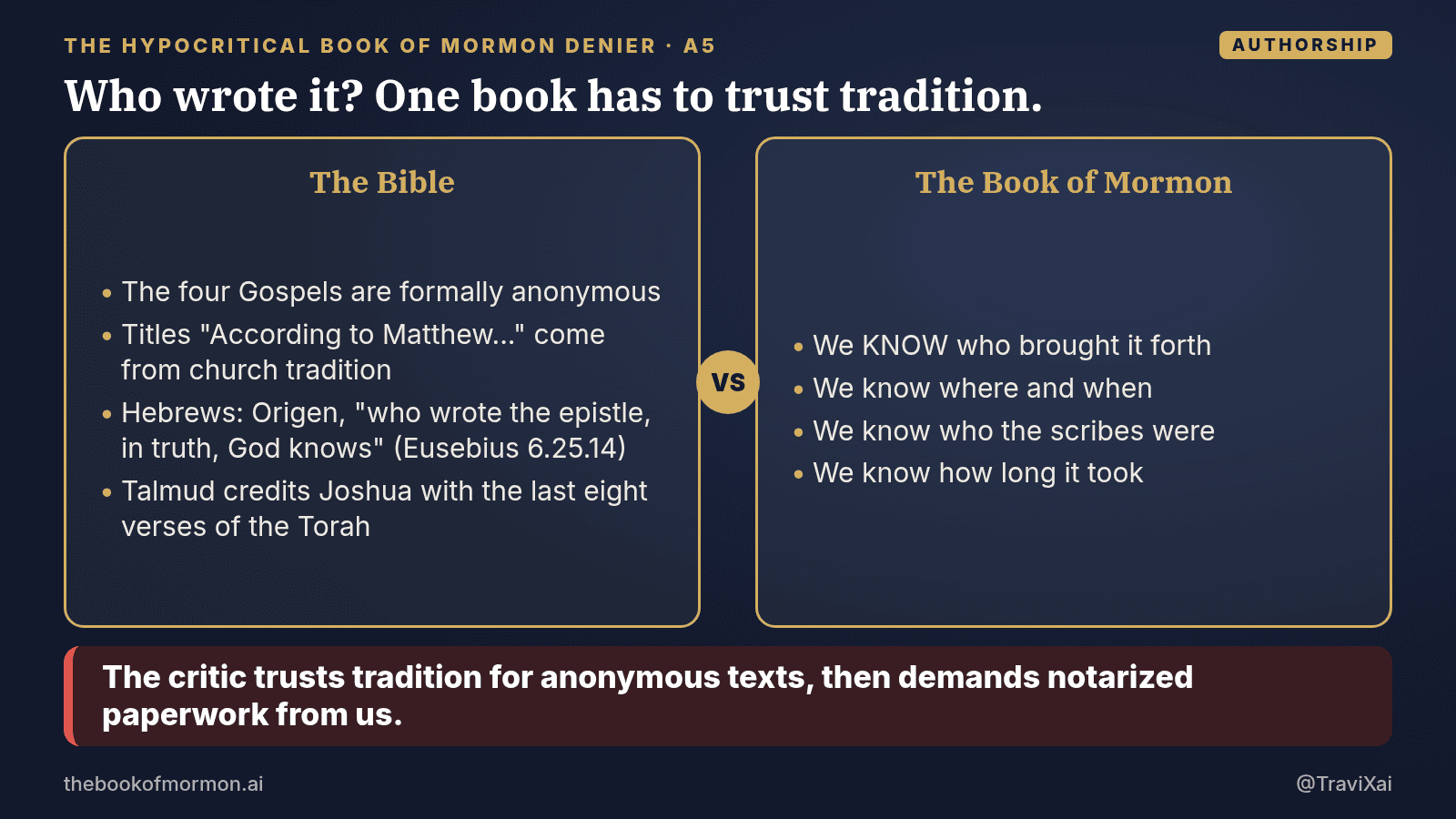
The four Gospels are formally anonymous. None of them names its author in the text. The titles “According to Matthew,” “According to Mark” and so on come from church tradition, and while Martin Hengel argued the titles were attached very early, other scholars like Michael Wolter argue they can’t be older than the first half of the 2nd century. Either way, you are trusting TRADITION for the names.
Hebrews is the classic example. The early church couldn’t agree who wrote it. Origen, in the 3rd century, famously said, as quoted by Eusebius in his Ecclesiastical History (6.25.14), that who wrote the epistle, in truth, God knows. And the Pentateuch, as we showed in the anachronisms article, includes the death of Moses, and the Talmud itself credits Joshua with the last eight verses.
Compare that to the Book of Mormon. We KNOW who brought it forth. We know where, when, who the scribes were, and how long it took. Critics don’t like the answer Joseph gave, but they can’t say the book’s origin is anonymous. The Bible believer trusts tradition about anonymous texts and then demands notarized paperwork from us.
6. “DNA disproves it”
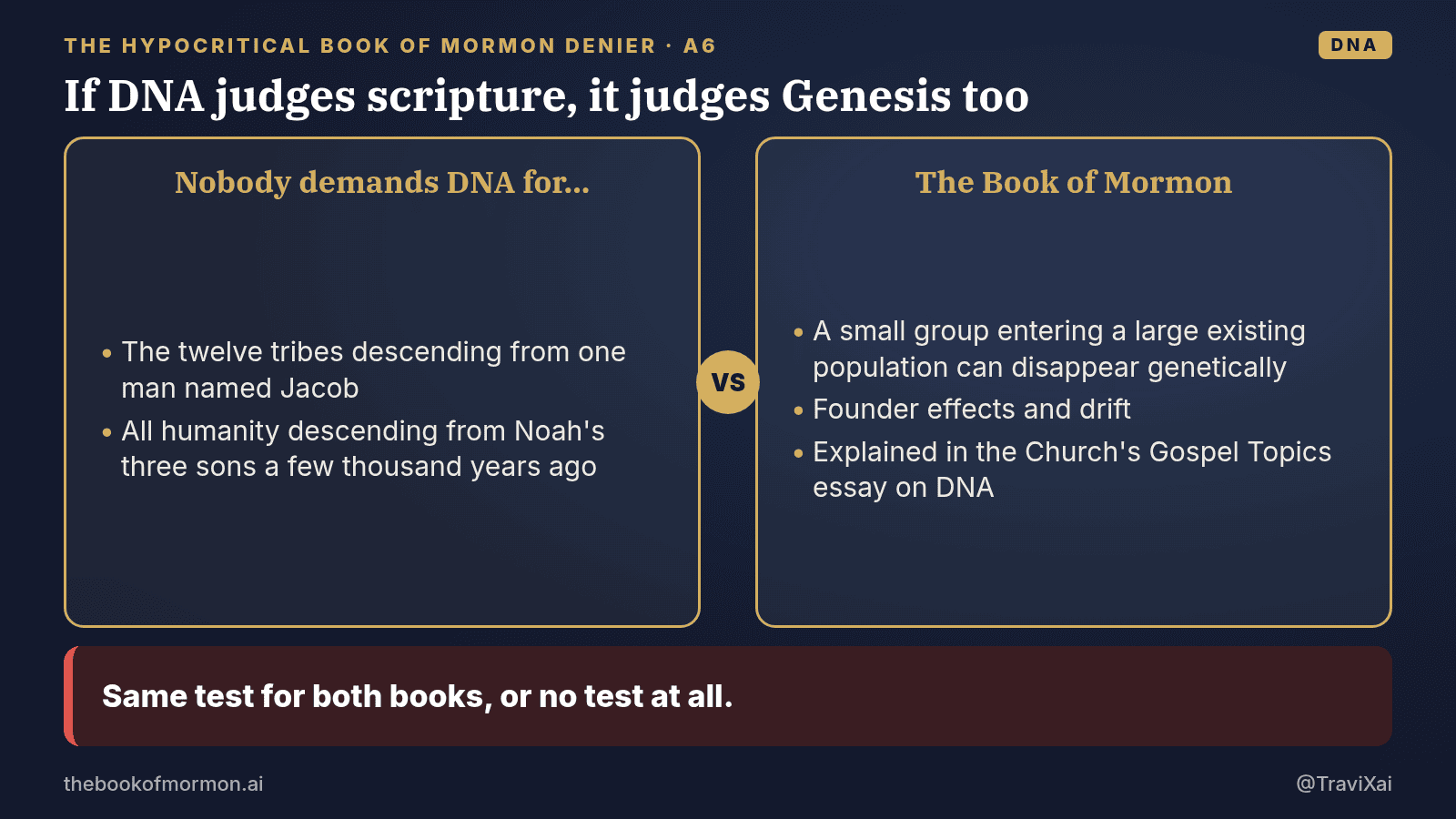
This one needs care, and we covered it properly in DNA and the Book of Mormon (2026 Edition). The short version is that a small group entering a large existing population can disappear genetically through founder effects and drift, and the Church’s own Gospel Topics essay on DNA explains why. The standard point here: nobody demands a DNA test to prove the twelve tribes descended from one man named Jacob, or that all humanity descends from Noah’s three sons a few thousand years ago. If a critic wants DNA to be the judge of scripture, he should be ready for it to judge Genesis too.
7. “The text has changed”
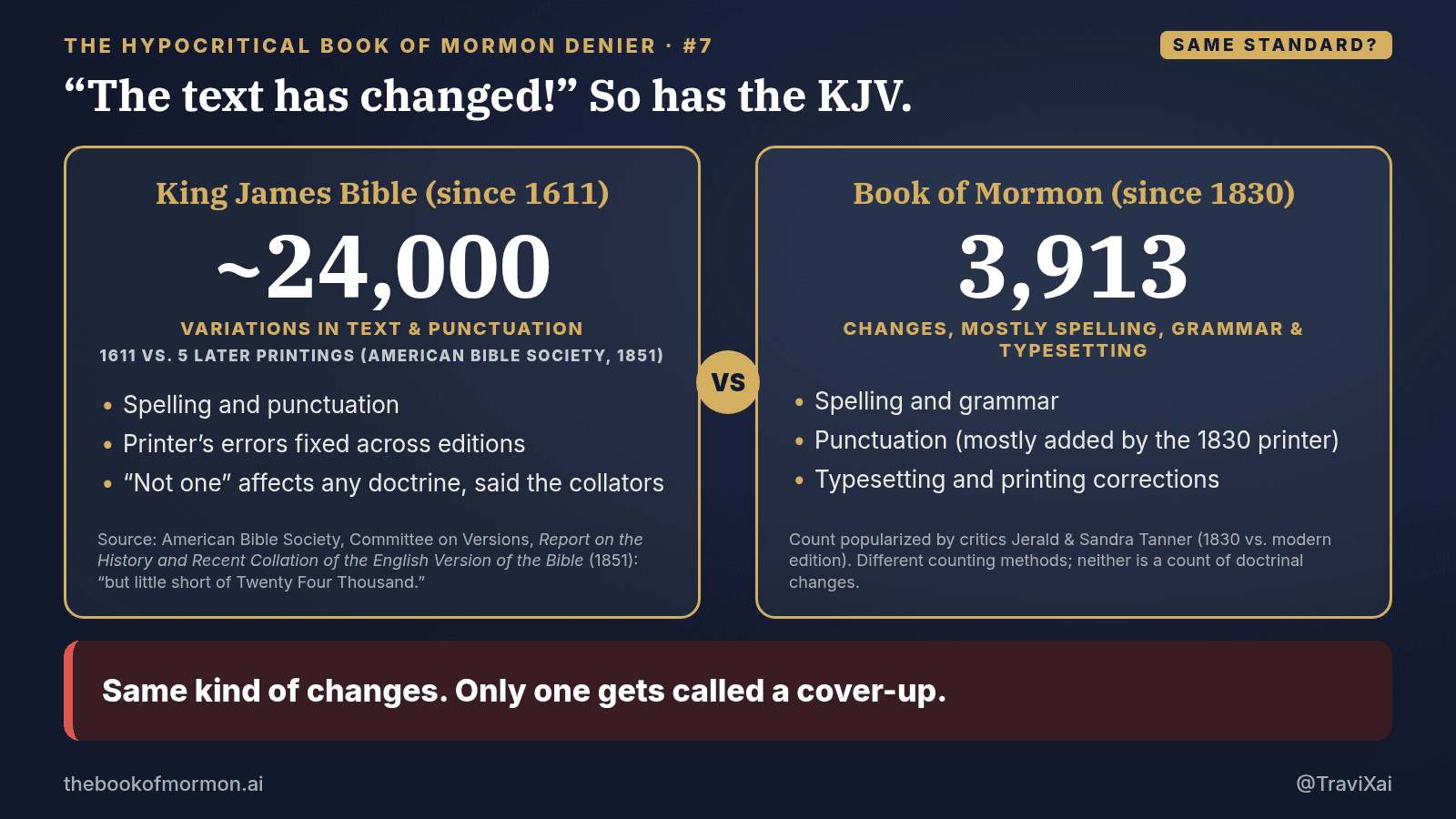
Critics love the “3,913 changes” line about the Book of Mormon. Most of those are spelling, punctuation and grammar fixes to a book dictated aloud and typeset by a printer who added most of the punctuation himself. And here’s the part critics NEVER mention. The King James Bible has been “changed” too, over and over, since 1611. In 1851 the American Bible Society’s Committee on Versions collated the 1611 edition against five later printings, and the number of variations recorded “solely in the text and punctuation of the six copies compared” came to “but little short of Twenty Four Thousand.” Nearly TWENTY-FOUR THOUSAND. And what were they? Mostly spelling, punctuation and printer’s errors, EXACTLY like most of the Book of Mormon changes. The committee itself said not one of them “mars the integrity of the text, or affects any doctrine or precept of the Bible.” So the critic accepts that explanation for the KJV without blinking, and calls the SAME explanation a cover-up when it’s the Book of Mormon. That’s not a standard. That’s a double standard. And the Bible? Bart Ehrman, no friend of inerrancy, wrote in Misquoting Jesus (2005) that “there are more variations among our manuscripts than there are words in the New Testament.” I’m not going to redo that whole case here, because it has its own article: What the Bible’s Own Manuscripts Say About Textual Variants (publishing October 31). The broader version is in “Your Church Changes”… So Does the Bible. If changes prove a book is false, the critic loses his Bible first.
The fallacy has a name
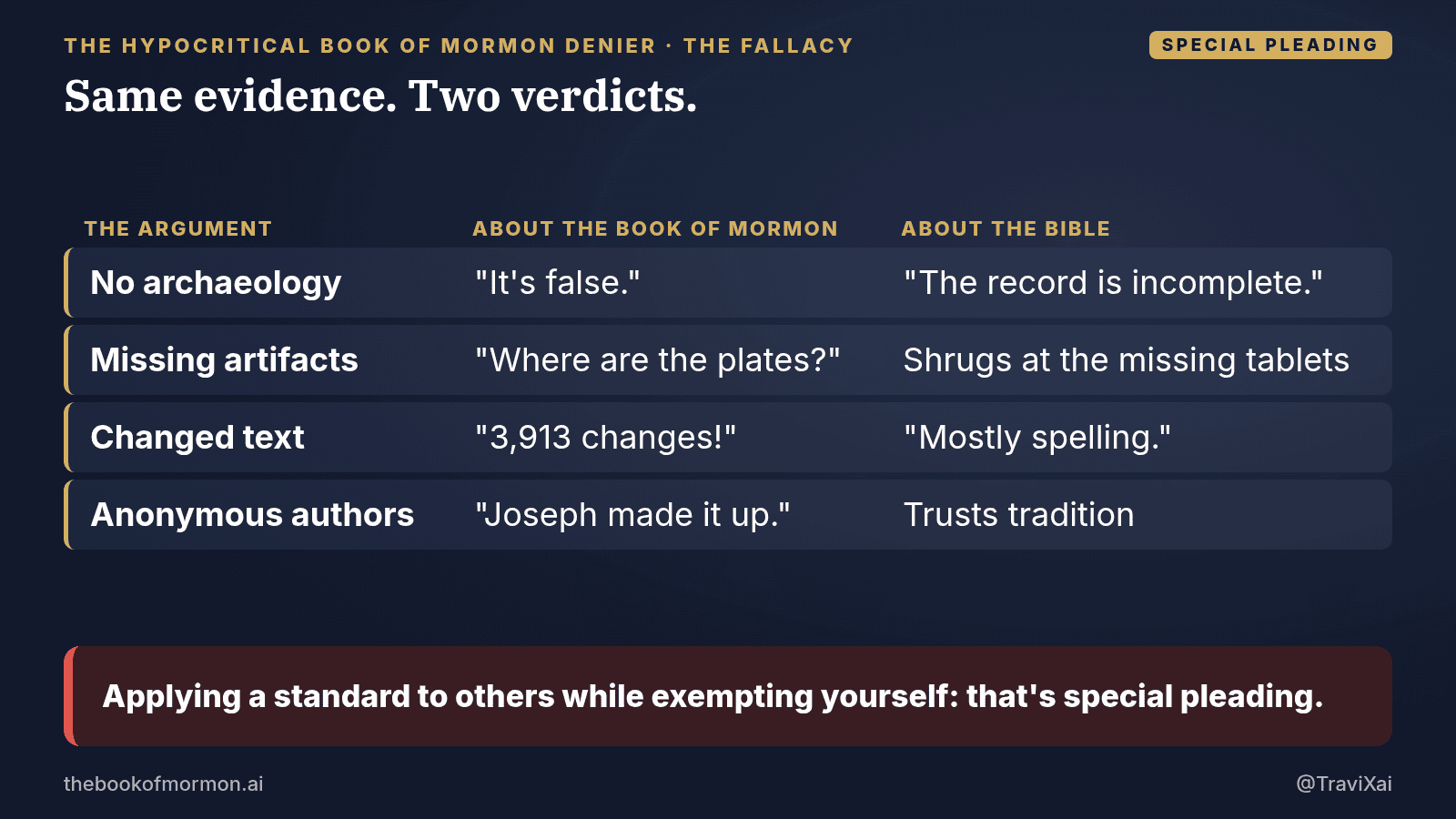
This isn’t a clever debating trick, it’s a named logical error. Special pleading is applying a standard to others while exempting yourself without a good reason. When the critic says “no archaeology means it’s false” about the Book of Mormon, and “the record is incomplete” about the Exodus, that’s special pleading. When he demands the plates but shrugs at the missing tablets, that’s special pleading. And when the standard keeps moving every time we meet it, that’s moving the goalposts.
Part B: What’s STRONGER for the Book of Mormon
Now the part critics never want to talk about. Not “the Book of Mormon is as good as the Bible.” I mean the places where the Book of Mormon’s evidence is actually BETTER, because it came forth in the modern era, in the full light of history, with hostile neighbors keeping records.
1. Named witnesses who signed their names
The Bible has witnesses. Paul says Jesus “was seen of above five hundred brethren at once” (1 Corinthians 15:6, KJV), and I believe him. But we don’t have their names, their signatures, or their later lives on record.
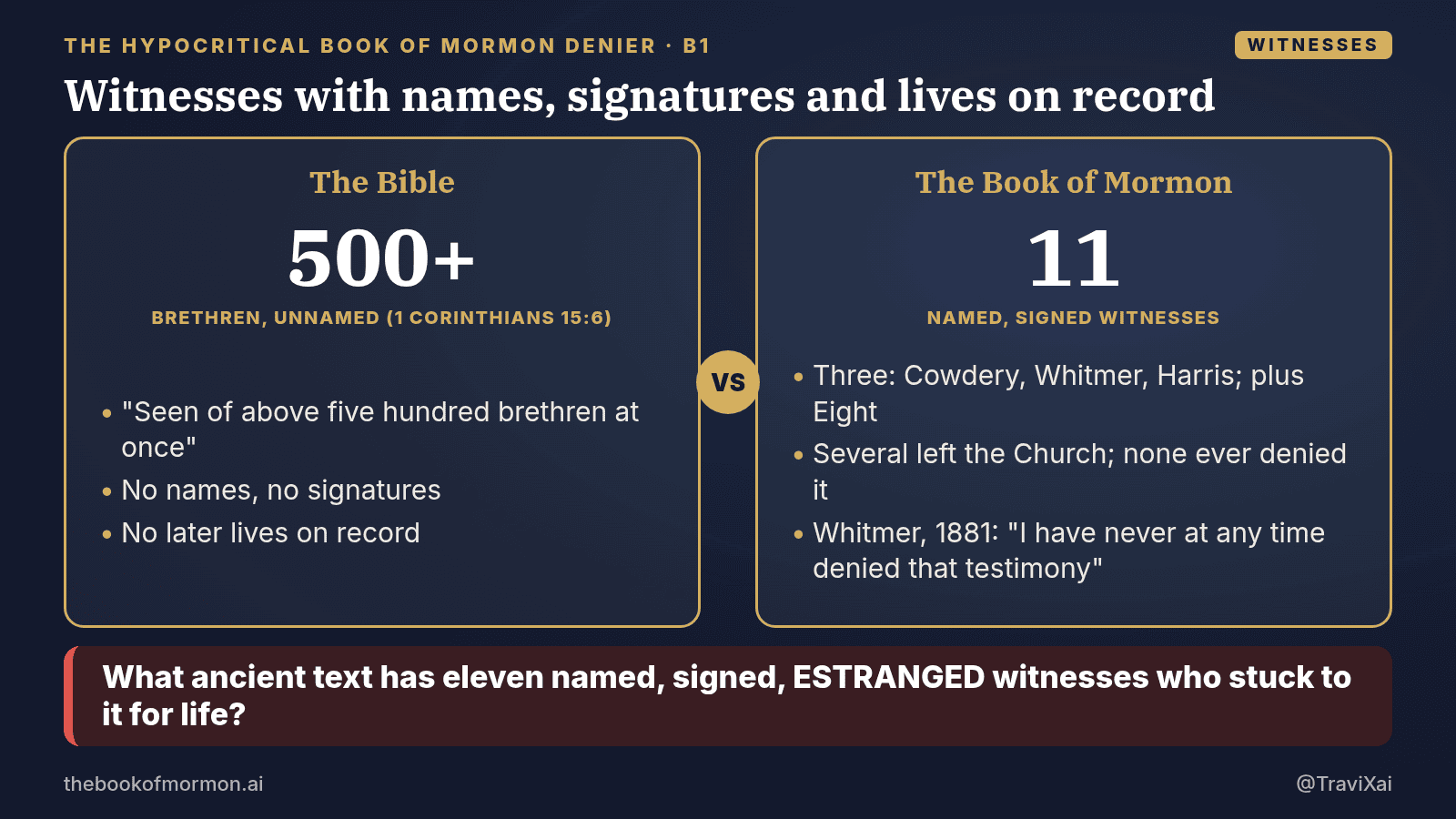
The Book of Mormon has the Testimony of Three Witnesses (Oliver Cowdery, David Whitmer, Martin Harris) and the Testimony of Eight Witnesses, printed in the book since 1830 with their names attached. Several of them later left the Church, some very bitterly, and had every motive to expose a fraud. None of them ever denied what they testified they saw. David Whitmer, out of the Church for decades, published a proclamation in March 1881 saying “I have never at any time denied that testimony” and “it was no delusion!” Oliver Cowdery came back before his death. Martin Harris came back too. I won’t repeat the whole story because we told it in Book of Mormon Evidence, Part 10: The Witnesses Who Never Recanted. But you tell me what ancient text has eleven named, signed, cross-examined, and in several cases ESTRANGED witnesses who stuck to their testimony for life.
2. The original and printer’s manuscripts survive
Remember “no originals” from Part A? Here’s the other side. The original manuscript of the Book of Mormon was dictated by Joseph Smith to scribes in 1829. Joseph placed it in the cornerstone of the Nauvoo House in 1841, and water damage destroyed most of it, but roughly 28 percent survives, according to the Joseph Smith Papers. The printer’s manuscript, the copy made for the typesetter in Palmyra, survives almost completely. The Church bought it from the Community of Christ in September 2017 for $35 million, and the Joseph Smith Papers have published both.
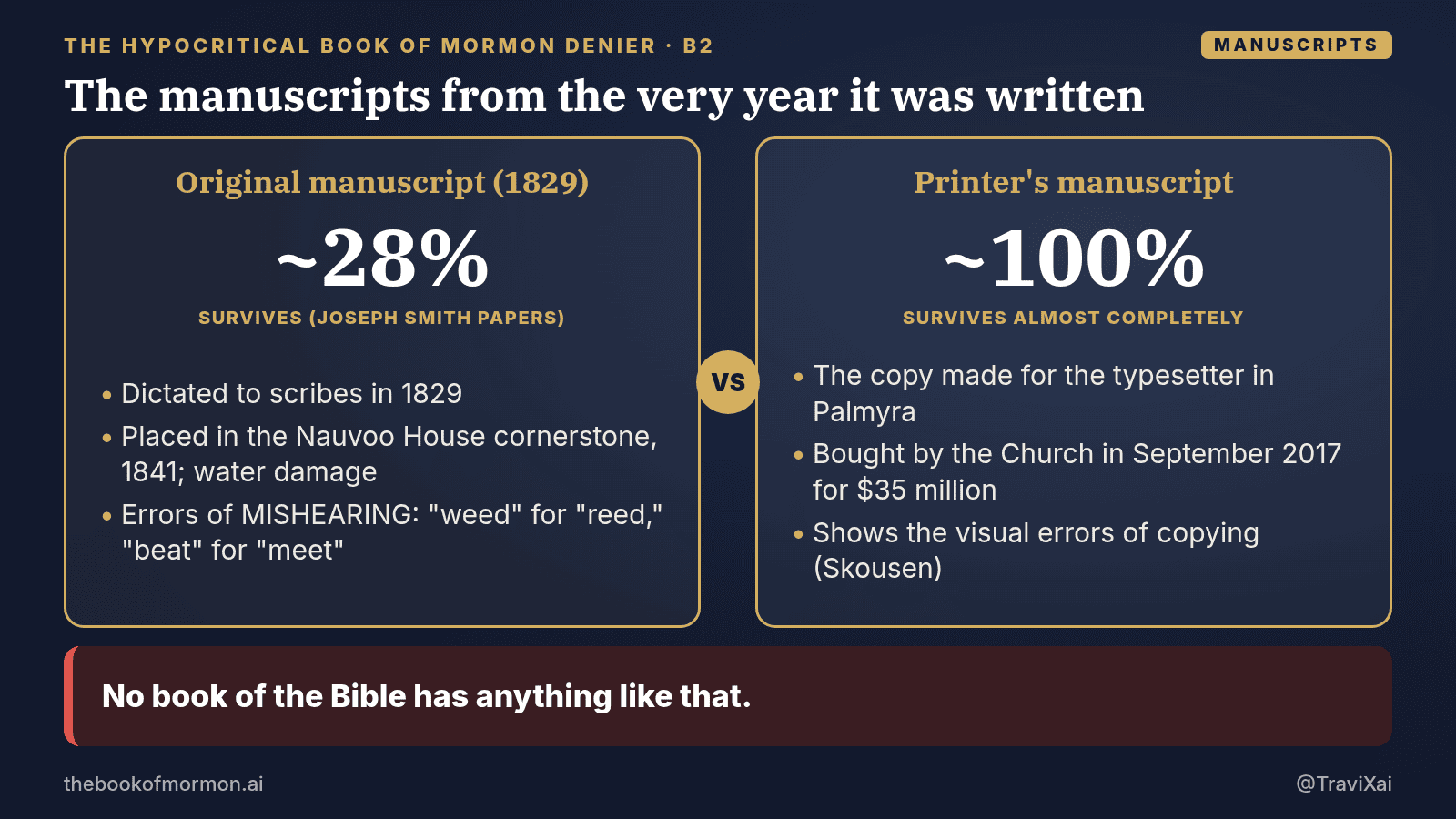
Royal Skousen’s decades-long Book of Mormon Critical Text Project studied those manuscripts down to individual spelling errors. His analysis found that the errors in the original manuscript are mostly the kind you get from MISHEARING dictation (“weed” for “reed,” “beat” for “meet”), while the printer’s manuscript shows the visual errors of copying. That’s evidence about HOW the book came forth, preserved on paper, in ink, from the very year it was written. No book of the Bible has anything like that.
3. A known translator, a known date, and HOSTILE records
We know who. We know when. The translation of the bulk of the book took place mostly in April through June of 1829, a span of a few months. The copyright for the title page was filed June 11, 1829, and the book went on sale in Palmyra in March 1830. We covered how tight that timeline is in Part 5: One Draft.
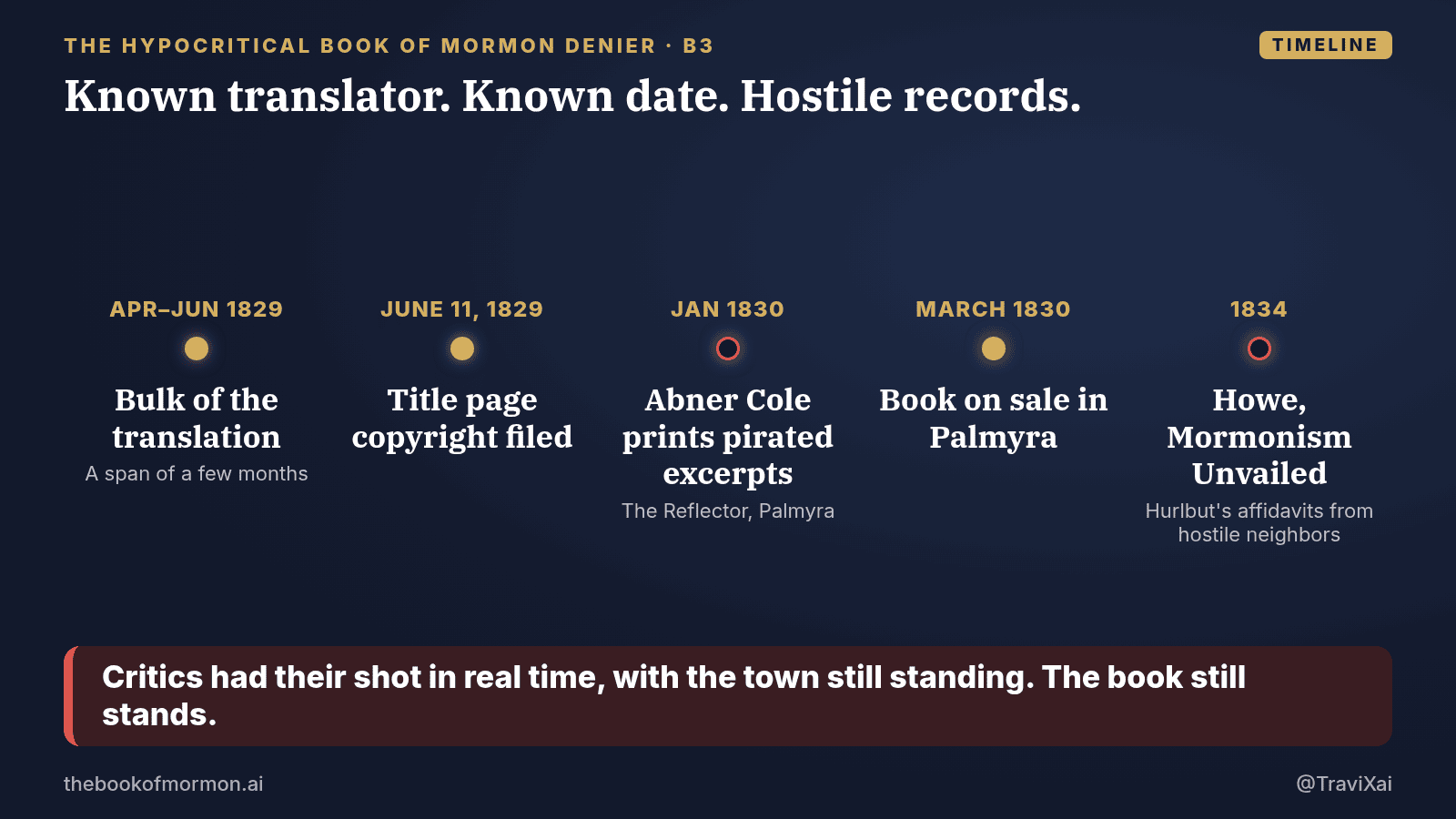
And the best part: the records aren’t only friendly. Abner Cole printed pirated excerpts in his Palmyra newspaper, The Reflector, in January 1830, and stopped only when Joseph asserted his copyright. Eber D. Howe published Mormonism Unvailed in 1834, built around affidavits Philastus Hurlbut gathered from the Smiths’ hostile neighbors. Critics had their shot, in real time, with the people still alive and the town still standing. The Bible’s authors didn’t come with hostile neighbors’ affidavits. Ours did, and the book still stands.
4. Wordprint studies
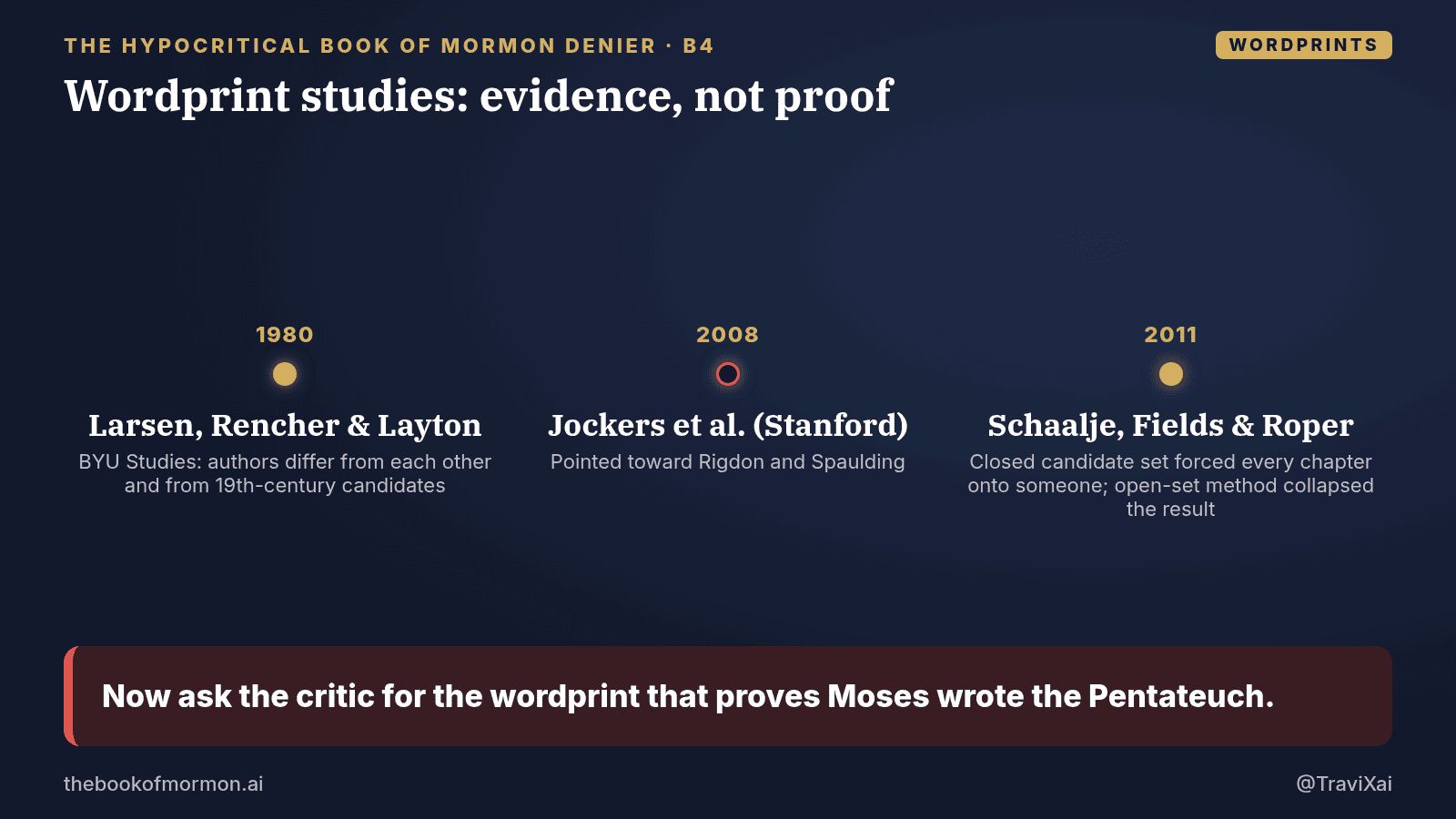
In 1980 Wayne Larsen, Alvin Rencher and Tim Layton published a statistical wordprint study in BYU Studies comparing the writing patterns of Book of Mormon authors with each other and with Joseph Smith, Oliver Cowdery and Solomon Spaulding. They found the main authors differ from each other and from the 19th-century candidates. Later studies have gone back and forth. A 2008 Stanford study by Matthew Jockers and colleagues pointed toward Rigdon and Spaulding, and Schaalje, Fields and Roper answered in the same journal in 2011 that its closed candidate set forced every chapter onto someone on the list; with an open-set method, the Spalding and Rigdon results collapsed. I won’t overclaim. Wordprints are evidence, not proof. But we go through it fairly in Part 2: The Berkeley Wordprint Test and Part 4: The Wordprint Track Record. Now ask the critic for the wordprint that proves Moses wrote the Pentateuch.
5. Nahom and the NHM altars
In 1 Nephi 16:34, Lehi’s family buries Ishmael “in the place which was called Nahom,” and right after, in 1 Nephi 17:1, they travel “nearly eastward.” In the 1990s a German archaeological team led by Burkhard Vogt excavated the Bar’an temple near Marib in Yemen and found altars whose inscriptions name a donor’s grandfather as “the Nihmite,” a member of the NHM tribe. Warren Aston published two of the altars in the Journal of Book of Mormon Studies in 2001. The altars were first dated to the 7th-6th centuries BC, and later chronological work places them a bit earlier, both of which are before Lehi’s journey around 600 BC. The tribal name is still found in that region today, and the turn eastward from that area fits the terrain.
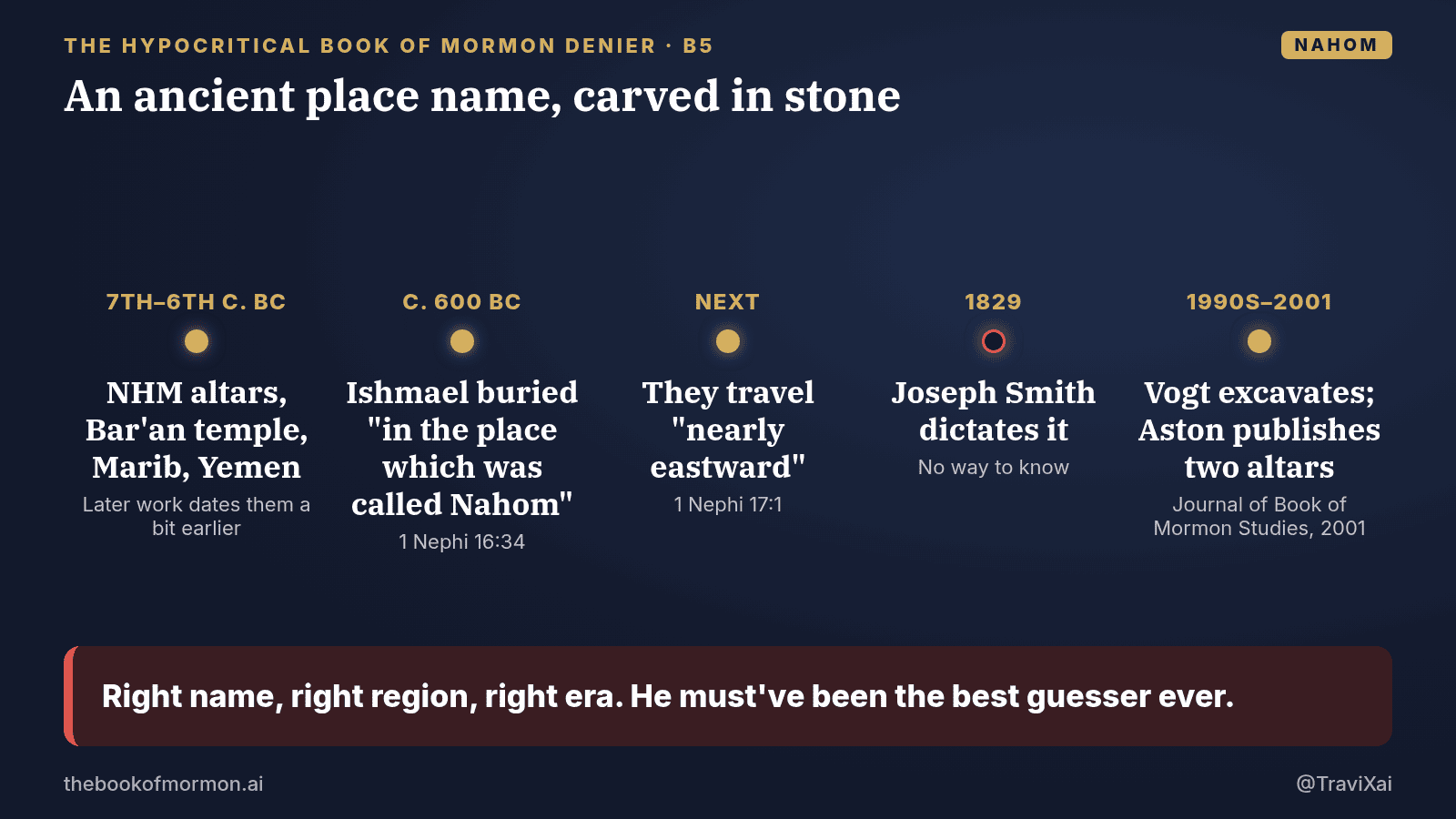
Is this proof? No. But it is an ancient place name, in the right region of Arabia, carved in stone from the right era, sitting next to a direction change the book describes. Joseph Smith in 1829 had no way to know. He must’ve been the best guesser ever.
6. Hebraisms and chiasmus
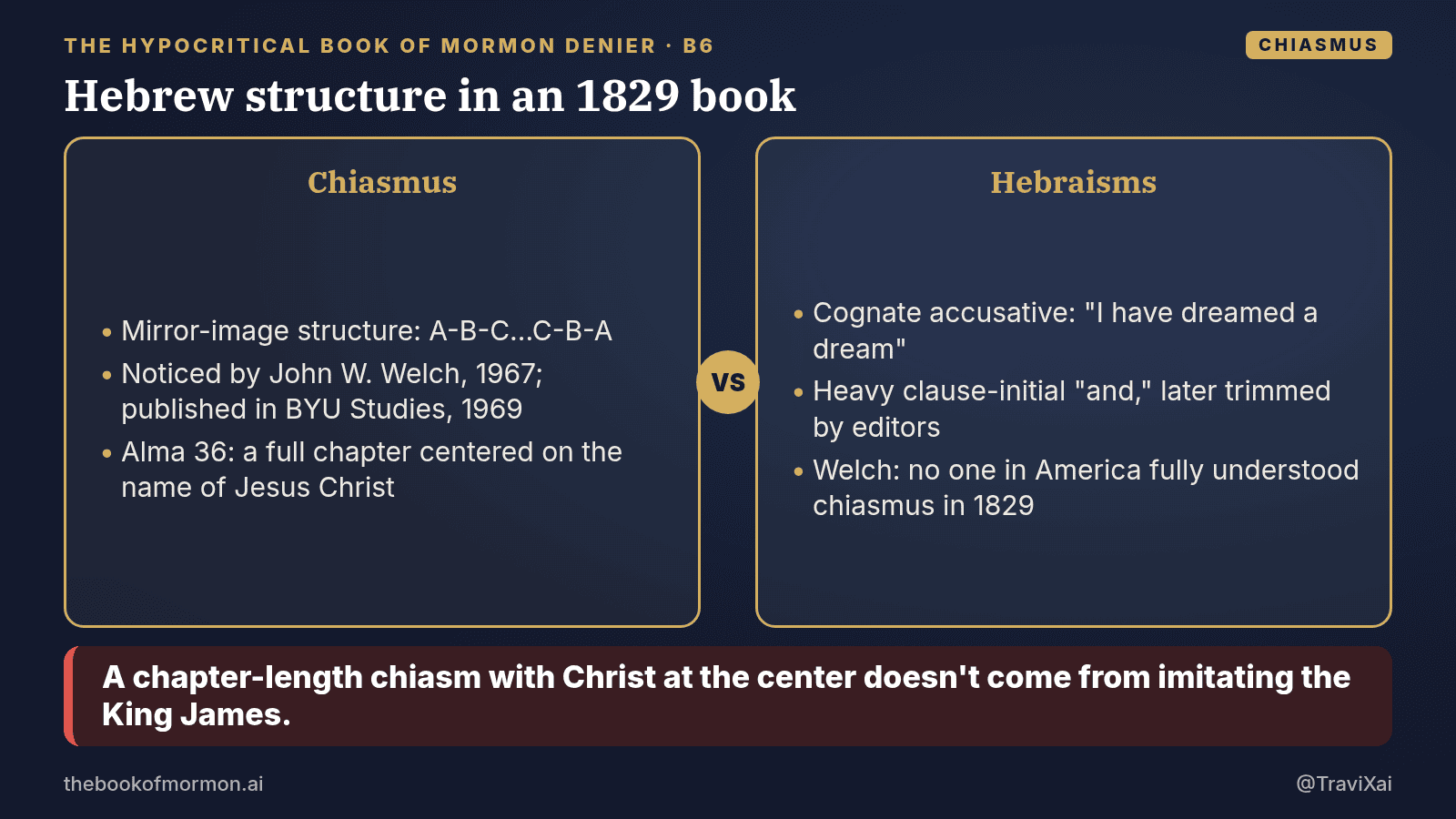
In 1967 a young missionary named John W. Welch noticed that some passages in the Book of Mormon are built as chiasms, a mirror-image structure (A-B-C…C-B-A) that is well known in the Hebrew Bible. He published “Chiasmus in the Book of Mormon” in BYU Studies in 1969. The most famous example, Alma 36, is a full chapter arranged around the name of Jesus Christ at its center. We walked through it in Part 7: Alma 36, Built as a Mirror. Add to that Hebrew-style constructions throughout the text, like the cognate accusative (“I have dreamed a dream”) and the heavy use of “and” at the start of clauses that 1830 editors later trimmed. Critics answer that Joseph could have picked these up from the KJV. Maybe some. But Welch himself points out that chiasmus only became widely understood with biblical scholarship of the mid-1800s, and that no one in America fully understood it in 1829. And a chapter-length chiasm with Christ at the center doesn’t happen by imitating the cadence of the King James.
The standard, both directions
So here’s where we end up. Every major argument critics use against the Book of Mormon (archaeology, anachronisms, missing originals, missing artifacts, disputed authorship, DNA, textual changes) either hits the Bible just as hard or harder. And when it comes to witnesses, manuscripts, a documented origin, hostile contemporary records, and physical evidence like Nahom, the Book of Mormon has things the Bible simply doesn’t.
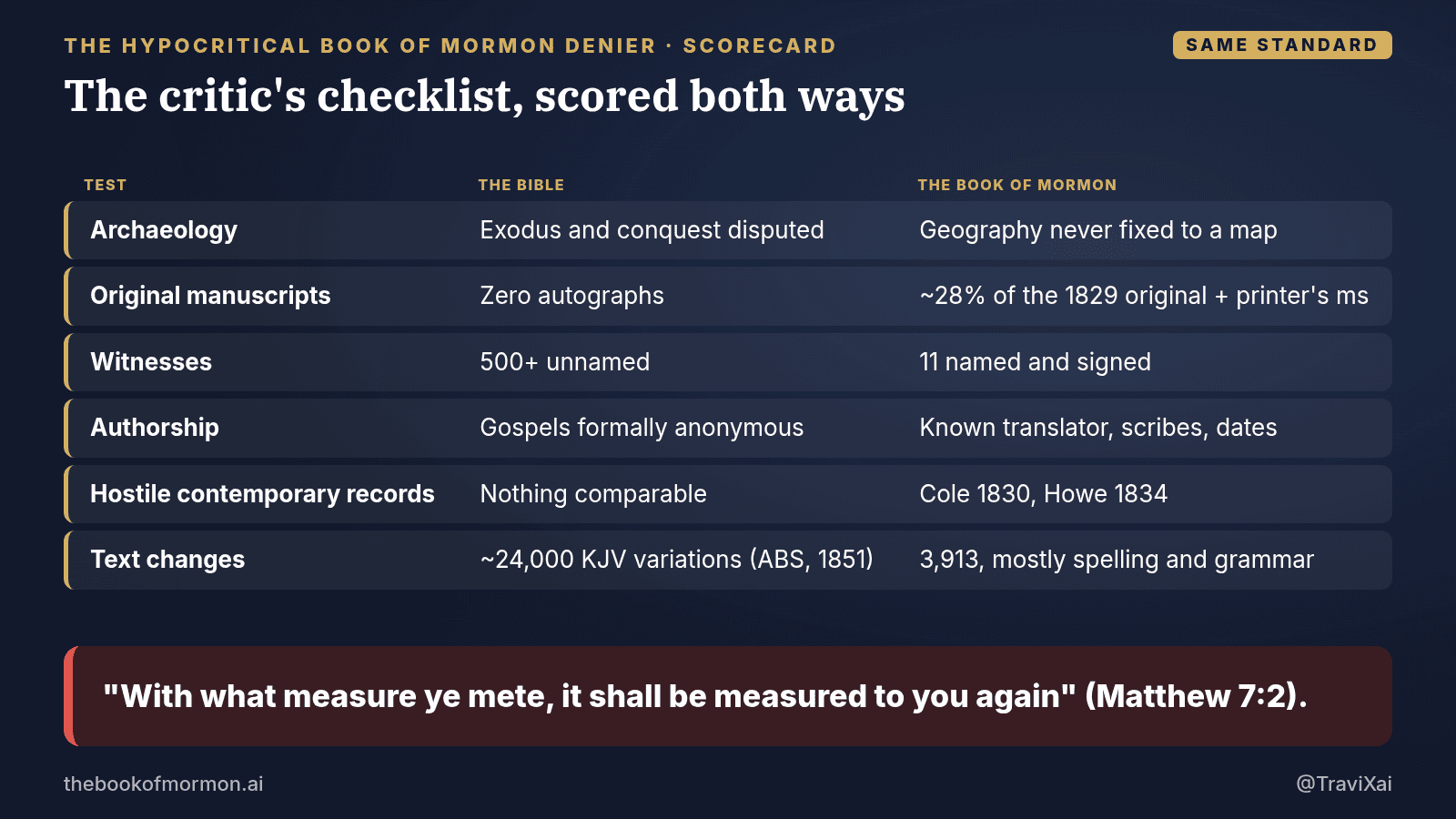
I’m not asking anyone to stop believing the Bible. I’d never ask that. I believe it too. I’m asking critics to pick ONE standard and use it on both books. If your standard throws out the Book of Mormon, it throws out the Bible first. If your explanations save the Bible, they save the Book of Mormon too.
Jesus already told us how this works: “For with what judgment ye judge, ye shall be judged: and with what measure ye mete, it shall be measured to you again” (Matthew 7:2, KJV).
If everyone held their own beliefs to the same standard they hold others to, the world would be a better place. Read it. Then ask.
Sources
- King James Version: Exodus 12:37; Matthew 7:2; 1 Corinthians 15:6; Book of Mormon: 1 Nephi 16:34; 17:1; Alma 36; Testimonies of the Three and Eight Witnesses. https://www.churchofjesuschrist.org/study/scriptures?lang=eng
- Articles of Faith 1:8: https://www.churchofjesuschrist.org/study/scriptures/pgp/a-of-f/1?lang=eng
- Israel Finkelstein and Neil Asher Silberman, The Bible Unearthed (Free Press, 2001).
- William G. Dever, Who Were the Early Israelites and Where Did They Come From? (Eerdmans, 2003).
- Kenneth A. Kitchen, On the Reliability of the Old Testament (Eerdmans, 2003).
- Council for British Research in the Levant, “Excavations at Jericho” (Kenyon, 1952-58): https://www.cbrl.ac.uk/project-library/excavations-at-jericho/
- “Merneptah Stele” (c. 1208 BCE): https://en.wikipedia.org/wiki/Merneptah_Stele
- “Tel Dan stele” (discovered 1993-94): https://en.wikipedia.org/wiki/Tel_Dan_stele
- John Rylands Library, Greek P 457 (P52): https://www.digitalcollections.manchester.ac.uk/view/MS-GREEK-P-00457
- Eusebius, Ecclesiastical History 6.25.14 (New Advent): https://www.newadvent.org/fathers/250106.htm
- Bart D. Ehrman, Misquoting Jesus (HarperSanFrancisco, 2005), ch. 3.
- Michael Wolter on Hengel and the Gospel titles (translated excerpt of Das Lukasevangelium, p. 4): https://germanforneutestamentler.com/2015/01/05/wolter-hengel-gospel-titles/
- Gospel Topics Essay, “Book of Mormon and DNA Studies”: https://www.churchofjesuschrist.org/study/manual/gospel-topics-essays/book-of-mormon-and-dna-studies?lang=eng
- Joseph Smith Papers, original manuscript (about 28% extant; Nauvoo House cornerstone 1841): https://www.josephsmithpapers.org/articles/revelations-volume-5-original-manuscript-of-the-book-of-mormon
- Joseph Smith Papers, Copyright for Book of Mormon, 11 June 1829 (incl. Cole’s Reflector excerpts, Jan. 1830): https://www.josephsmithpapers.org/paper-summary/copyright-for-book-of-mormon-11-june-1829/1
- Royal Skousen, “The Original Manuscript of the Book of Mormon,” Interpreter: https://scholarsarchive.byu.edu/cgi/viewcontent.cgi?article=1823&context=interpreter
- Skousen’s dictation-error findings, summarized: https://scripturecentral.org/evidence/book-of-mormon-evidence-earliest-manuscripts
- Church Newsroom, printer’s manuscript acquisition (2017): https://newsroom.churchofjesuschrist.org/article/church-acquires-printers-manuscript-book-of-mormon
- Deseret News, $35 million purchase (Sept. 20, 2017): https://www.deseret.com/2017/9/20/20619977/lds-church-buys-printer-s-manuscript-of-book-of-mormon-for-record-35-million/
- David Whitmer, “A Proclamation” (March 19, 1881): https://en.wikisource.org/wiki/A_Proclamation_by_David_Whitmer
- Eber D. Howe, Mormonism Unvailed (Painesville, 1834) and the Hurlbut affidavits: https://en.wikipedia.org/wiki/Mormonism_Unvailed
- Wayne A. Larsen, Alvin C. Rencher, Tim Layton, “Who Wrote the Book of Mormon? An Analysis of Wordprints,” BYU Studies 20, no. 3 (1980): 225-251: https://scholarsarchive.byu.edu/byusq/vol20/iss3/2
- Matthew L. Jockers, Daniela M. Witten, Craig S. Criddle, “Reassessing Authorship of the Book of Mormon Using Delta and Nearest Shrunken Centroid Classification,” Literary and Linguistic Computing 23, no. 4 (2008): https://doi.org/10.1093/llc/fqn040
- G. Bruce Schaalje, Paul J. Fields, Matthew Roper, Gregory L. Snow, “Extended Nearest Shrunken Centroid Classification,” LLC 26, no. 1 (2011): https://doi.org/10.1093/llc/fqq029
- Warren P. Aston, “Newly Found Altars from Nahom,” Journal of Book of Mormon Studies 10, no. 2 (2001): 56-61: https://scholarsarchive.byu.edu/cgi/viewcontent.cgi?article=1289&context=jbms
- Warren P. Aston, “The Origins of the Nihm Tribe of Yemen,” Journal of Arabian Studies 4, no. 1 (2014): https://doi.org/10.1080/21534764.2014.918372
- John W. Welch, “Chiasmus in the Book of Mormon,” BYU Studies 10, no. 1 (1969): 69-84: https://byustudies.byu.edu/article/chiasmus-in-the-book-of-mormon
- American Bible Society, Committee on Versions, Report on the History and Recent Collation of the English Version of the Bible (New York: American Bible Society, adopted May 1, 1851), p. 31.