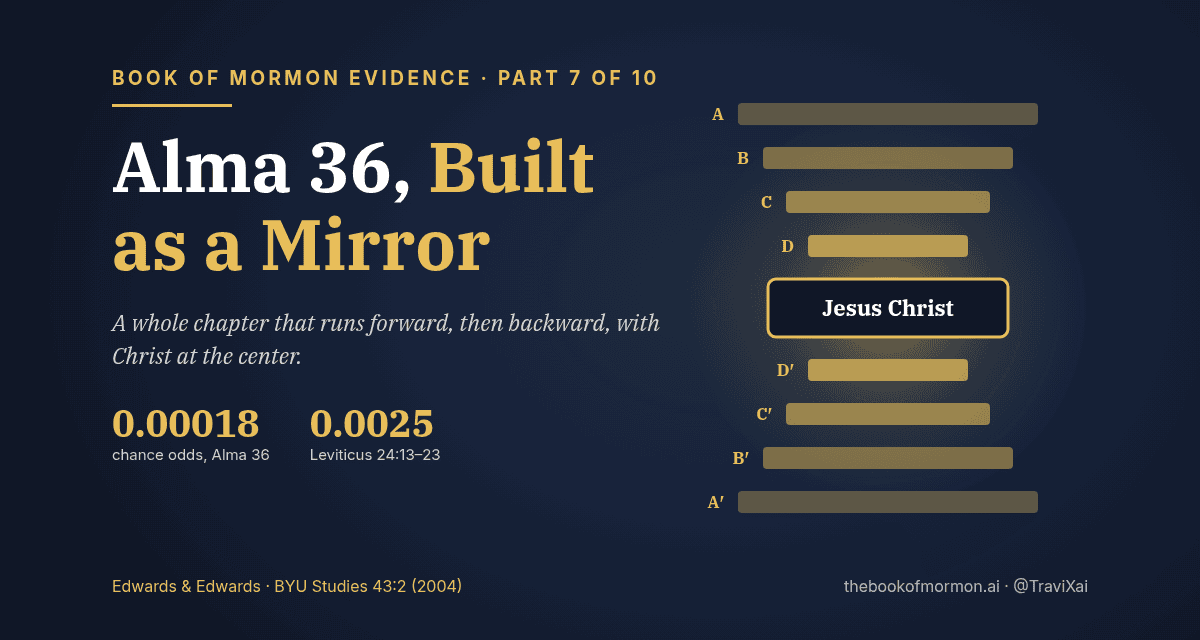

Alma 36 runs its ideas forward, reaches Jesus Christ at the exact center, then runs them back in reverse. Two physicists tested whether that could be chance.
A favorite complaint about the Book of Mormon is that it repeats itself. “And it came to pass.” The same phrases, over and over. But in Alma 36 the repetition has a shape. The chapter walks forward through a string of ideas, reaches Jesus Christ at the exact middle, then walks back out through the same ideas in reverse order. It’s built like a mirror.
In this series: Book of Mormon Evidence (10 parts)
- Part 1: 149 Voices
- Part 2: The Berkeley Wordprint Test
- Part 3: The “Someone Else” Problem
- Part 4: The Wordprint Track Record
- Part 5: One Draft
- Part 6: Older Than King James
- Part 7: Alma 36, Built as a Mirror (you are here)
- Part 8: Nahom (coming soon)
- Part 9: Could the Plates Work? (coming soon)
- Part 10: The Witnesses Who Never Recanted (coming soon)
This started as a post on X, Part 7 of my 10-part Book of Mormon Evidence series. This is the longer version. If you missed it, Part 6: Older Than King James covers the early modern English grammar that the 1800s imitators of scripture almost never wrote.
The patternWhat chiasmus is
Chiasmus (from the Greek letter chi, shaped like an X) is a crossing pattern: say A, then B, then B again, then A again. Jesus used a short one:
He that findeth his life shall lose it: and he that loseth his life for my sake shall find it.
Matthew 10:39 (KJV)
Find, lose, lose, find. Two elements, and you could stumble into that by accident. The interesting ones are long. Ancient Hebrew writers sometimes built whole passages this way, stacking idea after idea and then unwinding them in reverse, with the main point at the center. A celebrated example is Leviticus 24:13–23, which opens “And the LORD spake unto Moses” and closes “as the LORD commanded Moses,” with a mirrored law of “breach for breach, eye for eye” in between.
In 1969 a young BYU graduate student named John W. Welch published “Chiasmus in the Book of Mormon” in BYU Studies. He noted that chiasms in Greek, Latin and English rarely run past two elements, while Hebrew ones can run long. Then he showed long ones in the Book of Mormon, a book that claims roots in ancient Israel. (Galatians18 has a short overview of chiasmus in the Book of Mormon.)
The chapterAlma 36: in, through the center, and back out
Alma 36 is Alma telling his son Helaman about his own conversion. It opens with a promise:
My son, give ear to my words; for I swear unto you, that inasmuch as ye shall keep the commandments of God ye shall prosper in the land.
Alma 36:1
And it closes with the same promise, now with its flip side:
But behold, my son, this is not all; for ye ought to know as I do know, that inasmuch as ye shall keep the commandments of God ye shall prosper in the land; and ye ought to know also, that inasmuch as ye will not keep the commandments of God ye shall be cut off from his presence. Now this is according to his word.
Alma 36:30
In between, the ideas pair up from the outside in: remember the captivity of our fathers; God delivered them; trust in God and be lifted up at the last day; being born of God; Alma losing and then regaining the use of his limbs; being harrowed up by his sins, then harrowed up no more. And at the dead center, the turn of his whole life:
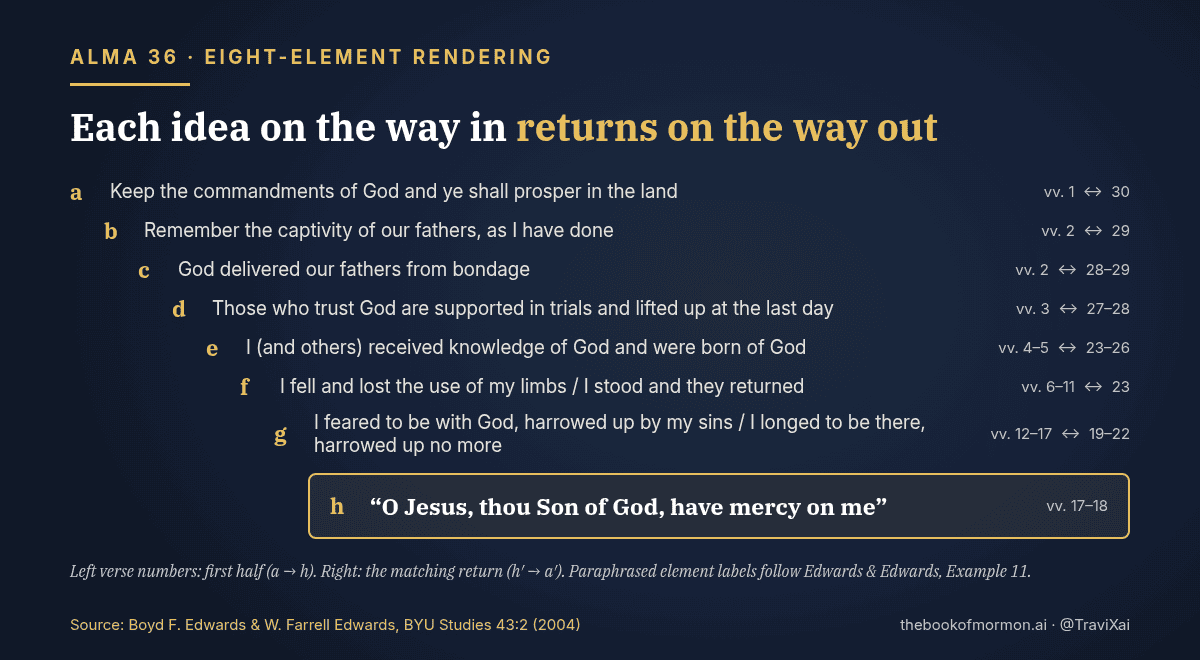
Now, as my mind caught hold upon this thought, I cried within my heart: O Jesus, thou Son of God, have mercy on me, who am in the gall of bitterness, and am encircled about by the everlasting chains of death.
Alma 36:18
Before that verse, everything is pain. After it, everything reverses. Two verses later:
And oh, what joy, and what marvelous light I did behold; yea, my soul was filled with joy as exceeding as was my pain!
Alma 36:20
Welch’s line in 1969 is still the best summary of why this matters: “Alma places the turning point of his life at the turning point of the chapter, i.e., Christ belongs at the center of both.”
The objection“You can find a chiasm anywhere”
The serious pushback is that people who go looking for patterns will find them. Brent Metcalfe put it this way: “Organizing these ideas into chiasms may be the result of subsequent interpreters rather than the intention of the original author.” Dan Vogel called it the “fallacy of the enumeration of favorable circumstances,” meaning you count the hits and ignore the misses. One critic even pulled a four-element “chiasm” out of the introduction to a computer manual, the INFORMIX-OnLine Database Administrator’s Guide, to show how cheap the trick is.
That’s a fair challenge, and it has a fair test. In 2004 two physicists, Boyd F. Edwards (then at West Virginia University) and W. Farrell Edwards (Utah State University), published “Does Chiasmus Appear in the Book of Mormon by Chance?” in BYU Studies 43:2. They built a way to measure how likely a given chiastic structure is to appear by accident, with rules meant to answer the critics directly:
- Element boundaries can’t cut a sentence in half.
- Paired elements have to share the same key word. No counting synonyms as matches.
- Extra repetitions that don’t fit the pattern have to be counted against it, not quietly dropped.
- You have to count every opportunity a writer had to produce a chiasm that good, not just the one you found.
They even dropped one of Welch’s own Alma 36 elements for failing that standard.
The numbersWhat the math found
Their headline number is P, the chance that a chiasm at least that strong would show up somewhere by accident. Here is what Table 1 of their paper reports:
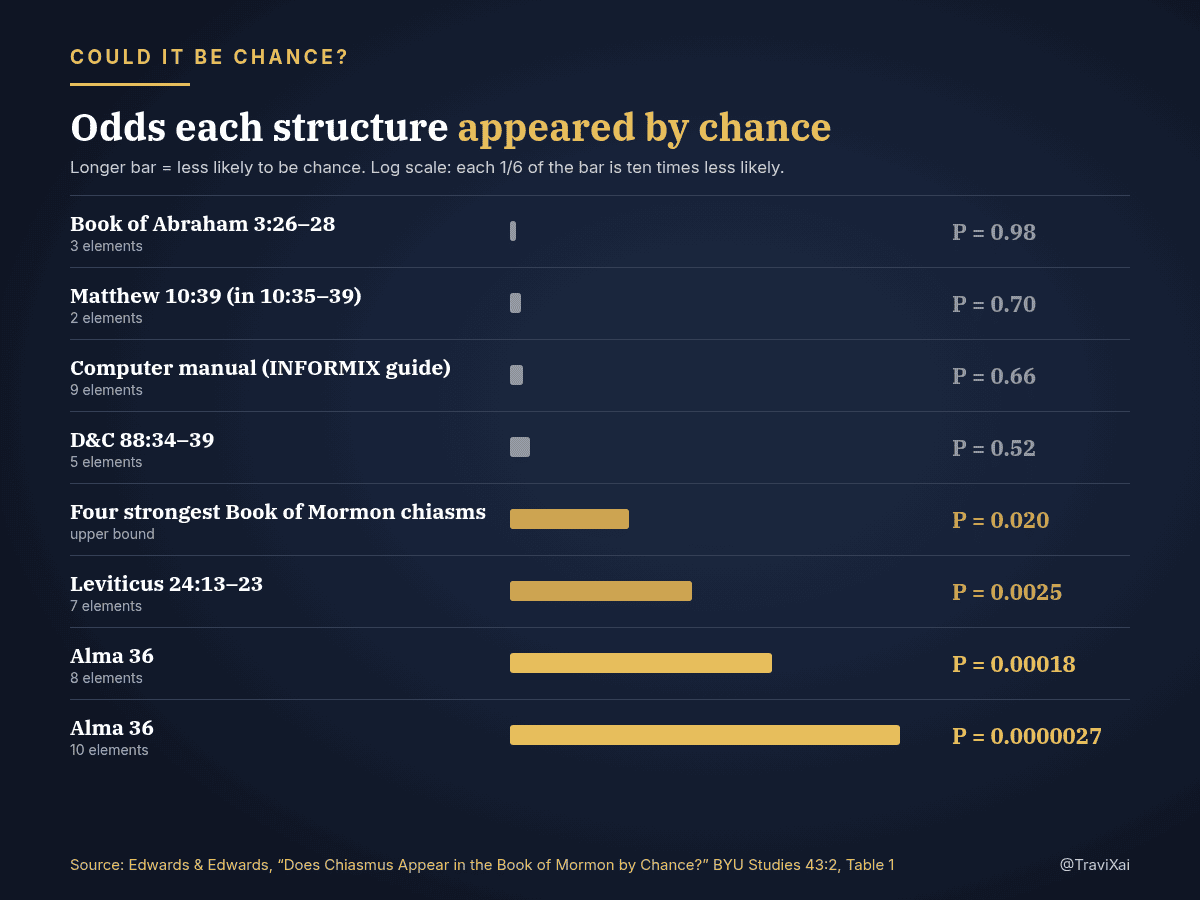
Alma 36 in its eight-element form came out at P = 0.00018. Leviticus 24:13–23, the famous biblical example, came out at 0.0025. By this measure Alma 36 is less likely to be an accident than the Bible’s own textbook case. In the authors’ words:
These results rule out, with 99.98 percent certainty, the claim that Alma 36:1–30 is simply an arrangement of words that happen to fall into chiastic order by chance.
Boyd F. Edwards and W. Farrell Edwards, BYU Studies 43:2
They stress-tested it, too. The conclusion held even if you assumed about 100,000 opportunities, roughly ten times the number of verses in the book. And for a longer, ten-element rendering of Alma 36 they ran a simulation of 400 million random orderings. Only three came out chiastic, for P = 0.0000027.
The control groupThe computer manual, Abraham and the D&C
A test is only worth trusting if it can say no. This one did. The computer manual “chiasm” scored P = 0.66, meaning it’s exactly the kind of thing chance produces. Matthew 10:39 scored 0.70: a real chiasm, but too short to prove anything. That’s the tool working as it should.
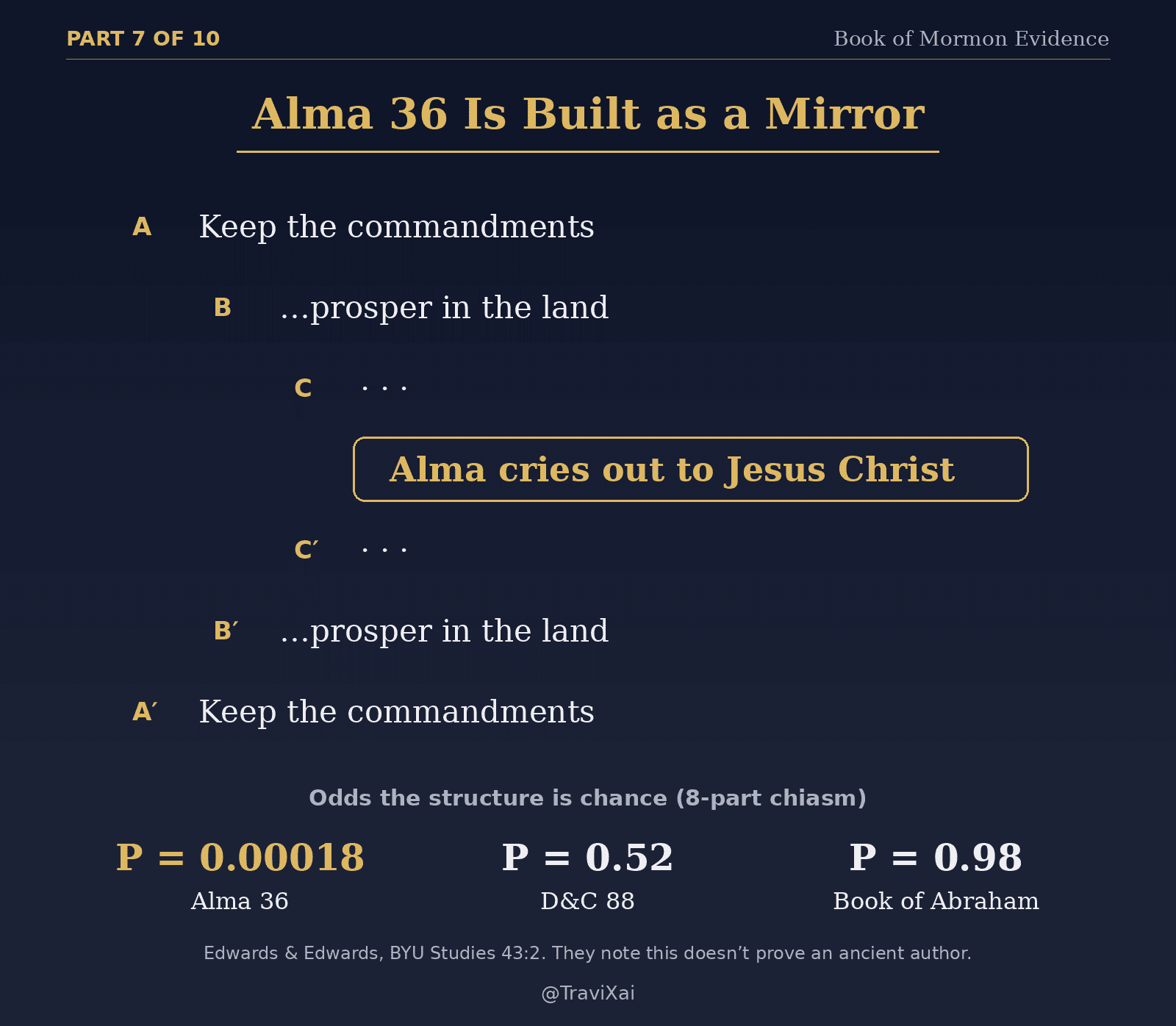
Then the part critics usually skip. If Joseph Smith had a personal habit of writing in chiasms, you’d expect it to show up in what he dictated later. The strongest chiasm the Edwardses found in the Doctrine and Covenants (in D&C 88, five elements) scored 0.52. The strongest in the book of Abraham (three elements) scored 0.98. Those numbers don’t prove those passages weren’t designed. But in the authors’ words they “do rule out the use of chiasms in the Doctrine and Covenants and the book of Abraham as possible evidence” that Joseph knew the form.
Fair framingWhat the math can’t tell you
Chiasmus wasn’t a secret in 1829. Thomas Boys published his Tactica Sacra in London in 1824 and laid out the Leviticus 24 structure in 1825, and John Jebb’s Sacred Literature came out in 1820. Welch argued that public awareness of the form “was slight in America” at the time, and the Edwardses add: “The historical record has yielded no direct evidence that Joseph Smith actually knew about chiasmus when he translated the Book of Mormon in 1829, although some other people at that time did.”
The physicists are also clear about the limits of their own work: “Our results do not prove that the Book of Mormon is a translation of an ancient document, but they do establish that chiastic passages in the Book of Mormon likely appeared by design.” Who designed it, they say, “cannot be determined using our statistical analysis.” Scholars also disagree on the fine details. Proposed outlines of Alma 36 run anywhere from 11 to 17 elements, though they agree on where it starts and ends and that the center is the cry to Christ.
So here is the honest claim. Alma 36 was built on purpose, and built well. Whoever built it did it in one pass of dictation, with no notes. If your theory is that a farm boy wrote nineteenth-century fiction, you now need him to have learned an obscure Hebrew form from British scholarship and then not use it measurably in his later revelations.
One more detailA quote dictated before its source
Look again at verse 22:
Yea, methought I saw, even as our father Lehi saw, God sitting upon his throne, surrounded with numberless concourses of angels, in the attitude of singing and praising their God; yea, and my soul did long to be there.
Alma 36:22
Alma says he saw what “our father Lehi saw,” and then quotes Lehi:
…he thought he saw God sitting upon his throne, surrounded with numberless concourses of angels in the attitude of singing and praising their God.
1 Nephi 1:8
Welch counts “exactly twenty-two words” quoted from Lehi. Here’s the catch: the pages with 1 Nephi were the last part dictated. In “Timing the Translation of the Book of Mormon” (BYU Studies 57:4, 2018), Welch places Alma 36 in Harmony, Pennsylvania, around April 24, 1829, while the Lehi text wasn’t supplied until about June 5 in Fayette, New York. Alma quotes a passage about six weeks before that part of 1 Nephi was dictated.
Alma 36 also retells Alma’s conversion from Mosiah 27, which Welch dates to about ten days earlier, and it reuses that chapter’s distinctive language: the “gall of bitterness,” the “marvelous light,” being “racked with eternal torment.” That fits Part 5: One Draft: a dictated text with no rewrite that still keeps track of itself across hundreds of pages.
SummaryKey takeaways
- Alma 36 runs its ideas in, through a center, and back out in reverse. The center is Alma’s cry, “O Jesus, thou Son of God, have mercy on me.”
- Physicists Boyd and Farrell Edwards tested whether that could be chance, with strict rules built to answer critics. Alma 36 scored P = 0.00018, stronger than Leviticus 24:13–23 (0.0025).
- The same test rejected a computer-manual “chiasm” (0.66), and the strongest chiasms in the D&C (0.52) and Abraham (0.98) showed no sign of design.
- The math says “design,” not “who.” Some 1820s scholars knew the form; no record shows Joseph did.
- Alma 36:22 quotes 1 Nephi 1:8, which Welch places about six weeks later in the dictation.
Coming upNext: Nahom
Next: Part 8: Nahom (coming soon). A place name in Arabia, right where Nephi says Ishmael was buried. (The short version is on Galatians18: Nahom and NHM.)
Read Alma 36 tonight, slowly, and watch for the turn at verse 18. Then catch up on Part 6: Older Than King James. For more like this, follow me on X at @TraviXai. And if someone answers all this with Galatians 1:8, the Galatians 1:8 app is ready for that conversation.
Sources
- Boyd F. Edwards and W. Farrell Edwards, “Does Chiasmus Appear in the Book of Mormon by Chance?” BYU Studies 43, no. 2 (2004): 103ff: byustudies.byu.edu (rules, Table 1 values, ten-element simulation, INFORMIX test, D&C and Abraham results, critics quoted, limits of the analysis)
- John W. Welch, “Timing the Translation of the Book of Mormon: ‘Days [and Hours] Never to Be Forgotten,’” BYU Studies Quarterly 57, no. 4 (2018): 10ff: byustudies.byu.edu (Alma 36:22 and 1 Nephi 1:8, April and June 1829 dates, Mosiah 27)
- John W. Welch, “Chiasmus in the Book of Mormon,” BYU Studies 10, no. 1 (1969): 69–84: byustudies.byu.edu
- Scripture Central, “The Amazing Chiasmus in Alma 36 of the Book of Mormon”: YouTube
- Scriptures: Leviticus 24:13–23 · Matthew 10:39 · Alma 36 · 1 Nephi 1:8 · Mosiah 27:29
- Previous in the series: Part 6: Older Than King James
- The original X post: x.com/TraviXai
- Featured image and charts: original graphics by thebookofmormon.ai (no photographs or likenesses of real people).