
Between April 7 and about June 30, 1829, Joseph Smith dictated roughly 269,500 words, a few dozen at a time, with no notes and no rewrite. Here is the timeline, the math, and what the text kept straight.
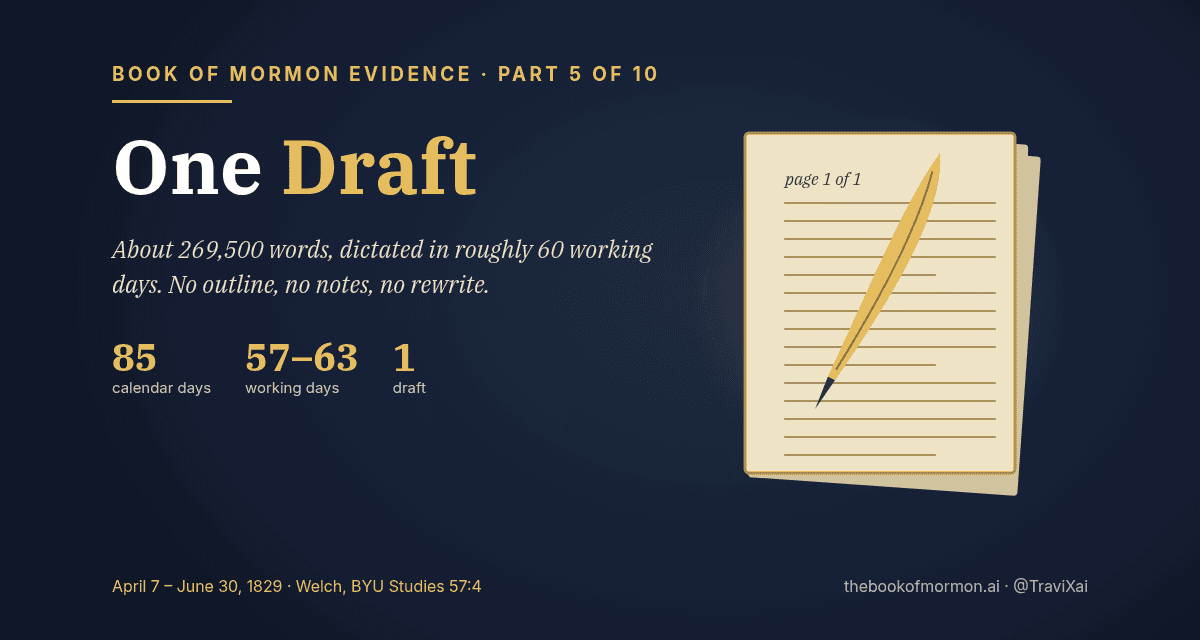
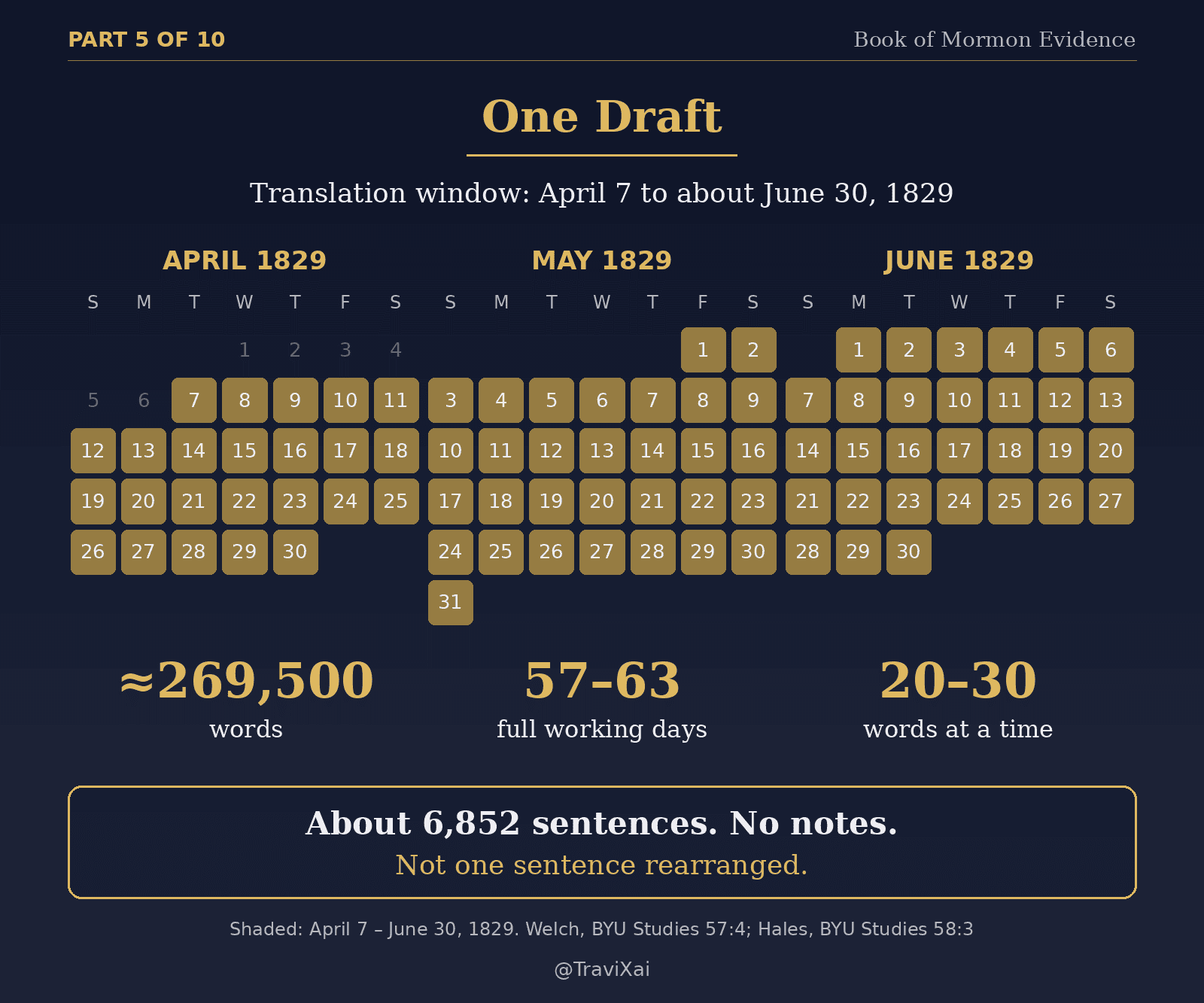
Every writer you have ever read had a second draft. Usually a tenth. Joseph Smith got one draft. Between April 7 and about June 30, 1829, he dictated roughly 269,500 words to a scribe, a few dozen words at a time, with no notes and no books, and the manuscript went to the printer without being rewritten. That’s the claim of Part 5. Let’s see whether the numbers hold up.
In this series: Book of Mormon Evidence (10 parts)
- Part 1: 149 Voices
- Part 2: The Berkeley Wordprint Test
- Part 3: The “Someone Else” Problem
- Part 4: The Wordprint Track Record
- Part 5: One Draft (you are here)
- Part 6: Older Than King James (coming soon)
- Part 7: Alma 36, Built as a Mirror (coming soon)
- Part 8: Nahom (coming soon)
- Part 9: Could the Plates Work? (coming soon)
- Part 10: The Witnesses Who Never Recanted (coming soon)
This started as a post on X, Part 5 of my 10-part Book of Mormon Evidence series. This is the longer version. If you missed it, Part 4: The Wordprint Track Record covers forty years of authorship studies, misses included.
The calendarEighty-five days, start to finish
The best single study of the timeline is John W. Welch’s “Timing the Translation of the Book of Mormon,” in BYU Studies 57:4. Welch builds it on five anchor dates. The first is firm: Oliver Cowdery arrived in Harmony, Pennsylvania, on the evening of Sunday, April 5, 1829, and on Tuesday, April 7, he “picked up his quill pen, dipped it in his inkwell, and began to write.”
The last is firm too. The title page, which comes from the end of the plates, was filed for copyright on June 11. Around June 28 the translation was finished, the Three Witnesses had their experience, and the Eight Witnesses handled the plates at the end of June or the first days of July. David Whitmer later said the work at his father’s house “occupied about one month, that is, from June 1st to July 1st, 1829.”
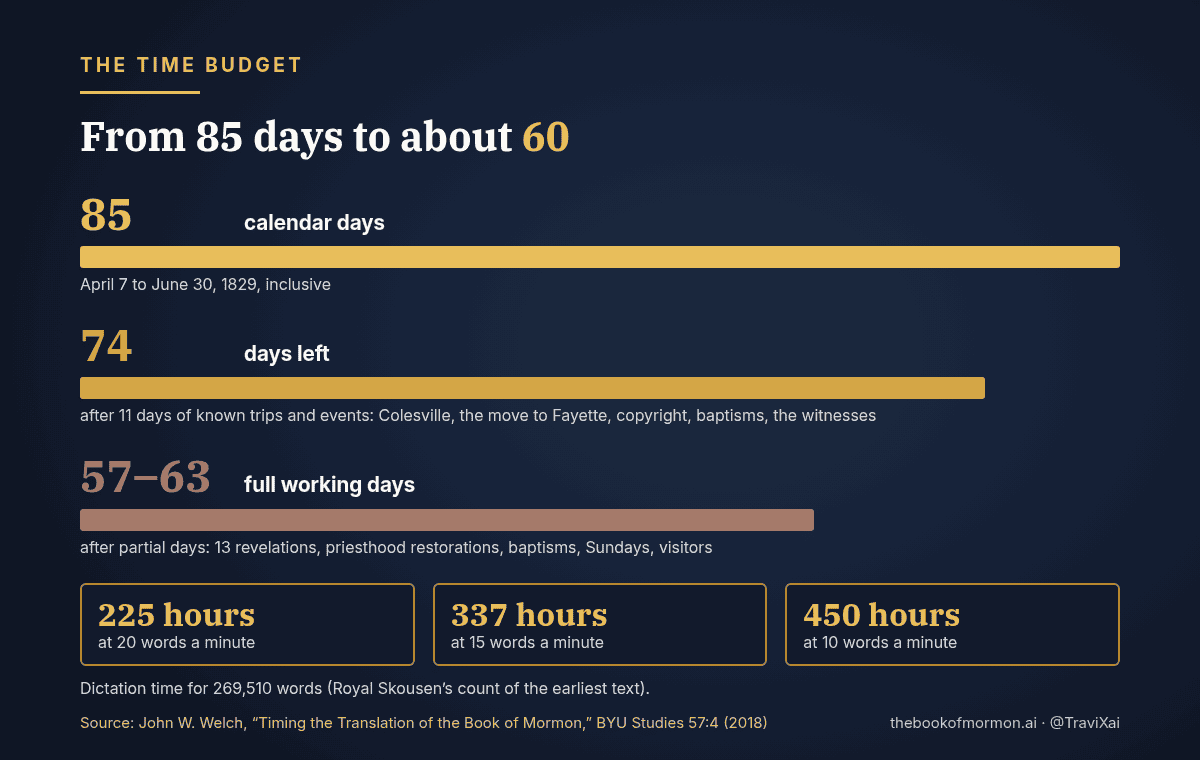
From April 7 to June 30, inclusive, is eighty-five days. But Joseph did not translate on all of them. Welch subtracts eleven days when he was clearly doing something else: a trip to Colesville and back, the move to Fayette, the copyright paperwork, baptisms in Seneca Lake, the witnesses. That leaves seventy-four.
Then come the partial days: priesthood restorations, baptizing his brothers Samuel and Hyrum, twelve Sundays, curious neighbors, farm work, and thirteen revelations now in the Doctrine and Covenants (6,124 words on their own). Welch’s bottom line: “a total of only 57 to 63 available full-time working days.”
The mathAbout 4,500 words a day
Royal Skousen, who has spent decades on the original manuscript, counts 269,510 words in the earliest text, on an estimated 608 manuscript pages. Divide that by about 60 working days and you get around 4,500 words a day, every working day, for three months.
Welch ran the hours. At 20 words a minute, the whole book takes about 225 hours of dictation. At 15, 337 hours. At 10, 450 hours. He and his wife then tested the pace themselves, one reading a line and the other writing it and reading it back, with a stopwatch running. About 20 words a minute was possible, he wrote, “But we couldn’t imagine sustaining that rate hour after hour, day after day.”
Critics have noticed the squeeze too. Welch notes that when Francis Kirkham proposed about seventy-five working days in 1941, Fawn Brodie answered by suggesting Martin Harris had been taking dictation for some time before April 7. Welch’s reply is that the work done between September 1828 and March 1829 was “probably relatively little.”
The methodTwenty or thirty words at a time
Speed alone proves little. What matters is how the words came. Brian C. Hales, writing in BYU Studies 58:3, sums up the eyewitness accounts this way:
- Joseph and his scribes worked in dictations of twenty to thirty words at a time.
- The scribe read each piece back to check it.
- “No books, manuscripts, or other documents were consulted during the dictation.”
- After breaks, he started where he had left off without having the previous part read back.
Emma Smith, who wrote for him before Oliver arrived, told her son in 1879 that “he had neither manuscript nor book to read from.” Then she added the detail that sticks:
when acting as his scribe, your father would dictate to me hour after hour; and when returning after meals, or after interruptions, he would at once begin where he had left off, without either seeing the manuscript or having any portion of it read to him.
Emma Smith, interview with Joseph Smith III, February 1879, Saints’ Herald, October 1, 1879 (transcription)
Her full testimony is in Emma Smith’s Last Testimony, and the question of which instrument Joseph used is its own debate: see the case for the Urim and Thummim, or Galatians18’s short take on the seer stone in a hat. For this post the point is narrower. Whatever he looked into, nobody saw him reading notes.
Even skeptics grant that much. Dan Vogel, the leading naturalistic biographer, describes the dictation as recited “mostly impromptu and without the aid of notes,” as Hales quotes him. Vogel thinks Joseph composed it; he doesn’t claim Joseph read it from anything.
Dictating sacred words to a scribe is nothing new. That’s how Jeremiah worked:
Then Baruch answered them, He pronounced all these words unto me with his mouth, and I wrote them with ink in the book.
Jeremiah 36:18 (KJV)
The draft6,852 sentences, none rearranged
Here’s where the title comes from. Typeset, the dictated text came to about 6,852 sentences averaging 39.3 words each, and, in Hales’s words, “Joseph afterward did not rearrange the sequence of a single sentence.” No rewriting or content editing happened before the manuscript went to the printer. Oliver copied it out for the typesetter; he didn’t restructure it.
Skousen, who has studied the surviving original manuscript closer than anyone, found “very few signs of any editing or Joseph changing his mind about the translation” (as quoted by Welch). Scribal slips, yes. Rethinking the story, no.
Compare that with how writing normally works. Hales quotes a standard college textbook: “All good writers rethink, rearrange, and rewrite large portions of their prose.” Fawn Brodie, no friend of Joseph’s claims, said he “laid out for himself a task that would have given the most experienced novelist pause.” And he did it without the novelist’s main tool: the second draft.
Every author gets a second draft. The Book of Mormon never had one.
thebookofmormon.ai
The bookkeepingWhat it kept straight without notes
A long book dictated in one pass should drift. Names should wobble and timelines should tangle. Instead, Welch points to details that had to be tracked across weeks:
- The Jaredite kings. Ether 1 lists thirty names, from Ether back to Jared, dictated on one day. Over the next three days, in Ether 2–11, the story walks through those same rulers in exactly the opposite order, “apparently without any notes.”
- Alma quotes Lehi. In Alma 36:22, Alma quotes exactly twenty-two words from Lehi in 1 Nephi 1:8. On Welch’s timeline, Alma was dictated around April 24 and the Lehi passage about June 5. The quotation came before the original.
- Seven tribes, same order. Nephites, Jacobites, Josephites, Zoramites, Lamanites, Lemuelites, and Ishmaelites appear in 4 Nephi 1:38, again in Mormon 1:8 a page later, and again about a month later in Jacob 1:13, in the same order each time.
- The map. Drawing on John Sorenson’s geography source book, Hales counts more than 425 geographic relationships among over 175 individuals and groups, in at least 125 different locations.
None of that requires a miracle to explain on its own. Together, at about 4,500 words a day with nothing to look back at, it asks a lot of whatever theory you hold.
For scaleThe “source” is a fifth the size
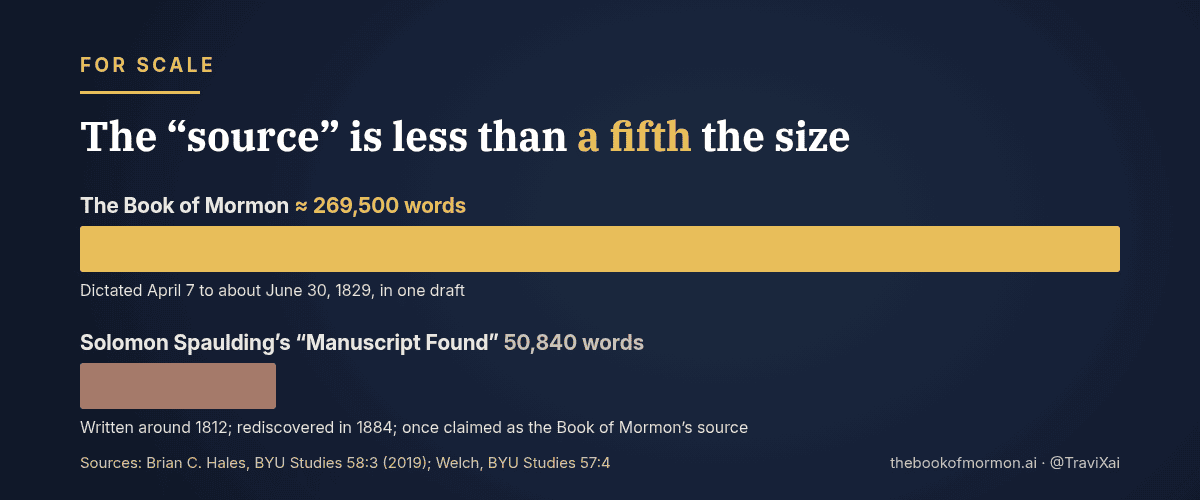
For decades the favorite explanation was that Joseph worked from Solomon Spaulding’s “Manuscript Found.” Then the manuscript turned up. Hales: “At 50,840 words, ‘Manuscript Found’ is less than a fifth the size of the Book of Mormon,” and it doesn’t read like the King James Bible at all. Part 3 covered the “someone else” wordprint study; Galatians18 has a short version on the Spaulding manuscript.
Outside scholars have stopped calling the book simple, too. Daniel Walker Howe, the Pulitzer-winning historian, isn’t a Latter-day Saint and assumes Joseph wrote it. Still, he says: “True or not, the Book of Mormon is a powerful epic written on a grand scale with a host of characters… Its narrative structure is complex.” Galatians18 covers the “19th-century fiction” claim head-on.
ObjectionsThe pushback, answered
“Fast doesn’t mean inspired.” Agreed. The argument is the combination: length, speed, no notes, no rereading, no rewrite, and consistency, all at once. Remove any one and it gets easier.
“What about Pearl Curran?” Hales takes this one seriously. In the 1910s Curran dictated The Sorry Tale through a Ouija board, quickly and with little editing. But the automatic-writing theory has a problem, and Hales spells it out: hypnosis and trance don’t add memory or intellect a person doesn’t already have. They can’t supply the bookkeeping.
“He memorized someone else’s manuscript.” Then he memorized thousands of sentences, delivered them in order across three months, and nobody living with him ever saw the original. Emma was blunt: “If he had had anything of the kind he could not have concealed it from me.”
Isaiah saw it coming, a sealed book delivered to someone with no credentials:
And the book is delivered to him that is not learned, saying, Read this, I pray thee: and he saith, I am not learned.
Isaiah 29:12 (KJV)
SummaryKey takeaways
- The translation ran from April 7 to about June 30, 1829: 85 calendar days, roughly 57–63 full working days (Welch).
- About 269,500 words means around 225 hours of dictation at 20 words a minute, or 450 at 10.
- Dictation came 20–30 words at a time, with no notes or books, and resumed after breaks without readback (Hales; Emma Smith).
- About 6,852 sentences, and none were rearranged afterward. There was one draft.
- Spaulding’s “Manuscript Found” is 50,840 words, less than a fifth the size.
Coming upNext: Older Than King James
The text was dictated in 1829 English, but some of its grammar sounds older than the King James Bible. Part 6: Older Than King James, coming tomorrow.
Catch up on Part 4: The Wordprint Track Record, and read the book for yourself; Moroni’s promise is for anyone who asks. For more like this, follow me on X at @TraviXai. And if someone answers all this with Galatians 1:8, the Galatians 1:8 app is ready for that conversation.
Sources
- John W. Welch, “Timing the Translation of the Book of Mormon: ‘Days [and Hours] Never to Be Forgotten,’” BYU Studies Quarterly 57, no. 4 (2018): byustudies.byu.edu (anchor dates, 85/74/57–63 days, 269,510 words, 225/337/450 hours, the Ether genealogy, Alma 36:22, the seven tribes, Skousen quotation, Whitmer quotation)
- Brian C. Hales, “Naturalistic Explanations of the Origin of the Book of Mormon: A Longitudinal Study,” BYU Studies Quarterly 58, no. 3 (2019): byustudies.byu.edu (dictation method, 6,852 sentences, Sorenson counts, “Manuscript Found,” Vogel, Brodie, Howe, Curran)
- Emma Smith, interview with Joseph Smith III, February 1879, Saints’ Herald 26 (October 1, 1879): 289–90: transcription (BYU Religious Studies Center)
- Royal Skousen, ed., The Original Manuscript of the Book of Mormon (FARMS, 2001), 6, as quoted by Welch
- Daniel Walker Howe, What Hath God Wrought: The Transformation of America, 1815–1848 (Oxford University Press, 2007), 314, as quoted by Hales
- Scriptures: Jeremiah 36:18 · Isaiah 29:12 · Ether 1:6 · Alma 36:22 · 1 Nephi 1:8
- Previous in the series: Part 4: The Wordprint Track Record
- The original X post: x.com/TraviXai
- Featured image, charts, and calendar graphic: original graphics by thebookofmormon.ai (no photographs or likenesses of real people).