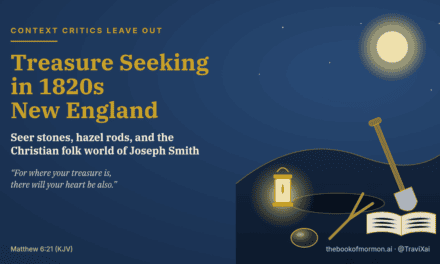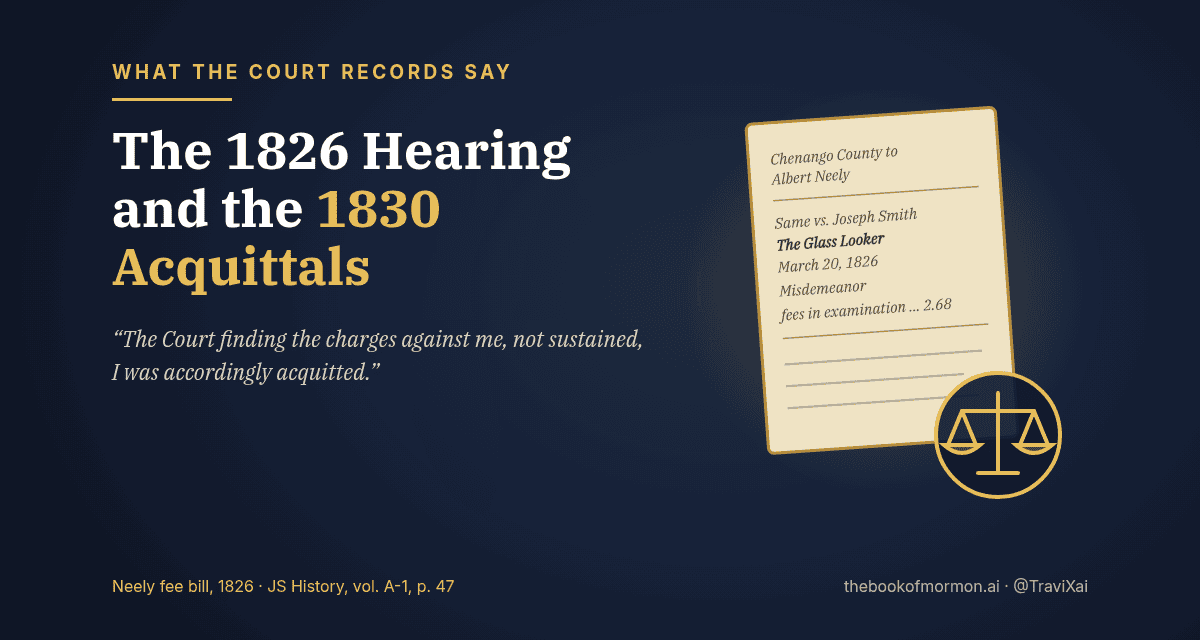

In 1826 a New York justice examined Joseph Smith as “the Glass Looker.” In 1830 two more courts heard the same charge and let him go. Here is what the surviving records prove, what they don’t, and what critics usually leave out.
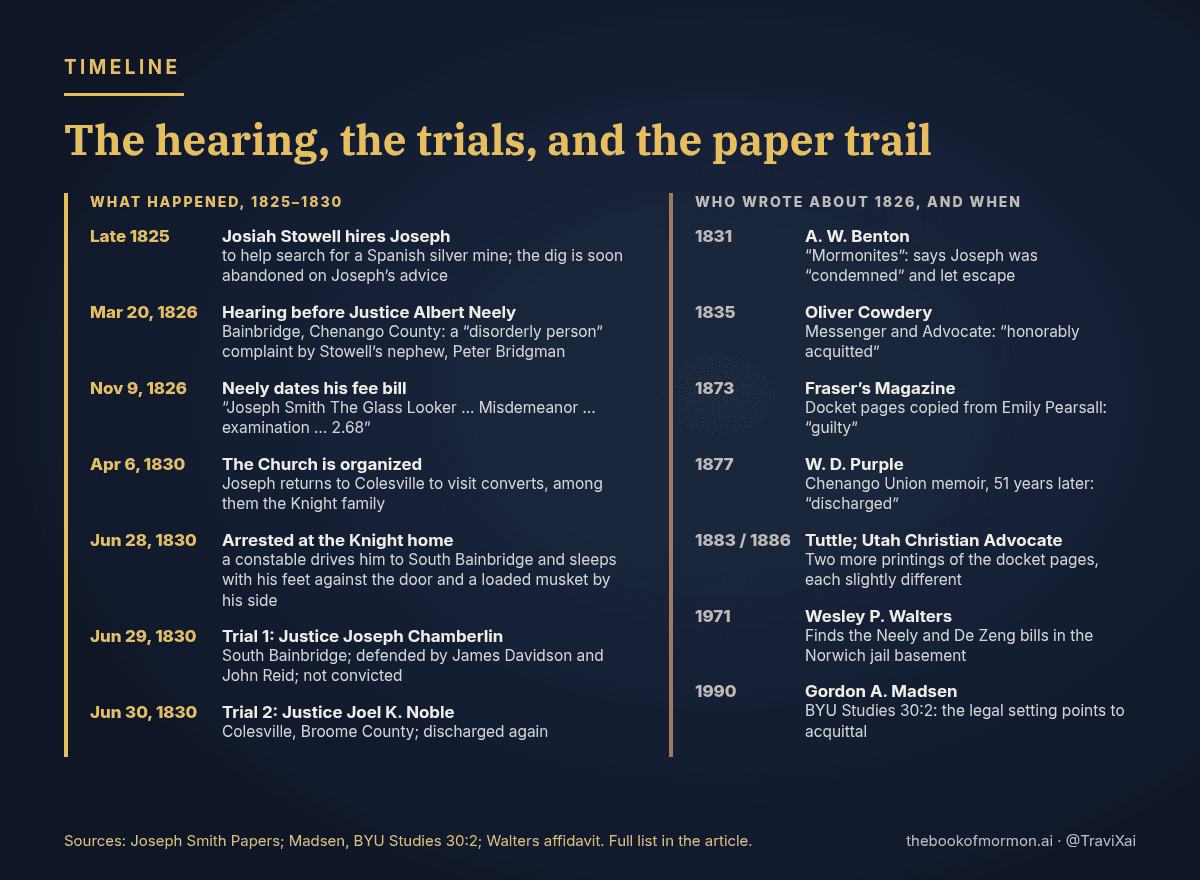
On the evening of June 28, 1830, a small congregation was gathering at Joseph Knight’s house near Colesville, New York, to confirm the people baptized that morning. Then a constable walked in with a warrant. The charge: being “a disorderly person.” The constable soon told Joseph Smith that the men behind the warrant meant to hand him to a mob waiting in ambush, so he whipped the horse and outran them, even after a wagon wheel came off. That night, in an upper room of a South Bainbridge tavern, the constable slept “with his feet against the door, and a loaded musket by his side.”
The charge reached back four years, to a March 1826 hearing before Justice Albert Neely. Critics love that hearing; mention it online and someone will call Joseph a convicted con man. The records are more interesting than that, and a lot less tidy.
So let’s read them: what survives from 1826, what it proves, what it doesn’t, and what happened when the charge came back twice in 1830.
Part IThe charge, and the part that’s true
Start with the concession, because it’s real. In late 1825 a farmer named Josiah Stowell hired Joseph to help look for a Spanish silver mine on the Pennsylvania side of the Susquehanna River. Lucy Mack Smith wrote that Stowell came for him after hearing Joseph “was in possession of certain means” by which he “could discern things, that could not be seen by the natural eye.” The means were seer stones. Joseph never hid this; his own history says he “prevailed with the old gentleman to cease digging after it” (Joseph Smith—History 1:56). That world is covered in Joseph Smith the “Money Digger”? and Seer Stones in the Bible (short versions on Galatians18: Treasure Seeking and Seer Stones in Joseph Smith’s World).
New York’s disorderly persons law lumped vagrants and jugglers together with “all persons pretending … to tell fortunes, or to discover where lost goods may be found.” The penalty for a conviction was up to sixty days at hard labor in the bridewell. The Joseph Smith Papers editors point out that the word “pretending” assumed the use of seer stones was “categorically deceptive and fraudulent, regardless of whether the accused sincerely believed that they had access to uncommon powers” (Introduction to State of New York v. JS–A).
In other words, the law settled the question of sincerity before anyone took the stand.
Part IITwo bills in a jail basement
For a century the hearing was known only through late printed accounts, and Latter-day Saint writers Francis Kirkham and Hugh Nibley doubted they were authentic. Then came 1971.
On July 28 of that year, the Reverend Wesley P. Walters and Fred Poffarl were digging through Chenango County’s dead storage in the basement of the county jail in Norwich. Poffarl found “two cardboard boxes in the darkest area of the room,” full of bills, “some badly water-soaked and mildewed from being shoved against a leaky wall.” In the damp 1826 bundle for Bainbridge, Walters found Justice Neely’s bill, then Constable Philip M. De Zeng’s (Walters affidavit).
Same vs. Joseph Smith The Glass Looker March 20, 1826 Misdemeanor To my fees in examination of the above cause 2.68
Albert Neely’s bill to Chenango County, dated November 9, 1826, as transcribed in Gordon A. Madsen, BYU Studies 30:2 (1990)
De Zeng billed for “Serving Warrant on Joseph Smith,” “Subpoenaing 12 Witnesses,” “Attendance with Prisoner two days & 1 night,” “Notifying two Justices,” and “10 miles travel with Mittimus to take him.”
What those two papers prove: a real proceeding on March 20, 1826. Joseph was arrested, held, and examined, twelve witnesses were subpoenaed, and locals knew him as “the Glass Looker.” Walters wrote that the bills made Joseph’s early glass-looking “an incontrovertible fact” (reprint). On that point he was right, and the earlier doubters were wrong. (Galatians18’s short version: The 1826 Glass-Looking Hearing.)
What they don’t prove: a verdict. Neither bill records one. And as lawyer Gordon Madsen notes, no crime of “glass looking” existed; the phrase identifies the man, and the charge reads only “Misdemeanor.”
Part IIISeven sources, no agreed verdict
Everything else we know about the hearing comes from later accounts, and they don’t agree.
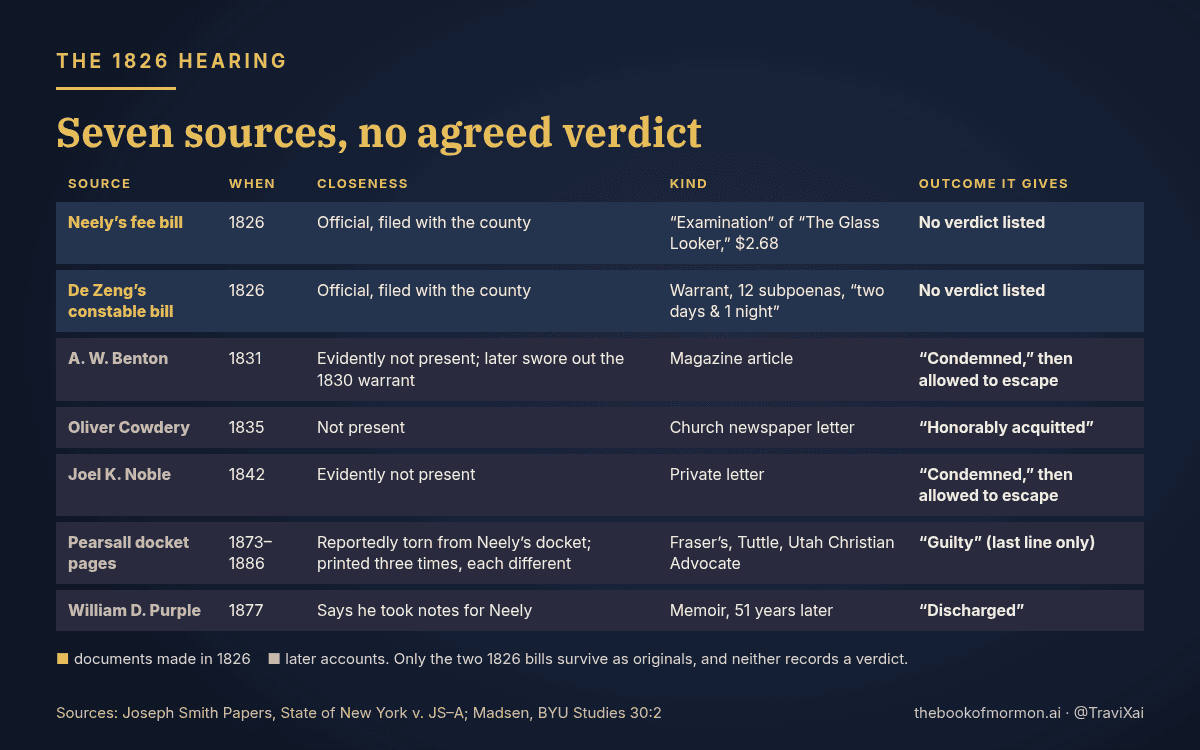
- A. W. Benton, 1831. The earliest account: Joseph was “tried and condemned,” then, as a minor, “designedly allowed to escape.” The Joseph Smith Papers attribute it to Abram W. Benton, and Joseph’s history names a young man called Benton as the one who “swore out the first warrant against me” in 1830.
- Oliver Cowdery, 1835. Not present. He wrote that “some very officious person complained of him as a disorderly person … but there being no cause of action he was honorably acquitted.”
- Joel K. Noble, 1842. Evidently not present. The justice who discharged Joseph in 1830 wrote that the 1826 court “condemned” him.
- The Pearsall pages, 1873–1886. Neely’s niece, Emily Pearsall, reportedly “tore the leaves” about the case out of his docket book. Copies were printed in Fraser’s Magazine (1873), by Bishop Daniel S. Tuttle (1883), and in the Utah Christian Advocate (1886). They end: “And therefore the court find the defendant guilty.”
- William D. Purple, 1877. He said he took notes for Neely, and wrote 51 years later. He names Stowell’s sons as the complainants, and ends: “the prisoner was discharged, and in a few weeks left the town” (Purple reminiscence).
To be fair to the critics: the Joseph Smith Papers say several details in the printed docket match the 1826 bills, “strongly suggesting that the published transcript was based on an authentic source.” But each printing “contains unique omissions and errors,” and without the original, “it remains unknown how accurately any of the published versions represents Neely’s original docket entry.”
Part IVSo was he convicted?
A conviction required a record of conviction, but the itemized costs in the printed docket include no charge for one. Neely knew how to bill it: in an August 1827 case he charged the county twenty-five cents for a “Record of Conviction.” Joseph is not in the county’s 1826 bridewell register, and De Zeng’s bill has no charge for “conveying a person to gaol.” The Joseph Smith Papers conclude:
While this strongly suggests that Neely did not convict JS, the lack of verifiable contemporary records renders tentative any conclusion about the case’s outcome.
Joseph Smith Papers, Introduction to State of New York v. JS–A
Madsen goes further. Through the whole Pearsall text, Joseph is “the prisoner”; only in the final “guilty” line does he become “the defendant,” which Madsen reads as “an afterthought supplied by whoever subsequently handled the notes.” His main point is about Stowell, the one man who had paid Joseph anything: “In short, only Josiah Stowell had any legal basis to complain, and he was not complaining.” In the docket Stowell swears Joseph “never deceived him.” In Purple’s telling, asked whether he really believed Joseph could see by the stone fifty feet below the surface, he answered, “it is not a matter of belief: I positively know it to be true.”
Walters suggested a conviction after which the young man was let go or jumped bail. Madsen answered that this “chain of unsupported hypotheses stretches credulity further at every link,” and concluded that Joseph was acquitted. That, he added, “does nothing to ‘prove’ or disprove the claim that he was reputed to be a ‘glass-looker.’ It simply means that he was found guilty of no crime” (Madsen, 1990; see also his updated chapter in Sustaining the Law).
He that is first in his own cause seemeth just; but his neighbour cometh and searcheth him.
Proverbs 18:17
Where that leaves us: the hearing happened, and the glass-looking was real. A conviction has never been proven, and the best clues point away from one.
Part VJune 1830: two courts, two acquittals
The Church was organized on April 6, 1830. By late June Joseph was back in Colesville, where thirteen people were baptized after opponents tore down the baptismal dam. Joseph Knight Sr. recalled that the opposition “made a Catspaw of a young fellow By the name of Docter Benton,” who swore a complaint “against Joseph for as they said pertending to see under ground” (Joseph Smith Papers).
Knight hired two neighbors, James Davidson and John Reid (spelled Reed in other records), “respectable farmers; men renowned for their integrity, and well versed in the laws of their country.” On June 29, before Justice Joseph Chamberlin in South Bainbridge, the prosecution called Josiah Stowell, the same man from 1826, as a witness against Joseph. It did not go as planned (Joseph Smith History, vol. A-1, pp. 44–45):
Q— Did not he go to you and tell you, that an angel had appeared unto him, and authorised him to get the horse from you? Ansr No, he told me no such story. … “I hold his note for the price of the horse, which I consider as good as the pay— for I am well acquainted with Joseph Smith Jr, and know him to be an honest man; and if he wishes I am ready to let him have another horse on the same terms”.
Josiah Stowell’s testimony, Joseph Smith History, vol. A-1, pp. 44–45
Jonathan Thompson said Joseph bought his oxen “same as another man would.” Stowell’s two daughters, sent for to testify about his conduct, both spoke in his favor. Joseph was acquitted, and at that very moment a second warrant was served, from Broome County.
That constable hurried Joseph about fifteen miles without food. At a tavern, men “spit upon me, pointed their fingers at me, saying prophesy, prophesy.” Supper was crusts of bread and water.
On June 30, before Justice Joel K. Noble in Colesville, prosecutor William Seymour pressed Newel Knight on whether Joseph had cast a devil out of him. Knight said “it was done by the power of God, and Joseph Smith was the instrument in the hands of God,” then asked Seymour if he understood “the things of the Spirit.” Seymour said no, and the room laughed. Seymour then “brought up the story of my having been a money digger.” It didn’t work (Joseph Smith History, vol. A-1, p. 47):
The Court finding the charges against me, not sustained, I was accordingly acquitted.
Joseph Smith History, vol. A-1, p. 47
The constable who had mistreated him apologized and offered to lead him out a private way, away from a mob planning to tar and feather him. Why did both courts let him go? The Joseph Smith Papers point to New York’s two-year statute of limitations: the seer-stone activity was at least four years old. An 1832 newspaper report of the Colesville trial summed it up (who wrote the line is unclear): “he had not looked in the glass for two years to find money, &c.—hence it was outlawed.” The editors also note the sources disagree on the exact legal form, acquittal or discharge, but “it is evident that JS was not convicted.”
Part VIWhat critics leave out
- Joseph published the money-digging story himself (Did the Church hide its history?).
- The man who paid Joseph in 1825–26 wasn’t the complainant. He swore Joseph “never deceived him,” and in 1830 called him “an honest man.”
- The only original 1826 documents record no verdict and lack the fees a conviction would produce.
- The “guilty” line comes from pages reportedly torn from a docket and printed decades later in three differing versions.
- The earliest account of 1826 is attributed to the man who swore out the 1830 warrant.
- In 1830 two courts, facing hostile crowds and eager prosecutors, heard the charge, and neither convicted him.
Blessed are ye, when men shall revile you, and persecute you, and shall say all manner of evil against you falsely, for my sake.
Matthew 5:11
- Joseph’s treasure seeking with a seer stone was real, and he said so himself.
- Two 1826 bills, found in 1971, prove a hearing of “Joseph Smith The Glass Looker.” Neither records a verdict.
- Later accounts disagree: “condemned,” “honorably acquitted,” “guilty,” “discharged.”
- The Joseph Smith Papers: the evidence “strongly suggests that Neely did not convict JS.” Madsen: acquitted.
- In June 1830 two courts heard the charge. Neither convicted him.
For the bigger picture, read Was Joseph Smith a Con Man?, Joseph Smith the “Money Digger”? and How the Book of Mormon Was Translated. For short, sourced answers to the attacks critics use most, visit Galatians18.
Follow me on X for more: @TraviXai.
Part VIISources
The 1826 hearing
- Joseph Smith Papers, Introduction to State of New York v. JS–A (disorderly persons statute, bills, Pearsall pages, Benton, Noble, Cowdery, verdict analysis)
- Joseph Smith Papers, Appendix: Docket Entry, 20 March 1826 (from the Utah Christian Advocate, January 1886, with variants from Fraser’s Magazine, February 1873, and Tuttle, 1883)
- Joseph Smith Papers, Appendix: Reminiscence of William D. Purple, 28 April 1877 (Chenango Union, May 2, 1877)
- Gordon A. Madsen, “Joseph Smith’s 1826 Trial: The Legal Setting,” BYU Studies 30, no. 2 (1990), beginning p. 91 (bill transcriptions, Cowdery 1835 quotation)
- Gordon A. Madsen, “Being Acquitted of a ‘Disorderly Person’ Charge in 1826,” in Sustaining the Law: Joseph Smith’s Legal Encounters (BYU Studies, 2014), 71–92
- Wesley P. Walters, “Joseph Smith’s Bainbridge, N.Y., Court Trials,” Westminster Theological Journal 36, no. 2 (Winter 1974): 123–55: abstract · reprint (Benton 1831 quotation)
- Wesley P. Walters, affidavit on the discovery of the 1826 bills (B. H. Roberts Foundation transcription)
The 1830 trials
- Joseph Smith Papers, Introduction to State of New York v. JS–B and State of New York v. JS–C (Joseph Knight Sr., John S. Reed, statute of limitations, Noble report)
- Joseph Smith Papers, Introduction to Joseph Smith’s New York and Pennsylvania Legal Cases
- Joseph Smith, History, vol. A-1, pp. 44, 45, 46, 47, 48 (Joseph Smith Papers)
Scripture (churchofjesuschrist.org)
Joseph Smith—History 1:56 · Proverbs 18:17 · Matthew 5:11
Image credits
- Featured image, chart and timeline: original graphics by thebookofmormon.ai (no photographs or likenesses of real people). The fee bill on the featured image is an illustration based on Madsen’s transcription of Neely’s bill, not a picture of the original.