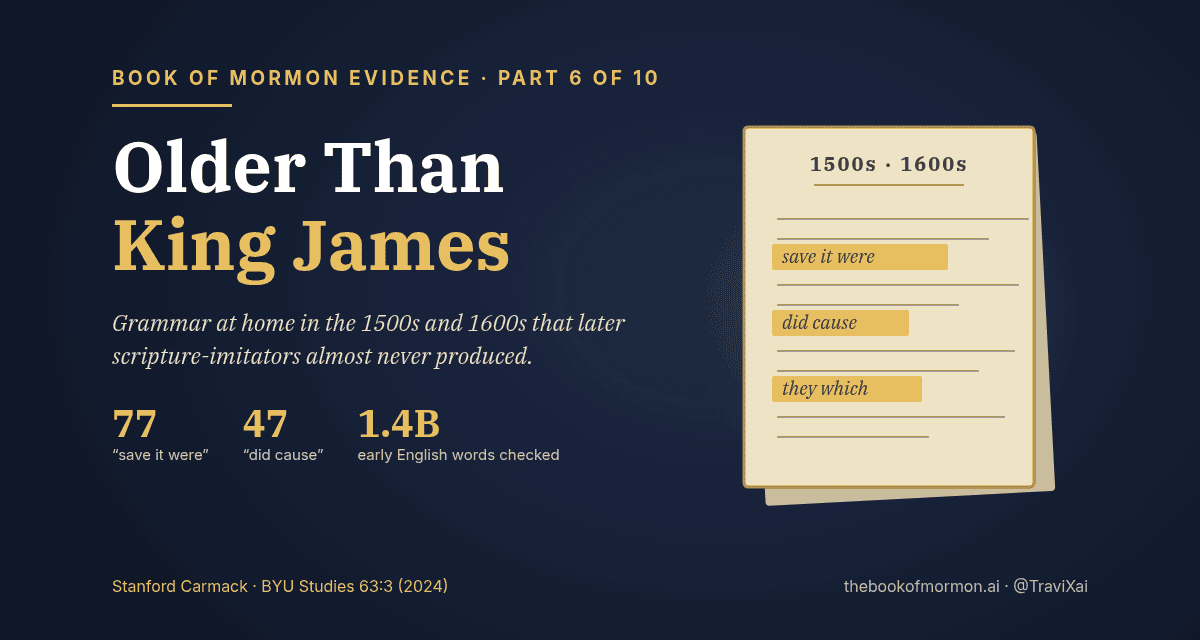

Much of the Book of Mormon’s odd grammar isn’t King James English. It’s older, and the 1800s writers who imitated scripture almost never produced it. Here’s what Stanford Carmack found.
The usual complaint about the Book of Mormon’s English is that it sounds like a farm boy doing a King James impression, and not a very good one. “Unto they which.” “Had spake.” “Save it were.” Look closer, though, and a lot of that grammar isn’t King James English at all. It’s older. And the people in the 1800s who really were doing King James impressions almost never wrote it.
In this series: Book of Mormon Evidence (10 parts)
- Part 1: 149 Voices
- Part 2: The Berkeley Wordprint Test
- Part 3: The “Someone Else” Problem
- Part 4: The Wordprint Track Record
- Part 5: One Draft
- Part 6: Older Than King James (you are here)
- Part 7: Alma 36, Built as a Mirror (coming soon)
- Part 8: Nahom (coming soon)
- Part 9: Could the Plates Work? (coming soon)
- Part 10: The Witnesses Who Never Recanted (coming soon)
This started as a post on X, Part 6 of my 10-part Book of Mormon Evidence series. This is the longer version. If you missed it, Part 5: One Draft covers how fast the book was dictated, with no notes and no rewrite.
The studyFour databases and a control group
Stanford Carmack is a linguist who has spent about a decade on the grammar of the earliest Book of Mormon text, much of it alongside Royal Skousen and his critical text project. His latest summary is “Book of Mormon Grammar and Translation,” in BYU Studies 63:3 (2024). What makes it more than opinion is the comparison material he built:
- a database of early modern English built from Early English Books Online (EEBO), about 1.4 billion words covering 1475 to 1700;
- a database of eighteenth-century English, about 9.4 billion words;
- a corpus of twenty-five pseudo-archaic texts, about 582,500 words, “whose writers were attempting to imitate King James English or archaic English,” written between 1740 and 1888;
- Joseph Smith’s own early writings, about 11,000 words, plus a grammatically tagged copy of the 1829 dictation (about 270,000 words).
That third set is the control group. If Joseph was dressing up his own speech in Bible clothes, the Book of Mormon should look like the other people who did the same thing. The obvious KJV parts, like the Isaiah chapters, are a separate question (Galatians18 has a short take on King James language in the Book of Mormon). This post is about the parts that don’t come from the KJV.
Pattern one“Did cause”: 47 times, and not once in the KJV
Early modern English often marked the plain past tense with an unstressed did: not “he caused” but “he did cause,” with no emphasis meant. The Book of Mormon does this constantly. Here is an example from the earliest text that Carmack highlights:
And it came to pass that the brother of Shiblon did cause that all the prophets which prophesied of the destruction of the people should be put to death.
Ether 11:5, earliest text, as quoted by Carmack (BYU Studies 63:3)
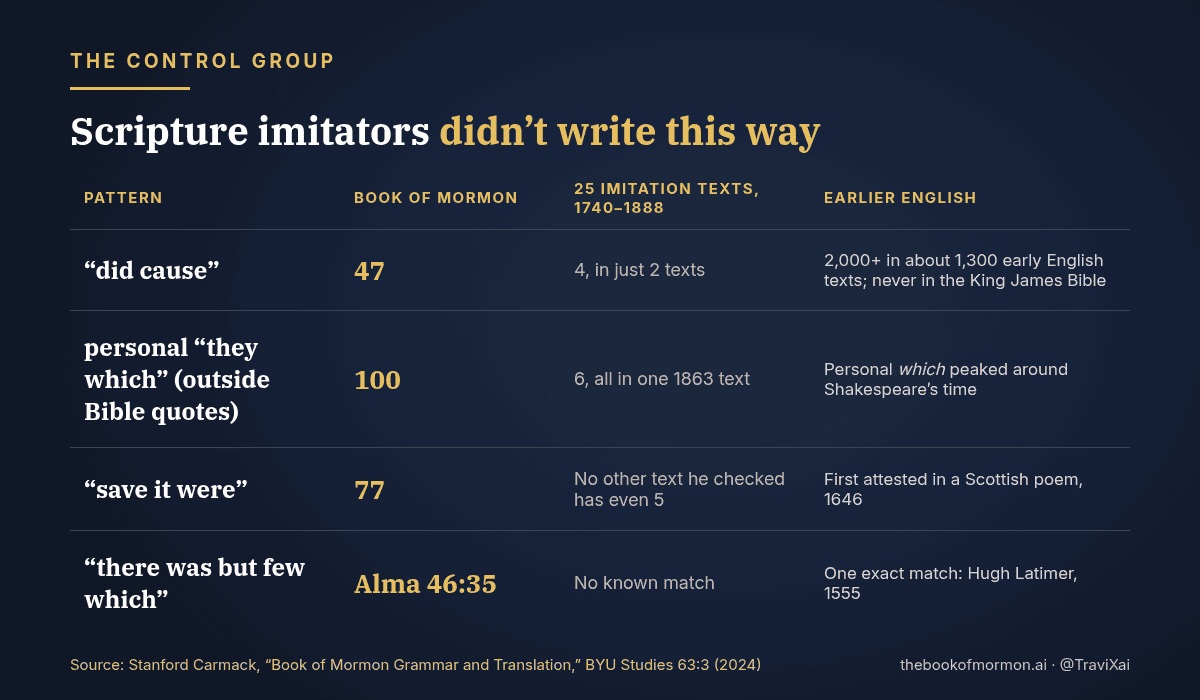
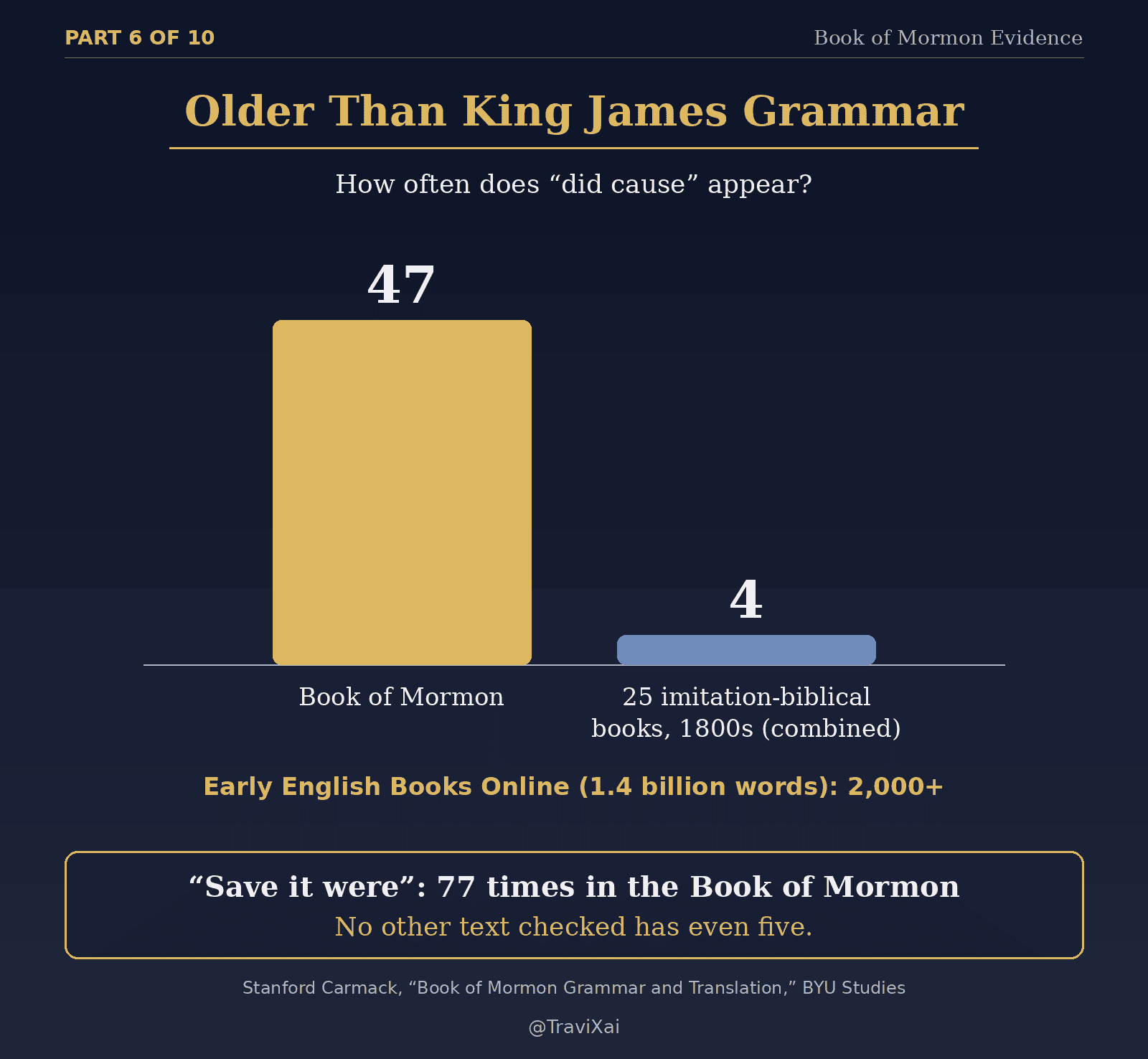
By Carmack’s count, “did cause” shows up forty-seven times in the Book of Mormon and more than two thousand times in EEBO, in about 1,300 texts. The King James Bible doesn’t have it at all. The closest it comes is “didst cause,” twice:
Thou preparedst room before it, and didst cause it to take deep root, and it filled the land.
Psalm 80:9 (KJV)
And the twenty-five imitation texts? Four instances of “did cause” in total, in two of them. So it wasn’t borrowed from the Bible, and the Bible’s imitators didn’t produce it either.
Pattern two“They which”: a hundred times
“They which” as a subject is King James English. You know it from the Beatitudes:
Blessed are they which do hunger and thirst after righteousness: for they shall be filled.
Matthew 5:6 (KJV)
What’s unusual is how much the Book of Mormon uses it. Carmack counts one hundred instances of personal “they which” in its non-biblical sections, including twenty-three in object position, as in 1 Nephi 22:11’s “unto they which are of the house of Israel.” By 1830 object they was nonstandard, but in the early modern period it was occasional grammar.
Joseph didn’t talk that way. In his own writing he used who or that after personal pronouns, never which. A letter he wrote with John Whitmer in 1830 says “Fear not those who are making you an offender for a word” (Joseph Smith Papers). Carmack says “those who” was Joseph’s most likely choice.
In the imitation texts, only one of the twenty-five uses “they which” at all: six times, in The New Gospel of Peace (1863), written by Richard Grant White, a Shakespeare scholar. In other words, the only imitator who used it was someone who read early modern English for a living.
Pattern three“Save it were”: 77 times
Then there’s this phrase, which Carmack calls “short” and “distinctive”: “save it were,” meaning “except.” It occurs seventy-seven times in the Book of Mormon. His verdict: “There is no other text that has even five of these.” You can still find it in today’s edition:
Behold, I say unto you, Nay; for ye have not come thus far save it were by the word of Christ with unshaken faith in him, relying wholly upon the merits of him who is mighty to save.
2 Nephi 31:19
It isn’t biblical. Carmack traces it to Scottish English, first attested in a poem published in 1646, with only five verified examples before 1830, all from authors in the British Isles. Rare American examples show up after 1830, including two in Hawthorne’s The Scarlet Letter (1850). Its cousin “except it were” appears only twice in the King James Bible and never in the imitation texts, yet the Book of Mormon has fifteen.
There’s a revealing detail in how Joseph later handled the phrase. In Alma 17:38 the 1830 text says Ammon “slew none save it were their leader.” For the 1837 edition Joseph added “with his sword” at the end. Carmack argues the fix is slightly off: it should have read “the sword,” placed earlier in the sentence. In the same edition Joseph changed which to who eight times where the original which was correct (most of those changes were dropped at the typesetting stage). Carmack reads this as a sign that Joseph never fully absorbed the text’s grammar. It looks less like an author polishing his own sentences and more like a man editing a text he didn’t compose.
Pattern fourA sentence with one match: 1555
Sometimes the match is a single phrase. Alma 46:35, in the earliest text, says “there was but few which” denied the covenant of freedom. (Today’s edition reads “there were but few who.”) Carmack found one precise match for that combination in the early English record:
In the primitive church, when there was but few which believed.
Hugh Latimer, 1555 or earlier, as quoted by Carmack (sermon printed in Certayn Godly Sermons, 1562)
Latimer was the English Reformer burned at the stake in 1555. When Carmack checked in January 2024, neither the eighteenth-century database nor Google Books had any other example.
One phrase can be a coincidence, but Carmack’s argument rests on patterns that repeat. The Book of Mormon has twelve sentences built like 1 Nephi 8:25, “after that they had partook of the fruit of the tree, they did cast their eyes about.” Neither the KJV nor the imitation texts combine those features. Early English texts have dozens of examples, mostly from 1550 to 1625, and the text with the most of them (seven) was printed in 1550.
The people trying hardest to sound like scripture in the 1800s mostly didn’t write like this. The 1500s did.
thebookofmormon.ai
Fair framingWhat Carmack isn’t claiming
Carmack isn’t saying every word of the Book of Mormon is sixteenth-century English. In a footnote he says “neither my position nor Royal Skousen’s position has ever been that the English usage of the Book of Mormon is completely early modern,” and his first paper on the subject pointed out a pattern that was late modern. His claim is that most of the nonstandard grammar fits early modern usage, and that Joseph wasn’t likely to produce it himself.
Not everyone agrees on what that means, including believers. Brant Gardner, a believing scholar who sees the text as a mostly functional translation, wrote: “I can’t see a reason to doubt Carmack’s descriptive work. I disagree about the meaning of the data, but not on the data themselves.” His objection is that dating grammar by its absence from surviving print is “an argument from silence,” since some forms turn up later (Times & Seasons, 2019). That’s a real debate, and he has a point: “save it were” itself shows up in Hawthorne in 1850.
But silence isn’t the strongest part of the case. The control group is. Twenty-five writers who were deliberately trying to sound like scripture had over a century to stumble onto these patterns, and they mostly didn’t. Whatever you think about how the translation worked (the Urim and Thummim, or the seer stone in a hat), the English Joseph dictated doesn’t look like his own letters or like his imitators.
The other common answer is “it’s just bad grammar.” People have said so since 1830, when Cornelius Blatchly objected to the book’s “more part” wording. Even B. H. Roberts, a believer, assumed Joseph was responsible for the grammar and listed twenty possible errors. Carmack says almost all of them “are fully accounted for from a rich, early modern perspective.” The text never claimed to be 1829 schoolbook English. Nephi’s own rule was simpler:
For my soul delighteth in plainness; for after this manner doth the Lord God work among the children of men. For the Lord God giveth light unto the understanding; for he speaketh unto men according to their language, unto their understanding.
2 Nephi 31:3
The surprise is that the “language” in this case includes grammar two or three centuries older than its first readers. If you think a young man in upstate New York wrote it as nineteenth-century fiction, you also have to explain where he picked up the grammar of Hugh Latimer’s sermons.
SummaryKey takeaways
- Carmack compared the earliest Book of Mormon text with 1.4 billion words of early modern English, 9.4 billion words from the 1700s, Joseph’s own writings, and twenty-five imitation-scripture texts (1740–1888).
- “Did cause” appears 47 times in the Book of Mormon, more than 2,000 times in EEBO, never in the KJV, and only four times in the imitation texts.
- Personal “they which” appears 100 times outside the Bible quotations. Only one imitation text has any, written by a Shakespeare scholar in 1863.
- “Save it were” appears 77 times; no other text Carmack found has even five.
- Alma 46:35’s “there was but few which” has one known match: Hugh Latimer, 1555.
- Carmack doesn’t claim the text is entirely early modern, and scholars like Brant Gardner accept his data but read it differently.
Coming upNext: Alma 36, Built as a Mirror
Next: Part 7: Alma 36, Built as a Mirror (coming soon).
Catch up on Part 5: One Draft, then read the book yourself, out loud. It sounds different once you know what to listen for. For more like this, follow me on X at @TraviXai. And if someone answers all this with Galatians 1:8, the Galatians 1:8 app is ready for that conversation.
Sources
- Stanford Carmack, “Book of Mormon Grammar and Translation,” BYU Studies Quarterly 63, no. 3 (2024): 49ff: byustudies.byu.edu (databases, “did cause,” “they which,” “save it were,” “except it were,” Alma 46:35 and Latimer, 1 Nephi 8:25 pattern, 1837 edits, footnote on not “completely early modern,” Blatchly and Roberts)
- Stanford Carmack, “Joseph Smith Read the Words,” Interpreter: A Journal of Mormon Scripture 18 (2016): 41–64: journal.interpreterfoundation.org (background on the early modern English argument)
- Stanford Carmack, “A Comparative View of Causative Constructions in the Book of Mormon,” Interpreter: A Journal of Latter-day Saint Faith and Scholarship 68 (2026): 223–42: interpreterfoundation.org (background on “did cause”)
- Brant Gardner, comment of March 29, 2019, on Clark Goble, “On Early Modern English and the Book of Mormon,” Times & Seasons: timesandseasons.org
- Joseph Smith and John Whitmer, Letter to the Church in Colesville, December 2, 1830: Joseph Smith Papers
- [Richard Grant White], The New Gospel of Peace, according to St. Benjamin (Sinclair Tousey, 1863): archive.org
- Hugh Latimer, Certayn Godly Sermons (John Day, 1562), 83, as quoted by Carmack
- Scriptures: Psalm 80:9 · Matthew 5:6 · 2 Nephi 31:3 · 2 Nephi 31:19 · Ether 11:5 · Alma 46:35 · Alma 17:38 · 1 Nephi 22:11 · 1 Nephi 8:25 (Book of Mormon wording in this post follows the earliest text as quoted by Carmack; the current edition differs in places)
- Previous in the series: Part 5: One Draft
- The original X post: x.com/TraviXai
- Featured image and charts: original graphics by thebookofmormon.ai (no photographs or likenesses of real people).