
Grace is more than forgiveness. Here’s what the Hebrew and Greek words for grace actually meant, how gifts worked in Paul’s world, and why Latter-day Saints call grace an enabling power.
For many Christians, “grace” means one thing: God forgives you even though you don’t deserve it. That’s true, and it’s beautiful. But it’s only part of what the Bible means by grace.
In scripture, grace is God’s favor. It’s God’s free gift. And it’s God’s power working inside people to change them. In the ancient world, a gift also created a relationship between the giver and the person who received it. Once you see that, a lot of old arguments about grace and works start to look different.
This post looks at the Hebrew and Greek words, the world Paul lived in, how the verses sort out, and why Latter-day Saints describe grace as an enabling power.
Part 1: Three words for grace
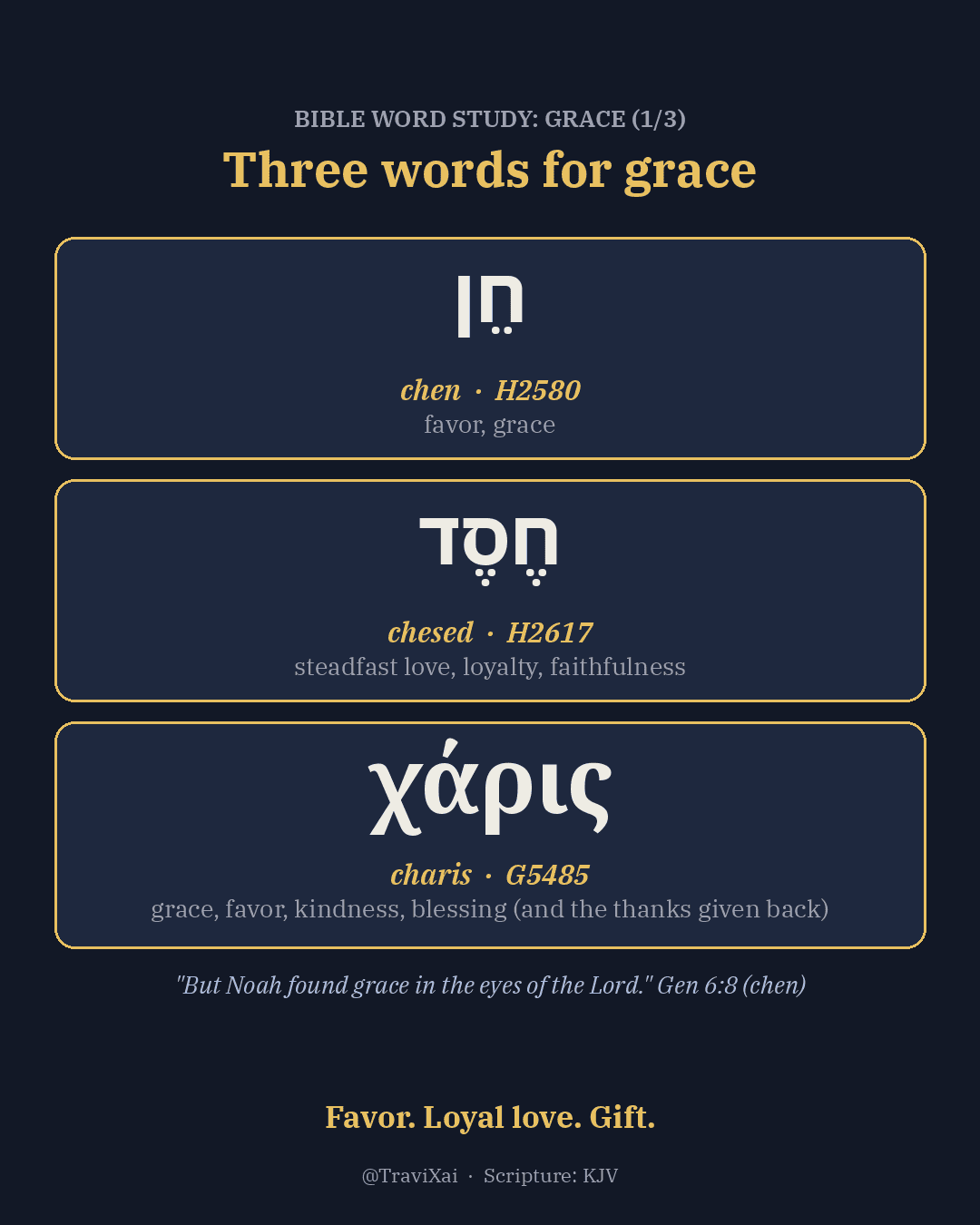
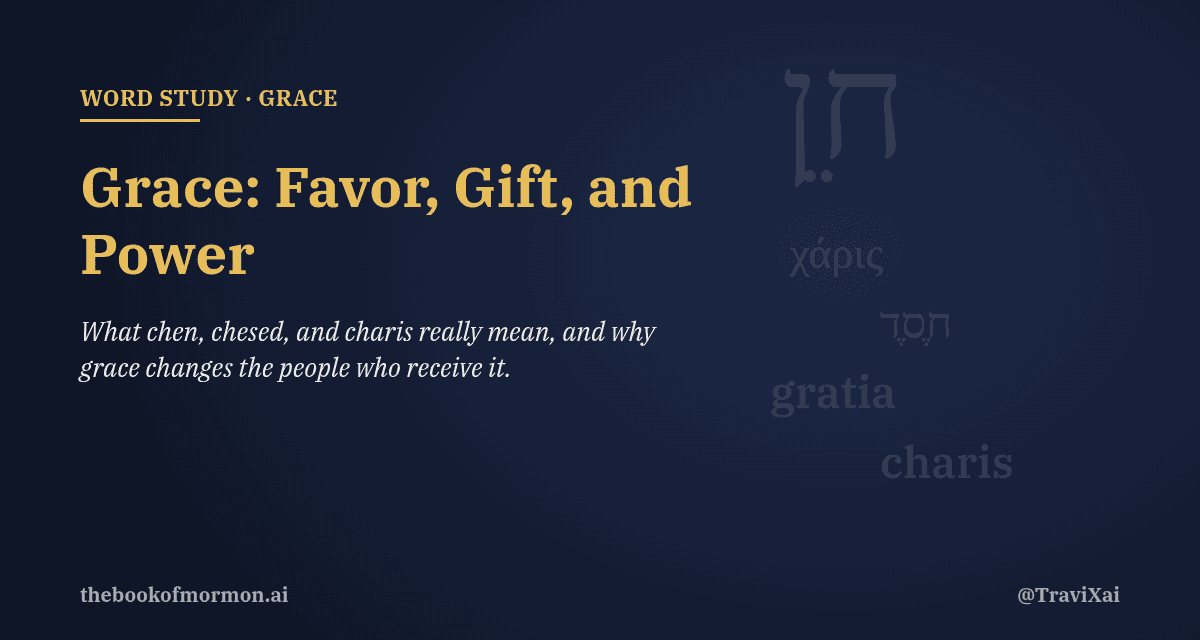
Chen: favor
The Hebrew word most often translated “grace” is chen (חֵן, Strong’s H2580). It means favor or grace: the goodwill someone shows you. Its first famous use is Genesis 6:8:
“But Noah found grace in the eyes of the Lord.”
The earth was full of violence, and God was grieved. But Noah found favor. The Old Testament often uses the phrase “find grace in the eyes of” someone. It describes a relationship in which a greater person looks kindly on a lesser one.
Chesed: loyal love
The second word is chesed (חֶסֶד, Strong’s H2617). English translations struggle with it. The KJV uses “mercy,” “kindness,” “lovingkindness,” and “goodness.” Modern translations often use “steadfast love.” The core idea is loyal love: love that keeps its covenant promises.
When God reveals His name to Moses, He says:
“The Lord, The Lord God, merciful and gracious, longsuffering, and abundant in goodness and truth,” (Exodus 34:6)
“Goodness” there is chesed. God’s grace isn’t a mood. It’s faithful, covenant-keeping love.
Charis: gift, and the thanks it creates
In the New Testament, the word is charis (χάρις, Strong’s G5485). Its meanings include grace, favor, kindness, gift, and blessing. And here’s the detail that changes everything: charis could also mean the gratitude given back in return. Greek used one word for both sides of the exchange: the favor given and the thanks returned.
The Latin translation of charis was gratia, which gives English both “grace” and “gratitude.” The connection is built into the language.
Part 2: Gifts in Paul’s world
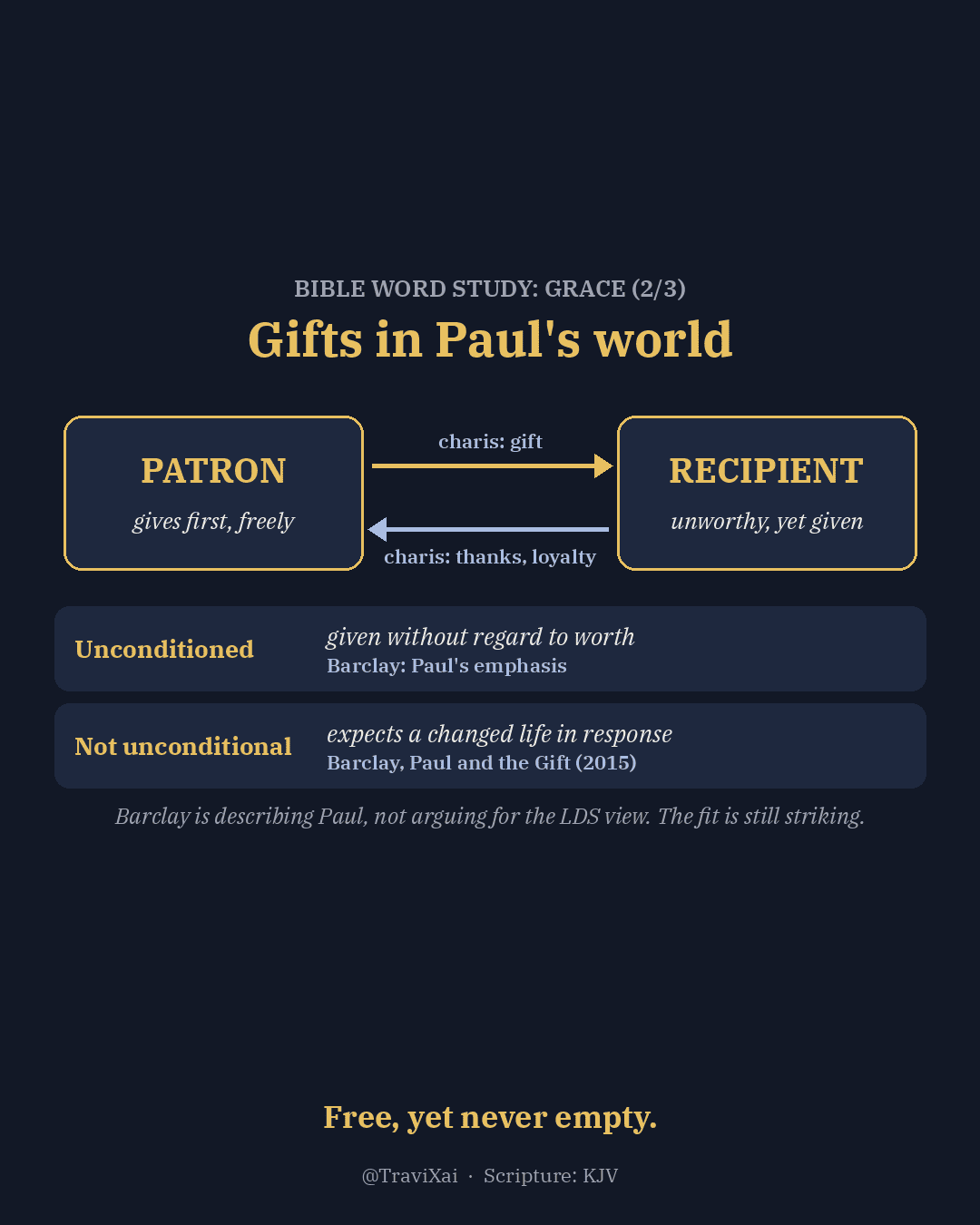
To understand how Paul’s first readers heard the word charis, we need to understand how gifts worked in their world.
The patron and the client
David A. deSilva, a non-LDS New Testament scholar, explains the ancient system of patronage in Honor, Patronage, Kinship & Purity: Unlocking New Testament Culture (InterVarsity Press, 2000). In the Greek and Roman world, people with wealth and power (patrons) gave benefits to people with less (clients): money, protection, a job, a favor in court. Those benefits were called charis.
The gifts were real gifts. A client couldn’t buy them, and a good patron didn’t give them as payment. But receiving a gift created a relationship. The client was expected to respond with gratitude, honor, and loyalty. That response was also called charis. Someone who took the gift and gave nothing back, not even thanks, was considered shameful.
So when Paul told his readers they were saved by charis, they wouldn’t have heard “a gift with no relationship attached.” They would have heard: God, the greatest patron of all, has given you a gift you could never earn. Now you belong to Him.
Barclay’s six “perfections”
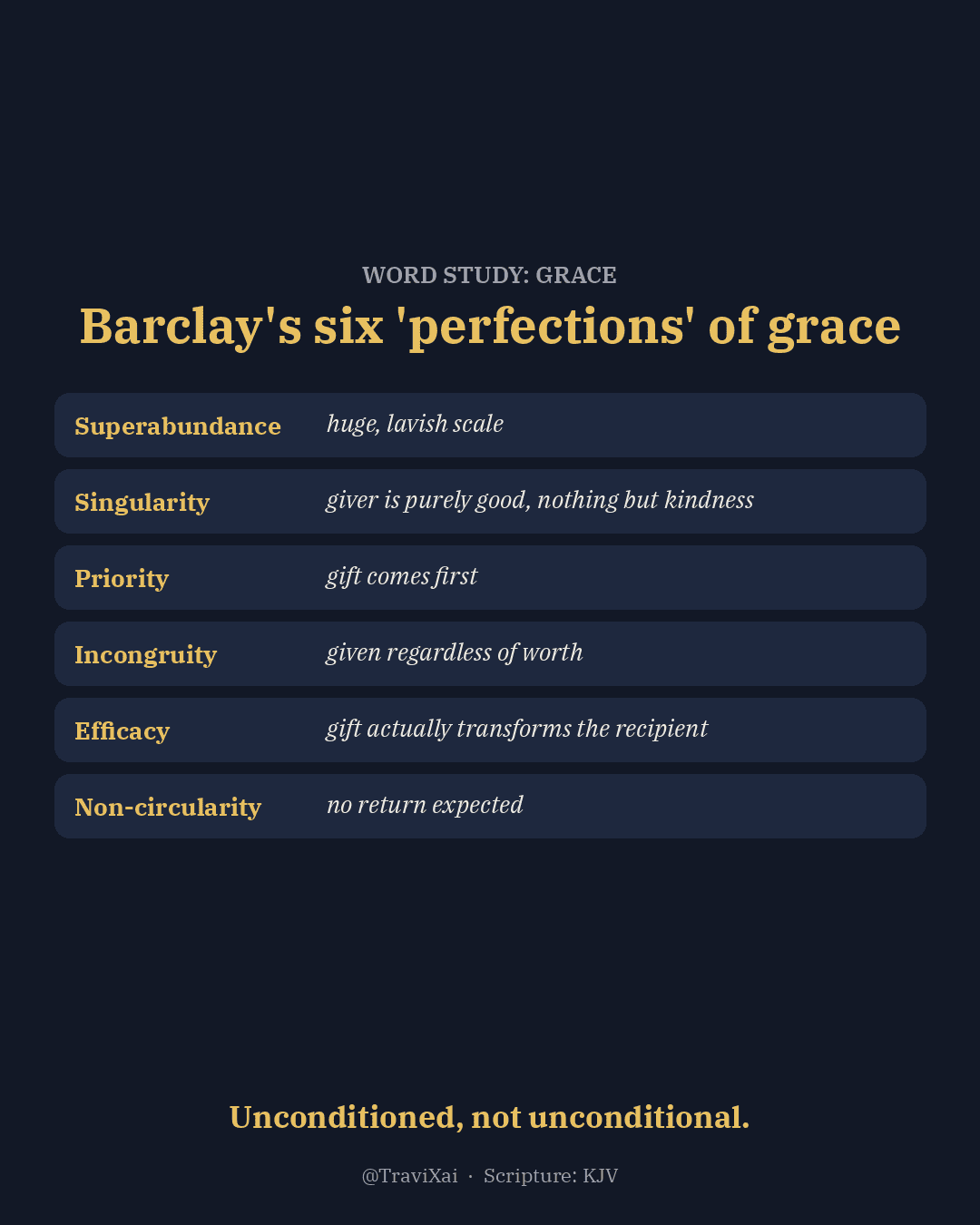
The most important recent book on this subject is John M. G. Barclay’s Paul and the Gift (Eerdmans, 2015). Barclay, a non-LDS scholar at Durham University, studied how ancient Jewish and Greco-Roman writers talked about gifts. He noticed that writers could push the idea of a “perfect” gift in six different directions. He calls these the six perfections of grace:
- Superabundance: the gift is lavish and huge.
- Singularity: the giver is purely good, nothing but kindness.
- Priority: the gift comes first, before anything the recipient does.
- Incongruity: the gift is given without regard to the worth of the person receiving it.
- Efficacy: the gift actually transforms the person who receives it.
- Non-circularity: the gift expects nothing in return.
Barclay’s key insight is that these don’t all go together. You can stress one without stressing the others. Different Christian traditions over the centuries have “perfected” grace in different ways, and that explains many of their disagreements.
His reading of Paul is that Paul’s great emphasis is incongruity. God gave Christ to people who didn’t deserve Him: sinners, gentiles, enemies. Nobody was worthy.
But Barclay argues Paul does not teach non-circularity. In Paul’s letters, God’s gift is meant to produce a response: a transformed life, obedience, and gratitude. Barclay’s short way of putting this is that grace is unconditioned (given without regard to prior worth) but not unconditional (it expects a response).
Barclay isn’t arguing for the Latter-day Saint position. He’s describing Paul in his own setting. But his description lands very close to how Latter-day Saints understand grace and covenant.
Part 3: Grace means three things
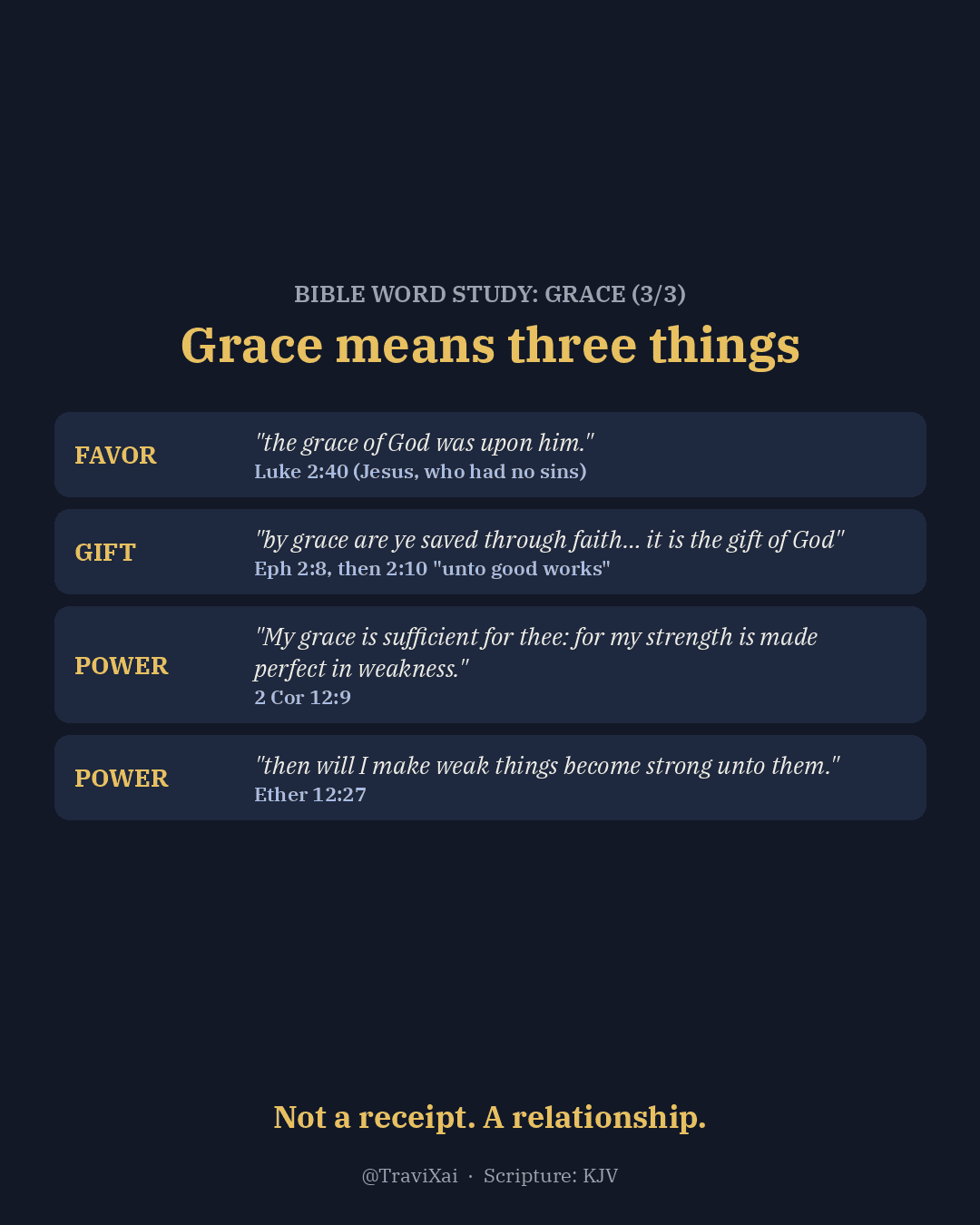
If you sort the grace verses by what they mean, they fall into three groups.
1. Favor
“And the child grew, and waxed strong in spirit, filled with wisdom: and the grace of God was upon him.” (Luke 2:40)
This is about Jesus as a boy. He had no sins. So the grace of God upon Him can’t mean forgiveness. It means favor: God’s delight and blessing. Genesis 6:8 (chen) belongs here too.
2. Gift
“For by grace are ye saved through faith; and that not of yourselves: it is the gift of God: Not of works, lest any man should boast.” (Ephesians 2:8–9)
“Being justified freely by his grace through the redemption that is in Christ Jesus:” (Romans 3:24)
Salvation is a gift. Nobody earns it. Nobody boasts. Latter-day Saints believe this completely.
But Paul doesn’t stop at verse 9:
“For we are his workmanship, created in Christ Jesus unto good works, which God hath before ordained that we should walk in them.” (Ephesians 2:10)
The gift has a purpose: good works. Titus says the same thing. The grace of God “that bringeth salvation hath appeared to all men,” and it is “Teaching us that, denying ungodliness and worldly lusts, we should live soberly, righteously, and godly, in this present world” (Titus 2:11–12). Grace teaches. Grace trains. Grace changes how you live.
3. Enabling power
“And he said unto me, My grace is sufficient for thee: for my strength is made perfect in weakness. Most gladly therefore will I rather glory in my infirmities, that the power of Christ may rest upon me.” (2 Corinthians 12:9)
Here grace is strength. Paul asked the Lord to remove his “thorn in the flesh.” The answer was not a pardon. It was power: my grace is enough, and my strength works best in your weakness. Paul connects grace directly to “the power of Christ.”
The Book of Mormon uses the same phrase in the same way:
“And if men come unto me I will show unto them their weakness. I give unto men weakness that they may be humble; and my grace is sufficient for all men that humble themselves before me; for if they humble themselves before me, and have faith in me, then will I make weak things become strong unto them.” (Ether 12:27)
“My grace is sufficient.” Weakness made strong. Two books of scripture, one message.
What the Church teaches about grace
The Bible Dictionary in the Latter-day Saint edition of the scriptures describes grace this way:
“The main idea of the word is divine means of help or strength, given through the bounteous mercy and love of Jesus Christ.”
And:
“This grace is an enabling power that allows men and women to lay hold on eternal life and exaltation after they have expended their own best efforts.”
The phrase “after they have expended their own best efforts” can be misread, so let’s look at the verse it echoes.
Reading 2 Nephi 25:23 carefully
“For we labor diligently to write, to persuade our children, and also our brethren, to believe in Christ, and to be reconciled to God; for we know that it is by grace that we are saved, after all we can do.”
Some readers take “after all we can do” to mean that we do our part first, then grace fills in the gap. Brad Wilcox, in his BYU devotional “His Grace Is Sufficient” (July 12, 2011), argued that’s a mistake. Christ has already paid the whole debt. Our efforts don’t pay any part of it. Wilcox compared our obedience to a child practicing the piano after a parent pays for lessons. The practice doesn’t pay the teacher. It’s how the child uses the gift and grows. In his words:
“Grace is not achieved somewhere down the road. It is received right here and right now. It is not a finishing touch; it is the Finisher’s touch.”
Stephen E. Robinson makes a similar point in Believing Christ (Deseret Book, 1992) with his well-known parable of the bicycle. His seven-year-old daughter, Sarah, saved every penny she could toward a bike, but when they found the one she wanted, she had only sixty-one cents. He told her to give him everything she had, plus a hug and a kiss, and the bike was hers. Her few coins didn’t buy the bike. Giving them was how she entered into the arrangement. Robinson calls this a covenant relationship with Christ.
Notice too that the same chapter says, “that our children may know to what source they may look for a remission of their sins” (2 Nephi 25:26). The source is Christ, not our efforts.
Moroni 10:32: where grace leads
“Yea, come unto Christ, and be perfected in him, and deny yourselves of all ungodliness; and if ye shall deny yourselves of all ungodliness, and love God with all your might, mind and strength, then is his grace sufficient for you, that by his grace ye may be perfect in Christ; and if by the grace of God ye are perfect in Christ, ye can in nowise deny the power of God.”
Moroni’s last invitation in the Book of Mormon is all about grace. We come to Christ. We turn from ungodliness and love God. And His grace makes us perfect “in Christ.” Not perfect on our own. Perfect in Him, by His grace.
The strongest case for the Latter-day Saint view
- Grace is power, not only pardon. 2 Corinthians 12:9 ties grace to “the power of Christ.” Ether 12:27 uses the same words, “my grace is sufficient,” and promises to make weak things strong. The Bible Dictionary’s “enabling power” is a faithful summary of both.
- 2 Nephi 25:23 doesn’t teach earning. “After all we can do” describes the life of someone who has received grace, not a down payment. The same chapter points to Christ as the only source of remission of sins.
- Moroni 10:32 shows the order. Grace isn’t a prize at the end. It’s the power that perfects us as we come to Christ, inside a covenant relationship.
- Non-LDS scholarship supports the relational reading. deSilva shows that ancient grace created a relationship of gratitude and loyalty. Barclay shows that Paul taught grace as unconditioned but not unconditional. Neither is a Latter-day Saint. Both describe something very close to covenant: God gives first and freely, and we respond with faithfulness. Brent J. Schmidt makes this case from a Latter-day Saint perspective in Relational Grace.
- Jesus is the source of grace. John 1:14 says He was “full of grace and truth,” and John 1:16 says, “And of his fulness have all we received, and grace for grace.” Grace isn’t a transaction. It’s a Person, and a relationship with Him.
The bottom line
Grace is God’s favor, God’s gift, and God’s power. It comes first. It’s undeserved. It can’t be bought. And it doesn’t leave us the way it found us.
In Paul’s world, a true gift created a bond. That’s what the grace of Christ does. It saves us, and then it keeps working on us, turning weakness into strength, until by His grace we may be perfect in Christ.
Next time someone says Latter-day Saints don’t believe in grace, ask them what Paul meant by “my grace is sufficient” in 2 Corinthians 12:9, and why Ephesians 2:10 follows verse 9. For quick, sourced answers on grace and works, open Galatians18. And for more word studies like this, follow me on X at @TraviXai.
Sources
- Strong’s H2580 (chen), H2617 (chesed), G5485 (charis). BibleHub.
- John M. G. Barclay, Paul and the Gift (Grand Rapids: Eerdmans, 2015). Non-LDS.
- David A. deSilva, Honor, Patronage, Kinship & Purity: Unlocking New Testament Culture (Downers Grove, IL: InterVarsity Press, 2000). Non-LDS.
- Brent J. Schmidt, Relational Grace: The Reciprocal and Binding Covenant of Charis (Provo, UT: BYU Studies, 2015). LDS.
- Brad Wilcox, “His Grace Is Sufficient,” BYU devotional, July 12, 2011 (speeches.byu.edu). LDS.
- Stephen E. Robinson, Believing Christ: The Parable of the Bicycle and Other Good News (Salt Lake City: Deseret Book, 1992). LDS. The bicycle story was first told in his BYU devotional “Believing Christ: A Practical Approach to the Atonement” (May 1990, speeches.byu.edu).
- Bible Dictionary, “Grace,” Latter-day Saint edition of the King James Bible (churchofjesuschrist.org).
- Scripture quotations: King James Version, churchofjesuschrist.org.
- Featured image, word cards, and charts: original graphics by thebookofmormon.ai (no photographs or likenesses of real people).