
Critics say Latter-day Saints and Muslims are alike because both had a prophet visited by an angel. 1 John 4:2-3 shows why the messages about Jesus are opposites.
There’s an argument I see over and over online. It goes like this: “Latter-day Saints are just like Muslims. Joseph Smith said an angel visited him. Muhammad said an angel visited him. Same thing.”
It sounds clever for about five seconds. Then you actually read what each message SAYS, and the comparison falls apart completely.
In this article I want to do something simple. I’m going to take the test the Bible itself gives for judging a spiritual messenger, apply it honestly to both claims, and let the texts speak for themselves. No spin, and nothing invented. Every quote below is cited so you can check it yourself.
The Fallacy: False Equivalence
Let’s name the problem first. The “just like Muslims” argument is a textbook case of false equivalence, a form of guilt by association. You find one surface-level similarity, “an angel appeared to a man,” and treat it as proof that two things are the same.
By that logic, a long list of biblical figures would be “just like Muslims” too. In the Gospel of Luke an angel appears to Zacharias, an angel appears to Mary, and angels appear to the shepherds. No Christian thinks that makes Luke’s Gospel Islamic. Why? Because everyone understands that the question was never WHETHER a messenger came. The question is WHAT the messenger said.
And the Bible tells us exactly what to look for.
The Bible’s Test for Any Spirit
The Apostle John wrote:
“Hereby know ye the Spirit of God: Every spirit that confesseth that Jesus Christ is come in the flesh is of God: And every spirit that confesseth not that Jesus Christ is come in the flesh is not of God: and this is that spirit of antichrist, whereof ye have heard that it should come; and even now already is it in the world.” (1 John 4:2-3, KJV)
Paul gave a related test:
“Wherefore I give you to understand, that no man speaking by the Spirit of God calleth Jesus accursed: and that no man can say that Jesus is the Lord, but by the Holy Ghost.” (1 Corinthians 12:3, KJV)
Notice what these passages do NOT say. They don’t say “reject every heavenly messenger.” They don’t say “any claim of an angel is automatically false.” They tell us to TEST the message by what it confesses about Jesus Christ: that He is Lord, and that He came in the flesh.
So let’s run the test.
What Joseph Smith’s Heavenly Visitors and Revelations Say About Jesus
The First Vision
Joseph Smith describes seeing two Personages in the spring of 1820:
“One of them spake unto me, calling me by name and said, pointing to the other—This is My Beloved Son. Hear Him!” (Joseph Smith—History 1:17)
The very first message of the Restoration is the Father pointing to Jesus Christ as His Son and commanding us to listen to Him.
The Vision of the Glories
In 1832, Joseph Smith and Sidney Rigdon recorded this testimony:
“And now, after the many testimonies which have been given of him, this is the testimony, last of all, which we give of him: That he lives! For we saw him, even on the right hand of God; and we heard the voice bearing record that he is the Only Begotten of the Father—” (Doctrine and Covenants 76:22-23)
He LIVES. He is at the right hand of God. He is the Only Begotten of the Father.
The Book of Mormon’s Stated Purpose
Joseph Smith said an angel, Moroni, directed him to the record he translated as the Book of Mormon. Read its title page and you’ll find its stated purpose:
“And also to the convincing of the Jew and Gentile that Jesus is the Christ, the Eternal God, manifesting himself unto all nations.” (Book of Mormon, Title Page)
The prophet Nephi summarized the focus of the whole record:
“And we talk of Christ, we rejoice in Christ, we preach of Christ, we prophesy of Christ, and we write according to our prophecies, that our children may know to what source they may look for a remission of their sins.” (2 Nephi 25:26)
The Resurrected Christ in the Flesh
This is the one that settles the 1 John test. In 3 Nephi, the resurrected Jesus appears to the people gathered in the land Bountiful:
“Behold, I am Jesus Christ, whom the prophets testified shall come into the world.” (3 Nephi 11:10)
Then He invites them to touch Him:
“Arise and come forth unto me, that ye may thrust your hands into my side, and also that ye may feel the prints of the nails in my hands and in my feet, that ye may know that I am the God of Israel, and the God of the whole earth, and have been slain for the sins of the world.” (3 Nephi 11:14)
Read that next to 1 John 4:2. Jesus Christ, come in the FLESH. Wounds in His hands, feet, and side. Slain for the sins of the world, and risen. The Book of Mormon doesn’t just pass John’s test. It practically quotes the answer key.
What the Quran Says About Jesus
Now let’s look at the message Muslims believe the angel Gabriel (Jibril) brought to Muhammad. I’m quoting the Sahih International English translation, a widely used standard translation available at quran.com.
On the crucifixion:
“And [for] their saying, ‘Indeed, we have killed the Messiah, Jesus the son of Mary, the messenger of Allah.’ And they did not kill him, nor did they crucify him; but [another] was made to resemble him to them.” (Quran 4:157)
On who Jesus is:
“The Messiah, Jesus the son of Mary, was but a messenger of Allah and His word which He directed to Mary and a soul [created at a command] from Him. So believe in Allah and His messengers. And do not say, ‘Three’; desist – it is better for you. Indeed, Allah is but one God. Exalted is He above having a son.” (Quran 4:171)
“They have certainly disbelieved who say, ‘Allah is the Messiah, the son of Mary’…” (Quran 5:72)
“They have certainly disbelieved who say, ‘Allah is the third of three.'” (Quran 5:73)
“It is not [befitting] for Allah to take a son; exalted is He!” (Quran 19:35)
“…and the Christians say, ‘The Messiah is the son of Allah.’ That is their statement from their mouths…” (Quran 9:30)
“He neither begets nor is born,” (Quran 112:3)
The Quran honors Jesus as a messenger and as the Messiah. Muslims love and respect Him in their own way, and that deserves to be acknowledged. But on the specific points the Bible makes the test, the Quran is clear: Jesus was NOT crucified, and He is NOT the Son of God.
Side by Side
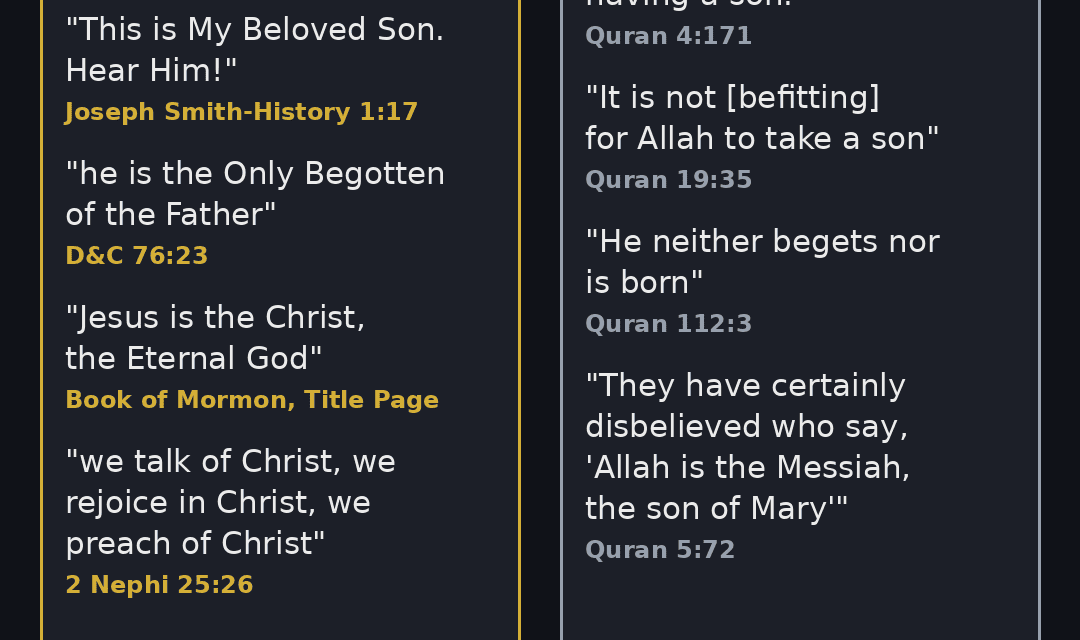
| The question | Joseph Smith’s revelations | The Quran (Sahih International) |
|---|---|---|
| Is Jesus the Son of God? | “This is My Beloved Son” (JS—H 1:17); “the Only Begotten of the Father” (D&C 76:23) | “Exalted is He above having a son” (4:171); “It is not [befitting] for Allah to take a son” (19:35) |
| Is Jesus divine? | “Jesus is the Christ, the Eternal God” (Title Page) | “was but a messenger of Allah” (4:171) |
| Was Jesus crucified? | “the prints of the nails in my hands and in my feet” (3 Ne. 11:14) | “nor did they crucify him” (4:157) |
| Did He die for sin? | “slain for the sins of the world” (3 Ne. 11:14) | “they did not kill him, for certain” (4:157) |
| Does He live? | “That he lives!” (D&C 76:22) | Crucifixion and death denied (4:157) |
These are not two versions of the same message. They are OPPOSITE answers to the exact question the Bible says matters most.
The Irony
Here’s the part critics don’t see coming. The person making the “just like Muslims” argument usually means it as a warning: “Joseph Smith’s angel must be a false spirit, just like Muhammad’s.”
But they’re the ones who brought up testing angels. So use the Bible’s test. Run 1 John 4:2-3 honestly and here is what you get:
- Joseph Smith’s testimony confesses Jesus Christ as the Son of God, crucified, resurrected, and come in the flesh. It passes.
- The Quran denies the crucifixion and denies that Jesus is the Son of God. On John’s own terms, it does not.
The test the critic wanted to use against Latter-day Saints ends up separating the two claims as clearly as anything could. You can’t lump them together without ignoring the very scripture you’re appealing to.
A Word About Our Muslim Neighbors
None of this is an attack on Muslims. I respect my Muslim neighbors. Many of them pray more faithfully, give more generously, and live with more devotion than a lot of people who claim to follow Christ. This article is about an argument, not about people.
In fact, most thoughtful Muslims would agree with my main point. Ask a Muslim whether their faith teaches that Jesus is the Son of God who died on the cross for our sins and rose again, and they’ll tell you plainly: no. Ask whether Islam is the same as the faith of the Latter-day Saints, and they’ll tell you: no. Muslims understand their own scripture well enough to know the difference. It’s the critic who hasn’t read either book closely enough to notice.
Conclusion: Ask the Right Question
The next time someone tells you “Latter-day Saints are just like Muslims,” don’t get defensive. Just ask one question:
What did the angel say about Jesus?
Then open 1 John 4 and let the Bible answer. One message says, “This is My Beloved Son. Hear Him!” The other says Jesus was “but a messenger” and was never crucified.
That’s not a similarity. That’s a contrast. And it’s the contrast the Bible itself told us to look for.
Sources: Bible quotations from the King James Version. Latter-day Saint scripture quotations from the official editions at churchofjesuschrist.org. Quran quotations from the Sahih International translation (quran.com).