

Tag: Church history
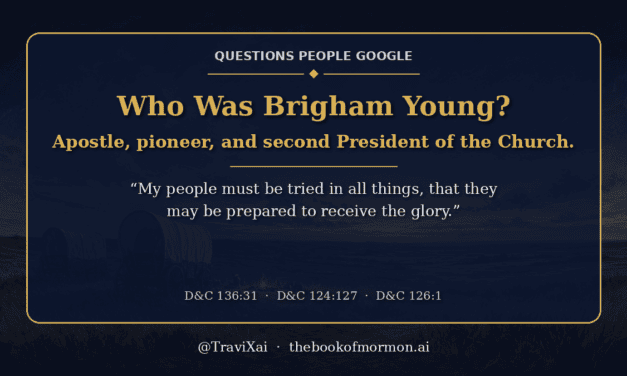
Who Was Brigham Young? The Prophet Who Led the Saints West, Hard Parts Included
Brigham Young, second President of the Church, led the Saints to Utah in 1847 and founded hundreds of towns. His life, his revelation, and the hard parts.
Read More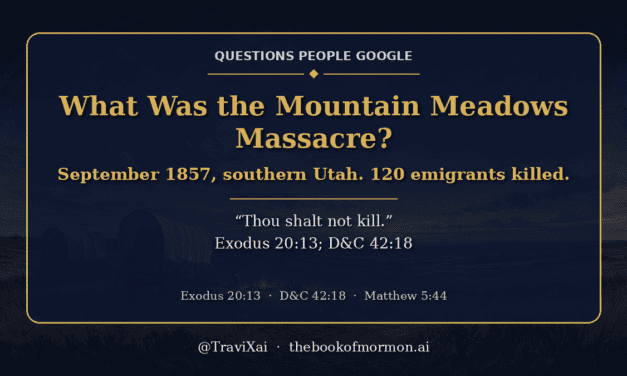
What Was the Mountain Meadows Massacre? What Happened, Who Was Responsible, and What the Church Says
In September 1857, Latter-day Saint militiamen in southern Utah killed 120 emigrants at Mountain Meadows. Here is what happened, what Brigham Young’s letter said, and the Church’s response.
Read More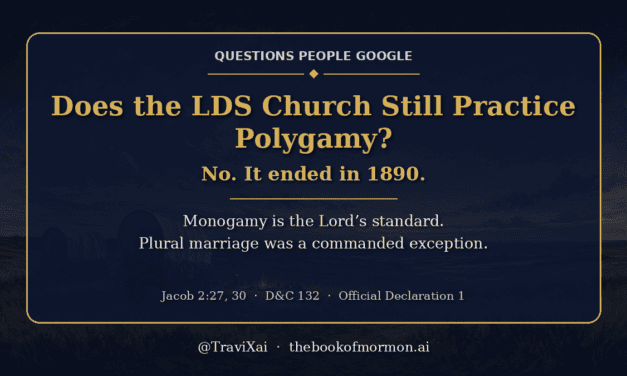
Does the LDS Church Still Practice Polygamy? Plural Marriage, Explained Honestly
Does the LDS Church practice polygamy? No. It ended in 1890 and members who practice it today lose membership. Here’s why it began, the Bible, and how it ended.
Read More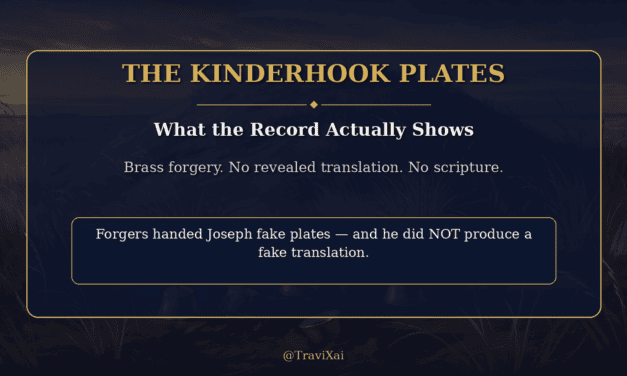
The Kinderhook Plates: What the Record Actually Shows
The Kinderhook plates were brass, not gold — a confessed 1843 hoax. Joseph Smith never published a revealed translation. Here is what Clayton wrote, what Fugate confessed, what Northwestern found, and why the trap never sprang.
Read More
Joseph Told It Four Times, Paul Told It Three: The First Vision Accounts and the Damascus Road
Critics say Joseph Smith’s First Vision accounts don’t match, so he made it up. Acts tells Paul’s Damascus road vision three times, and those accounts differ on who heard the voice, who fell, and who gave Paul his calling. Here’s the side-by-side, and why the standard has to cut both ways.
Read More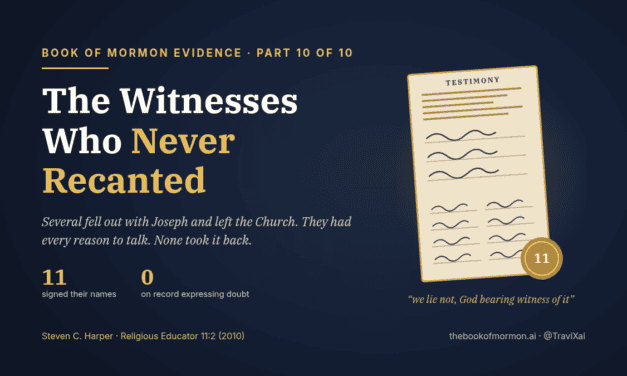
Book of Mormon Evidence, Part 10 of 10: The Witnesses Who Never Recanted
All three of the Three Witnesses left the Church after falling out with Joseph Smith, and so did at least two of the Eight. They had every reason to recant. David Whitmer, Oliver Cowdery, Martin Harris, Hiram Page, John Whitmer, and even outsider William McLellin left statements affirming what they saw, and none is on record expressing doubt. The series finale. Part 10 of 10.
Read More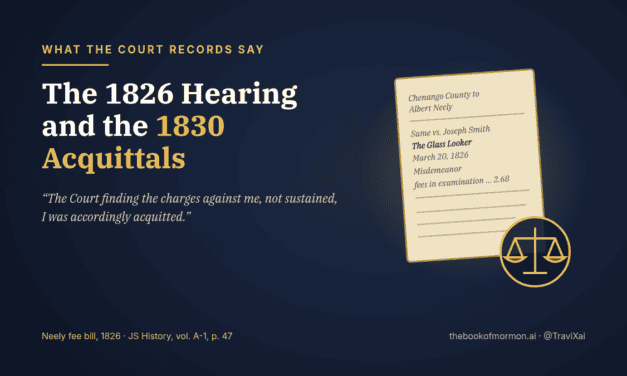
The 1826 Hearing and the 1830 Acquittals: What the Records Say
In 1826 a New York justice examined Joseph Smith as “the Glass Looker.” In 1830 two more courts heard the same charge and let him go. Here is what the surviving records prove, what they don’t, and what critics usually leave out.
Read More
Joseph Smith the “Money Digger”? Treasure Seeking in 1820s New England
“Joseph Smith was a money digger.” He said so himself in 1838, for fourteen dollars a month. What critics leave out: treasure seeking was widespread among churchgoing Christians in 1820s New England and New York, the man who hired Joseph was a Presbyterian who later joined the Church, and the Bible has its own seer for lost property in 1 Samuel 9.
Read More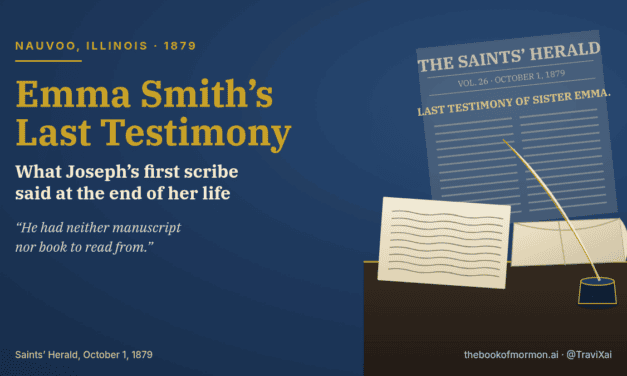
Emma Smith’s Last Testimony (1879): “Neither Manuscript nor Book”
In February 1879, a few months before she died, Emma Smith answered her son’s questions about the Book of Mormon. Joseph’s first scribe said he dictated “hour after hour” with his face in a hat, the plates wrapped in her linen tablecloth, and “neither manuscript nor book to read from.” She never went west, split with Brigham Young, and still never denied the book. Plus the polygamy objection, answered honestly.
Read More
Carthage: Why Joseph Walked In “Like a Lamb to the Slaughter”
In June 1844 Joseph Smith was safe across the Mississippi in Iowa, with horses ordered for the trip west. He went back, told his brother “we shall be butchered,” and rode to Carthage saying “I am going like a lamb to the slaughter.” A con man runs. Joseph walked toward death with Hyrum, a witness of the plates, and never recanted the Book of Mormon.
Read More
The Kirtland Safety Society: What Really Happened in 1837
Critics call the Kirtland Safety Society proof Joseph Smith was a con man. The records tell a different story: no bank got an Ohio charter that year, the Panic of 1837 broke banks nationwide, an enemy drained the reserves and sued, Joseph resigned and warned people off the notes, paid the judgment, and lost heavily. Here’s what really happened, mistakes included.
Read More
His Name Had for Good and Evil: JS-H 1:33 Two Centuries Later
In 1823 an angel told a 17-year-old farm boy that his name “should be had for good and evil among all nations, kindreds, and tongues.” It was in print by 1842. Here’s the paper trail, the Church’s own numbers on the good half, the long record of the evil half, and why every critic who keeps talking about Joseph Smith is part of the fulfillment.
Read More