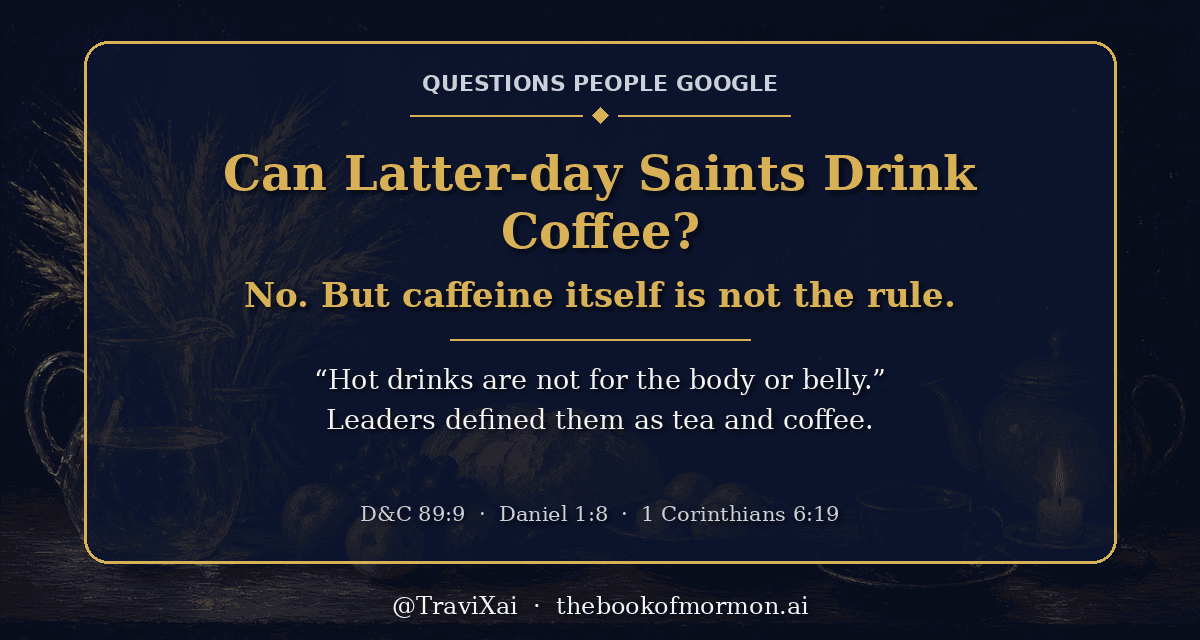

Coffee is one of the most-searched questions about Latter-day Saints. Here’s the rule, where it comes from, and why caffeine isn’t the issue.
No, Latter-day Saints don’t drink coffee or tea. Doctrine and Covenants 89:9 says “hot drinks are not for the body or belly,” and Church leaders have taught that this means tea and coffee. Caffeine itself isn’t banned: the Church said in 2012 that the revelation “does not mention the use of caffeine,” so soda is a personal choice.
The revelationWhat D&C 89 actually says
In 1833 Joseph Smith received a revelation now printed as Doctrine and Covenants 89, known as the Word of Wisdom. It was given “not by commandment or constraint, but by revelation and the word of wisdom” (D&C 89:2), and it was “adapted to the capacity of the weak and the weakest of all saints” (D&C 89:3). It warns against wine and strong drink, tobacco, and then one more thing:
And again, hot drinks are not for the body or belly.
D&C 89:9
The revelation doesn’t name coffee. So where does the coffee rule come from? From prophets explaining what the Lord meant. In 1842 Hyrum Smith, the Prophet’s brother and Church patriarch, taught in the Times and Seasons that the “hot drinks” of the revelation were tea and coffee. That has been the Church’s teaching ever since. The New Era put it simply in 2008:
The only official interpretation of this term is the statement made by early Church leaders that it means tea and coffee.
New Era, April 2008
That’s also the wording the Church used in its 2010 handbook. A revelation plus a prophet’s explanation of it is exactly how the Church is supposed to work. Members don’t each guess what “hot drinks” means.
CaffeineIs caffeine banned? No
This is where a lot of people, including some members, get it wrong. The rule names tea and coffee. It doesn’t name a chemical. When the subject came up during the 2012 presidential campaign, the Church said so plainly:
the Church revelation spelling out health practices (Doctrine and Covenants 89) does not mention the use of caffeine. The Church’s health guidelines prohibit alcoholic drinks, smoking or chewing of tobacco, and “hot drinks” — taught by Church leaders to refer specifically to tea and coffee.
Church Newsroom, August 29, 2012
The 2008 New Era said the same thing from the other side: “Caffeine is not specifically mentioned as the reason not to drink these drinks.” In 2017 BYU started selling caffeinated soft drinks on campus. So a Latter-day Saint with a cola is not breaking the Word of Wisdom. Whether a given person should drink a lot of it is a separate question, and the revelation leaves room for that kind of wisdom.
Edge casesIced coffee, decaf, herbal tea, and hot chocolate
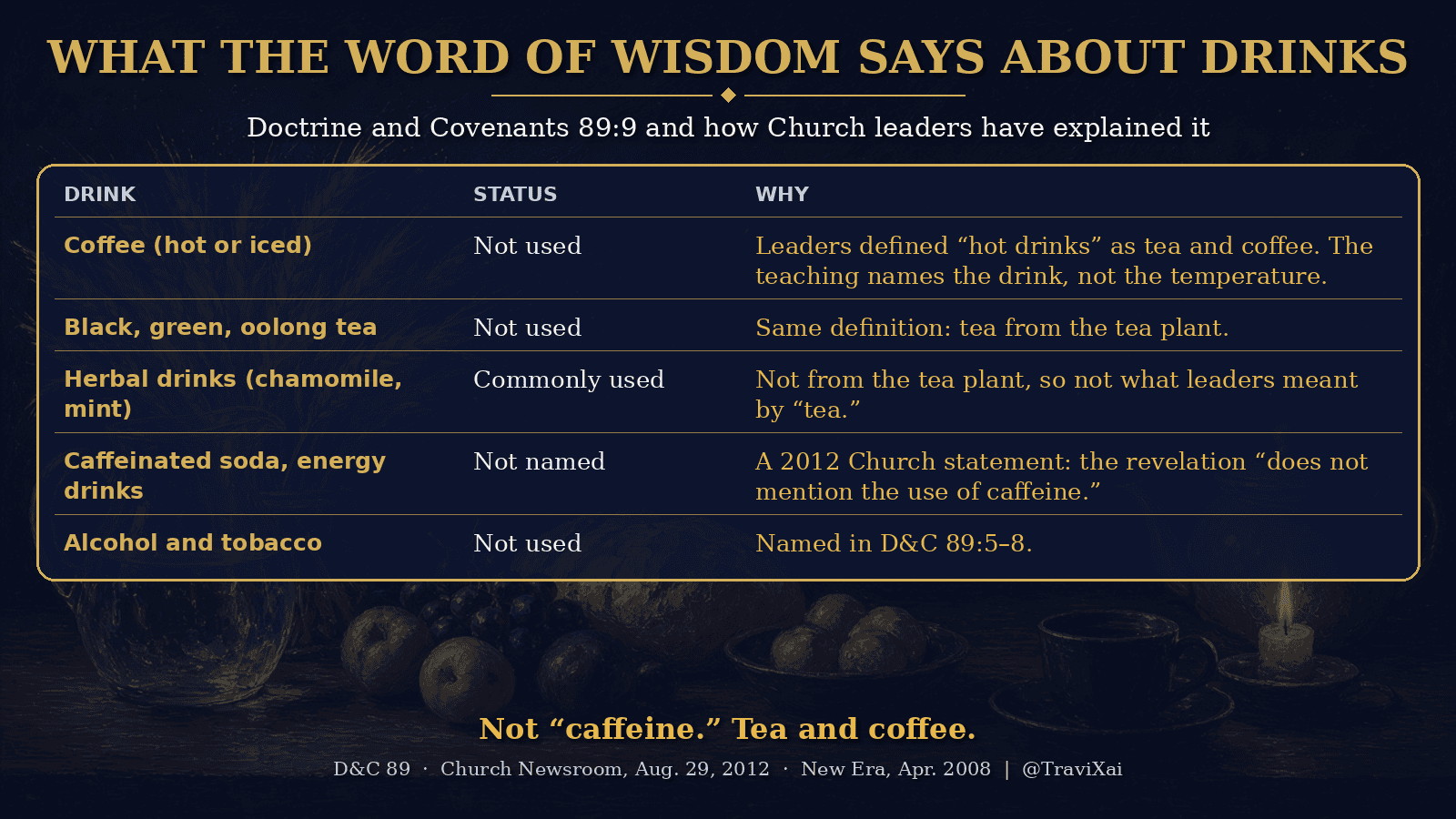
Iced coffee and cold brew: still coffee. The teaching names the drinks, not the temperature, so a cold coffee is treated the same as a hot one. Most Latter-day Saints treat decaf the same way, since it’s still coffee.
Herbal drinks: chamomile, peppermint, and similar infusions aren’t made from the tea plant, and members commonly drink them.
Hot chocolate: it’s hot, but it isn’t what Church leaders defined as “hot drinks.”
Is it a big deal? Yes, in one specific way: living the Word of Wisdom is one of the questions asked before a member receives a temple recommend. That’s not because coffee is evil. It’s because keeping a commandment you’ve been given is how you show God you mean it.
Old TestamentGod has always given His people a diet law
Critics sometimes say a drink rule is un-Christian. But the Bible is full of covenant people refusing food and drink for God’s sake. A Nazarite “shall separate himself from wine and strong drink” (Numbers 6:3). Daniel in Babylon is the clearest picture:
But Daniel purposed in his heart that he would not defile himself with the portion of the king’s meat, nor with the wine which he drank.
Daniel 1:8
Ten days later “their countenances appeared fairer and fatter in flesh than all the children which did eat the portion of the king’s meat” (Daniel 1:15). And God gave those four young men “knowledge and skill in all learning and wisdom” (Daniel 1:17). Compare the promise at the end of D&C 89: those who keep it “shall find wisdom and great treasures of knowledge, even hidden treasures” (D&C 89:19). Same God, same pattern.
New Testament & Book of MormonYour body is a temple, and passions need a bridle
Paul asked, “know ye not that your body is the temple of the Holy Ghost which is in you, which ye have of God, and ye are not your own?” (1 Corinthians 6:19). The Word of Wisdom takes that seriously. So does the Book of Mormon. Alma told his son Shiblon to “see that ye bridle all your passions, that ye may be filled with love” (Alma 38:12). A small daily habit you can say no to is training for the bigger things you’ll need to say no to.
And the Pearl of Great Price explains why God gives commandments like this at all: “we will prove them herewith, to see if they will do all things whatsoever the Lord their God shall command them” (Abraham 3:25). The Word of Wisdom ends with a Passover promise: “the destroying angel shall pass by them, as the children of Israel, and not slay them” (D&C 89:21).
For a closer look at what the revelation does and doesn’t say about meat, see Does the Word of Wisdom Ban Carnivore and Keto?.
Check the premiseThe presuppositions baked into the question
Before this question can be answered fairly, the person asking has to justify a few assumptions packed inside it:
- That Christians are free from every food rule. Jesus said nothing entering a man defiles him spiritually (Mark 7:15), and the Word of Wisdom doesn’t claim coffee makes anyone unclean. But the apostles still told Gentile converts to “abstain from meats offered to idols, and from blood, and from things strangled” (Acts 15:29). A health law from God isn’t a return to the law of Moses.
- That the rule must be about caffeine. That assumes the reason has to be a chemical someone can name. The Church has said the revelation “does not mention the use of caffeine.” The rule is tea and coffee because that’s what the prophets said the Lord meant.
- That if the text doesn’t say “coffee,” the rule is made up. That assumes scripture interprets itself without prophets. The Bible works the same way: Jesus and the apostles constantly explained what earlier scripture meant. A living prophet explaining a revelation is the point of having one.
- That obedience in small things is legalism. Jesus said, “He that is faithful in that which is least is faithful also in much” (Luke 16:10). Small commandments are where faithfulness gets practiced.
FAQQuick answers
Can Latter-day Saints drink coffee?
No. Doctrine and Covenants 89:9 says “hot drinks are not for the body or belly,” and Church leaders have taught since the 1840s that “hot drinks” means tea and coffee.
Can Mormons drink caffeine?
Yes. The Church said in 2012 that the revelation “does not mention the use of caffeine.” The rule names tea and coffee, not caffeine, and BYU began selling caffeinated soda on campus in 2017.
Can Latter-day Saints drink iced coffee?
No. The teaching names coffee and tea, not a temperature, so iced coffee and cold brew are treated the same as hot coffee.
Can Latter-day Saints drink herbal tea or hot chocolate?
Yes. Herbal drinks like chamomile and peppermint aren’t made from the tea plant, and hot chocolate isn’t what Church leaders defined as “hot drinks.”
Why don’t Latter-day Saints drink coffee?
Because they believe D&C 89 is a revelation from God and accept the prophets’ explanation of it. It also comes with promises of health, “wisdom and great treasures of knowledge” (D&C 89:19–21).
What does the Word of Wisdom encourage people to eat and drink?
It praises “wholesome herbs” used “with prudence and thanksgiving” (D&C 89:10–11), and says “All grain is good for the food of man” (D&C 89:16). Water, milk, juice and herbal drinks are all fine.
Is the Word of Wisdom a commandment?
It was first given in 1833 “not by commandment or constraint” (D&C 89:2). Later prophets taught members to keep it as a commandment, and living it has long been required for a temple recommend.
What blessings does the Word of Wisdom promise?
Health, “wisdom and great treasures of knowledge,” and the promise that the faithful “shall run and not be weary, and shall walk and not faint” (D&C 89:19–20).
SummaryKey takeaways
- D&C 89:9: “hot drinks are not for the body or belly.” Church leaders defined hot drinks as tea and coffee.
- Caffeine isn’t the rule. The Church said in 2012 the revelation “does not mention the use of caffeine.”
- Iced coffee is still coffee; herbal drinks and hot chocolate aren’t covered.
- Daniel, the Nazarites, and Paul’s “your body is the temple” show God has always tied obedience to what His people eat and drink.
If a friend asks why you skip the coffee, tell them about Daniel 1 and the promise in D&C 89:19–21. For quick, sourced answers, open Galatians18, and follow me on X at @TraviXai.
Sources
- Doctrine and Covenants: D&C 89:2–3 · D&C 89:9 · D&C 89:19–21
- King James Bible: Numbers 6:3 · Daniel 1:8–17 · Mark 7:15 · Luke 16:10 · Acts 15:29 · 1 Corinthians 6:19
- Book of Mormon and Pearl of Great Price: Alma 38:12 · Abraham 3:25
- Church Newsroom statement, August 29, 2012, as archived by FAIR
- “To the Point,” New Era, April 2008
- Hyrum Smith, remarks on the Word of Wisdom, Times and Seasons 3 (June 1, 1842)
- Featured image and in-article graphic: original graphics by thebookofmormon.ai (painterly backgrounds; no photographs or likenesses of real people).