
People are often surprised that the man leading a Latter-day Saint congregation isn’t paid. Here’s how the lay ministry works and where it comes from in scripture.
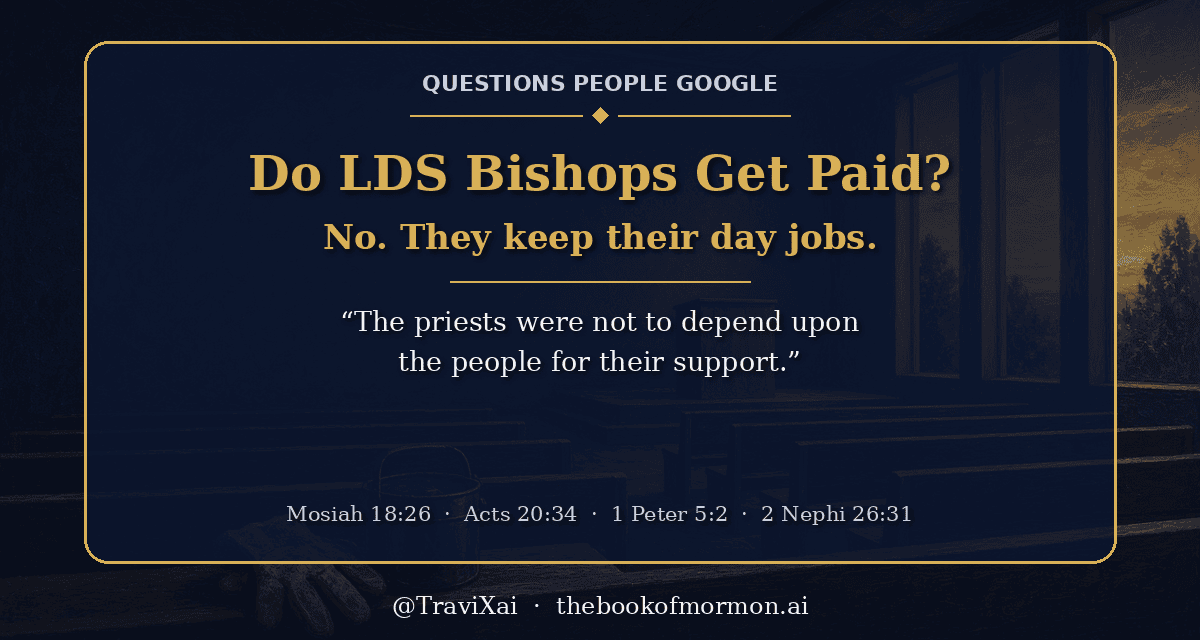
No, LDS bishops don’t get paid. A bishop keeps his regular job and, as the Church puts it, “receives no pay of any kind for his service in the Church,” often giving 15 to 30 hours a week for about five years. The pattern is scriptural: Alma’s priests worked “with their own hands for their support” (Mosiah 18:24), and Paul preached “without charge” (1 Corinthians 9:18).
How it worksA bishop is a volunteer with a day job
In a Latter-day Saint ward, the bishop is a local man called from the congregation. He might be an electrician, a dentist, or a farmer. He keeps that job. The Church’s Newsroom states that a bishop “earns his own living and receives no pay of any kind for his service in the Church” (Newsroom, Lay Priesthood).
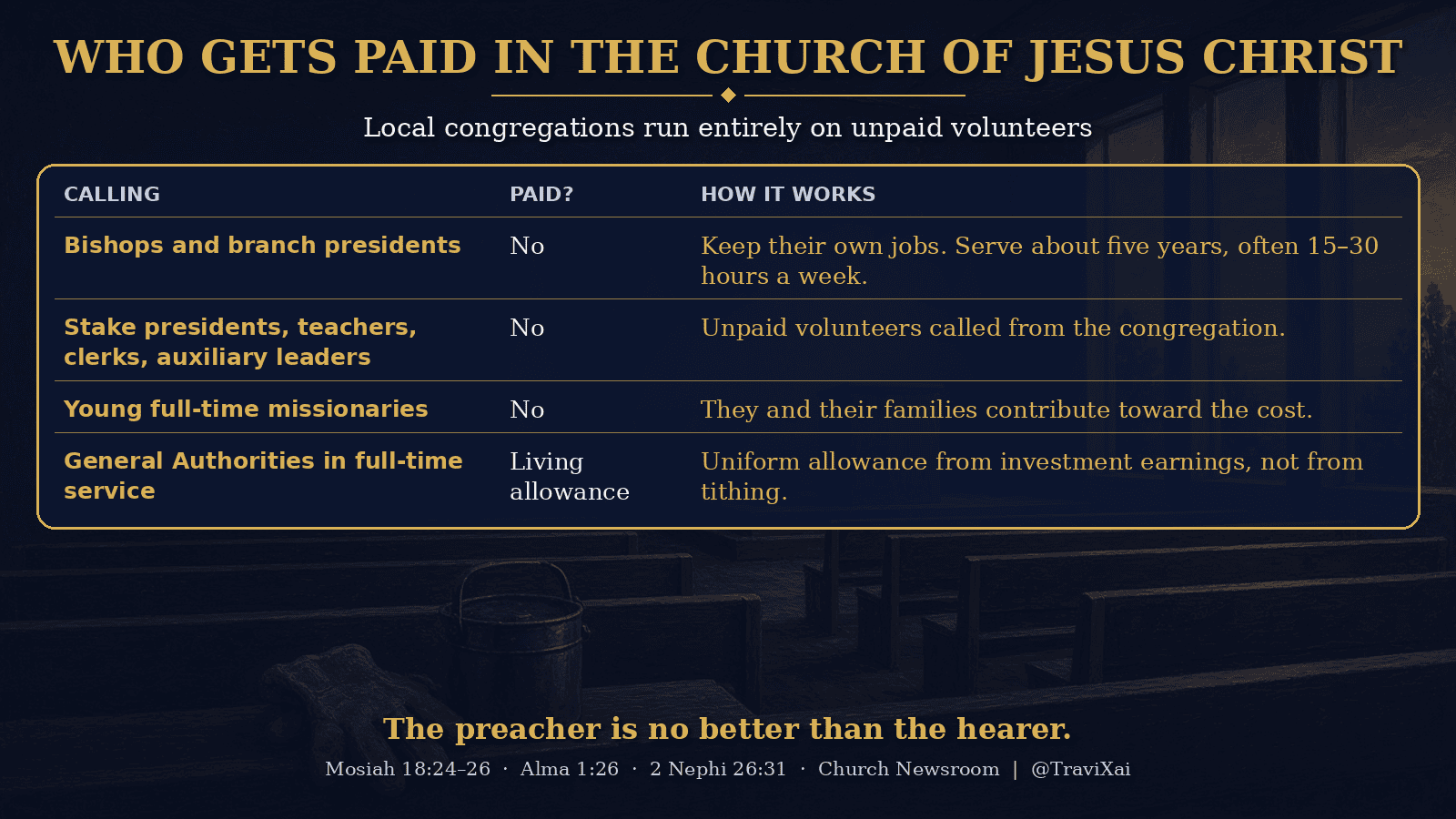
The calling isn’t light. The Newsroom describes bishops serving 15 to 30 hours a week, typically for about five years, on top of work and family (Newsroom, lay ministry). He counsels members, oversees help for the poor, interviews youth, and conducts sacrament meeting. Then he goes to work Monday morning. The same is true of the people who teach the classes, lead the youth, play the organ, and keep the records. Nobody in a ward is on payroll.
Book of MormonThe Book of Mormon’s pattern: priests who work
This isn’t a modern policy choice. It’s the pattern the Book of Mormon teaches again and again. When Alma organized the church at the waters of Mormon, he “commanded them that the priests whom he had ordained should labor with their own hands for their support” (Mosiah 18:24). Then:
And the priests were not to depend upon the people for their support; but for their labor they were to receive the grace of God, that they might wax strong in the Spirit.
Mosiah 18:26
The first big apostasy in the book of Alma started with the opposite idea. Nehor taught “that every priest and teacher ought to become popular; and they ought not to labor with their hands, but that they ought to be supported by the people” (Alma 1:3). The faithful church answered by doing what Alma 1:26 describes: the priest taught and then went back to work, “not esteeming himself above his hearers, for the preacher was no better than the hearer.”
Nephi named the danger outright. “Priestcrafts are that men preach and set themselves up for a light unto the world, that they may get gain and praise of the world” (2 Nephi 26:29). His rule is short: “the laborer in Zion shall labor for Zion; for if they labor for money they shall perish” (2 Nephi 26:31).
New TestamentPaul worked with his hands too
Paul could have taken support. He said so: “the Lord ordained that they which preach the gospel should live of the gospel” (1 Corinthians 9:14). But he chose not to, so “I may make the gospel of Christ without charge” (1 Corinthians 9:18). To the elders of Ephesus he said:
I have coveted no man’s silver, or gold, or apparel. Yea, ye yourselves know, that these hands have ministered unto my necessities, and to them that were with me.
Acts 20:33–34
Peter told the elders to feed the flock “not by constraint, but willingly; not for filthy lucre, but of a ready mind” (1 Peter 5:2). A lay ministry is that verse turned into an organization.
Full-time leadersWhat about General Authorities?
A small number of senior leaders leave their careers to serve full time, often for the rest of their lives. They receive a modest, uniform living allowance. The Church’s own FAQ says: “None of the funds for this living allowance come from the tithing of Church members, but instead from proceeds of the Church’s financial investments” (Church FAQ).
In 2017 the Salt Lake Tribune reported a leaked 2014 memo showing the base allowance going from $116,400 to $120,000 (Salt Lake Tribune). A Church spokesman declined to confirm the figures but repeated that the allowance is uniform and doesn’t come from tithing. The same article noted that many of these men had been college presidents, lawyers, surgeons, and CEOs, and quoted historian Jan Shipps, who isn’t a Latter-day Saint, comparing the amount with what university presidents earn: “Compared to their pay, this is small potatoes.”
The Doctrine and Covenants allowed for this from the start. In 1831 the Lord said “the bishop, also, shall receive his support, or a just remuneration for all his services in the church” (D&C 42:73). In that early period the bishop was a full-time general officer overseeing the Church’s property. Today local bishops aren’t full-time, and they receive nothing.
AuthorityCalled by God, not hired
The deeper reason has to do with authority. Latter-day Saints believe “a man must be called of God, by prophecy, and by the laying on of hands by those who are in authority, to preach the Gospel and administer in the ordinances thereof” (Article of Faith 5). A bishop doesn’t apply, interview, or study for a degree. He’s called, then released, and goes back to sitting in the pews. That’s how Hebrews describes priesthood: “no man taketh this honour unto himself, but he that is called of God, as was Aaron” (Hebrews 5:4). I dig into that verse in the posts on priesthood authority.
Check the premiseThe presuppositions baked into the question
Before this question can be answered fairly, the person asking has to justify a few assumptions packed inside it:
- That every real church needs paid clergy. That’s a later pattern, not a biblical requirement. Paul worked as a tentmaker (Acts 18:3) and preached without charge. The Book of Mormon makes unpaid priests the norm and treats paid popularity as the first step toward apostasy (Alma 1:3).
- That a living allowance means leaders are “in it for the money.” The allowance goes only to the few who serve full time, comes from investment earnings rather than tithing, and has been publicly acknowledged. Local leaders, who are the vast majority, receive nothing.
- That volunteers can’t be qualified. Moses’s father-in-law told him to choose “able men, such as fear God” to judge the people (Exodus 18:21), not professionals. The Lord qualifies those He calls.
FAQQuick answers
Do LDS bishops get paid?
No. A bishop in The Church of Jesus Christ of Latter-day Saints keeps his regular job and, in the Church’s words, “receives no pay of any kind for his service in the Church.”
How long does an LDS bishop serve?
Typically about five years. The Church’s Newsroom says bishops may spend 15 to 30 hours a week in the calling, on top of their work and family responsibilities.
Are any LDS leaders paid?
Local leaders are not. General Authorities who leave their careers for full-time service receive a uniform living allowance, which the Church says comes from investment earnings, not from tithing.
Do LDS missionaries get paid?
No. Young full-time missionaries serve without pay, and they and their families contribute toward the cost of the mission.
Why doesn’t the Church have paid clergy?
Because the scriptures teach it. Alma’s priests labored “with their own hands for their support” (Mosiah 18:24), Paul preached “without charge” (1 Corinthians 9:18), and Nephi warned, “if they labor for money they shall perish” (2 Nephi 26:31).
What does an LDS bishop do?
A bishop presides over a local congregation (a ward). He counsels members, cares for the poor using fast offerings, leads the ward’s youth, and oversees worship. Paul’s list of qualifications still applies: “A bishop then must be blameless” (1 Timothy 3:2).
Who chooses an LDS bishop?
The stake presidency recommends a man, the First Presidency approves the call, and the congregation sustains him. No one applies for the job: “no man taketh this honour unto himself, but he that is called of God, as was Aaron” (Hebrews 5:4).
Do LDS bishops go to seminary or divinity school?
No. Bishops are lay members with ordinary jobs. The apostles were the same: the council saw that Peter and John “were unlearned and ignorant men” and “took knowledge of them, that they had been with Jesus” (Acts 4:13).
SummaryKey takeaways
- Bishops and all other local leaders are unpaid volunteers who keep their day jobs.
- The Book of Mormon teaches priests to labor for their own support (Mosiah 18:24–26) and condemns priestcraft (2 Nephi 26:29–31).
- Paul worked with his own hands and made the gospel “without charge” (Acts 20:34; 1 Corinthians 9:18).
- The few full-time General Authorities receive a living allowance from investment earnings, not tithing.
Next time someone assumes your bishop is on salary, read Mosiah 18:24–26 with them. For quick, sourced answers, open Galatians18, and follow me on X at @TraviXai.
Sources
- Book of Mormon: Mosiah 18:24–26 · Alma 1:3 · Alma 1:26 · 2 Nephi 26:29–31
- King James Bible: Exodus 18:21 · Acts 18:3 · Acts 20:33–34 · 1 Corinthians 9:14–18 · Hebrews 5:4 · 1 Peter 5:2
- Doctrine and Covenants and Pearl of Great Price: D&C 42:73 · Article of Faith 5
- Church Newsroom, “Lay Priesthood” and “Lay Ministry”
- Church FAQ, “Do General Authorities Get Paid?”
- Peggy Fletcher Stack, Salt Lake Tribune, January 26, 2017, on the 2014 living-allowance memo (archive)
- Featured image and in-article graphic: original graphics by thebookofmormon.ai (painterly backgrounds; no photographs or likenesses of real people).