
Joseph Smith spent the winter of 1838–39 in a Missouri dungeon. Here is why, what the charges were, and the revelations that came out of it.
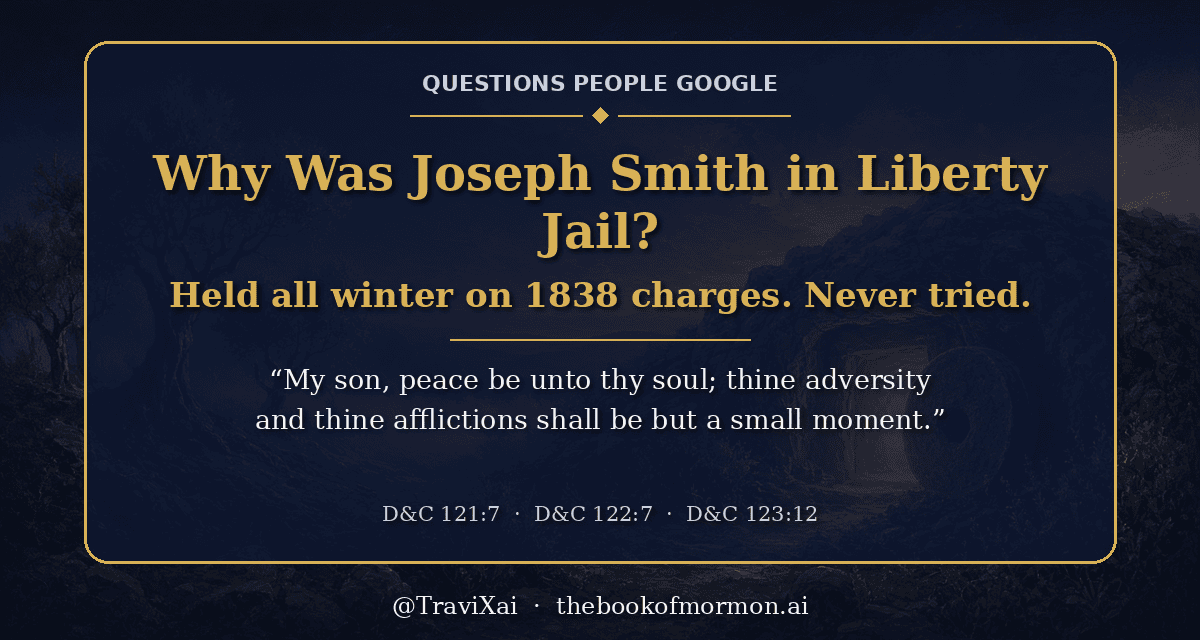
The question often assumes jail means guilt, or that he was there only for his faith. The record is more specific than either. Joseph Smith was held in Liberty Jail from December 1, 1838, to April 1839 on charges, including treason, from the 1838 Missouri conflict, after Governor Boggs ordered the Saints “exterminated or driven from the state.” He was never tried. From that cell came D&C 121–123: “My son, peace be unto thy soul; thine adversity and thine afflictions shall be but a small moment” (D&C 121:7).
Why he was thereThe Missouri conflict of 1838
By 1838 thousands of Latter-day Saints had gathered to northern Missouri, and tensions with older settlers boiled over into armed conflict: an election-day brawl at Gallatin in August, raids and counter-raids, and the Battle of Crooked River on October 25. Two days later Governor Lilburn W. Boggs issued Executive Order 44, declaring that “the Mormons must be treated as enemies, and must be exterminated or driven from the state if necessary for the public peace.” On October 30 a militia killed 17 Latter-day Saints at Haun’s Mill.
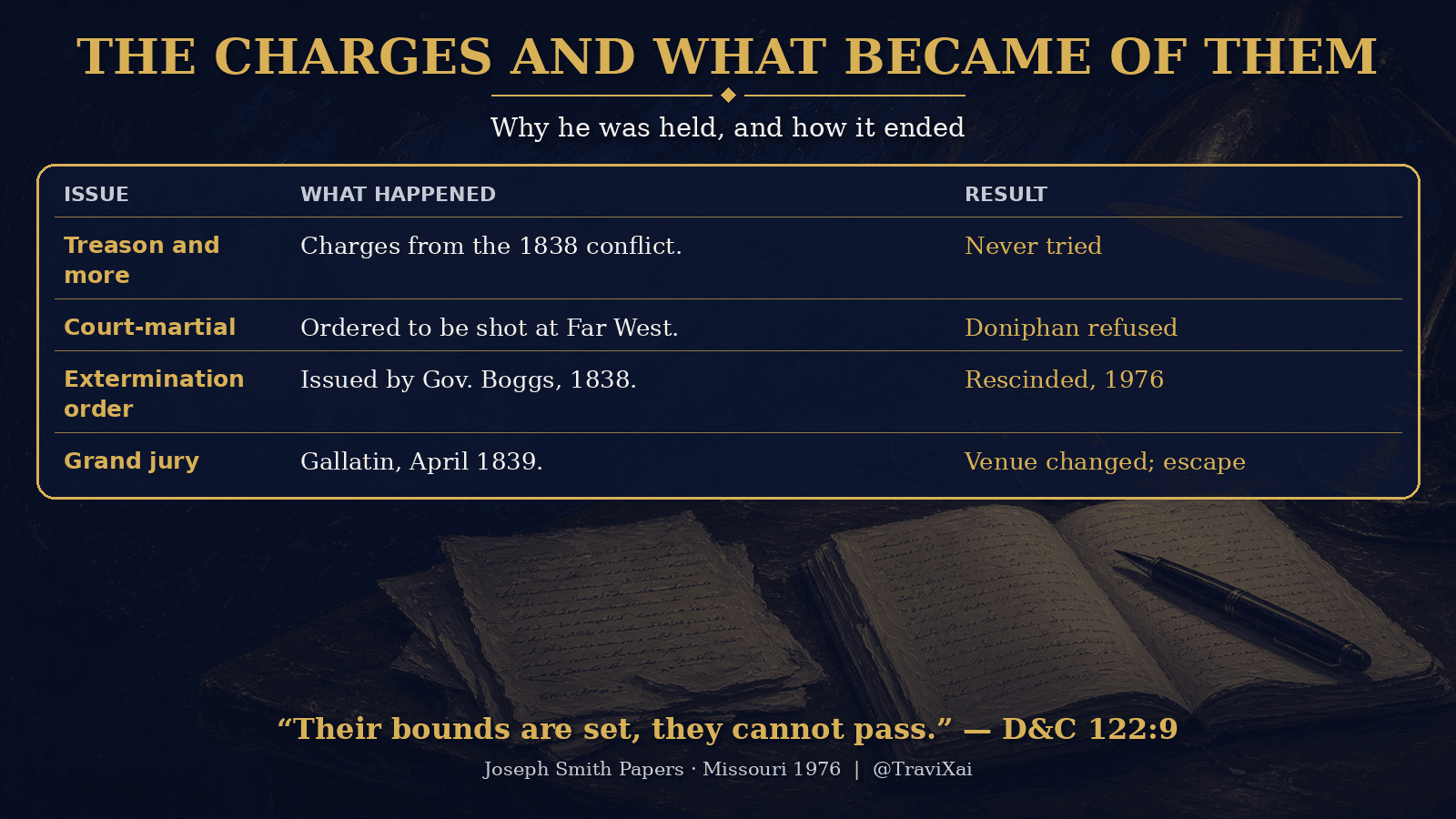
On October 31 Joseph Smith and other leaders were taken prisoner at Far West. A militia court-martial ordered them shot the next morning. General Alexander Doniphan refused to carry it out, calling it cold-blooded murder. After a preliminary hearing in Richmond before Judge Austin A. King in November, Joseph, his brother Hyrum, Sidney Rigdon, Lyman Wight, Caleb Baldwin and Alexander McRae were committed to the jail in Liberty, Clay County, on charges arising from the conflict, including treason. They arrived December 1, 1838.
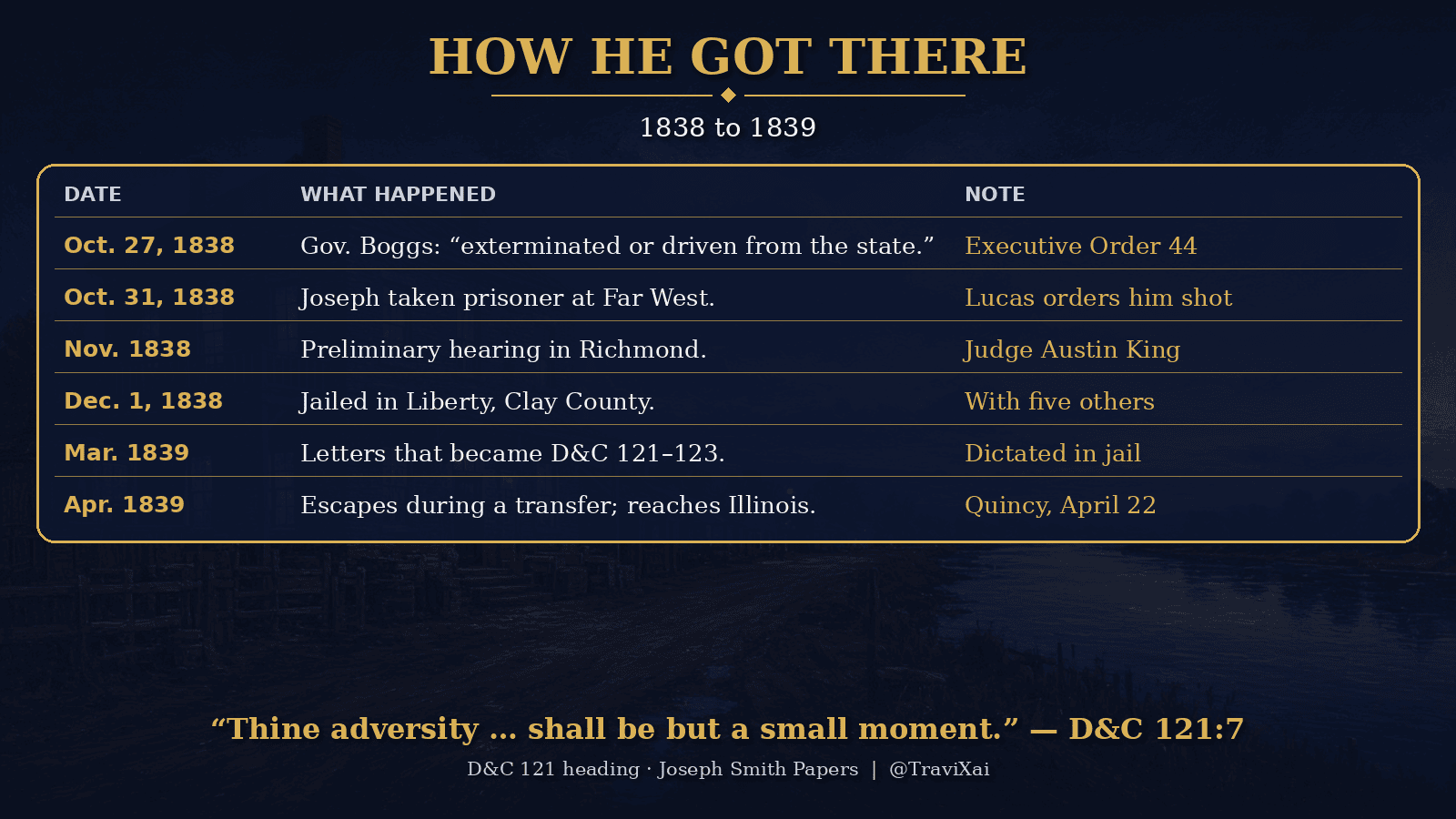
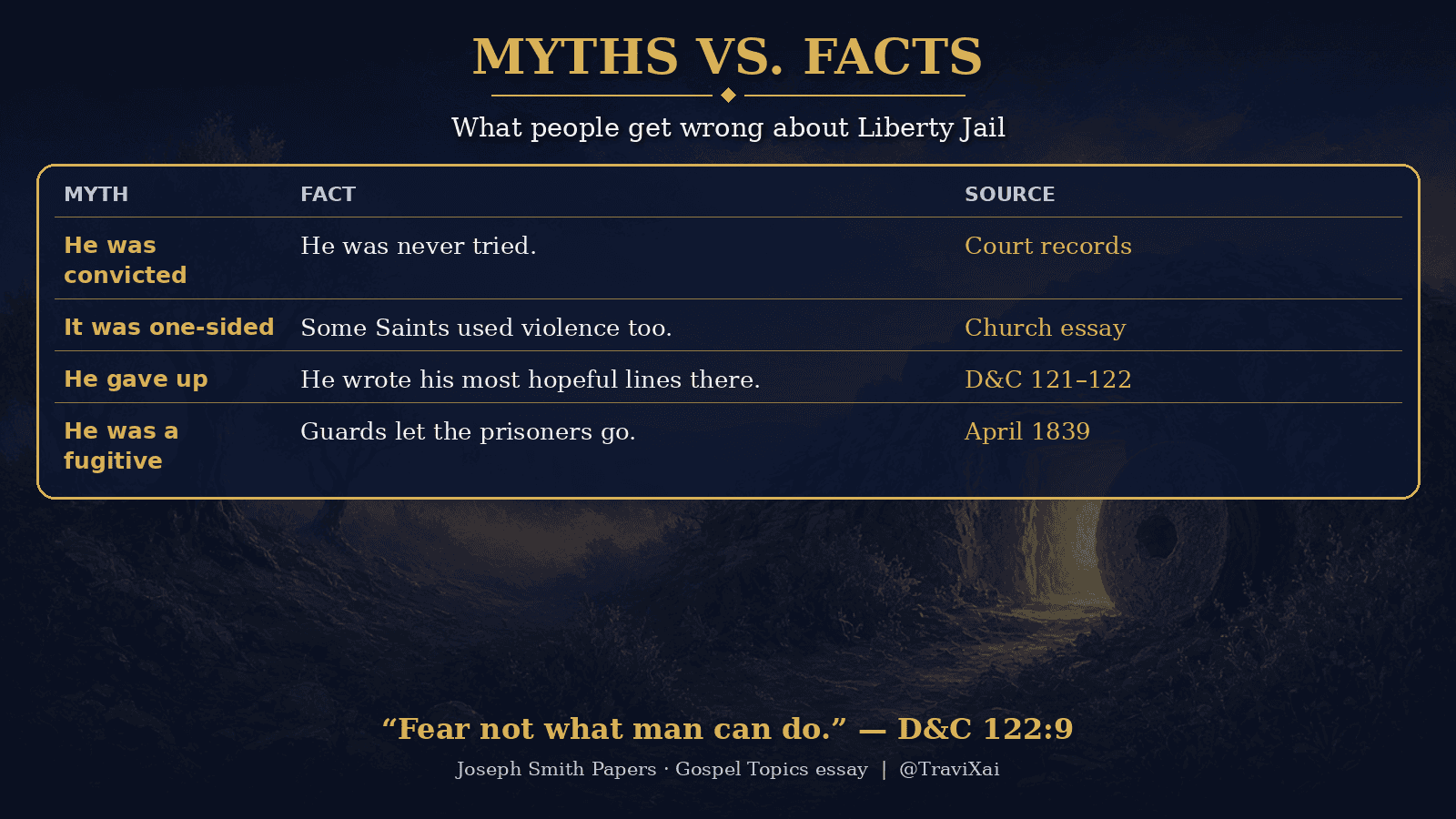
So the plain answer to “why was he in jail” is this: he was held without trial on charges from a civil conflict, by a state whose governor had ordered his people expelled or exterminated. He was never convicted. In April 1839 the prisoners were taken to Gallatin for a grand jury, granted a change of venue, and during the transfer the guards let them go. Joseph reached his family in Quincy, Illinois, on April 22. Missouri formally rescinded the extermination order in 1976.
The winterFour months in the dungeon
The prisoners spent most of the winter in the lower level of a small stone jail, a cold, dark, low-ceilinged room they called the dungeon, with straw on the floor and poor food. Rigdon was released in February. Meanwhile the Saints, homeless in midwinter, were crossing into Illinois under Brigham Young and the Twelve. In March 1839, Joseph dictated two long letters to the Church. Excerpts from them became sections 121, 122 and 123 of the Doctrine and Covenants.
The Doctrine and CovenantsWhat came out of the jail
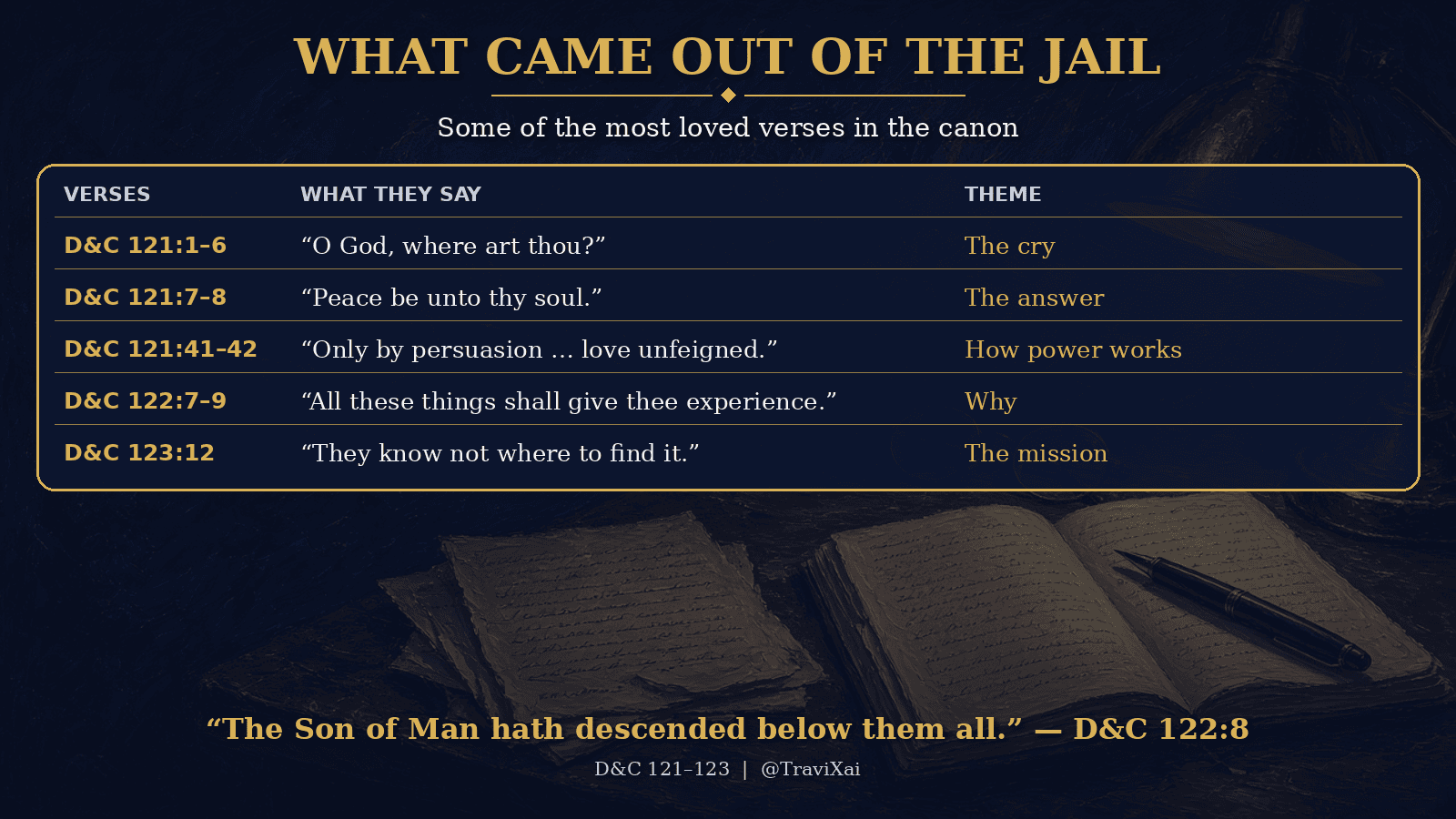
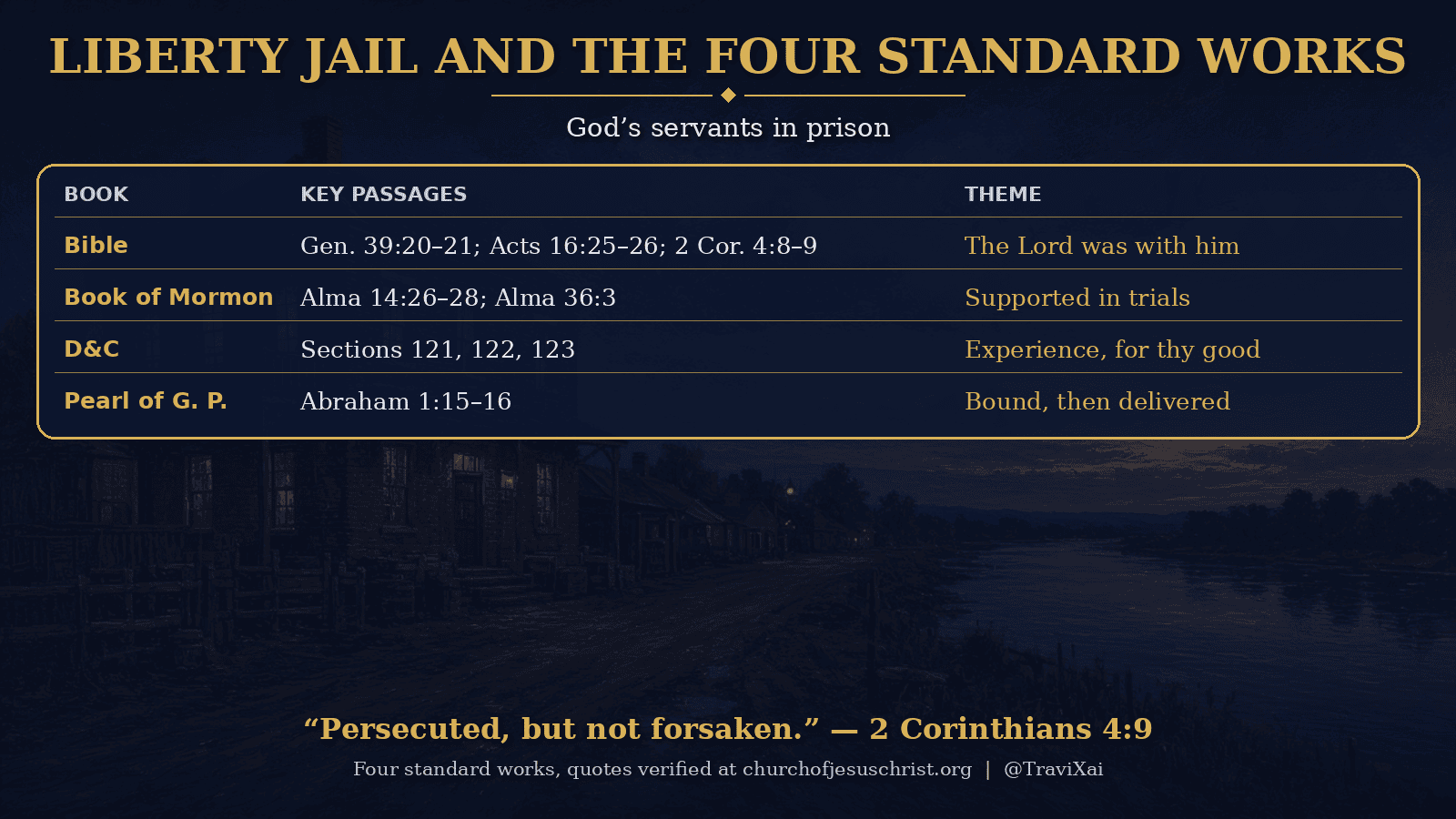
Section 121 opens with a cry anyone who has suffered will recognize: “O God, where art thou? And where is the pavilion that covereth thy hiding place? How long shall thy hand be stayed … ?” (D&C 121:1–6). And the Father answers as a father: “My son, peace be unto thy soul; thine adversity and thine afflictions shall be but a small moment; and then, if thou endure it well, God shall exalt thee on high” (D&C 121:7–8).
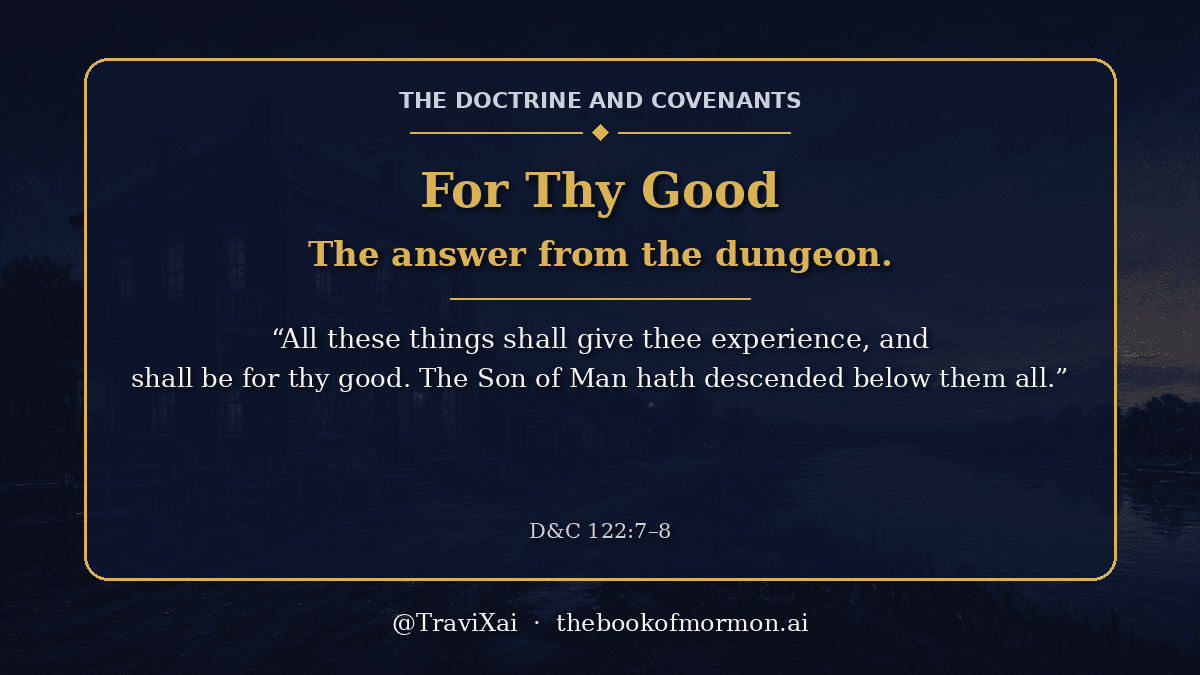
Section 122 lists every horror Joseph had faced or might face, “and above all, if the very jaws of hell shall gape open the mouth wide after thee, know thou, my son, that all these things shall give thee experience, and shall be for thy good. The Son of Man hath descended below them all. Art thou greater than he? Therefore, hold on thy way … fear not what man can do, for God shall be with you forever and ever” (D&C 122:7–9). Note the order. The Father is always above, and the Son descended below all, so no child of God suffers anything Christ did not go beneath. See What Is the Atonement?.
From the same jail came the Church’s charter on authority: “the rights of the priesthood are inseparably connected with the powers of heaven … No power or influence can or ought to be maintained by virtue of the priesthood, only by persuasion, by long-suffering, by gentleness and meekness, and by love unfeigned; by kindness, and pure knowledge” (D&C 121:34–36, 41–42). And section 123 gave the mission: “there are many yet on the earth … who are only kept from the truth because they know not where to find it” (D&C 123:12–13).
The BibleProphets in prison
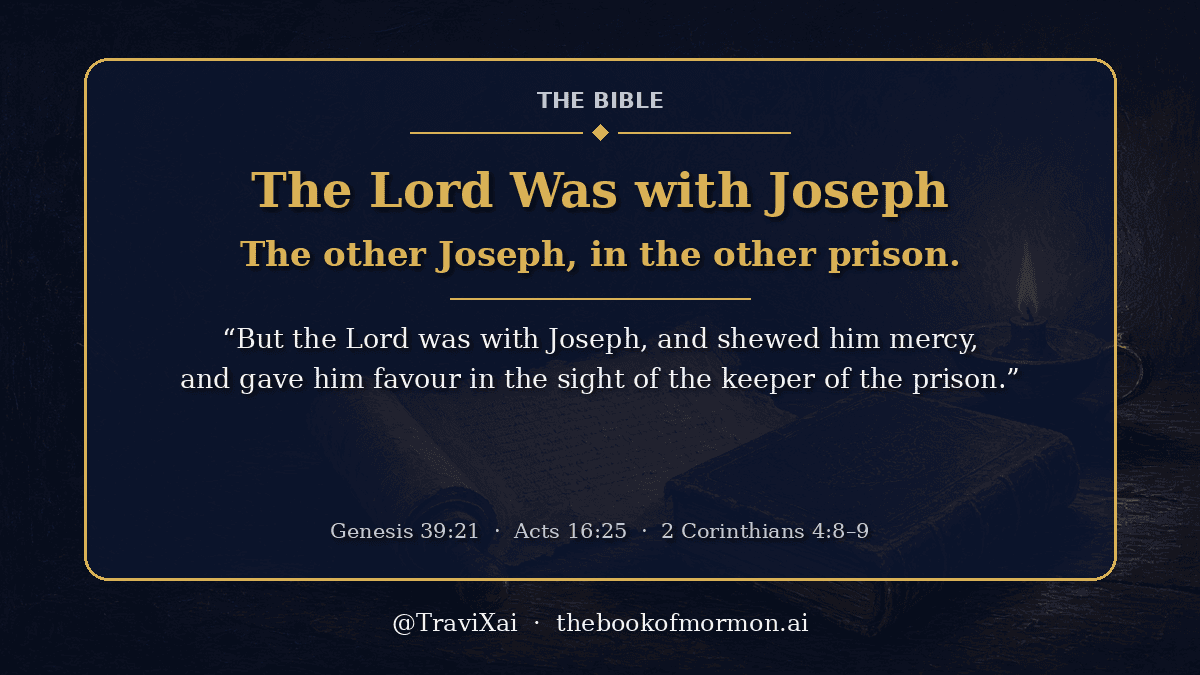
Prison is a familiar place for God’s servants. The first Joseph was thrown into Pharaoh’s prison on a false charge, “but the Lord was with Joseph, and shewed him mercy” (Genesis 39:20–21). Paul and Silas, beaten and jailed at Philippi, “at midnight … prayed, and sang praises unto God” until “the foundations of the prison were shaken” (Acts 16:25–26). Paul summed up the apostolic life: “We are troubled on every side, yet not distressed; we are perplexed, but not in despair; persecuted, but not forsaken; cast down, but not destroyed” (2 Corinthians 4:8–9). Critics who count Liberty Jail against Joseph have to count Philippi against Paul.
The Book of MormonAlma and Amulek

In Ammonihah, Alma and Amulek were bound and jailed by the city’s judges. Alma cried, “How long shall we suffer these great afflictions, O Lord? O Lord, give us strength according to our faith which is in Christ, even unto deliverance,” and the walls of the prison fell (Alma 14:26–28). It is almost the same cry as D&C 121:3. Years later Alma told his son: “whosoever shall put their trust in God shall be supported in their trials, and their troubles, and their afflictions, and shall be lifted up at the last day” (Alma 36:3).
The Pearl of Great PriceAbraham on the altar

Abraham was bound by men who meant to kill him: “as they lifted up their hands upon me, that they might offer me up and take away my life, behold, I lifted up my voice unto the Lord my God, and the Lord hearkened and heard … and immediately unloosed my bands” (Abraham 1:15–16). Joseph published that account in 1842, three years after Liberty. He knew what bound hands felt like. See What Is the Book of Abraham?.
What critics sayThe honest version
Critics sometimes cite Liberty Jail as proof Joseph was a criminal. The record does not support that: he was held on charges never brought to trial, after an order for his execution that a Missouri general refused as murder, under a governor’s order to drive out his people. But the honest version also includes this: in 1838 some Latter-day Saints, including a secret band called the Danites organized by Sampson Avard, used violence and intimidation too. The Church’s own essay “Peace and Violence among 19th-Century Latter-day Saints” says so, and Joseph denounced Avard in a letter from the jail that December. Wrongs on one side do not excuse an extermination order on the other.
Judge by the fruit. A man in a cold cell for four months, his people driven into winter, wrote that priesthood power works “only by persuasion … and by love unfeigned.” See Carthage: Like a Lamb to the Slaughter and Was Joseph Smith a Con Man?.
Check the premiseThe presuppositions baked into the question
Before this question can be answered fairly, the person asking has to justify a few assumptions packed inside it:
- That being jailed means he was guilty. He was never tried. Joseph in Egypt, Paul and Silas, and Alma and Amulek were jailed too (Genesis 39; Acts 16; Alma 14).
- That he was jailed for his religion alone. The charges came out of an armed conflict in which both sides committed wrongs, though the extermination order targeted Latter-day Saints as a people.
- That he escaped like a fugitive from justice. During a court-ordered change of venue in April 1839, the guards let the prisoners go.
- That the jail broke him. He came out with D&C 121–123, including the Church’s charter on priesthood power by love unfeigned.
FAQQuick answers
Why was Joseph Smith in Liberty Jail?
He was held on charges, including treason, arising from the 1838 conflict between Latter-day Saints and other Missourians. He was never tried.
How long was Joseph Smith in Liberty Jail?
About four months, from December 1, 1838, to early April 1839.
Who was in Liberty Jail with Joseph Smith?
Hyrum Smith, Sidney Rigdon (released in February), Lyman Wight, Caleb Baldwin and Alexander McRae.
Which revelations came from Liberty Jail?
D&C 121, 122 and 123, excerpted from letters Joseph dictated in March 1839.
What is the extermination order?
Missouri Executive Order 44, issued by Governor Lilburn W. Boggs on October 27, 1838, ordering that Latter-day Saints be “exterminated or driven from the state.” It was rescinded in 1976.
How did Joseph Smith get out of Liberty Jail?
In April 1839 the prisoners were granted a change of venue, and during the transfer the guards allowed them to escape. Joseph reached Quincy, Illinois, on April 22.
What does “O God, where art thou?” mean?
It is Joseph’s prayer in D&C 121:1. The Lord’s answer follows: “My son, peace be unto thy soul; thine adversity … shall be but a small moment” (121:7).
Can you visit Liberty Jail?
Yes. The Church operates a visitors’ center in Liberty, Missouri, with a reconstructed cutaway of the jail.
SummaryKey takeaways
- Jailed December 1, 1838, to April 1839, on charges from the Missouri conflict.
- Never tried; a general refused an order to have him shot.
- Some Saints also committed violence in 1838; the Church acknowledges it.
- D&C 121–123 came from his letters in the jail.
- The Son of Man “descended below them all” (D&C 122:8).
Read D&C 121 and 122 tonight. For quick, sourced answers, open Galatians18, and follow me on X at @TraviXai.
Sources
- King James Bible (churchofjesuschrist.org): Genesis 39:20–21 · Acts 16:25–26 · 2 Corinthians 4:8–9
- Book of Mormon: Alma 14:26–28 · Alma 36:3
- Doctrine and Covenants: D&C 121:1–8 · D&C 121:34–36 · D&C 121:41–42 · D&C 122:7–9 · D&C 123:12–13
- Pearl of Great Price: Abraham 1:15–16
- Gospel Topics Essay, “Peace and Violence among 19th-Century Latter-day Saints” · The Joseph Smith Papers · Missouri Executive Order 44 (1838; rescinded 1976)
- Featured image and in-article graphic: original graphics by thebookofmormon.ai (painterly backgrounds; no photographs or likenesses of real people).