
It’s one of critics’ favorite targets. Here’s what the Book of Abraham is, what the surviving papyri actually show, and what the Church itself says.
The Book of Abraham is a record of the prophet Abraham that Joseph Smith translated from Egyptian papyri bought in 1835, published in 1842, and canonized in the Pearl of Great Price in 1880. It tells how Jehovah rescued Abraham from idolatrous priests and taught him about premortal life and the Creation (Abraham 1:15–17; 3:22–25). Most of the papyri were later lost. The ten surviving fragments are Egyptian funerary texts that don’t match the translation, as the Church openly says, but eyewitnesses described much more papyrus than survives. Ancient details like Olishem and Elkenah fit the book.
The short versionScripture about Abraham, from Egyptian papyri
The Church’s Gospel Topics essay describes it this way: “This book, a record of the biblical prophet and patriarch Abraham, recounts how Abraham sought the blessings of the priesthood, rejected the idolatry of his father, covenanted with Jehovah, married Sarai, moved to Canaan and Egypt, and received knowledge about the Creation.” It “was first published in 1842 and was canonized as part of the Pearl of Great Price in 1880. The book originated with Egyptian papyri that Joseph Smith translated beginning in 1835” (Translation and Historicity of the Book of Abraham).
It opens in the first person: “In the land of the Chaldeans, at the residence of my fathers, I, Abraham, saw that it was needful for me to obtain another place of residence” (Abraham 1:1).
What it teachesWhat it adds to the Bible
Genesis says God called Abram to leave his country and promised, “in thee shall all families of the earth be blessed” (Genesis 12:1–3). It doesn’t say why Abram left. The Book of Abraham does: priests of his idolatrous homeland tried to sacrifice him. “As they lifted up their hands upon me, that they might offer me up … the angel of his presence stood by me, and immediately unloosed my bands; And his voice was unto me: Abraham, Abraham, behold, my name is Jehovah” (Abraham 1:15–17).
God told Abraham, “Look now toward heaven, and tell the stars” (Genesis 15:5). In the Book of Abraham, God shows him the heavens and then the premortal spirits: “Abraham, thou art one of them; thou wast chosen before thou wast born” (Abraham 3:22–23). One “like unto God” says, “we will take of these materials, and we will make an earth whereon these may dwell; And we will prove them herewith, to see if they will do all things whatsoever the Lord their God shall command them” (Abraham 3:24–25). The Book of Mormon teaches the same premortal calling (Alma 13:3).
The New Testament treats Abraham as a man who saw more than Genesis records. Jesus said, “Your father Abraham rejoiced to see my day: and he saw it, and was glad” (John 8:56), and Paul says the scripture “preached before the gospel unto Abraham” (Galatians 3:8). Modern revelation adds that Abraham “received all things … by revelation” and “hath entered into his exaltation” (D&C 132:29).
The papyriWhat happened to the scrolls
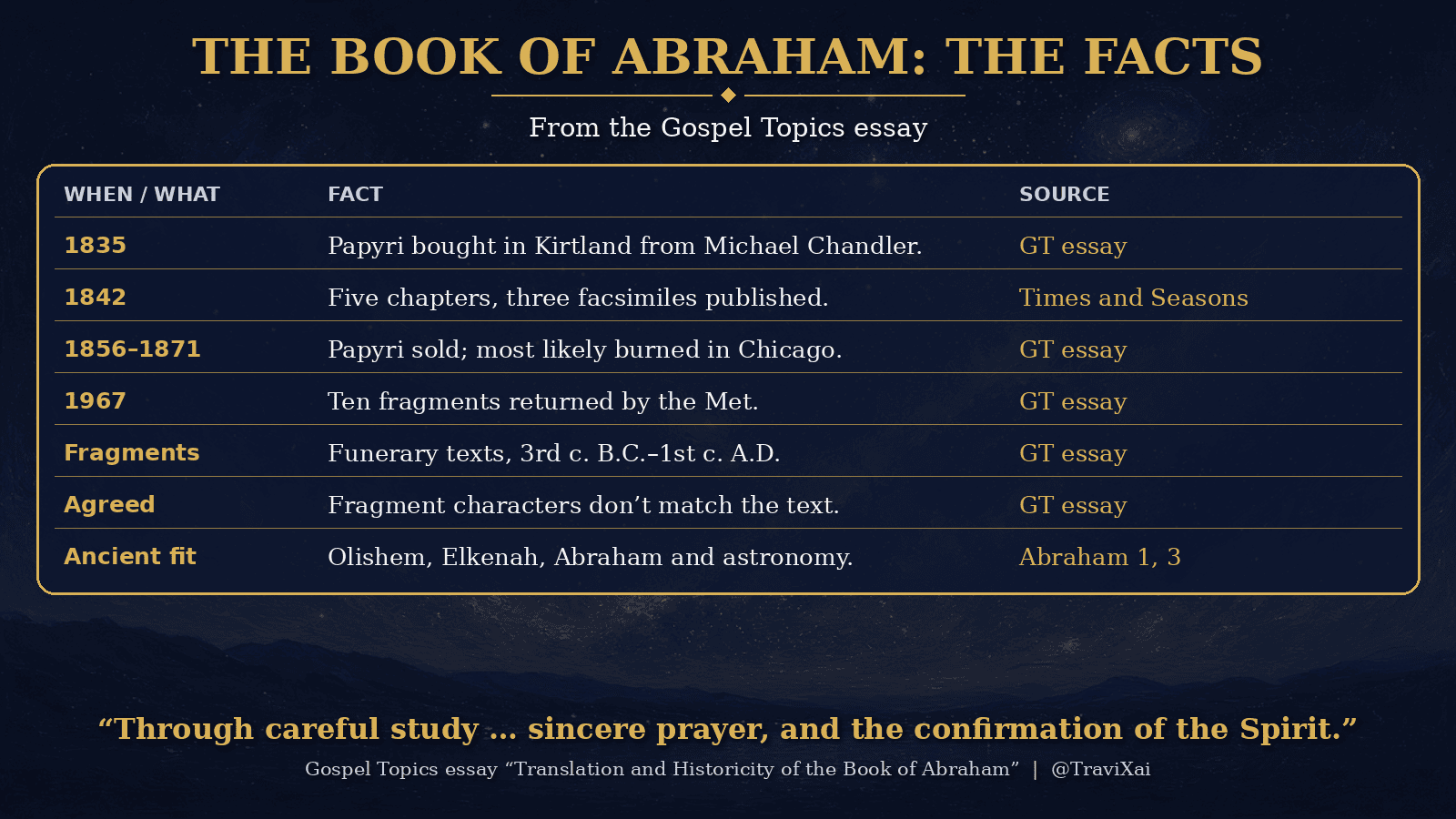
In 1835 Michael Chandler brought four mummies and several papyrus scrolls to Kirtland, Ohio, and Latter-day Saints bought them. After Joseph’s death, “Joseph Smith’s family sold the papyri and the mummies in 1856 … historians believe that most were destroyed in the Great Chicago Fire of 1871. Ten papyrus fragments once in Joseph Smith’s possession ended up in the Metropolitan Museum of Art,” which transferred them to the Church in 1967 (Gospel Topics essay).
Here’s the part critics quote, and the essay states it plainly: “None of the characters on the papyrus fragments mentioned Abraham’s name or any of the events recorded in the book of Abraham. Latter-day Saint and non-Latter-day Saint Egyptologists agree that the characters on the fragments do not match the translation given in the book of Abraham.” The fragments are “standard funerary texts” dating “between the third century B.C.E. and the first century C.E.”
What critics usually leave out is what the essay says next: “Eyewitnesses spoke of ‘a long roll’ or multiple ‘rolls’ of papyrus. Since only fragments survive, it is likely that much of the papyri accessible to Joseph when he translated the book of Abraham is not among these fragments.” Judging the translation from the fragments that happened to survive means judging it without most of the source.
The translationHow did Joseph translate it?
“Joseph Smith claimed no expertise in any language,” the essay notes. “No eyewitness account of the translation survives, making it impossible to reconstruct the process.” The essay gives two possibilities. One is that the text came from parts of the scrolls that no longer exist. The other is that “Joseph’s study of the papyri may have led to a revelation about key events and teachings in the life of Abraham, much as he had earlier received a revelation about the life of Moses while studying the Bible.” Either way, the knowledge came “by the gift and power of God.”
The Lord had taught that translating sacred records takes both study and revelation: “you must study it out in your mind; then you must ask me if it be right” (D&C 9:8). For the facsimiles, see Book of Abraham Facsimiles (2026 Edition), and for ancient parallels, The Book of Abraham’s Ancient Roots.
Ancient fingerprintsDetails Joseph Smith couldn’t have looked up
The essay lists details that fit the ancient world. Abraham 1:10 names “the plain of Olishem,” a place not mentioned in the Bible: “An ancient inscription, not discovered and translated until the 20th century, mentions a town called ‘Ulisum,’ located in northwestern Syria” (Abraham 1:10). The god Elkenah (Abraham 1:17) “is not mentioned in the Bible, yet modern scholars have identified it as being among the gods worshipped by ancient Mesopotamians.”
Ancient non-biblical traditions say Abraham taught the Egyptians astronomy, and that a Pharaoh tried to sacrifice him but an angel delivered him. The essay notes, “All these details are found in the book of Abraham.” It also notes that Abraham 3:22–23 “is written in a poetic structure more characteristic of Near Eastern languages than early American writing style.”
The essay is also honest about the limits of this kind of evidence: it “cannot prove the truthfulness of the book of Abraham any more than archaeological evidence can prove the exodus of the Israelites from Egypt or the Resurrection of the Son of God.” Its conclusion: “The truth of the book of Abraham is ultimately found through careful study of its teachings, sincere prayer, and the confirmation of the Spirit.”
Check the premiseThe presuppositions baked into the question
Before this question can be answered fairly, the person asking has to justify a few assumptions packed inside it:
- That the Church hides the papyri problem. The Church’s own essay states that the fragment characters “do not match the translation” and that Egyptologists agree on this.
- That the surviving fragments are the whole source. Eyewitnesses described “a long roll” and multiple “rolls,” and most were likely destroyed in the 1871 Chicago fire (Gospel Topics essay).
- That a translation must be word for word from the papyri. Joseph also received revelation about Moses while studying the Bible. The essay allows that the papyri may have been the occasion for revelation.
- That nothing in the book fits the ancient world. Olishem, Elkenah, and Abraham teaching astronomy in Egypt were unknown or obscure in 1842 (Abraham 1:10, 17; Gospel Topics essay).
FAQQuick answers
What is the Book of Abraham?
A book of scripture in the Pearl of Great Price, a record of the prophet Abraham translated by Joseph Smith from Egyptian papyri he acquired in 1835. It was published in 1842 and canonized in 1880.
Do the Book of Abraham papyri match the translation?
The ten surviving fragments don’t. The Church’s essay says Egyptologists agree the characters “do not match the translation.” But the surviving fragments are only a small part of the original scrolls, most of which were likely destroyed in 1871.
What happened to the Book of Abraham papyri?
Joseph Smith’s family sold them in 1856. Most were likely destroyed in the Great Chicago Fire of 1871. Ten fragments surfaced at the Metropolitan Museum of Art and were given to the Church in 1967.
Is there evidence for the Book of Abraham?
Some details fit the ancient world, such as the place name Olishem (Ulisum), the god Elkenah, and traditions of Abraham teaching Egyptians astronomy. The Church says the book’s truth is ultimately confirmed by the Spirit.
What does the Book of Abraham teach?
It teaches about Abraham’s deliverance from idolaters, the Abrahamic covenant and priesthood, premortal life (“thou wast chosen before thou wast born”), and the Creation from existing materials (Abraham 1–5).
What is Kolob in the Book of Abraham?
A great star nearest to the throne of God: “the name of the great one is Kolob, because it is near unto me” (Abraham 3:3). Abraham learned of it through the Urim and Thummim.
What does the Book of Abraham teach about premortal life?
Abraham saw “the intelligences that were organized before the world was,” and “among all these there were many of the noble and great ones” (Abraham 3:22).
What does Facsimile 1 show?
Abraham on an altar as an idolatrous priest tries to sacrifice him, which Abraham 1 describes: “the priests laid violence upon me, that they might slay me also” (Abraham 1:12), before the Lord delivered him.
SummaryKey takeaways
- The Book of Abraham is a record of Abraham translated by Joseph Smith, published in 1842.
- Only ten fragments of the papyri survive, and they don’t match the translation; the Church says so openly.
- Most of the scrolls were lost, and the essay allows for translation by revelation.
- Ancient details like Olishem and Elkenah fit, but the book’s truth is confirmed by the Spirit.
Read Abraham 3 under the night sky, then ask God about it. For quick, sourced answers, open Galatians18, and follow me on X at @TraviXai.
Sources
- King James Bible (churchofjesuschrist.org): Genesis 12:1–3 · Genesis 15:5–6 · John 8:56 · Galatians 3:8 · Hebrews 11:8–10
- Book of Mormon: Alma 13:3
- Doctrine and Covenants: D&C 9:8 · D&C 132:29
- Pearl of Great Price: Abraham 1:1 · Abraham 1:10 · Abraham 1:15–17 · Abraham 3:22–25
- “Translation and Historicity of the Book of Abraham,” Gospel Topics Essays, churchofjesuschrist.org
- Featured image and in-article graphic: original graphics by thebookofmormon.ai (painterly backgrounds; no photographs or likenesses of real people).