
It is two short passages in the Pearl of Great Price that critics turned into a punchline. Here is what Abraham actually saw, and why it matters.
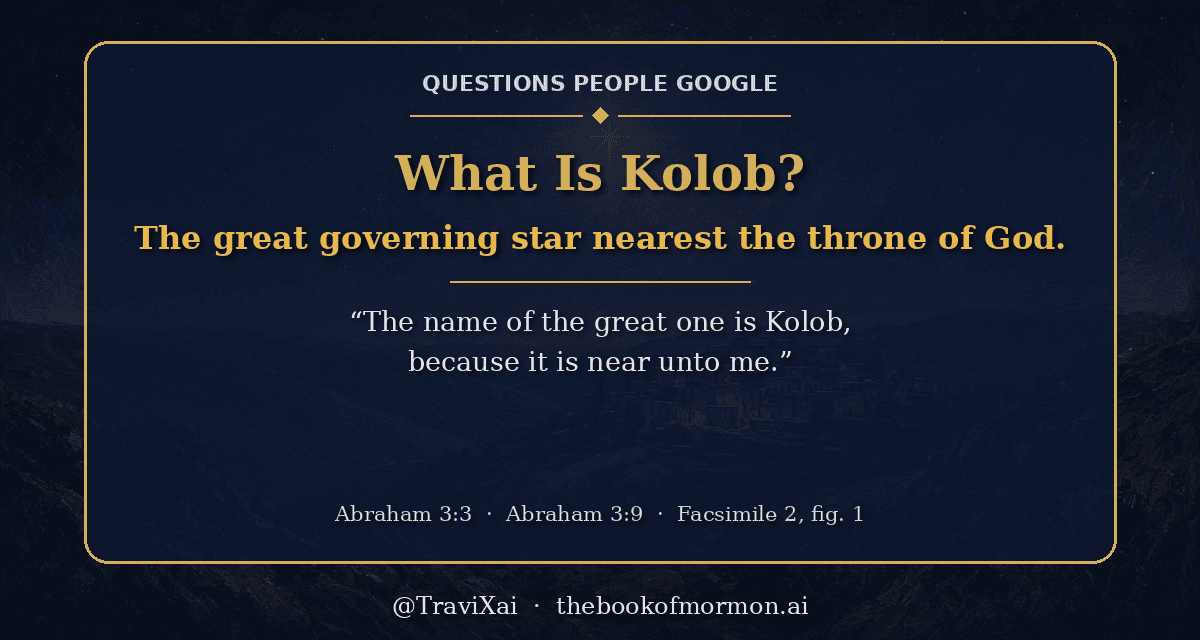
The question usually assumes Latter-day Saints think God lives on a planet called Kolob and worship it. Neither is true. Kolob is the great governing star that Abraham saw “nearest unto the throne of God” (Abraham 3:2–3). One revolution of Kolob is “a day unto the Lord … one thousand years” of our time (Abraham 3:4), the ratio the Bible already gives in Psalm 90:4 and 2 Peter 3:8. Abraham 3 then moves from stars to spirits, “one above the other,” up to God, who is “more intelligent than they all” (Abraham 3:16–19).
What it isKolob in Abraham 3
Abraham, who “had the Urim and Thummim,” saw the heavens in vision: “I saw the stars, that they were very great, and that one of them was nearest unto the throne of God; and there were many great ones which were near unto it” (Abraham 3:1–2). The Lord named it: “These are the governing ones; and the name of the great one is Kolob, because it is near unto me, for I am the Lord thy God: I have set this one to govern all those which belong to the same order as that upon which thou standest” (Abraham 3:3).
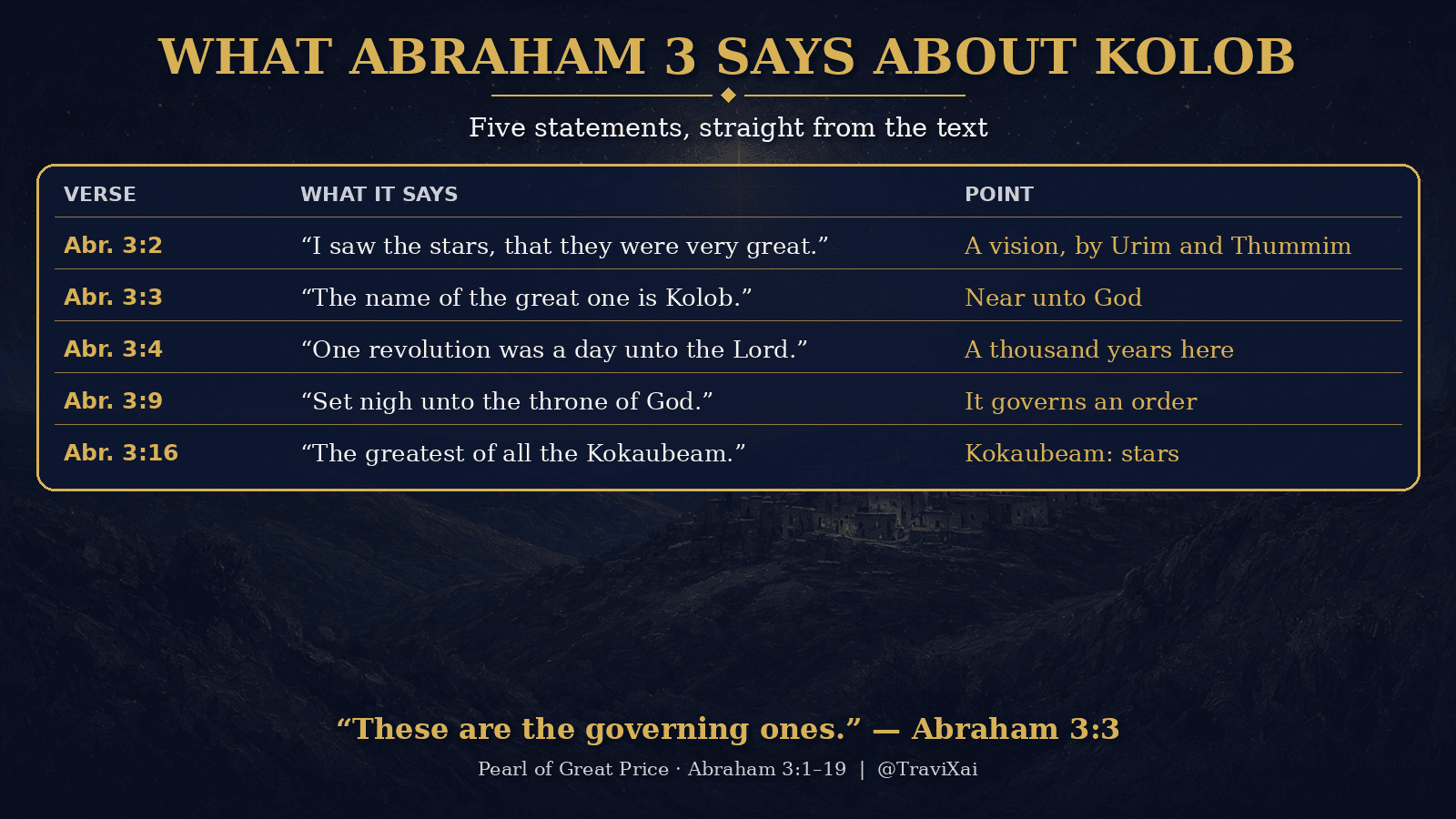
Then comes the time ratio: “one revolution was a day unto the Lord, after his manner of reckoning, it being one thousand years according to the time appointed unto that whereon thou standest. This is the reckoning of the Lord’s time, according to the reckoning of Kolob” (Abraham 3:4). Verse 9 repeats that Kolob “is set nigh unto the throne of God, to govern all those planets which belong to the same order as that upon which thou standest” (Abraham 3:9), and verse 16 calls it “the greatest of all the Kokaubeam that thou hast seen, because it is nearest unto me” (Abraham 3:16). Kokaubeam is the text’s own word for stars (Hebrew kokhavim).
Facsimile 2 adds the explanation for figure 1: “Kolob, signifying the first creation, nearest to the celestial, or the residence of God. First in government, the last pertaining to the measurement of time. … One day in Kolob is equal to a thousand years according to the measurement of this earth” (Abraham, Facsimile 2, fig. 1). For the facsimiles themselves, see The Book of Abraham Facsimiles.
What it is notClearing away the cartoon
Most jokes about Kolob attack claims the text never makes. Abraham never says God lives on Kolob. He says Kolob is “near unto” God and “nigh unto the throne of God.” Near the throne is not the throne. When the Doctrine and Covenants describes where God dwells, it describes a celestial globe: angels “reside in the presence of God, on a globe like a sea of glass and fire, where all things for their glory are manifest,” and “the place where God resides is a great Urim and Thummim” (D&C 130:7–8).
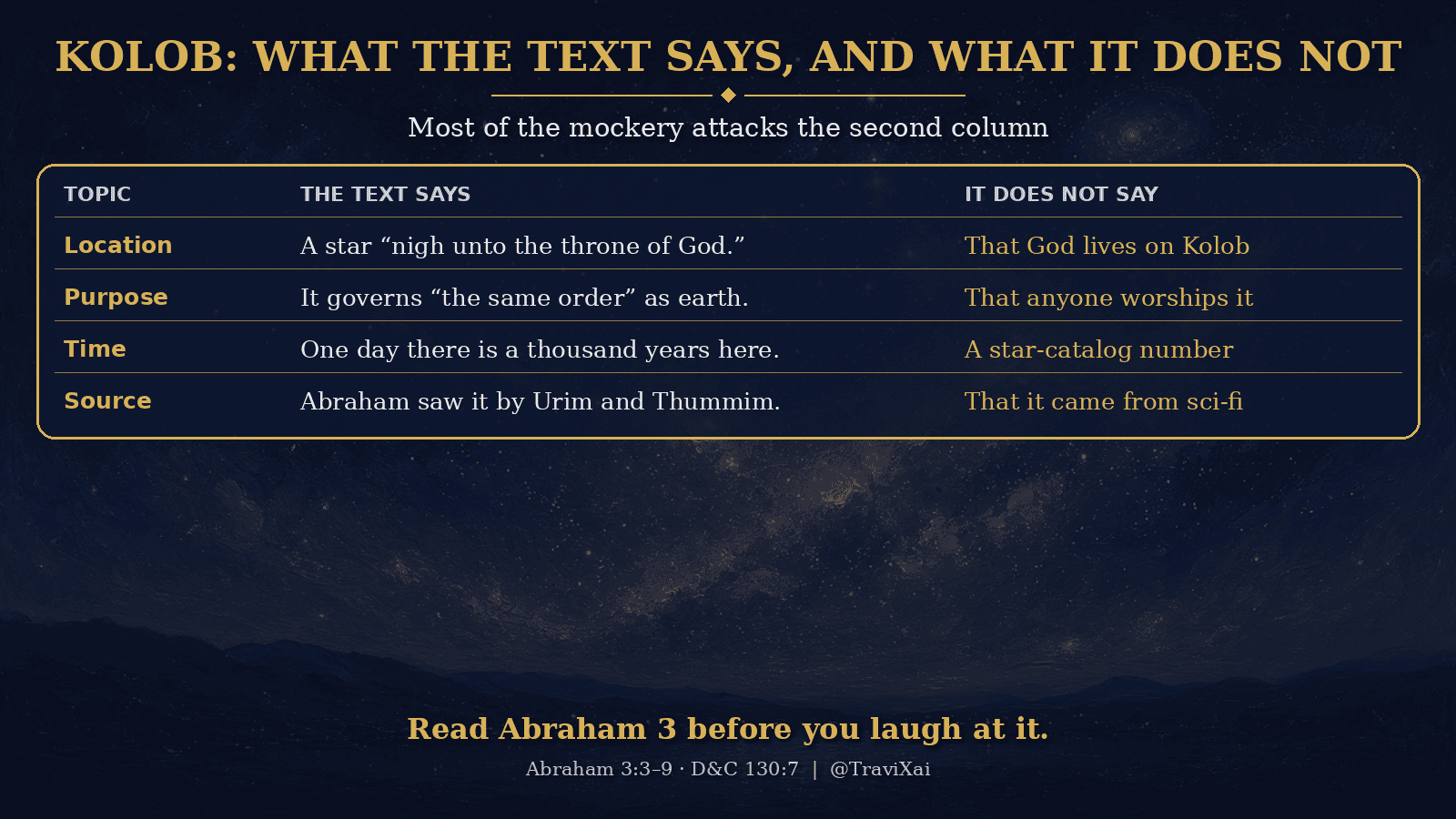
Nobody worships Kolob. Latter-day Saints worship the Father in the name of the Son, as the angel told Adam: “thou shalt repent and call upon God in the name of the Son forevermore” (Moses 5:8). And the Church has never matched Kolob to a star in a modern catalog. People have guessed, but nobody has revealed it. The text names it, places it and gives its job. It does not hand you its coordinates.
The BibleThe heavens in God’s order
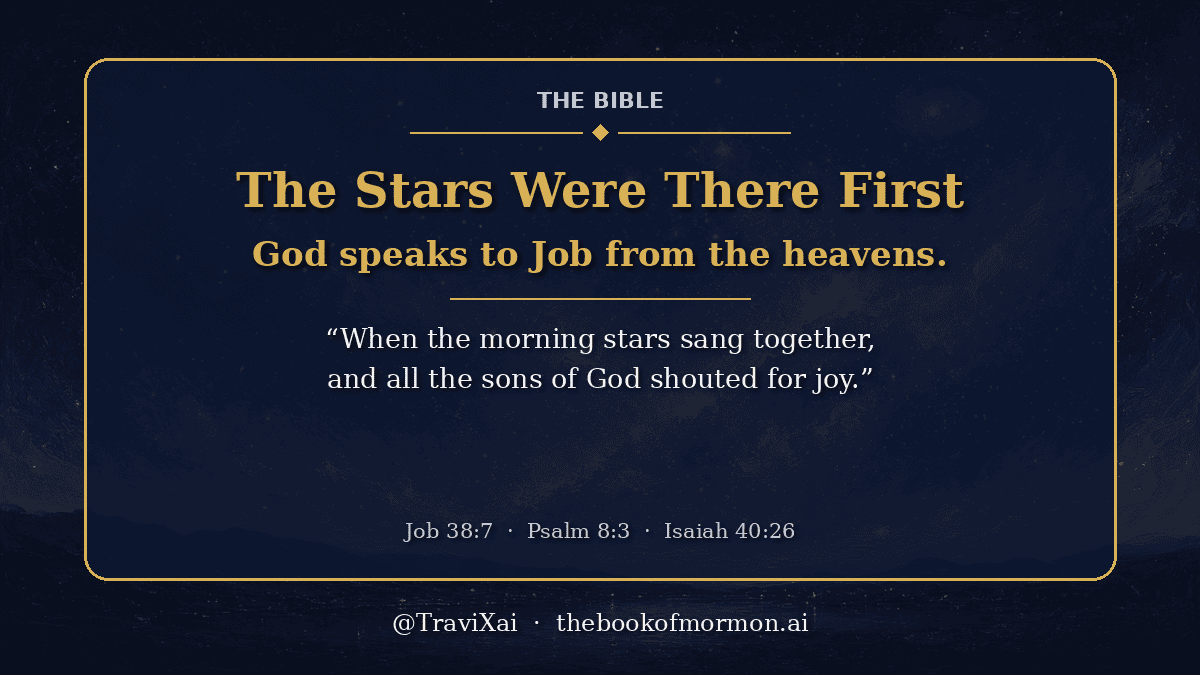
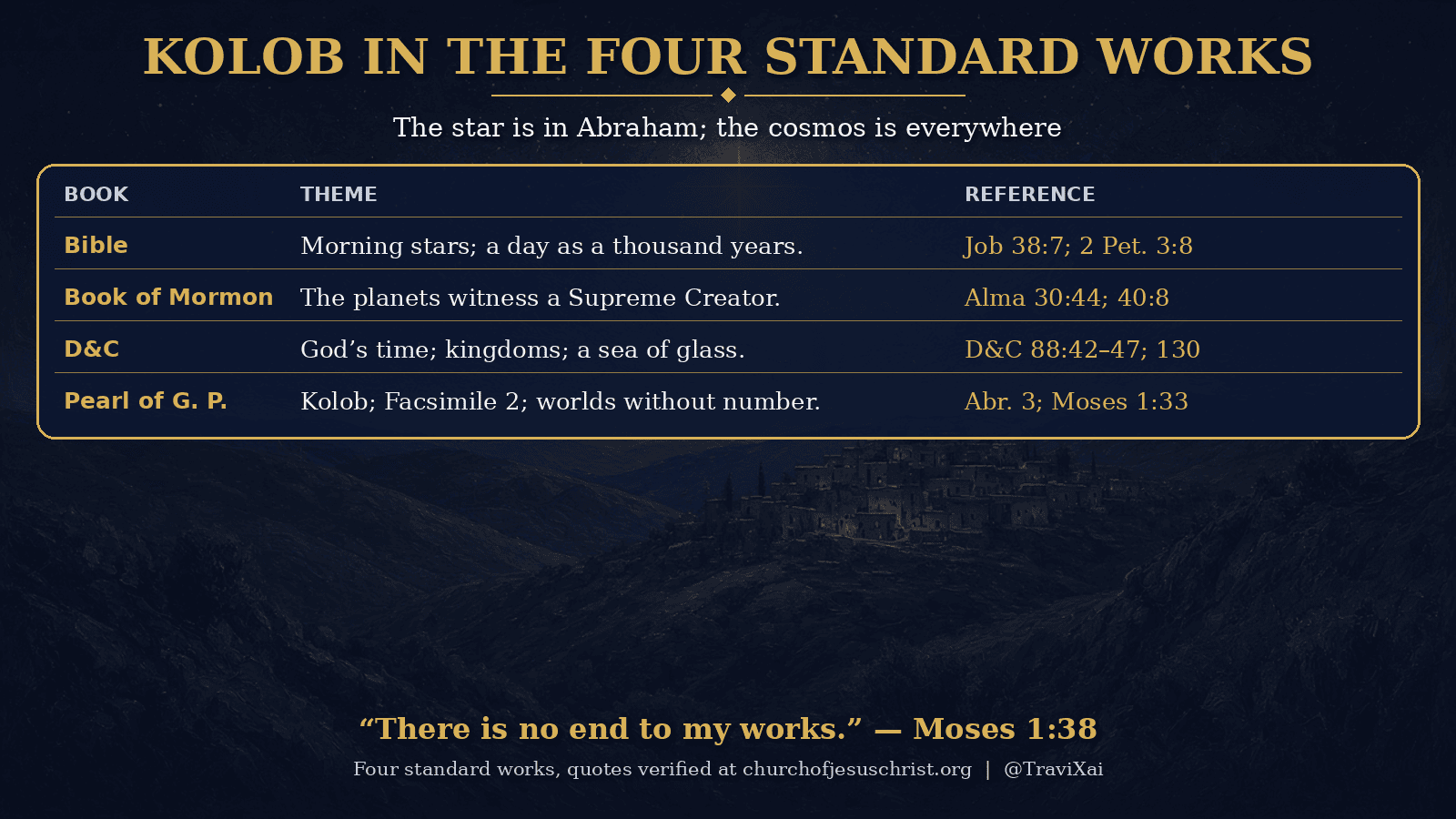
God answered Job out of the whirlwind: “Where wast thou when I laid the foundations of the earth? … When the morning stars sang together, and all the sons of God shouted for joy?” (Job 38:4–7), and “Canst thou bind the sweet influences of Pleiades, or loose the bands of Orion? … or canst thou guide Arcturus with his sons?” (Job 38:31–32). The Bible names stars, puts the sons of God in the premortal scene and treats the heavens as an ordered system God governs. That is Abraham 3 in brief.
Isaiah: “Lift up your eyes on high, and behold who hath created these things, that bringeth out their host by number: he calleth them all by names” (Isaiah 40:26). If God “calleth them all by names,” then a star with a name in Abraham is not strange. It is just one of the names we were told.
The thousand-year day is biblical as well: “For a thousand years in thy sight are but as yesterday when it is past” (Psalm 90:4), and “one day is with the Lord as a thousand years, and a thousand years as one day” (2 Peter 3:8). Peter states the ratio. Abraham tells you where it comes from.
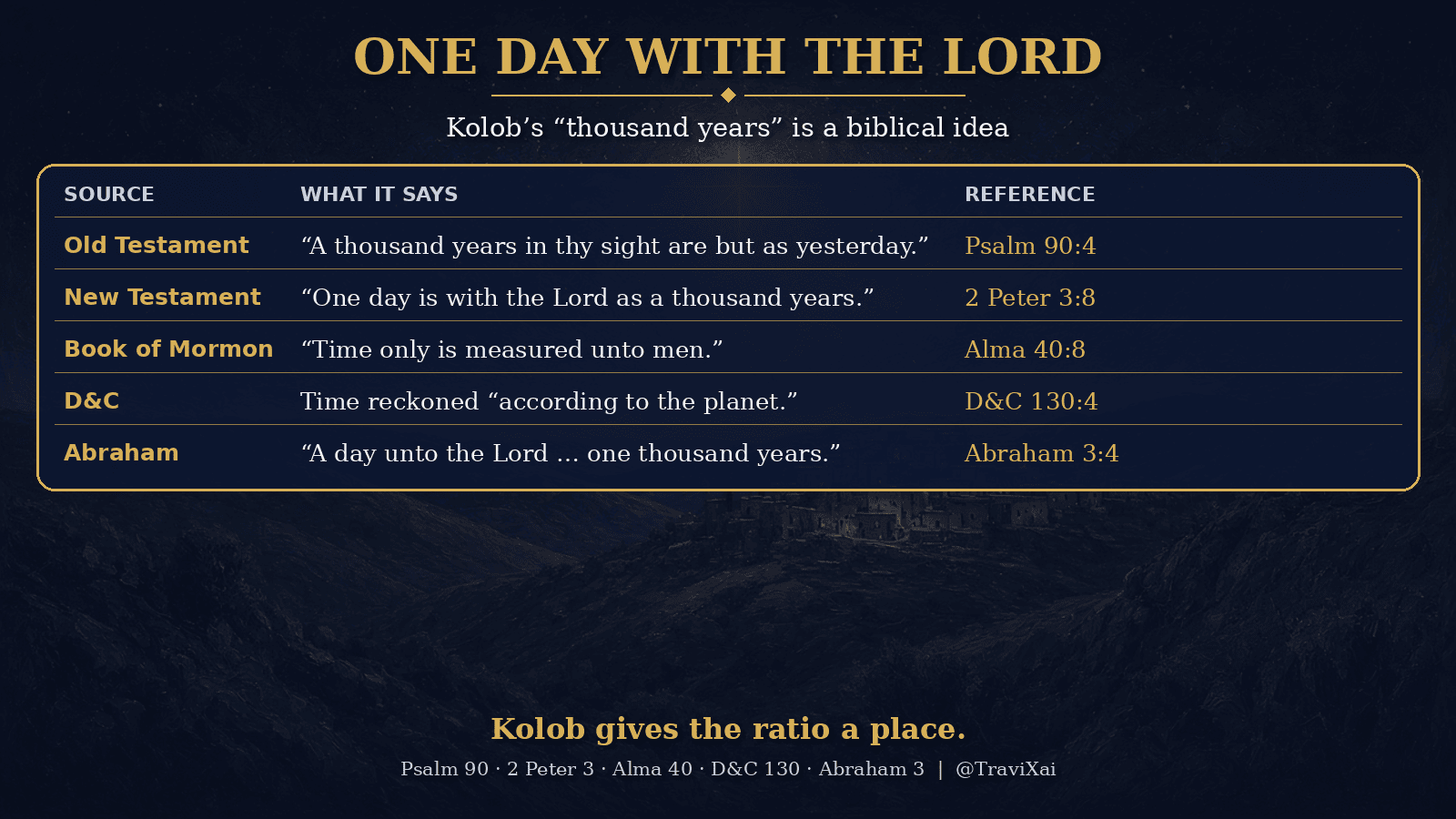
The Book of MormonThe planets testify
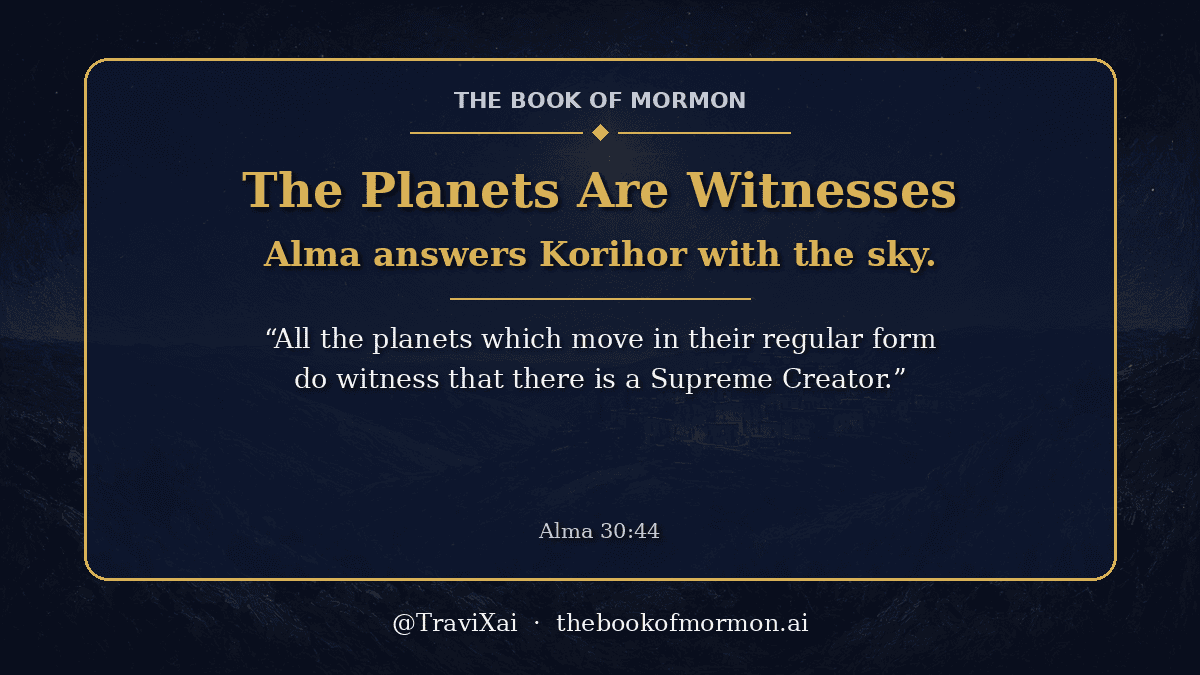
When Korihor demanded a sign, Alma pointed at the sky: “all things denote there is a God; yea, even the earth, and all things that are upon the face of it, yea, and its motion, yea, and also all the planets which move in their regular form do witness that there is a Supreme Creator” (Alma 30:44). And on God’s time: “all is as one day with God, and time only is measured unto men” (Alma 40:8). The Book of Mormon never names Kolob, but it teaches the same two points: an ordered heaven that points to its Creator, and God’s time is not ours.
The Doctrine and CovenantsKingdoms, courses and God’s time
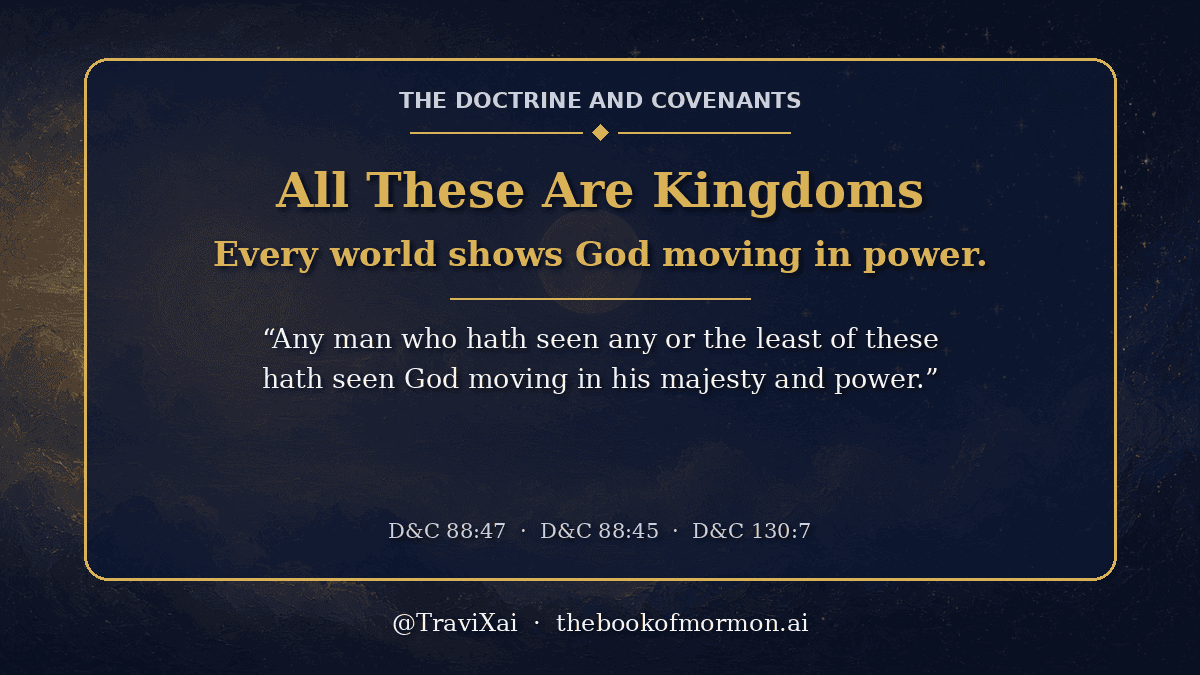
“He hath given a law unto all things, by which they move in their times and their seasons; and their courses are fixed, even the courses of the heavens and the earth, which comprehend the earth and all the planets. … all these are one year with God, but not with man” (D&C 88:42–44). The stars “roll upon their wings in their glory, in the midst of the power of God,” and “all these are kingdoms, and any man who hath seen any or the least of these hath seen God moving in his majesty and power” (D&C 88:45–47).
Joseph Smith also recorded this question and answer: “Is not the reckoning of God’s time, angel’s time, prophet’s time, and man’s time, according to the planet on which they reside? I answer, Yes” (D&C 130:4–5). That is Abraham 3:4 stated as doctrine. Time depends on where you stand, and Kolob is the measure nearest God.
The Pearl of Great PriceWorlds without number, and one above another
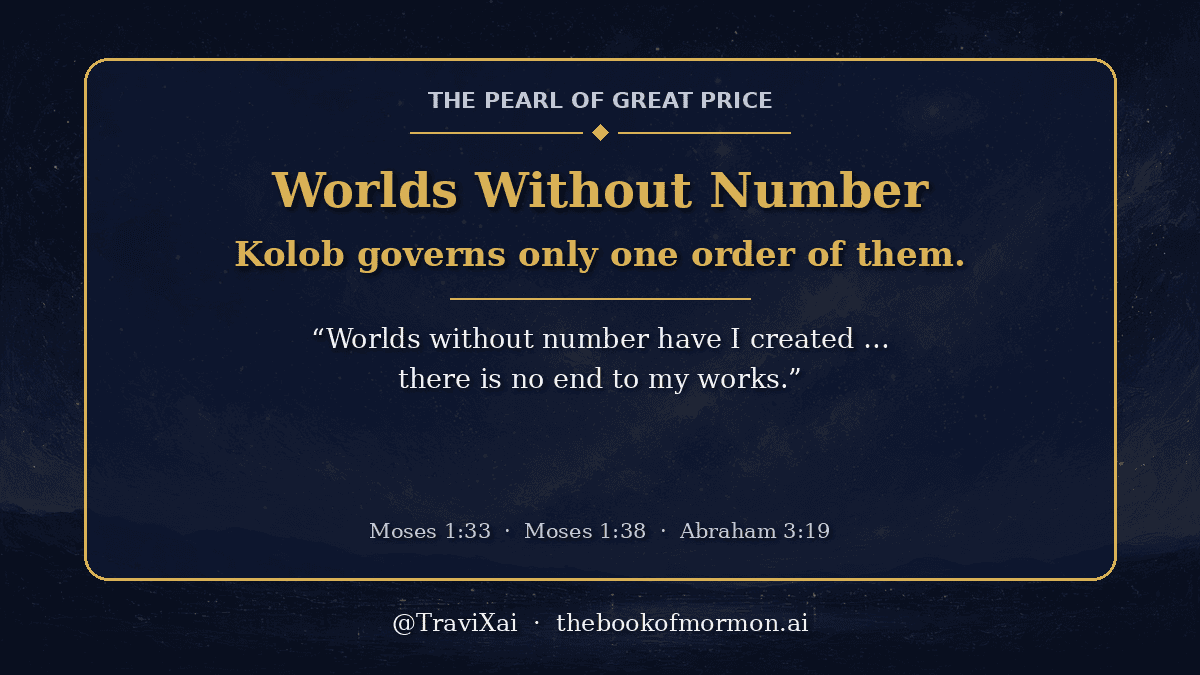
Kolob governs “the same order” as our earth, and that implies other orders. Moses saw the scale: “worlds without number have I created; and I also created them for mine own purpose; and by the Son I created them” (Moses 1:33), and “as one earth shall pass away, and the heavens thereof even so shall another come; and there is no end to my works, neither to my words” (Moses 1:38). Enoch said that “millions of earths like this” would “not be a beginning to the number of thy creations” (Moses 7:30). Kolob is one landmark in a creation with no edge.
Then Abraham 3 does something critics skip. It moves from stars to spirits using the same logic: “If two things exist, and there be one above the other, there shall be greater things above them” (Abraham 3:16). Spirits “have no beginning; they existed before, they shall have no end” (Abraham 3:18), and the Lord closes the chain: “there shall be another more intelligent than they; I am the Lord thy God, I am more intelligent than they all” (Abraham 3:19). The chapter then goes to the council of “the intelligences that were organized before the world was” and the making of an earth (Abraham 3:22–24). See What Is the Premortal Life?.
Why it mattersKolob and eternal progression
Joseph Smith read Abraham 3 literally, and he taught it plainly in June 1844. Thomas Bullock’s report of the Sermon in the Grove records Joseph saying that “intelligences exist one above ano[the]r that there is no end to it,” and then: “where was there ever a Son with[ou]t a Fa[the]r— when ever did a tree or any thing spring into existence with[ou]t a progenitor” (Discourse, 16 June 1844–A, as reported by Thomas Bullock, p. [3]; these are Bullock’s contemporaneous notes, quoted with the Joseph Smith Papers’ brackets). The order of the stars in Abraham 3 matches the order of intelligences, and Joseph did not put an end on either one. Our Father had a Father, and the chain of Fathers has no first link. See Was God Once a Man? The King Follett Discourse.
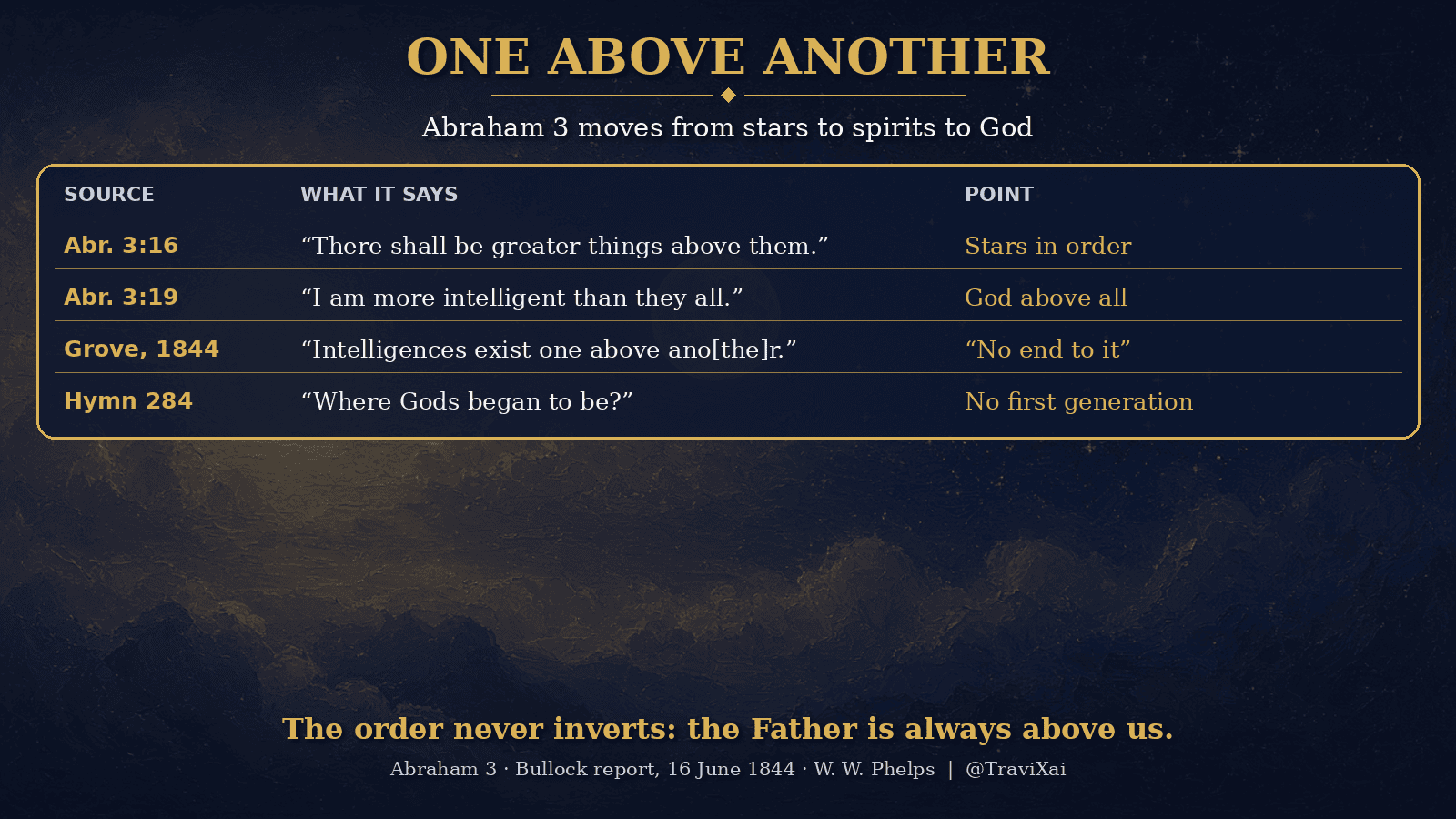
W. W. Phelps put it into the hymn Latter-day Saints still sing: “If you could hie to Kolob In the twinkling of an eye, And then continue onward With that same speed to fly, Do you think that you could ever, Through all eternity, Find out the generation Where Gods began to be?” The answer the hymn expects is no: “The works of God continue, And worlds and lives abound; Improvement and progression Have one eternal round” (“If You Could Hie to Kolob,” Hymns, no. 284).
That is why the faithful may create worlds as the Father has. The Father promises sealed and faithful children “a continuation of the seeds forever and ever. Then shall they be gods” (D&C 132:19–20). Abraham 3 also guards the order. “One above the other” is permanent. Exaltation never moves a child above his Father. The Father who is “more intelligent than they all” is always our Father, always above us, and always worshipped. We become heirs of what He has. We never outrank Him. See Do Latter-day Saints Get Their Own Planet?.
Check the premiseThe presuppositions baked into the question
Before this question can be answered fairly, the person asking has to justify a few assumptions packed inside it:
- That Latter-day Saints believe God lives on Kolob. The text says Kolob is “near unto” God and “nigh unto the throne of God” (Abraham 3:3, 9). God’s dwelling is described separately (D&C 130:7–8).
- That Kolob is a modern sci-fi idea. Abraham 3 was published in the Times and Seasons in 1842. If anything borrowed, it was the 1978 TV series Battlestar Galactica, whose mythic planet “Kobol” is widely read as a nod from its creator, Glen A. Larson, a Latter-day Saint.
- That a named star near God is absurd. Isaiah says God calls the stars “all by names” (Isaiah 40:26), and Job names Pleiades, Orion and Arcturus (Job 38:31–32).
- That a thousand-year day is a Joseph Smith invention. Psalm 90:4 and 2 Peter 3:8 state it first. Abraham 3:4 places it.
- That modern astronomy has disproven it. Abraham describes the heavens as he saw them in vision, as an order of governing bodies. No telescope has looked for the throne of God, and none could.
FAQQuick answers
What is Kolob?
In the Book of Abraham, Kolob is the great star “nearest unto the throne of God,” set “to govern all those which belong to the same order” as our earth (Abraham 3:2–3, 9).
Do Latter-day Saints believe God lives on Kolob?
No. The text says Kolob is “near unto” God, not that God lives there. D&C 130:7–8 describes God’s dwelling as a globe “like a sea of glass and fire.”
What does “one day in Kolob is a thousand years” mean?
Abraham 3:4 says one revolution of Kolob is “a day unto the Lord … one thousand years” on earth, the same ratio as Psalm 90:4 and 2 Peter 3:8.
Where is Kolob mentioned in scripture?
Abraham 3:3–16 and the explanation of Facsimile 2, figure 1, in the Pearl of Great Price. It is not in the Bible, the Book of Mormon or the Doctrine and Covenants.
Do Latter-day Saints worship Kolob?
No. Latter-day Saints worship God the Eternal Father in the name of His Son, Jesus Christ (Moses 5:8; Article of Faith 1).
Is Kolob a real star?
Scripture presents it as real. The Church has not identified it with any star in a modern catalog, and any guess is speculation.
What is the hymn “If You Could Hie to Kolob”?
A hymn by W. W. Phelps (Hymns, no. 284) that uses Kolob to teach endless creation and progression: “Find out the generation Where Gods began to be?”
What does Kolob have to do with eternal progression?
Abraham 3 orders stars and intelligences “one above the other,” with God “more intelligent than they all” (Abraham 3:16–19). Joseph Smith taught that the chain has no end, and that the Father always stays above His children.
SummaryKey takeaways
- Kolob is a star “nearest unto the throne of God” (Abraham 3:2–3, 9).
- Near the throne, not the throne: God’s dwelling is described in D&C 130:7–8.
- One day there equals a thousand years here, as in Psalm 90:4 and 2 Peter 3:8.
- Abraham 3 runs from stars to intelligences “one above the other,” up to God.
- The Father is always above His children, even as they inherit and create.
Read Abraham 3 in one sitting. For quick, sourced answers, open Galatians18, and follow me on X at @TraviXai.
Sources
- King James Bible (churchofjesuschrist.org): Job 38:4–7 · Job 38:31–32 · Psalm 90:4 · Isaiah 40:26 · 2 Peter 3:8
- Book of Mormon: Alma 30:44 · Alma 40:8
- Doctrine and Covenants: D&C 88:42–47 · D&C 130:4–8 · D&C 132:19–20
- Pearl of Great Price: Abraham 3:1–4 · Abraham 3:9 · Abraham 3:16–19 · Abraham 3:22–24 · Facsimile 2, fig. 1 · Moses 1:33 · Moses 1:38 · Moses 5:8 · Moses 7:30
- “If You Could Hie to Kolob,” Hymns, no. 284 (text: William W. Phelps) · Discourse, 16 June 1844–A, as reported by Thomas Bullock (Joseph Smith Papers)
- Featured image and in-article graphic: original graphics by thebookofmormon.ai (painterly backgrounds; no photographs or likenesses of real people).